Items Similar to
Garçon donnant l
avoine à un cheval dételé
— 19th Century French Romanticism
Want more images or videos?
Request additional images or videos from the seller
1 of 6
Jean Louis Andre Theodore Gericault
Garçon donnant l
avoine à un cheval dételé
— 19th Century French Romanticism1822
1822
$1,100
£837.63
€964.50
CA$1,558.80
A$1,676.71
CHF 896.08
MX$19,763.62
NOK 11,297.49
SEK 10,328.05
DKK 7,206.48
About the Item
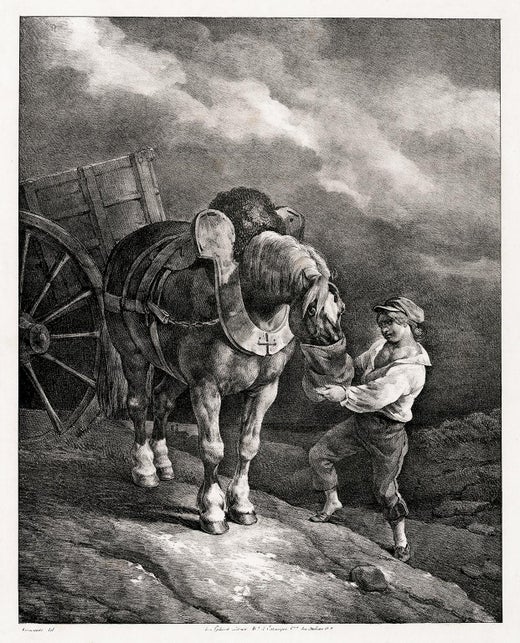
Théodore Géricault, 'Garçon donnant l'avoine à un cheval dételé' (Boy Giving Oats to a Hitched Horse), lithograph, 1822, 2nd state of 2, Delteil 89. Lettered inscription: "Géricault del", "chez Gihaut Editeur. Md. d'Estampes, bard. des Italiens, N 5". Rendering by Joseph Simon Volmar. Printed by Villain. Published by Gihaut Frères.
A superb, richly-inked impression, on off-white wove paper, with margins (7/8 to 1 7/8 inches) in good condition. Archivally matted to museum standards, unframed.
Image size 16 7/16 x 13 1/16 inches (418 x 332 mm); sheet size 20 1/4 x 15 1/8 inches (527 x 384 mm).
Collections: Blanton Museum of Art (Texas), British Museum (London), Five Colleges and Historic Deerfield Museum Consortium (Mass.), High Museum of Art (Atlanta), McMaster Museum of Art (Ontario, Can.), Museum of Fine Arts, Boston; Toledo Museum of Arts (Ohio).
ABOUT THE ARTIST
Géricault's fiery, audacious personality and short life fit the mold of Romantic artists of his era and, along with his controversial paintings, profoundly influenced nineteenth-century art. Notwithstanding about three years of studio training, Géricault was largely self-taught. He copied paintings in the Louvre and traveled to Rome, where he discovered Michelangelo's works and the exuberance of Baroque art.
In his enormous 'Raft of the Medusa,' now at the Louvre, Géricault fused Realism and Romanticism, elevating a contemporary event—a shipwreck with few survivors—to the status of monumental art. To achieve authenticity, he used a model of the raft and carefully studied real cadavers—even his friend, Eugène Delacroix, posed for one of the figures. The wreck was attributed to governmental negligence and corruption and the resulting controversy, combined with the painting's veracity, brought Géricault widespread attention.
Géricault was a master of lithography, the sole printmaking medium he employed to produce his breathtaking representations of horses and military subjects, two of his lifelong passions. During his English sojourn of 1820-21, Géricault improved his knowledge of the lithographic technique in the London workshop of Charles Joseph Hullmandel. The most striking result of this experience was the series of twelve lithographs ‘Various Subjects Drawn from Life and on Stone’, also known as ‘The English Set.’ Géricault continued his studies of the horse once he was back in France, producing the renowned series ‘Etudes, de chevaux lithographiés' (Studies of Horses in Lithography).
Géricault died in 1824 at age thirty-two after a prolonged illness caused by a riding accident. His last major works, discovered almost fifty years after his death, were penetrating portraits of the insane. Like the 'Raft of the Medusa,' they offered a new concept of appropriate subject matter for serious painting.
Gericault's lithographs are held in numerous museums in Europe, Britain, and the United States including The Art Institute of Chicago (Chicago), The Getty Museum (Los Angeles), The Metropolitan Museum of Art (New York), The Morgan Library
Museum (New York), The Museum of Fine Arts, Boston, The National Gallery of Art (Washington D.C., The National Gallery (London), The British Museum (London), The Wallace Collection (London), The Louvre Museum (Paris), Musée des Beaux-Arts de Lyon (Lyon), Musée Fabre (Montpellier, France), Kunsthalle Hamburg (Hamburg, Germany), Alte Pinakothek (Munich, Germany), Musée Royal des Beaux-Arts de Belgique (Brussels, Belgium), and the Hermitage Museum (St. Petersburg, Russia).
- Creator:Jean Louis Andre Theodore Gericault (1791 - 1824, French)
- Creation Year:1822
- Dimensions:Height: 16.44 in (41.76 cm)Width: 13.07 in (33.2 cm)
- Medium:
- Movement Style:
- Period:
- Condition:
- Gallery Location:Myrtle Beach, SC
- Reference Number:Seller: 1039161stDibs: LU53238669322
Jean Louis Andre Theodore Gericault
Théodore Géricault was born in Rouen in 1791 into a wealthy family from the Manche region. His father, a magistrate and wealthy landowner, ran a tobacco factory. The family moved to Paris around 1796, and in 1810 Théodore Géricault entered Carle Vernet's studio, where he met his son Horace. He then studied with Pierre-Narcisse Guérin before enrolling on February 5, 1811 at the École des Beaux-Arts in Paris, where he pursued a classical training based on copying the masters at the Louvre Museum. Géricault was expelled from the École des Beaux-Arts in 1812 for his misconduct; he then rented a back store on rue de la Michodière, where he painted one of his first masterpieces, a portrait of an officer of the imperial guard (the Lieutenant Dieudonné) charging while on horseback. This painting was exhibited at the 1812 Salon and won him the gold medal at the age of 21! Géricault became a sought-after painter, specializing in military subjects. Géricault falled in love with his aunt Alexandrine Caruel de Saint-Martin (the wife of his mother's brother). Aged 28 years younger than her husband, she was only 6 years older than him. From this affair, which lasted for many years, a son Georges-Hippolyte was born in 1818. After a short engagement in King Louis XVIII's Company of Grey Musketeers, Géricault, disappointed at not winning the Prix de Rome, spent two years in Italy. On his return in 1817, he embarked on the creation of his masterpiece, The Raft of the Medusa, which was exhibited in the Louvre in 1819 and was negatively received by the critics. The presentation of the Raft in London in 1820 brought Géricault to the English capital, first for a two-month period between April and June 1820, then again in 1821 after a return to the continent and a stay in Brussels. The painting was triumphantly received in England (partly for the opposite political reasons to those that had led to its unsuccessful reception in France), and 50,000 visitors flocked to Bullock's gallery where it was exhibited during six months. In November 1821, Géricault returned home very weakened by a venereal disease contracted probably during his stay in England. He fell off his horse several times, and in August 1823 broke his back in a fall. He died at the age of thirty-two on January 24, 1824, after a long agony.
About the Seller
5.0
Recognized Seller
These prestigious sellers are industry leaders and represent the highest echelon for item quality and design.
Platinum Seller
Premium sellers with a 4.7+ rating and 24-hour response times
Established in 1995
1stDibs seller since 2016
336 sales on 1stDibs
Typical response time: 1 hour
Associations
International Fine Print Dealers Association
- ShippingRetrieving quote...Shipping from: Myrtle Beach, SC
- Return Policy
More From This Seller
View All
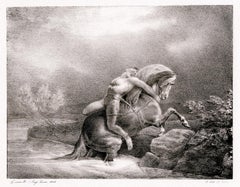
Mazeppa
— 19th-Century French Romanticism
By Jean Louis Andre Theodore Gericault
Located in Myrtle Beach, SC
Théodore Géricault and Eugène Lami, 'Mazeppa' from the series 'Oeuvres de Lord Byron', lithograph, 1823, 2nd state of 3, Delteil 94. Rendered by Thé...
Category
1820s Romantic Animal Prints
Materials
Lithograph
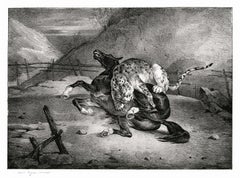
Horse Attacked by Tiger
— 19th-Century French Romanticism
By Jean Louis Andre Theodore Gericault
Located in Myrtle Beach, SC
Théodore Géricault (after), 'Tigre dévorant un cheval' (Tiger Devouring a Horse), lithograph, 3rd state of 3, Clement 97, c. 1820. Lettered 'Volmar ...
Category
1820s Romantic Animal Prints
Materials
Lithograph
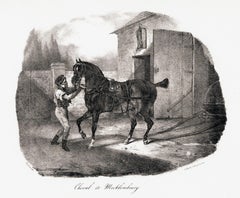
Cheval de Mecklembourg
— 19th-Century French Romanticism
By Jean Louis Andre Theodore Gericault
Located in Myrtle Beach, SC
Théodore Géricault 'Cheval de Mecklembourg' (Mecklembourg Horse), lithograph, 1822, 2nd state of 4, Delteil 47. Signed in the matrix 'Gericault', lower left. Published by Godefroy En...
Category
1820s Romantic Animal Prints
Materials
Lithograph
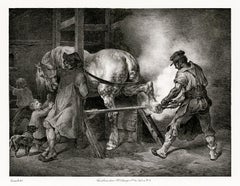
Le maréchal flamand
(The Flemish Blacksmith) — 19th-Century French Romanticism
By Jean Louis Andre Theodore Gericault
Located in Myrtle Beach, SC
Théodore Géricault 'Le maréchal flamand' (The Flemish Blacksmith) from the series ‘Etudes, de chevaux lithographiés,’ lithograph, 1822, 2nd state ...
Category
1820s Romantic Animal Prints
Materials
Lithograph
Foul Rope (Left)
— Early American Southwest Rodeo
By William Robinson Leigh
Located in Myrtle Beach, SC
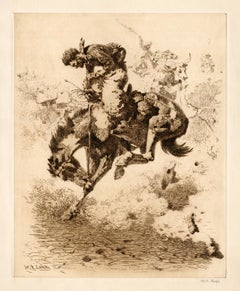
William Robinson Leigh, 'Foul Rope (Left)', etching, c. 1920, edition unknown but small. Signed in pencil and signed in the plate, lower left. A superb, richly-inked impression, in dark brown ink, on buff wove Umbria paper, the full sheet with margins (1 1/2 to 2 3/4 inches); slight toning at the sheet edges, otherwise in excellent condition. Very scarce. Archivally matted to museum standards, unframed.
Image size 14 7/8 x 11 15/16 inches (378 x 303 mm); sheet size 20 3/8 x 15 3/8 inches (518 x 391 mm).
ABOUT THE ARTIST
Born near Falling Waters, West Virginia, on a plantation a year after the Civil War and raised in Baltimore, William Robinson Leigh (1866 - 1955) became one of the foremost painters of the American West. His career spanning some seventy-five years, Leigh created some of the most iconic depictions of the Western landscape, with admirers referring to him as ‘The Sagebrush Rembrandt.’
The son of impoverished Southern aristocrats, Leigh received his first art training at age 14 from Hugh Newell at the Maryland Institute, where he was regarded as the best student in his class. From 1883 to 1895, he studied in Europe, mainly at the Royal Academy in Munich with Ludwig Loefftz. From 1891 to 1896, he painted six cycloramas or murals in the round, a giant German panorama.
In 1896, Leigh began working as a magazine illustrator for Scribner's and Collier's Weekly Magazine in New York City. He also painted portraits, landscapes, and genre scenes.
Leigh's trips to the Southwest began in 1906 when he agreed to paint the Grand Canyon with William Simpson, Santa Fe Railway advertising manager, in exchange for free transportation West. In 1907, he completed his Grand Canyon painting, which led to more commissions and an extensive painting trip through Arizona and New Mexico. These travels inspired him to paint western subjects for the next 50 years, and his primary interests were the Hopi and Navajo Indians.
In 1910, he traveled to Wyoming, where he painted in Yellowstone Park and created sketches, many of which he later converted into large canvases such as ‘Lower Falls of the Yellowstone’ (1915) and ‘Grand Canyon of the Yellowstone’ (1911).
In 1926, he traveled to Africa at the invitation of Carl Akeley for the American Museum of Natural History, and from this experience, wrote and illustrated 'Frontiers of Enchantment: An Artist's Adventures in Africa'. In 1933, he wrote and illustrated 'The Western Pony'. His adventures were chronicled in several popular magazines, including Life, the Saturday Evening Post, and Colliers.
For many years, Grand Central Art Galleries at the Biltmore Hotel handled his work exclusively in New York. In 1953, Leigh was elected an associate member of the National Academy of Design and became a full Academician in 1955.
In March 1999, the Historical Center of Cody, Wyoming, held an exhibition of his field sketches and finished works depicting his experiences near Cody early in the century. Between 1910 and 1921, when he often painted in the Carter Mountain vicinity, these years were considered pivotal to his artistic development and devotion to the Western landscape.
Leigh's work is held in many museum collections of American Western art...
Category
1920s Realist Animal Prints
Materials
Etching
Plowing It Under
— WPA Era American Regionalism
By Thomas Hart Benton
Located in Myrtle Beach, SC
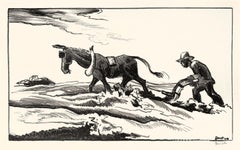
Thomas Hart Benton, 'Goin' Home', lithograph, 1937, edition 250, Fath 14. Signed in pencil. Signed in the stone, lower right. A fine, richly-inked impression, on off-white, wove pape...
Category
1930s American Realist Figurative Prints
Materials
Lithograph
You May Also Like
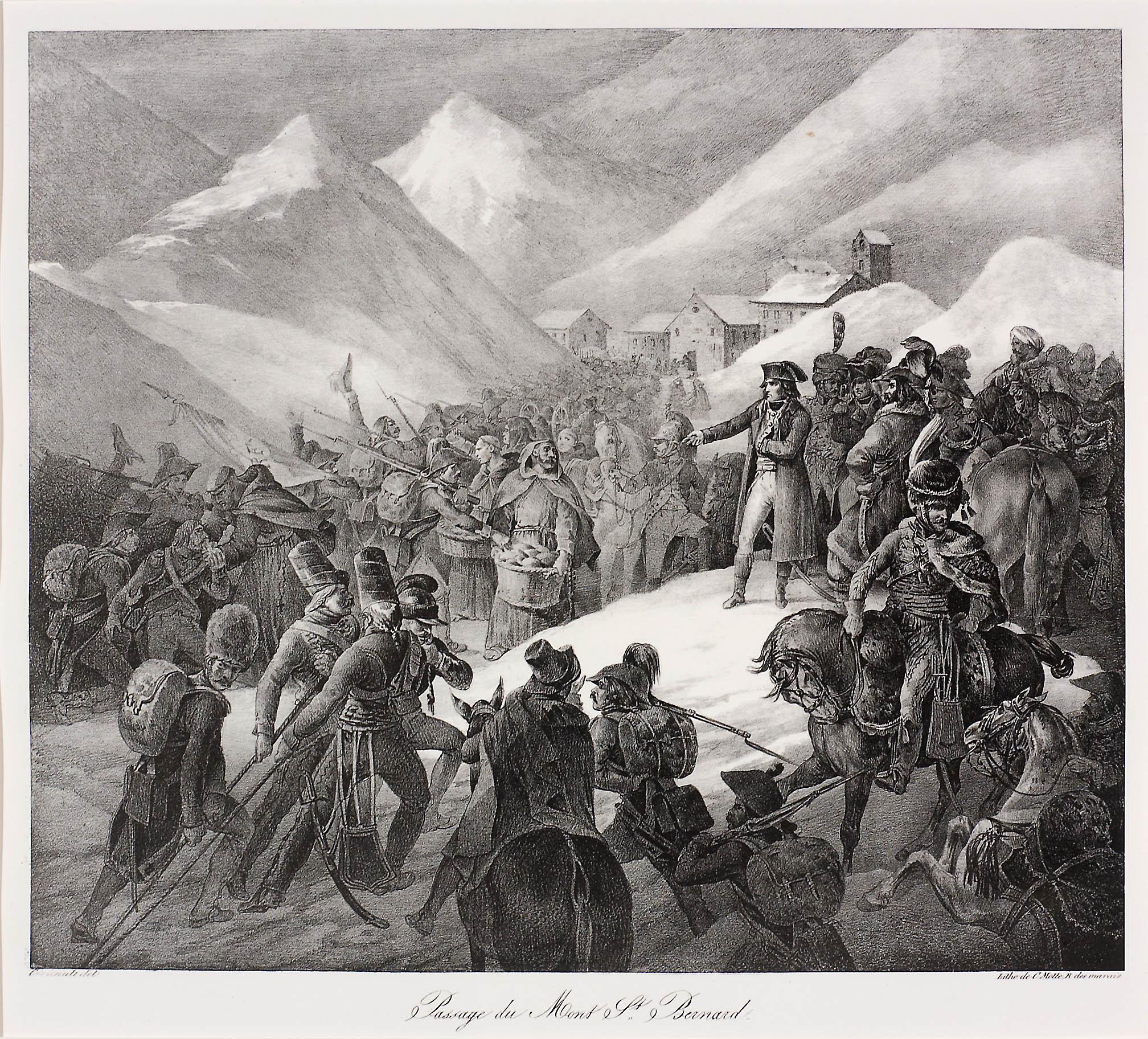
Passage du Mont Saint-Bernard
By Jean Louis Andre Theodore Gericault
Located in Fairlawn, OH
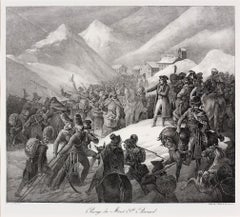
Theodore Gericault (1791-1824)
Passage du Mont Saint-Bernard
Lithograph, 1822
Signed and titled in the stone
As published in Arnault "Vie politique et militaire de Napoleon"
Conditio...
Category
1820s Romantic Figurative Prints
Materials
Lithograph
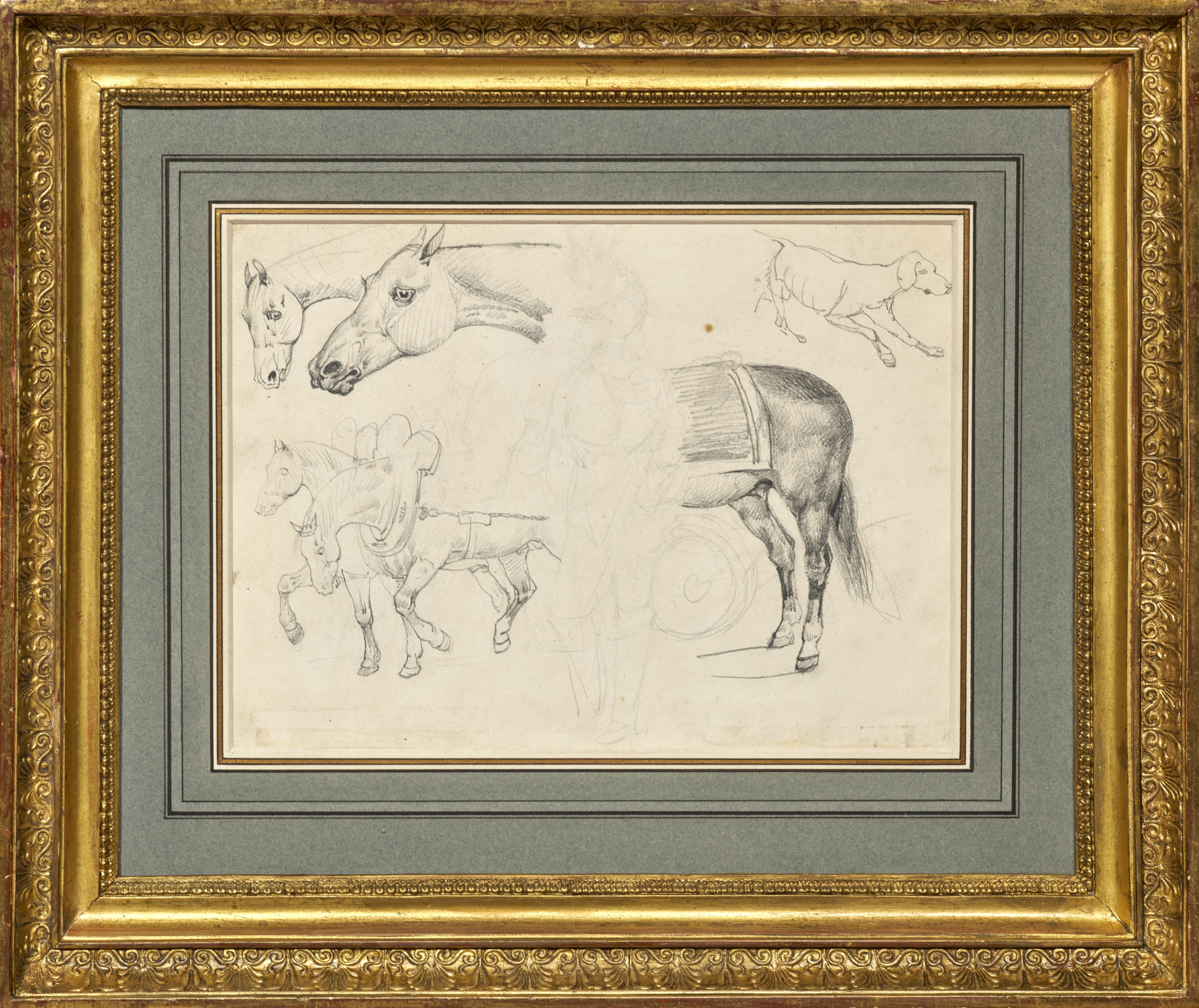
Double-sided Horse Studies by Théodore Géricault
By Jean Louis Andre Theodore Gericault
Located in PARIS, FR
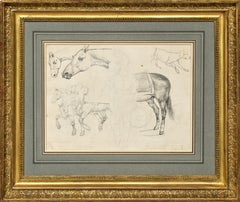
Recto: two horses, preparatory study for the lithograph "Les Boueux" ("The Muddy Ones")
Verso: four studies of horse heads (including two preparatory studies for the watercolor "Plowing in England"), a study of a life guard with the rump of his horse (preparatory to the lithograph "A Party of Life...
Category
1820s Old Masters Animal Drawings and Watercolors
Materials
Carbon Pencil
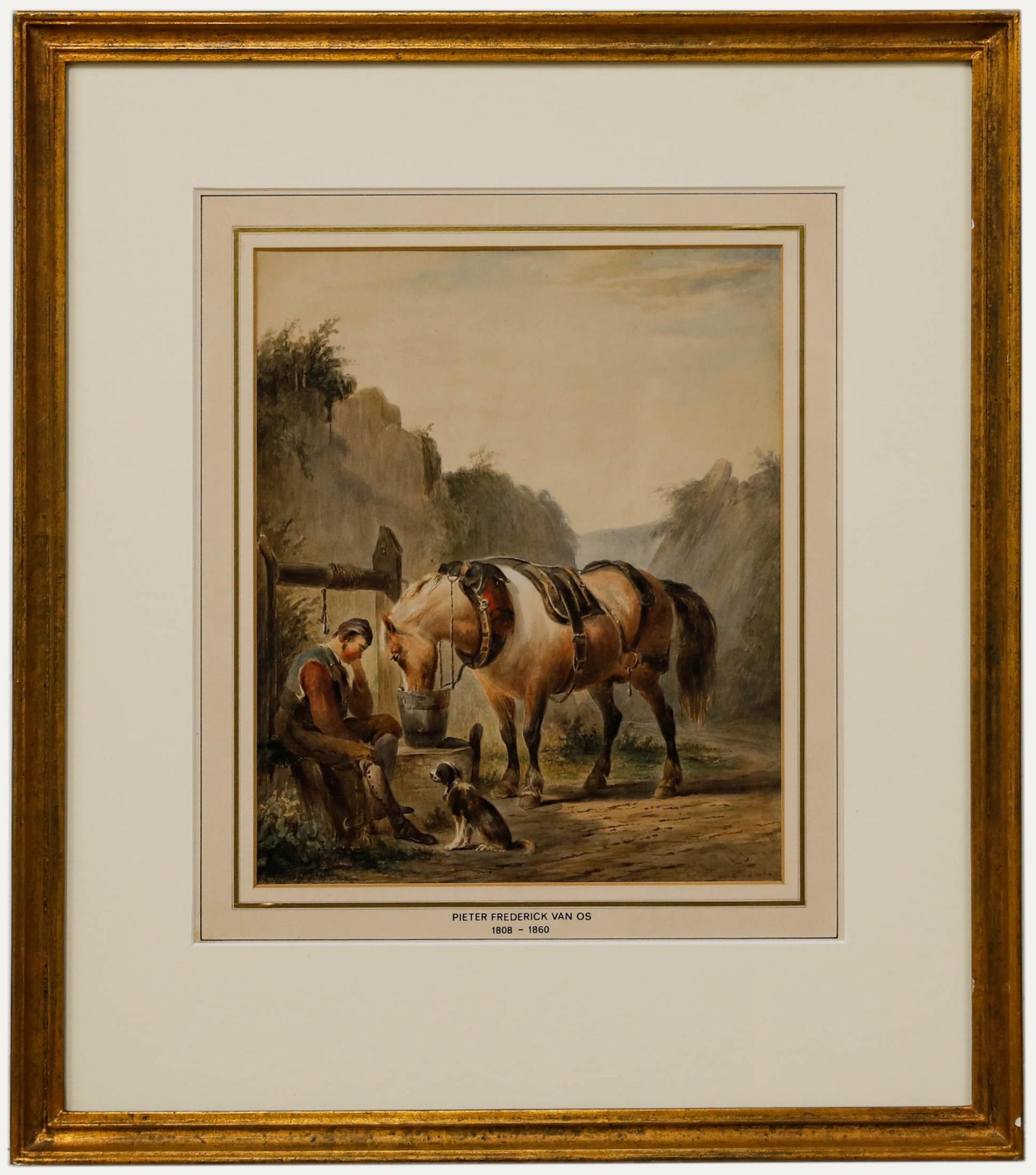
Pieter Frederick van Os (1808-1892) - 20th Century Oil, A Horse Watering
By Pieter Frederik van Os
Located in Corsham, GB
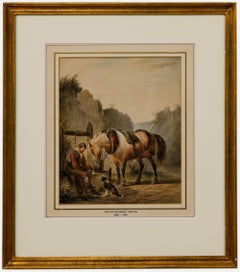
This atmospheric painting depicts a tranquil rural scene, with a figure tending to a draught horse on a dusty path amid towering cliffs. The composition balances the intimate foregro...
Category
20th Century Animal Paintings
Materials
Oil
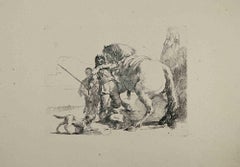
The Knight and his Horse - Etching by G.B. Tiepolo - 1785
By Giovanni Battista Tiepolo
Located in Roma, IT
The knight and his horse is an etching realized by Giambattista Tiepolo, in 1785.
Sheet 23 x 30 cm.
Good impressions on paper, with wide margin...
Category
1780s Old Masters Figurative Prints
Materials
Etching
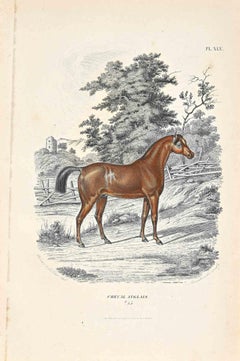
English Horse - Original Lithograph by Paul Gervais - 1854
By Paul Gervais
Located in Roma, IT
English Horse is an original lithograph on ivory-colored paper, realized by Paul Gervais (1816-1879). The artwork is from The Series of "Les Trois Règnes de la Nature", and was publi...
Category
1850s Modern Figurative Prints
Materials
Lithograph
Original Antique Lithograph of a Horse Showing the Passion
Affection
, 1827
Located in Langweer, NL
Antique horse print titled 'Plate 4th Affection, dedicated by permission to his most Gracious Majesty George the Fourth (..)'.
Artists and Engravers: In 1827, British artist Henry Barnard Chalon (1770-1849), designed and lithographed a portfolio of six prints illustrating the “passions” of horses. Chalon had been appointed animal painter to the Duchess of York...
Category
Antique 1820s Prints
Materials
Paper