Items Similar to
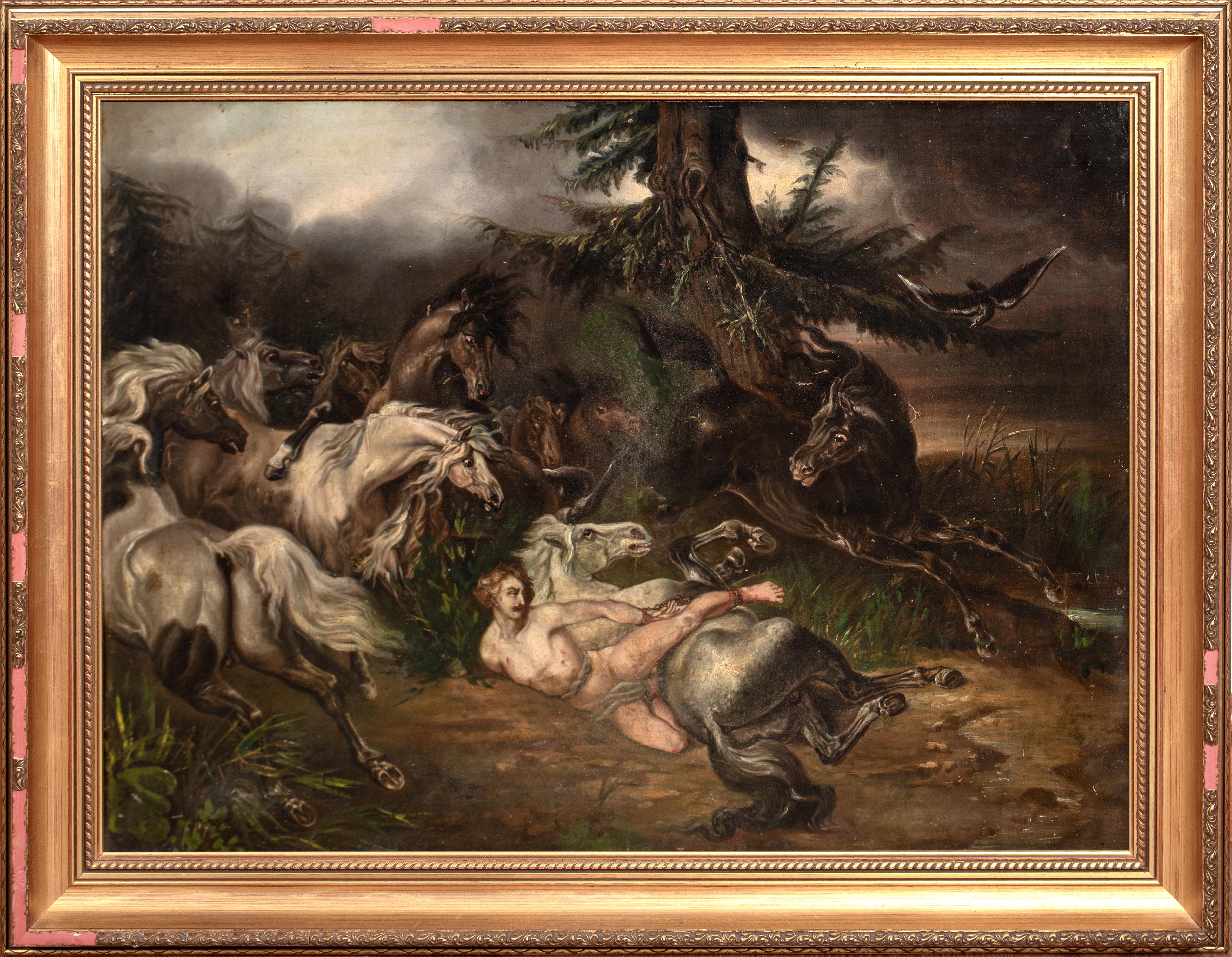
Mazeppa
— 19th-Century French Romanticism
Want more images or videos?
Request additional images or videos from the seller
1 of 3
Mazeppa
— 19th-Century French Romanticism1823
1823
$750
£572.27
€651
CA$1,053.24
A$1,152.65
CHF 609.07
MX$13,757.61
NOK 7,772.53
SEK 7,108.61
DKK 4,862.64
About the Item
Théodore Géricault and Eugène Lami, 'Mazeppa' from the series 'Oeuvres de Lord Byron', lithograph, 1823, 2nd state of 3, Delteil 94. Rendered by Théodore Géricault and Eugène Lami; printed by Villain; published by Gihaut Frères. A fine impression on off-white wove paper, with wide margins (1 3/4 to 3 1/4 inches), in very good condition. Archivally matted to museum standards, unframed.
Lettered 'Géricault
Eug. Lami 1823'; and 'Litho de Villain'; with the title lettering 'MAZEPPA (ch. XVII)'; 'Chez Gihaut Boul. d des Italiens No 5'; and the line from Lord Byron's poem:
'Le Coursier tente de s'élancer sur le rivage qui semble le repousser, ses poils et sa crinière sont lissants et humides... (Lord Byron)'.
'The wild steed's sinewy nerves will strain
Up the rebelling the bank
We gain the top: a boundless plain
Spreads through the shadow of the night.'
Image size 6 1/4 x 8 3/16 inches (159 x 208 mm); sheet size 10 3/4 x 14 1/4 inches (273 x 362 mm). Matted to museum standards, unframed.
Collections: British Museum, Metropolitan Museum of Art, Virginia Museum of Fine Arts.
ABOUT THE PRINT
According to Delteil, the print is part of a series of six lithographs intended to illustrate the works of Lord Byron and published in 1823. Four of them were produced in collaboration with Eugène Lami, the remaining two solely by Eugène Lami.
Mazeppa is a narrative poem written by the English Romantic poet Lord Byron in 1819. It is based on a popular legend about the early life of Ivan Mazepa (1639–1709), who later became Hetman (military leader) of Ukraine. Byron's poem was immediately translated into French, where it inspired a series of works in various art forms. The cultural legacy of Mazeppa was revitalized with the independence of Ukraine in 1991.
According to the poem, the young Mazeppa has a love affair with a Polish Countess, Theresa, while serving as a page at the Court of King John II Casimir Vasa. Countess Theresa was married to a much older Count. On discovering the affair, the Count punishes Mazeppa by tying him naked to a wild horse and setting the horse loose. The bulk of the poem describes the traumatic journey of the hero strapped to the horse. The poem has been praised for its "vigor of style and its sharp realization of the feelings of suffering and endurance".
ABOUT THE ARTIST
Géricault's fiery, audacious personality and short life fit the mold of Romantic artists of his era and, along with his controversial paintings, profoundly influenced nineteenth-century art. Notwithstanding about three years of studio training, Géricault was largely self-taught. He copied paintings in the Louvre and traveled to Rome, where he discovered Michelangelo's works and the exuberance of Baroque art.
In his enormous 'Raft of the Medusa,' now at the Louvre, Géricault fused Realism and Romanticism, elevating a current event—a shipwreck with few survivors—to the status of monumental art. To achieve authenticity, he used a model of the raft and carefully studied real cadavers—even his friend, Eugène Delacroix, posed for one of the figures. The wreck was attributed to governmental negligence and corruption and the resulting controversy, combined with the painting's veracity, brought Géricault widespread attention.
Géricault was also a master of lithography, the sole printmaking medium he employed to produce his breathtaking representations of horses and military subjects, two of his lifelong passions. During his English sojourn of 1820-21, Géricault improved his knowledge of the lithographic technique in the London workshop of Charles Joseph Hullmandel. The most striking result of this experience was the series of twelve lithographs ‘Various Subjects Drawn from Life and on Stone’, also known as ‘The English Set.’ Géricault continued his studies of the horse once he was back in France, producing the renowned series ‘Etudes, de chevaux lithographiés’.
Géricault died in 1824 at age thirty-two after a prolonged illness caused by a riding accident. His last major works, discovered almost fifty years after his death, were penetrating portraits of the insane. Like the 'Raft of the Medusa,' they offered a new concept of appropriate subject matter for serious painting.
- Creation Year:1823
- Dimensions:Height: 6.25 in (15.88 cm)Width: 8.19 in (20.81 cm)
- Medium:
- Movement Style:
- After:Jean Louis Andre Theodore Gericault (1791 - 1824, French)
- Period:
- Condition:
- Gallery Location:Myrtle Beach, SC
- Reference Number:Seller: 1039131stDibs: LU532310400322
About the Seller
5.0
Recognized Seller
These prestigious sellers are industry leaders and represent the highest echelon for item quality and design.
Platinum Seller
Premium sellers with a 4.7+ rating and 24-hour response times
Established in 1995
1stDibs seller since 2016
334 sales on 1stDibs
Typical response time: 1 hour
Associations
International Fine Print Dealers Association
- ShippingRetrieving quote...Shipping from: Myrtle Beach, SC
- Return Policy
More From This Seller
View All
Horse Attacked by Tiger
— 19th-Century French Romanticism
By Jean Louis Andre Theodore Gericault
Located in Myrtle Beach, SC
Théodore Géricault (after), 'Tigre dévorant un cheval' (Tiger Devouring a Horse), lithograph, 3rd state of 3, Clement 97, c. 1820. Lettered 'Volmar ...
Category
1820s Romantic Animal Prints
Materials
Lithograph
Cheval de Mecklembourg
— 19th-Century French Romanticism
By Jean Louis Andre Theodore Gericault
Located in Myrtle Beach, SC
Théodore Géricault 'Cheval de Mecklembourg' (Mecklembourg Horse), lithograph, 1822, 2nd state of 4, Delteil 47. Signed in the matrix 'Gericault', lower left. Published by Godefroy En...
Category
1820s Romantic Animal Prints
Materials
Lithograph
Rendez-Vous — Early 20th-Century Modernism
By Boris Lovet-Lorski
Located in Myrtle Beach, SC
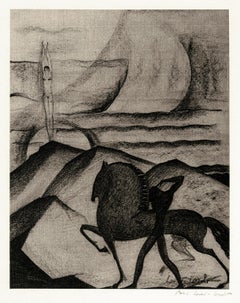
Boris Lovet-Lorski, Untitled (Rendez-Vous), lithograph, edition 250, 1929. Signed in pencil. Signed in the stone, lower right. From a suite of 10 lithographs published by the artist ...
Category
1920s American Modern Nude Prints
Materials
Lithograph
Taos - Relic of the Insurrection of 1845
— Southwest Regionalism
By Ira Moskowitz
Located in Myrtle Beach, SC
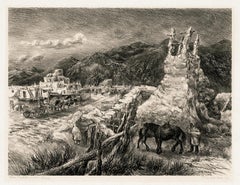
Ira Moskowitz, 'Relic of the Insurrection of 1845' also 'Taos Pueblo with Ruin)', lithograph, 1944, edition 30, Czestochowski 121. Signed and titled in pencil. Signed and dated in the stone, lower right. A fine, richly-inked impression, on cream wove paper, with full margins (1 3/8 to 1 15/16 inches). Very pale light toning within a previous mat opening, otherwise in excellent condition. Matted to museum standards, unframed.
Image size 11 5/8 x 15 1/2 inches (296 x 394 mm); sheet size 15 1/8 x 19 inches (384 x 483 mm).
ABOUT THE IMAGE
The Taos Revolt was a populist insurrection in January 1847 by Hispano and Pueblo allies against the United States occupation of present-day northern New Mexico during the Mexican–American War. The rebels killed provisional governor Charles Bent and several other Americans. In two short campaigns, United States troops and militia crushed the rebellion of the Hispano and Pueblo people. The New Mexicans, seeking better representation, regrouped and fought three more engagements, but after being defeated, they abandoned open warfare. The hatred of New Mexicans for the occupying American army, combined with the rebelliousness of Taos residents against imposed outside authority, were causes of the revolt. In the uprising's aftermath, the Americans executed at least 28 rebels. The Treaty of Guadalupe Hidalgo in 1850 guaranteed the property rights of New Mexico's Hispanic and American Indian residents.
ABOUT THE ARTIST
Ira Moskowitz was born in Galicia, Poland, in 1912, emigrating with his family to New York in 1927. He enrolled at the Art Student's League and studied there from 1928-31. In 1935, Moskowitz traveled to Paris and then lived until 1937 in what is now Israel. He returned to the United States in 1938 to marry artist Anna Barry in New York. The couple soon visited Taos and Santa Fe in New Mexico, returning for extended periods until 1944, when they moved there permanently, staying until 1949. During this especially productive New Mexico period, Moskowitz received a Guggenheim fellowship. His work was inspired by the New Mexico landscape and the state’s three cultures (American Southwest, Native American, and Mexican). He focused on Pueblo and Navajo life, producing an extensive oeuvre of authentic American Indian imagery. He and Anna also visited and sketched across the border in Old Mexico. While in the Southwest, Moskowitz flourished as a printmaker while continuing to produce oils and watercolors. Over 100 of Moskowitz’s works depicting Native American ceremonies were used to illustrate the book American Indian Ceremonial Dances by John Collier, Crown Publishers, New York, 1972.
After leaving the Southwest, printmaking remained an essential medium for the artist while his focus changed to subject matter celebrating Judaic religious life and customs. These works were well received early on, and Moskowitz was content to stay with them the rest of his life. From 1963 until 1966, Moskowitz lived in Paris, returning to New York City in 1967, where he made his permanent home until he died in 2001.
Shortly before his death, Zaplin-Lampert Gallery of Santa Fe staged an exhibition of the artist's works, December 2000 - January 2001. Other one-person shows included the 8th Street Playhouse, New York, 1934; Houston Museum, 1941; and the San Antonio Museum, 1941. The artist’s work was included in exhibitions at the Art Students League, Art Institute of Chicago, Philadelphia Print Club, College Art Association (promotes excellence in scholarship and teaching), and the International Exhibition of Graphic Arts (shown at MOMA, 1955).
Moskowitz’s lithographs of American Indian...
Category
1940s American Modern Landscape Prints
Materials
Lithograph
Search
— Australian Romanticism
Located in Myrtle Beach, SC
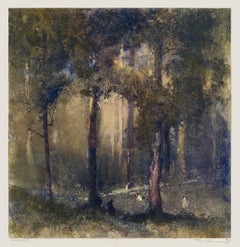
Thomas Balfour Garrett, 'Search', monotype in colors, c. 1910, a unique impression. Signed and titled in pencil. A superb, painterly impression with fresh colors on off-white, wove p...
Category
1910s Romantic Figurative Prints
Materials
Monotype
Le Paradis Terrestre
(Paradise on Earth) — French Symbolism
By Edouard Goerg
Located in Myrtle Beach, SC
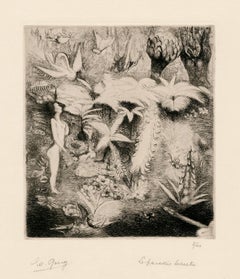
Edouard Goerg, 'Le Paradis Terrestre' (Paradise on Earth), etching, 1931, edition 40. Signed, titled, and numbered '3/40' in pencil. A fine richly-inked impression, on heavy, cream w...
Category
1930s Symbolist Figurative Prints
Materials
Etching
You May Also Like
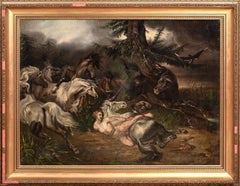
Ivan Mazeppa, 19th Century - From The Poem By Lord Byron
Located in Blackwater, GB
Mazeppa, 19th Century
From The Poem By Lord Byron
English School
Large 19th Century English scene from Lord Byrons narrative poem "Mazeppa", oil on canvas. Excellent quality circa...
Category
19th Century Landscape Paintings
Materials
Canvas, Oil
The Rest - Lithograph - 19th Century
Located in Roma, IT
Lithograph realized in 19th Century.
In very good condition, it is matted in a black mat.
Category
19th Century Modern Figurative Prints
Materials
Lithograph
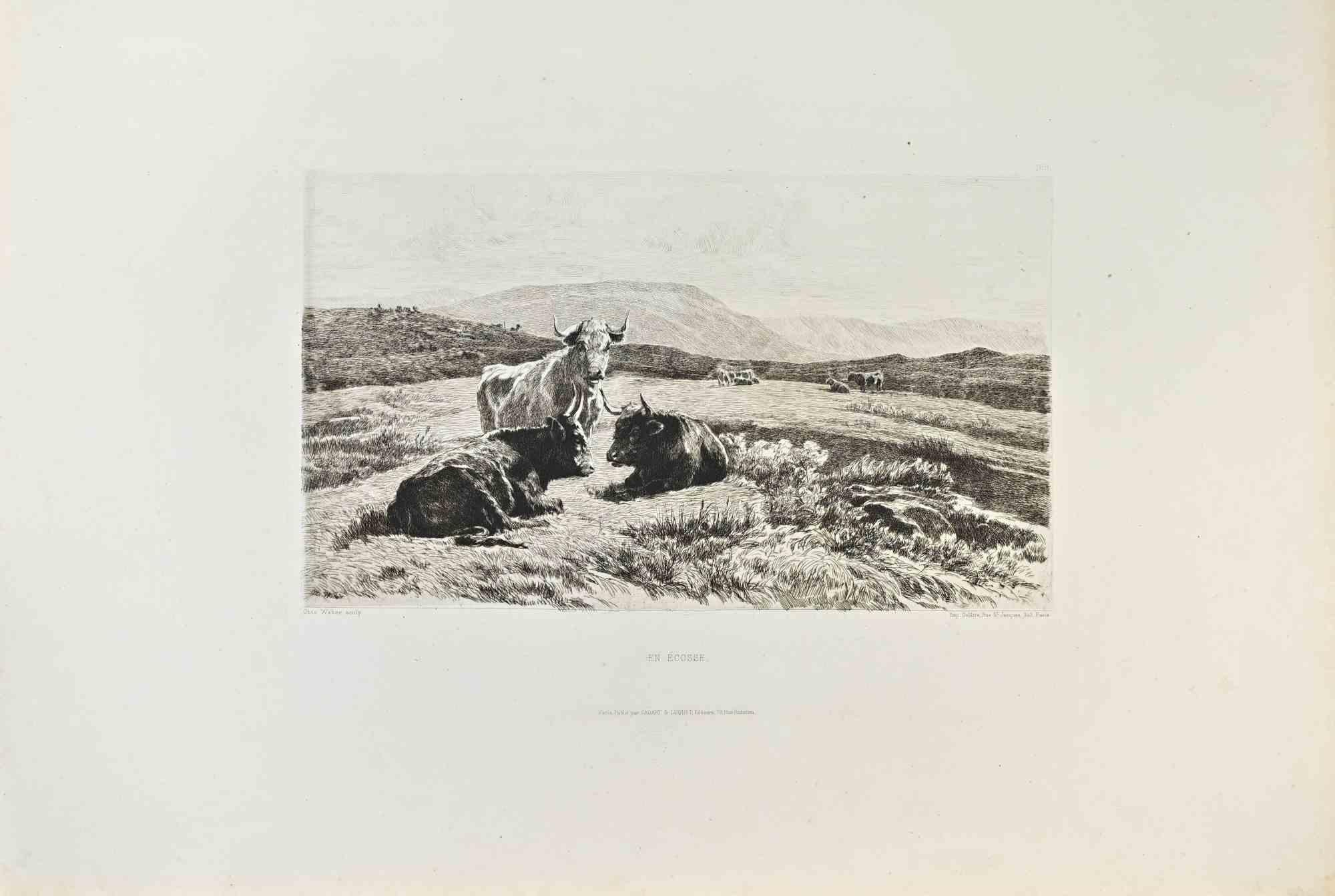
En Écosse - Etching by Otto Weber - 1870s
Located in Roma, IT
En Écosse is an artwork realized by Otto Weber in the 1870s.
Etching.
Image size:19x31
Good conditions.
Realized for the "Société des Aquafortistes. Born on the initiative of t...
Category
1870s Modern Figurative Prints
Materials
Etching
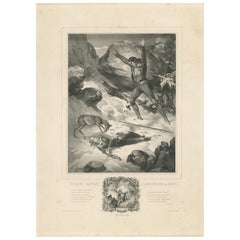
Uses and Customs - Horse Mounting Method - Lithograph - 1862
Located in Roma, IT
Uses and Customs - Horse Mounting Method is a lithograph on paper realized in 1862.
The artwork belongs to the Suite Uses and customs of all the peoples o...
Category
1860s Modern Figurative Prints
Materials
Lithograph
Romantic Era Lithograph – Jocelyn Sauvant Laurence de la Mort, c.1840
Located in Langweer, NL
Romantic antique lithograph of Jocelyn Sauvant, from Lamartine’s literary work, circa 1840. A poetic and emotional 19th-century French composition.
Jocelyn Sauvant Laurence de la Mo...
Category
Antique Mid-19th Century French Prints
Materials
Paper
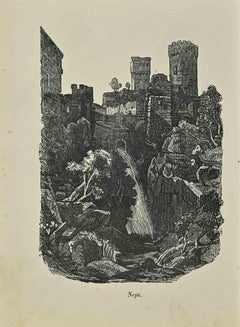
Uses and Customs - Nepi - Lithograph - 1862
Located in Roma, IT
Uses and Customs - Nepi is a lithograph on paper realized in 1862.
The artwork belongs to the Suite Uses and customs of all the peoples of the universe: " History of the government,...
Category
1860s Modern Figurative Prints
Materials
Lithograph
More Ways To Browse
19th Century French Prints
French 19th Century Lithographs
Military Horse
Flamingo Prints Vintage
Vintage Circus Animals
John Bowen
Sea Bird Art
Antique Crab Print
Camera Lucida
Chris Forrest
Intaglio Bird
Jacques Antiques
White Line Woodcut
Charles Schulz
Etchings Of Horses
Race Horse Print
Reptile Art
Tiger Lithograph