Want more images or videos?
Request additional images or videos from the seller
1 of 4
J.M.W. TurnerBridge and Cows.1807
1807
Price:$550
About the Item
About the Seller
5.0
Recognized Seller
These prestigious sellers are industry leaders and represent the highest echelon for item quality and design.
Gold Seller
Premium sellers maintaining a 4.3+ rating and 24-hour response times
Established in 1977
1stDibs seller since 2016
730 sales on 1stDibs
Typical response time: 1 hour
Associations
International Fine Print Dealers Association
Authenticity Guarantee
In the unlikely event there’s an issue with an item’s authenticity, contact us within 1 year for a full refund. DetailsMoney-Back Guarantee
If your item is not as described, is damaged in transit, or does not arrive, contact us within 7 days for a full refund. Details24-Hour Cancellation
You have a 24-hour grace period in which to reconsider your purchase, with no questions asked.Vetted Professional Sellers
Our world-class sellers must adhere to strict standards for service and quality, maintaining the integrity of our listings.Price-Match Guarantee
If you find that a seller listed the same item for a lower price elsewhere, we’ll match it.Trusted Global Delivery
Our best-in-class carrier network provides specialized shipping options worldwide, including custom delivery.You May Also Like
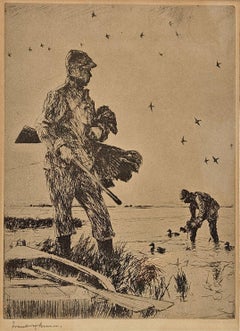
"Winter Wildfowling" Frank Weston Benson, Hunting Scene, Outdoors, Marshes
By Frank Weston Benson
Located in New York, NY
Frank Weston Benson
Winter Wildfowling, 1927
Signed lower left
Etching on paper
Image 8 1/2 x 7 inches
Born in Salem, Massachusetts, a descendant of a long line of sea captains, Benson first studied art at Boston’s Museum School where he became editor of the student magazine. In 1883, Benson enrolled at the Académie Julian in Paris where artists such as Bouguereau, Lefebvre, Constant, Doucet and Boulanger taught students from all over Europe and America. It was Boulanger who gave Benson his highest commendation. “Young man,” he said, “Your career is in your hands . . . you will do very well.” Benson’s parents gave him a present of one thousand dollars a twenty-first birthday and told him to return home when it ran out. The money lasted long enough to provide Benson with two years of schooling in Paris, a summer at the seaside village of Concarneau in Brittany and travel in England.
Upon returning to America, Benson opened a studio on Salem’s Chestnut Street and began painting portraits of family and friends. An oil of his wife, Ellen Perry Peirson, dressed in her wedding gown is representative of this period. It demonstrates not only the academic techniques he learned at the Academie Julian but also his own growing emphasis on the effects of light. And yet, despite all the technical mastery displayed in the work, the painting exudes the warmth that existed between model and artist. More than a likeness, it is a study in serenity. Perhaps it was of a work such as this that Benson was thinking when he said, “The more a painter knows about his subject, the more he studies and understands it, the more the true nature of it is perceived by whoever looks at it, even though it is extremely subtle and not easy to see or understand. A painter must search deeply into the aspects of a subject, must know and understand it thoroughly before he can represent it well.”
Following a brief stint as an instructor at the Portland, Maine, Society of Art, Benson was appointed as instructor of antique drawing at the Museum School in Boston in the spring of l889. Benson’s long association with the school was particularly fruitful. Under the leadership of Edmund Tarbell and Benson the Museum School became a national and internationally recognized institution. The students won numerous prizes, enrollment tripled, a new school building was erected and visiting delegations from other schools sought the secret of their success. Benson cherished his role as teacher and was held in high esteem by his students, many of whom called him “Cher Maitre.” Reminiscing about his long career with the school Benson once said, “I may have taught many students, but it was I who learned the most.”
In 1890, Benson won the Hallgarten Prize at the National Academy in New York. It was the first of a long series of awards, that earning for him the sobriquet “America’s Most Medalled Painter.” In the early years of his career, Benson’s studio works were mostly portraits or paintings of figures set in richly appointed interiors. Young women in white stretch their hands out towards the glow of an unseen fire; girls converse on an antique settee in a room full of objets d’arts; his first daughter, Eleanor, poses with her cat. Works of this sort, together with a steady influx of portrait commissions, earned Benson both renown and financial rewards, yet it was in his outdoor works that gave Benson his greatest pleasure.
In the latter half of the 1890s, Benson summered in Newcastle, on New Hampshire’s short stretch of seacoast. It was here, in 1899, that Benson made his first foray into impressionism with Children in the Woods and The Sisters, the latter a sun-dappled study of his two youngest daughters, Sylvia and Elisabeth.
This painting was one of the first works that Benson hung at an exhibition with nine friends. The resignation of these ten illustrious artists rocked the American art establishment but, the catalogue for their first exhibition was titled, simply, “Ten American Painters.” When, in 1898, the three Bostonians and seven New Yorkers began to exhibit their best work in exquisitely arranged small shows, the group (dubbed by newspapers, “The Ten” ) quickly became known as the American Impressionists, a bow to the style of their French predecessors. The Ten’s annual shows soon became an eagerly awaited part of the annual exhibition calendar and were always well reviewed. Held annually in New York City, the group’s yearly exhibitions usually traveled to Boston and were occasionally seen in other cities. Benson’s association with other members of the group such as Childe Hassam, Thomas Dewing, William Merrit Chase and J. Alden Weir, only reinforced his growing emphasis on the tenets of Impressionism. As he later said to his daughter Eleanor, “I follow the light, where it comes from, where it goes.”
The principles of Impressionism began to dominate Benson’s work by 1901, the year that the Bensons first summered on the island of North Haven in Maine’s Penobscot Bay. His summer home “Wooster Farm,” which they rented and finally bought in 1906, became the setting for some of Benson’s best known work and there, it seemed, he found endless inspiration. Benson’s sparkling plein-air paintings of his children–Eleanor, George, Elisabeth and Sylvia–capture the very essence of summer and have been widely reproduced: In The Hilltop, George and Eleanor watch the sailboat races from the headland near their house.
As a boy, Benson dreamed of being an ornithological illustrator. In mid-life, he returned to the wildfowl and sporting subjects that had remained his lifelong passion. Using etching and lithography, watercolor, oil and wash, Benson portrayed the birds observed since childhood and captured scenes of his hunting and fishing expeditions.
Together with his two brothers-in-law, Benson bought a small hunting retreat on a hill overlooking Cape Cod’s Nauset Marsh. Here, in the late 1890s, he began experimenting with black and white wash drawings. These paintings became so popular that Benson was not able to keep up with the demand. He turned to an art publishing company to have several made into it intaglio prints; twelve wash drawings are known to have been reproduced in this manner. At least two of them were given as gifts to associate members of the Boston Guild of artists, of which Benson was a founding member.
Benson was also an avid fisherman and his salmon fishing expeditions to Canada’s Gaspé Peninsula where one of the high points of his summer. There, in 1921, he began the first in a series of watercolors that would eventually over 500 works.
Benson’s watercolors conveyed the joy and beauty of a sportsman’s life whether in a painting of a hunter setting out decoys, a flock of ducks coming in for a landing or a grouse flushed from cover. The critics favorably compared Benson’s watercolors to those of Homer. “The love of the almost primitive wilderness which appears in many of Homer’s landscapes and the swift, sure touch with which he suggests rather than describes–these also characterize Benson’s work,” one critic wrote. “The solitude of the northern woods is very much like Homer’s.”
Like the wash drawings before them, Benson’s watercolors proved...
Category
1920s Academic Animal Prints
Materials
Paper, Etching
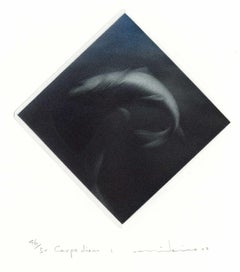
Carpe Diem I
By Mikio Watanabe
Located in New Orleans, LA
this impression is #46 from edition of 50
Mezzotint artist Mikio Watanabe was born in 1954 in Japan and currently lives in France. He is most known for his elegant, evocative black ...
Category
Early 2000s American Modern Animal Prints
Materials
Mezzotint
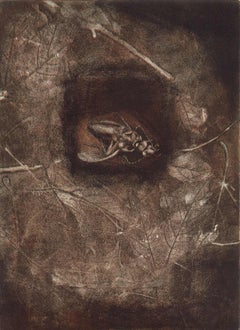
Crushed Beetle / Fragile Series
By Lois Ward
Located in New Orleans, LA
Lois Ward created a Fragile Series of images including "Crushed Beetle" in 1990 in a very small edition of just 9. This impression is #1 of 9.
Ward has always been concerned with t...
Category
1990s American Modern Animal Prints
Materials
Mezzotint
Her Majesty
s Stag Hounds on Ascot, A Colored 19th Century British Hunting Scene
Located in Alamo, CA
"The Meeting of Her Majesty's Stag Hounds on Ascot Heath" is a large colorful mezzotint engraving of an extensive British hunting scene. It was created by Sir Francis Grant...
Category
1830s Landscape Prints
Materials
Engraving, Mezzotint
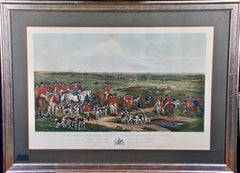
Francis Grant Her Majesty
s Stag Hounds on Ascot, A Colored 19th Century British Hunting Scene, 1839
$1,675
H 29 in W 38.88 in D 1.25 in
Three Gould Hand-colored Lithographs from Birds of Australia and New Zealand
By John Gould
Located in Alamo, CA
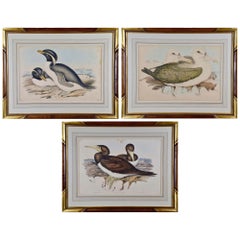
Three hand-colored lithographs from John Gould's seven volume book "The Birds of Australia", which included New Zealand, depicting: pairs of "Eudyptes Chrysocome" (New Zealand Rock-hopper Crested Penguins), "Diomedea O Thalassarche Cauta" (Australian Shy Albatross) and "Sula Fusca" (Brown Gannets).
These beautiful sea bird prints are presented in identical very attractive brown wood frames, embellished with gold highlights in the corners and gold inner trim, along with light cream-colored French mats, each with a medium cream-colored band and a gold highlight line. There is scattered spotting. There is a small tear in the lower right corner of the penguin lithograph...
Category
1840s Academic Animal Prints
Materials
Lithograph
$3,175
H 22 in W 28.25 in D 1 in
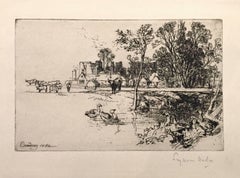
Cowdray Castle (with Geese)
By Sir Francis Seymour Haden, R.A.
Located in Roma, IT
Beautiful proof on vergé crème, signed by the artist in pencil.
Full margins. Ex-coll. H.H. Benedict (Lugt 1298).
Ref. Cat. Harrington 221; Schneiderman 208.
Category
1880s Modern Landscape Prints
Materials
Drypoint, Etching
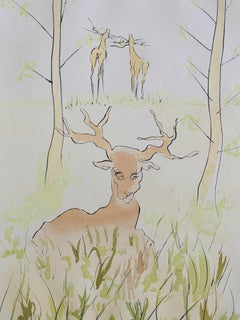
Salvador Dali, Le Cerf Malade Signed Etching Engraving, Color Lithograph Pochoir
By Salvador Dalí
Located in Surfside, FL
An original signed drypoint etching with color pochoir by Spanish artist Salvador Dali titled "La Cerf Malade", depicting a stag deer, from the Portfolio: Le Bestiaire de la Fontaine...
Category
1970s Surrealist Animal Prints
Materials
Color, Drypoint, Etching
$3,600
H 35.5 in W 27.75 in
"Dialogue to the Wind" - Intaglio Print by Tomoya Uchida
Located in Soquel, CA
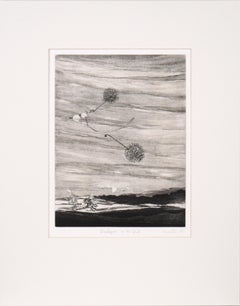
"Dialogue to the Wind" by Tomoya Uchida (American, 20th Century). Plant matter swirls in the air above a minimalist landscape. In the foreground, two bees have landed on a housekey. The sky is subtly textured, creating the impression of passing gusts of wind.
Titled "Dialogue to the Wind" along the bottom edge.
Signed and dated "T. Uchida - 89" in the lower right corner.
Presented in a new light grey mat with foamcore backing.
Mat size: 22"H x 17"W
Paper size: 19.75"H x 13"W
Tomoya Uchida (Japanese, b. 1947) was born in Tsuyama City in the Okayama prefecture in Japan. He graduated from Doshisha University, Kyoto, in 1970, and went on to become the artist-in-residence at the KALA Institute of Prints in Berkeley, CA, in 1989. He then moved to Australia, where he studied under Prof. Jorg Schmeisser...
Category
1980s Contemporary Landscape Prints
Materials
Paper, Ink, Drypoint
$880 Sale Price
20% Off
H 22 in W 17 in D 0.25 in
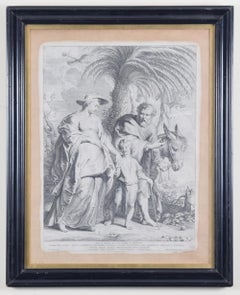
The Flight into Egypt 17th century engraving after Rubens by Lucas Vorsterman
By Peter Paul Rubens
Located in London, GB
To see more, scroll down to "More from this Seller" and below it click on "See all from this Seller."
Lucas Vorsterman (1595 - 1675) after Peter Paul Rubens (1577 - 1640)
The Fligh...
Category
1620s Realist Landscape Prints
Materials
Engraving
$1,987
H 43 in W 31 in
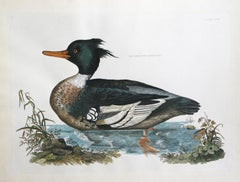
Red Breasted Merganser from Illustrations of British Ornithology Pl.58 by Selby
Located in Paonia, CO
Red Breasted Merganser PL 58 from a rare black and white edition of Prideaux John Selby’s two volume set of 222 engravings “Illustrations of British Ornithology”. These original...
Category
Mid-19th Century Realist Animal Prints
Materials
Engraving
More From This Seller
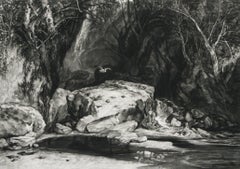
View AllA Yorkshire Dell or The Heron’s Pool.
By Sir Frank Short
Located in Plano, TX
A Yorkshire Dell or The Heron’s Pool. (after J.M.W. Turner, R.A., 1775-1851.) Soft-ground etching and mezzotint. Hardie 85. mezzotint over etching on India paper printed on chine-co...
Category
Early 20th Century Romantic Landscape Prints
Materials
Mezzotint, Etching
$1,000 Sale Price
20% Off
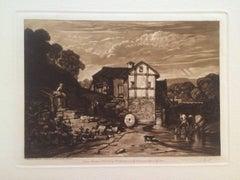
Water Mill
By Sir Frank Short
Located in Plano, TX
Water Mill (after the drawing by J.M.W. Turner, R.A., 1775-1851). 1885. Mezzotint. Hardie 3.ii. With the publication line. 7 x 10 1/8 (sheet 12 1/4 x 16 5/8...
Category
1880s Animal Prints
Materials
Mezzotint
Through the Storm.
By Edmund Blampied
Located in Plano, TX
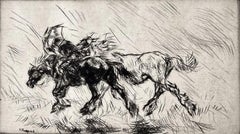
Appleby 97. 4 x 6 15/16 (sheet 8 1/8 x 10 3/8). Edition 100. A rich impression with drypoint burr and carefully wiped plate tone, printed on 'FJ Head' paper, on the full sheet with ...
Category
1920s Modern Animal Prints
Materials
Drypoint, Etching
Misty Morning.
By Edmund Blampied
Located in Plano, TX
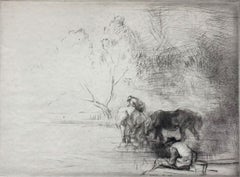
Misty Morning. 1928-29. Drypoint. Appleby 137. 8 5/8 x 12 (sheet 11 5/8 x 18 1/16). Edition 100, #86. A rich impression with drypoint burr. Printed with ...
Category
1920s Modern Landscape Prints
Materials
Drypoint, Etching
The Vraic Season (No 1).
By Edmund Blampied
Located in Plano, TX
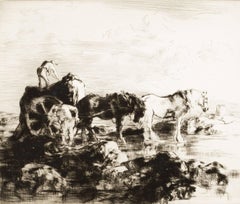
The Vraic Season (No 1). 1936. Etching. Appleby 181. 12 x 14 1/4 (sheet 15 1/4 x 20). Edition 125 for The American College Society of Print Collectors (alternatively titled Seaweed H...
Category
1930s Modern Landscape Prints
Materials
Drypoint, Etching
$900 Sale Price
40% Off
Lumbermen.
By Edmund Blampied
Located in Plano, TX
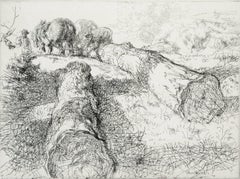
Lumbermen. 1923. Etching. Appleby 91. 9 x 12 (sheet 12 3/8 x 18 1/8). Edition 100. A cleanly-wiped impression printed on off-white 'FG Head & Co' laid paper with full margins. Signed...
Category
1920s Modern Landscape Prints
Materials
Drypoint, Etching
$500 Sale Price
33% Off