Want more images or videos?
Request additional images or videos from the seller
1 of 15
Joseph Wolf"Lady Amherst Pheasant (Thaumalea Amherstiae)" Naturalistic Bird Lithograph1870s
1870s
Price:$320
$400List Price
About the Item
- Creator:Joseph Wolf (1820 - 1899, German)
- Creation Year:1870s
- Dimensions:Height: 20.5 in (52.07 cm)Width: 24.5 in (62.23 cm)Depth: 1 in (2.54 cm)
- Medium:
- Movement Style:
- Period:
- Condition:Wear consistent with age.
- Gallery Location:Houston, TX
- Reference Number:Seller: A2021.1021.31321stDibs: LU55139112262
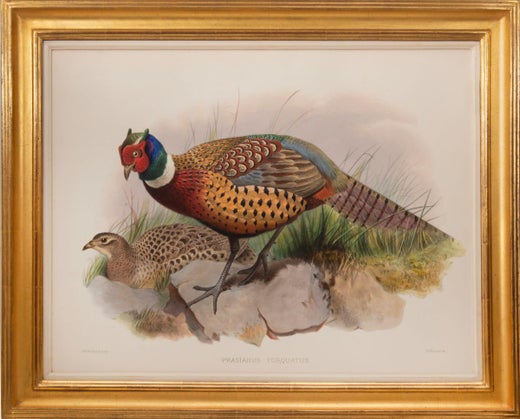
Joseph Wolf
Joseph Wolf was the most prominent ornithological artist to contribute illustrations to John Gould’s bird books. While growing up on a farm in Germany, Wolf roamed the countryside and developed a strong interest in observing and sketching the wildlife. In 1836 his father reluctantly permitted him to become an apprentice at a lithographic firm in nearby Coblenz (Jackson 1975, 63). After spending three years there improving his drawing skills and learning how to copy drawings onto the limestone blocks used for lithographic printing, Wolf returned to the family farm, but only for a year. Scientific contacts led him first to Darmstadt and then to Leiden in the Netherlands, where he progressed from illustrating ornithological books to become a painter of birds and animals. He improved his artistic skills still more by attending art school.
He developed the idea of depicting birds in motion, such as the dramatic scene of a Capercaillie escaping a fox that he drew for the publisher, Kern, in 1846 (Jackson 1975, 64). When revolution disrupted life on the European continent in 1848, Wolf took up the invitation of David William Mitchell, secretary of the Zoological Society of London, and assisted Mitchell in illustrating George Robert Gray’s book, Genera of Birds (1844-1849). In 1849 Wolf also began to provide John Gould with illustrations for The Birds of Great Britain (1862-1873), his approach being especially suitable for birds of prey (Jackson 1975, 67). For example, he shows the Hooded Crow stealing an egg from a nest (Figs. 2 and 3). Rather than commit to working full-time for Gould, Wolf retained his independence as a free-lance artist. Wolf’s biographer, Samuel Palmer, recounted that Gould enticed Wolf to visit and make charcoal drawings of birds for him by setting out Wolf’s favorite cigars and drawing materials. Whether that story is true or not, it is also recorded that Wolf objected to the overly bright tints chosen by Gould for coloring the lithographic prints (Jackson 1975, 67).
The drawings made by Wolf for The Birds of Asia (1850-1883) were his last for Gould Gould’s text about Bulwer’s Pheasant thanks the British Museum for loaning him the unique type specimen, “which has enabled me to prepare the accompanying Plate from the talented pencil of Mr. Wolf’ (Figs. 4 and 5). Wolf’s drawings were rendered on stone by Henry Constantine Richter, another Gould artist who had earlier worked on illustrations for Gray’s Genera of Birds. It must have been an oversight that Wolf’who had drawn the Painted Spurfowl for Gould, was not credited on the published plate. Source:
Website of University of Kansas Libraries: Gould History and Background

About the Seller
5.0
Gold Seller
Premium sellers maintaining a 4.3+ rating and 24-hour response times
Established in 1969
1stDibs seller since 2014
888 sales on 1stDibs
Typical response time: 10 hours
Authenticity Guarantee
In the unlikely event there’s an issue with an item’s authenticity, contact us within 1 year for a full refund. DetailsMoney-Back Guarantee
If your item is not as described, is damaged in transit, or does not arrive, contact us within 7 days for a full refund. Details24-Hour Cancellation
You have a 24-hour grace period in which to reconsider your purchase, with no questions asked.Vetted Professional Sellers
Our world-class sellers must adhere to strict standards for service and quality, maintaining the integrity of our listings.Price-Match Guarantee
If you find that a seller listed the same item for a lower price elsewhere, we’ll match it.Trusted Global Delivery
Our best-in-class carrier network provides specialized shipping options worldwide, including custom delivery.You May Also Like
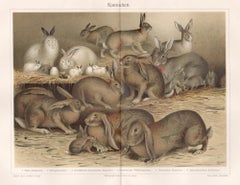
Rabbits, German antique animal chromolithograph print.
Located in Melbourne, Victoria
'Kaninchen'
(Rabbits)
German chromolithograph, circa 1910. Key in German to the types of rabbits at the bottom of the image. Central vertical fold as issued.
245mm by 305mm (shee...
Category
Early 20th Century Naturalistic Animal Prints
Materials
Lithograph
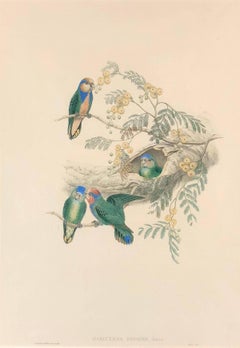
Nasiterna Bruijni
By John Gould
Located in Missouri, MO
John Gould (British, 1804-1881)
Nasiterna Bruijni c. 1849-1861
Hand Colored Lithograph
Image Size: approx 19.5 x 13.5 inches
Framed Size: 27 3/8 x 21 1/2 inches
John Gould was an English ornithologist and bird artist. The Gould League in Australia was named after him. His identification of the birds now nicknamed "Darwin's finches" played a role in the inception of Darwin's theory of evolution by natural selection. Gould's work is referenced in Charles Darwin's book, On the Origin of Species.
Gould was born in Lyme Regis, Dorset, the son of a gardener, and the boy probably had a scanty education. Shortly afterwards his father obtained a position on an estate near Guildford, Surrey, and then in 1818 became foreman in the Royal Gardens of Windsor. He was for some time under the care of J T Aiton, of the Royal Gardens of Windsor. The young Gould started training as a gardener, being employed under his father at Windsor from 1818 to 1824, and he was subsequently a gardener at Ripley Castle in Yorkshire. He became an expert in the art of taxidermy, and in 1824 he set himself up in business in London as a taxidermist, and his skill led to him becoming the first Curator and Preserver at the museum of the Zoological Society of London in 1827.
Gould's position brought him into contact with the country's leading naturalists, and also meant that he was often the first to see new collections of birds given to the Society. In 1830 a collection of birds arrived from the Himalayas, many not previously described. Gould published these birds in A Century of Birds from the Himalaya Mountains (1830-1832). The text was by Nicholas Aylward Vigors, and the illustrations were lithographed by Gould's wife Elizabeth, daughter of Nicholas Coxen of Kent.
This work was followed by four more in the next seven years including Birds of Europe in five volumes - completed in 1837, with the text written by Gould himself, edited by his clerk Edwin Prince. Some of the illustrations were made by Edward Lear as part of his Illustrations of the Family of Psittacidae in 1832. Lear however was in financial difficulty, and he sold the entire set of lithographs to Gould. The books were published in a very large size, imperial folio, with magnificent coloured plates. Eventually 41 of these volumes were published with about 3000 plates. They appeared in parts at £3 3s. a number, subscribed for in advance, and in spite of the heavy expense of preparing the plates, Gould succeeded in making his ventures pay and in realizing a fortune. In 1838 he and his wife moved to Australia to work on the Birds of Australia and shortly after his return to England, his wife died in 1841.
When Charles Darwin presented his mammal and bird specimens collected during the second voyage of HMS Beagle to the Geological Society of London at their meeting on 4 January 1837, the bird specimens were given to Gould for identification. He set aside his paying work and at the next meeting on 10 January reported that birds from the Galápagos Islands, which Darwin had thought were blackbirds, "gross-bills" and finches were in fact "a series of ground Finches which are so peculiar" as to form "an entirely new group, containing 12 species." This story made the newspapers.
In March, Darwin met Gould again, learning that his Galápagos "wren" was another species of finch and the mockingbirds he had labeled by island were separate species rather than just varieties, with relatives on the South American mainland. Subsequently Gould advised that the smaller southern Rhea specimen that had been rescued from a Christmas dinner...
Category
1850s Naturalistic Animal Prints
Materials
Lithograph
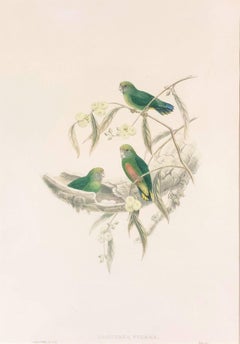
Nasiterna Pygmae
By John Gould
Located in Missouri, MO
John Gould (British, 1804-1881)
Nasiterna Pygmae c. 1849-1861
Hand Colored Lithograph
Image Size: approx 19.5 x 13.5 inches
Framed Size: 27 3/8 x 21 1/2 inches
John Gould was an English ornithologist and bird artist. The Gould League in Australia was named after him. His identification of the birds now nicknamed "Darwin's finches" played a role in the inception of Darwin's theory of evolution by natural selection. Gould's work is referenced in Charles Darwin's book, On the Origin of Species.
Gould was born in Lyme Regis, Dorset, the son of a gardener, and the boy probably had a scanty education. Shortly afterwards his father obtained a position on an estate near Guildford, Surrey, and then in 1818 became foreman in the Royal Gardens of Windsor. He was for some time under the care of J T Aiton, of the Royal Gardens of Windsor. The young Gould started training as a gardener, being employed under his father at Windsor from 1818 to 1824, and he was subsequently a gardener at Ripley Castle in Yorkshire. He became an expert in the art of taxidermy, and in 1824 he set himself up in business in London as a taxidermist, and his skill led to him becoming the first Curator and Preserver at the museum of the Zoological Society of London in 1827.
Gould's position brought him into contact with the country's leading naturalists, and also meant that he was often the first to see new collections of birds given to the Society. In 1830 a collection of birds arrived from the Himalayas, many not previously described. Gould published these birds in A Century of Birds from the Himalaya Mountains (1830-1832). The text was by Nicholas Aylward Vigors, and the illustrations were lithographed by Gould's wife Elizabeth, daughter of Nicholas Coxen of Kent.
This work was followed by four more in the next seven years including Birds of Europe in five volumes - completed in 1837, with the text written by Gould himself, edited by his clerk Edwin Prince. Some of the illustrations were made by Edward Lear as part of his Illustrations of the Family of Psittacidae in 1832. Lear however was in financial difficulty, and he sold the entire set of lithographs to Gould. The books were published in a very large size, imperial folio, with magnificent coloured plates. Eventually 41 of these volumes were published with about 3000 plates. They appeared in parts at £3 3s. a number, subscribed for in advance, and in spite of the heavy expense of preparing the plates, Gould succeeded in making his ventures pay and in realizing a fortune. In 1838 he and his wife moved to Australia to work on the Birds of Australia and shortly after his return to England, his wife died in 1841.
When Charles Darwin presented his mammal and bird specimens collected during the second voyage of HMS Beagle to the Geological Society of London at their meeting on 4 January 1837, the bird specimens were given to Gould for identification. He set aside his paying work and at the next meeting on 10 January reported that birds from the Galápagos Islands, which Darwin had thought were blackbirds, "gross-bills" and finches were in fact "a series of ground Finches which are so peculiar" as to form "an entirely new group, containing 12 species." This story made the newspapers.
In March, Darwin met Gould again, learning that his Galápagos "wren" was another species of finch and the mockingbirds he had labeled by island were separate species rather than just varieties, with relatives on the South American mainland. Subsequently Gould advised that the smaller southern Rhea specimen that had been rescued from a Christmas dinner...
Category
Mid-19th Century Naturalistic Animal Prints
Materials
Lithograph
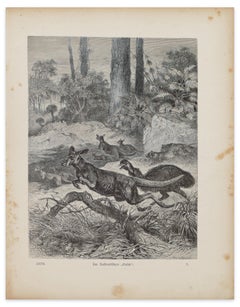
Cangaroos in Danger - Lithograph by F. Specht - 1879
By Friedrich Specht 1
Located in Roma, IT
Cangaroos in Danger is a black and white lithograph realized by Friedrich Specht in 1879.
Image dimensions: 19,7 x 13,7 cm.
Original Title: Am Auftralifchen "Bufch". Dated 1879 an...
Category
1870s Naturalistic Animal Prints
Materials
Lithograph
$335
H 10.36 in W 7.33 in D 0.08 in
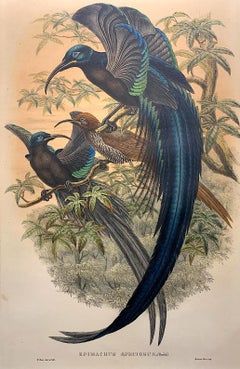
Superb Epimachus Speciosus Bird lithographed by the ornithologists Gould
By John and Elizabeth Gould
Located in Milan, IT
This plate is unique because of the bird species' unmistakable beauty and the great scientific and artistic skill with which Elisabeth and Jhon Gould rendered it.
The price quoted h...
Category
Late 19th Century Naturalistic Animal Prints
Materials
Lithograph
$1,914
H 21.66 in W 13.94 in D 0.04 in
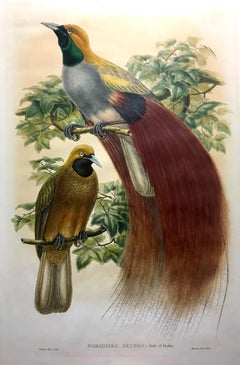
Superb Paradisea Decora bird lithographed by the greatest ornithologists Gould
By John and Elizabeth Gould
Located in Milan, IT
This plate is unique both for the unmistakable beauty of the bird species and for the great scientific and artistic skill of Elisabeth and Jhon Gould to have rendered it.
The price ...
Category
Late 19th Century Naturalistic Animal Prints
Materials
Lithograph
$1,914
H 21.66 in W 13.94 in D 0.04 in
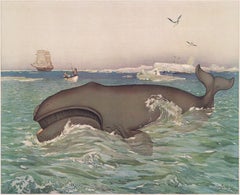
Whaling – Vintage Monumental Zoology Lithograph
Located in Myrtle Beach, SC
Joseph Fleischmann, 'Whaling' (Hartingers Wandtafeln: Zoologie T. XXXII), monumental vintage color lithograph, 1900. Signed in the matrix, lower right. A superb, beautifully nuanced impression, on cream wove paper, the full sheet with margins (1 1/2 to 2 3/16 inches), in very good condition. Sheet size 28 x 38 1/2 inches (711 x 978 mm). The full sheet, unmounted and unmatted—shipped carefully rolled and protected.
Rendering by A. Berger after Joseph Fleischmann. Published by Carl Gerold’s Son, Vienna, 1900.
This Artic whaling scene depicts a Greenland whale in the foreground pursued by whalers. A whaling ship is seen in the background and at right, another whale among icebergs with seagulls overhead. The print by Albert Berger...
Category
Early 1900s Naturalistic Animal Prints
Materials
Lithograph
$1,125 Sale Price
25% Off
H 28 in W 38.5 in
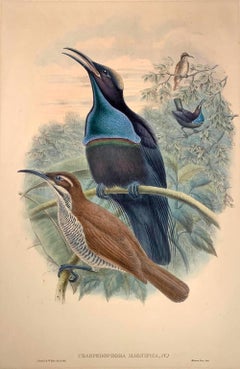
Superb Craspedophora Magnifica Bird lithographed by the ornithologists Gould
By John and Elizabeth Gould
Located in Milan, IT
This plate is unique because of the bird species' unmistakable beauty and the great scientific and artistic skill with which Elisabeth and Jhon Gould rendered it.
The price quoted h...
Category
Late 19th Century Naturalistic Animal Prints
Materials
Lithograph
$1,914
H 21.66 in W 13.94 in D 0.04 in
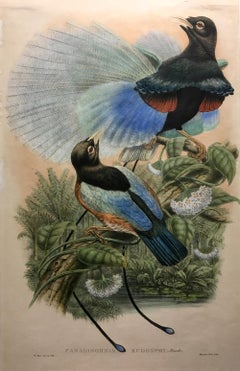
Superb Paradisornis Rudolphi Bird lithographed by the ornithologists Gould
By John and Elizabeth Gould
Located in Milan, IT
This plate is unique because of the bird species' unmistakable beauty and the great scientific and artistic skill with which Elisabeth and Jhon Gould rendered it.
The price quoted h...
Category
Late 19th Century Naturalistic Animal Prints
Materials
Lithograph
$1,914
H 21.66 in W 13.94 in D 0.04 in
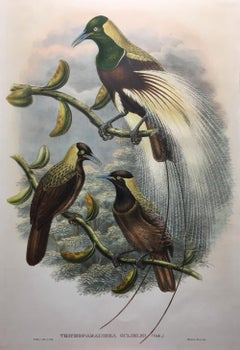
Superb Trichoparadisea Gulielmi Bird lithographed by the ornithologists Gould
By John and Elizabeth Gould
Located in Milan, IT
This plate is unique both because of the bird species' unmistakable beauty and the great scientific and artistic skill with which Elisabeth and Jhon Gould rendered it.
The price quo...
Category
Late 19th Century Naturalistic Animal Prints
Materials
Lithograph
$1,914
H 21.66 in W 13.94 in D 0.04 in
More From This Seller
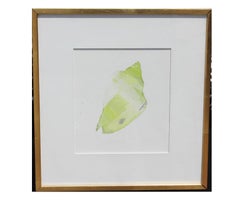
View AllGreen Painted Sea Shell Lithograph Edition 33 of 34
By Frances Nail
Located in Houston, TX
Green shell lithograph of a cone shell. Print is edition 33 of 34. Signed and dated by the artist along with titled. Print is framed in a golden frame...
Category
1970s Naturalistic Still-life Prints
Materials
Lithograph
Naturalistic Modern Texas Bobcat Black and White Animal Wildlife Print
By Charles Beckendorf
Located in Houston, TX
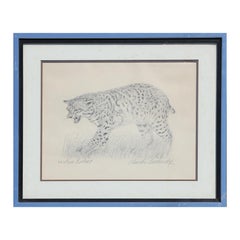
A signed and numbered print of a bobcat from Texas artist Charles Beckendorf. Charles did the original in pencil for this series. The print is displayed in a chrome frame and white m...
Category
1960s Naturalistic Animal Prints
Materials
Paper, Black and White
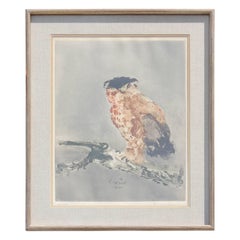
Owl On Branch Print Edition 92/120
By Kaiko Moti
Located in Houston, TX
Aquatint print of an owl perched on a branch with bright yellow eyes. The work is signed by the artist. It is framed in a wooden frame with a burlap matte.
Artist Biography: Kaiko M...
Category
1970s Naturalistic Animal Prints
Materials
Aquatint
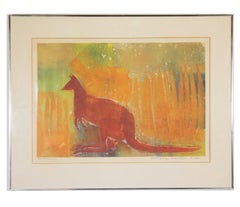
"Marsupial" Abstract Impressionist Lithograph of a Kangaroo Edition 3 of 4
By Paul Sprohge
Located in Houston, TX
Abstract animal lithograph of a kangaroo. The work is framed in a gold frame with a white matte. It is signed, dated and titled by the artist. Paul Sprohge is a Houston, Texas artist...
Category
1970s Impressionist Animal Prints
Materials
Lithograph
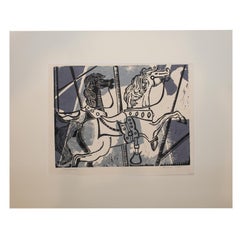
"Carousel" Blue Abstract Horse Serigraph
By Barbara Maples
Located in Houston, TX
Blue toned serigraph of a carousel with horses. The work is signed and numbered by the artist. It is not framed but comes with a white matte.
Artist Biography:
Barbara Maples...
Category
1950s Modern Figurative Prints
Materials
Lithograph
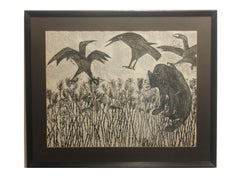
Woodblock Print with a Cat and Birds in a Field
Located in Houston, TX
Japanese woodblock print of a field with a cat and birds. The print is framed in a black frame with a black matte. It is stamped with a red stamp by the artist. The woodblock print is in the style of Kunihiro Amano.
Category
20th Century Modern Figurative Prints
Materials
Woodcut
Still Thinking About These?
All Recently ViewedMore Ways To Browse
Antique Pheasant Prints
Hooded Crows
Thaumalea Amherstiae
Audubon Puffin
Azoulay Art Horses
Banksy Greenpeace
Blue Dog Lithograph
Blue Dog Mardi Gras
Chagall The Green Bird
Cow 11a
Cowboy Coffee Table
Dali Argus
Dali Unicorn
Damien Hirst Jacobs Ladder
Darwins Rhea
Dog Running Painting
Edward Lear Birds
Entomology Cabinet