Want more images or videos?
Request additional images or videos from the seller
1 of 2
JW LudlowCinnamon Canaries, antique bird canary chromolithograph print, 18801871
1871
$120List Price
About the Item
- Creator:JW Ludlow
- Creation Year:1871
- Dimensions:Height: 10.63 in (27 cm)Width: 8.27 in (21 cm)
- Medium:
- Movement Style:
- Period:
- Condition:
- Gallery Location:Melbourne, AU
- Reference Number:1stDibs: LU124426400582
About the Seller
5.0
Gold Seller
Premium sellers maintaining a 4.3+ rating and 24-hour response times
Established in 2005
1stDibs seller since 2019
633 sales on 1stDibs
Typical response time: 1 hour
Authenticity Guarantee
In the unlikely event there’s an issue with an item’s authenticity, contact us within 1 year for a full refund. DetailsMoney-Back Guarantee
If your item is not as described, is damaged in transit, or does not arrive, contact us within 7 days for a full refund. Details24-Hour Cancellation
You have a 24-hour grace period in which to reconsider your purchase, with no questions asked.Vetted Professional Sellers
Our world-class sellers must adhere to strict standards for service and quality, maintaining the integrity of our listings.Price-Match Guarantee
If you find that a seller listed the same item for a lower price elsewhere, we’ll match it.Trusted Global Delivery
Our best-in-class carrier network provides specialized shipping options worldwide, including custom delivery.You May Also Like
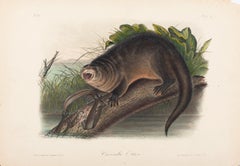
The Viviparous Quadrupeds of North America "Canada Otter" Plate 51
By John James Audubon
Located in Columbia, MO
Hand-colored lithograph
Master printer: J.T. Bowen
John James Audubon was born in Haiti in 1785. Most of his childhood was spent in France, where he first took interest in birds and...
Category
1840s Naturalistic Animal Prints
Materials
Lithograph
$1,920
H 7.25 in W 10.5 in
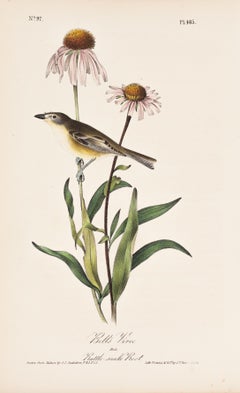
The Birds of America "Bell
s Vireo" Plate 485
By John James Audubon
Located in Columbia, MO
Hand-colored lithograph
1st ed. Royal Octavo
Master printer: J.T. Bowen
John James Audubon was born in Haiti in 1785. Most of his childhood was spent in ...
Category
1840s Naturalistic Animal Prints
Materials
Lithograph
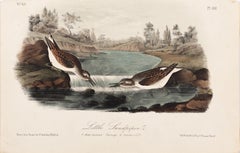
Little Sandpiper
By John James Audubon
Located in Columbia, MO
John James Audubon was born in Haiti in 1785. Most of his childhood was spent in France, where he first took interest in birds and drawing. He came to the U.S. at age 18, and made ma...
Category
1850s Naturalistic Animal Prints
Materials
Lithograph
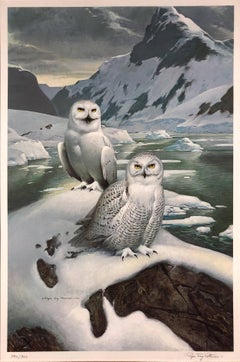
Two Snowy Owls
By Roger Tory Peterson
Located in Missouri, MO
Color Lithograph
Image Size: 30 x 19 inches
Framed Size: 40.25 x 29.75 inches
Edition 392/950
Artist Signed and Numbered
Artist and naturalist Roger Tory Peterson...
Category
Late 20th Century Naturalistic Animal Prints
Materials
Lithograph
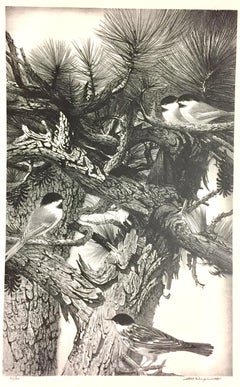
Stow Wengenroth, Friendly Neighbors (Birds)
By Stow Wengenroth
Located in New York, NY
Edition of 80. Signed and numbered in pencil. Really, no one could draw on a lithographic stone like Stow Wengenroth. He drew many animals and birds...
Category
Mid-20th Century Naturalistic Landscape Prints
Materials
Lithograph
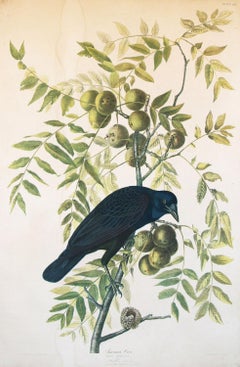
American Crow 1858 Chromolithograph by J.J. Audubon Plate, Julius Bien Edition
By John James Audubon
Located in Paonia, CO
American Crow by J.J. Audubon from his Birds of America folio shows an adult male crow in a Black Walnut bush with a nest of a Ruby-Throated Hummingbird in a branch below the crow. This original chromolithograph plate no. 226 is in good condition with a repairable water mark in the image on the left side as can be seen in the photos.
The ” Birds of America” by John James...
Category
1850s Naturalistic Animal Prints
Materials
Lithograph
$5,200 Sale Price
20% Off
H 39.5 in W 26.5 in
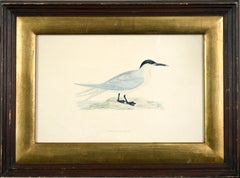
"Sandwich Tern
Antique Hand Colored Lithograph
Located in Soquel, CA
"Sandwich Tern' Antique Hand Colored Lithograph
Delicately rendered naturalist drawing of a sandwich tern from the 1903 edition of "A History of British Birds" by F.O. Morris. This...
Category
Early 1900s Naturalistic Animal Prints
Materials
Paper, Watercolor, Lithograph
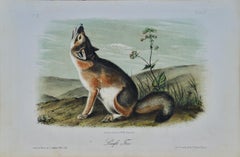
Swift Fox: An Original 19th Century Hand-colored Lithograph by John J. Audubon
By John James Audubon
Located in Alamo, CA
This is an original 19th century John James Audubon hand-colored lithograph entitled "Swift Fox", No. 11, Plate LII, from Audubon's "Viviparous Quadrupeds of North America", printed ...
Category
Mid-19th Century Naturalistic Animal Prints
Materials
Lithograph
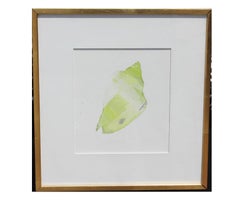
Green Painted Sea Shell Lithograph Edition 33 of 34
By Frances Nail
Located in Houston, TX
Green shell lithograph of a cone shell. Print is edition 33 of 34. Signed and dated by the artist along with titled. Print is framed in a golden frame...
Category
1970s Naturalistic Still-life Prints
Materials
Lithograph
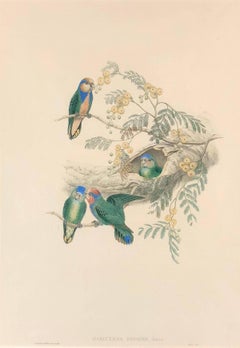
Nasiterna Bruijni
By John Gould
Located in Missouri, MO
John Gould (British, 1804-1881)
Nasiterna Bruijni c. 1849-1861
Hand Colored Lithograph
Image Size: approx 19.5 x 13.5 inches
Framed Size: 27 3/8 x 21 1/2 inches
John Gould was an English ornithologist and bird artist. The Gould League in Australia was named after him. His identification of the birds now nicknamed "Darwin's finches" played a role in the inception of Darwin's theory of evolution by natural selection. Gould's work is referenced in Charles Darwin's book, On the Origin of Species.
Gould was born in Lyme Regis, Dorset, the son of a gardener, and the boy probably had a scanty education. Shortly afterwards his father obtained a position on an estate near Guildford, Surrey, and then in 1818 became foreman in the Royal Gardens of Windsor. He was for some time under the care of J T Aiton, of the Royal Gardens of Windsor. The young Gould started training as a gardener, being employed under his father at Windsor from 1818 to 1824, and he was subsequently a gardener at Ripley Castle in Yorkshire. He became an expert in the art of taxidermy, and in 1824 he set himself up in business in London as a taxidermist, and his skill led to him becoming the first Curator and Preserver at the museum of the Zoological Society of London in 1827.
Gould's position brought him into contact with the country's leading naturalists, and also meant that he was often the first to see new collections of birds given to the Society. In 1830 a collection of birds arrived from the Himalayas, many not previously described. Gould published these birds in A Century of Birds from the Himalaya Mountains (1830-1832). The text was by Nicholas Aylward Vigors, and the illustrations were lithographed by Gould's wife Elizabeth, daughter of Nicholas Coxen of Kent.
This work was followed by four more in the next seven years including Birds of Europe in five volumes - completed in 1837, with the text written by Gould himself, edited by his clerk Edwin Prince. Some of the illustrations were made by Edward Lear as part of his Illustrations of the Family of Psittacidae in 1832. Lear however was in financial difficulty, and he sold the entire set of lithographs to Gould. The books were published in a very large size, imperial folio, with magnificent coloured plates. Eventually 41 of these volumes were published with about 3000 plates. They appeared in parts at £3 3s. a number, subscribed for in advance, and in spite of the heavy expense of preparing the plates, Gould succeeded in making his ventures pay and in realizing a fortune. In 1838 he and his wife moved to Australia to work on the Birds of Australia and shortly after his return to England, his wife died in 1841.
When Charles Darwin presented his mammal and bird specimens collected during the second voyage of HMS Beagle to the Geological Society of London at their meeting on 4 January 1837, the bird specimens were given to Gould for identification. He set aside his paying work and at the next meeting on 10 January reported that birds from the Galápagos Islands, which Darwin had thought were blackbirds, "gross-bills" and finches were in fact "a series of ground Finches which are so peculiar" as to form "an entirely new group, containing 12 species." This story made the newspapers.
In March, Darwin met Gould again, learning that his Galápagos "wren" was another species of finch and the mockingbirds he had labeled by island were separate species rather than just varieties, with relatives on the South American mainland. Subsequently Gould advised that the smaller southern Rhea specimen that had been rescued from a Christmas dinner...
Category
1850s Naturalistic Animal Prints
Materials
Lithograph
More From This Seller
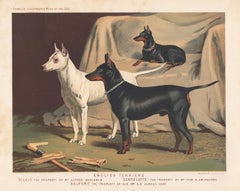
View AllEnglish Terriers, English Victorian dog chromolithograph, 1881
Located in Melbourne, Victoria
"Silvio," the Property of Mr. Alfred Benjamin. "Serpolette,"the Property of Mr. Tom. B. Swinburne. "Salford," the Property of Sir Wm. E. H. Verner, Bart.
English 19th century chrom...
Category
Late 19th Century Naturalistic Animal Prints
Materials
Lithograph
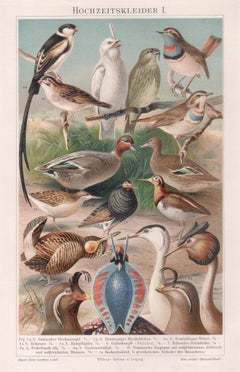
Birds, German antique natural history chromolithograph print
Located in Melbourne, Victoria
'Hochzeitskleider I'
(Birds)
German chromolithograph, circa 1895.
240mm by 155mm (sheet)
Category
Late 19th Century Naturalistic Animal Prints
Materials
Lithograph
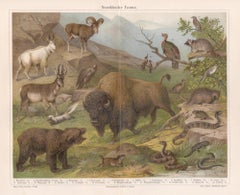
Neartktische Fauna (Neartic Fauna), German antique animal chromolithograph
Located in Melbourne, Victoria
'Neartktische Fauna'
(Neartic Fauna)
German chromolithograph, circa 1895. Key to animals in German below the image.
245mm by 305mm (sheet).
Central vertical fold as issued.
Category
Late 19th Century Naturalistic Animal Prints
Materials
Lithograph
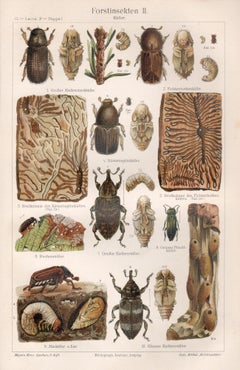
Forest Insects - Beetles, German antique chromolithograph print
Located in Melbourne, Victoria
'Forstinsekten II Kafer'
(Forest Insects - Beetles)
German chromolithograph, circa 1895.
245mm by 155mm (sheet)
Category
Late 19th Century Naturalistic Animal Prints
Materials
Lithograph
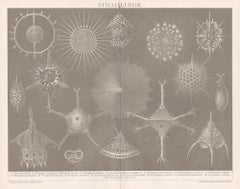
Strahlinge (Protozoa - Radiolarians or Radioza) German antique lithograph print
Located in Melbourne, Victoria
'Strahlinge'
(Protozoa - Radiolarians or Radioza)
German lithograph, circa 1895. Key to protozoa in German below the image.
250mm by 305mm (sheet).
Central vertical fold as iss...
Category
Late 19th Century Naturalistic Animal Prints
Materials
Lithograph
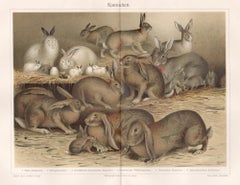
Rabbits, German antique animal chromolithograph print.
Located in Melbourne, Victoria
'Kaninchen'
(Rabbits)
German chromolithograph, circa 1910. Key in German to the types of rabbits at the bottom of the image. Central vertical fold as issued.
245mm by 305mm (shee...
Category
Early 20th Century Naturalistic Animal Prints
Materials
Lithograph
Still Thinking About These?
All Recently ViewedMore Ways To Browse
Joop Sanders
Salvador Dali Pegasus
William Hayes Prints
Victor Vasarely Tigers
Vintage Wooden Leaning Chair
Wilfred Fairclough
Washington Blue Dog
Warhol Purple Cow
Rolf Knie
Tom Lane
Descourtilz Jean Theodore
Kaiko Moti On Sale
Rodrigue The Rat Pack
Sussex Spaniel
Pablo Lucker
19th Century Goya Bullfighting Prints
Arlene Solomon
Banksy Laugh Now