Want more images or videos?
Request additional images or videos from the seller
1 of 6
Leon DanchinMallards in Flight1930s
1930s
Price:$1,125
$1,250List Price
About the Item
- Creator:Leon Danchin (1887 - 1938, French)
- Creation Year:1930s
- Dimensions:Height: 29.5 in (74.93 cm)Width: 21.5 in (54.61 cm)
- Medium:
- Movement Style:
- Period:
- Condition:
- Gallery Location:Missouri, MO
- Reference Number:1stDibs: LU74737351822
About the Seller
5.0
Vetted Professional Seller
Every seller passes strict standards for authenticity and reliability
Established in 1970
1stDibs seller since 2017
157 sales on 1stDibs
Typical response time: Several days
Authenticity Guarantee
In the unlikely event there’s an issue with an item’s authenticity, contact us within 1 year for a full refund. DetailsMoney-Back Guarantee
If your item is not as described, is damaged in transit, or does not arrive, contact us within 7 days for a full refund. Details24-Hour Cancellation
You have a 24-hour grace period in which to reconsider your purchase, with no questions asked.Vetted Professional Sellers
Our world-class sellers must adhere to strict standards for service and quality, maintaining the integrity of our listings.Price-Match Guarantee
If you find that a seller listed the same item for a lower price elsewhere, we’ll match it.Trusted Global Delivery
Our best-in-class carrier network provides specialized shipping options worldwide, including custom delivery.You May Also Like
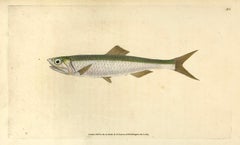
50: Clupea encrasicolus, Anchovy
By Edward Donovan
Located in Columbia, MO
Edward Donovan (1768–1837) was an Anglo Irish writer, natural history illustrator and amateur zoologist. Born in Cork, Ireland, Donovan was an avid collector of natural history speci...
Category
Early 1800s Naturalistic Animal Prints
Materials
Color, Etching
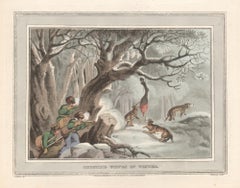
Shooting the Wolves in Winter, aquatint engraving hunting print, 1813
By Samuel Howitt
Located in Melbourne, Victoria
'Shooting the Wolves in Winter'
Colour aquatint by Mathew Dubourg (1786-1838) after Franz Joseph Manskirch (1768-1830).
From Samuel Howitt's 'Foreign Field Sports'. Samuel Howitt w...
Category
Early 19th Century Naturalistic Animal Prints
Materials
Aquatint
$140
H 7.09 in W 9.06 in
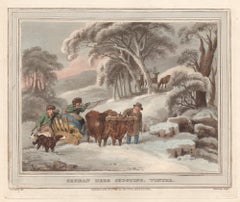
German Deer Shooting, Winter, aquatint engraving hunting print, 1813
By Samuel Howitt
Located in Melbourne, Victoria
'German Deer Shooting, Winter'
Colour aquatint by Mathew Dubourg (1786-1838) after Franz Joseph Manskirch (1768-1830).
From Samuel Howitt's 'Foreign Fiel...
Category
Early 19th Century Naturalistic Animal Prints
Materials
Aquatint
$140
H 7.09 in W 9.06 in
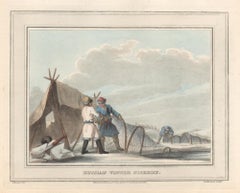
Russian Winter Fishery, aquatint engraving hunting print, 1813
By Samuel Howitt
Located in Melbourne, Victoria
'Russian Winter Fishery'
Colour aquatint by Mathew Dubourg (1786-1838) after John Augustus Atkinson (1775 – after 1830).
From Samuel Howitt's 'Foreign ...
Category
Early 19th Century Naturalistic Animal Prints
Materials
Aquatint
$140
H 7.09 in W 9.06 in
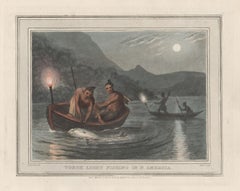
Torch Light Fishing in N America, aquatint engraving hunting print, 1813
By Samuel Howitt
Located in Melbourne, Victoria
'Torch Light Fishing in N America'
Colour aquatint by Merke after John Heavenside Clark (c1770-1863).
From Samuel Howitt's 'Foreign Field Sports'. Samuel...
Category
Early 19th Century Naturalistic Animal Prints
Materials
Aquatint
$140
H 7.09 in W 9.06 in
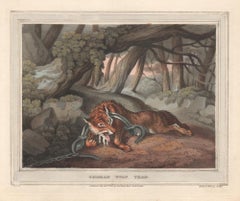
German Wolf Trap, aquatint engraving field sport hunting print, 1813
By Samuel Howitt
Located in Melbourne, Victoria
'German Wolf Trap'
Colour aquatint by Mathew Dubourg (1786-1838) and Samuel Howitt (1756/7-1822) after Samuel Howitt (1756/7-1822).
From Samuel Howitt's 'Foreign Field Sports'. Sam...
Category
Early 19th Century Naturalistic Animal Prints
Materials
Aquatint
$140
H 7.09 in W 9.06 in
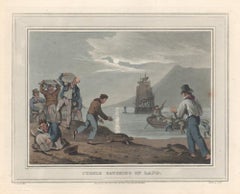
Turtle Catching on Land, aquatint engraving hunting print, 1813
By Samuel Howitt
Located in Melbourne, Victoria
'Turtle Catching on Land'
Colour aquatint by Mathew Dubourg (1786-1838) after John Heavenside Clark (c1770-1863).
From Samuel Howitt's 'Foreign Field Sports'...
Category
Early 19th Century Naturalistic Animal Prints
Materials
Aquatint
$140
H 7.09 in W 9.06 in
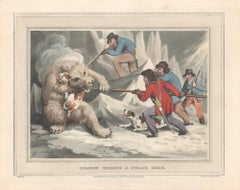
Seamen Killing a Polar Bear, aquatint engraving field sport hunting print, 1813
By Samuel Howitt
Located in Melbourne, Victoria
'Seamen Killing a Polar Bear'
Colour aquatint by Mathew Dubourg (1786-1838) and Samuel Howitt (1756/7-1822) after Samuel Howitt (1756/7-1822).
From Samuel Howitt's 'Foreign Field S...
Category
Early 19th Century Naturalistic Animal Prints
Materials
Aquatint
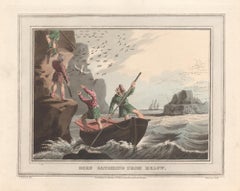
Bird Catching from Below, Scotland, aquatint engraving field sport print, 1813
By Samuel Howitt
Located in Melbourne, Victoria
'Bird Catching from Below'
Colour aquatint by Mathew Dubourg (1786-1838) after John Heavenside Clark (c1770-1863).
From Samuel Howitt's 'Foreign Field Sports...
Category
Early 19th Century Naturalistic Animal Prints
Materials
Aquatint
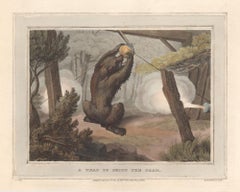
A Trap to Shoot the Bear, aquatint engraving hunting print, 1813
By Samuel Howitt
Located in Melbourne, Victoria
'A Trap to Shoot the Bear'
Colour aquatint by Mathew Dubourg (1786-1838) and Samuel Howitt (1756/7-1822) after Samuel Howitt (1756/7-1822).
From Samuel Howitt's 'Foreign Field Spor...
Category
Early 19th Century Naturalistic Animal Prints
Materials
Aquatint
$140
H 7.09 in W 9.06 in
More From This Seller
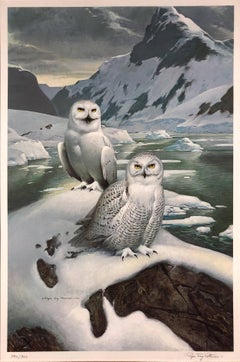
View AllTwo Snowy Owls
By Roger Tory Peterson
Located in Missouri, MO
Color Lithograph
Image Size: 30 x 19 inches
Framed Size: 40.25 x 29.75 inches
Edition 392/950
Artist Signed and Numbered
Artist and naturalist Roger Tory Peterson...
Category
Late 20th Century Naturalistic Animal Prints
Materials
Lithograph
Price Upon Request
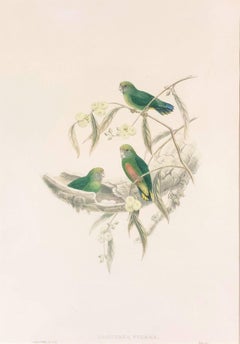
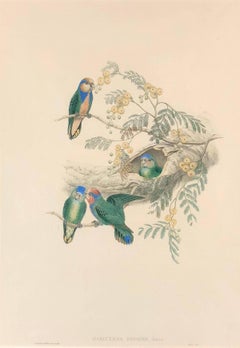
Nasiterna Pygmae
By John Gould
Located in Missouri, MO
John Gould (British, 1804-1881)
Nasiterna Pygmae c. 1849-1861
Hand Colored Lithograph
Image Size: approx 19.5 x 13.5 inches
Framed Size: 27 3/8 x 21 1/2 inches
John Gould was an English ornithologist and bird artist. The Gould League in Australia was named after him. His identification of the birds now nicknamed "Darwin's finches" played a role in the inception of Darwin's theory of evolution by natural selection. Gould's work is referenced in Charles Darwin's book, On the Origin of Species.
Gould was born in Lyme Regis, Dorset, the son of a gardener, and the boy probably had a scanty education. Shortly afterwards his father obtained a position on an estate near Guildford, Surrey, and then in 1818 became foreman in the Royal Gardens of Windsor. He was for some time under the care of J T Aiton, of the Royal Gardens of Windsor. The young Gould started training as a gardener, being employed under his father at Windsor from 1818 to 1824, and he was subsequently a gardener at Ripley Castle in Yorkshire. He became an expert in the art of taxidermy, and in 1824 he set himself up in business in London as a taxidermist, and his skill led to him becoming the first Curator and Preserver at the museum of the Zoological Society of London in 1827.
Gould's position brought him into contact with the country's leading naturalists, and also meant that he was often the first to see new collections of birds given to the Society. In 1830 a collection of birds arrived from the Himalayas, many not previously described. Gould published these birds in A Century of Birds from the Himalaya Mountains (1830-1832). The text was by Nicholas Aylward Vigors, and the illustrations were lithographed by Gould's wife Elizabeth, daughter of Nicholas Coxen of Kent.
This work was followed by four more in the next seven years including Birds of Europe in five volumes - completed in 1837, with the text written by Gould himself, edited by his clerk Edwin Prince. Some of the illustrations were made by Edward Lear as part of his Illustrations of the Family of Psittacidae in 1832. Lear however was in financial difficulty, and he sold the entire set of lithographs to Gould. The books were published in a very large size, imperial folio, with magnificent coloured plates. Eventually 41 of these volumes were published with about 3000 plates. They appeared in parts at £3 3s. a number, subscribed for in advance, and in spite of the heavy expense of preparing the plates, Gould succeeded in making his ventures pay and in realizing a fortune. In 1838 he and his wife moved to Australia to work on the Birds of Australia and shortly after his return to England, his wife died in 1841.
When Charles Darwin presented his mammal and bird specimens collected during the second voyage of HMS Beagle to the Geological Society of London at their meeting on 4 January 1837, the bird specimens were given to Gould for identification. He set aside his paying work and at the next meeting on 10 January reported that birds from the Galápagos Islands, which Darwin had thought were blackbirds, "gross-bills" and finches were in fact "a series of ground Finches which are so peculiar" as to form "an entirely new group, containing 12 species." This story made the newspapers.
In March, Darwin met Gould again, learning that his Galápagos "wren" was another species of finch and the mockingbirds he had labeled by island were separate species rather than just varieties, with relatives on the South American mainland. Subsequently Gould advised that the smaller southern Rhea specimen that had been rescued from a Christmas dinner...
Category
Mid-19th Century Naturalistic Animal Prints
Materials
Lithograph
Nasiterna Bruijni
By John Gould
Located in Missouri, MO
John Gould (British, 1804-1881)
Nasiterna Bruijni c. 1849-1861
Hand Colored Lithograph
Image Size: approx 19.5 x 13.5 inches
Framed Size: 27 3/8 x 21 1/2 inches
John Gould was an English ornithologist and bird artist. The Gould League in Australia was named after him. His identification of the birds now nicknamed "Darwin's finches" played a role in the inception of Darwin's theory of evolution by natural selection. Gould's work is referenced in Charles Darwin's book, On the Origin of Species.
Gould was born in Lyme Regis, Dorset, the son of a gardener, and the boy probably had a scanty education. Shortly afterwards his father obtained a position on an estate near Guildford, Surrey, and then in 1818 became foreman in the Royal Gardens of Windsor. He was for some time under the care of J T Aiton, of the Royal Gardens of Windsor. The young Gould started training as a gardener, being employed under his father at Windsor from 1818 to 1824, and he was subsequently a gardener at Ripley Castle in Yorkshire. He became an expert in the art of taxidermy, and in 1824 he set himself up in business in London as a taxidermist, and his skill led to him becoming the first Curator and Preserver at the museum of the Zoological Society of London in 1827.
Gould's position brought him into contact with the country's leading naturalists, and also meant that he was often the first to see new collections of birds given to the Society. In 1830 a collection of birds arrived from the Himalayas, many not previously described. Gould published these birds in A Century of Birds from the Himalaya Mountains (1830-1832). The text was by Nicholas Aylward Vigors, and the illustrations were lithographed by Gould's wife Elizabeth, daughter of Nicholas Coxen of Kent.
This work was followed by four more in the next seven years including Birds of Europe in five volumes - completed in 1837, with the text written by Gould himself, edited by his clerk Edwin Prince. Some of the illustrations were made by Edward Lear as part of his Illustrations of the Family of Psittacidae in 1832. Lear however was in financial difficulty, and he sold the entire set of lithographs to Gould. The books were published in a very large size, imperial folio, with magnificent coloured plates. Eventually 41 of these volumes were published with about 3000 plates. They appeared in parts at £3 3s. a number, subscribed for in advance, and in spite of the heavy expense of preparing the plates, Gould succeeded in making his ventures pay and in realizing a fortune. In 1838 he and his wife moved to Australia to work on the Birds of Australia and shortly after his return to England, his wife died in 1841.
When Charles Darwin presented his mammal and bird specimens collected during the second voyage of HMS Beagle to the Geological Society of London at their meeting on 4 January 1837, the bird specimens were given to Gould for identification. He set aside his paying work and at the next meeting on 10 January reported that birds from the Galápagos Islands, which Darwin had thought were blackbirds, "gross-bills" and finches were in fact "a series of ground Finches which are so peculiar" as to form "an entirely new group, containing 12 species." This story made the newspapers.
In March, Darwin met Gould again, learning that his Galápagos "wren" was another species of finch and the mockingbirds he had labeled by island were separate species rather than just varieties, with relatives on the South American mainland. Subsequently Gould advised that the smaller southern Rhea specimen that had been rescued from a Christmas dinner...
Category
1850s Naturalistic Animal Prints
Materials
Lithograph
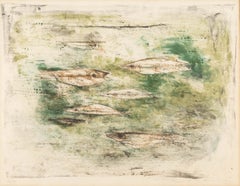
Les Poissons
By Zao Wou-Ki
Located in Missouri, MO
Zao Wou-Ki (Chinese, French, 1921-2013)
Les Poissons, 1953
Lithograph
Hand-signed in pencil Lower Right
Hand-numbered 16/55 in pencil Lower Left
18 x 23 1/8 inches
29 x 33 inches wit...
Category
1950s Modern Animal Prints
Materials
Lithograph
$12,500
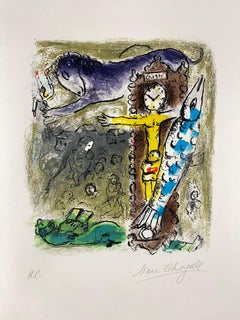
Le Christ a l
Horloge, Paris (Christ in the Clock)
By Marc Chagall
Located in Missouri, MO
Marc Chagall
"Le Christ a l'Horloge, Paris" (Christ in the Clock) 1957 (M. 196)
Color Lithograph on Arches Wove Paper
Signed in Pencil "Marc Chagall" Lower Right
Initialed "H.C." (Hors Commerce) Lower Left, aside from numbered edition of 90
*Floated in Gold Frame with Linen Matting, UV Plexiglass
Sheet Size: 18 3/4 x 14 3/4 inches (47.5 cm x 38 cm)
Image Size: 9 3/4 x 8 1/2 inches
Framed Size: 28.5 x 24.25 inches
Marc Chagall was a man of keen intelligence, a shrewd observer of the contemporary scene, with a great sympathy for human suffering. He was born on July 7, 1887 in Vitebsk, Russia; his original name was Moishe Shagal (Segal), but when he became a foremost member of the Ecole de Paris, he adopted French citizenship and the French spelling of his name. Vitebsk was a good-sized Russian town of over 60,000, not a shtetl. His father supported a wife and eight children as a worker in a herring-pickling plant.
Sheltered by the Jewish commandment against graven images, the young Chagall never saw so much as a drawing until, one day, he watched a schoolmate copying a magazine illustration. He was ridiculed for his astonishment, but he began copying and improvising from magazines. Both Chagall's parents reluctantly agreed to let him study with Yehuda Pen, a Jewish artist in Vitebsk. Later, in 1906, they allowed their son to study in St. Petersburg, where he was exposed to Russian Iconography and folk art. At that time, Jews could leave the Pale only for business and employment and were required to carry a permit. Chagall, who was in St. Petersburg without a permit, was imprisoned briefly.
His first wife, Bella Rosenfeld, was a product of a rich cultivated and intellectual group of Jews in Vitebsk. Chagall was made commissar for the arts for the area, charged with directing its cultural life and establishing an art school. Russian folklore, peasant life and landscapes persisted in his work all his life. In 1910 a rich patron, a lawyer named Vinaver, staked him to a crucial trip to Paris, where young artists were revolutionizing art. He also sent him a handsome allowance of 125 francs (in those days about $24) each month. Chagall rejected cubism, fauvism and futurism, but remained in Paris. He found a studio near Montparnasse in a famous twelve-sided wooden structure divided into wedge-shaped rooms. Chaim Soutine, a fellow Russian Jew, and Modigliani lived on the same floor. To Chagall's astonishment, he found himself heralded as one of the fathers of surrealism. In 1923, a delegation of Max Ernst, Paul Eluard and Gala (later Salvador Dali's wife) actually knelt before Chagall, begging him to join their ranks. He refused.
To understand Chagall's work, it is necessary to know that he was born a Hasidic Jew, heir to mysticism and a world of the spirit, steeped in Jewish lore and reared in the Yiddish language. The Hasidim had a special feeling for animals, which they tried not to overburden. In the mysterious world of Kabbala and fantastic ancient legends of Chagall's youth, the imaginary was as important as the real. His extraordinary use of color also grew out of his dream world; he did not use color realistically, but for emotional effect and to serve the needs of his design. Most of his favorite themes, though superficially light and trivial, mask dark and somber thoughts. The circus he views as a mirror of life; the crucifixion as a tragic theme, used as a parallel to the historic Jewish condition, but he is perhaps best known for the rapturous lovers he painted all his life. His love of music is a theme that runs through his paintings.
After a brief period in Berlin, Chagall, Bella and their young daughter, Ida, moved to Paris and in 1937 they assumed French citizenship. When France fell, Chagall accepted an invitation from the Museum of Modern Art to immigrate to the United States. He was arrested and imprisoned in Marseilles for a short time, but was still able to immigrate with his family. The Nazi onslaught caught Chagall in Vichy, France, preoccupied with his work. He was loath to leave; his friend Varian Fry rescued him from a police roundup of Jews in Marseille, and packed him, his family and 3500 lbs. of his art works on board a transatlantic ship. The day before he arrived in New York City, June 23, 1941, the Nazis attacked Russia. The United States provided a wartime haven and a climate of liberty for Chagall. In America he spent the war years designing large backdrops for the Ballet.
Bella died suddenly in the United States of a viral infection in September 1944 while summering in upstate New York. He rushed her to a hospital in the Adirondacks, where, hampered by his fragmentary English, they were turned away with the excuse that the hour was too late. The next day she died.
He waited for three years after the war before returning to France. With him went a slender married English girl, Virginia Haggard MacNeil; Chagall fell in love with her and they had a son, David. After seven years she ran off with an indigent photographer. It was an immense blow to Chagall's ego, but soon after, he met Valentine Brodsky, a Russian divorcee designing millinery in London (he called her Fava). She cared for him during the days of his immense fame and glory. They returned to France, to a home and studio in rustic Vence. Chagall loved the country and every day walked through the orchards, terraces, etc. before he went to work.
Chagall died on March 28, 1985 in the south of France. His heirs negotiated an arrangement with the French state allowing them to pay most of their inheritance taxes in works of art. The heirs owed about $30 million to the French government; roughly $23 million of that amount was deemed payable in artworks. Chagall's daughter, Ida and his widow approved the arrangement.
Written and submitted by Jean Ershler Schatz, artist and researcher from Laguna Woods, California.
Sources:
Hannah Grad Goodman in Homage to Chagall in Hadassah Magazine, June 1985
Jack Kroll in Newsweek, April 8, 1985
Andrea Jolles in National Jewish Monthly Magazine, May 1985
Michael Gibson...
Category
1950s Modern Figurative Prints
Materials
Lithograph
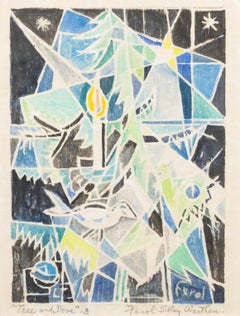
Tree and Dove
Located in Missouri, MO
Tree and Dove
Ferol K. Sibley Warthen (American, 1890-1986)
Color Woodblock Print
Edition of 3
6.25 x 4.75 inches
13 x 11.5 inches with frame
Signed Lower Right
Titled Lower Left
Born 1890, Died 1986...
Category
Mid-20th Century American Modern Animal Prints
Materials
Color
Still Thinking About These?
All Recently ViewedMore Ways To Browse
Mallard Prints
Mallards In Flight
Damien Hirst The Souls
David Hockney Boodge
Francisco Toledo Etching
George Rodrigue Texas
George Rodrigue Tie
George Rodrigue Top Dog
George Studdy
Hans Kleiber
Horse Hunting Prints
Johann Leonhard Frisch
Kip Gresham
Larry Rivers Camel
Leroy Neiman Elephant
Lloyd Kiva
Lobster Telephone
Norbertine Bresslern Roth