Want more images or videos?
Request additional images or videos from the seller
1 of 7
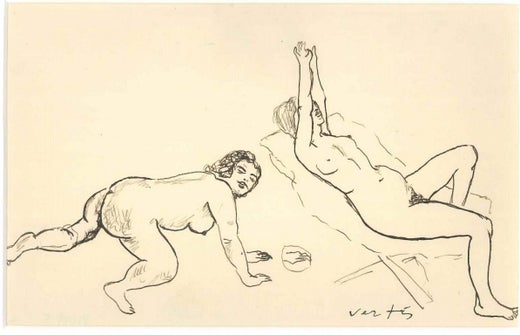
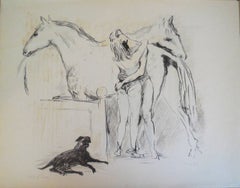
Marcel VertèsCircus girls with horse
$1,100List Price
About the Item
- Creator:Marcel Vertès (1895 - 1961, Hungarian)
- Dimensions:Height: 17.38 in (44.15 cm)Width: 22.38 in (56.85 cm)
- Movement Style:
- Period:
- Condition:minor edge wear. never been framed.
- Gallery Location:Surfside, FL
- Reference Number:1stDibs: LU382417022
Marcel Vertès
Emmanuel Marcel Vertès, born Vértes Marcell in Újpest (Hungary) on 10 August 1895 and died in Paris 16th arrondissement on 31 October 1961, was a Hungarian-born French painter, engraver, illustrator and costume and film designer. After studying with Ferenczy at the Beaux-Arts in Budapest, Marcel Vertès produced political posters during the First World War. Going into exile at the end of the hostilities, like his comrades Mihály Bíró and Róbert Berény, he studied at the Académie Julian in Paris. He made a name for himself in France in the mid-1920s, particularly for his lithographs and illustrations. He published L'heure exquise, a series of erotic engravings, followed by Le pays à mon goût. His favourite subjects were the circus, balls and brothels. His real fame came with an album of lithographs entitled Dancings. Among the works he illustrated were Chéri and La Vagabonde by Colette, L'Europe galante by Paul Morand and Le Cirque by Ramón Gómez de la Serna, published by gallery owners Madeleine and Pierre Trémois. He was associated with the Hungarian cartoonist Alex Szekely.
In the 1930s, he also worked for fashion magazines such as the English edition of Vogue, the American rival Harper's Bazaar and the Gazette du Bon Ton. An engraver, watercolourist and costume designer, this artist also collaborated with Elsa Schiaparelli on numerous occasions, including advertising campaigns for perfumes, the creation of fabrics and even a portrait of the couturier. Mobilised at the start of the war, he was demobilised the following year and left for Biarritz. After passing through Spain, he returned to New York with his wife shortly afterwards and settled in 57th Street, continuing his collaborations and illustrations with the fashion world.
In the early 1950s, Marcel Vertès enjoyed a high profile in artistic circles, justified by a talent often described as exceptional. His drawings were characterised by a great economy of line and colour, and he also produced illustrations in black and white.
It was during this period that he worked on John Huston's Moulin Rouge as costume designer and set designer. He won two Oscars for this film. He moved back to Paris in the late 1950s and died there in 1961.
He is buried in the Père-Lachaise cemetery (90th division).
About the Seller
4.9
Platinum Seller
Premium sellers with a 4.7+ rating and 24-hour response times
Established in 1995
1stDibs seller since 2014
1,858 sales on 1stDibs
Authenticity Guarantee
In the unlikely event there’s an issue with an item’s authenticity, contact us within 1 year for a full refund. DetailsMoney-Back Guarantee
If your item is not as described, is damaged in transit, or does not arrive, contact us within 7 days for a full refund. Details24-Hour Cancellation
You have a 24-hour grace period in which to reconsider your purchase, with no questions asked.Vetted Professional Sellers
Our world-class sellers must adhere to strict standards for service and quality, maintaining the integrity of our listings.Price-Match Guarantee
If you find that a seller listed the same item for a lower price elsewhere, we’ll match it.Trusted Global Delivery
Our best-in-class carrier network provides specialized shipping options worldwide, including custom delivery.You May Also Like
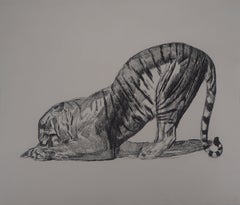
Tiger Eating - Original etching (Marcilhac #370)
By Paul Jouve
Located in Paris, IDF
Paul Jouve
Tiger Eating, c. 1931
Original etching
Unsigned proof
On vellum 42 x 50 cm (c. 16 x 20 in)
REFERENCES : Félix Marcilhac, "Paul Jouve, Peintre sculpteur animalier", Les É...
Category
Early 20th Century Art Deco Animal Prints
Materials
Etching
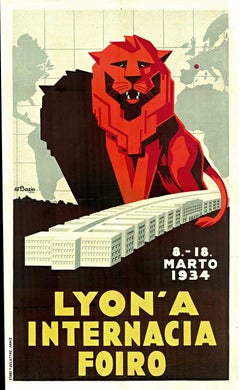
Original Lyon A Internacia Foiro 1934, France vintage art deco poster
Located in Spokane, WA
Original 1934 “Lyon — A Internacia Foiro” original vintage poster, linen-backed and ready to frame.
Striking original 1934 Art Deco-era poster for the Lyon International Fair, title...
Category
1930s Art Deco Landscape Prints
Materials
Lithograph
$975
H 38.5 in W 23.5 in D 0.3 in
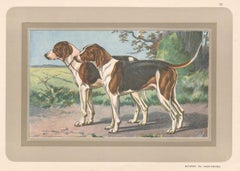
Batards Du Haut-Poitou, French hound, dog chromolithograph, 1930s
By P. Mahler
Located in Melbourne, Victoria
French chromolithograph, published in 1931. Signed by artist in the plate. Printed title lower right of sheet. Plate number top right. From a French series of illustrations of sporti...
Category
1930s Art Deco Animal Prints
Materials
Lithograph
$95
H 7.68 in W 11.03 in
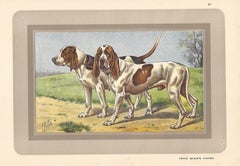
Chiens Briquets D
Artois, French hound, dog chromolithograph, 1930s
By P. Mahler
Located in Melbourne, Victoria
French chromolithograph, published in 1931. Signed by artist in the plate. Printed title lower right of sheet. Plate number top right. From a French series of illustrations of sporti...
Category
1930s Art Deco Animal Prints
Materials
Lithograph
$95
H 7.68 in W 11.03 in
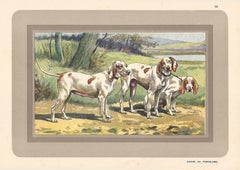
Chiens de Porcelaine, French hound, dog chromolithograph, 1930s
By P. Mahler
Located in Melbourne, Victoria
French chromolithograph, published in 1931. Signed by artist in the plate. Printed title lower right of sheet. Plate number top right. From a French series of illustrations of sporti...
Category
1930s Art Deco Animal Prints
Materials
Lithograph
$95
H 7.68 in W 11.03 in
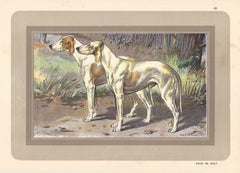
Chien de Billy, French hound, dog chromolithograph, 1930s
By P. Mahler
Located in Melbourne, Victoria
French chromolithograph, published in 1931. Signed by artist in the plate. Printed title lower right of sheet. Plate number top right. From a French series of illustrations of sporti...
Category
1930s Art Deco Animal Prints
Materials
Lithograph
Griffon Vendeens Nivernais, French hound, dog chromolithograph, 1930s
By P. Mahler
Located in Melbourne, Victoria
French chromolithograph, published in 1931. Signed by artist in the plate. Printed title lower right of sheet. Plate number top right. From a French series of illustrations of sporti...
Category
1930s Art Deco Animal Prints
Materials
Lithograph
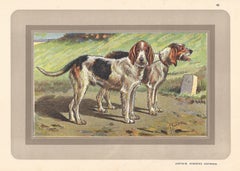
$95
H 7.68 in W 11.03 in
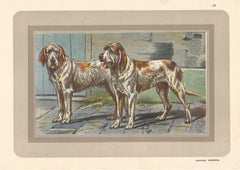
Griffon Vendeens, French hound, dog chromolithograph, 1930s
By P. Mahler
Located in Melbourne, Victoria
French chromolithograph, published in 1931. Signed by artist in the plate. Printed title lower right of sheet. Plate number top right. From a French series of illustrations of sporti...
Category
1930s Art Deco Animal Prints
Materials
Lithograph
Batard Anglo-Normand, French hound, dog chromolithograph, 1930s
By P. Mahler
Located in Melbourne, Victoria
French chromolithograph, published in 1931. Signed by artist in the plate. Printed title lower right of sheet. Plate number top right. From a French series of illustrations of sporti...
Category
1930s Art Deco Animal Prints
Materials
Lithograph
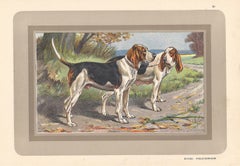
$95
H 7.68 in W 11.03 in
Irish Water Spaniel, French hound, dog chromolithograph, 1930s
By P. Mahler
Located in Melbourne, Victoria
French chromolithograph, published in 1931. Signed by artist in the plate. Printed title lower right of sheet. Plate number top right. From a French series of illustrations of sporti...
Category
1930s Art Deco Animal Prints
Materials
Lithograph
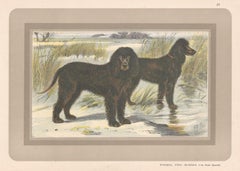
$95
H 7.68 in W 11.03 in
More From This Seller
View AllCircus Lovers (Horse
Dog)
By Marcel Vertès
Located in Surfside, FL
This is an original hand signed (I believe it is also hand colored but i am not positive) Artists Proof Lithograph of a Circus scene. This depicts a trapeze artist an acrobat on the ...
Category
1940s Art Deco Animal Prints
Materials
Lithograph
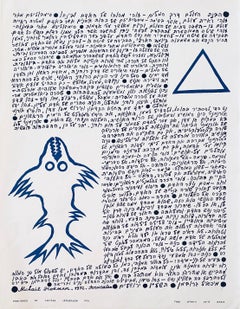
Post Soviet Nonconformist Avant Garde Russian Israeli Screen Print Lithograph
By Michail Grobman
Located in Surfside, FL
Michail Grobman (Russian: Михаил Гробман, Hebrew: מיכאיל גרובמן, born 1939) is an artist and a poet working in Israel and Russia. He is father to Hollywood producer Lati Grobman an...
Category
20th Century Modern Abstract Prints
Materials
Screen
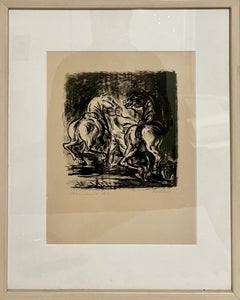
1916 German Expressionism Figurative Lithograph Man Two Horses Paul Kleinschmidt
By Paul Kleinschmidt
Located in Surfside, FL
Paul Kleinschmidt, (1883–1949)
"Man & Two Horses" Lithograph
1916
Frame: 21" X 17"
Image: 13.5" X 10.5"
Rare Artist's Proof
Provenance: bears labels from ACA Galleries and Richard ...
Category
1910s Abstract Figurative Prints
Materials
Lithograph
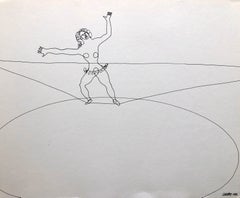
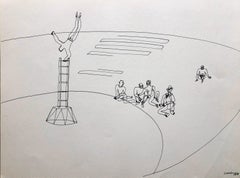
Alexander Calder Circus Reproduction Lithograph After a Drawing
By (after) Alexander Calder
Located in Surfside, FL
(after) Alexander Calder
"Calder's Circus" offset lithograph on wove paper after drawings by the artist
Published by Art in America and Perls gallery in 1964 (from drawings done in the 1930's)
these range slightly in size but they are all about 13 X 17 inches (with minor variations in size as issued.) These have never been framed. The outer folio is not included just the one lithograph.
James Sweeny from the introduction “The fame of Calder’s circus spread quickly between the years 1927 and 1930. All the Paris art world came to know it. It brought him his first great personal success. But what was more important, the circus also provided the first steps in Calder’s development as an original sculptor”
Clive Gray wrote ”A visit to the studio of Alexander Calder led to the chance discovery of some hundred masterful circus drawings completed over thirty years ago. We publish, for the first time, a choice of sixteen from that group.” With signed introduction by Miro.
These whimsical drawings, done in the style of wire sculpture, include acrobats, clowns, jugglers, trapeeze artists, an elephant, dog and lion. they are great.
Alexander Calder is widely considered to be one of the most important American sculptors of the 20th century. He is best known for his colorful, whimsical abstract public sculptures and his innovative mobiles, kinetic sculptures powered by motors or air currents, which embraced chance in their aesthetic. Born into a family of accomplished artists, Calder's work first gained attention in Paris in the 1930s and was soon championed by the Museum of Modern Art in New York, resulting in a retrospective exhibition in 1943. Major retrospectives were also held at the Solomon R. Guggenheim Museum (1964) and the Museum of Contemporary Art, Chicago (1974). Calder’s work is in many permanent collections, most notably in the Whitney Museum of American Art, but also the Guggenheim Museum; the Museum of Modern Art; the National Gallery of Art, Washington, D.C.; and the Centre Georges Pompidou. He produced many large public works, including .125 (at JFK Airport, 1957), Pittsburgh (Carnegie International prize winner 1958, Pittsburgh International Airport) Spirale (UNESCO in Paris, 1958), Flamingo and Universe (both in Chicago, 1974), and Mountains and Clouds (Hart Senate Office Building, Washington, D.C., 1976). Although primarily known for his sculpture, Calder was a prodigious artist with a restless creative spirit, whose diverse practice included painting and printmaking, miniatures (such as his famous Cirque Calder), children’s book illustrations, theater set design, jewelry design, tapestry and rug works, and political posters. Calder was honored by the US Postal Service with a set of five 32-cent stamps in 1998, and received the Presidential Medal of Freedom, posthumously in 1977, after refusing to receive it from Gerald Ford one year earlier in protest of the Vietnam War.
Calder moved to New York and enrolled at the Art Students League, studying briefly with Thomas Hart Benton, George Luks, Kenneth Hayes Miller, and John Sloan. While a student, he worked for the National Police Gazette where, in 1925, one of his assignments was sketching the Ringling Bros. and Barnum & Bailey Circus. Calder became fascinated with the action of the circus, a theme that would reappear in his later work.
In 1926, Calder moved to Paris, enrolled in the Académie de la Grande Chaumière, and established a studio at 22 rue Daguerre in the Montparnasse Quarter. In June 1929, while traveling by boat from Paris to New York, Calder met his future wife, Louisa James (1905-1996), grandniece of author Henry James and philosopher William James. They married in 1931. While in Paris, Calder met and became friends with a number of avant-garde artists, including Fernand Léger, Jean Arp, and Marcel Duchamp. Cirque Calder (on view at the Whitney Museum of American Art at present) became popular with the Parisian avant-garde. He also invented wire sculpture, or "drawing in space," and in 1929 he had his first solo show of these sculptures in Paris at Galerie Billiet. Hi! (Two Acrobats) in the collection of the Honolulu Museum of Art is an early example of the artist's wire sculpture. The painter Jules Pascin, a friend of Calder's from the cafes of Montparnasse, wrote the preface to the catalog. A visit to Piet Mondrian's studio in 1930, where he was impressed by the environment-as-installation, "shocked" him into fully embracing abstract art, toward which he had already been tending.
Dating from 1931, Calder’s sculptures of discrete movable parts powered by motors were christened “mobiles” by Marcel Duchamp, a French pun meaning both "motion" and "motive." At the same time, Calder was also experimenting with self-supporting, static, abstract sculptures, dubbed "stabiles" by Jean Arp in 1932 to differentiate them from mobiles.
Public commissions increasingly came his way in the 1960s. Notable examples are .125 for JFK Airport in 1957, Spirale for UNESCO in Paris 1958 and Trois disques, commissioned for Expo 67 in Montreal, Quebec, Canada. Calder's largest sculpture at 25.7 meters high was El Sol Rojo, constructed outside the Aztec Stadium for the 1968 Summer Olympics "Cultural Olympiad" events in Mexico City. Many of his public works were commissioned by renowned architects; I.M. Pei commissioned his La Grande Voile (1966), a 25-ton, 40-foot high stabile for the Massachusetts Institute of Technology.
Part of Calder's repertoire includes pivotal stage sets for more than a dozen theatrical productions, including Nucléa, Horizon, and most notably, Martha Graham’s Panorama (1935), a production of the Erik Satie symphonic drama Socrate (1936), and later, Works in Progress (1968).
In addition to sculptures, Calder painted throughout his career, beginning in the early 1920s. He picked up his study of printmaking in 1925, and continued to produce illustrations for books and journals.As Calder’s professional reputation expanded in the late 1940s and 1950s, so did his production of prints. Masses of lithographs based on his gouache paintings hit the market, and deluxe editions of plays, poems, and short stories illustrated with fine art prints by Calder became available for sale.
One of Calder's most celebrated and unconventional undertakings was a commission from Dallas-based Braniff International Airways to paint a full-size Douglas DC-8-62 four-engined jet as a "flying canvas."
Calder created over 2,000 pieces of jewelry over the course of his career, many of them as gifts for friends and relatives. For his lifelong friend Joan Miró, he set a shard of a broken porcelain vessel in a brass ring. Peggy Guggenheim received enormous silver mobile earrings and later commissioned a hammered silver headboard...
Category
1930s American Modern Animal Prints
Materials
Lithograph
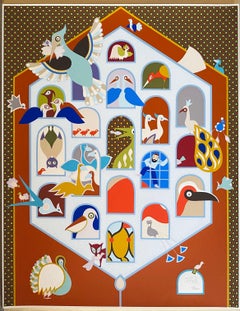
Israeli Naive Folk Art Birdhouse Silkscreen Lithograph David Sharir Birds
By David Sharir
Located in Surfside, FL
David Sharir was born in 1938 in Tel Aviv, Israel and currently resides there.
David Sharir, the son of Russian immigrants, was born in Israel. Beginning his study of art in Tel Aviv...
Category
20th Century Folk Art Figurative Prints
Materials
Screen
Alexander Calder Circus Reproduction Lithograph of a Drawing
By (after) Alexander Calder
Located in Surfside, FL
(after) Alexander Calder
"Calder's Circus" offset lithograph on wove paper a reproduction lithograph after the drawings by the artist
Published by Art in America and Perls gallery in 1964 (from drawings done in the 1930's)
these range slightly in size but they are all about 13 X 17 inches (with minor variations in size as issued.) These have never been framed. The outer folio is not included just the one lithograph.
James Sweeny from the introduction “The fame of Calder’s circus spread quickly between the years 1927 and 1930. All the Paris art world came to know it. It brought him his first great personal success. But what was more important, the circus also provided the first steps in Calder’s development as an original sculptor”
Clive Gray wrote ”A visit to the studio of Alexander Calder led to the chance discovery of some hundred masterful circus drawings completed over thirty years ago. We publish, for the first time, a choice of sixteen from that group.” With signed introduction by Miro.
These whimsical drawings, done in the style of wire sculpture, include acrobats, clowns, jugglers, trapeeze artists, an elephant, dog and lion. they are great.
Alexander Calder is widely considered to be one of the most important American sculptors of the 20th century. He is best known for his colorful, whimsical abstract public sculptures and his innovative mobiles, kinetic sculptures powered by motors or air currents, which embraced chance in their aesthetic. Born into a family of accomplished artists, Calder's work first gained attention in Paris in the 1930s and was soon championed by the Museum of Modern Art in New York, resulting in a retrospective exhibition in 1943. Major retrospectives were also held at the Solomon R. Guggenheim Museum (1964) and the Museum of Contemporary Art, Chicago (1974). Calder’s work is in many permanent collections, most notably in the Whitney Museum of American Art, but also the Guggenheim Museum; the Museum of Modern Art; the National Gallery of Art, Washington, D.C.; and the Centre Georges Pompidou. He produced many large public works, including .125 (at JFK Airport, 1957), Pittsburgh (Carnegie International prize winner 1958, Pittsburgh International Airport) Spirale (UNESCO in Paris, 1958), Flamingo and Universe (both in Chicago, 1974), and Mountains and Clouds (Hart Senate Office Building, Washington, D.C., 1976). Although primarily known for his sculpture, Calder was a prodigious artist with a restless creative spirit, whose diverse practice included painting and printmaking, miniatures (such as his famous Cirque Calder), children’s book illustrations, theater set design, jewelry design, tapestry and rug works, and political posters. Calder was honored by the US Postal Service with a set of five 32-cent stamps in 1998, and received the Presidential Medal of Freedom, posthumously in 1977, after refusing to receive it from Gerald Ford one year earlier in protest of the Vietnam War.
Calder moved to New York and enrolled at the Art Students League, studying briefly with Thomas Hart Benton, George Luks, Kenneth Hayes Miller, and John Sloan. While a student, he worked for the National Police Gazette where, in 1925, one of his assignments was sketching the Ringling Bros. and Barnum & Bailey Circus. Calder became fascinated with the action of the circus, a theme that would reappear in his later work.
In 1926, Calder moved to Paris, enrolled in the Académie de la Grande Chaumière, and established a studio at 22 rue Daguerre in the Montparnasse Quarter. In June 1929, while traveling by boat from Paris to New York, Calder met his future wife, Louisa James (1905-1996), grandniece of author Henry James and philosopher William James. They married in 1931. While in Paris, Calder met and became friends with a number of avant-garde artists, including Fernand Léger, Jean Arp, and Marcel Duchamp. Cirque Calder (on view at the Whitney Museum of American Art at present) became popular with the Parisian avant-garde. He also invented wire sculpture, or "drawing in space," and in 1929 he had his first solo show of these sculptures in Paris at Galerie Billiet. Hi! (Two Acrobats) in the collection of the Honolulu Museum of Art is an early example of the artist's wire sculpture. The painter Jules Pascin, a friend of Calder's from the cafes of Montparnasse, wrote the preface to the catalog. A visit to Piet Mondrian's studio in 1930, where he was impressed by the environment-as-installation, "shocked" him into fully embracing abstract art, toward which he had already been tending.
Dating from 1931, Calder’s sculptures of discrete movable parts powered by motors were christened “mobiles” by Marcel Duchamp, a French pun meaning both "motion" and "motive." At the same time, Calder was also experimenting with self-supporting, static, abstract sculptures, dubbed "stabiles" by Jean Arp in 1932 to differentiate them from mobiles.
Public commissions increasingly came his way in the 1960s. Notable examples are .125 for JFK Airport in 1957, Spirale for UNESCO in Paris 1958 and Trois disques, commissioned for Expo 67 in Montreal, Quebec, Canada. Calder's largest sculpture at 25.7 meters high was El Sol Rojo, constructed outside the Aztec Stadium for the 1968 Summer Olympics "Cultural Olympiad" events in Mexico City. Many of his public works were commissioned by renowned architects; I.M. Pei commissioned his La Grande Voile (1966), a 25-ton, 40-foot high stabile for the Massachusetts Institute of Technology.
Part of Calder's repertoire includes pivotal stage sets for more than a dozen theatrical productions, including Nucléa, Horizon, and most notably, Martha Graham’s Panorama (1935), a production of the Erik Satie symphonic drama Socrate (1936), and later, Works in Progress (1968).
In addition to sculptures, Calder painted throughout his career, beginning in the early 1920s. He picked up his study of printmaking in 1925, and continued to produce illustrations for books and journals.As Calder’s professional reputation expanded in the late 1940s and 1950s, so did his production of prints. Masses of lithographs based on his gouache paintings hit the market, and deluxe editions of plays, poems, and short stories illustrated with fine art prints by Calder became available for sale.
One of Calder's most celebrated and unconventional undertakings was a commission from Dallas-based Braniff International Airways to paint a full-size Douglas DC-8-62 four-engined jet as a "flying canvas."
Calder created over 2,000 pieces of jewelry over the course of his career, many of them as gifts for friends and relatives. For his lifelong friend Joan Miró, he set a shard of a broken porcelain vessel in a brass ring. Peggy Guggenheim received enormous silver mobile earrings and later commissioned a hammered silver headboard...
Category
1930s American Modern Animal Prints
Materials
Lithograph