Want more images or videos?
Request additional images or videos from the seller
1 of 14

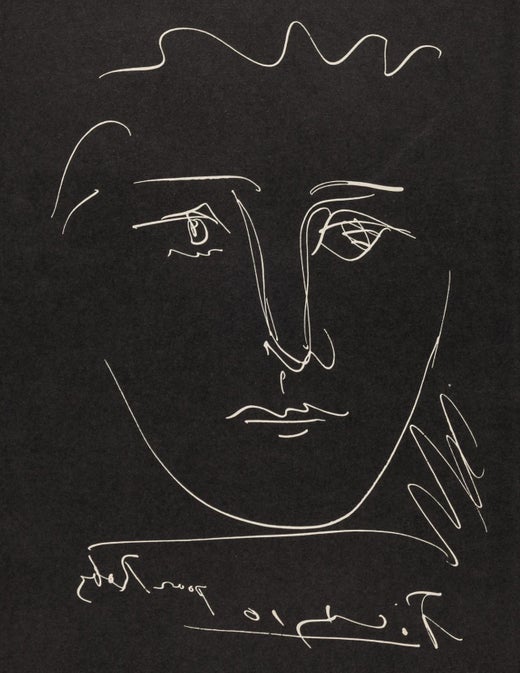
Pablo Picasso
La Petite Corrida

1971

Price:$975
$1,250List Price

You May Also Like

Lettera Amorosa
By George Braque
Located in San Francisco, CA
This artwork titled "Lettera Amorosa" 1963, is an original color lithograph on Japan nacre paper by renown French artist Georges Braque, 1882-1963. It is hand signed and numbered 42/...
Category

Mid-20th Century Cubist Abstract Prints

Materials

Lithograph

Lettera Amorosa
$7,000
H 31.5 in W 31.25 in D 1.1 in
"Gray with Dove" 54/100 Cubist Mother Child Bird Blue Earth Tones Peaceful
By Alvar Sunol Munoz-Ramos
Located in Austin, TX
Page size: 27 x 20 in. Frame size: 32 x 25 in. Signed in pencil, bottom right: "ALVAR" Numbered in pencil, bottom left "54/100" A dreamy, abstract litograph in misty blues, grays, w...
Category

Mid-20th Century Cubist Abstract Prints

Materials

Archival Paper, Lithograph

Jean Cocteau - Europe s Agriculture - Original Lithograph
By Jean Cocteau
Located in Collonge Bellerive, Geneve, CH
Original Lithograph by Jean Cocteau Title: Europe's Agriculture Signed in the stone/printed signature Dimensions: 33 x 46 cm Luxury impression from the portfolio published by Sciaky....
Category

1960s Cubist Animal Prints

Materials

Lithograph

After Georges Braque - Antiborée - Lithograph
Located in Collonge Bellerive, Geneve, CH
Lithograph after Georges Braque. Signed in the plate Edition of 150 Dimensions: 76 x 117 cm Bibliography: « Les Métamorphoses de Braque» of Heger de Loewenfeld and Raphaël de Cuttoli , Editions FAC, Paris, 1989. In 1961 Georges Braque decided with his laidary friend Heger de Loewenfeld to pick up certain of his works to in order to create artworks, this beautiful litograph is one of them. Héméra in the Mythology: In Greek mythology Hemera was the personification of day and one of the Greek primordial deities. She is the goddess of the daytime and, according to Hesiod, the daughter of Erebus and Nyx (the goddess of night). Hemera is remarked upon in Cicero's De Natura Deorum, where it is logically determined that Dies (Hemera) must be a god, if Uranus is a god. The poet Bacchylides states that Nyx and Chronos are the parents, but Hyginus in his preface to the Fabulae mentions Chaos as the mother/father and Nyx as her sister. She was the female counterpart of her brother and consort, Aether (Light), but neither of them figured actively in myth or cult. Hyginus lists their children as Uranus, Gaia, and Thalassa (the primordial sea goddess), while Hesiod only lists Thalassa as their child. The father of Cubism Three Cubist that distinguishes art historian periods were initiated and developed by Georges Braque: The Cubist Cézanne (1907-1909), Executive (1909-1912) and synthetic (1912-1922). Post-Impressionist and fawn, Braque no longer adheres to the contingency of a decorative way or the other. Cézanne’s paintings exhibited at the Grand Palais during the retrospective of 1907 are a revelation: Cézanne sought and invented a pictorial language. In his footsteps, Braque went to the South with the reasons of the Master. He returned with Estaque landscapes and surprising Ciotat it keeps Cezanne geometric model and retains the “passages” continuity from one surface to another to create the sensation of “turning around” of the object represented. But he wants to go after the consequences of the vision of Cezanne. In his paintings Houses in L’Estaque (1908) it simplifies the volumes of houses, neglects detail by removing doors and windows: the plastic rhythm that builds the table. Large Nude , a masterpiece of the period, can be considered the first work of Cézanne cubism . Systematizing and deepening Braque discoveries open the door analytical cubism. In 1909, his painting became more cerebral than sensual. The pattern is recreated in the two-dimensionality of the canvas, leaving aside any illusionistic perspective. In Still Life with Violin, objects are analyzed facets according to their characteristic elements, each facet referring to a particular view of the object. There are so many facets of points selected view: Table reflects the knowledge of the object and the ubiquity of the eye. Moreover, Braque is looking for the essence of the objects in the world rather than their contingency, which explains the absence of light source and use of muted colors (gray, ocher), contingent aspects of the object . But formal logic has stepped facets, erased any anecdote to the object and ultimately led to his painting a hermetic more marked on the edge of abstraction (see the series of Castle Roche-Guyon ). Braque, anxious to keep the concrete and refusing at all costs that the logic of Cubism takes the paintings to abstract, reintroduced signs of reality in his paintings in 1912 marks the beginning of Synthetic Cubism. Historians speak of “signs of real” rather than reality because what interests Braque, this is not to put reality into a table, but to create a painting which, by its language, refers to the real. To do this, he invented two major techniques XX th century inclusions and contributions. The inclusions consist of painting objects that have no real depth, materials (wallpaper in Nature morte aux playing cards faux wood is a pictorial inclusion) or letters (calligraphic inclusion in Portuguese ), made first brush and a few months later stencil. Contributions are defined in contrast with the collage on canvas of foreign materials: glued or sand paper, sawdust, etc.. Regarding the collages, Braque used for the first time in September 1912 a piece of adhesive paper imitating faux wood Compote...
Category

1950s Cubist Animal Prints

Materials

Lithograph

After Georges Braque - Antiborée - Lithograph
$3,797
H 29.93 in W 46.07 in D 0.04 in
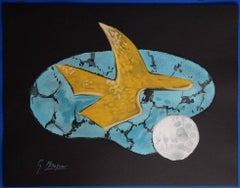
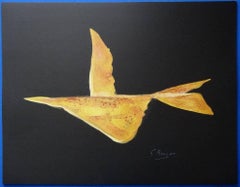
The Flight - French Cubism Bird
By Georges Braque
Located in London, GB
This original lithograph in colours is hand signed in pencil by the artist "G. Braque" at the lower right margin. It is also hand numbered in pencil from the edition of 75, at the lo...
Category

1960s Cubist Animal Prints

Materials

Lithograph

Leda and the Swann - lithograph - 399 copies
By (after) Georges Braque
Located in Paris, IDF
Georges BRAQUE Leda and the Swann Stone lithograph (Art-Litho workshop, Paris) Printed signature in the pate Limited to 399 copies unumbered On Arches vellum 18 x 23" (45 x 58 cm) E...
Category

Late 20th Century Cubist Animal Prints

Materials

Lithograph

Secret thoughts - lithograph - 399 copies
By (after) Georges Braque
Located in Paris, IDF
MEDIUM : Lithograph PRINTER : Atelier Art-Litho EDITOR : Armand ISRAEL, Paris SIGNATURE : Printed LIMITED : 399 copies unumbered PAPER : Arches vellum SIZE : 18 x 23" CONDITION : Ex...
Category

Late 20th Century Cubist Animal Prints

Materials

Lithograph

Phoenix : Bird in Fire - Lithograph - Limited /399 copies
By Georges Braque
Located in Paris, IDF
after Georges BRAQUE Phoenix : Bird in Fire Lithograph (Art-Litho workshop) Printed signature in the plate On Arches vellum 18 x 23" (58 x 45 cm) INFORMATION: Limited edition of 3...
Category

Late 20th Century Cubist Animal Prints

Materials

Lithograph

Bird of the Moon - lithograph - 399 copies
By Georges Braque
Located in Paris, IDF
Georges BRAQUE Bird of the Moon Lithograph (Art-Litho workshop) Printed signature in the plate On Arches vellum 18 x 23" INFORMATION: Limited edition of 399 copies unumbered - Ed...
Category

Late 20th Century Cubist Animal Prints

Materials

Lithograph

Elegant flight - Lithograph - Printed signature
By (after) Georges Braque
Located in Paris, IDF
George BRAQUE Elegant flight Lithograph on vellum after a painting Printed signature in the plate 399 copies unnumbered On Arches vellum 18 x 23" (45 x 58 cm) Excellent condition
Category

Late 20th Century Cubist Animal Prints

Materials

Lithograph

More From This Seller

View All
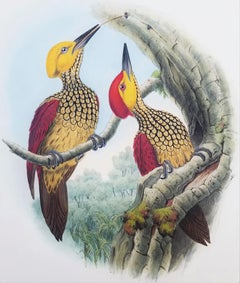
Chrysocolaptes Xanthocephalus (Yellow-faced flameback) /// John Gould Ornitholog
By John Gould
Located in Saint Augustine, FL
Artist: John Gould (English, 1804-1881) Title: "Chrysocolaptes Xanthocephalus (Yellow-faced flameback)" (Vol. 6, Plate 37) Portfolio: The Birds of Asia Year: 1850-1883 Medium: Origin...
Category

1850s Victorian Animal Prints

Materials

Watercolor, Lithograph

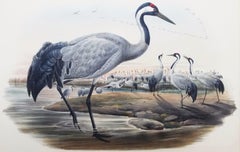
Grus Cinerea (Common Crane) /// John Gould Ornithology Bird Animal Lithograph
By John Gould
Located in Saint Augustine, FL
Artist: John Gould (English, 1804-1881) Title: "Grus Cinerea (Common Crane)" (Vol. 4, Plate 19) Portfolio: The Birds of Great Britain Year: 1862-1873 Medium: Original Hand-Colored Lithograph on wove paper Limited edition: approx. 750 Printer: Walter or Walter & Cohn, London, UK Publisher: Taylor and Francis, John Gould, London, UK Reference: Sauer No. 23; Ayer/Zimmer page 261; Wood page 365; Nissen No. IVB 372; Sitwell page 78 Sheet size: 14.75" x 21.57" Image size: 12.75" x 20.13" Condition: Has been professionally stored away for decades. In excellent condition with strong colors Notes: Provenance: private collection - Aspen, CO. Lithography and hand-coloring by German artist Joseph Wolf (1820-1899) and Irish artist William Hart (1830-1908). Comes from Gould's five volume "The Birds of Great Britain", (1862-1873) (First edition), which consists of 367 hand-colored lithographs. Other contributing lithographers were John Gould and English artist Henry Constantine Richter (1821-1902). "The Birds of Great Britain" is recognized as Gould's greatest work. Gold gilded edges as issued. The common crane, also known as the Eurasian crane, is a bird of the family Gruidae, the cranes. A medium-sized species, it is the only crane commonly found in Europe besides the demoiselle crane and the Siberian crane that only are regular in the far eastern part of the continent. Biography: John Gould FRS (14 September 1804 – 3 February 1881) was an English ornithologist and bird artist. He published a number of monographs on birds, illustrated by plates that he produced with the assistance of his wife, Elizabeth Gould, and several other artists including Edward Lear, Henry Constantine Richter, Joseph Wolf and William Matthew Hart. He has been considered the father of bird study in Australia and the Gould League in Australia is named after him. His identification of the birds now nicknamed "Darwin's finches" played a role in the inception of Darwin's theory of evolution by natural selection. Gould's work is referenced in Charles Darwin's book, "On the Origin of Species".
Category

1860s Victorian Animal Prints

Materials

Watercolor, Lithograph

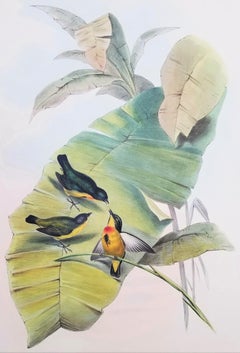
Myzanthe Ignipectus (Fire-breasted Flowerpecker) /// John Gould Ornithology Bird
By John Gould
Located in Saint Augustine, FL
Artist: John Gould (English, 1804-1881) Title: "Myzanthe Ignipectus (Fire-breasted Flowerpecker)" (Vol. 2, Plate 40) Portfolio: The Birds of Asia Year: 1850-1883 Medium: Original Hand-Colored Lithograph on wove paper Limited edition: approx. 235 Printer: Hullmandel & Walton, T. Walter or Walter & Cohn, London, UK Publisher: Taylor and Francis, John Gould, London, UK Reference: Anker No. 178; Nissen No. IVB 368; Sauer No. 17, Zimmer page 258; Wood page 365; Sitwell page 102 Sheet size: 21.38" x 14.57" Image size: 16" x 9.75" Condition: Light toning to sheet. Has been professionally stored away for decades. In excellent condition with strong colors Extremely rare Notes: Provenance: private collection - Aspen, CO. Lithography and hand-coloring by John Gould and English artist Henry Constantine Richter (1821-1902). Comes from Gould's seven volume "The Birds of Asia", (1850-1883) (First edition), which consists of 530 hand-colored lithographs. Other contributing lithographers were German artist Joseph Wolf (1820-1899) and Irish artist William Hart (1830-1908). "The Birds of Asia" was Gould's last work before his death. Gold gilded edges as issued. The fire-breasted flowerpecker is a species of bird in the family Dicaeidae found in the Indian Subcontinent and Southeast Asia. Like other flowerpeckers, this tiny bird feeds on fruits and plays an important role in the dispersal of fruiting plants. Biography: John Gould FRS (14 September 1804 – 3 February 1881) was an English ornithologist and bird artist. He published a number of monographs on birds, illustrated by plates that he produced with the assistance of his wife, Elizabeth Gould, and several other artists including Edward Lear, Henry Constantine Richter, Joseph Wolf and William Matthew Hart. He has been considered the father of bird study in Australia and the Gould League in Australia is named after him. His identification of the birds now nicknamed "Darwin's finches" played a role in the inception of Darwin's theory of evolution by natural selection. Gould's work is referenced in Charles Darwin's book, "On the Origin of Species".
Category

1850s Victorian Animal Prints

Materials

Watercolor, Lithograph

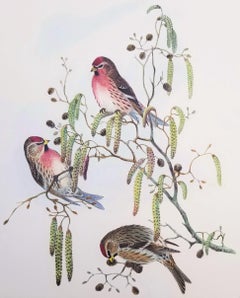
Aegiothus Linaria (Common Redpoll) /// John Gould Ornithology Bird Lithograph
By John Gould
Located in Saint Augustine, FL
Artist: John Gould (English, 1804-1881) Title: "Aegiothus Linaria (Common Redpoll)" (Vol. 3, Plate 51) Portfolio: The Birds of Great Britain Year: 1862-1873 Medium: Original Hand-Colored Lithograph on wove paper Limited edition: approx. 750 Printer: Walter or Walter & Cohn, London, UK Publisher: Taylor and Francis, John Gould, London, UK Reference: Sauer No. 23; Ayer/Zimmer page 261; Wood page 365; Nissen No. IVB 372; Sitwell page 78 Sheet size: 21.63" x 14.75" Image size: 13.75" x 10.5" Condition: Faint UV stain to sheet. Remnants of mounting tape from previous framing on verso. Has been professionally stored away for decades. In excellent condition with strong colors Very rare Notes: Provenance: private collection - Aspen, CO. Lithography and hand-coloring by John Gould and English artist Henry Constantine Richter (1821-1902). Comes from Gould's five volume "The Birds of Great Britain", (1862-1873) (First edition), which consists of 367 hand-colored lithographs. Other contributing lithographers were German artist Joseph Wolf (1820-1899) and Irish artist William Hart (1830-1908). "The Birds of Great Britain" is recognized as Gould's greatest work. Gold gilded edges as issued. The common redpoll or mealy redpoll is a species of bird in the finch family. It breeds somewhat further south than the Arctic redpoll, also in habitats with thickets or shrubs. Biography: John Gould FRS (14 September 1804 – 3 February 1881) was an English ornithologist and bird artist. He published a number of monographs on birds, illustrated by plates that he produced with the assistance of his wife, Elizabeth Gould, and several other artists including Edward Lear, Henry Constantine Richter, Joseph Wolf and William Matthew Hart. He has been considered the father of bird study in Australia and the Gould League in Australia is named after him. His identification of the birds now nicknamed "Darwin's finches" played a role in the inception of Darwin's theory of evolution by natural selection. Gould's work is referenced in Charles Darwin's book, "On the Origin of Species".
Category

1860s Victorian Animal Prints

Materials

Watercolor, Lithograph

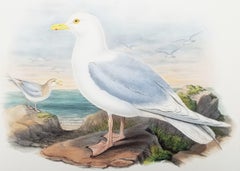
Larus Islandicus (Iceland Gull) /// John Gould Ornithology Bird Animal Litho Art
By John Gould
Located in Saint Augustine, FL
Artist: John Gould (English, 1804-1881) Title: "Larus Islandicus (Iceland Gull)" (Vol. 5, Plate 58) Portfolio: The Birds of Great Britain Year: 1862-1873 Medium: Original Hand-Colored Lithograph on wove paper Limited edition: approx. 750 Printer: Walter or Walter & Cohn, London, UK Publisher: Taylor and Francis, John Gould, London, UK Reference: Sauer No. 23; Ayer/Zimmer page 261; Wood page 365; Nissen No. IVB 372; Sitwell page 78 Sheet size: 14.57" x 21.57" Image size: 12" x 16.25" Condition: Soft handling creases to sheet. Remnants of mounting tape from previous framing at top on verso. In excellent condition with strong colors Notes: Provenance: private collection - Mount Vernon, IA. Lithography and hand-coloring by German artist Joseph Wolf (1820-1899) and Irish artist William Hart (1830-1908). Comes from Gould's five volume "The Birds of Great Britain", (1862-1873) (First edition), which consists of 367 hand-colored lithographs. Other contributing lithographers were John Gould and English artist Henry Constantine Richter (1821-1902) "The Birds of Great Britain" is recognized as Gould's greatest work. Comes with its original accompanying text page. Gold gilded edges as issued. The Iceland gull is a medium-sized gull that breeds in the Arctic regions of Canada and Greenland, but not in Iceland, where it is only seen during winter. The genus name is from Latin larus, which appears to have referred to a gull or other large seabird. Biography: John Gould FRS (14 September 1804 – 3 February 1881) was an English ornithologist and bird artist. He published a number of monographs on birds, illustrated by plates that he produced with the assistance of his wife, Elizabeth Gould, and several other artists including Edward Lear, Henry Constantine Richter, Joseph Wolf and William Matthew Hart. He has been considered the father of bird study in Australia and the Gould League in Australia is named after him. His identification of the birds now nicknamed "Darwin's finches" played a role in the inception of Darwin's theory of evolution by natural selection. Gould's work is referenced in Charles Darwin's book, "On the Origin of Species".
Category

1860s Victorian Animal Prints

Materials

Watercolor, Lithograph

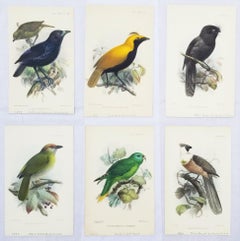
Set of Six Hand-Colored Lithograph Ornithological Prints from "The Ibis"
Located in Saint Augustine, FL
Artist: Philip Lutley Sclater (English, 1829-1913) Titles: "Loria Mariae (MacGregor's Bowerbird)", "Cnemophilus Macgregorii (Crested Satinbird)", "Aegotheles Savesi (New Caledonian O...
Category

1870s Victorian Animal Prints

Materials

Watercolor, Lithograph

Still Thinking About These?

All Recently Viewed