Want more images or videos?
Request additional images or videos from the seller
1 of 2
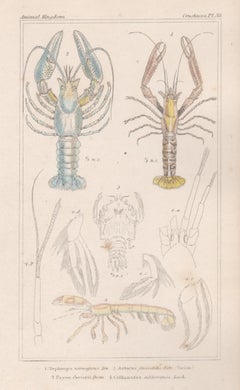
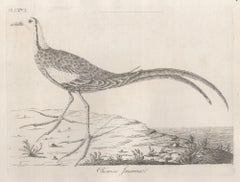
UnknownSpiders, antique English natural history engraving prints, 18371837
1837
$45List Price
About the Item
- Creation Year:1837
- Dimensions:Height: 8.27 in (21 cm)Width: 4.93 in (12.5 cm)
- Medium:
- Movement Style:
- Period:
- Condition:A few small marks in the image. Some light creasing at the very top of the sheet.
- Gallery Location:Melbourne, AU
- Reference Number:1stDibs: LU1244213182022
About the Seller
5.0
Gold Seller
Premium sellers maintaining a 4.3+ rating and 24-hour response times
Established in 2005
1stDibs seller since 2019
632 sales on 1stDibs
Typical response time: 1 hour
Authenticity Guarantee
In the unlikely event there’s an issue with an item’s authenticity, contact us within 1 year for a full refund. DetailsMoney-Back Guarantee
If your item is not as described, is damaged in transit, or does not arrive, contact us within 7 days for a full refund. Details24-Hour Cancellation
You have a 24-hour grace period in which to reconsider your purchase, with no questions asked.Vetted Professional Sellers
Our world-class sellers must adhere to strict standards for service and quality, maintaining the integrity of our listings.Price-Match Guarantee
If you find that a seller listed the same item for a lower price elsewhere, we’ll match it.Trusted Global Delivery
Our best-in-class carrier network provides specialized shipping options worldwide, including custom delivery.You May Also Like
Set of Four Hand Colored Monkey Prints
Located in Palm Beach, FL
This set of four hand colored copper plate engravings are illustrations by early 19th century naturalist J. H. Jacob first published in Italy in 1812, and are referred to as "Jacob's...
Category
Early 19th Century Naturalistic Animal Prints
Materials
Engraving
Cocoa plant, caterpillar, ..., Plate 26, Metamorphosis Insectorum Surinamensium
By Maria Sibylla Merian
Located in Middletown, NY
Metamorphosis Insectorum Surinamensium, Plate No. 26; Cocoa plant, caterpillar, pupa, and butterflies. The Netherlands: 1705. En...
Category
Early 18th Century Naturalistic Still-life Prints
Materials
Watercolor, Engraving
4 plates from The Wondrous Transformation of Caterpillars
their Strange Diet..
By Maria Sibylla Merian
Located in Middletown, NY
Four plates from The Wondrous Transformation of Caterpillars and their Strange Diet of Flowers. “Wolfsmelk Rupsen;" “Wolfsmilch, Raupe und Schmetterling" Amsterdam: JF Bernard, 1730. Each an engraving with hand coloring in watercolor and gouache printed on one sheet of watermarked Honig cream laid paper, each measures 6 1/4 x 5 inches (157 x 121 mm), sheet measures 20 5/8 x 14 inches (522 x 355 mm), full margins. With handling creases in the lower right sheet quadrant, as well as minor, loose cockling, otherwise in very good condition. The colors are superb with exceptionally fresh and bright saturation. Engraved between 1679 and 1683, printed 1730. Plates included: CXLI, CXLII, CXIII & CXLIV.
MARIA SIBYLLA MERIAN was one of the most highly respected entomologists of the 17th century, and remains today one of the field's most significant figures. A German-born naturalist and scientific illustrator, she reared herself on the study of caterpillars, and made tremendous contributions to the knowledge of the life cycles of numerous species. Until her detailed and careful study of the process of metamorphosis it was thought that insects were "born of mud," through spontaneous generation.
Trained as a miniature painter by her stepfather, she published her first book of illustrations in 1675, at the age of 28. In 1679, Merian published the first volume of the two-volume series on caterpillars, The Wondrous Transformation of Caterpillars and their Strange Diet of Flowers; the second volume followed in 1683. Each volume contained 50 plates that she engraved and etched. In 1699, Merian traveled to Dutch Guiana...
Category
Early 18th Century Naturalistic Still-life Prints
Materials
Watercolor, Engraving
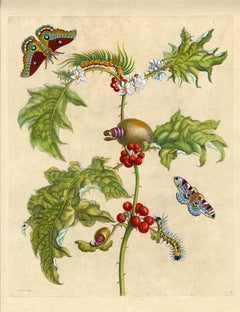
Thistle and Moths, plate no. 6, Metamorphosis Insectorum Surinamensium
By Maria Sibylla Merian
Located in Middletown, NY
Metamorphosis Insectorum Surinamensium, Plate No. 6; Thistle and Moths. The Netherlands: 1705. Engraving with hand coloring in w...
Category
Early 18th Century Naturalistic Still-life Prints
Materials
Watercolor, Engraving
$5,300
H 12.88 in W 9.63 in
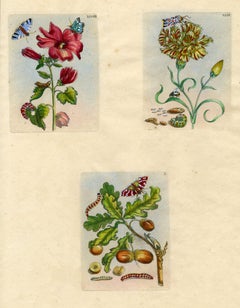
3 plates from The Wondrous Transformation of Caterpillars
their Strange Diet..
By Maria Sibylla Merian
Located in Middletown, NY
Three plates from The Wondrous Transformation of Caterpillars and their Strange Diet of Flowers. “Wolfsmelk Rupsen;" “Wolfsmilch, Raupe und Schmetterling" Amsterdam: J F Bernard, 1730. Each an engraving with hand coloring in watercolor and gouache printed on one sheet of watermarked Honig cream laid paper, each measures 6 1/4 x 5 inches (157 x 121 mm), sheet measures 20 5/8 x 14 inches (522 x 355 mm), full margins. With handling creases in the lower right sheet quadrant, as well as minor, loose cockling, otherwise in very good condition. The colors are superb with exceptionally fresh and bright saturation. Engraved between 1679 and 1683, printed 1730. Plates included: XLVIII; XLIX & L.
MARIA SIBYLLA MERIAN was one of the most highly respected entomologists of the 17th century, and remains today one of the field's most significant figures. A German-born naturalist and scientific illustrator, she reared herself on the study of caterpillars, and made tremendous contributions to the knowledge of the life cycles of numerous species. Until her detailed and careful study of the process of metamorphosis it was thought that insects were "born of mud," through spontaneous generation.
Trained as a miniature painter by her stepfather, she published her first book of illustrations in 1675, at the age of 28. In 1679, Merian published the first volume of the two-volume series on caterpillars, The Wondrous Transformation of Caterpillars and their Strange Diet of Flowers; the second volume followed in 1683. Each volume contained 50 plates that she engraved and etched. In 1699, Merian traveled to Dutch Guiana...
Category
Early 18th Century Naturalistic Still-life Prints
Materials
Watercolor, Engraving
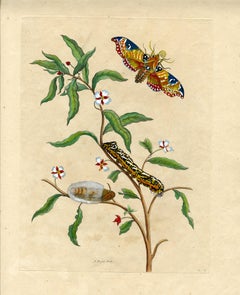
Tree with moth, caterpillar..., Plate 39, Metamorphosis Insectorum Surinamensium
By Maria Sibylla Merian
Located in Middletown, NY
Metamorphosis Insectorum Surinamensium, Plate No. 39; Unidentified tree with moth, caterpillar and pupa.
The Netherlands: 1705....
Category
Early 18th Century Naturalistic Still-life Prints
Materials
Watercolor, Engraving
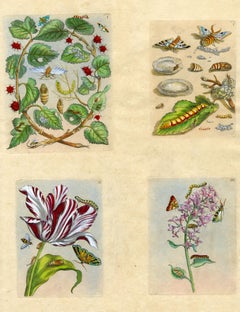
4 plates from The Wondrous Transformation of Caterpillars
their Strange Diet..
By Maria Sibylla Merian
Located in Middletown, NY
Four plates from The Wondrous Transformation of Caterpillars and their Strange Diet of Flowers. “Wolfsmelk Rupsen;" “Wolfsmilch, Raupe und Schmetterling" Amsterdam: J F Bernard, 1730. Each an engraving with hand coloring in watercolor and gouache printed on one sheet of watermarked Honig cream laid paper, each measures 6 1/4 x 5 inches (157 x 121 mm), sheet measures 20 5/8 x 14 inches (522 x 355 mm), full margins. With handling creases in the lower right sheet quadrant, as well as minor, loose cockling, otherwise in very good condition. The colors are superb with exceptionally fresh and bright saturation. Engraved between 1679 and 1683, printed 1730. Plates included: No.1:I; No. 2:1; II & III.
MARIA SIBYLLA MERIAN was one of the most highly respected entomologists of the 17th century, and remains today one of the field's most significant figures. A German-born naturalist and scientific illustrator, she reared herself on the study of caterpillars, and made tremendous contributions to the knowledge of the life cycles of numerous species. Until her detailed and careful study of the process of metamorphosis it was thought that insects were "born of mud," through spontaneous generation.
Trained as a miniature painter by her stepfather, she published her first book of illustrations in 1675, at the age of 28. In 1679, Merian published the first volume of the two-volume series on caterpillars, The Wondrous Transformation of Caterpillars and their Strange Diet of Flowers; the second volume followed in 1683. Each volume contained 50 plates that she engraved and etched. In 1699, Merian traveled to Dutch Guiana...
Category
Early 18th Century Naturalistic Still-life Prints
Materials
Watercolor, Engraving
4 plates from The Wondrous Transformation of Caterpillars
their Strange Diet..
By Maria Sibylla Merian
Located in Middletown, NY
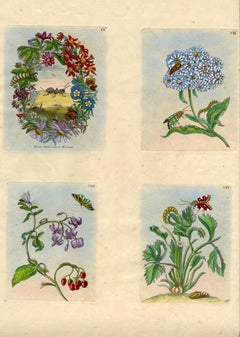
Four plates from The Wondrous Transformation of Caterpillars and their Strange Diet of Flowers. “Wolfsmelk Rupsen;" “Wolfsmilch, Raupe und Schmetterling" Amsterdam: J F Bernard, 1730. Each an engraving with hand coloring in watercolor and gouache printed on one sheet of watermarked Honig cream laid paper, each measures 6 1/4 x 5 inches (157 x 121 mm), sheet measures 20 5/8 x 14 inches (522 x 355 mm), full margins. With handling creases in the lower right sheet quadrant, as well as minor, loose cockling, otherwise in very good condition. The colors are superb with exceptionally fresh and bright saturation. Engraved between 1679 and 1683, printed 1730. Plates included: CI; CII; CIII & CIV.
MARIA SIBYLLA MERIAN was one of the most highly respected entomologists of the 17th century, and remains today one of the field's most significant figures. A German-born naturalist and scientific illustrator, she reared herself on the study of caterpillars, and made tremendous contributions to the knowledge of the life cycles of numerous species. Until her detailed and careful study of the process of metamorphosis it was thought that insects were "born of mud," through spontaneous generation.
Trained as a miniature painter by her stepfather, she published her first book of illustrations in 1675, at the age of 28. In 1679, Merian published the first volume of the two-volume series on caterpillars, The Wondrous Transformation of Caterpillars and their Strange Diet of Flowers; the second volume followed in 1683. Each volume contained 50 plates that she engraved and etched. In 1699, Merian traveled to Dutch Guiana...
Category
Early 18th Century Naturalistic Still-life Prints
Materials
Watercolor, Engraving
4 plates from The Wondrous Transformation of Caterpillars
their Strange Diet..
By Maria Sibylla Merian
Located in Middletown, NY
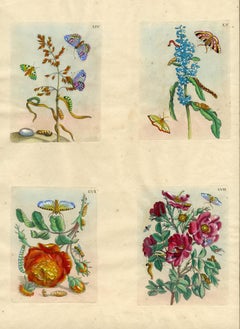
Four plates from The Wondrous Transformation of Caterpillars and their Strange Diet of Flowers. “Wolfsmelk Rupsen;" “Wolfsmilch, Raupe und Schmetterling" Amsterdam: J F Bernard, 1730. Each an engraving with hand coloring in watercolor and gouache printed on one sheet of watermarked Honig cream laid paper, each measures 6 1/4 x 5 inches (157 x 121 mm), sheet measures 20 5/8 x 14 inches (522 x 355 mm), full margins. With handling creases in the lower right sheet quadrant, as well as minor, loose cockling, otherwise in very good condition. The colors are superb with exceptionally fresh and bright saturation. Engraved between 1679 and 1683, printed 1730. Plates included: LIV, LV, LVI, & LVII.
MARIA SIBYLLA MERIAN was one of the most highly respected entomologists of the 17th century, and remains today one of the field's most significant figures. A German-born naturalist and scientific illustrator, she reared herself on the study of caterpillars, and made tremendous contributions to the knowledge of the life cycles of numerous species. Until her detailed and careful study of the process of metamorphosis it was thought that insects were "born of mud," through spontaneous generation.
Trained as a miniature painter by her stepfather, she published her first book of illustrations in 1675, at the age of 28. In 1679, Merian published the first volume of the two-volume series on caterpillars, The Wondrous Transformation of Caterpillars and their Strange Diet of Flowers; the second volume followed in 1683. Each volume contained 50 plates that she engraved and etched. In 1699, Merian traveled to Dutch Guiana...
Category
Early 18th Century Naturalistic Still-life Prints
Materials
Watercolor, Engraving
4 plates from The Wondrous Transformation of Caterpillars
their Strange Diet..
By Maria Sibylla Merian
Located in Middletown, NY
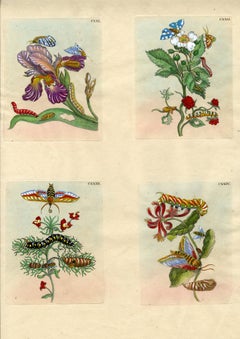
Four plates from The Wondrous Transformation of Caterpillars and their Strange Diet of Flowers. “Wolfsmelk Rupsen;" “Wolfsmilch, Raupe und Schmetterling" Amsterdam: J F Bernard, 1730. Each an engraving with hand coloring in watercolor and gouache printed on one sheet of watermarked Honig cream laid paper, each measures 6 1/4 x 5 inches (157 x 121 mm), sheet measures 20 5/8 x 14 inches (522 x 355 mm), full margins. With one 1.5 inch inch tear across the area of the top-left corner, well outside of image area. Handling creases in the lower right sheet quadrant, as well as minor, loose cockling, otherwise in very good condition. The colors are superb with exceptionally fresh and bright saturation. Engraved between 1679 and 1683, printed 1730. Plates included: CXXI, CXXII, CXXIII, & CXXIV.
MARIA SIBYLLA MERIAN was one of the most highly respected entomologists of the 17th century, and remains today one of the field's most significant figures. A German-born naturalist and scientific illustrator, she reared herself on the study of caterpillars, and made tremendous contributions to the knowledge of the life cycles of numerous species. Until her detailed and careful study of the process of metamorphosis it was thought that insects were "born of mud," through spontaneous generation.
Trained as a miniature painter by her stepfather, she published her first book of illustrations in 1675, at the age of 28. In 1679, Merian published the first volume of the two-volume series on caterpillars, The Wondrous Transformation of Caterpillars and their Strange Diet of Flowers; the second volume followed in 1683. Each volume contained 50 plates that she engraved and etched. In 1699, Merian traveled to Dutch Guiana...
Category
Early 18th Century Naturalistic Still-life Prints
Materials
Watercolor, Engraving
More From This Seller
View AllChinese Jacana, 18th century bird engraving by John Latham
By John Latham
Located in Melbourne, Victoria
Copper-line engraving. 1781. From John Latham's 'General Synopsis of Birds' 1781-1785, and its Supplements. Plate number top left. Laid paper.
John Latham was the leading English or...
Category
Late 18th Century Naturalistic Animal Prints
Materials
Engraving
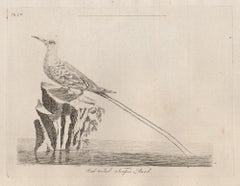
Red-tailed Tropic Bird, 18th century bird engraving by John Latham
By John Latham
Located in Melbourne, Victoria
Copper-line engraving. 1781. From John Latham's 'General Synopsis of Birds' 1781-1785, and its Supplements. Plate number top left. Laid paper.
John Latham was the leading English or...
Category
Late 18th Century Naturalistic Animal Prints
Materials
Engraving
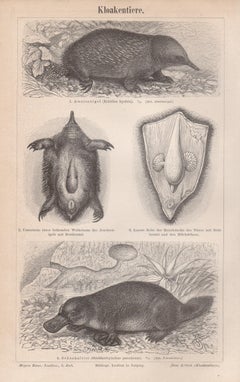
Echidna and Platypus, Australian animal monotreme antique engraving print
Located in Melbourne, Victoria
'Kloakentiere'
(Monotremes - echidna and platypus))
German wood-engraving, circa 1895.
240mm by 155mm (sheet)
Category
Late 19th Century Naturalistic Still-life Prints
Materials
Engraving
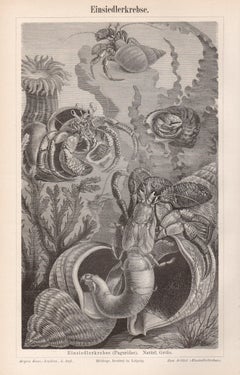
Hermit Crabs, German animal antique underwater crustacean engraving print
Located in Melbourne, Victoria
'Einsiedlerkrebse'
(Hermit crabs)
German wood-engraving, circa 1895.
240mm by 155mm (sheet)
Category
Late 19th Century Naturalistic Still-life Prints
Materials
Engraving
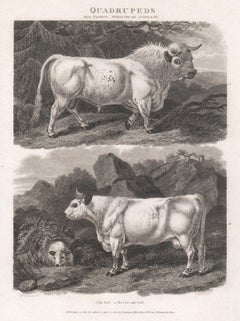
The Bull
The Cow and Calf, English animal cow cattle engraving, 1807
Located in Melbourne, Victoria
Early 19th century cattle engraving from Rees' Cyclopaedia. Sydenham Teast Edwards (1768-1819), was a natural history illustrator. He produced watercolours for engraving for Curtis's Botanical Magazine, New Botanic...
Category
Early 19th Century Naturalistic Animal Prints
Materials
Engraving
Crustaceans - lobsters, antique English natural history engraving print, 1837
Located in Melbourne, Victoria
'Crustacea'
Copper-line engraving with original hand-colouring. From Baron Georges Cuvier's (1769-1832) 'Animal Kingdom', published in London in 1837.
210mm by 130mm (sheet)
Category
Mid-19th Century Naturalistic Animal Prints
Materials
Engraving