Items Similar to
Loop Alley
— Modernist Chicago Cityscape, WPA
Want more images or videos?
Request additional images or videos from the seller
1 of 3
Charles Turzak
Loop Alley
— Modernist Chicago Cityscape, WPA1939
1939
On Hold
$2,800
On Hold
£2,142.52
On Hold
€2,452.14
On Hold
CA$3,954.34
On Hold
A$4,297.69
On Hold
CHF 2,303.17
On Hold
MX$52,181.54
On Hold
NOK 28,914.86
On Hold
SEK 26,814.14
On Hold
DKK 18,314.46
About the Item
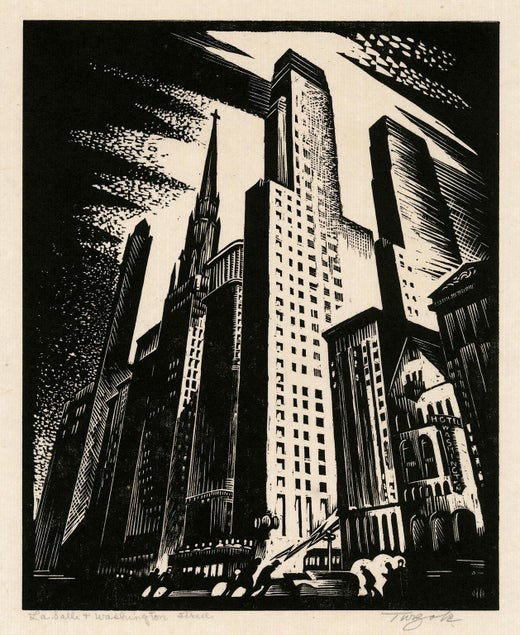
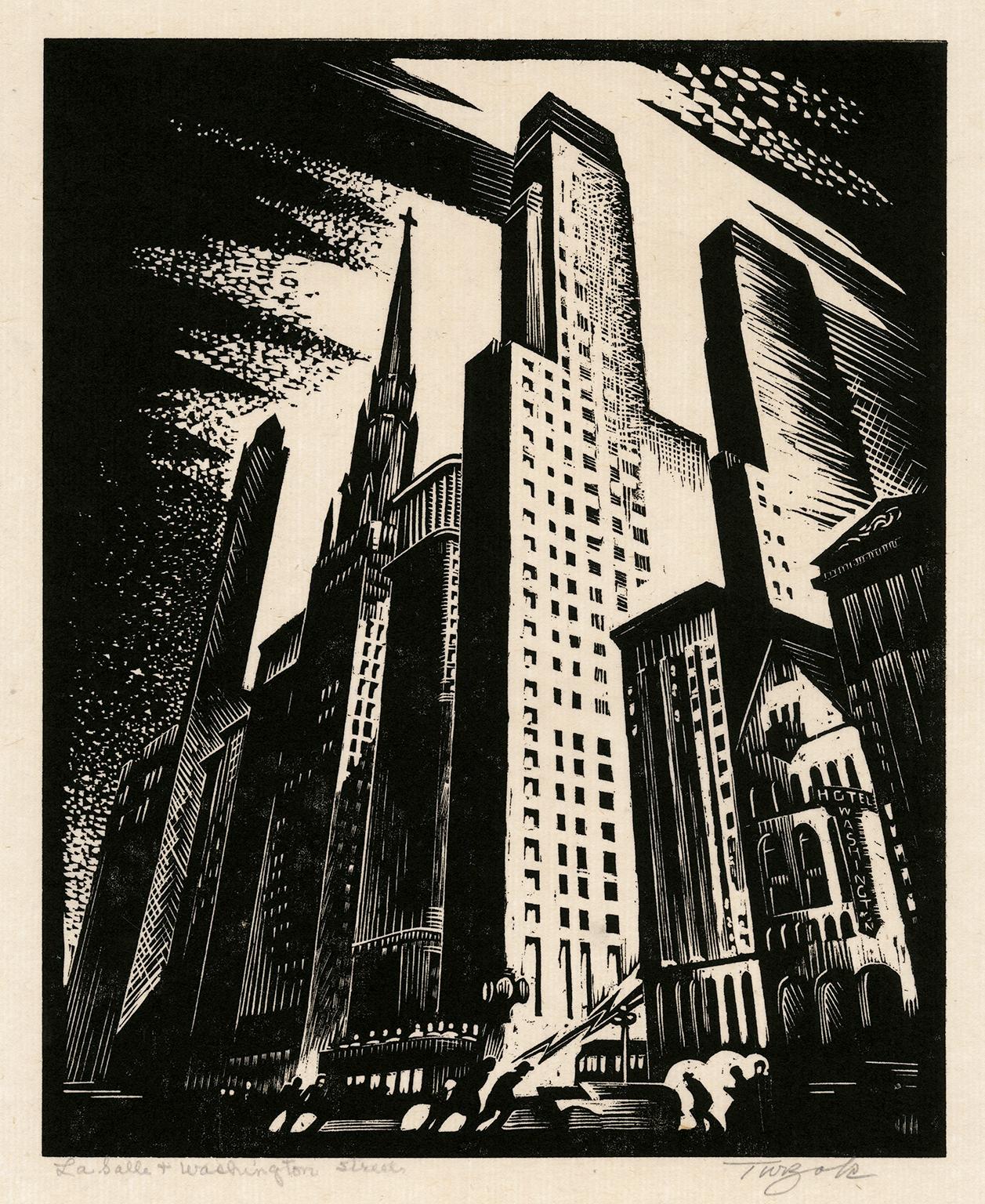
Charles Turzak, 'Loop Alley (Chicago)', color woodcut, edition c. 25, c. 1935. Signed and titled in pencil. A fine, richly-inked impression, with fresh colors, on cream wove Japan paper. The sheet trimmed with margins (1/2 to 1 3/8 inch); tape stains from prior hinging in the upper left and right sheet edges, away from the image, otherwise in very good condition. Matted to museum standards, unframed.
Image size 11 x 8 3/4 inches; sheet size 13 1/2 x 10 3/8 inches.
Collection: Art Institute of Chicago
One of a series of four color woodcuts entitled 'Chicago Moods In Color', created by the artist for the Works Progress Administration (WPA). Very scarce.
'The Loop' is one of Chicago's three downtown community areas, bounded by the Chicago River to the north and west, Harrison Street to the south, and Lake Michigan to the east. At the iconic center of the city, it contains the tallest of Chicago's skyscrapers. The Loop also holds a world-class public art collection in the form of giant street-side statues by many of the 20th century's most famous sculptors. The Loop initially got its name from the looping route of streetcars that served as the transit hub of early downtown Chicago, but the name has come to be defined by the modern era's looping route of elevated train tracks, serving seven CTA lines, which ensures the continued prominence of the area as the center of Chicago's working world. Despite the gradual northwards shift in the city's center with increasing suburbanization, all tracks lead there. Accordingly, the Loop remains the most attractive location in the city for major businesses and most of the city's visitors.
ABOUT THE ARTIST
Charles Turzak, born in Streator, Illinois, was the third child and only son of Czechoslovakian immigrant parents. His coal miner father toiled long hours, leaving the boy with numerous household chores. Yet, amidst these responsibilities, Turzak found creative expression in the meticulous carving of miniature animals from peach seeds, a craft he would later sell for pennies.
Turzak learned woodworking from a neighbor, an English cabinet maker, and soon apprenticed for violin making. He drew cartoons for his school's yearbook and designed sale bills for local merchants. In 1920, he won a cartoon contest sponsored by the Purina Company in St. Louis, Missouri, which helped provide his tuition for the School of the Art Institute of Chicago. He excelled in drawing and woodcarving and gained membership in Delta Phi Delta, an honorary art fraternity. He supported himself through freelance advertising, selling insurance, and teaching woodcut and wood engraving classes at the Academy of Fine Arts.
By the late 1920s, Turzak had gained recognition through the exhibition and sale of his prints of Northwestern University and the iconic Chicago landmarks such as the Chicago Water Tower, Tribune Tower, and Buckingham Fountain, as well as his watercolors of steel mills, boats, harbors, skylines, woodlands, parks, and still life subjects. In 1929, he traveled to Europe to study the works of the masters firsthand, visiting England, Germany, Czechoslovakia, Austria, and France. His return to the United States coincided with the onset of the Great Depression, a period that would test his resilience and ingenuity.
Turzak was one of the early artists to participate in the Works Progress Administration (WPA) depression-era public art projects designed to employ out-of-work artists. Turzak painted murals for the Old Chicago Main Post Office and the post office in Lemont, Illinois. He produced a WPA-sponsored portfolio, History of Illinois in Woodcuts, in 1935—the acclaimed series of 10 prints helped establish him in an advertising career. During this period, Turzak also created woodcut biographies of notable Americans—his first edition on Abraham Lincoln sold so well at the Century of Progress International Exhibition (Chicago World’s Fair, 1933-34) that it supported him throughout the Depression. He followed it with 'Benjamin Franklin: A Biography in Woodcuts', accompanied by text written by his wife, Florence Turzak.
In 1942, Turzak became the art director of Today's Health Magazine while continuing to create his art. He moved to Orlando, Florida, in 1958, where he continued painting and experimenting with modernist genres and abstraction.
The Figge Art Museum mounted an exhibition of Turzak’s WPA-era graphics, ‘Beyond the Surface: WPA Works of Charles Turzak’, November 11, 2011- March 10, 2012.
Turzak’s graphic works are represented in numerous museum collections, including the Ackland Art Museum, Art Institute of Chicago, Cleveland Museum of Art, Columbus Museum of Art, Crystal Bridges Museum of Art, Figge Art Museum, Library of Congress, Metropolitan Museum of Art, National Gallery of Art, Philadelphia Museum of Art, Smithsonian American Art Museum, Spencer Museum of Art, Western Illinois University Art Gallery, and the Whitney Museum of American Art.
About the Seller
5.0
Recognized Seller
These prestigious sellers are industry leaders and represent the highest echelon for item quality and design.
Platinum Seller
Premium sellers with a 4.7+ rating and 24-hour response times
Established in 1995
1stDibs seller since 2016
334 sales on 1stDibs
Typical response time: 1 hour
Associations
International Fine Print Dealers Association
- ShippingRetrieving quote...Shipping from: Myrtle Beach, SC
- Return Policy
More From This Seller
View AllNaked Young Man Sitting On Lopped Branch; Naked Young Woman Sitting on a Branch.
By Eric Gill
Located in Myrtle Beach, SC
Wood engraving, 1930, edition small, Physick 642 / 643. Initialed in pencil.
Two blocks printed on a single sheet: fine impressions on cream laid Japan with full margins (1 1/2 to 2...
Category
1930s Art Deco Figurative Prints
Materials
Woodcut
Dancers
— 1930s American Modernism
By Charles Turzak
Located in Myrtle Beach, SC
Charles Turzak, 'Dancers', 1939, wood engraving, edition 100. Signed, titled, and numbered 72/100 in pencil. A fine, richly-inked impression, on off-white Japan paper, with full marg...
Category
Mid-20th Century Art Deco Figurative Prints
Materials
Woodcut
La Pêche
(Fishing) — French Cubist Woodcut
By Raoul Dufy
Located in Myrtle Beach, SC
Raoul Dufy, 'La Pêche' (Fishing), woodcut, 1910, from the second edition of 220 printed in 1953. With the estate stamp 'ATELIER RAOUL DUFY' in the lower left margin. Numbered '106/220' in pencil, lower right. Titled in the block, lower right. A superb, richly-inked impression, on heavy, cream wove paper, the full sheet with wide margins (3 to 5 inches), slight toning at the sheet edges, well away from the image; otherwise in excellent condition. Archivally sleeved, unmatted.
Image size 12 1/2 x 15 13/16 inches (318 x 402 mm); sheet size 19 9/16 x 25 3/4 inches (497 x 654 mm).
From the suite of four woodcuts entitled 'Les Plaisirs de la Paix' (The Pleasures of Peace), originally published by Éditions de La Sirène, Paris in 1926. The other three works in the series are 'La Danse' (The Dance), 'La Chase' (The Hunt), and 'L'amore' (Love). See our other listings for 'La Danse' and 'L'amore'.
Collections: Cleveland Museum of Art, Minneapolis Art...
Category
1910s Cubist Figurative Prints
Materials
Woodcut
La Danse
(Dance) — French Cubist Woodcut
By Raoul Dufy
Located in Myrtle Beach, SC
Raoul Dufy, 'La Danse' (Dance), woodcut, 1910. A proof impression before the second edition of 220 in 1953; with the estate stamp 'ATELIER RAOUL DUFY' in the lower right margin; the blind stamp 'GG' in the lower left sheet corner. Annotated 'E/Z' in pencil, beneath the estate stamp; and 'bois original' in the margin, lower left. Titled in the block, lower right. A superb, richly-inked impression, on heavy, cream wove paper; the full sheet with wide margins (3 1/2 to 6 3/4 inches); slight toning at the bottom and right sheet edges, well away from the image, otherwise in excellent condition. Archivally sleeved, unmatted.
Image size 12 5/16 x 12 1/2 inches (313 x 318 mm); sheet size 19 3/4 x 25 3/4 inches (502 x 654 mm).
Collections: Art Gallery of New South Wales (Australia), Brooklyn Museum, Cleveland Art Museum, Fine Arts Museums of San Francisco, Minneapolis Institute of Art, Museum of Fine Arts, Boston, The Nelson-Atkins Museum of Art, Nasher Museum of Art (Duke University), Toledo Art Museum.
From the suite of four woodcuts entitled 'Les Plaisirs de la Paix' (The Pleasures of Peace), published by Éditions de La Sirène, Paris in 1926. The other three works in the series are 'La Peche' (Fishing), 'La Chase' (The Hunt), and 'L'amore' (Love). See our other listings for 'La Peche' and 'L'amore'.
Collections: Brooklyn Museum, Art Gallery of New South Wales, Cleveland Museum of Art, Dallas Museum of Art, Fine Arts Museums of San Francisco, Minneapolis Art...
Category
1910s Cubist Figurative Prints
Materials
Woodcut
The Pimp
— Graphic Modernism
By Fritz Eichenberg
Located in Myrtle Beach, SC
Fritz Eichenberg, 'The Pimp', wood engraving, 1980, artist's proof before the edition. Signed in pencil. Signed in the block, lower right. A fine, richly-inked impression, on cream wove paper, with full margins (2 3/16 to 3 1/2 inches), in excellent condition. Archivally sleeved, unmatted.
Image size 12 x 9 3/4 inches (305 x 248 mm); sheet size 18 x 14 inches (457 x 356 mm).
ABOUT THE ARTIST
Fritz Eichenberg (1901–1990) was a German-American illustrator and arts educator who worked primarily in wood engraving. His best-known works were concerned with religion, social justice, and nonviolence.
Eichenberg was born to a Jewish family in Cologne, Germany, where the destruction of World War I helped to shape his anti-war sentiments. He worked as a printer's apprentice and studied at the Municipal School of Applied Arts in Cologne and the Academy of Graphic Arts in Leipzig, where he studied under Hugo Steiner-Prag. In 1923 he moved to Berlin to begin his career as an artist, producing illustrations for books and newspapers. In his newspaper and magazine work, Eichenberg was politically outspoken and sometimes wrote and illustrated his reporting.
In 1933, the rise of Adolf Hitler drove Eichenberg, who was a public critic of the Nazis, to emigrate with his wife and children to the United States. He settled in New York City, where he lived most of his life. He worked in the WPA Federal Arts Project and was a member of the Society of American Graphic Artists.
In his prolific career as a book illustrator, Eichenberg portrayed many forms of literature but specialized in works with elements of extreme spiritual and emotional conflict, fantasy, or social satire. Over his long career, Eichenberg was commissioned to illustrate more than 100 classics by publishers in the United States and abroad, including works by renowned authors Dostoyevsky, Tolstoy, Charlotte and Emily Brontë, Poe, Swift, and Grimmelshausen. He also wrote and illustrated books of folklore and children's stories.
Eichenberg was a long-time contributor to the progressive magazine The Nation, his illustrations appearing between 1930 and 1980. Eichenberg’s work has been featured by such esteemed publishers as The Heritage Club, Random House, Book of the Month Club, The Limited Editions Club, Kingsport Press, Aquarius Press, and Doubleday.
Raised in a non-religious family, Eichenberg had been attracted to Taoism as a child. Following his wife's unexpected death in 1937, he turned briefly to Zen Buddhist meditation, then joined the Religious Society of Friends in 1940. Though he remained a Quaker until his death, Eichenberg was also associated with Catholic charity work through his friendship with Dorothy Day...
Category
1980s American Modern Figurative Prints
Materials
Woodcut
Japanese Kimono Fabric Design — Vintage Color Woodblock Print
Located in Myrtle Beach, SC
Anonymous, Japanese Kimono Fabric Design, color woodcut, c. 1930. A superb impression, with fresh colors, fine graduations, and metallic gold motifs, on ...
Category
Early 1900s Showa Figurative Prints
Materials
Woodcut
You May Also Like
Art Deco City Scene with Motor Car print by Gerald Mac Spink
By Gerald Mac Spink
Located in London, GB
To see our other Modern British Art, scroll down to "More from this Seller" and below it click on "See all from this Seller" - or send us a message if you cannot find the artist you ...
Category
Early 20th Century Art Deco Landscape Prints
Materials
Woodcut
1945 Brazilian Master, Art Deco Nudes Serigraph Woodcut Carnaval Bahia
By Odetto Guersoni
Located in Surfside, FL
Genre: Brazilian Art Deco, African Diaspora
Bahian Carnival
Subject: Abstract
Medium: Print
Surface: Paper
Country: Brazil
Dimensions of overall paper are listed.
This is from a series of work he did in the 1940's, we sold one called Ritmo Negro, they are about Afro-Brazilian jazz, dance and music.
Odetto Guersoni was born in the city of Jaboticabal, State of São Paulo, in 1924. From 1936 to 1941 he attended the Liceu de Artes de Ofícios in São Paulo, beginning his artistic career in 1945, when he exhibited paintings in the Hall of the Plastic Artists Union . Two years later he was part of the collective group of 19, alongside Aldemir, Charoux, Otavio Araújo, Grassmann, Maria Leontina and several other artists that time would make famous. He then practiced a figurative painting of accentuated Expressionist lauds, characterized by deformation and coloring, raw and Satirical- as, moreover, so many of his fellow exhibitors at the time. As a French government scholar, Odette Guerzoni went to Paris in 1947 and the following year took part in the Peintres et Graveurs Etrangers and Art Libre exhibitions. Student of engraving by Renê Cottet, gradually transformed this expressive medium into his favorite, to the detriment of painting, which he practically abandoned soon after.
In 1947, he participated in the 19 Painters exhibition at the Prestes Maia Gallery together with Lothar Charoux, Maria Leontina,Grassmann, Aldemir Martins, Luiz Sacilotto and hiró. Guersoni was awarded a scholarship by the French government, and traveled to Paris, where he began work in engraving. Back in Brazil, in 1951, he founded the Art Workshop, in São Paulo. In 1954, he returned to Europe for a year, financed by the International Labor Organization (ILO). In Geneva, he studied engraving with René Cottet (1902 - 1992) and worked in Stanley william Hayter's studio, Atelier 17, in Paris (1901 - 1988). From 1956 to 1957, he became director of the Union of Plastic Artists of São Paulo. From 1960, he attended, as a trainee, some art schools in the United States and Japan such as The New York School of Printing and Osaka University. In 1971, also in Japan, he attended the workshop of I. Jokuriti. Two years later, he was voted Best Recorder of the Year by the Paulista Association of Art Critics - APCA. He took part in a special room at the Ibero-American Biennial in Montevideo in 1983. The Pinacoteca do Estado de São Paulo - Pesp presents a retrospective of his work in 1994.
Odetto Guersoni explores the wide spectrum of possibilities of the engraving. In addition to using techniques such as metal etching, lithograph, serigraph, linocut and, especially, woodcut he developed, in the 1950s, the philigraphy, in which the forms he developed gained points of embroidery made by Bonadei (1906 - 1974) . And, in the 1960s, the plastigraphy, in which he makes engravings on pasty surfaces, obtained from gypsum or other soft material. In the 1970s, technical investigations were associated with pictographic, ideographic, archaic symbol searches, Brazilian cave paintings and plant forms. The drawings are reduced to stylized, geometric shapes and transformed into abstract graphic elements. The artist works with few matrices, which, organized in rectangles, squares or circles, become modules to be combined. Guersoni juxtaposes them, adds, changes colors, and thereby composes colorful mandalas and structural geometries. Based on concise compositions, it produces color vibrations through optical illusions. In many of his woodcut works of the 1980s he uses smooth wood, knives, saws, gouges, punches, avoiding the natural textures of wood. In printing, it leaves the vibrant color and employs dosed inks with colorless masses, obtaining transparencies by superpositions. New journeys of study and specialization in engraving techniques took him in 1954 to Switzerland, 1960 to the United States, and in 1966 to Germany and Austria. Today, after having performed more than 40 individuals including 16 abroad and having participated in more than 50 collectives in several countries, Guersoni is considered one of the most notable Brazilian engravers. Conquered awards in several shows.
CHRONOLOGY
Individual exhibitions
1946 - Sao Paulo SP - 10th Salon of the Artists' Union, at the Prestes Maia Gallery
1947 - São Paulo SP - 19 Painters, at the Prestes Maia Gallery
1948 - Paris France - Peintres et Graveurs Etrangers at the École des Beaux-Arts
1949 - São Paulo SP - 13th Salon of the Artists' Union, at the Prestes Maia Gallery
1951 - São Paulo SP - 1st Paulista Salon of Modern Art, at Prestes Maia Gallery - silver medal
1953 - São Paulo SP - 2nd International Biennial of São Paulo, at MAM / SP
1954 - São Paulo SP - 3rd Paulista Salon of Modern Art, in the Prestes Maia Gallery
1955 - Rio de Janeiro RJ - 4th National Salon of Modern Art
1955 - Salvador BA - 5th Baiano Salon of Fine Arts, in Belvedere da Sé - honorable mention
1962 - São Paulo SP - Leirner Prize for Contemporary Art at the Folha Art Gallery - 1st printing award
1963 - Curitiba PR - 20th Salão Paranaense de Belas Artes, at the Public Library of Paraná
1963 - Rio de Janeiro RJ - Individual, no MAM / RJ
1968 - Bradford England - First International Print Biennale
1970 - São Paulo SP - Antonio Henrique Amaral, Odetto Guersoni, Tomie Ohtake, Pedro Tort and Gerda Brentani, in the Alberto Bonfiglioli Gallery
1971 - São Paulo SP - 11th International Biennial of São Paulo, at the Biennial Foundation - acquisition award
1973 - Punta del Este Uruguay - 1st Engraving Meeting of the Prata Basin Countries - International Prize
1977 - São Paulo SP - The Groups: the 40's, at the Lasar Segall Museum
1982 - São Paulo SP - Ismenia Coaracy, Odetto Guersoni and Alice Brill...
Category
1940s Art Deco Nude Prints
Materials
Woodcut
1945 Brazilian Master, Art Deco Serigraph Woodcut Colonial Architecture Mission
By Odetto Guersoni
Located in Surfside, FL
Genre: Brazilian Art Deco, African Diaspora
Bahian Carnival
Subject: Abstract
Medium: Print
Surface: Paper
Country: Brazil
Dimensions of overall paper are listed.
This is from a series of work he did in the 1940's, we sold one called Ritmo Negro, they are about Afro-Brazilian jazz, dance and music.
Odetto Guersoni was born in the city of Jaboticabal, State of São Paulo, in 1924. From 1936 to 1941 he attended the Liceu de Artes de Ofícios in São Paulo, beginning his artistic career in 1945, when he exhibited paintings in the Hall of the Plastic Artists Union . Two years later he was part of the collective group of 19, alongside Aldemir, Charoux, Otavio Araújo, Grassmann, Maria Leontina and several other artists that time would make famous. He then practiced a figurative painting of accentuated Expressionist lauds, characterized by deformation and coloring, raw and Satirical- as, moreover, so many of his fellow exhibitors at the time. As a French government scholar, Odette Guerzoni went to Paris in 1947 and the following year took part in the Peintres et Graveurs Etrangers and Art Libre exhibitions. Student of engraving by Renê Cottet, gradually transformed this expressive medium into his favorite, to the detriment of painting, which he practically abandoned soon after.
In 1947, he participated in the 19 Painters exhibition at the Prestes Maia Gallery together with Lothar Charoux, Maria Leontina,Grassmann, Aldemir Martins, Luiz Sacilotto and hiró. Guersoni was awarded a scholarship by the French government, and traveled to Paris, where he began work in engraving. Back in Brazil, in 1951, he founded the Art Workshop, in São Paulo. In 1954, he returned to Europe for a year, financed by the International Labor Organization (ILO). In Geneva, he studied engraving with René Cottet (1902 - 1992) and worked in Stanley william Hayter's studio, Atelier 17, in Paris (1901 - 1988). From 1956 to 1957, he became director of the Union of Plastic Artists of São Paulo. From 1960, he attended, as a trainee, some art schools in the United States and Japan such as The New York School of Printing and Osaka University. In 1971, also in Japan, he attended the workshop of I. Jokuriti. Two years later, he was voted Best Recorder of the Year by the Paulista Association of Art Critics - APCA. He took part in a special room at the Ibero-American Biennial in Montevideo in 1983. The Pinacoteca do Estado de São Paulo - Pesp presents a retrospective of his work in 1994.
Odetto Guersoni explores the wide spectrum of possibilities of the engraving. In addition to using techniques such as metal etching, lithograph, serigraph, linocut and, especially, woodcut he developed, in the 1950s, the philigraphy, in which the forms he developed gained points of embroidery made by Bonadei (1906 - 1974) . And, in the 1960s, the plastigraphy, in which he makes engravings on pasty surfaces, obtained from gypsum or other soft material. In the 1970s, technical investigations were associated with pictographic, ideographic, archaic symbol searches, Brazilian cave paintings and plant forms. The drawings are reduced to stylized, geometric shapes and transformed into abstract graphic elements. The artist works with few matrices, which, organized in rectangles, squares or circles, become modules to be combined. Guersoni juxtaposes them, adds, changes colors, and thereby composes colorful mandalas and structural geometries. Based on concise compositions, it produces color vibrations through optical illusions. In many of his woodcut works of the 1980s he uses smooth wood, knives, saws, gouges, punches, avoiding the natural textures of wood. In printing, it leaves the vibrant color and employs dosed inks with colorless masses, obtaining transparencies by superpositions. New journeys of study and specialization in engraving techniques took him in 1954 to Switzerland, 1960 to the United States, and in 1966 to Germany and Austria. Today, after having performed more than 40 individuals including 16 abroad and having participated in more than 50 collectives in several countries, Guersoni is considered one of the most notable Brazilian engravers. Conquered awards in several shows.
CHRONOLOGY
Individual exhibitions
1946 - Sao Paulo SP - 10th Salon of the Artists' Union, at the Prestes Maia Gallery
1947 - São Paulo SP - 19 Painters, at the Prestes Maia Gallery
1948 - Paris France - Peintres et Graveurs Etrangers at the École des Beaux-Arts
1949 - São Paulo SP - 13th Salon of the Artists' Union, at the Prestes Maia Gallery
1951 - São Paulo SP - 1st Paulista Salon of Modern Art, at Prestes Maia Gallery - silver medal
1953 - São Paulo SP - 2nd International Biennial of São Paulo, at MAM / SP
1954 - São Paulo SP - 3rd Paulista Salon of Modern Art, in the Prestes Maia Gallery
1955 - Rio de Janeiro RJ - 4th National Salon of Modern Art
1955 - Salvador BA - 5th Baiano Salon of Fine Arts, in Belvedere da Sé - honorable mention
1962 - São Paulo SP - Leirner Prize for Contemporary Art at the Folha Art Gallery - 1st printing award
1963 - Curitiba PR - 20th Salão Paranaense de Belas Artes, at the Public Library of Paraná
1963 - Rio de Janeiro RJ - Individual, no MAM / RJ
1968 - Bradford England - First International Print Biennale
1970 - São Paulo SP - Antonio Henrique Amaral, Odetto Guersoni, Tomie Ohtake, Pedro Tort and Gerda Brentani, in the Alberto Bonfiglioli Gallery
1971 - São Paulo SP - 11th International Biennial of São Paulo, at the Biennial Foundation - acquisition award
1973 - Punta del Este Uruguay - 1st Engraving Meeting of the Prata Basin Countries - International Prize
1977 - São Paulo SP - The Groups: the 40's, at the Lasar Segall Museum
1982 - São Paulo SP - Ismenia Coaracy, Odetto Guersoni and Alice Brill...
Category
1940s Art Deco Nude Prints
Materials
Woodcut
1945 Brazilian Master, Art Deco Clown Serigraph Woodcut
By Odetto Guersoni
Located in Surfside, FL
Genre: Brazilian Art Deco, African Diaspora
Bahian Carnival
Subject: harlequin clown
Medium: Print
Surface: Paper
Country: Brazil
Dimensions of overall paper are listed.
This is from a series of work he did in the 1940's, we sold one called Ritmo Negro, they are about Afro-Brazilian jazz, dance and music.
Odetto Guersoni was born in the city of Jaboticabal, State of São Paulo, in 1924. From 1936 to 1941 he attended the Liceu de Artes de Ofícios in São Paulo, beginning his artistic career in 1945, when he exhibited paintings in the Hall of the Plastic Artists Union . Two years later he was part of the collective group of 19, alongside Aldemir, Charoux, Otavio Araújo, Grassmann, Maria Leontina and several other artists that time would make famous. He then practiced a figurative painting of accentuated Expressionist lauds, characterized by deformation and coloring, raw and Satirical- as, moreover, so many of his fellow exhibitors at the time. As a French government scholar, Odette Guerzoni went to Paris in 1947 and the following year took part in the Peintres et Graveurs Etrangers and Art Libre exhibitions. Student of engraving by Renê Cottet, gradually transformed this expressive medium into his favorite, to the detriment of painting, which he practically abandoned soon after.
In 1947, he participated in the 19 Painters exhibition at the Prestes Maia Gallery together with Lothar Charoux, Maria Leontina,Grassmann, Aldemir Martins, Luiz Sacilotto and hiró. Guersoni was awarded a scholarship by the French government, and traveled to Paris, where he began work in engraving. Back in Brazil, in 1951, he founded the Art Workshop, in São Paulo. In 1954, he returned to Europe for a year, financed by the International Labor Organization (ILO). In Geneva, he studied engraving with René Cottet (1902 - 1992) and worked in Stanley william Hayter's studio, Atelier 17, in Paris (1901 - 1988). From 1956 to 1957, he became director of the Union of Plastic Artists of São Paulo. From 1960, he attended, as a trainee, some art schools in the United States and Japan such as The New York School of Printing and Osaka University. In 1971, also in Japan, he attended the workshop of I. Jokuriti. Two years later, he was voted Best Recorder of the Year by the Paulista Association of Art Critics - APCA. He took part in a special room at the Ibero-American Biennial in Montevideo in 1983. The Pinacoteca do Estado de São Paulo - Pesp presents a retrospective of his work in 1994.
Odetto Guersoni explores the wide spectrum of possibilities of the engraving. In addition to using techniques such as metal etching, lithograph, serigraph, linocut and, especially, woodcut he developed, in the 1950s, the philigraphy, in which the forms he developed gained points of embroidery made by Bonadei (1906 - 1974) . And, in the 1960s, the plastigraphy, in which he makes engravings on pasty surfaces, obtained from gypsum or other soft material. In the 1970s, technical investigations were associated with pictographic, ideographic, archaic symbol searches, Brazilian cave paintings and plant forms. The drawings are reduced to stylized, geometric shapes and transformed into abstract graphic elements. The artist works with few matrices, which, organized in rectangles, squares or circles, become modules to be combined. Guersoni juxtaposes them, adds, changes colors, and thereby composes colorful mandalas and structural geometries. Based on concise compositions, it produces color vibrations through optical illusions. In many of his woodcut works of the 1980s he uses smooth wood, knives, saws, gouges, punches, avoiding the natural textures of wood. In printing, it leaves the vibrant color and employs dosed inks with colorless masses, obtaining transparencies by superpositions. New journeys of study and specialization in engraving techniques took him in 1954 to Switzerland, 1960 to the United States, and in 1966 to Germany and Austria. Today, after having performed more than 40 individuals including 16 abroad and having participated in more than 50 collectives in several countries, Guersoni is considered one of the most notable Brazilian engravers. Conquered awards in several shows.
CHRONOLOGY
Individual exhibitions
1946 - Sao Paulo SP - 10th Salon of the Artists' Union, at the Prestes Maia Gallery
1947 - São Paulo SP - 19 Painters, at the Prestes Maia Gallery
1948 - Paris France - Peintres et Graveurs Etrangers at the École des Beaux-Arts
1949 - São Paulo SP - 13th Salon of the Artists' Union, at the Prestes Maia Gallery
1951 - São Paulo SP - 1st Paulista Salon of Modern Art, at Prestes Maia Gallery - silver medal
1953 - São Paulo SP - 2nd International Biennial of São Paulo, at MAM / SP
1954 - São Paulo SP - 3rd Paulista Salon of Modern Art, in the Prestes Maia Gallery
1955 - Rio de Janeiro RJ - 4th National Salon of Modern Art
1955 - Salvador BA - 5th Baiano Salon of Fine Arts, in Belvedere da Sé - honorable mention
1962 - São Paulo SP - Leirner Prize for Contemporary Art at the Folha Art Gallery - 1st printing award
1963 - Curitiba PR - 20th Salão Paranaense de Belas Artes, at the Public Library of Paraná
1963 - Rio de Janeiro RJ - Individual, no MAM / RJ
1968 - Bradford England - First International Print Biennale
1970 - São Paulo SP - Antonio Henrique Amaral, Odetto Guersoni, Tomie Ohtake, Pedro Tort and Gerda Brentani, in the Alberto Bonfiglioli Gallery
1971 - São Paulo SP - 11th International Biennial of São Paulo, at the Biennial Foundation - acquisition award
1973 - Punta del Este Uruguay - 1st Engraving Meeting of the Prata Basin Countries - International Prize
1977 - São Paulo SP - The Groups: the 40's, at the Lasar Segall Museum
1982 - São Paulo SP - Ismenia Coaracy, Odetto Guersoni and Alice Brill...
Category
1940s Art Deco Nude Prints
Materials
Woodcut
1945 Brazilian Master, Art Deco Nudes Serigraph Woodcut Carnaval Bahia
By Odetto Guersoni
Located in Surfside, FL
Genre: Brazilian Art Deco, African Diaspora
Bahian Carnival
Subject: Abstract
Medium: Print
Surface: Paper
Country: Brazil
Dimensions of overall paper are listed.
This is from a series of work he did in the 1940's, we sold one called Ritmo Negro, they are about Afro-Brazilian jazz, dance and music.
Odetto Guersoni was born in the city of Jaboticabal, State of São Paulo, in 1924. From 1936 to 1941 he attended the Liceu de Artes de Ofícios in São Paulo, beginning his artistic career in 1945, when he exhibited paintings in the Hall of the Plastic Artists Union . Two years later he was part of the collective group of 19, alongside Aldemir, Charoux, Otavio Araújo, Grassmann, Maria Leontina and several other artists that time would make famous. He then practiced a figurative painting of accentuated Expressionist lauds, characterized by deformation and coloring, raw and Satirical- as, moreover, so many of his fellow exhibitors at the time. As a French government scholar, Odette Guerzoni went to Paris in 1947 and the following year took part in the Peintres et Graveurs Etrangers and Art Libre exhibitions. Student of engraving by Renê Cottet, gradually transformed this expressive medium into his favorite, to the detriment of painting, which he practically abandoned soon after.
In 1947, he participated in the 19 Painters exhibition at the Prestes Maia Gallery together with Lothar Charoux, Maria Leontina,Grassmann, Aldemir Martins, Luiz Sacilotto and hiró. Guersoni was awarded a scholarship by the French government, and traveled to Paris, where he began work in engraving. Back in Brazil, in 1951, he founded the Art Workshop, in São Paulo. In 1954, he returned to Europe for a year, financed by the International Labor Organization (ILO). In Geneva, he studied engraving with René Cottet (1902 - 1992) and worked in Stanley william Hayter's studio, Atelier 17, in Paris (1901 - 1988). From 1956 to 1957, he became director of the Union of Plastic Artists of São Paulo. From 1960, he attended, as a trainee, some art schools in the United States and Japan such as The New York School of Printing and Osaka University. In 1971, also in Japan, he attended the workshop of I. Jokuriti. Two years later, he was voted Best Recorder of the Year by the Paulista Association of Art Critics - APCA. He took part in a special room at the Ibero-American Biennial in Montevideo in 1983. The Pinacoteca do Estado de São Paulo - Pesp presents a retrospective of his work in 1994.
Odetto Guersoni explores the wide spectrum of possibilities of the engraving. In addition to using techniques such as metal etching, lithograph, serigraph, linocut and, especially, woodcut he developed, in the 1950s, the philigraphy, in which the forms he developed gained points of embroidery made by Bonadei (1906 - 1974) . And, in the 1960s, the plastigraphy, in which he makes engravings on pasty surfaces, obtained from gypsum or other soft material. In the 1970s, technical investigations were associated with pictographic, ideographic, archaic symbol searches, Brazilian cave paintings and plant forms. The drawings are reduced to stylized, geometric shapes and transformed into abstract graphic elements. The artist works with few matrices, which, organized in rectangles, squares or circles, become modules to be combined. Guersoni juxtaposes them, adds, changes colors, and thereby composes colorful mandalas and structural geometries. Based on concise compositions, it produces color vibrations through optical illusions. In many of his woodcut works of the 1980s he uses smooth wood, knives, saws, gouges, punches, avoiding the natural textures of wood. In printing, it leaves the vibrant color and employs dosed inks with colorless masses, obtaining transparencies by superpositions. New journeys of study and specialization in engraving techniques took him in 1954 to Switzerland, 1960 to the United States, and in 1966 to Germany and Austria. Today, after having performed more than 40 individuals including 16 abroad and having participated in more than 50 collectives in several countries, Guersoni is considered one of the most notable Brazilian engravers. Conquered awards in several shows.
CHRONOLOGY
Individual exhibitions
1946 - Sao Paulo SP - 10th Salon of the Artists' Union, at the Prestes Maia Gallery
1947 - São Paulo SP - 19 Painters, at the Prestes Maia Gallery
1948 - Paris France - Peintres et Graveurs Etrangers at the École des Beaux-Arts
1949 - São Paulo SP - 13th Salon of the Artists' Union, at the Prestes Maia Gallery
1951 - São Paulo SP - 1st Paulista Salon of Modern Art, at Prestes Maia Gallery - silver medal
1953 - São Paulo SP - 2nd International Biennial of São Paulo, at MAM / SP
1954 - São Paulo SP - 3rd Paulista Salon of Modern Art, in the Prestes Maia Gallery
1955 - Rio de Janeiro RJ - 4th National Salon of Modern Art
1955 - Salvador BA - 5th Baiano Salon of Fine Arts, in Belvedere da Sé - honorable mention
1962 - São Paulo SP - Leirner Prize for Contemporary Art at the Folha Art Gallery - 1st printing award
1963 - Curitiba PR - 20th Salão Paranaense de Belas Artes, at the Public Library of Paraná
1963 - Rio de Janeiro RJ - Individual, no MAM / RJ
1968 - Bradford England - First International Print Biennale
1970 - São Paulo SP - Antonio Henrique Amaral, Odetto Guersoni, Tomie Ohtake, Pedro Tort and Gerda Brentani, in the Alberto Bonfiglioli Gallery
1971 - São Paulo SP - 11th International Biennial of São Paulo, at the Biennial Foundation - acquisition award
1973 - Punta del Este Uruguay - 1st Engraving Meeting of the Prata Basin Countries - International Prize
1977 - São Paulo SP - The Groups: the 40's, at the Lasar Segall Museum
1982 - São Paulo SP - Ismenia Coaracy, Odetto Guersoni and Alice Brill...
Category
1940s Art Deco Nude Prints
Materials
Woodcut
Allegory of Peace : the Family in Countryside - Original wooodcut, Handsigned
By Paul Colin
Located in Paris, IDF
Paul Emile Colin
Allegory of Peace : the Family in Countryside, 1929
Original woodcut
Handsigned in pencil
Numbered /160
On vellum 32.5 x 25.5 cm (c. 13 x 10 in)
Bears the blind sta...
Category
1920s Art Deco Figurative Prints
Materials
Woodcut