Want more images or videos?
Request additional images or videos from the seller
1 of 3

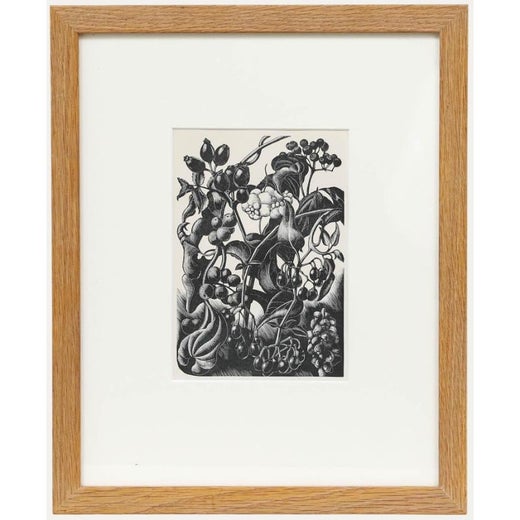
Clare Leighton
Snow Shovellers, New York — American Modernism

1929

$4,200List Price

You May Also Like

Dickie (Child in High Chair)
By Will Barnet
Located in Buffalo, NY
An original woodcut on japan paper created by master American artist Will Barnet in 1942.
Category

1940s American Modern Figurative Prints

Materials

Paper, Woodcut

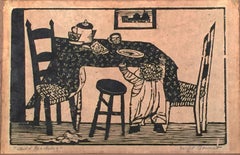
Early Morning
By Will Barnet
Located in Buffalo, NY
A nice rare woodcut by the noted American Artist Will Barnet. This woodcut is from 1939 and is titled and pencil signed on the base "Early Morning", Will...
Category

1930s American Modern Figurative Prints

Materials

Paper, Woodcut

Early Morning
$7,500
H 9 in W 15 in
Self Portrait-L.B. AET 56
By Leonard Baskin
Located in Fairlawn, OH
Self Portrait-L.B. AET 56 Color woodcut printed in black and green, 1978 Signed in pencil lower right (see photo) Edition: 150 (97/150) Condition: Excellent Image: 32 x 22” Sheet: 35...
Category

1970s American Modern Figurative Prints

Materials

Woodcut

CHILD REACHING
By Will Barnet
Located in Portland, ME
Barnet, Will. CHILD REACHING. Szoke 83, Cole 82, Johnson 65. Woodcut, 1940. Edition of 25. Titled and signed in pencil. 7 1/4 x 11 1/4 inches (image), 8 1/8 x 11 1/2 inches (sheet). ...
Category

1940s American Modern Figurative Prints

Materials

Woodcut

SLEEPING MAN (REST)
By Will Barnet
Located in Portland, ME
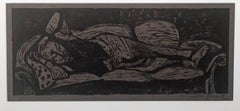
Barnet, Will. SLEEPING MAN (REST). Szoke 42, Cole 41, Johnson 40. Woodcut, 1937. Edition of 10. Titled "Sleeping Man" at left, and signed at right, both in pencil. This print is usua...
Category

1930s American Modern Figurative Prints

Materials

Woodcut

AT THE SEASHORE
By Will Barnet
Located in Portland, ME
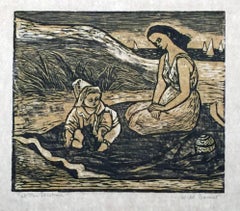
Barnet, Will. AT THE SEASHORE. Szoke 69, Cole 68, Johnson 54. Woodcut printed in black, brown and white, 1939. There was no edition, only a few proofs printed by the artist on Japane...
Category

1930s American Modern Figurative Prints

Materials

Woodcut

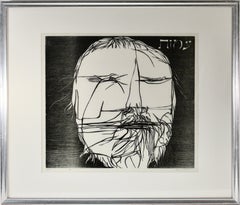
The Owl that calls upon the Night speaks the Unbeliever s ...
By Leonard Baskin
Located in San Francisco, CA
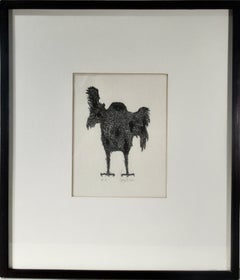
This artwork titled "The Owl that calls upon the Night speaks the Unbeliever's" 1968 is an original woodcut on Makuroko paper by noted American artist Leonard Baskin, 1922-2000. It i...
Category

Mid-20th Century American Modern Figurative Prints

Materials

Woodcut

Amos
By Leonard Baskin
Located in San Francisco, CA
This artwork titled "Amos" 1960 is an original woodcut on paper by noted American artist Leonard Baskin, 1922-2000. It is hand signed, titled and numbered 35/50in pencil by the artis...
Category

Mid-20th Century American Modern Figurative Prints

Materials

Woodcut

Amos
$950
H 23 in W 27 in D 0.75 in
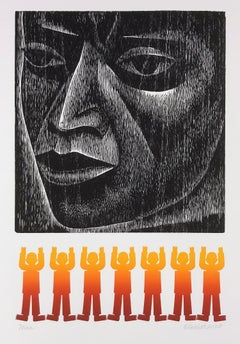
Man
By Elizabeth Catlett
Located in Missouri, MO
Elizabeth Catlett “Man” 1975 (The Print Club of Cleveland Publication Number 83, 2005) Woodcut and Color Linocut Printed in 2003 at JK Fine Art Editions Co., Union City, New Jersey Signed and Dated By The Artist Lower Right Titled Lower Left Ed. of 250 Image Size: approx 18 x 12 inches Elizabeth Catlett (1915-2012) is regarded as one of the most important women artists and African American artists of our time. She believed art could affect social change and that she should be an agent for that change: “I have always wanted my art to service black people—to reflect us, to relate to us, to stimulate us, to make us aware of our potential.” As an artist and an activist, Catlett highlighted the dignity and courage of motherhood, poverty, and the working class, returning again and again to the subject she understood best—African American women. The work below, entitled, “Man”, is "carved from a block of wood, chiseled like a relief. Catlett, a sculptor as well as a printmaker, carves figures out of wood, and so is extremely familiar with this material. For ‘Man’ she exploits the grain of the wood, allowing to to describe the texture of the skin and form vertical striations, almost scarring the image. Below this intense, three-dimensional visage parades seven boys, printed repetitively from a single linoleum block in a “rainbow roll” that changes from gold to brown. This row of brightly colored figures with bare feet, flat like a string of paper dolls, raise their arms toward the powerful depiction of the troubled man above.” Biography: Elizabeth Catlett (1915-2012) Known for abstract sculpture in bronze and marble as well as prints and paintings, particularly depicting the female figure, Elizabeth Catlett is unique for distilling African American, Native American, and Mexican art in her work. She is "considered by many to be the greatest American black sculptor". . .(Rubinstein 320) Catlett was born in Washington D.C. and later became a Mexican citizen, residing in Cuernavaca Morelos, Mexico. She spent the last 35 years of her life in Mexico. Her father, a math teacher at Tuskegee Institute in Alabama, died before she was born, but the family, including her working mother, lived in the relatively commodious home of his family in DC. Catlett received a Bachelor of Arts degree from Howard University, where there was much discussion about whether or not black artists should depict their own heritage or embrace European modernism. She earned a Master of Fine Arts degree in 1940 from the University of Iowa, where she had gone to study with Grant Wood, Regionalist* painter. His teaching dictum was "paint what you know best," and this advice set her on the path of dealing with her own background. She credits Wood with excellent teaching and deep concern for his students, but she had a problem during that time of taking classes from him because black students were not allowed housing in the University's dormitories. Following graduation in 1940, she became Chair of the Art Department at Dillard University in New Orleans. There she successfully lobbied for life classes with nude models, and gained museum admission to black students at a local museum that to that point, had banned their entrance. That same year, her painting Mother and Child, depicting African-American figures won her much recognition. From 1944 to 1946, she taught at the George Washington Carver School, an alternative community school in Harlem that provided instruction for working men and women of the city. From her experiences with these people, she did a series of paintings, prints, and sculptures with the theme "I Am a Negro Woman." In 1946, she received a Rosenwald Fellowship*, and she and her artist husband, Charles White, traveled to Mexico where she became interested in the Mexican working classes. In 1947, she settled permanently in Mexico where she, divorced from White, married artist Francisco Mora...
Category

Late 19th Century American Modern Figurative Prints

Materials

Linocut, Woodcut

Man
Price Upon Request
H 18 in W 12 in
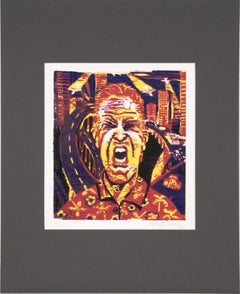
Portrait of Modern Man - Multilayer Woodblock in Ink on Paper
Located in Soquel, CA
Portrait of Anger - Multilayer Woodblock in Ink on Paper Bold and saturated woodblock print of a screaming man by Michael Dow (American, 20th Century). The man is centered in this m...
Category

1990s American Modern Figurative Prints

Materials

Paper, Ink, Woodcut

More From This Seller

View All
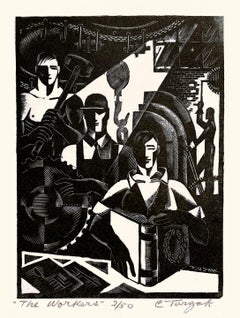
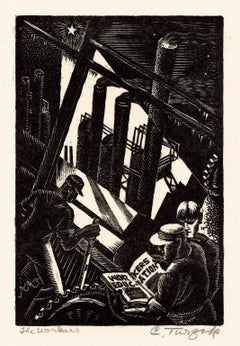
The Workers (No. 2) — 1930s WPA Modernist Woodcut
By Charles Turzak
Located in Myrtle Beach, SC
Charles Turzak, 'The Workers (No. 2)', woodcut, edition 50, c. 1935. Signed and numbered 2/50 in pencil. A fine, richly-inked impression, on cream wove Japan paper, with full margin...
Category

1930s American Modern Figurative Prints

Materials

Woodcut

The Workers (No. 1) — 1930s WPA Modernist Woodcut
By Charles Turzak
Located in Myrtle Beach, SC
Charles Turzak, 'The Workers (No. 1)', woodcut, edition c. 50, c. 1935. Signed and titled in pencil. Signed in the block, lower right. A fine, richly-inked impression, on cream wove...
Category

1930s American Modern Figurative Prints

Materials

Woodcut

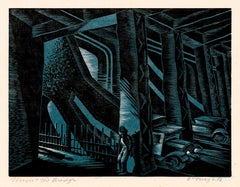
Under the Bridge — 1930s Chicago, Modernist Color Woodcut
By Charles Turzak
Located in Myrtle Beach, SC
Charles Turzak, 'Under the Bridge', color woodcut, edition c. 50, 1934. Signed and titled in pencil. A fine, richly-inked impression, with fresh colors, on cream wove Japan paper; th...
Category

1930s American Modern Figurative Prints

Materials

Woodcut

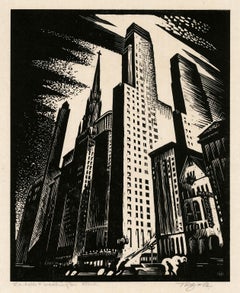
La Salle and Washington Street (Chicago, Illinois) — WPA American Modernism
By Charles Turzak
Located in Myrtle Beach, SC
Charles Turzak, 'La Salle and Washington Street (Chicago, Illinois)', woodcut, c. 1935, edition c. 25. Signed and titled in pencil. A fine, richly-inked impre...
Category

1930s American Modern Figurative Prints

Materials

Woodcut

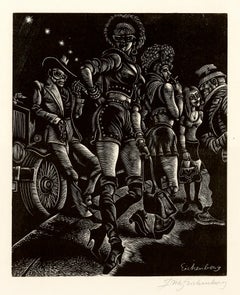
The Pimp — Graphic Modernism
By Fritz Eichenberg
Located in Myrtle Beach, SC
Fritz Eichenberg, 'The Pimp', wood engraving, 1980, artist's proof before the edition. Signed in pencil. Signed in the block, lower right. A fine, richly-inked impression, on cream wove paper, with full margins (2 3/16 to 3 1/2 inches), in excellent condition. Archivally sleeved, unmatted. Image size 12 x 9 3/4 inches (305 x 248 mm); sheet size 18 x 14 inches (457 x 356 mm). ABOUT THE ARTIST Fritz Eichenberg (1901–1990) was a German-American illustrator and arts educator who worked primarily in wood engraving. His best-known works were concerned with religion, social justice, and nonviolence. Eichenberg was born to a Jewish family in Cologne, Germany, where the destruction of World War I helped to shape his anti-war sentiments. He worked as a printer's apprentice and studied at the Municipal School of Applied Arts in Cologne and the Academy of Graphic Arts in Leipzig, where he studied under Hugo Steiner-Prag. In 1923 he moved to Berlin to begin his career as an artist, producing illustrations for books and newspapers. In his newspaper and magazine work, Eichenberg was politically outspoken and sometimes wrote and illustrated his reporting. In 1933, the rise of Adolf Hitler drove Eichenberg, who was a public critic of the Nazis, to emigrate with his wife and children to the United States. He settled in New York City, where he lived most of his life. He worked in the WPA Federal Arts Project and was a member of the Society of American Graphic Artists. In his prolific career as a book illustrator, Eichenberg portrayed many forms of literature but specialized in works with elements of extreme spiritual and emotional conflict, fantasy, or social satire. Over his long career, Eichenberg was commissioned to illustrate more than 100 classics by publishers in the United States and abroad, including works by renowned authors Dostoyevsky, Tolstoy, Charlotte and Emily Brontë, Poe, Swift, and Grimmelshausen. He also wrote and illustrated books of folklore and children's stories. Eichenberg was a long-time contributor to the progressive magazine The Nation, his illustrations appearing between 1930 and 1980. Eichenberg’s work has been featured by such esteemed publishers as The Heritage Club, Random House, Book of the Month Club, The Limited Editions Club, Kingsport Press, Aquarius Press, and Doubleday. Raised in a non-religious family, Eichenberg had been attracted to Taoism as a child. Following his wife's unexpected death in 1937, he turned briefly to Zen Buddhist meditation, then joined the Religious Society of Friends in 1940. Though he remained a Quaker until his death, Eichenberg was also associated with Catholic charity work through his friendship with Dorothy Day...
Category

1980s American Modern Figurative Prints

Materials

Woodcut

The Yankee — America s Cup, 1934
By Jacques La Grange
Located in Myrtle Beach, SC
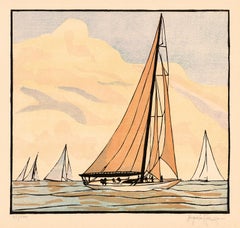
Jacques La Grange, 'The Yankee', color woodcut, edition 500, 1934. Signed and numbered '25/500' in pencil. A fine impression, with fresh colors, on cream wove paper, with margins (1 1/8 to 1 1/4 inches), in excellent condition. A work from La Grange’s celebrated series of woodcuts 'Drama and Color in the America's Cup Races'. Image size 10 x 10 11/16 inches (254 x 271 mm); sheet size 12 1/4 x 13 1/4 inches (311 x 337 mm). Archivally matted to museum standards, unframed. When the artist created this print in 1934, the 'Yankee' was one of the most promising yachts eligible for the America's Cup but ultimately 'Rainbow' was chosen to defend against England's 'Endeavor' in that year's race. The 'Endeavor' was built for Thomas Sopwith who used his aviation design expertise to ensure the yacht was the most advanced of its day with a steel hull and mast. She was launched in 1934 and won many races in her first season but the Cup challenge was blighted by a strike of Sopwith's professional crew prior to departing for America. Forced to rely mainly on keen amateurs, who lacked the necessary experience, the campaign failed. 'Rainbow' won the series 4–2. This was one of the most contentious of the America's Cup battles and prompted the headline "Britannia rules the waves and America waives the rules." ABOUT THE ARTIST Jacques La Grange was born in Clanwilliam (near Cape Town) in South Africa in 1895. He studied at London University and later immigrated to the United States. La Grange established himself as a painter, illustrator, and printmaker specializing in nautical subjects. He and his wife, Helen La Grange, published 'Drama and Color in the America's Cup Races' in 1934 and 'Clipper Ships of America and Great Britain 1833-1869', in 1936. Both were deluxe hardcover limited edition volumes with signed original color woodblock prints. La Grange had solo exhibitions at the Buchanan Gallery in 1929; the Babcock Gallery and the 56th Street Gallery, New York, in 1930; and at the Nicholas Roerich...
Category

1930s American Modern Figurative Prints

Materials

Woodcut

Still Thinking About These?

All Recently Viewed