Want more images or videos?
Request additional images or videos from the seller
1 of 10
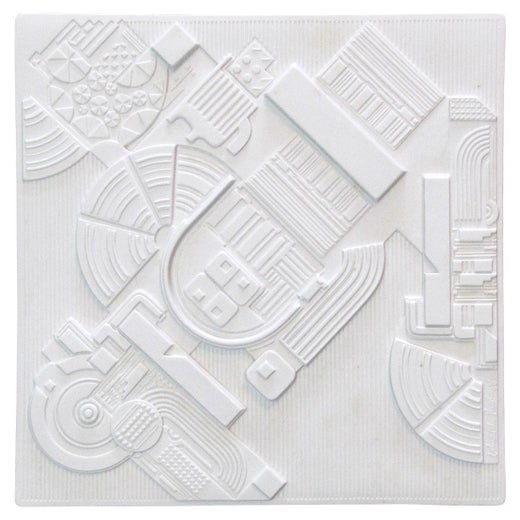
Eduardo PaolozziLots of Pictures, Lots of Fun (Pop Art Crayon Ad)1971
1971
Price:$338
About the Item
- Creator:Eduardo Paolozzi (1924 - 2005, British)
- Creation Year:1971
- Dimensions:Height: 30 in (76.2 cm)Width: 22 in (55.88 cm)
- Medium:
- Movement Style:
- Period:
- Condition:
- Gallery Location:Wilton Manors, FL
- Reference Number:1stDibs: LU24529452202
Eduardo Paolozzi
Eduardo Paolozzi (1924 – 2005) was a prolific and inventive Scottish artist most known for his marriage of Surrealism's early principles with brave new elements of popular culture, modern machinery and technology. He was raised in the shadows of World War II in a family deeply affected by the divisive nature of a country involved in conflict, which birthed his lifelong exploration into the many ways humans are influenced by external, uncontrollable forces. This exploration would come to inform a vast and various body of work that vacillated between the darker and lighter consequences of society's advancements and its so-called progress. His collages reflect the way contemporary culture and mass media influenced individual identity. Some of these, with their appropriation of American advertising's look and feel would inspire the future Pop art movement.
About the Seller
4.9
Platinum Seller
Premium sellers with a 4.7+ rating and 24-hour response times
Established in 2007
1stDibs seller since 2015
449 sales on 1stDibs
Typical response time: 2 hours
Authenticity Guarantee
In the unlikely event there’s an issue with an item’s authenticity, contact us within 1 year for a full refund. DetailsMoney-Back Guarantee
If your item is not as described, is damaged in transit, or does not arrive, contact us within 7 days for a full refund. Details24-Hour Cancellation
You have a 24-hour grace period in which to reconsider your purchase, with no questions asked.Vetted Professional Sellers
Our world-class sellers must adhere to strict standards for service and quality, maintaining the integrity of our listings.Price-Match Guarantee
If you find that a seller listed the same item for a lower price elsewhere, we’ll match it.Trusted Global Delivery
Our best-in-class carrier network provides specialized shipping options worldwide, including custom delivery.You May Also Like
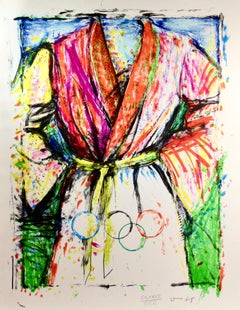
"Olympic Robe" Large colors lithograph
By Jim Dine
Located in San Francisco, CA
This artwork titled "Olympic Robe" From "Game of the XXIVth Olympic, Seoul" is an original colors lithograph on Wove paper by renown artist Jim Dine, b.1935. It is hand signed and nu...
Category
Late 20th Century Pop Art Figurative Prints
Materials
Lithograph
Anne
By Robert Indiana
Located in San Francisco, CA
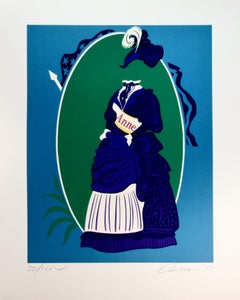
Artist: Robert Indiana (American, born 1928)
Title: "Anne"
Year: 1977
Medium: Original color lithograph
Edition: Numbered 32/150 in pencil
Paper: Arches
Image size: 18 x 14 inches
paper size: 23.65 x 19.5 inches
Signature: Hand signed in pencil by the artist
Publisher: Leon Amiel, New York
Printer: Fernand Mourlot, Paris
Condition: It is in excellent condition, has never been framed.
Description: From the suite "The Mother of All Us"
About the artist:
Robert Indiana was born in New Castle, Indiana, in 1928. His family name was Clark but he adopted the name of his native state early in his career. His father worked for a Phillips 66 gas station and his mother ran a diner. He began his studies in art in 1945 at the Herron School of Art in Indianapolis and then at the Munson-Williams-Proctor Institute in Utica, New York. He then moved to Chicago and continued his studies at the School of the Art Institute of Chicago. He also studied at the Skowhgan School of Painting and Sculpture in Maine, the Edinburgh College of Art and London University, eventually moving to New York City in 1956.
A major Pop Artist, his work is characterized by the use of words and relatively flat paint with no brush strokes. This cold and somewhat mechanical approach to painting in which the words are often stenciled into the design probably was influenced by street signs, pinball machines, the commercial stenciling process used in printing and advertisements. In fact, Indiana calls himself "a painter of signs". He uses the common everyday symbols and words of America and paints them as brilliantly colored pop art paintings. His work comments in an ironic fashion on American life and culture, often making pointed political statements about American society.
The words in his painting are usually simple and short words, sometimes with clear meaning and other times arranged in an ambiguous fashion to project multiple meanings, and occasionally involve puns. It is interesting to try to put his "words" together to get a sense of the meaning. For instance, in The Triumph of Tira, painted in, 1960-61, the artist presents four circles with four squares inside them and four stars inside the squares. There is one word in each star. The upper left says "Law"; the upper right says "Cat"; the lower left says "Men"; and the lower right says "Sex." Of course it is hard to understand the relationship between the words, and as you begin to speculate on what it might mean, a number of possible interpretations evolve.
Other works have more obvious meanings, sometimes political. One painting shows an outline of the State of Alabama with Selma marked in the right location. The words "Just as in the anatomy of man, every nation must have its hind part", are stenciled around the map. This is a reference to the march on Selma, which was an important event in the Civil Rights Movement during the 60's.
Indiana's most famous painting is of the word "Love". It is painted with the LO on the top and VE on the bottom. This painting was used as a design for an American postage stamp in 1973, which became very popular. Since then there have been a number of other American stamps with the word love on them, but Indiana's was the first. In addition to the stamp, the image was reproduced countless times during the 70s, as poster, candles, t-shirts and many other items.
Indiana continues to work as an artist and recently (2000) released a print with the image 2000 on it arranged in a pattern similar to that of the LOVE design.
The work of Robert Indians...
Category
1970s Pop Art Figurative Prints
Materials
Lithograph
Jo the Loiterer
By Robert Indiana
Located in San Francisco, CA
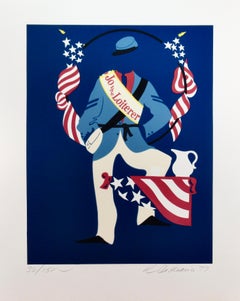
Artist: Robert Indiana (American, born 1928)
Title: "Jo the Loiterer"
Year: 1977
Medium: Original color lithograph
Edition: Numbered 32/150 in pencil
Paper: Arches
Image size: 18 x 14 inches
paper size: 23.65 x 19.5 inches
Signature: Hand signed in pencil by the artist
Publisher: Leon Amiel, New York
Printer: Fernand Mourlot, Paris
Condition: It is in excellent condition, has never been framed.
Description: From the suite "The Mother of All Us"
About the artist:
Robert Indiana was born in New Castle, Indiana, in 1928. His family name was Clark but he adopted the name of his native state early in his career. His father worked for a Phillips 66 gas station and his mother ran a diner. He began his studies in art in 1945 at the Herron School of Art in Indianapolis and then at the Munson-Williams-Proctor Institute in Utica, New York. He then moved to Chicago and continued his studies at the School of the Art Institute of Chicago. He also studied at the Skowhgan School of Painting and Sculpture in Maine, the Edinburgh College of Art and London University, eventually moving to New York City in 1956.
A major Pop Artist, his work is characterized by the use of words and relatively flat paint with no brush strokes. This cold and somewhat mechanical approach to painting in which the words are often stenciled into the design probably was influenced by street signs, pinball machines, the commercial stenciling process used in printing and advertisements. In fact, Indiana calls himself "a painter of signs". He uses the common everyday symbols and words of America and paints them as brilliantly colored pop art paintings. His work comments in an ironic fashion on American life and culture, often making pointed political statements about American society.
The words in his painting are usually simple and short words, sometimes with clear meaning and other times arranged in an ambiguous fashion to project multiple meanings, and occasionally involve puns. It is interesting to try to put his "words" together to get a sense of the meaning. For instance, in The Triumph of Tira, painted in, 1960-61, the artist presents four circles with four squares inside them and four stars inside the squares. There is one word in each star. The upper left says "Law"; the upper right says "Cat"; the lower left says "Men"; and the lower right says "Sex." Of course it is hard to understand the relationship between the words, and as you begin to speculate on what it might mean, a number of possible interpretations evolve.
Other works have more obvious meanings, sometimes political. One painting shows an outline of the State of Alabama with Selma marked in the right location. The words "Just as in the anatomy of man, every nation must have its hind part", are stenciled around the map. This is a reference to the march on Selma, which was an important event in the Civil Rights Movement during the 60's.
Indiana's most famous painting is of the word "Love". It is painted with the LO on the top and VE on the bottom. This painting was used as a design for an American postage stamp...
Category
1970s Pop Art Figurative Prints
Materials
Lithograph
Jenny Reefer
By Robert Indiana
Located in San Francisco, CA
Artist: Robert Indiana (American, born 1928)
Title: "Jenny Reefer"
Year: 1977
Medium: Original color lithograph
Edition: Numbered 32/150 in pencil
Paper: Arches
Image size: 18 x 14 inches
paper size: 23.65 x 19.5 inches
Signature: Hand signed in pencil by the artist
Publisher: Leon Amiel, New York
Printer: Fernand Mourlot, Paris
Condition: It is in excellent condition, has never been framed.
Description: From the suite "The Mother of All Us"
About the artist:
Robert Indiana was born in New Castle, Indiana, in 1928. His family name was Clark but he adopted the name of his native state early in his career. His father worked for a Phillips 66 gas station and his mother ran a diner. He began his studies in art in 1945 at the Herron School of Art in Indianapolis and then at the Munson-Williams-Proctor Institute in Utica, New York. He then moved to Chicago and continued his studies at the School of the Art Institute of Chicago. He also studied at the Skowhgan School of Painting and Sculpture in Maine, the Edinburgh College of Art and London University, eventually moving to New York City in 1956.
A major Pop Artist, his work is characterized by the use of words and relatively flat paint with no brush strokes. This cold and somewhat mechanical approach to painting in which the words are often stenciled into the design probably was influenced by street signs, pinball machines, the commercial stenciling process used in printing and advertisements. In fact, Indiana calls himself "a painter of signs". He uses the common everyday symbols and words of America and paints them as brilliantly colored pop art paintings. His work comments in an ironic fashion on American life and culture, often making pointed political statements about American society.
The words in his painting are usually simple and short words, sometimes with clear meaning and other times arranged in an ambiguous fashion to project multiple meanings, and occasionally involve puns. It is interesting to try to put his "words" together to get a sense of the meaning. For instance, in The Triumph of Tira, painted in, 1960-61, the artist presents four circles with four squares inside them and four stars inside the squares. There is one word in each star. The upper left says "Law"; the upper right says "Cat"; the lower left says "Men"; and the lower right says "Sex." Of course it is hard to understand the relationship between the words, and as you begin to speculate on what it might mean, a number of possible interpretations evolve.
Other works have more obvious meanings, sometimes political. One painting shows an outline of the State of Alabama with Selma marked in the right location. The words "Just as in the anatomy of man, every nation must have its hind part", are stenciled around the map. This is a reference to the march on Selma, which was an important event in the Civil Rights Movement during the 60's.
Indiana's most famous painting is of the word "Love". It is painted with the LO on the top and VE on the bottom. This painting was used as a design for an American postage stamp...
Category
1970s Pop Art Figurative Prints
Materials
Lithograph
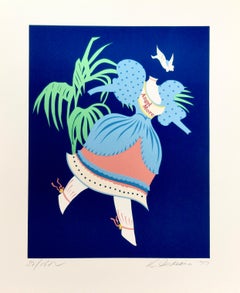
Angel More
By Robert Indiana
Located in San Francisco, CA
Artist: Robert Indiana (American, born 1928)
Title: Angel More
Year: 1977
Medium: Original color lithograph
Edition: Numbered 32/150 in pencil
Paper: Arches
Image size: 18 x ...
Category
1970s Pop Art Figurative Prints
Materials
Lithograph
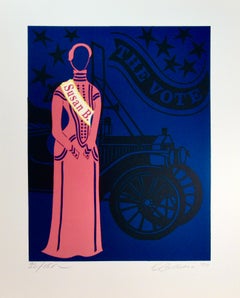
Susan B.
By Robert Indiana
Located in San Francisco, CA
Artist: Robert Indiana (American, born 1928)
Title: "ISusan B."
Year: 1977
Medium: Original color lithograph
Edition: Numbered 32/150 in pencil
Paper: Arches
Image size: 18 x 14 inches
paper size: 23.65 x 19.5 inches
Signature: Hand signed in pencil by the artist
Publisher: Leon Amiel, New York
Printer: Fernand Mourlot, Paris
Condition: It is in excellent condition, has never been framed.
Description: From the suite "The Mother of All Us"
About the artist:
Robert Indiana was born in New Castle, Indiana, in 1928. His family name was Clark but he adopted the name of his native state early in his career. His father worked for a Phillips 66 gas station and his mother ran a diner. He began his studies in art in 1945 at the Herron School of Art in Indianapolis and then at the Munson-Williams-Proctor Institute in Utica, New York. He then moved to Chicago and continued his studies at the School of the Art Institute of Chicago. He also studied at the Skowhgan School of Painting and Sculpture in Maine, the Edinburgh College of Art and London University, eventually moving to New York City in 1956.
A major Pop Artist, his work is characterized by the use of words and relatively flat paint with no brush strokes. This cold and somewhat mechanical approach to painting in which the words are often stenciled into the design probably was influenced by street signs, pinball machines, the commercial stenciling process used in printing and advertisements. In fact, Indiana calls himself "a painter of signs". He uses the common everyday symbols and words of America and paints them as brilliantly colored pop art paintings. His work comments in an ironic fashion on American life and culture, often making pointed political statements about American society.
The words in his painting are usually simple and short words, sometimes with clear meaning and other times arranged in an ambiguous fashion to project multiple meanings, and occasionally involve puns. It is interesting to try to put his "words" together to get a sense of the meaning. For instance, in The Triumph of Tira, painted in, 1960-61, the artist presents four circles with four squares inside them and four stars inside the squares. There is one word in each star. The upper left says "Law"; the upper right says "Cat"; the lower left says "Men"; and the lower right says "Sex." Of course it is hard to understand the relationship between the words, and as you begin to speculate on what it might mean, a number of possible interpretations evolve.
Other works have more obvious meanings, sometimes political. One painting shows an outline of the State of Alabama with Selma marked in the right location. The words "Just as in the anatomy of man, every nation must have its hind part", are stenciled around the map. This is a reference to the march on Selma, which was an important event in the Civil Rights Movement during the 60's.
Indiana's most famous painting is of the word "Love". It is painted with the LO on the top and VE on the bottom. This painting was used as a design for an American postage stamp...
Category
1970s Pop Art Figurative Prints
Materials
Lithograph
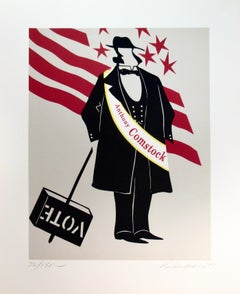
Anthony Comstock
By Robert Indiana
Located in San Francisco, CA
Artist: Robert Indiana (American, born 1928)
Title: "Anthony Comstock"
Year: 1977
Medium: Original color lithograph
Edition: Numbered 32/150 in pencil
Paper: Arches
Image size: 18 x 14 inches
paper size: 23.65 x 19.5 inches
Signature: Hand signed in pencil by the artist
Publisher: Leon Amiel, New York
Printer: Fernand Mourlot, Paris
Condition: It is in excellent condition, has never been framed.
Description: From the suite "The Mother of All Us"
About the artist:
Robert Indiana was born in New Castle, Indiana, in 1928. His family name was Clark but he adopted the name of his native state early in his career. His father worked for a Phillips 66 gas station and his mother ran a diner. He began his studies in art in 1945 at the Herron School of Art in Indianapolis and then at the Munson-Williams-Proctor Institute in Utica, New York. He then moved to Chicago and continued his studies at the School of the Art Institute of Chicago. He also studied at the Skowhgan School of Painting and Sculpture in Maine, the Edinburgh College of Art and London University, eventually moving to New York City in 1956.
A major Pop Artist, his work is characterized by the use of words and relatively flat paint with no brush strokes. This cold and somewhat mechanical approach to painting in which the words are often stenciled into the design probably was influenced by street signs, pinball machines, the commercial stenciling process used in printing and advertisements. In fact, Indiana calls himself "a painter of signs". He uses the common everyday symbols and words of America and paints them as brilliantly colored pop art paintings. His work comments in an ironic fashion on American life and culture, often making pointed political statements about American society.
The words in his painting are usually simple and short words, sometimes with clear meaning and other times arranged in an ambiguous fashion to project multiple meanings, and occasionally involve puns. It is interesting to try to put his "words" together to get a sense of the meaning. For instance, in The Triumph of Tira, painted in, 1960-61, the artist presents four circles with four squares inside them and four stars inside the squares. There is one word in each star. The upper left says "Law"; the upper right says "Cat"; the lower left says "Men"; and the lower right says "Sex." Of course it is hard to understand the relationship between the words, and as you begin to speculate on what it might mean, a number of possible interpretations evolve.
Other works have more obvious meanings, sometimes political. One painting shows an outline of the State of Alabama with Selma marked in the right location. The words "Just as in the anatomy of man, every nation must have its hind part", are stenciled around the map. This is a reference to the march on Selma, which was an important event in the Civil Rights Movement during the 60's.
Indiana's most famous painting is of the word "Love". It is painted with the LO on the top and VE on the bottom. This painting was used as a design for an American postage stamp...
Category
1970s Pop Art Figurative Prints
Materials
Lithograph
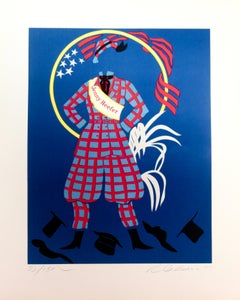
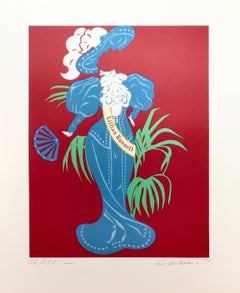
Lillian Russell
By Robert Indiana
Located in San Francisco, CA
Artist: Robert Indiana (American, born 1928)
Title: "Lillian Russell"
Year: 1977
Medium: Original color lithograph
Edition: Numbered 32/150 in pencil
Paper: Arches
Image size: ...
Category
1970s Pop Art Figurative Prints
Materials
Lithograph
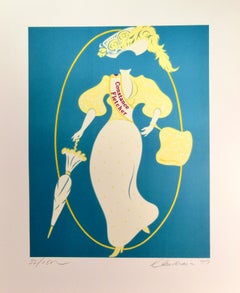
Constance Fletcher
By Robert Indiana
Located in San Francisco, CA
Artist: Robert Indiana (American, born 1928)
Title: "Constance Fletcher"
Year: 1977
Medium: Original color lithograph
Edition: Numbered 32/150 in pencil
Paper: Arches
Image size: 18 x 14 inches
paper size: 23.65 x 19.5 inches
Signature: Hand signed in pencil by the artist
Publisher: Leon Amiel, New York
Printer: Fernand Mourlot, Paris
Condition: It is in excellent condition, has never been framed.
Description: From the suite "The Mother of All Us"
About the artist:
Robert Indiana was born in New Castle, Indiana, in 1928. His family name was Clark but he adopted the name of his native state early in his career. His father worked for a Phillips 66 gas station and his mother ran a diner. He began his studies in art in 1945 at the Herron School of Art in Indianapolis and then at the Munson-Williams-Proctor Institute in Utica, New York. He then moved to Chicago and continued his studies at the School of the Art Institute of Chicago. He also studied at the Skowhgan School of Painting and Sculpture in Maine, the Edinburgh College of Art and London University, eventually moving to New York City in 1956.
A major Pop Artist, his work is characterized by the use of words and relatively flat paint with no brush strokes. This cold and somewhat mechanical approach to painting in which the words are often stenciled into the design probably was influenced by street signs, pinball machines, the commercial stenciling process used in printing and advertisements. In fact, Indiana calls himself "a painter of signs". He uses the common everyday symbols and words of America and paints them as brilliantly colored pop art paintings. His work comments in an ironic fashion on American life and culture, often making pointed political statements about American society.
The words in his painting are usually simple and short words, sometimes with clear meaning and other times arranged in an ambiguous fashion to project multiple meanings, and occasionally involve puns. It is interesting to try to put his "words" together to get a sense of the meaning. For instance, in The Triumph of Tira, painted in, 1960-61, the artist presents four circles with four squares inside them and four stars inside the squares. There is one word in each star. The upper left says "Law"; the upper right says "Cat"; the lower left says "Men"; and the lower right says "Sex." Of course it is hard to understand the relationship between the words, and as you begin to speculate on what it might mean, a number of possible interpretations evolve.
Other works have more obvious meanings, sometimes political. One painting shows an outline of the State of Alabama with Selma marked in the right location. The words "Just as in the anatomy of man, every nation must have its hind part", are stenciled around the map. This is a reference to the march on Selma, which was an important event in the Civil Rights Movement during the 60's.
Indiana's most famous painting is of the word "Love". It is painted with the LO on the top and VE on the bottom. This painting was used as a design for an American postage stamp...
Category
1970s Pop Art Figurative Prints
Materials
Lithograph
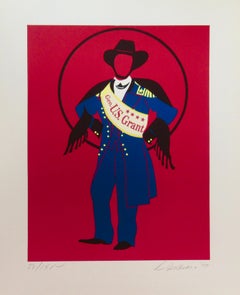
General U.S. Grant
By Robert Indiana
Located in San Francisco, CA
Artist: Robert Indiana (American, born 1928)
Title: General U.S. Grant
Year: 1977
Medium: Original color lithograph
Edition: Numbered 32/150 in pencil
Paper: Arches
Image size: 18 x 14 inches
paper size: 23.65 x 19.5 inches
Signature: Hand signed in pencil by the artist
Publisher: Leon Amiel, New York
Printer: Fernand Mourlot, Paris
Condition: It is in excellent condition, has never been framed.
Description: From the suite "The Mother of All Us"
About the artist:
Robert Indiana was born in New Castle, Indiana, in 1928. His family name was Clark but he adopted the name of his native state early in his career. His father worked for a Phillips 66 gas station and his mother ran a diner. He began his studies in art in 1945 at the Herron School of Art in Indianapolis and then at the Munson-Williams-Proctor Institute in Utica, New York. He then moved to Chicago and continued his studies at the School of the Art Institute of Chicago. He also studied at the Skowhgan School of Painting and Sculpture in Maine, the Edinburgh College of Art and London University, eventually moving to New York City in 1956.
A major Pop Artist, his work is characterized by the use of words and relatively flat paint with no brush strokes. This cold and somewhat mechanical approach to painting in which the words are often stenciled into the design probably was influenced by street signs, pinball machines, the commercial stenciling process used in printing and advertisements. In fact, Indiana calls himself "a painter of signs". He uses the common everyday symbols and words of America and paints them as brilliantly colored pop art paintings. His work comments in an ironic fashion on American life and culture, often making pointed political statements about American society.
The words in his painting are usually simple and short words, sometimes with clear meaning and other times arranged in an ambiguous fashion to project multiple meanings, and occasionally involve puns. It is interesting to try to put his "words" together to get a sense of the meaning. For instance, in The Triumph of Tira, painted in, 1960-61, the artist presents four circles with four squares inside them and four stars inside the squares. There is one word in each star. The upper left says "Law"; the upper right says "Cat"; the lower left says "Men"; and the lower right says "Sex." Of course it is hard to understand the relationship between the words, and as you begin to speculate on what it might mean, a number of possible interpretations evolve.
Other works have more obvious meanings, sometimes political. One painting shows an outline of the State of Alabama with Selma marked in the right location. The words "Just as in the anatomy of man, every nation must have its hind part", are stenciled around the map. This is a reference to the march on Selma, which was an important event in the Civil Rights Movement during the 60's.
Indiana's most famous painting is of the word "Love". It is painted with the LO on the top and VE on the bottom. This painting was used as a design for an American postage stamp...
Category
1970s Pop Art Figurative Prints
Materials
Lithograph
More From This Seller
View AllMalach
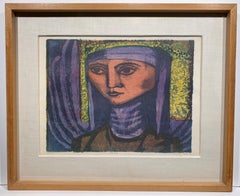
By Jerome Kaplan
Located in Wilton Manors, FL
Jerome Kaplan (1920-1997). Malach (Angel), 1952. Lithograph on wove paper. Image measures 15 x 19 inches; 23 x 28 inches in custom shadowbox frame with custom beveled linen matting. ...
Category
Mid-20th Century Abstract Abstract Prints
Materials
Lithograph
$400 Sale Price
20% Off
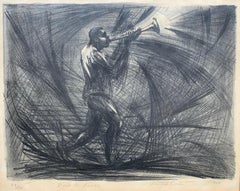
Didn
t He Ramble? (Jazz Musician Trumpet Player)
Located in Wilton Manors, FL
Whitford Carter (1915-1973). Didn't He Ramble?, 1964. Lithograph on paper, image measures 13 x 17 inches; 19 x 22 inches in original frame. Signed, dat...
Category
Mid-20th Century American Realist Figurative Prints
Materials
Lithograph
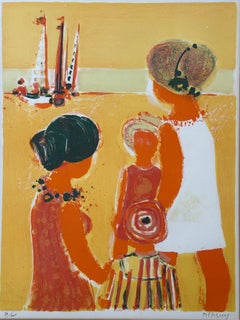
En Allant a la Plage (Beach Landscape w/ Boats France)
By Frederic Menguy
Located in Wilton Manors, FL
Frederic Menguy (1927-2007)
En Allant a la Plage (Beach Landscape w/ Boats France)
Lithograph, image measures 16 x 21 inches.
The piece is sold unframed and will require replaceme...
Category
Mid-20th Century Abstract Figurative Prints
Materials
Lithograph
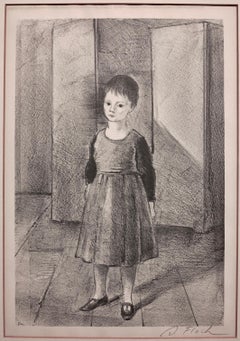
Portrait of a Young Girl (the artist
s daughter).
By Joseph Floch
Located in Wilton Manors, FL
Joseph Floch (1894-1977). Young Girl, c.1930s. Lithograph on paper, plate measures 9 1/8 x 13 3/4 inches. Measures 17 x 21 inches framed. Excellent condition with no damage or conser...
Category
1930s Realist Figurative Prints
Materials
Lithograph
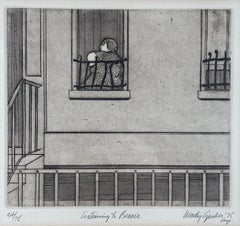
Listening to Bessie Smith
Located in Wilton Manors, FL
Woody Gruber (1946-2022)
Listening to Bessie, 1975.
Etching on paper, plate measures 7 inches h. x 7.75 w.
Overall framed measurement in 14 x 15 inches.
Numbered, titled, signed ...
Category
1970s Realist Figurative Prints
Materials
Etching
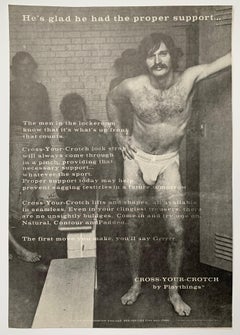
Undergarment Model (1970s Gay Bathhouse Jockstrap Ad)
Located in Wilton Manors, FL
Vintage jockstrap ad poster, 1975. Offset lithograph on paper measures 18.5 x 12.75 inches. Copyright Winifred Bonney. Original offset period print on perio...
Category
1970s Realist Figurative Prints
Materials
Offset
$1,170 Sale Price
35% Off
Still Thinking About These?
All Recently ViewedMore Ways To Browse
National Brass And Iron Works
Long Evening Gloves
Manuel Reyes
Mao Tse Tung
Maurice Barraud
Michael Gates
Minnie Evans
Moose Oil Painting
Nude In Stockings
Nyc Street Sign
Ocean Liner Poster
Oil Painting Of Parrots
Oil Paintings Of Stags
Osprey Painting
Paintings By Chase
Paintings Of Donkeys
Paintings Of Tall Ships
Pathe Poster