Want more images or videos?
Request additional images or videos from the seller
1 of 8
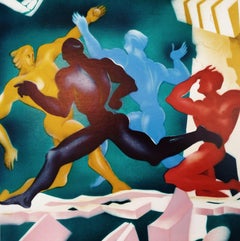
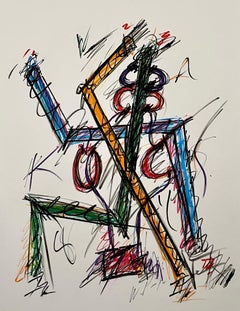
Ernst NeizvestnyLithograph Screenprint Male Heroic Figures
$1,100List Price
About the Item
- Creator:Ernst Neizvestny (1926 - 2016, Russian)
- Dimensions:Height: 24.5 in (62.23 cm)Width: 17.5 in (44.45 cm)
- Medium:
- Movement Style:
- Period:
- Condition:
- Gallery Location:Surfside, FL
- Reference Number:1stDibs: LU38211400442
About the Seller
4.9
Platinum Seller
Premium sellers with a 4.7+ rating and 24-hour response times
Established in 1995
1stDibs seller since 2014
1,846 sales on 1stDibs
Authenticity Guarantee
In the unlikely event there’s an issue with an item’s authenticity, contact us within 1 year for a full refund. DetailsMoney-Back Guarantee
If your item is not as described, is damaged in transit, or does not arrive, contact us within 7 days for a full refund. Details24-Hour Cancellation
You have a 24-hour grace period in which to reconsider your purchase, with no questions asked.Vetted Professional Sellers
Our world-class sellers must adhere to strict standards for service and quality, maintaining the integrity of our listings.Price-Match Guarantee
If you find that a seller listed the same item for a lower price elsewhere, we’ll match it.Trusted Global Delivery
Our best-in-class carrier network provides specialized shipping options worldwide, including custom delivery.You May Also Like
“Marcel Marceau Mime”
By Marcel Marceau
Located in Southampton, NY
Original artist signed colored lithograph by the well known French actor, artist and mime, Marcel Marceau. Circa 1975. Condition is very good Edition:, 112/275; signed in pencil lowe...
Category
1970s Post-Modern Figurative Prints
Materials
Archival Paper, Lithograph
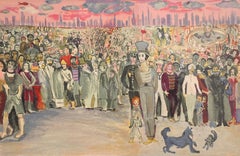
The boy 1/17. 1983. Paper, lithography, 39x51 cm
Located in Riga, LV
The boy
1/17. 1983. Paper, lithography, 39x51 cm
The artwork was published in the catalog - "Baņuta Ancāne. Personālizstāde ''Rīgas galerijā''. 30.09.-11.10.2003" Publisher: Neputn...
Category
1980s Post-Modern Portrait Prints
Materials
Paper, Lithograph
$766 Sale Price
20% Off
H 15.36 in W 20.08 in D 0.79 in
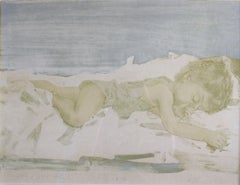
Amsterdam Signed Limited Edition Lithograph Large
By Ernesto
Located in Rochester Hills, MI
Artist Name: Ernesto Amsterdam
Title: Capturing the Essence of Amsterdam:
Medium Type: Lithograph on Arches Archival Pape
Size-Width Size-Height: 46½'' x 28¾'' inches
Signed Edit...
Category
1990s Post-Modern Figurative Prints
Materials
Lithograph
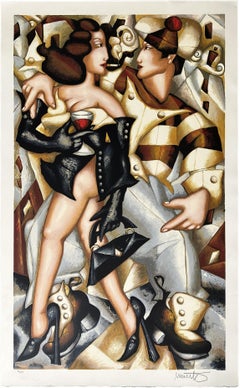
Beach
By Marcia Marx
Located in Long Island City, NY
Artist: Marcia Marx, American (1931 - 2005)
Title: Beach
Year: circa 1975
Medium: Lithograph, signed and numbered in pencil
Edition: 250
Paper Size: 25 x 38 inches
Category
Late 20th Century Post-Modern Figurative Prints
Materials
Lithograph
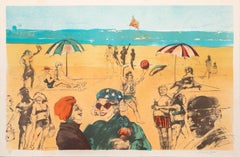
Original Dali Fantasy of the seasons Lithograph
By Salvador Dali and Philippe Halsman
Located in Pasadena, CA
Salvador Dalí (Spanish, 1904-1989)
Date: Circa 1982
Medium: Offset lithograph in color on paper
Edition: Limited edition, typically 100 copies; this one is numbered EA
Signature:...
Category
1970s Post-Modern Figurative Prints
Materials
Lithograph
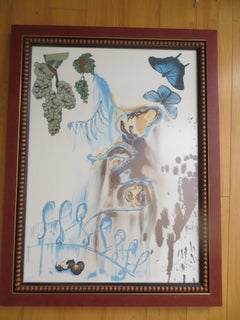
20th century color lithograph French winter scene female figures trees leaves
By Francois Batet
Located in Milwaukee, WI
"Promenade sous les Arbres (Walk under the Trees)" is an original color lithograph by Francois Batet, signed in the lower right and numbered in the lower left. At the center of the p...
Category
1980s Post-Modern Figurative Prints
Materials
Lithograph
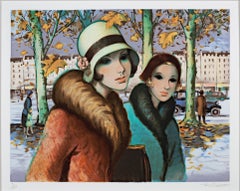
$2,430
H 31.5 in W 36.5 in
20th century color lithograph French scene female figures river umbrellas
By Francois Batet
Located in Milwaukee, WI
"Sur les Ponts de Paris" (Bridges of Paris) is an original color lithograph by Francois Batet, signed on the lower right corner. Three women in stylish 20's fashion cruise by in the ...
Category
1980s Post-Modern Figurative Prints
Materials
Lithograph

$2,430
H 19 in W 22.75 in
From Portfolio "Twilight" with Karin Szekessy
By Paul Wunderlich
Located in Kansas City, MO
Paul Wunderlich
From Portfolio "Twilight" with Karin Szekessy
Year: 1971
Medium: Color Lithograph
Edition: 125
Size: 33 x 25 in.
Publisher: A.A.A., New ...
Category
1970s Post-Modern Prints and Multiples
Materials
Lithograph
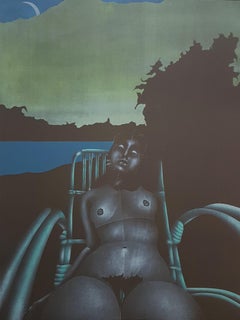
$490 Sale Price
30% Off
H 33 in W 25 in
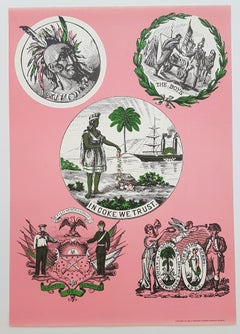
In Coke we trust
By Lothar-Günther Buchheim
Located in Kansas City, MO
Lothar Gunther Buchheim (* 1918 † 2007)
Title: In Coke we trust
Color lithograph
Year: 1968
Size: 24.0 × 16.8 inches
Lothar-Günther Buchheim (February ...
Category
1960s Post-Modern Prints and Multiples
Materials
Lithograph
Desiree Calderon
By Agent X
Located in Kansas City, MO
Agent X
Title : Desiree Calderon
Year: 2019
Medium: Digital Print
Signed
Edition: 125
70 x 70 inches
Agent X, cultural explorer and agent of the unknown, is an emerging artist who c...
Category
2010s Post-Modern Prints and Multiples
Materials
Lithograph, Offset
More From This Seller
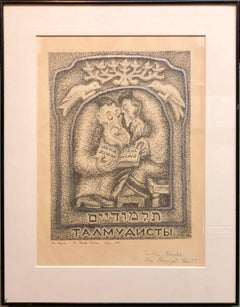
View AllThe Talmudists Post Soviet Non Conformist Avant Garde Judaica Lithograph
By Alek Rapoport
Located in Surfside, FL
Dimensions w/Frame: 18.5 X 14.5
Alek Rapoport (November 24, 1933, Kharkiv, Ukraine SSR – February 4, 1997, San Francisco) was a Russian Nonconformist artist, art theorist and teacher.
Alek Rapoport spent his childhood in Kiev (Ukraine SSR). During Stalin's "purges" both his parents were arrested. His father was shot and his mother spent ten years in a Siberian labor camp. Rapoport lived with his aunt. At the beginning of World War II, he was evacuated to the city of Ufa (the Bashkir Autonomous Soviet Socialist Republic). A time of extreme loneliness, cold, hunger and deprivation, this period also marked the beginning of Rapoport's drawing studies.
After the war, Rapoport lived in Chernovtsy (Western Ukraine), a city with a certain European flair. At the local House of Folk Arts, he found his first art teacher, E.Sagaidachny (1886–1961), a former member of the nonconformist artist groups Union of the Youth (Soyuz Molodyozhi) and Donkey's Tail, popular during the 1910s–1920s. His other art teacher was I. Beklemisheva (1903–1988). Impressed by Rapoport's talent, she later (1950) organized his move to Leningrad, where he entered the famous V.Serov School of Art (the former School of the Imperial Society for the Promotion of Arts, OPKh, later the Tavricheskaya Art School).
His association with this school lasted eight years, first as a student, and then, from 1965 to 1968, as a teacher. With "Socialist realism" the only official style during this time, most of the art school's faculty had to conceal any prior involvement in non-conformist art movements. Ya.K.Shablovsky, V.M.Sudakov, A.A.Gromov introduced their students to Constructivism only through clandestine means.
(1959–1963) Rapoport studied stage design at the Leningrad Institute of Theater, Music and Cinema under the supervision of the famous artist and stage director N.P.Akimov. Akimov taught a unique course based on theories of Russian Suprematism and Constructivism, while encouraging his graduate students to apply their knowledge to every field of art design. Despite differences in personal artistic taste with Akimov, who was drawn to Vermeer and Dalí, Rapoport was influenced by Akimov's personality and liberalism, as well as the logical style of his art.
In 1963, Rapoport graduated from the institute. His highly acclaimed MFA work involved the stage and costume design for I.Babel's play Sunset. In preparation, he traveled to the southwest regions of the Soviet Union, where he accumulated many objects of Judaic iconography from former ghettos, disappearing synagogues and old cemeteries. He wandered Odessa in search of Babel's characters and the atmosphere of his books.
He organized a new liberal course in technical aesthetics, introducing his students to Lotman's theory of semiotics, the Modulor of Le Corbusier, the Bauhaus school, Russian Constructivism, Russian icons and contemporary Western art. As a result of his "radicalism," Rapoport was fired for "ideological conspiracy."
He sought to cultivate himself as Jewish artist. This became particularly noticeable after the Six-Day War, when the Israeli victory led intellectuals, including the Jewish intelligentsia, to feel a heightened interest in Jewish culture and its Biblical roots. Rapoport's works of this period include Three Figures, a series of images of Talmudic Scholars, and works dealing with anti-Semitism. In the 1970s Rapoport joined the non-conformist movement, which opposed the dogmas of "Socialist realism" in art, along with Soviet censorship. The movement sought to preserve the traditions of Russian iconography...
Category
1970s Post-Modern Figurative Prints
Materials
Lithograph
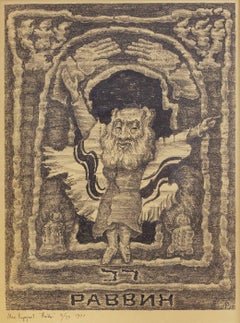
The Rabbi 1977 Soviet Non Conformist Avant Garde Print
By Alek Rapoport
Located in Surfside, FL
Dimensions w/Frame: 25 3/4" x 20 3/4"
Alek Rapoport (November 24, 1933, Kharkiv, Ukraine SSR – February 4, 1997, San Francisco) was a Russian Nonconformist artist, art theorist and teacher.
Alek Rapoport spent his childhood in Kiev (Ukraine SSR). During Stalin's "purges" both his parents were arrested. His father was shot and his mother spent ten years in a Siberian labor camp. Rapoport lived with his aunt. At the beginning of World War II, he was evacuated to the city of Ufa (the Bashkir Autonomous Soviet Socialist Republic). A time of extreme loneliness, cold, hunger and deprivation, this period also marked the beginning of Rapoport's drawing studies.
After the war, Rapoport lived in Chernovtsy (Western Ukraine), a city with a certain European flair. At the local House of Folk Arts, he found his first art teacher, E.Sagaidachny (1886–1961), a former member of the nonconformist artist groups Union of the Youth (Soyuz Molodyozhi) and Donkey's Tail, popular during the 1910s–1920s. His other art teacher was I. Beklemisheva (1903–1988). Impressed by Rapoport's talent, she later (1950) organized his move to Leningrad, where he entered the famous V.Serov School of Art (the former School of the Imperial Society for the Promotion of Arts, OPKh, later the Tavricheskaya Art School).
His association with this school lasted eight years, first as a student, and then, from 1965 to 1968, as a teacher. With "Socialist realism" the only official style during this time, most of the art school's faculty had to conceal any prior involvement in non-conformist art movements. Ya.K.Shablovsky, V.M.Sudakov, A.A.Gromov introduced their students to Constructivism only through clandestine means.
(1959–1963) Rapoport studied stage design at the Leningrad Institute of Theater, Music and Cinema under the supervision of the famous artist and stage director N.P.Akimov. Akimov taught a unique course based on theories of Russian Suprematism and Constructivism, while encouraging his graduate students to apply their knowledge to every field of art design. Despite differences in personal artistic taste with Akimov, who was drawn to Vermeer and Dalí, Rapoport was influenced by Akimov's personality and liberalism, as well as the logical style of his art.
In 1963, Rapoport graduated from the institute. His highly acclaimed MFA work involved the stage and costume design for I.Babel's play Sunset. In preparation, he traveled to the southwest regions of the Soviet Union, where he accumulated many objects of Judaic iconography from former ghettos, disappearing synagogues and old cemeteries. He wandered Odessa in search of Babel's characters and the atmosphere of his books.
He organized a new liberal course in technical aesthetics, introducing his students to Lotman's theory of semiotics, the Modulor of Le Corbusier, the Bauhaus school, Russian Constructivism, Russian icons and contemporary Western art. As a result of his "radicalism," Rapoport was fired for "ideological conspiracy."
He sought to cultivate himself as Jewish artist. This became particularly noticeable after the Six-Day War, when the Israeli victory led intellectuals, including the Jewish intelligentsia, to feel a heightened interest in Jewish culture and its Biblical roots. Rapoport's works of this period include Three Figures, a series of images of Talmudic Scholars, and works dealing with anti-Semitism. In the 1970s Rapoport joined the non-conformist movement, which opposed the dogmas of "Socialist realism" in art, along with Soviet censorship. The movement sought to preserve the traditions of Russian iconography and the Constructivist/Suprematist style of the 1910s. Despite the authorities' persecutions of nonconformist artists (including arrests, forced evictions, terminations of employment, and various forms of routine hassling), they united in a group, "TEV – Fellowship of Experimental Exhibitions." TEV's exhibitions proved tremendously successful.
In the same period, Rapoport became one of the initiators of another anti-establishment group, ALEF (Union of Leningrad's Jewish Artists). In the United States this group was known as "Twelve from the Soviet Underground." Rapoport's involvement with this group increased tension with the authorities and attracted KGB scrutiny, including "friendly conversations," surveillance, detentions and house arrests. It became increasingly dangerous for him to live and work in the USSR. In October 1976, Rapoport with his wife and son were forced to leave Russia.
In Italy, Rapoport exhibited at the Venice Biennale, "La Nuova Arte Sovietica-Una prospettiva non-ufficiale" (1977), participated in television programs about nonconformist art in the Soviet Union, and created lithographic works continuing his theme of Jewish characters from Babel's play Sunset.
In 1977, Rapoport's family was granted U.S. immigration status and settled in San Francisco. a significant event in Rapoport's life occurred in his meeting with San Francisco gallery owner Michael Dunev, who became his friend and representative, organizing all his exhibitions until the artist's death.
Toward the end of the 1980s and beginning of the 1990s, Rapoport completed his most ambitious works on the theme of the Old Testament prophets: Samson Destroying the House of the Philistines (1989), Lamentation and Mourning and Woe (1990), the four paintings Angel and Prophets (1990–1991) and Three Deeds of Moses (1992).
In 1992, the artist's friends in St. Petersburg organized the first exhibition of his works there since his departure into exile, with works patiently gathered from collectors and art museums. This exhibition, held in the City Museum of St. Petersburg and accompanied by headlines such as "A St. Petersburg artist returns to his town," was followed by much larger ones in 1993 (St. Petersburg and Moscow), organized in collaboration with Michael Dunev Gallery under the name California Branches – Russian Roots.
He Exhibited in "Soviet Artists, Jewish Themes...
Category
1970s Post-Modern Figurative Prints
Materials
Lithograph
Lithograph Screenprint Male Heroic Figures
By Ernst Neizvestny
Located in Surfside, FL
Ernst Iosifovich Neizvestny (Russian: Эрнст Ио́сифович Неизве́стный) (born 1925) is a Russian sculptor. He lives and works in New York City.
Non Conformist Post Soviet Avant Garde
N...
Category
20th Century Post-Modern Figurative Prints
Materials
Lithograph
1981 American Post Minimalist Abstract Art Lithograph Neon Series Keith Sonnier
By Keith Sonnier
Located in Surfside, FL
Keith Sonnier, American (1941-2020)
lithograph
From Neon series
circa 1980-1981
Bears the Waterstreet Press watermarks and Arches paper blind stamp to lower right corner. Pub. Edizioni Lucio Amelio
Hand signed with initials in pencil
Dimensions: 30 x 21 3/4 inches
Post minimalist Abstract by Keith Sonnier
Keith Sonnier (1941 – 2020) was a post minimalist sculptor, performance artist, video and light artist. Sonnier was one of the first artists to use light in sculpture in the 1960s. With his use of neon in combination with ephemeral materials he achieved international recognition. Sonnier was part of the Process Art movement.
James Keith Sonnier was born July 31, 1941, in Mamou, Louisiana. His family was Cajun and Roman Catholic. His father was a hardware store owner, Joseph Sonnier, and his mother was a florist and singer, Mae Ledoux. He graduated in 1963 from Southwestern Louisiana Institute (now known as the University of Louisiana at Lafayette). In 1966, he graduated with his MFA degree from Rutgers University, where he studied under Allan Kaprow, Robert Watts, and Robert Morris. After graduation from Rutgers, he moved to New York City with Jackie Winsor and some of his former classmates.
Sonnier died in Southampton, NY on July 18, 2020.
Sonnier began experimenting with neon in 1968. Neon lights became a signature material used in his sculptural works. The common materials Sonnier employed included neon and fluorescent lights; reflective materials; aluminum and copper; and glass and wires. Of the generation of James Turrell and Dan Flavin, He was also associated with the Light and Space movement, a loosely affiliated art movement related to op art, minimalism and geometric abstraction originating in Southern California in the 1960s and influenced by John McLaughlin. It is characterized by a focus on perceptual phenomena, such as light, volume and scale, and the use of materials such as glass, neon, fluorescent lights, resin and cast acrylic, often forming installations conditioned by the work's surroundings. Artists included Ron Cooper...
Category
1980s Post-Minimalist Abstract Prints
Materials
Paper, Lithograph
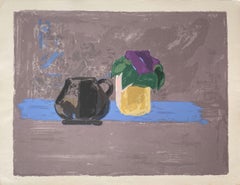
Chinese Israeli Modernist Still Life Lithograph Abstract Flowers in Vase
By Efraim Fima
Located in Surfside, FL
On Arches French art paper.
Fima (born Efraim Roeytenberg) (1914 – 2005) was an Israeli artist born in China. He spent most of his career in France.
Ephraim (Yafim) Roeytenberg, know...
Category
20th Century Abstract Expressionist Interior Prints
Materials
Lithograph
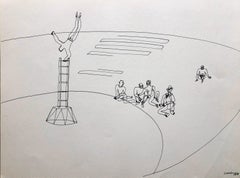
Alexander Calder Circus Reproduction Lithograph After a Drawing
By (after) Alexander Calder
Located in Surfside, FL
(after) Alexander Calder
"Calder's Circus" offset lithograph on wove paper after drawings by the artist
Published by Art in America and Perls gallery in 1964 (from drawings done in the 1930's)
these range slightly in size but they are all about 13 X 17 inches (with minor variations in size as issued.) These have never been framed. The outer folio is not included just the one lithograph.
James Sweeny from the introduction “The fame of Calder’s circus spread quickly between the years 1927 and 1930. All the Paris art world came to know it. It brought him his first great personal success. But what was more important, the circus also provided the first steps in Calder’s development as an original sculptor”
Clive Gray wrote ”A visit to the studio of Alexander Calder led to the chance discovery of some hundred masterful circus drawings completed over thirty years ago. We publish, for the first time, a choice of sixteen from that group.” With signed introduction by Miro.
These whimsical drawings, done in the style of wire sculpture, include acrobats, clowns, jugglers, trapeeze artists, an elephant, dog and lion. they are great.
Alexander Calder is widely considered to be one of the most important American sculptors of the 20th century. He is best known for his colorful, whimsical abstract public sculptures and his innovative mobiles, kinetic sculptures powered by motors or air currents, which embraced chance in their aesthetic. Born into a family of accomplished artists, Calder's work first gained attention in Paris in the 1930s and was soon championed by the Museum of Modern Art in New York, resulting in a retrospective exhibition in 1943. Major retrospectives were also held at the Solomon R. Guggenheim Museum (1964) and the Museum of Contemporary Art, Chicago (1974). Calder’s work is in many permanent collections, most notably in the Whitney Museum of American Art, but also the Guggenheim Museum; the Museum of Modern Art; the National Gallery of Art, Washington, D.C.; and the Centre Georges Pompidou. He produced many large public works, including .125 (at JFK Airport, 1957), Pittsburgh (Carnegie International prize winner 1958, Pittsburgh International Airport) Spirale (UNESCO in Paris, 1958), Flamingo and Universe (both in Chicago, 1974), and Mountains and Clouds (Hart Senate Office Building, Washington, D.C., 1976). Although primarily known for his sculpture, Calder was a prodigious artist with a restless creative spirit, whose diverse practice included painting and printmaking, miniatures (such as his famous Cirque Calder), children’s book illustrations, theater set design, jewelry design, tapestry and rug works, and political posters. Calder was honored by the US Postal Service with a set of five 32-cent stamps in 1998, and received the Presidential Medal of Freedom, posthumously in 1977, after refusing to receive it from Gerald Ford one year earlier in protest of the Vietnam War.
Calder moved to New York and enrolled at the Art Students League, studying briefly with Thomas Hart Benton, George Luks, Kenneth Hayes Miller, and John Sloan. While a student, he worked for the National Police Gazette where, in 1925, one of his assignments was sketching the Ringling Bros. and Barnum & Bailey Circus. Calder became fascinated with the action of the circus, a theme that would reappear in his later work.
In 1926, Calder moved to Paris, enrolled in the Académie de la Grande Chaumière, and established a studio at 22 rue Daguerre in the Montparnasse Quarter. In June 1929, while traveling by boat from Paris to New York, Calder met his future wife, Louisa James (1905-1996), grandniece of author Henry James and philosopher William James. They married in 1931. While in Paris, Calder met and became friends with a number of avant-garde artists, including Fernand Léger, Jean Arp, and Marcel Duchamp. Cirque Calder (on view at the Whitney Museum of American Art at present) became popular with the Parisian avant-garde. He also invented wire sculpture, or "drawing in space," and in 1929 he had his first solo show of these sculptures in Paris at Galerie Billiet. Hi! (Two Acrobats) in the collection of the Honolulu Museum of Art is an early example of the artist's wire sculpture. The painter Jules Pascin, a friend of Calder's from the cafes of Montparnasse, wrote the preface to the catalog. A visit to Piet Mondrian's studio in 1930, where he was impressed by the environment-as-installation, "shocked" him into fully embracing abstract art, toward which he had already been tending.
Dating from 1931, Calder’s sculptures of discrete movable parts powered by motors were christened “mobiles” by Marcel Duchamp, a French pun meaning both "motion" and "motive." At the same time, Calder was also experimenting with self-supporting, static, abstract sculptures, dubbed "stabiles" by Jean Arp in 1932 to differentiate them from mobiles.
Public commissions increasingly came his way in the 1960s. Notable examples are .125 for JFK Airport in 1957, Spirale for UNESCO in Paris 1958 and Trois disques, commissioned for Expo 67 in Montreal, Quebec, Canada. Calder's largest sculpture at 25.7 meters high was El Sol Rojo, constructed outside the Aztec Stadium for the 1968 Summer Olympics "Cultural Olympiad" events in Mexico City. Many of his public works were commissioned by renowned architects; I.M. Pei commissioned his La Grande Voile (1966), a 25-ton, 40-foot high stabile for the Massachusetts Institute of Technology.
Part of Calder's repertoire includes pivotal stage sets for more than a dozen theatrical productions, including Nucléa, Horizon, and most notably, Martha Graham’s Panorama (1935), a production of the Erik Satie symphonic drama Socrate (1936), and later, Works in Progress (1968).
In addition to sculptures, Calder painted throughout his career, beginning in the early 1920s. He picked up his study of printmaking in 1925, and continued to produce illustrations for books and journals.As Calder’s professional reputation expanded in the late 1940s and 1950s, so did his production of prints. Masses of lithographs based on his gouache paintings hit the market, and deluxe editions of plays, poems, and short stories illustrated with fine art prints by Calder became available for sale.
One of Calder's most celebrated and unconventional undertakings was a commission from Dallas-based Braniff International Airways to paint a full-size Douglas DC-8-62 four-engined jet as a "flying canvas."
Calder created over 2,000 pieces of jewelry over the course of his career, many of them as gifts for friends and relatives. For his lifelong friend Joan Miró, he set a shard of a broken porcelain vessel in a brass ring. Peggy Guggenheim received enormous silver mobile earrings and later commissioned a hammered silver headboard...
Category
1930s American Modern Animal Prints
Materials
Lithograph
Still Thinking About These?
All Recently ViewedMore Ways To Browse
Ecclesiastical Art
Archangel Michael
Prometheus Sculpture
Erotica Prints
Guerin Prints
Japanese Beauties Prints
John Hay Whitney
Joseph And His Brothers
Kaws Pink Companion
Keith Haring Bill T Jones
Laura Owens
Le Couple
Leonard Baskin Woodcut
Les Bijoux Vintage
Linocut Africa
Lithograph Jesus
Lois Jones
Marc Chagall Lion