Items Similar to Bodies and Heads / - The new human couple -
Want more images or videos?
Request additional images or videos from the seller
1 of 9
Frans MasereelBodies and Heads / - The new human couple -1948
1948
$498.96
£374.31
€420
CA$690.84
A$750.83
CHF 402.37
MX$9,116.36
NOK 5,051.56
SEK 4,684.55
DKK 3,199.62
About the Item
Frans Masereel (1889 Blankenberge - 1972 Avignon), Bodies and Heads, 1948. Woodcut on Japanese paper, 24.5 cm x 18 cm (image), 42.5 cm x 33.5 cm (frame), monogrammed and dated “FM 1948” in the print, signed “Frans Masereel” in pencil below.
- Image carrier slightly browned, hardly any stains, very high-contrast, powerful print. Attractively framed behind museum glass.
- The new human couple -
The figures of a man and a woman stand on a suggested round pedestal. They appear to be moving as if dancing, which is reinforced by the free, dynamic strokes. Facing each other, they embody the new human couple. But their heads are missing, and instead of necks, screw threads can be seen on their upper arms. The missing heads seem to lead a life of their own in the background, looking at the bodies standing in front of them, while the severed arms at the bottom left cheer on the male torso. Humans have become fragmented mechanical dolls that admire themselves. A real dystopia that is also evident in the intense black of the bodies. Due to the symbolic significance of the image, the sheet is a major work in Masereel's graphic oeuvre.
About the artist
Frans Masereel began studying art in Ghent at the age of 18, but his true artistic education came during extensive travels through Europe and North Africa, which sharpened his awareness of social injustices.
The outbreak of World War I marked a turning point in his life. Masereel, a staunch pacifist, refused to serve in the military and emigrated to neutral Switzerland in 1915. He found asylum in Geneva, where he worked for various political and humanitarian magazines and belonged to the circle of pacifists around Henri Guilbeaux and Romain Rolland. During this period, woodcut became his preferred artistic technique.
Masereel is considered the pioneer of the modern graphic novel, also known as the “novel without words.” He created works consisting exclusively of a sequence of woodcuts that spanned complex narrative arcs to depict human destiny in the context of war, industrialization, and social injustice. His groundbreaking works, including The Passion of a Man (1918) and My Book of Hours (1919), gained international recognition and made him a key figure in Expressionism.
After World War I, Masereel returned to Paris in 1922, where he increasingly turned to oil painting. A first retrospective of 200 of his works took place in 1929 at the Kunsthalle in Mannheim. This was immediately followed by 11 further solo exhibitions, which brought Masereel widespread recognition. Stigmatized as “degenerate” by the National Socialists, he fled Paris in 1940 and worked in the south of France. After the Second World War, Masereel worked at the newly founded State School of Art and Crafts in Saarbrücken from 1947 to 1949. He then settled in Nice to devote himself entirely to art again. Throughout his life, he remained politically active and used his art as a weapon against fascism, war, and poverty.
GERMAN VERSION
Frans Masereel (1889 Blankenberge - 1972 Avignon), Körper und Köpfe, 1948. Holzschnitt auf Japanpapier, 24,5 cm x 18 cm (Darstellung), 42,5 cm x 33,5 cm (Rahmen), im Druck mit „FM 1948“ monogrammiert und datiert, darunter in Bleistift mit „Frans Masereel“ signiert.
- Bildträger leicht gebräunt, kaum fleckig, sehr kontrastreicher, kraftvoller Druck. Ansprechend hinter Museumsglas gerahmt.
- Das neue Menschenpaar -
Auf einem angedeuteten runden Podest stehen die Figuren eines Mannes und einer Frau. Sie wirken wie tänzerisch bewegt, was durch die freien dynamischen Striche verstärkt wird. Einander zugewandt verkörpern sie das neue Menschenpaar. Doch fehlen Ihnen die Köpfe und statt der Hälse sind ebenso wie an den Oberarmen Schraubgewinde zu sehen. Die abhandengekommenen Köpfe führen im Hintergrund offenbar ein Eigenleben und betrachten die vor ihnen stehenden Körper, während die abgetrennten Arme unten links dem männlichen Torso zujubeln. Der Mensch ist zur fragmentierten mechanischen Puppe geworden, die sich selbst bewundert. Eine reale Dystopie, die sich auch im intensiven Schwarz der Körper kundtut. Aufgrund der symbolischen Tragweite des Bildes, ist das Blatt ein Hauptwerk von Masereels graphischem Oeuvre.
zum Künstler
Bereits mit 18 Jahren begann Frans Masereel ein Kunststudium in Gent, doch seine wahre künstlerische Bildung erfuhr er auf ausgedehnten Reisen durch Europa und Nordafrika, die seinen Blick für soziale Missstände schärften.
Der Ausbruch des Ersten Weltkriegs markierte einen Wendepunkt in seinem Leben. Masereel, ein überzeugter Pazifist, verweigerte den Kriegsdienst und emigrierte 1915 in die neutrale Schweiz. In Genf fand er Asyl, wo er für verschiedene politische und humanitäre Zeitschriften arbeitete und zum Kreis der Pazifisten um Henri Guilbeaux und Romain Rolland gehörte. In dieser Zeit wurde der Holzschnitt zu seiner bevorzugten künstlerischen Technik.
Masereel gilt als der Pionier der modernen Graphic Novel, auch bekannt als "Roman ohne Worte". Er schuf Werke, die ausschließlich aus einer Abfolge von Holzschnitten bestanden und komplexe narrative Bögen spannten, um das menschliche Schicksal im Kontext von Krieg, Industrialisierung und sozialer Ungerechtigkeit darzustellen. Seine bahnbrechenden Werke, darunter Die Passion eines Menschen (1918) und Mein Stundenbuch (1919), erlangten internationale Anerkennung und machten ihn zu einer Schlüsselfigur des Expressionismus.
Nach dem ersten Weltkrieg lebte Masereel ab 1922 wieder in Paris, wo er sich zunehmend der Ölmalerei zuwandte. Eine erste Retrospektive mit 200 seiner Werke fand 1929 in der Mannheimer Kunsthalle statt. Unmittelbar darauf folgten 11 weitere Einzelausstellungen, die Masereel allgemeine Bekanntheit verschafften. Von den Nationalsozialisten als ‚entartet‘ stigmatisiert, floh er 1940 aus Paris und wirkte im Süden Frankreichs. Nach dem Zweiten Weltkrieg arbeitete Masereel von 1947 bis 1949 an der neugegründeten Staatlichen Schule für Kunst und Handwerk in Saarbrücken. Anschließend wurde er in Nizza ansässig, um sich wieder ganz der Kunst zu widmen. Zeit seines Lebens blieb er politisch engagiert und nutzte seine Kunst als Waffe gegen Faschismus, Krieg und Armut.
- Creator:Frans Masereel (1889 - 1972, Belgian)
- Creation Year:1948
- Dimensions:Height: 16.74 in (42.5 cm)Width: 13.19 in (33.5 cm)Depth: 1.58 in (4 cm)
- Medium:
- Movement Style:
- Period:
- Condition:
- Gallery Location:Berlin, DE
- Reference Number:1stDibs: LU2438217309722
Frans Masereel
In 1921 Masereel returned to Paris, where he painted his famous street scenes, the Montmartre-paintings. He lived for a time in Berlin, where his closest creative friend was George Grosz. After 1925 he lived near Boulogne-sur-Mer, where he painted predominantly coast areas, harbour views, and portraits of sailors and fishermen. During the 1930s the number of illustrated books and single woodcuts decreased. In 1940 he fled from Paris and lived in several cities in the South of France.
About the Seller
5.0
Vetted Professional Seller
Every seller passes strict standards for authenticity and reliability
Established in 2014
1stDibs seller since 2023
22 sales on 1stDibs
- ShippingRetrieving quote...Shipping from: Berlin, Germany
- Return Policy
More From This Seller
View AllThe Reconciliation / - Togetherness -
Located in Berlin, DE
Rudolf Nehmer (1912 Bobersberg - 1983 Dresden), The Reconciliation, 1948. Woodcut on yellowish wove paper, 20 cm x 15 cm (image), 45 cm x 30 cm (sheet size), signed “Rud.[olf] Nehmer...
Category
1940s Realist Figurative Prints
Materials
Woodcut
$171 Sale Price
20% Off
Intertwined Figures - Complementary tension -
Located in Berlin, DE
Johanna Obermüller (*1938 Timișoara), Intertwined Figures, around 1985. Pigment print on Japanese paper, 25 cm x 33.5 cm (image), 29.8 cm x 42.5 cm (sheet dimensions), signed “Johann...
Category
1980s Contemporary Figurative Prints
Materials
Paper
Mockery / - Desk Perpetrators -
By Josef Scharl
Located in Berlin, DE
Josef Scharl (1896 Munich - 1954 New York), Mockery, 1935 (1964), Bronner 30 A. Woodcut on Japanese paper, 51.8 x 25.7 cm (image), 65 cm x 37 cm (sheet size), signed lower right in t...
Category
1930s Expressionist Figurative Prints
Materials
Paper
$361 Sale Price
20% Off
The Zero Hour / - After the End of the World -
Located in Berlin, DE
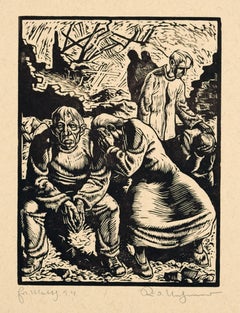
Rudolf Nehmer (1912 Bobersberg - 1983 Dresden), The Zero Hour, 1948. Woodcut on yellowish wove paper, 20 cm x 14.8 cm (image), 43 cm x 30 cm (sheet size), signed “Rud.[olf] Nehmer” i...
Category
1940s Realist Figurative Prints
Materials
Woodcut
$266 Sale Price
20% Off
The Mother / - Violated Motherhood -
By Georg Tappert
Located in Berlin, DE
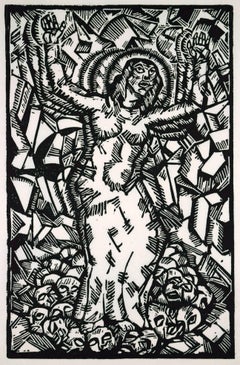
Georg Tappert (1880 Berlin - 1957 Berlin), The Mother, 1918 (1964). Estate print from 1964. Linocut on Japan, 31.5 cm x 20 cm (image), 44.5 cm x 28 cm (sheet size), marked lower left...
Category
1910s Expressionist Figurative Prints
Materials
Paper
$266 Sale Price
20% Off
Blessed are the peacemakers / - Dehumanization -
Located in Berlin, DE
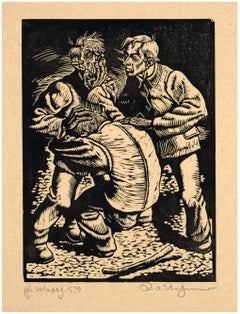
Rudolf Nehmer (1912 Bobersberg - 1983 Dresden), Blessed are the peacemakers, 1948. Woodcut on yellowish wove paper, 18 cm x 15.5 cm (image), 45 cm x 30 cm (sheet size), signed “Rud.[...
Category
1940s Realist Figurative Prints
Materials
Woodcut
$171 Sale Price
20% Off
You May Also Like
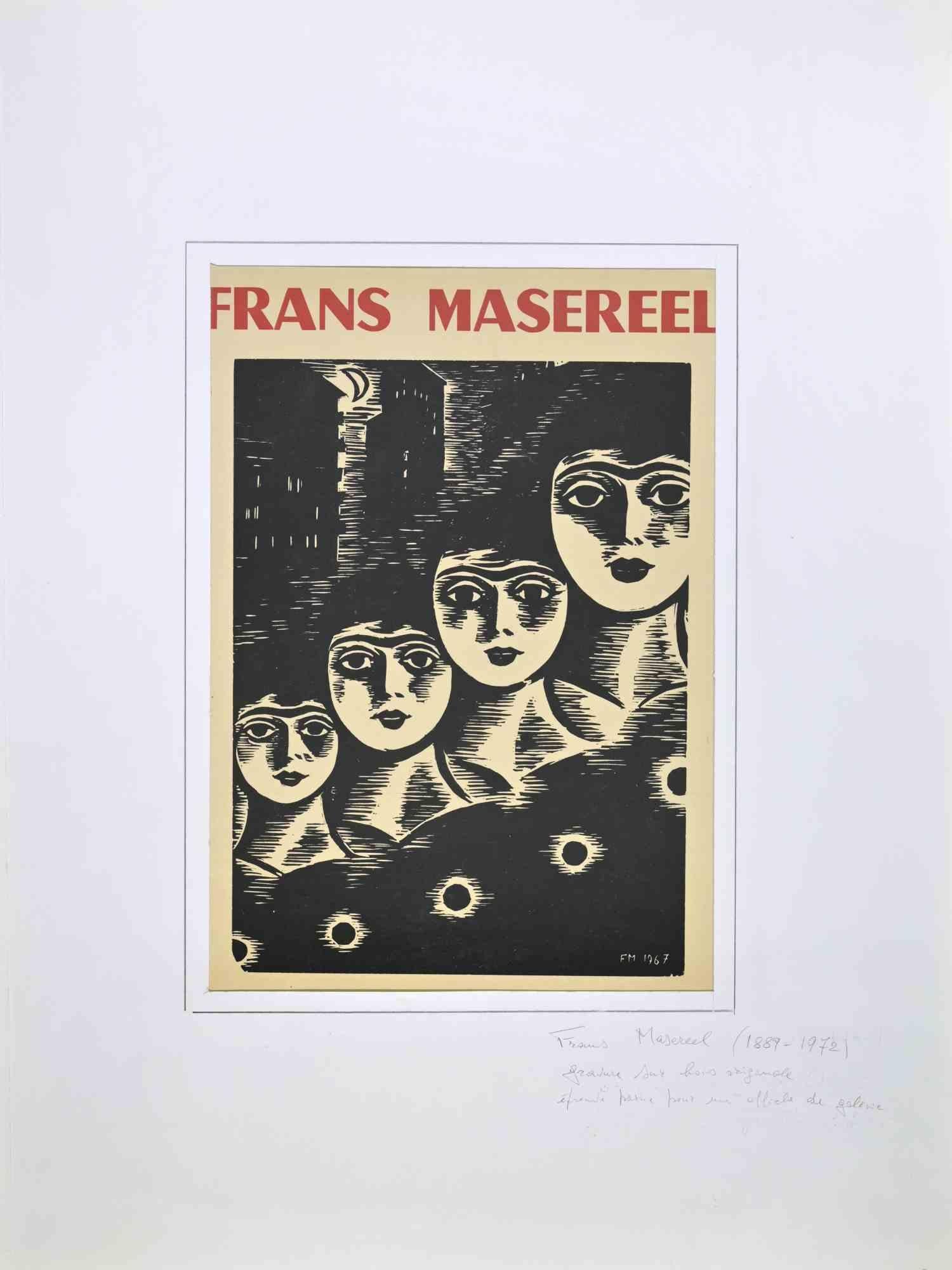
Frans Masereel - Exposition - Woodcut by Frans Masereel - 1967
By Frans Masereel
Located in Roma, IT
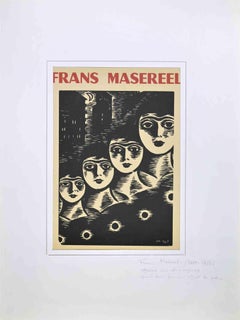
Frans Masereel - Exposition is an artwork realized in 1967.
Woodcut.
Signed on plate.
Good condition.
Category
1960s Modern Portrait Prints
Materials
Woodcut
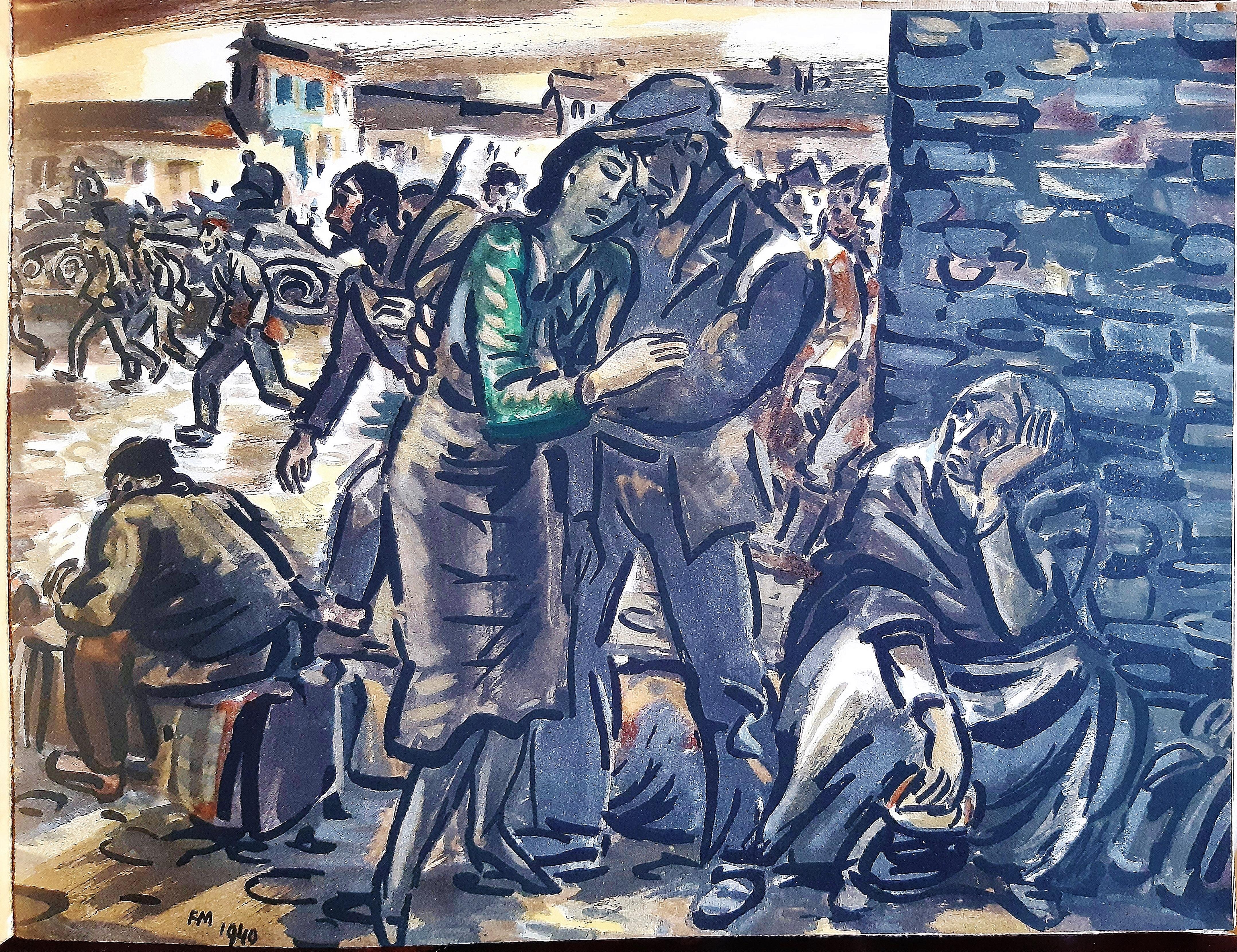
Juin 40 - Rare Book Illustrated by Frans Masereel - 1912
By Frans Masereel
Located in Roma, IT
Juin 40 is an original Rare Book illustrated by Frans Masereel (1889 – 1972) in 1912.
Original Edition.
Précédé de “Fragments d’un journal de guerre 1940” de Henry de Montherlant.
1550 numbered copies.
Published by Pierre Tisné, Paris.
Format: Oblong 4°. The dimensions and the weight are indicative.
The book includes 32 + 7 Pages with 32 Full page Lithographs.
Good conditions.
Frans Masereel (1889 – 1972). He was a Flemish painter and graphic artist who worked mainly in France, known especially for his woodcuts focused on political and social issues, such as war and capitalism. He completed over 40 wordless novels in his career, and among these, his greatest is generally said to be Passionate Journey. Masereel's woodcuts influenced Lynd Ward and later graphic artists such as Clifford Harper, Eric Drooker, and Otto Nückel. Masereel's woodcuts influenced Lynd Ward and later graphic artists such as George Walker, Clifford Harper, Eric Drooker, and New Yorker cartoonist Peter Arno. Masereel's woodcut series, mainly of sociocritical content and expressionistic in form, made Masereel internationally known. Among them were the wordless novels 25 Images of a Man's Passion (1918), Passionate Journey (1919), The Sun (1919), The Idea (1920), Story Without Words (1920), and Landscapes and Voices (1929). At that time Masereel also drew illustrations for famous works of world literature by Thomas Mann, Émile Zola, and Stefan Zweig.
Category
1940s Modern More Art
Materials
Lithograph
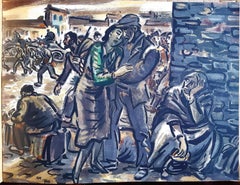
(after) Frans Masereel "Melancolie"
By Frans Masereel
Located in Henderson, NV
Medium: collotype (after the woodcut). Printed in 1925 and published in Paris by Albert Morance for "L'Art d'Aujourd'hui", and now very scarce. Image size: 7 7/8 x 5 1/4 inches (200 ...
Category
1920s Expressionist Prints and Multiples
Materials
Photogravure
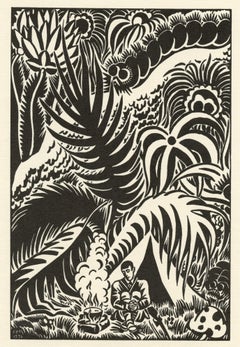
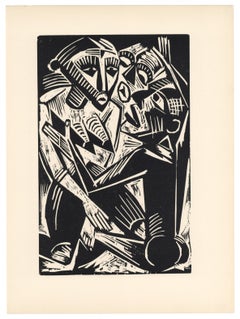
"Woman Desired by Man" original woodcut
By Max Pechstein
Located in Henderson, NV
Medium: original woodcut. Printed in 1920 for the Deutsche Graphiker der Gegenwart portfolio, and published in Leipzig by Klinkhardt & Biermann in an edition of 500. Catalogue refere...
Category
1920s Expressionist Figurative Prints
Materials
Woodcut
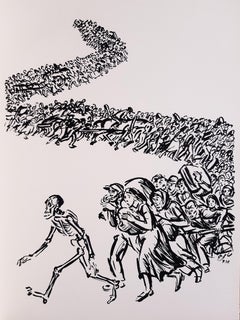
Danse Macabre - Rare Book Engraved by Frans Masereel - 1941
By Frans Masereel
Located in Roma, IT
Danse Macabre is an original Rare Book illustrated by Frans Masereel (1889 – 1972) in 1941.
Original Edition.
950 numbered copies.
Published by Lang, ...
Category
1940s Contemporary More Art
Materials
Photogravure
(after) Frans Masereel "Le Calvaire"
By Frans Masereel
Located in Henderson, NV
Medium: collotype (after the woodcut). Printed in 1925 and published in Paris by Albert Morance for "L'Art d'Aujourd'hui", and now very scarce. Image size: 8 x 4 3/4 inches (205 x 11...
Category
1920s Expressionist Prints and Multiples
Materials
Photogravure