Items Similar to
The Wolf and the Little Kids
— Graphic Modernism
Want more images or videos?
Request additional images or videos from the seller
1 of 7
Fritz Eichenberg
The Wolf and the Little Kids
— Graphic Modernism1975-76
1975-76
On Hold
$450
On Hold
£344.08
On Hold
€394.14
On Hold
CA$634.68
On Hold
A$690.78
On Hold
CHF 369.13
On Hold
MX$8,341.96
On Hold
NOK 4,639.02
On Hold
SEK 4,314.83
On Hold
DKK 2,944.44
About the Item
Fritz Eichenberg, 'The Wolf and the Little Kids' from the suite 'Fables with a Twist', wood engraving, 1975-76, artist's proof apart from the edition of c. 50. Signed, titled, and annotated 'Artist’s Proof' in pencil. Signed in the block, lower right. A fine, richly-inked impression, on cream wove paper, with full margins (7/8 to 1 1/2 inches), in excellent condition. Complete with vellum folder with descriptive text in red and black linotype. Printed by master printer Harold McGrath at The Gehenna Press, Northampton, MA. Image size 13 15/16 x 12 1/8 inches (354 x 308 mm); sheet size 16 1/2 x 14 inches (419 x 356 mm). Archivally sleeved, unmatted.
Collection: Harvard Museums.
ABOUT THE ARTIST
Fritz Eichenberg (1901–1990) was a German-American illustrator and arts educator who worked primarily in wood engraving. His best-known works were concerned with religion, social justice, and nonviolence.
Eichenberg was born to a Jewish family in Cologne, Germany, where the destruction of World War I helped to shape his anti-war sentiments. He worked as a printer's apprentice and studied at the Municipal School of Applied Arts in Cologne and the Academy of Graphic Arts in Leipzig, where he studied under Hugo Steiner-Prag. In 1923 he moved to Berlin to begin his career as an artist, producing illustrations for books and newspapers. In his newspaper and magazine work, Eichenberg was politically outspoken and sometimes wrote and illustrated his reporting.
In 1933, the rise of Adolf Hitler drove Eichenberg, who was a public critic of the Nazis, to emigrate with his wife and children to the United States. He settled in New York City, where he lived most of his life. He worked in the WPA Federal Arts Project and was a member of the Society of American Graphic Artists.
In his prolific career as a book illustrator, Eichenberg portrayed many forms of literature but specialized in works with elements of extreme spiritual and emotional conflict, fantasy, or social satire. Over his long career, Eichenberg was commissioned to illustrate more than 100 classics by publishers in the United States and abroad, including works by renowned authors Dostoyevsky, Tolstoy, Charlotte and Emily Brontë, Poe, Swift, and Grimmelshausen. He also wrote and illustrated books of folklore and children's stories.
Eichenberg was a long-time contributor to the progressive magazine The Nation, his illustrations appearing between 1930 and 1980. Eichenberg’s work has been featured by such esteemed publishers as The Heritage Club, Random House, Book of the Month Club, The Limited Editions Club, Kingsport Press, Aquarius Press, and Doubleday.
Raised in a non-religious family, Eichenberg had been attracted to Taoism as a child. Following his wife's unexpected death in 1937, he turned briefly to Zen Buddhist meditation, then joined the Religious Society of Friends in 1940. Though he remained a Quaker until his death, Eichenberg was also associated with Catholic charity work through his friendship with Dorothy Day—whom he met at a Quaker conference on religion and publishing in 1949—and frequently contributed illustrations to Day's newspaper ‘Catholic Worker’.
In 1947, Eichenberg was elected into the National Academy of Design as an Associate member and became a full Academician in 1949. In 1956, he became Chairman of the Department of Graphic Arts and founded the Pratt Graphic Arts Center in Manhattan. Ten years later, he served as Chairman of the Art Department at the University of Rhode Island. Eichenberg also served as the head of the art department at the University of Rhode Island and designed the printmaking studios there.
- Creator:Fritz Eichenberg (1901 - 1990, American, German)
- Creation Year:1975-76
- Dimensions:Height: 13.94 in (35.41 cm)Width: 12.13 in (30.82 cm)
- Medium:
- Movement Style:
- Period:
- Condition:
- Gallery Location:Myrtle Beach, SC
- Reference Number:Seller: 1041841stDibs: LU532311994492
Fritz Eichenberg
Fritz Eichenberg was one of the world's most sought-after illustrators of literary classics, including The Brothers Karamazov and Crime and Punishment, as well as works by Edgar Allan Poe, Dylan Thomas, the Brontë sisters, and others. Born in Cologne, Germany in 1901, he learned lithography, wood-engraving, and etching and by his early twenties had produced masterful illustrations for Gulliver's Travels and Till Eulenspiegel. He came to the United States in 1933 and over the next five decades produced an astonishing range of individual images and book illustrations. Throughout his life, he was preoccupied with the tragedy of war. He became a close friend and great supporter of Dorothy Day and The Catholic Worker and used his art to express his hope for more justice in the world.
About the Seller
5.0
Recognized Seller
These prestigious sellers are industry leaders and represent the highest echelon for item quality and design.
Platinum Seller
Premium sellers with a 4.7+ rating and 24-hour response times
Established in 1995
1stDibs seller since 2016
334 sales on 1stDibs
Typical response time: 1 hour
Associations
International Fine Print Dealers Association
- ShippingRetrieving quote...Shipping from: Myrtle Beach, SC
- Return Policy
More From This Seller
View All
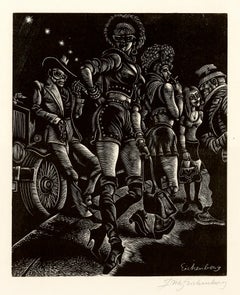
The Pimp
— Graphic Modernism
By Fritz Eichenberg
Located in Myrtle Beach, SC
Fritz Eichenberg, 'The Pimp', wood engraving, 1980, artist's proof before the edition. Signed in pencil. Signed in the block, lower right. A fine, richly-inked impression, on cream wove paper, with full margins (2 3/16 to 3 1/2 inches), in excellent condition. Archivally sleeved, unmatted.
Image size 12 x 9 3/4 inches (305 x 248 mm); sheet size 18 x 14 inches (457 x 356 mm).
ABOUT THE ARTIST
Fritz Eichenberg (1901–1990) was a German-American illustrator and arts educator who worked primarily in wood engraving. His best-known works were concerned with religion, social justice, and nonviolence.
Eichenberg was born to a Jewish family in Cologne, Germany, where the destruction of World War I helped to shape his anti-war sentiments. He worked as a printer's apprentice and studied at the Municipal School of Applied Arts in Cologne and the Academy of Graphic Arts in Leipzig, where he studied under Hugo Steiner-Prag. In 1923 he moved to Berlin to begin his career as an artist, producing illustrations for books and newspapers. In his newspaper and magazine work, Eichenberg was politically outspoken and sometimes wrote and illustrated his reporting.
In 1933, the rise of Adolf Hitler drove Eichenberg, who was a public critic of the Nazis, to emigrate with his wife and children to the United States. He settled in New York City, where he lived most of his life. He worked in the WPA Federal Arts Project and was a member of the Society of American Graphic Artists.
In his prolific career as a book illustrator, Eichenberg portrayed many forms of literature but specialized in works with elements of extreme spiritual and emotional conflict, fantasy, or social satire. Over his long career, Eichenberg was commissioned to illustrate more than 100 classics by publishers in the United States and abroad, including works by renowned authors Dostoyevsky, Tolstoy, Charlotte and Emily Brontë, Poe, Swift, and Grimmelshausen. He also wrote and illustrated books of folklore and children's stories.
Eichenberg was a long-time contributor to the progressive magazine The Nation, his illustrations appearing between 1930 and 1980. Eichenberg’s work has been featured by such esteemed publishers as The Heritage Club, Random House, Book of the Month Club, The Limited Editions Club, Kingsport Press, Aquarius Press, and Doubleday.
Raised in a non-religious family, Eichenberg had been attracted to Taoism as a child. Following his wife's unexpected death in 1937, he turned briefly to Zen Buddhist meditation, then joined the Religious Society of Friends in 1940. Though he remained a Quaker until his death, Eichenberg was also associated with Catholic charity work through his friendship with Dorothy Day...
Category
1980s American Modern Figurative Prints
Materials
Woodcut
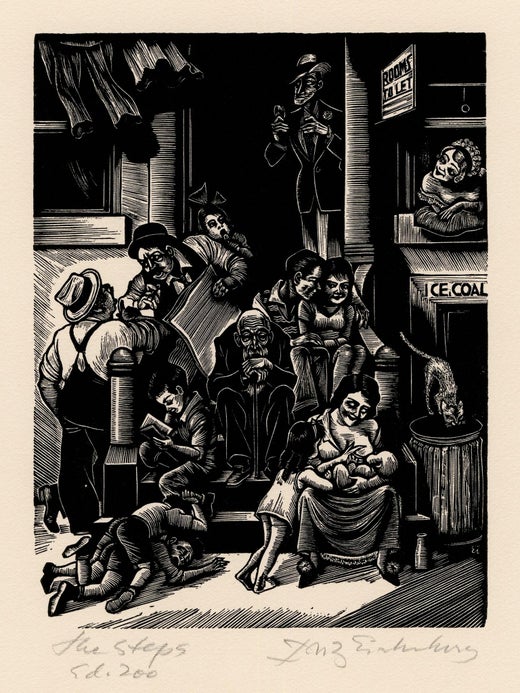
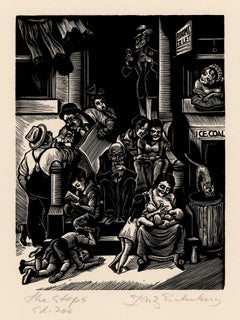
The Steps
— WPA Era Graphic Modernism
By Fritz Eichenberg
Located in Myrtle Beach, SC
Fritz Eichenberg, 'The Steps', wood engraving, 1933, edition 200. Signed, titled, and annotated 'Ed. 200' in pencil. Initialed in the block, lower right. A superb, richly-inked impr...
Category
1930s American Modern Figurative Prints
Materials
Woodcut
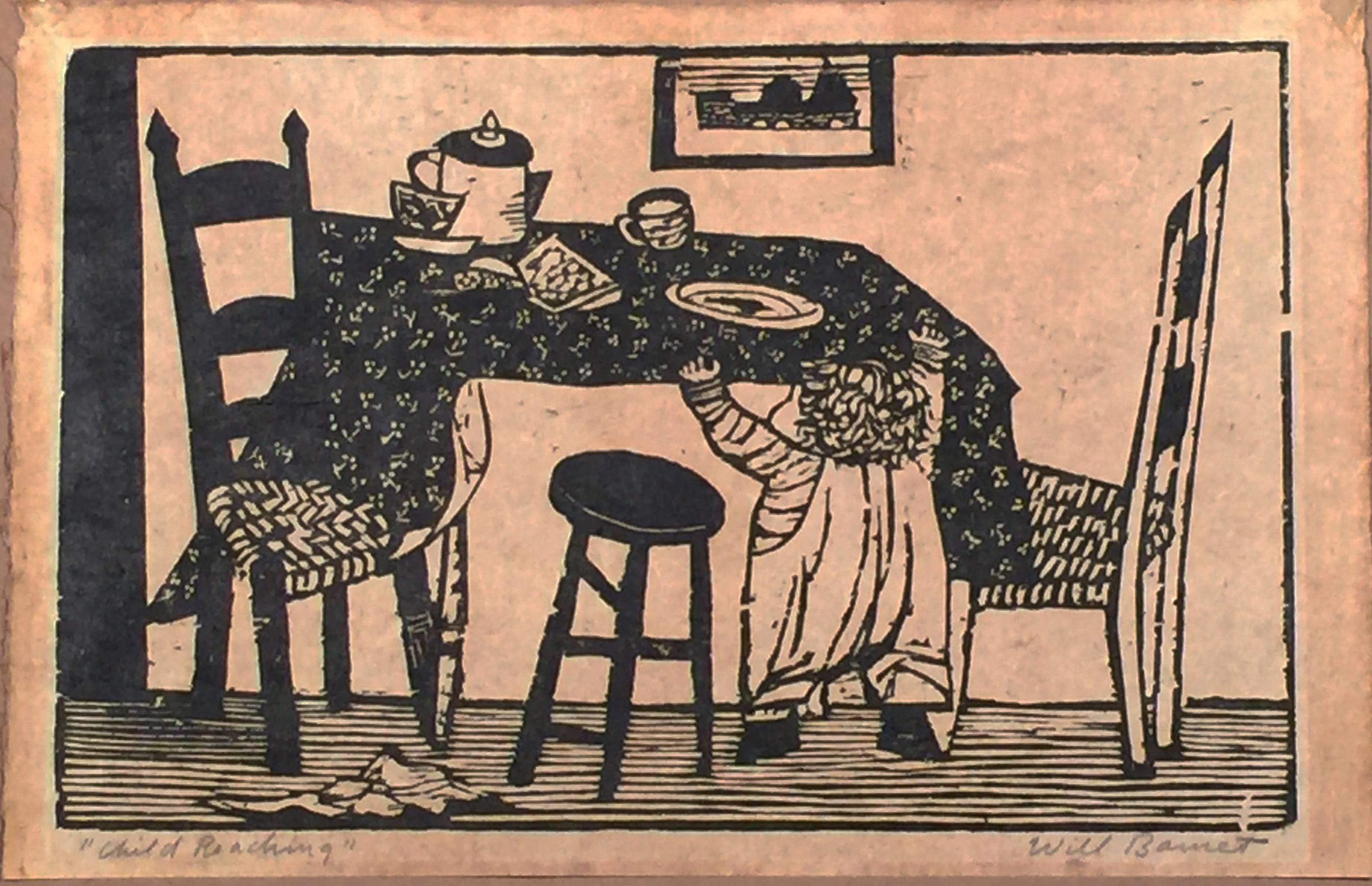
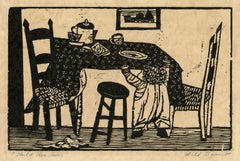
Child Reaching
— 1940s American Modernism
By Will Barnet
Located in Myrtle Beach, SC
Will barnet, 'Child Reaching', woodcut, 1940, edition 25, Cole 82. Signed and titled in pencil. A fine, black impression, on fibrous Japan paper, with full margins (5/8 to 1 3/4 inch...
Category
1940s American Modern Figurative Prints
Materials
Woodcut
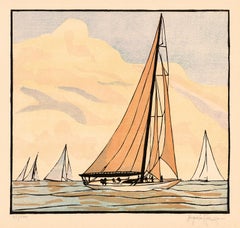
The Yankee
— America
s Cup, 1934
By Jacques La Grange
Located in Myrtle Beach, SC
Jacques La Grange, 'The Yankee', color woodcut, edition 500, 1934. Signed and numbered '25/500' in pencil. A fine impression, with fresh colors, on cream wove paper, with margins (1 1/8 to 1 1/4 inches), in excellent condition. A work from La Grange’s celebrated series of woodcuts 'Drama and Color in the America's Cup Races'. Image size 10 x 10 11/16 inches (254 x 271 mm); sheet size 12 1/4 x 13 1/4 inches (311 x 337 mm). Archivally matted to museum standards, unframed.
When the artist created this print in 1934, the 'Yankee' was one of the most promising yachts eligible for the America's Cup but ultimately 'Rainbow' was chosen to defend against England's 'Endeavor' in that year's race. The 'Endeavor' was built for Thomas Sopwith who used his aviation design expertise to ensure the yacht was the most advanced of its day with a steel hull and mast. She was launched in 1934 and won many races in her first season but the Cup challenge was blighted by a strike of Sopwith's professional crew prior to departing for America. Forced to rely mainly on keen amateurs, who lacked the necessary experience, the campaign failed. 'Rainbow' won the series 4–2. This was one of the most contentious of the America's Cup battles and prompted the headline "Britannia rules the waves and America waives the rules."
ABOUT THE ARTIST
Jacques La Grange was born in Clanwilliam (near Cape Town) in South Africa in 1895. He studied at London University and later immigrated to the United States. La Grange established himself as a painter, illustrator, and printmaker specializing in nautical subjects. He and his wife, Helen La Grange, published 'Drama and Color in the America's Cup Races' in 1934 and 'Clipper Ships of America and Great Britain 1833-1869', in 1936. Both were deluxe hardcover limited edition volumes with signed original color woodblock prints. La Grange had solo exhibitions at the Buchanan Gallery in 1929; the Babcock Gallery and the 56th Street Gallery, New York, in 1930; and at the Nicholas Roerich...
Category
1930s American Modern Figurative Prints
Materials
Woodcut
$560 Sale Price
20% Off
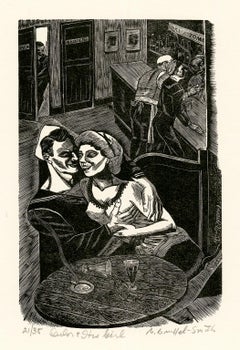
Sailor and His Girl
—Mid-Century Modernism, WWII
By Bernard Brussel-Smith
Located in Myrtle Beach, SC
Bernard Brussel-Smith, 'Sailor and His Girl', wood engraving, 1941, edition 35. Signed, titled, and numbered '21/35' in pencil. Signed in the block, lower right. A superb, richly-in...
Category
1940s American Modern Figurative Prints
Materials
Woodcut
Madman
s Drum (Brothel) —
Story Without Words
Graphic Modernism
By Lynd Ward
Located in Myrtle Beach, SC
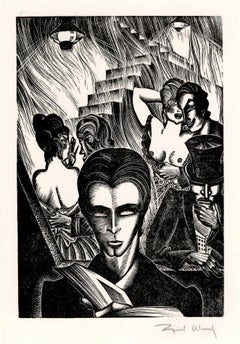
Lynd Ward, 'Madman's Drum, Plate 41', wood engraving, 1930, edition small. Signed in pencil. A fine, richly-inked impression, on off-white tissue-thin Japan paper; the full sheet with margins (1 5/8 to 2 1/2 inches); a small paper blemish in the upper right margin, away from the image, otherwise in excellent condition. A scarce, artist-printed, hand-signed proof impression before the published edition. Matted to museum standards, unframed.
Image size 5 1/2 x 3 3/4 inches (140 x 95 mm); sheet size 9 5/8 x 7 1/8 inches (244 x 181 mm).
From Lynd Ward’s book of illustrations without words, 'Madman’s Drum', Jonathan Cape and Harrison Smith, New York, 1930.
Reproduced in 'Storyteller Without Words, the Wood Engravings of Lynd Ward', Harry N. Abrams, New York, 1974.
ABOUT THE ARTIST
Lynd Ward is acknowledged as one of America’s foremost wood engravers and book illustrators of the first half of the twentieth century. His innovative use of narrative printmaking as a stand-alone storytelling vehicle was uniquely successful in reaching a broad audience. The powerful psychological intensity of his work, celebrated for its dynamic design, technical precision, and compelling dramatic content, finds resonance in the literature of Poe, Melville, and Hawthorne. Like these classic American writers, Ward was concerned with the themes of man’s inner struggles and the role of the subconscious in determining his destiny. An artist of social conscience during the Great Depression and World War II, he infused his graphic images with his unique brand of social realism, deftly portraying the problems that challenged the ideals of American society.
The son of a Methodist preacher, Lynd Ward, moved from Chicago to Massachusetts at an early age. He graduated from the Teachers College of Columbia University, New York, in 1926, where he studied illustration and graphic arts. He married May Yonge McNeer in 1936 and left for Europe for their honeymoon in Eastern Europe. After four months, they settled in Leipzig, where Ward studied at the National Academy of Graphic Arts and Bookmaking. Inspired by Belgian expressionist artist Frans Masereel's graphic novel ‘The Sun,’ and another graphic novel by the German artist Otto Nückel, ‘Destiny,’ he determined to create his own "wordless" novel. Upon his return to America, Ward completed his first book, ‘God's Man: A Novel in Woodcuts,’ published in 1929. ‘Gods’ Man’ was a great success for its author and publisher and was reprinted four times in 1930, including a British edition. This book and several which followed it, ‘Madman’s Drum,’ 1930, ‘Wild Pilgrimage...
Category
1930s American Modern Figurative Prints
Materials
Woodcut
You May Also Like
Portrait of Modern Man - Multilayer Woodblock in Ink on Paper
Located in Soquel, CA
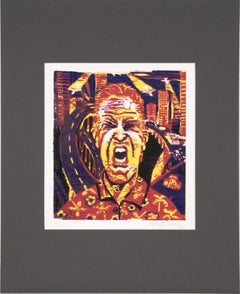
Portrait of Anger - Multilayer Woodblock in Ink on Paper
Bold and saturated woodblock print of a screaming man by Michael Dow (American, 20th Century). The man is centered in this m...
Category
1990s American Modern Figurative Prints
Materials
Paper, Ink, Woodcut
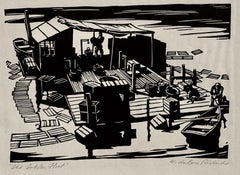
Walter DuBois Richards, The Lobster Float
By Walter DuBois Richards
Located in New York, NY
Ohio-born Walter DuBois Richards (1907-2006) was educated at the Cleveland School of Art. He re-located to New York around 1933 where he had a successful career as a commercial artis...
Category
1930s American Modern Landscape Prints
Materials
Woodcut
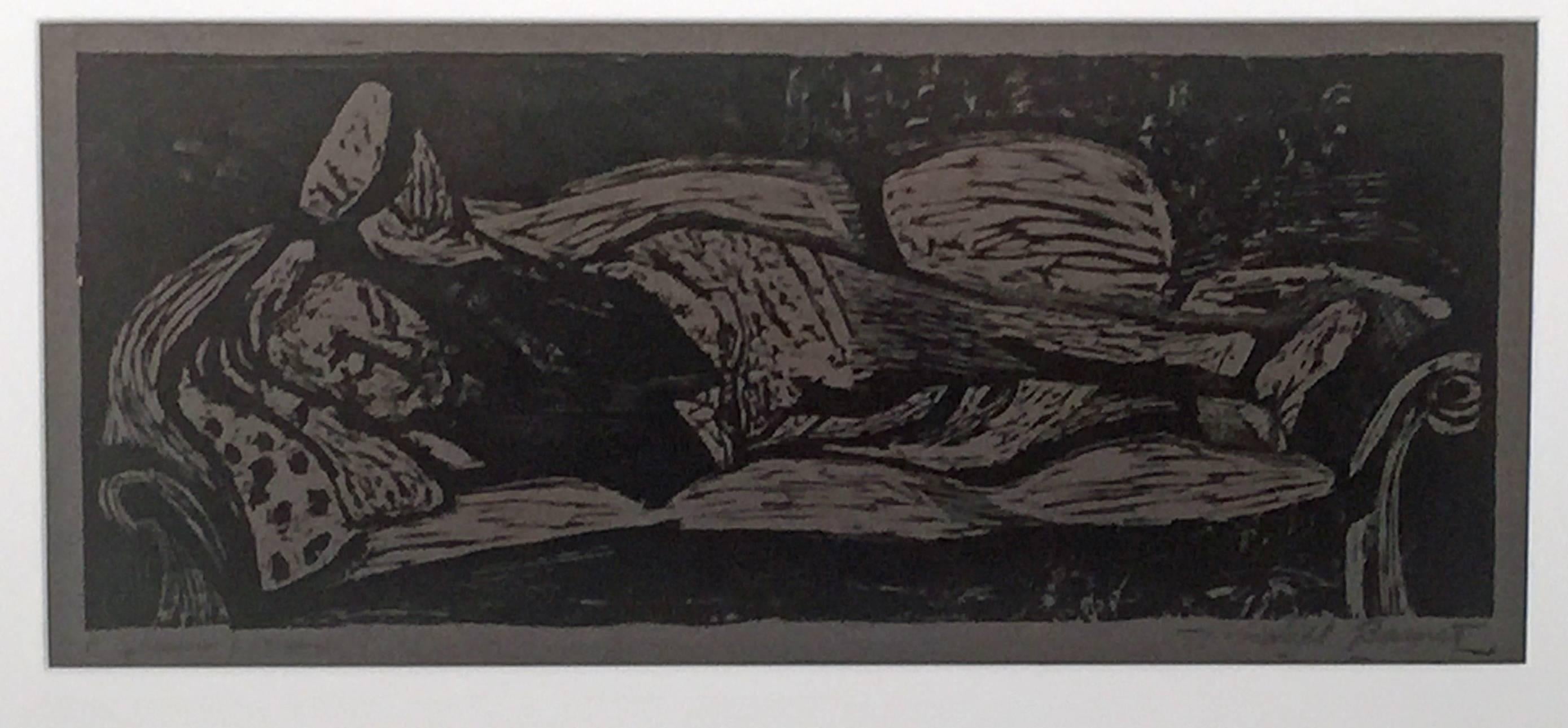
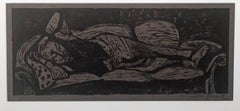
SLEEPING MAN (REST)
By Will Barnet
Located in Portland, ME
Barnet, Will. SLEEPING MAN (REST). Szoke 42, Cole 41, Johnson 40. Woodcut, 1937. Edition of 10. Titled "Sleeping Man" at left, and signed at right, both in pencil. This print is usua...
Category
1930s American Modern Figurative Prints
Materials
Woodcut
Shift Change, Social Realist Woodblock Print by Mike Goscinsky
Located in Long Island City, NY
Shift Change
Mike Goscinsky, American (1933–2021)
Woodblock on thin wove paper, signed, titled and numbered in pencil
Edition of 15/75
Image Size: 14 x 19 inches
Size: 22 x 26.5 in. ...
Category
1990s American Modern Landscape Prints
Materials
Woodcut
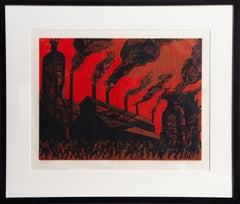
Modern American Industrial Landscape
Located in Buffalo, NY
An original woodblock print dated 1965, titled "Our Town" but signed illegibly.
Category
1960s American Modern Figurative Prints
Materials
Paper, Woodcut
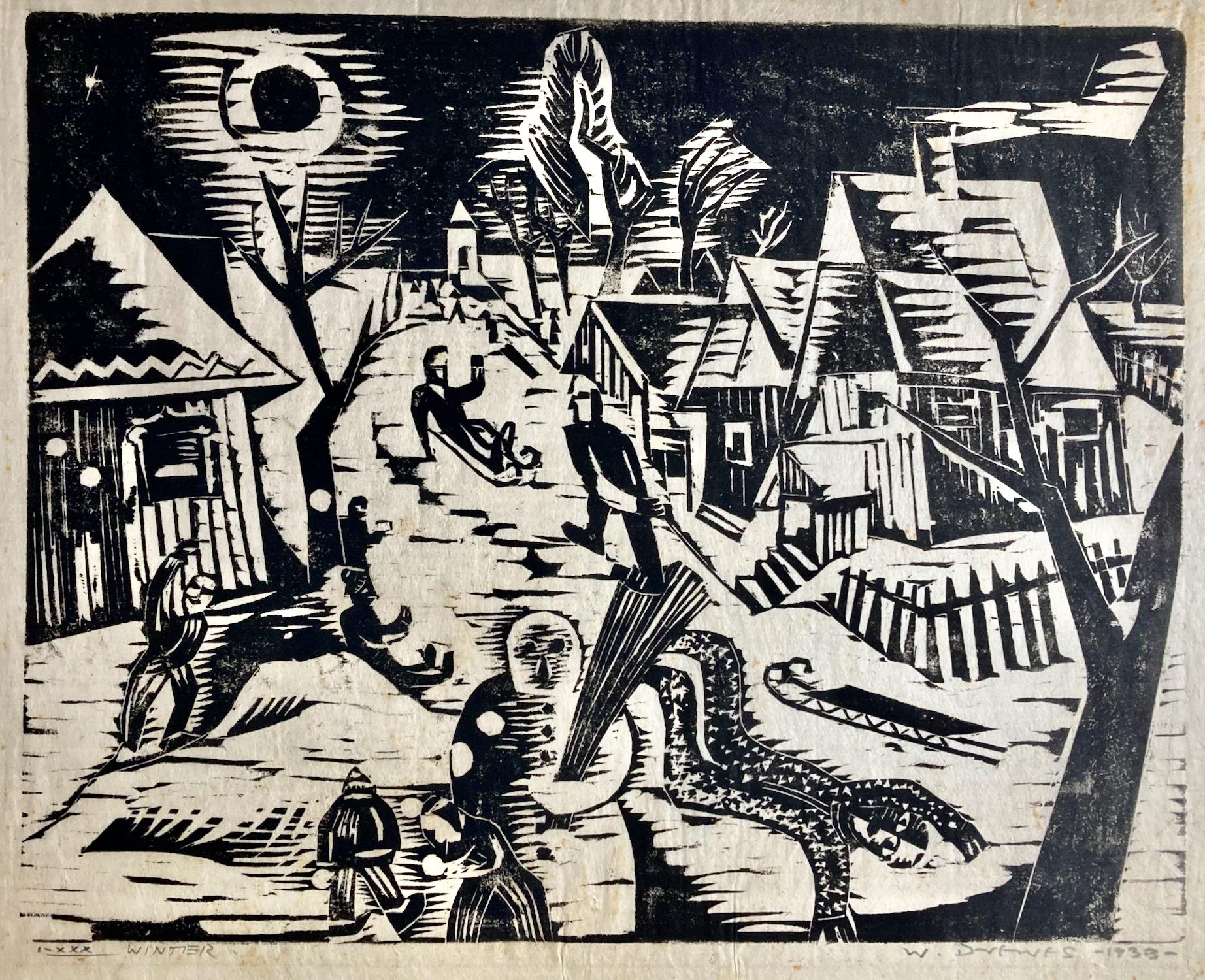
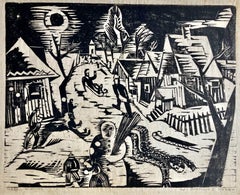
Werner Drewes, Winter, 1933, modernist woodcut
By Werner Drewes
Located in New York, NY
A modernist fantasy winter scene created by Werner Drewes, this print brings key aspects of the period together. His cubist-inspired woodcut technique is utilized here to bring the s...
Category
1930s American Modern Landscape Prints
Materials
Woodcut
More Ways To Browse
Charlotte Bronte
Richard Seewald
Rouault Miserere
Sex And The City 2 Dress
Susan Rothenberg
The Jetsons
Ting Shao
Used Steel Girders
Vintage Tom Sawyer
Visage De Femme
Whistlers Mother
Woodblock Print Flower
Zamy Steynovitz
1973 Salvador Dali
Albrecht Durer Engravings
Antique Sky Map
Auguste Louis Lepere
Best Buddies