Want more images or videos?
Request additional images or videos from the seller
1 of 13

George Cruikshank
SCENE AT THE LONDON MUSEUM - PICCADILLY

1816

Price:$875
$1,200List Price

You May Also Like

17th century etching black and white mother and child figures scene
By Cornelis Bega
Located in Milwaukee, WI
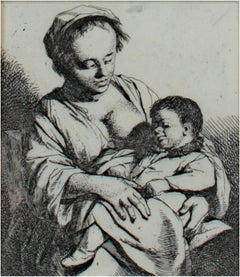
"Mother & Child" is an original etching by Cornelis-Pietersz Bega. It depicts a mother and her child. Publisher: Pearce #51. 3" x 3" art 13 3/4" x 11 3/4" frame Cornelis Pietersz B...
Category

Mid-17th Century Old Masters Figurative Prints

Materials

Etching

17th century etching black and white figures scene
By Cornelis Bega
Located in Milwaukee, WI
"The Singer" is an original etching by Cornelis-Pietersz Bega. It depicts a performer and onlookers. Publisher: Pearce #50. 4" x 3" art 16 1/2" x 13 1/2" frame Cornelis Pietersz Be...
Category

Mid-17th Century Old Masters Figurative Prints

Materials

Etching

17th century etching black and white indoors table figures scene
By Cornelis Bega
Located in Milwaukee, WI
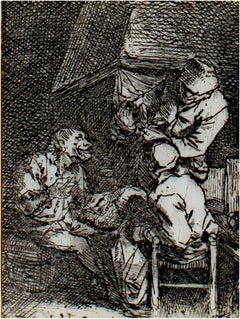
"The Conversation" is an original etching by Cornelis-Pietersz Bega. It depicts three men conversing in a dark interior. Publisher: Pearce #43. 3" x 2 1/4" art 12 3/4" x 11 5/8" fra...
Category

Mid-17th Century Old Masters Figurative Prints

Materials

Etching

17th century etching black and white figure table tobacco pipe scene
By Cornelis Bega
Located in Milwaukee, WI
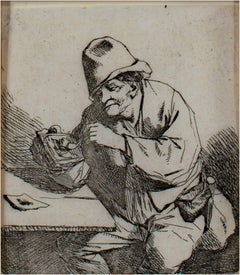
"The Pipe Smoker" is an original etching by Cornelis-Pietersz Bega. It depicts a man sitting at a table with his pipe. Publisher: Pearce #38. 3 1/2" x 3 1/4" art 13 5/8" x 11 3/4" f...
Category

Mid-17th Century Old Masters Figurative Prints

Materials

Etching

17th century etching black and white indoor dramatic figures scene
By Cornelis Bega
Located in Milwaukee, WI
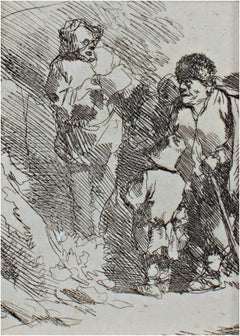
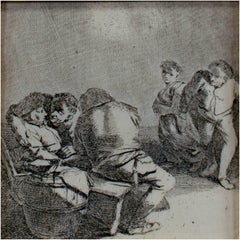
"The Meeting" is an original etching by Cornelis-Pietersz Bega. It depicts a confrontation between two groups of figures. Publisher: Pearce #48. 2 3/4" x 2 3/4" art 10 1/4" x 10 3/8...
Category

Mid-17th Century Old Masters Figurative Prints

Materials

Etching

The Smoker (Le Fumeur) original etching by Cornelis-Pietersz Bega
By Cornelis Bega
Located in Milwaukee, WI
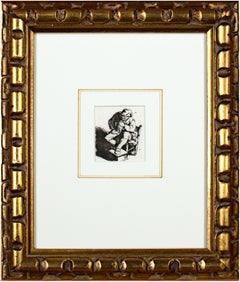
'The Smoker (Le Fumeur)' is an original etching by the celebrated Dutch painter and printmaker Cornelis-Pietersz Bega. It presents a genre scene of the type Bega was best known for: Bega's principal subjects were genre representations of taverns, domestic interiors and villages. He depicted nursing mothers, prostitutes, drunks, gamblers and fools such as quack doctors and alchemists. In this case, he shows a man seated on a chair with his foot on a flat stool and holding a smoking pipe. For Bega, this representation was more of a caricature than it was an image of a specific person, and such genre scenes would have held allegorical and symbolic meaning for the seventeenth-century viewer. During the seventeenth century, the Dutch of all levels of society consumed tobacco and alcohol, and these were an important part of the Dutch economy and a major source of wealth. At the same time, however, moralists and ministers sought to curb intoxication: they openly described drinking and smoking as sinful, immoral, and a general threat to one’s reputation. This paradox is reflected in prints such as this, which inherently carry the national pride of the Dutch economy alongside a moral warning in a print that could be just as easily consumed and collected. 2.5 x 2.25 inches, print 12.38 x 10.38 inches, frame Framed to conservation standards using archival materials including 100 percent rag matting and mounting materials. Housed in a gold finish Spanish-style wood moulding. Overall good and stable condition; margins cut to plate; some wrinkling in the corners from previous mounting; housed in a new custom frame. Cornelis Bega was born into prosperous circumstances. His mother, Maria Cornelis, inherited half the estate (gold, silver, paintings, drawings and prints) and all of the red chalk drawings of her father, Cornelis Cornelisz van Haarlem, a renowned Mannerist artist. Bega's father was Pieter Jansz Begijn (d 1648), a gold and silversmith. Like other family members, Bega was probably Catholic. Houbraken's claim that Bega studied with Adriaen van Ostade is likely to be correct; this was probably before 24 April 1653, when Bega joined Vincent Laurentsz. van der Vinne in Frankfurt for a journey through Germany, Switzerland and France. Bega had returned to Haarlem by 1 September 1654, at which time he joined the Guild of St Luke; he was already a competent draughtsman, as indicated by his first extant dated work, Interior with a Nursing Mother (1652; Frankfurt am Main, Städel. Kstinst.), and by a remarkable double portrait (Amsterdam, Rijksmuseum) drawn by him and Leendert van der Cooghen in 1654. Bega painted, drew, etched and made counterproofs in a wide variety of materials on different types of small-scale supports. He may have been the first Dutch artist to make monotypes, but this remains controversial. Approximately 160 paintings, 80 drawings and six monotypes by Bega have been catalogued, as well as around 34 etchings. Bega's principal subjects were genre representations of taverns, domestic interiors and villages. He depicted nursing mothers, prostitutes, drunks, smokers, gamblers and fools such as quack doctors and alchemists. Less common subjects include the ridiculed or pestered woman, as in Two Figures and Mother with a Spirits Bottle (c. 1662; Gouda, Stedel, Museum Catharina Gasthuis) and The Inn (etching), as well as witty satires on traditional scenes of middle-class music-makers, such as the Music Lesson (1663; Paris, Petit Palace). Bega's early paintings, such as the Weaver's Family (c. 1652; St Petersburg, Hermitage), are freely executed, dark and coarse, recalling the many-figured peasant subjects of van Ostade. Between c. 1660 and 1664 he began to paint genre scenes with fewer figures, which are finely articulated, colourful and psychologically expressive, for example Two Men Singing (1662; Dublin, N.G.). His exquisite, late fijnschilderen ('fine painting') manner, evident in The Alchemist (1663; Malibu, Getty Museum), compares well with that of Gerrit Dou. As a draughtsman Bega is noted for his single-figure studies, executed mainly in black and white chalk on blue paper or red chalk on white paper. None of the studies, which were drawn naer het leven (from life), seem to relate to a painting or etching. Bega traded drawings or shared models with other artists of the Haarlem school, including van der Cooghen, Gerrit Berckheyde, Dirck Helmbreker and Cornelis Visscher. These artists drew chalk figure studies in a very similar style, characterised by regular and precise parallel shading and well-defined forms; their drawings, especially those of Bega and Berckheyde, have been frequently confused. Unlike the realistic figure studies, Bega's etchings depict interiors with figures or single figures in the manner of van Ostade; the compositions, often with masterful chiaroscuro effects, reflect most closely the paintings of the 1650s. Bega is likely to have remained in Haarlem, where he paid dues to the Guild in 1661. He probably died from the plague; fees for his expensive funeral at St. Bavo's were paid on 30 August 1664. Among the artists he influenced were Thomas Wijck, Jan Steen, Richard Brakenburg (1650-1702) and Cornelis Dusart. Painters such as R. Oostrzaen ( fl ?1656) and Jacob Toorenvliet...
Category

17th Century Old Masters Figurative Prints

Materials

Paper, Etching

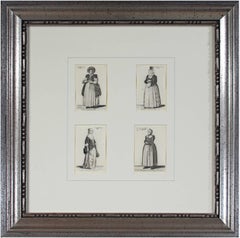
Four original etchings of women from Aula Veneris series by Wenceslaus Hollar
By Wenceslaus Hollar
Located in Milwaukee, WI
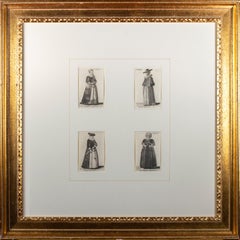
Presented here as a group are four original etchings of women in European national dress from the master printmaker Wenceslaus Hollar's series "Aula V...
Category

17th Century Old Masters Figurative Prints

Materials

Etching, Paper

Near Mrs. Teshmakers, Edmonton original etching by John Thomas Smith
By John Thomas Smith
Located in Milwaukee, WI
The present is one of the many prints John Thomas Smith produced of English cottages and vernacular architecture. This example, a view of a cottage in Edmonton, is closely related to...
Category

1790s Old Masters Landscape Prints

Materials

Paper, Etching

17th century etching black and white figurative character print expressive
By Jan Gillisz van Vliet
Located in Milwaukee, WI
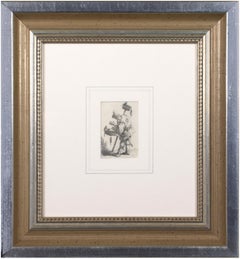
Jan Gillisz van Vliet (1605–1668) was a Dutch Golden Age artist and student of Rembrandt. He worked with Rembrandt between 1628 and 1637, inspired by his master's work. Like Rembrandt, van Vliet made a series of beggar figures, though often with a greater degree of satire and expressiveness. For example, this image of a rat catcher...
Category

1630s Old Masters Figurative Prints

Materials

Etching

"Four Women in National Costumes, " Etchings by Wenceslaus Hollar
By Wenceslaus Hollar
Located in Milwaukee, WI
"Four Women in National Costumes" is a set of four original etchings by Wenceslaus Von Prachna Hollar. 3 5/8" x 2 3/8" each print 19 1/8" x 18 1/2" frame Wenceslaus Von Prachna Ho...
Category

17th Century Old Masters Figurative Prints

Materials

Etching

More From This Seller

View All
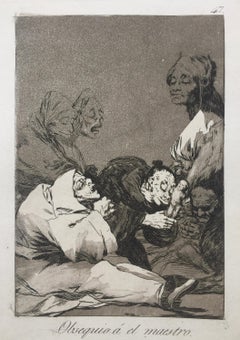
OBSEQUIO á el MAESTRO (‘A gift for the master’)
By Francisco Goya
Located in Santa Monica, CA
FRANCISCO de GOYA y LUCIENTES (1746 -1828) OBSEQUIO á el MAESTRO (‘A gift for the master’) Plate 47 from the 1st edition of Los Caprichos (Blas, ...
Category

1790s Old Masters Figurative Prints

Materials

Etching, Aquatint

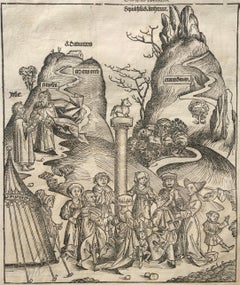
The Golden Calf - Nuremberg Chronicle, (528 Years Old)
Located in Santa Monica, CA
NUREMBERG CHRONICLE, 1493 THE GOLDEN CALF (THE CALF OF GOD) 1493 Woodcut. from "Liber Chronicarum." Printed by Anton Koberger text by Hartmann Sc...
Category

15th Century and Earlier Old Masters Figurative Prints

Materials

Woodcut

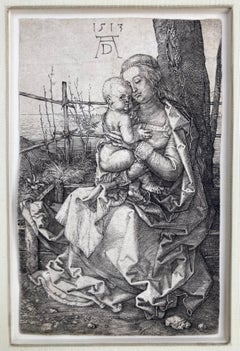
THE VIRGIN AND CHILD SEATED BY A TREE
By Albrecht Dürer
Located in Santa Monica, CA
ALBRECHT DURER (1471-1528) THE VIRGIN AND CHILD SEATED BY A TREE 1513 (Bartsch 35; Meder 34 c-d, Hollstein 34) Engraving a generally good impression. Trimmed slightly into the i...
Category

16th Century Old Masters Figurative Prints

Materials

Engraving

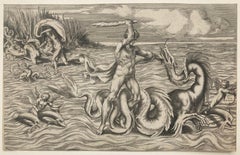
HERCULES FIGHTS ADRAGON center, ACHELOUS CARRYING OFF DEIANEIRA left
By Giulio Bonasone
Located in Santa Monica, CA
GIULIO BONASONE (Italian 1500/10-1574) HERCULES FiGHTS ADRAGON center, ACHELOUS CARRYING OFF DEIANEIRA left 1531–76 (Bartsch XV.157.178; Massari 1983, no.230) Engraving. Lettered in roundel held by putto at right: 'Iulio / Bonasone' Sheet 10 5/8 x 16 7/8 inches. Thread margins outside border line. A fair impression. Early annotations lower left verso, as well aa a collectors stamp: Lugt 2773 - A. Freiherr von...
Category

16th Century Old Masters Figurative Prints

Materials

Engraving

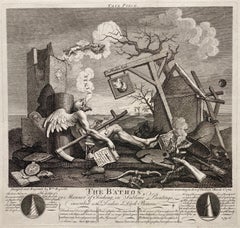
BATHOS / Tail PIece
By William Hogarth
Located in Santa Monica, CA
WILLIAM HOGRATH (1767- 1764) THE BATHOS / Tail Piece 1764 (Paulson 1989: 216 I/I Paulson 1965/70: 216 I/I) Engraving Plate 12 7/8 x 13 3/8, sheet 17 ¾ x 18 ¾ Designed & Engrav’d by Wm Hogarth at left and Published according to Act of Parliam’t March 3, 1764 at right. Good condition on thick laid paper Small bit of tape on the left & right sheet edges small stan lower sheet edge all on recto. This Hogarth’s last print is fascinating as it is prophacy about death. Various institutions have interesting commentaries - to wit: Chicago Art Institute: Hogarth created The Bathos toward the end of his life. It is considered one of the bleakest artworks of the 18th century because it depicts the Apocalypse without an afterlife. The Angel of Death even collapses in exhaustion after having destroyed the world. In his hand is an execution decree and around him lies a mass of broken objects. Princeton: Hogarth’s last print, The Bathos,….. is filled with all manner of images denoting the end of life as we know it. Entry no. 216 in Ronald Paulson’s catalogue raisonne Hogarth’s Graphic Works, 3rd revised edition says “This print is the culmination of such pessimistic images . . . . [taking] his general composition, the configuration of objects, and some of the particular items, from Dürer’s engraving, Melancholia; but he also recalls Salvator Rosa’s Democritus in Meditation (which derives from Dürer’s print) with a scroll at the bottom of the etching: ‘Democritus the mocker of all things, confounded by the ending of All Things’ (Antal, p.168).” Newfields (Indianapolis Museum of Art): Hogarth intended this engraving to serve as the tailpiece to bound volumes of his collected engravings and, appropriately, it proved to be his last engraving. Father Time has died and his last will and testament has been witnessed by the three Fates. He is surrounded by a landscape of death, decay, and ruin. Hogarth aimed this print at dealers in “dark” Old Masters paintings who promoted the idea that ruins evoked sublime feelings in viewers—a sentiment, Hogarth wrote, that was reducing the world to ruin. British Caricature...
Category

1760s Old Masters Figurative Prints

Materials

Woodcut

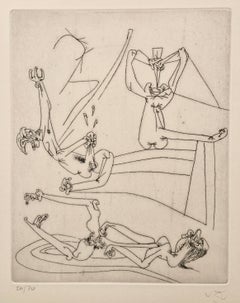
MATTA - 10 EROTIC ETCHINGS - New School Portfolio
By Roberto Matta
Located in Santa Monica, CA
ROBERTO MATTA (Chilean 1911- 2002) NEW SCHOOL PORTFOLIO (1943-5) (Sabatier 1-7, 4 prints not recorded by Sabatier) Portfolio with complete set of 10 etch...
Category

1940s Surrealist Figurative Prints

Materials

Etching

Still Thinking About These?

All Recently Viewed