Items Similar to "Business-Men
s Class, Y.M.C.A." George Bellows, Ashcan School Print
Want more images or videos?
Request additional images or videos from the seller
1 of 9
George Wesley Bellows"Business-Men
s Class, Y.M.C.A." George Bellows, Ashcan School Print1916
1916
$8,000
£6,075.32
€6,979.39
CA$11,278.12
A$11,990.96
CHF 6,484.35
MX$142,636.19
NOK 81,225.73
SEK 74,183.25
DKK 52,138.48
About the Item
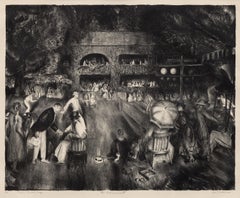
George Bellows
Business-Men's Class, Y.M.C.A, 1916
Signed, numbered "No. 41" and titled lower margin
Lithograph on wove paper
11 1/2 x 17 1/8 inches
Edition of 64
Provenance:
Hirschl
Adler Galleries, New York
Private Collection, Ohio
Literature:
Mason, 20.
After his arrival from Columbus, Ohio in 1904, Bellows lived at the West Side YMCA. It was there that he met Eugene Speicher, another aspiring young artist who was to become his lifelong friend. Always interested in the anatomy of the human body, Bellows often satirized the various types who, while leading a sedentary life, feel compelled to devote a portion of their daily routine to physical self-improvement.
Throughout his brief but illustrious career, George Wesley Bellows created striking scenes that documented ordinary American life in all its beauty and banality. Considered an American Realist, the artist eschewed embellishment, finding inspiration in the gritty boroughs of New York City, the rocky coastline of Maine, and, later, in his friends and family. Bellows garnered early recognition for his arresting portrayals of illegal prizefighting, dramatic works executed in dark tonal palettes that underscore the brutality of the violent sport.
Bellows’ elderly Methodist parents hoped their son might pursue the ministry, a calling the extroverted athlete never received. The Columbus native competed on the baseball team at Ohio State University and also served as an illustrator for the college yearbook. In the fall of 1904—just months shy of his expected graduation—Bellows defied his father’s wishes and boarded a train to New York City in hopes of becoming a magazine illustrator like his idols Howard Chandler Christy and Charles Dana Gibson. Before leaving, he reportedly turned down an offer to play professional baseball with the Cincinnati Reds.
Upon his arrival, Bellows enrolled in courses at the New York Art School, also called the “Chase School” after its renowned founder and the pioneer of American Impressionism, William Merritt Chase. He received instruction from Chase, as well as Robert Henri, a fellow Midwesterner who first encouraged Bellows to take to the streets of Manhattan in search of subject matter. Henri was the leader of an informal association of artists known as “The Eight.” These men spurned the confines of the European academic tradition and chose instead to record working-class street life, in all its color and complexity, with unvarnished realism. The group—which, along with Bellows and Henri, included William Glackens, Ernest Lawson, George Luks, Maurice Prendergast, Everett Shinn, and John Sloan—was later identified as “Ashcan School,” a designation derived from Bellows’s grim drawing Disappointments of the Ash Can (1915), in which three men examine the worm-ridden contents of a filthy waste receptacle.
Bellows’s vigorously executed oil paintings met with early critical and commercial success. He was elected an associate of the National Academy of Design in 1909, and full membership accrued in 1913—notable achievements for such a young artist. Along with his teaching duties at the Art Students League, Bellows produced over 170 lithographic images and was a prolific illustrator. He contributed to many of the popular periodicals of the day, including Vanity Fair, Harper’s Weekly, and Metropolitan Magazine, as well as the socialist publication The Masses. Indeed, many of Bellows’s drawing and prints reveal an acute interest in social and political issues, such as a series that gruesomely detailed German atrocities during World War I. Intrigued by the modernist art theories emanating from Europe, Bellows was an organizer and exhibitor at the landmark Armory Show of 1913. When he succumbed to peritonitis—triggered by a ruptured appendix—in January of 1925, the forty-two-year-old was considered one of the most popular painters in America.
In 1908, Bellows accepted a six-week summer teaching position at the University of Virginia in Charlottesville, during which time he painted Footpath Virginia. Markedly different in composition and style from his New York scenes, the loosely-painted Footpath depicts two women taking a leisurely stroll on a summer day. One of the vignette’s subjects has been identified as Miss Marie Ellis Bowles of Staunton, Virginia, a student to whom Bellows gave the painting. Footpath is one of three works that Bellows completed during his Southern stay.
- Creator:George Wesley Bellows (1882-1925, American)
- Creation Year:1916
- Dimensions:Height: 21.5 in (54.61 cm)Width: 25.5 in (64.77 cm)
- Medium:
- Movement Style:
- Period:
- Condition:
- Gallery Location:New York, NY
- Reference Number:1stDibs: LU1841211362342
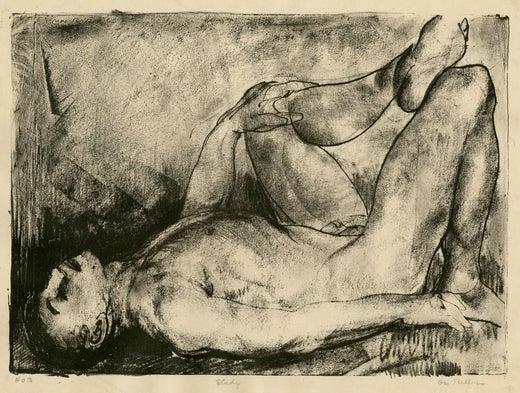
George Wesley Bellows
George Bellows, an American artist, was born in Columbus, Ohio in 1882, the only child of a successful building contractor from Sag Harbor, New York. He entered Ohio State University in 1901, where he played baseball and basketball and made drawings for college publications. He dropped out of college in 1904, went to New York, and studied under Robert Henri (American, 1865 – 1929) at the New York School of Art, where Edward Hopper (American, 1882 – 1967), Rockwell Kent (American, 1882 – 1971), and Guy Pène du Bois (American, 1884 – 1958) were his classmates. A superb technician who worked in a confident, painterly style, Bellows soon established himself as the most important realist of his generation. He created memorable images of club fights, street urchins swimming in the East River, and the Pennsylvania Station excavation site and garnered praise from both progressive and conservative critics. In 1910 Bellows began teaching at the Art Students League and married Emma Story, by whom he had two daughters. After 1910 Bellows gradually abandoned the stark urban realism and dark palette characteristic of his early work and gravitated toward painting landscapes, seascapes, and portraits. Bellows helped organize the Armory Show in 1913, in which five of his paintings and a number of drawings were included. That year he was elected a full member of the National Academy of Design. He had leftist political views and contributed illustrations to the Socialist publication The Masses from 1912 to 1917. Bellows began to make lithographs in 1916 and his exceptional talent engendered a revival of interest in the medium. He worked in Maine, in Carmel, California, and in Middletown, Rhode Island, and was a founding member of the Society of Independent Artists and a charter member of the Association of American Painters and Sculptors. In 1919 he taught at the Art Institute of Chicago. Bellows, who never went to Europe, is regarded as a quintessential American artist whose vigorous style enabled him to explore a wide range of subjects from scenes of modern urban life to portraits of his daughters, to turbulent Maine seascapes. As an early biographer noted, Bellows “caught the brute force of the prizefighter, the ruggedness of the country pasture, the essence of childhood and recorded them appropriately not only for his own generation but for all time.”[1] [1] [Frederick A. Sweet], George Bellows: Paintings, Drawings and Prints (Art Institute of Chicago, IL, 1946). Robert Torchia September 29, 2016
About the Seller
5.0
Platinum Seller
Premium sellers with a 4.7+ rating and 24-hour response times
Established in 2022
1stDibs seller since 2022
137 sales on 1stDibs
Typical response time: <1 hour
- ShippingRetrieving quote...Shipping from: New York, NY
- Return Policy
More From This Seller
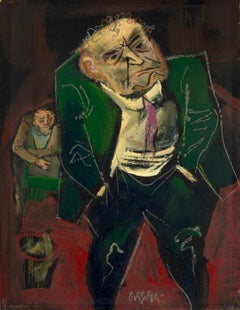
View All"Senator" William Gropper, Social Realism, WPA Political Art, Caricature
By William Gropper
Located in New York, NY
William Gropper
Senator
Signed lower center
Oil on board
16 x 12 1/4 inches
ACA Galleries, New York
Private Collection, New York
Bonhams, American Art Online, August 23, 2023, Lot 3...
Category
Mid-20th Century American Realist Figurative Paintings
Materials
Oil, Board
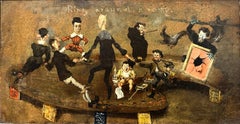
"Ring Around the Rosy" Theodore Wendel, circa 1880 Caricature of Duveneck Boys
By Theodore Wendel
Located in New York, NY
Theodore Wendel
Ring Around the Rosy (Duveneck Boys Caricature), circa 1880
Oil on board
12 x 22 3/4 inches
Theodore Wendel is one of the most respected American impressionists and major museums and collectors are eager to purchase exquisitely rendered works like View from the Artist’s Farmhouse, Ipswich, MA that display Wendel’s finest period of impressionism. He is considered the “most French” of American painters along with Theodore Robinson and Childe Hassam.
Wendel was born in Midway, Ohio, and lived in Newport (RI), Boston (1889-1898) and Ipswich (MA, 1898-). As a boy, he joined a circus as an acrobat. He studied with Thomas Noble at the McMicken School of Art at the University of Cincinnati, where he met and became a life long friend of Joseph DeCamp. He and DeCamp traveled to Munich, Germany, in 1878, to study with Frank Duveneck at the Munich Academy and they became known as “The Duveneck Boys.” Duveneck, Chase, Whistler, Twachtman and Wendel painted landscapes and figural paintings in Polling, Florence, and Venice from 1878-1880. Most of his paintings from this period disappeared and are very rare. He sailed for Newport, Rhode Island in 1882 and lived briefly in New York. In 1883, he exhibited in Cincinnati with Twachtman, DeCamp and Potthast and in that year Wendel and Louis Ritter...
Category
1880s Impressionist Figurative Paintings
Materials
Oil, Board
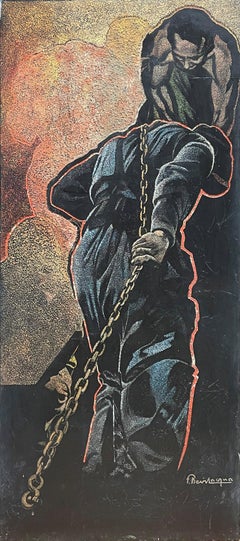
"Working Laborers, " Francis Bevilacqua, Soviet Cold War Art
Located in New York, NY
Francis Bevilacqua (American, b. 1911)
Working Laborers, n.d.
Oil and pigment on black granite
44 x 21 inches
Signed lower right
Born in 1911, Francis Bevilacqua was predominantly influenced by the 1930s. The period of the 1930s is epitomized by the conflict between many political ideologies, including Marxist Socialism, Capitalist Democracy, and the Totalitarianism of both Communism and Fascism. In the Soviet Union, Stalin’s government needed urgent funds to implement the rapid industrialization demanded by the first Five Year Plan. It initiated a secret strategy to sell off treasures from the State Hermitage Museum in Leningrad (St. Petersburg), including a primary list of two hundred and fifty irreplaceable paintings by the Old Masters, a number of which ended up in the collection of Andrew Mellon...
Category
Mid-20th Century Realist Figurative Paintings
Materials
Granite
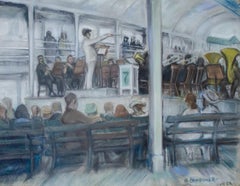
"Musical Conductor" Amy Londoner, Ashcan School, Figurative Concert Scene
By Amy Londoner
Located in New York, NY
Amy Londoner
Musical Conductor, 1922
Signed and dated lower right
Pastel on paper
Sight 18 x 23 inches
Amy Londoner (April 12, 1875 – 1951) was an American painter who exhibited at the 1913 Armory Show. One of the first students of the Henri School of Art in 1909. Prior to the Armory Show of 1913, Amy Londoner and her classmates studied with "Ashcan" painter Robert Henri at the Henri School of Art in New York, N.Y. One notable oil painting, 'The Vase', was painted by both Henri and Londoner.
Londoner was born in Lexington, Missouri on April 12, 1875. Her parents were Moses and Rebecca Londoner, who moved to Leadville, Colorado, by 1880. In 1899, Amy took responsibility for her father who had come to Los Angeles from Leadville and had mental issues. By 1900, Amy was living with her parents and sister, Blanche, in the vicinity of Leadville, Denver, Colorado. While little was written about her early life, Denver City directories indicated that nineteenth-century members of the family were merchants, with family ties to New York, N.Y. The family had a male servant. Londoner traveled with her mother to England in 1907 then shortly later, both returned to New York in 1909. Londoner was 34 years old at the time, and, according to standards of the day, should have married and raised a family long before. Instead, she enrolled as one of the first students at the Henri School of Art in 1909.
At the Henri School, Londoner established friendships with Carl Sprinchorn (1887-1971), a young Swedish immigrant, and Edith Reynolds (1883-1964), daughter of wealthy industrialist family from Wilkes-Barre, PA. Londoner's correspondence, which often included references to Blanche, listed the sisters' primary address as the Hotel Endicott at 81st Street and Columbus Avenue, NYC. Other correspondence also reached Londoner in the city via Mrs. Theodore Bernstein at 252 West 74th Street; 102 West 73rd Street; and the Independent School of Art at 1947 Broadway. In 1911, Londoner vacationed at the Hotel Trexler in Atlantic City, NJ. As indicated by an undated photograph, Londoner also spent time with Edith Reynolds and Robert Henri at 'The Pines', the Reynolds family estate in Bear Creek, PA.
Through her connections with the Henri School, Londoner entered progressive social and professional circles. Henri's admonition, phrased in the vocabulary of his historical time period, that one must become a "man" first and an artist second, attracted both male and female students to classes where development of unique personal styles, tailored to convey individual insights and experiences, was prized above the mastery of standardized, technical skill. Far from being dilettantes, women students at the Henri School were daring individuals willing to challenge tradition. As noted by former student Helen Appleton Read, "it was a mark of defiance,to join the radical Henri group."
As Henri offered educational alternatives for women artists, he initiated exhibition opportunities for them as well. Troubled by the exclusion of work by younger artists from annual exhibitions at the National Academy of Design, Henri was instrumental in organizing the no-jury, no-prize Exhibition of Independent Artists in 1910. About half of the 103 artists included in the exhibition were or had been Henri students, while twenty of the twenty-six women exhibiting had studied with Henri. Among the exhibition's 631 pieces, nine were by Amy Londoner, including the notorious 'Lady with a Headache'. Similarly, fourteen of Henri's women students exhibited in the groundbreaking Armory Show of 1913, forming about eight percent of the American exhibitors and one-third of American women exhibitors. Of the nine documented works submitted by Londoner, five were rejected, while four pastels of Atlantic City beach scenes, including 'The Beach Umbrellas' now in the Remington Collection, were displayed.
Following Henri's example, Londoner served as an art instructor for younger students at the Modern School, whose only requirement was to genuinely draw what they pleased. The work of dancer Isadora Duncan, another artist devoted to the ideals of a liberal education, was also lauded by the Modern School. Henri, who long admired Duncan and invited members of her troupe to model for his classes, wrote an appreciation of her for the Modern School journal in 1915. She was also the subject of Londoner's pastel Isadora Duncan and the Children: Praise Ye the Lord with Dance. In 1914, Londoner traveled to France to spend summer abroad, living at 99 rue Notre Dames des Champs, Paris, France. As the tenets of European modernism spread throughout the United States, Londoner showed regularly at venues which a new generation of artists considered increasingly passe, including the annual Society of Independent Artists' exhibitions between 1918 and 1934, and the Salons of America exhibition in 1922. Londoner also exhibited at the Morton Gallery, Opportunity Gallery, Leonard Clayton Gallery and Brownell-Lambertson Galleries in NYC. Her painting of a 'Blond Girl' was one of two works included in the College Art Associations Traveling Exhibition of 1929, which toured colleges across the country to broad acclaim.
Londoner later in life suffered from illnesses then suffered a stroke which resulted in medical bills significantly mounting over the years that her old friends from the Henri School, including Carl Sprinchorn, Florence Dreyfous, Florence Barley, and Josephine Nivison Hopper, scrambled to raise funds and find suitable long-term care facilities for Londoner. Londoner later joined Reynolds in Bear Creek, PA. Always known for her keen wit, Londoner retained her humor and concern for her works even during her illness, noting that "if anything happens to the Endicott, I guess they will just throw them out." Sprinchorn and Reynolds, however, did not allow this to happen. In 1960, Londoner's paintings 'Amsterdam Avenue at 74th Street' and 'The Builders' were loaned by Reynolds to a show commemorating the Fiftieth Anniversary of the Exhibition of Independent Artists in 1910, presented at the Delaware Art Center, Wilmington, DE. In the late 80's, Francis William Remington, 'Bill Remington', of Bear Creek Village PA, along with his neighbor and artist Frances Anstett Brennan, both had profound admiration for Amy Londoner's art work and accomplishments as a woman who played a significant role in the Ashcan movement. Remington acquired a significant number of Londoner's artwork along with Frances Anstett Brenan that later was part of an exhibition of Londoner's artwork in April 15 of 2007, at the Hope Horn...
Category
1920s Ashcan School Figurative Paintings
Materials
Paper, Pastel
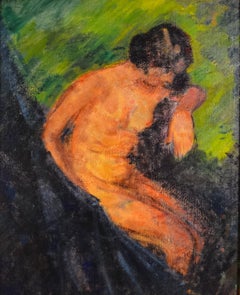
"Female Nude, " Edith Glackens Dimock, Ashcan School Figurative Painting
By Edith Glackens Dimock
Located in New York, NY
Edith (Glackens) Dimock (1876 - 1955)
Untitled (Female Nude), circa 1915
Oil on canvas
34 1/2 x 28 1/4 inches
Signed lower left
Provenance:
Private Colle...
Category
1910s Ashcan School Nude Paintings
Materials
Canvas, Oil
"The Doubtful Bill" Charles Blauvelt, 19th Century Genre Painting Money Interior
Located in New York, NY
Charles Blauvelt
The Doubtful Bill, 1868
Signed and dated lower left
Oil on canvas
12 1/4 x 9 1/2 inches
Provenance:
Private Collection, Connecticut...
Category
1860s Figurative Paintings
Materials
Canvas, Oil
You May Also Like
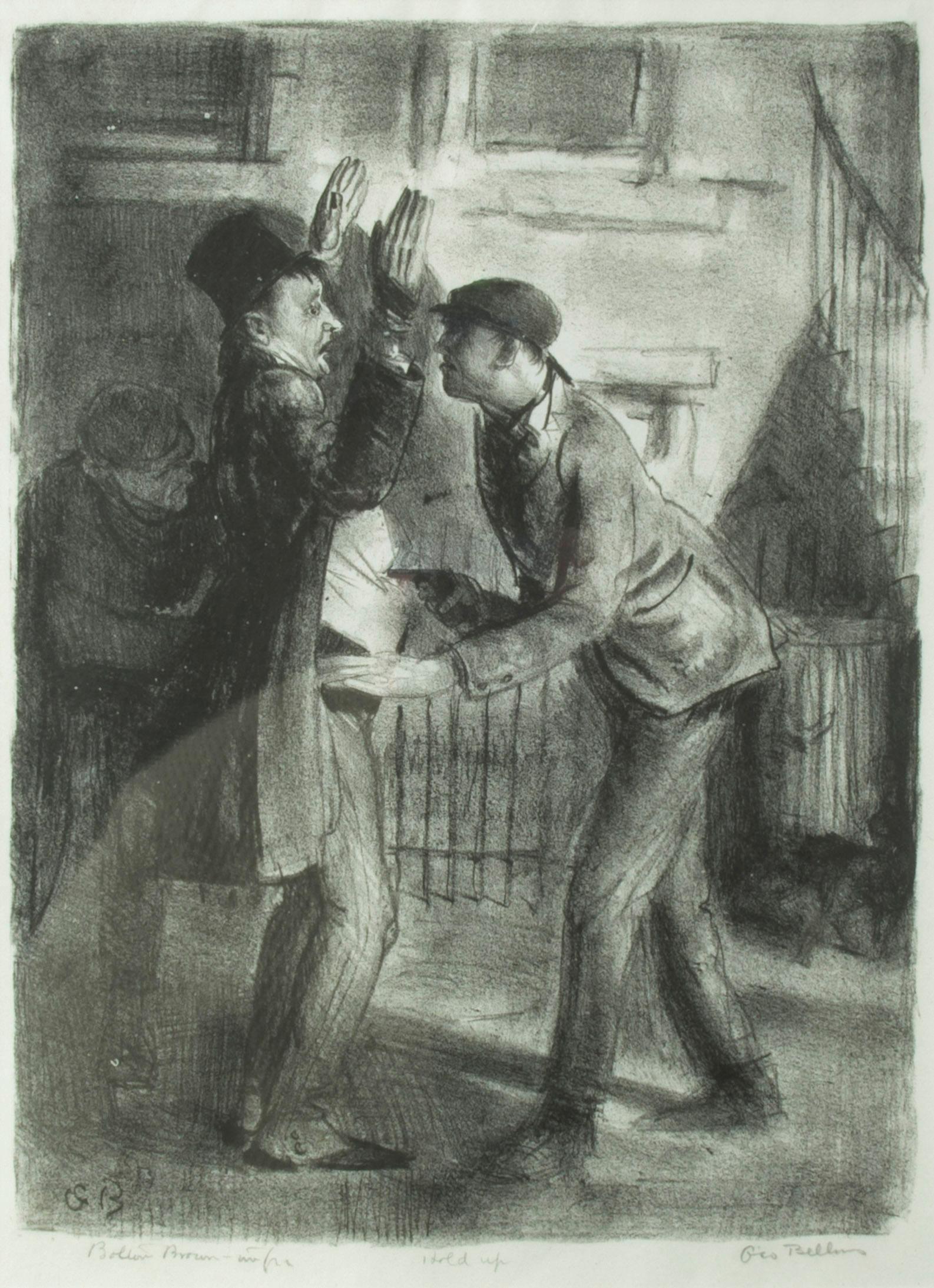
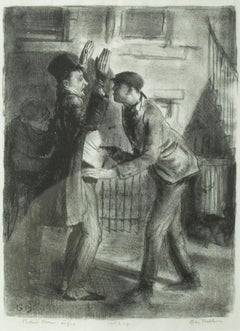
The Hold Up, First State
By George Wesley Bellows
Located in Fairlawn, OH
Signed in pencil by the artist lower right
Titled "Hold Up" by the artist in pencil.
Signed by the printer Bolton Brown lower left.
Edition: 42 in this state
Note: In The Hold Up, se...
Category
1920s American Realist Figurative Prints
Materials
Lithograph
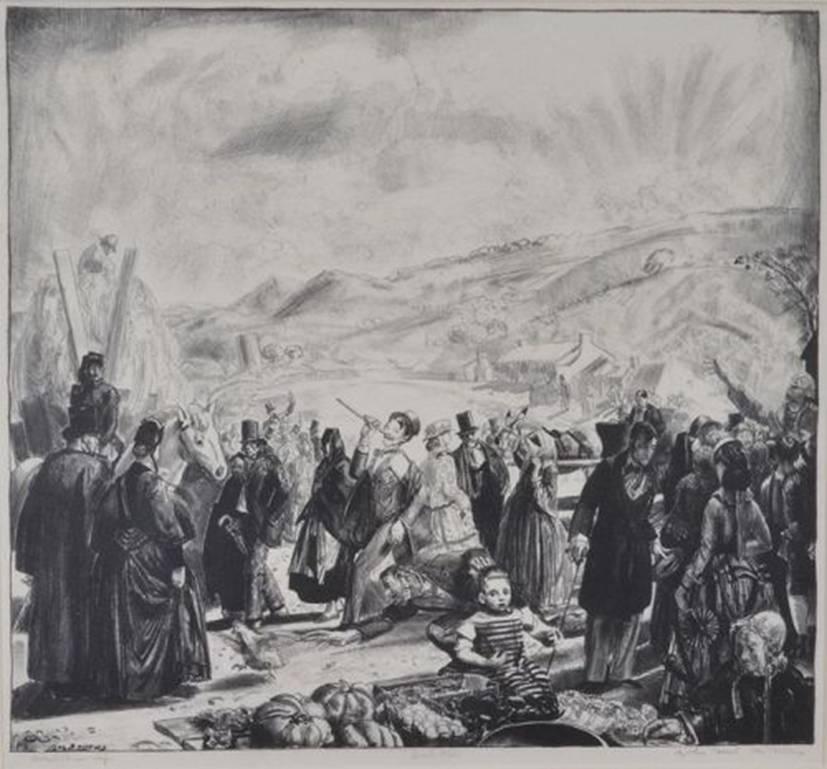
The Irish Fair
By George Wesley Bellows
Located in Fairlawn, OH
Irish Fair
Lithograph, 1923
Signed and numbered in pencil by the artist (see photo)
Titled "Irish Fair" by the artist in pencil
Edition: 84
Housed in an archival frame with acid free matting (see photo)
Provenance:
Estate of the artist, Bellows Family Trust
H.V. Allison & Company (label)
Private Collection, Columbus
References And Exhibitions:
Reference: Mason 153
Note: An illustration commissioned by The Century Company for Don Byrne's novel The Wind Bloweth
Image: 18 7/8 x 21 3/8"
Frame: 29 1/2 x 30 1/2"
“Eleven on a hot July morning, and the little town...
Category
1920s Ashcan School Figurative Prints
Materials
Lithograph
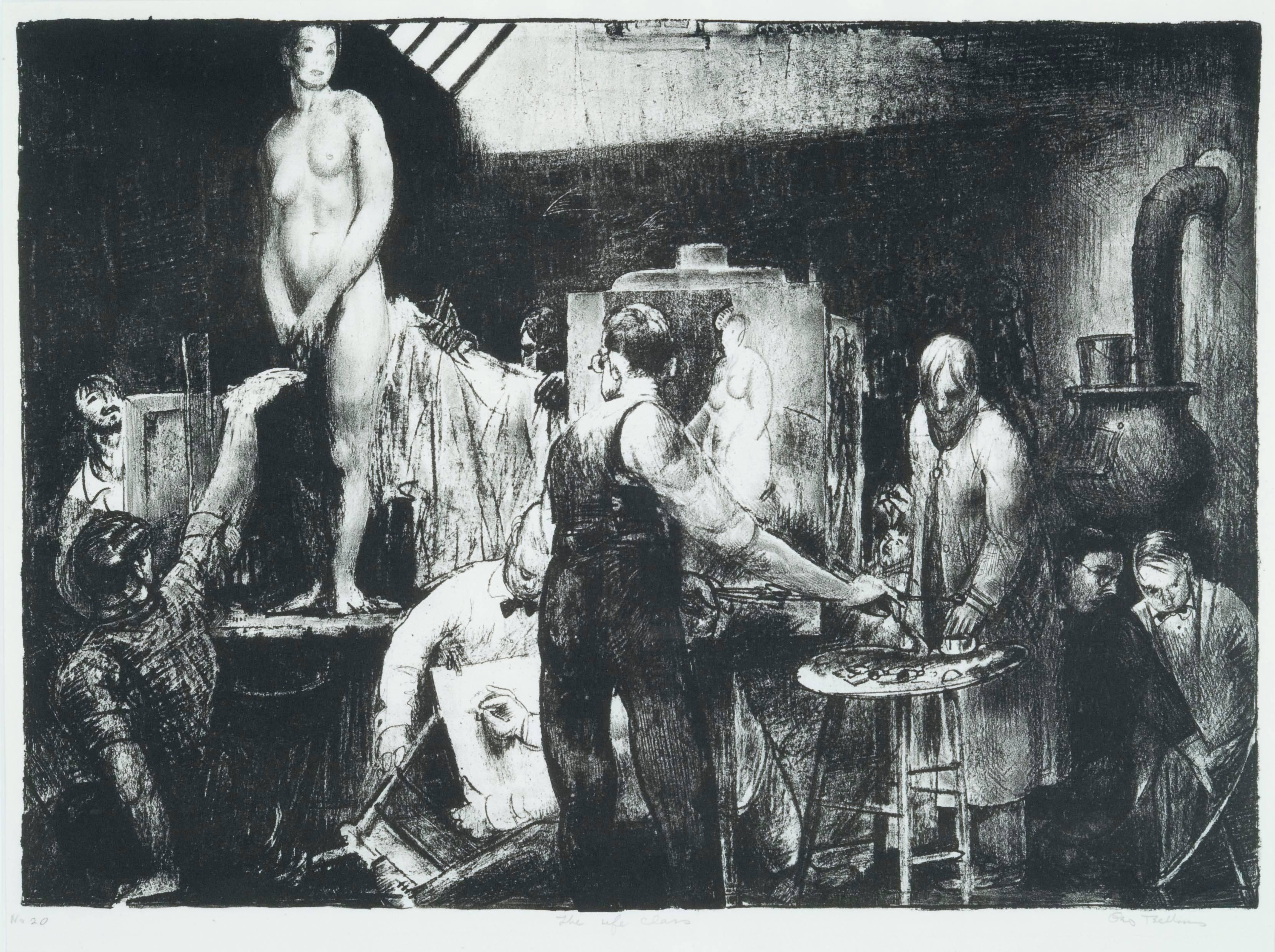
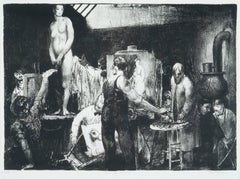
THE LIFE CLASS - SECOND STONE (THE MODEL, LIFE CLASS).
By George Wesley Bellows
Located in Portland, ME
Bellows, George. THE LIFE CLASS - SECOND STONE (THE MODEL, LIFE
CLASS). Mason 43, Bellows 193. Lithograph, 1917. Edition of 49,
signed by Bellows. Inscribed "No.20," titled and sign...
Category
Early 20th Century Figurative Prints
Materials
Lithograph
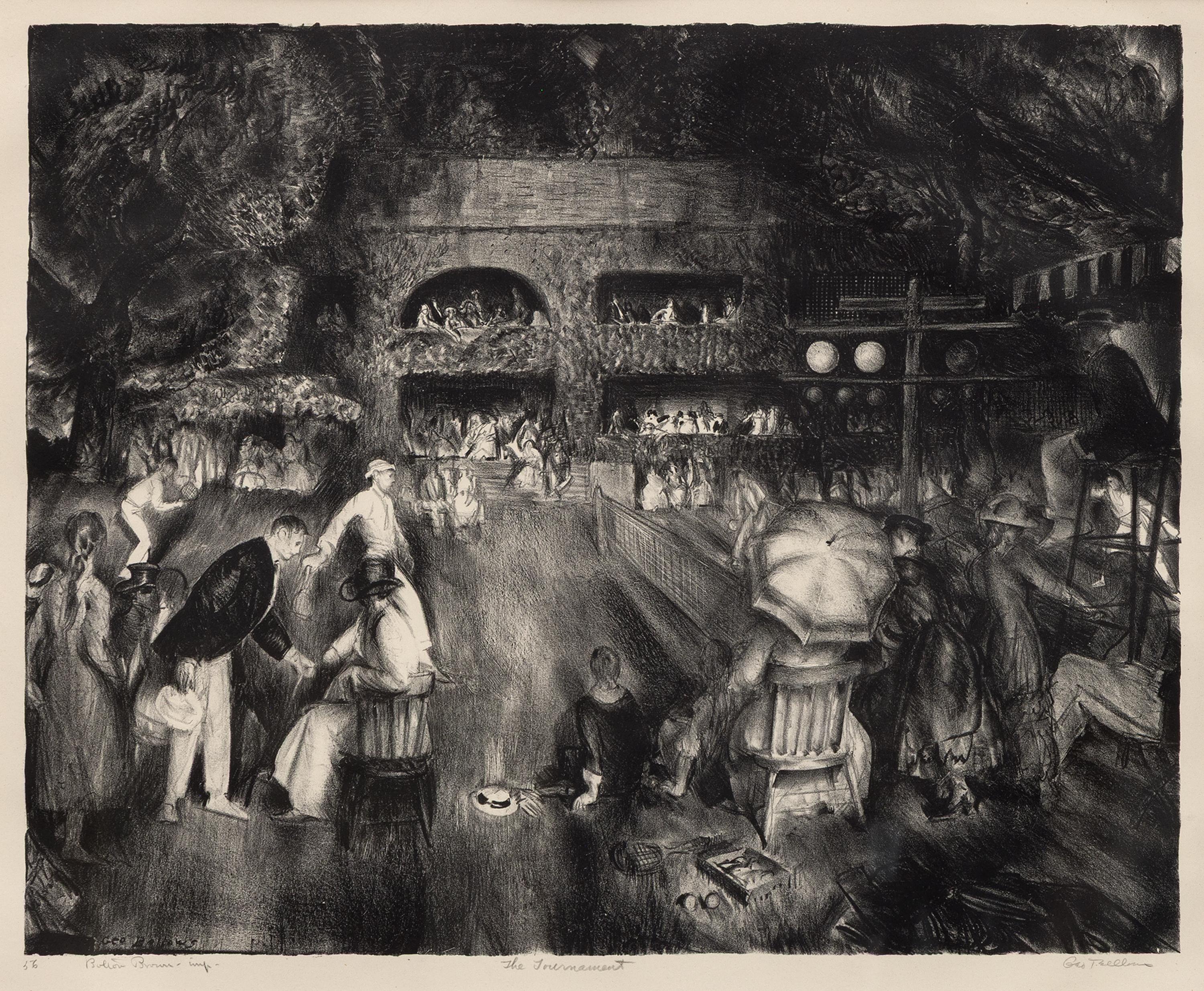
The Tournament (Tennis at Newport)
By George Wesley Bellows
Located in Palm Desert, CA
A lithograph by George Bellows. “The Tournament (Tennis at Newport)” is a realistic lithograph on paper in black and white by American Realist artist, George Bellows. Bellows' depictions of sporting / leisure scenes are unique and valuable. This artwork is edition 56/63 with framed dimensions of 26 x 29 x 1 1/4 inches and has been in the same private collection for almost four decades. The artwork is signed in pencil, lower right, "G. Bellows.”
Provenance:
Catherine E Burns...
Category
1920s American Realist Figurative Prints
Materials
Lithograph
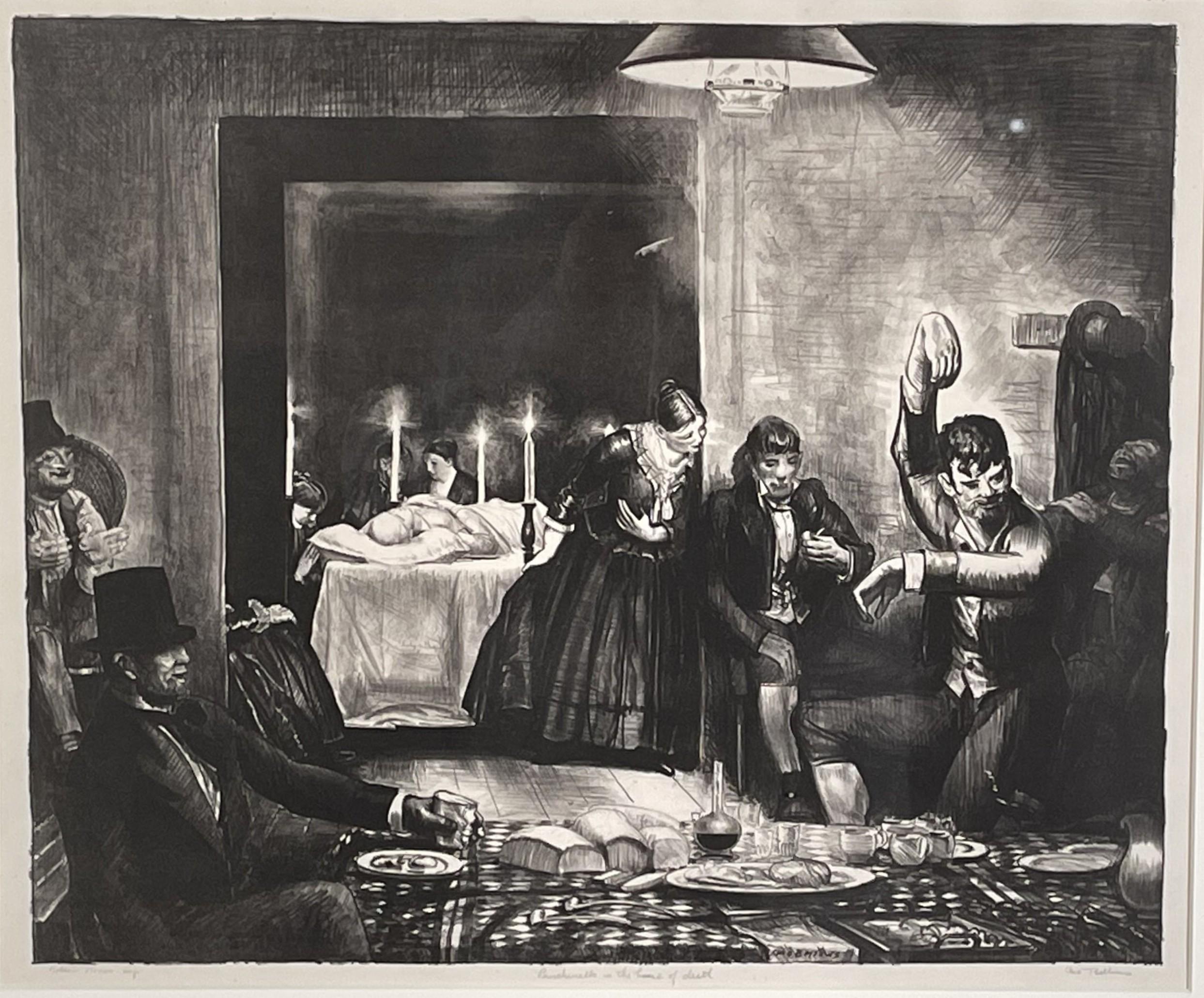
PUNCHINELLO IN THE HOUSE OF DEATH.
By George Wesley Bellows
Located in Portland, ME
Bellows, George (American 1882-1925). PUNCHINELLO IN THE HOUSE OF DEATH.Mason 151 Lithograph, 1923. Edition of 60. Titled and signed in pencil by Bellows, and also signed "Bolton Bro...
Category
1920s Interior Prints
Materials
Lithograph

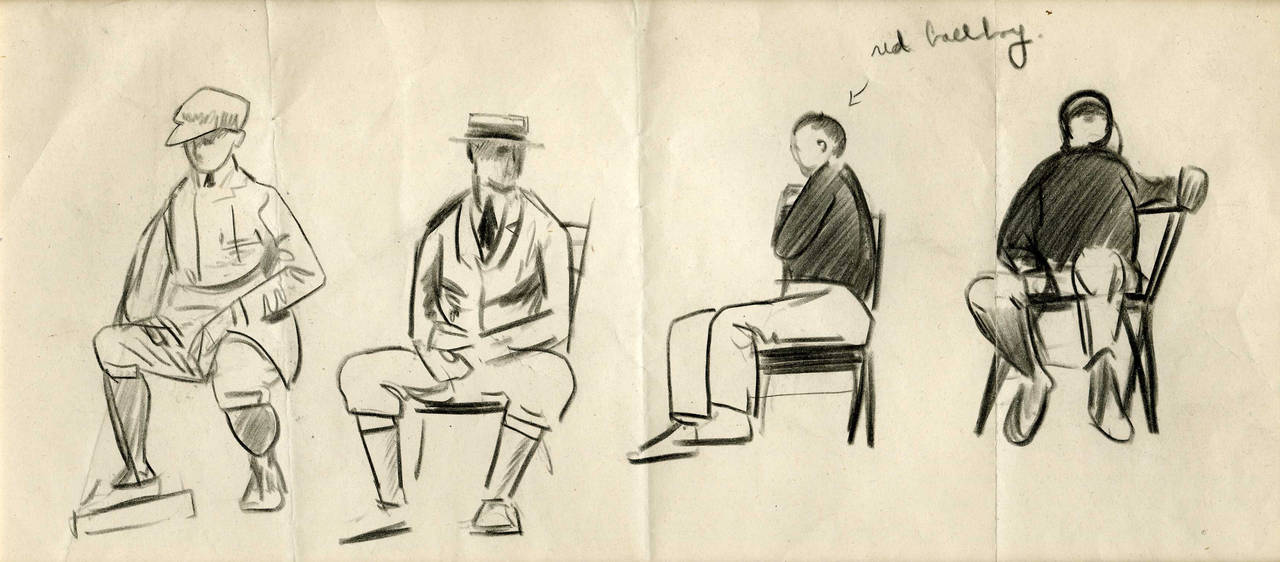
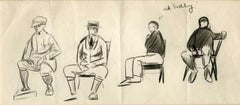
red ballboy or Studies for "Tennis Tournament"
By George Wesley Bellows
Located in Fairlawn, OH
Red Ballboy or Studies for "Tennis Tournament"
Crayon on paper, c. 1920
Unsigned
Condition: three vertical folds created by the artist to transport the drawing from the tennis match ...
Category
1910s Ashcan School Figurative Drawings and Watercolors
Materials
Graphite
More Ways To Browse
Dali Beatrice
Daumier Les Gens De Justice
De La Fille
Elizabeth Ii Signed
Erotica Prints
Guerin Prints
Japanese Beauties Prints
John Hay Whitney
Joseph And His Brothers
Kaws Pink Companion
Keith Haring Bill T Jones
Laura Owens
Le Couple
Leonard Baskin Woodcut
Les Bijoux Vintage
Linocut Africa
Lithograph Jesus
Lois Jones