1 of 7
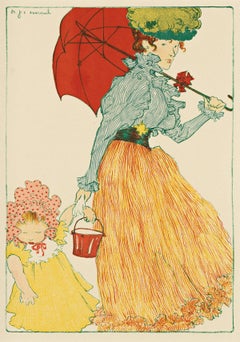
Georges Rouault"Portents", Plate 41 from Rouault
s Miserere1923
1923
$1,500List Price
About the Item
- Creator:Georges Rouault (1871-1958, French)
- Creation Year:1923
- Dimensions:Height: 19.75 in (50.17 cm)Width: 17.25 in (43.82 cm)
- Medium:
- Movement Style:
- Period:
- Condition:
- Gallery Location:New York, NY
- Reference Number:1stDibs: LU5181033933
Georges Rouault
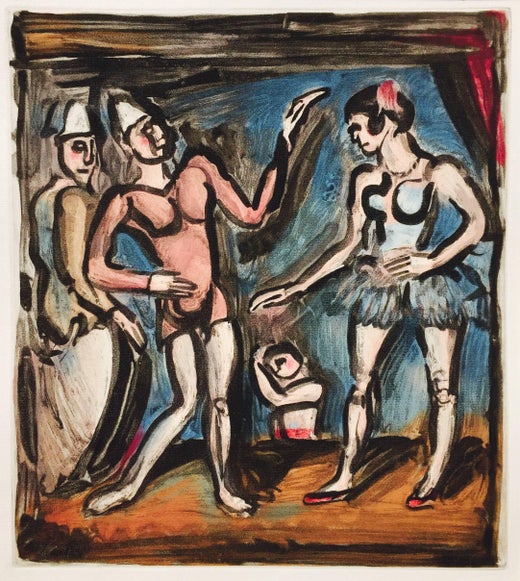
Executed in 1937, Carlotta belongs to a group of portraits of members of society. Unlike Picasso and Toulouse-Lautrec, who portrayed these individuals with pathos, Rouault’s approach was unapologetic and raw. In the present work several layers of pigment can be discerned; the build-up of translucent and opaque layers of paint creates a three-dimensionality that characterizes the artist’s strongest work. Furthermore, the work is highlighted by the deep swaths of black delineating the subject, representing a signature element of Rouault’s portraiture of this period.
Authenticity Guarantee
In the unlikely event there’s an issue with an item’s authenticity, contact us within 1 year for a full refund. DetailsMoney-Back Guarantee
If your item is not as described, is damaged in transit, or does not arrive, contact us within 7 days for a full refund. Details24-Hour Cancellation
You have a 24-hour grace period in which to reconsider your purchase, with no questions asked.Vetted Professional Sellers
Our world-class sellers must adhere to strict standards for service and quality, maintaining the integrity of our listings.Price-Match Guarantee
If you find that a seller listed the same item for a lower price elsewhere, we’ll match it.Trusted Global Delivery
Our best-in-class carrier network provides specialized shipping options worldwide, including custom delivery.You May Also Like
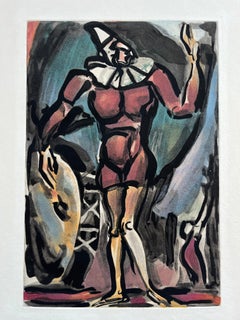
Clown au Timbale
Clown Assis (2 prints)
By Georges Rouault
Located in New York, NY
Both are color aquatints with same noted dimensions, the sheets with full margins. Both are from an edition of 270. From the portfolio "Cirque." Printed by Maurice Potin, Paris. P...
Category
1930s Fauvist Figurative Prints
Materials
Aquatint, Color
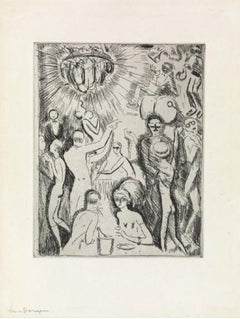
Boite de Nuit
By Kees van Dongen
Located in New York, NY
Etching printed in black on cream wove pape, 1927r. Full margins (full sheet dimensions 9.75 x 12.75 inches). Artist's proof, side from edition of 250. Signed by the artist in pen...
Category
1920s Fauvist Figurative Prints
Materials
Etching
Dors mon amour
By Georges Rouault
Located in New York, NY
A superb impression of this color aquatint. From an unnumbered edition of 280. Printed by Lacouriere, Paris. Published by Vollard, Paris. From "Cirque de l'Étoile Filante."
Catalogu...
Category
1930s Fauvist Abstract Prints
Materials
Color, Aquatint
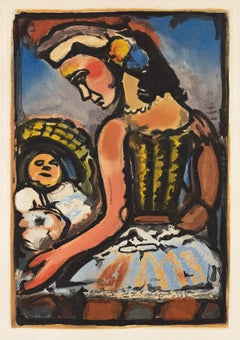
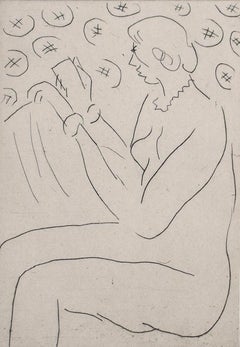
Figure Reading - Etching - Fauvism - French Art
By Henri Matisse
Located in London, GB
HENRI MATISSE 1869-1954
(Emile Benoît)
Le Cateau-Cambrésis 1869-1954 Nice (French)
Title: Figure Reading Figure lisant, 1929
Technique: Original Hand Signed and Numbered Etching o...
Category
1920s Fauvist Figurative Prints
Materials
Etching
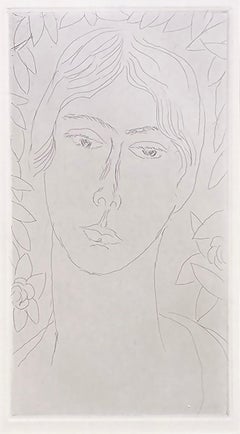
"Mlle Landsberg" (grade planche, pl. 16)
By Henri Matisse
Located in Missouri, MO
"Mlle Landsberg" (grade planche, pl. 16), 1914
Henri Matisse (French, 1869-1954)
Signed and Numbered Lower Right
Edition 12/15
Image size: 7 7/8 x 4 5/16 inches
Sheet size: 17 11/16 x 12 1/2 inches
With frame: 19 1/2 x 14 1/2 inches
Henri Matisse came from a family who were of Flemish origin and lived near the Belgian border. At eight o'clock on the evening of December 31, 1869, he was born in his grandparents' home in the town of Le Cateau in the cheerless far north of France. His father was a self-made seed merchant who was a mixture of determination and tightly coiled tension.
Henri had no clear idea of what he wanted to do with his life. He was a twenty-year-old law clerk convalescing from appendicitis when he first began to paint, using a box of colors given to him by his mother. Little more than a year later, in 1890, he had abandoned law and was studying art in Paris. The classes consisted of drawing from plaster casts and nude models and of copying paintings in the Louvre. He soon rebelled against the school's conservative atmosphere; he replaced the dark tones of his earliest works with brighter colors that reflected his awareness of Impressionism. Matisse was also a violinist; he took an odd pride in the notion that if his painting eye failed, he could support his family by fiddling on the streets of Paris.
Henri found a girlfriend while studying art, and he fathered a daughter, Marguerite, by her in 1894. In 1898 he married another woman, Amelie Parayre. She adopted the beloved Marguerite; they eventually had two sons, Jean, a sculptor and Pierre who became an eminent art dealer. Relations between Matisse and his wife were often strained. He often dallied with other women, and they finally separated in 1939 over a model who had been hired as a companion for Mme. Matisse. She was Madame Lydia, and after Mme. Matisse left, she remained with Matisse until he died.
Matisse spent the summer of 1905 working with Andre Derain in the small Mediterranean seaport of Collioure. They began using bright and dissonant colors. When they and their colleagues exhibited together, they caused a sensation. The critics and the public considered their paintings to be so crude and so roughly crafted that the group became known as Les Fauves (the wild beasts).
By 1907, Matisse moved on from the concerns of Fauvism and turned his attention to studies of the human figure. He had begun to sculpt a few years earlier. In 1910, when he saw an exhibition of Islamic art, he was fascinated with the multiple patterned areas and adapted the decorative universe of the miniatures to his interiors. As a continuation of his interest in the "exotic", Matisse made extended trips to Morocco in 1912 and 1913.
At the end of 1917, Matisse moved to Nice; he would spend part of each year there for the remainder of his life. A meticulous dandy, he wore a light tweed jacket amd a tie when he painted. He never used a palette, but instead squeezed his colors on to plain white kitchen dishes...
Category
1910s Fauvist Figurative Prints
Materials
Drypoint, Etching
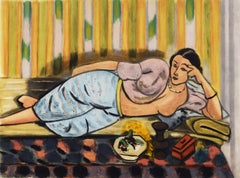
Odalisque with the Red Coffer - French Odalisque Fauvusm
By (after) Henri Matisse
Located in London, GB
This aquatint is hand signed in pencil by the artist "Henri Matisse" at the lower right margin.
It is also hand numbered in pencil 103 from the edition of 200, at the lower left marg...
Category
1920s Fauvist Figurative Prints
Materials
Aquatint
$43,800
H 22.45 in W 30.12 in
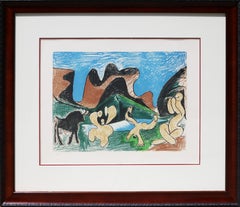
Bacchanale, Cubist Lithograph after Pablo Picasso
By Pablo Picasso
Located in Long Island City, NY
A lithograph from the Marina Picasso Estate Collection after the Pablo Picasso painting "Bacchanale". The original painting was completed circa 1922. In the 1970's after Picasso's d...
Category
1980s Fauvist Figurative Prints
Materials
Lithograph
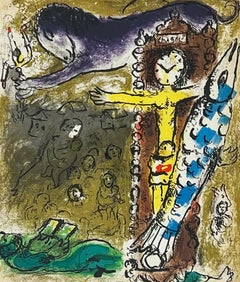
Christ in the Clock, from Chagall - Jacques Lassaigne
By Marc Chagall
Located in Washington, DC
Artist: Marc Chagall
Title: Christ in the Clock
Portfolio: Chagall - Jacques Lassaigne
Medium: Lithograph
Year: 1957
Edition: 6,000
Sheet Size: 9" x 7 7/8"
Image Size: 9" x 7 7/8"
Si...
Category
1950s Fauvist Figurative Prints
Materials
Lithograph
$1,295
Free Shipping
H 9 in W 7.875 in
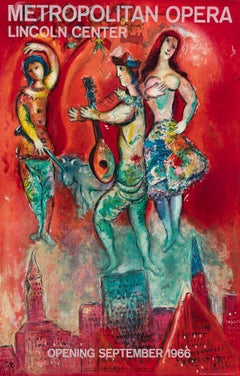
Carmen
By (after) Marc Chagall
Located in New York, NY
A very good impression of this color lithograph. Edition of 3000. Printed by Mourlot, Paris. Published by Editions of the Metropolitan Opera, New York.
Category
1960s Fauvist Abstract Prints
Materials
Color, Lithograph
Au Square
By Henri Evenepoel
Located in New York, NY
A very good impression of this color lithograph. Edition of 2000. Published by "L'Estampe Moderne," Paris, with the blind stamp (Lugt 2790, lower right).
Category
1890s Fauvist Abstract Prints
Materials
Color, Lithograph