Want more images or videos?
Request additional images or videos from the seller
1 of 7
Gilles DemarteauHead of a Man - Etching by Gilles Demarteau - 18th Century18th Century
18th Century
Price:$570.61
About the Item
- Creator:Gilles Demarteau (1722 - 1776, French)
- Creation Year:18th Century
- Dimensions:Height: 25.6 in (65 cm)Width: 21.26 in (54 cm)Depth: 1.19 in (3 cm)
- Medium:
- Movement Style:
- Period:
- Condition:Insurance may be requested by customers as additional service, contact us for more information.
- Gallery Location:Roma, IT
- Reference Number:Seller: T-1488601stDibs: LU650314430552
About the Seller
4.9
Platinum Seller
Premium sellers with a 4.7+ rating and 24-hour response times
1stDibs seller since 2017
7,838 sales on 1stDibs
Typical response time: 1 hour
Authenticity Guarantee
In the unlikely event there’s an issue with an item’s authenticity, contact us within 1 year for a full refund. DetailsMoney-Back Guarantee
If your item is not as described, is damaged in transit, or does not arrive, contact us within 7 days for a full refund. Details24-Hour Cancellation
You have a 24-hour grace period in which to reconsider your purchase, with no questions asked.Vetted Professional Sellers
Our world-class sellers must adhere to strict standards for service and quality, maintaining the integrity of our listings.Price-Match Guarantee
If you find that a seller listed the same item for a lower price elsewhere, we’ll match it.Trusted Global Delivery
Our best-in-class carrier network provides specialized shipping options worldwide, including custom delivery.You May Also Like
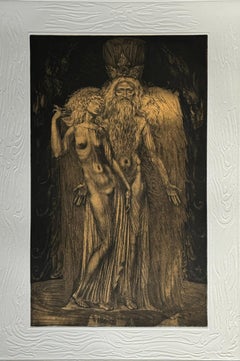
Engraving #1 by Ernst Fuchs: KABBALAH (SEFER YETSIRA and 32 PATHS OF WISDOM)
By Ernst Fuchs
Located in Cliffside Park, NJ
Original engraving #7 by Ernst FUCHS from Kabbalah (THIRTY-TWO PATHS OF WISDOM by SEFER YETZIRA), 1978
Etching signed and numbered 16/30 E.A.
Page size - 30 ...
Category
1970s Modern Figurative Prints
Materials
Paper, Etching
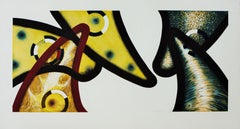
Victor Guadalajara, "Intersections", 2009, Woodcut 16x12in
By Victor Guadalajara
Located in Miami, FL
Victor Guadalajara (Mexican, 1965)
'Intersecciones', 2009
Woodcut and Aquatint
100.00 x 185 cm. (39.4 x 72.8 in.)
Edition of 30
Unframed
Category
Early 2000s Modern Abstract Prints
Materials
Paper, Ink, Engraving, Etching, Woodcut
$3,500
H 40 in W 73 in
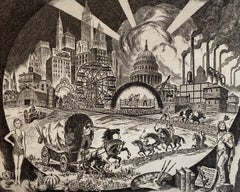
“Americana”
By Ralph Fabri
Located in Southampton, NY
Here for your consideration is a wonderful original etching on archival paper by the well known American artist, Ralph Fabri. Strong impression; signed in pencil by the artist lower right margin. Titled and dated bottom left of the sheet “1947-Americana”. Condition of the etching is excellent. Top corner of sheet and bottom right corner of sheet have tiny creases. Not visible, under the mat. Sheet size is 12 by 15 inches. Image size is 8 by 9.75 inches. Matted but not framed. Provenance: A Long Island, New York collector.
Painter and printmaker, commercial artist, writer, and teacher, Ralph Fabri was born Fabri Reszo in Hungary in 1894. He was educated in Budapest, first studying architecture at the Royal Institute of Technology from 1912 to 1914. He then enrolled in the Royal Academy of Fine Arts, from which he graduated in 1918 with a Professor's Diploma (M.A.) "for teaching drawing, painting and geometry – including descriptive and projective geometry – in schools of higher education."
Fabri arrived in New York City in 1921 and soon adopted the anglicized version of his name, Ralph Fabri. He began doing commercial design work and during the academic year of 1923/24 was enrolled as an evening student at the National Academy of Design. After becoming an American citizen in 1927, he traveled extensively in Europe. Upon returning to New York that same year, Fabri decided his financial situation was stable enough to allow him to focus his attention on fine art.
During the Great Depression, Fabri's already inadequate portrait commissions and art sales further declined and he returned to commercial work. He established a workshop known as the Ralph Fabri Studios, that designed theatrical and movie sets, window displays, and retail interiors. But Fabri found the workshop dirty and distasteful, and eventually was able to concentrate on advertising work which could be done from home. The largest clients for his pen and ink drawings were The Stamp and Album Co. of America, Inc. (for which he designed covers for stamp albums and produced illustrations for envelopes housing sets of stamps sold to collectors), Geographica Map Co., and Joseph H. Cohen & Sons (for whom he designed and illustrated mail order catalogs). Another source of income during this period was the design and construction of an addition to "Iroki," Theodore Dreiser...
Category
1940s American Modern Figurative Prints
Materials
Archival Paper, Etching
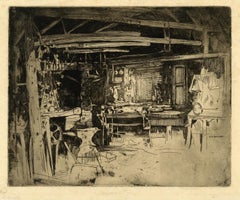
The Smithy
By Sir David Young Cameron, R.A.
Located in Middletown, NY
A warm composition, in theme and tone; the creaky timber interior of a 19th century Scottish blacksmith's shop.
Etching and drypoint on cream laid Japan paper, 8 x 10 inches (202 x ...
Category
Late 20th Century Modern Interior Prints
Materials
Laid Paper, Drypoint, Etching
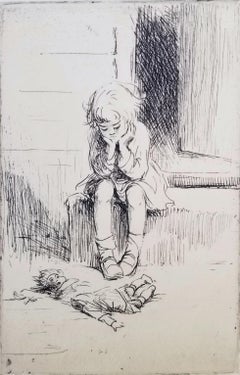
The Tragedy /// Modern Female Artist Children Child Cute Toy Childhood Etching
By Eileen Soper
Located in Saint Augustine, FL
Artist: Eileen Alice Soper (English, 1905-1990)
Title: "The Tragedy"
*Signed by Soper in pencil lower right
Year: 1922
Medium: Original Etching on cream laid paper
Limited edition: 264
Printer: Likely printed by Eva Soper, London, UK
Publisher: H C Dickens, London, UK
Reference: "The Catalogue Raisonne of Prints and Etchings of George and Eileen Soper" - Beetles No. 31, page 111, 141, 155
Sheet size: 9.13" x 5.5"
Image size: 3.88" x 6"
Condition: Remnants of previous mounting tape at right edges. In excellent condition
Notes:
Provenance: private collection - Boulder, CO.
Biography:
Eileen Soper was born in 1905 in the Municipal Borough of Enfield and moved to the house where she was to spend the rest of her life in Harmer Green, Welwyn in the Hertfordshire countryside in 1908. The house she later named "Wildings" was built by her father, the artist George Soper...
Category
1920s Modern Figurative Prints
Materials
Laid Paper, Etching, Intaglio
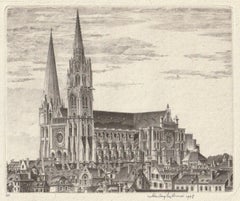
Chartres, The Magnificent
By John Taylor Arms
Located in Middletown, NY
Etching on handmade cream laid paper, 3 1/2 x 4 1/4 inches (890 x 108 mm), full margins. Signed, dated and inscribed "III" in pencil, lower margin. Edition of 150, third state (of th...
Category
Early 20th Century American Modern Landscape Prints
Materials
Laid Paper, Etching
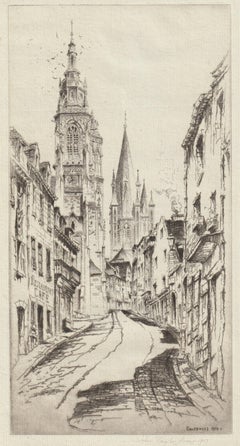
Coutances
By John Taylor Arms
Located in Middletown, NY
Etching on thin, bluish-green cream laid paper, 9 1/4 x 4 3/4 inches (233 x 120 mm), full margins. Signed and dated in pencil, lower margin. First and only state. Printed by Frederi...
Category
Early 20th Century American Modern Landscape Prints
Materials
Laid Paper, Etching
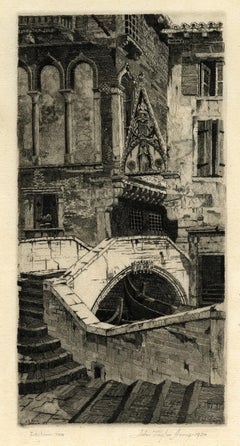
Porta del Paradiso, Venezia
By John Taylor Arms
Located in Middletown, NY
Etching on cream laid paper, 1930. 7 1/2 x 3 7/8 inches (190 x 970 mm), full margins. Signed and inscribed "Edition 100" in pencil, lower margin. In very good condition with minor s...
Category
Early 20th Century American Modern Landscape Prints
Materials
Laid Paper, Etching
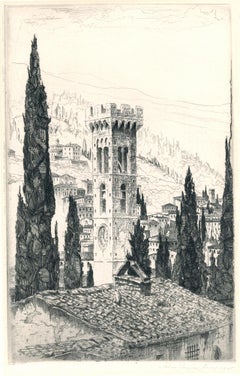
Fiesole, an Ancient Tower
By John Taylor Arms
Located in Middletown, NY
Etching on antique cream laid paper, 7 7/8 x 5 1/8 inches (201 x 130 mm), full margins. Edition of 150. Printed by Federick Reynolds. Signed and dated in pencil, lower right. Arms wa...
Category
Early 20th Century American Modern Landscape Prints
Materials
Handmade Paper, Laid Paper, Etching
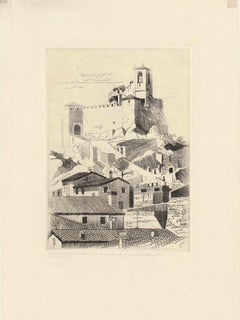
San Marino (Sketch)
By John Taylor Arms
Located in Middletown, NY
Ecthing in black ink on cream laid paper with a partial watermark, full margins. In excellent condition. A very scarce work from an edition of less than 20 impressions. Signed, date...
Category
Mid-20th Century American Modern Landscape Prints
Materials
Laid Paper, Etching
More From This Seller
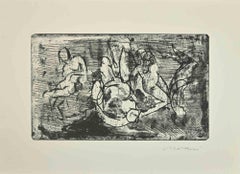
View AllFigures - Drypoint by Mino Maccari - Mid-20th Century
By Mino Maccari
Located in Roma, IT
Figures is an Etching and Drypoint realized by Mino Maccari in the Mid-20th Century.
Hand-signed in the lower right part.
Good conditions.
Mino Maccari (Siena, 1924-Rome, June ...
Category
Mid-20th Century Modern Figurative Prints
Materials
Paper, Drypoint, Etching
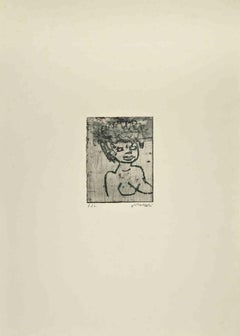
Nude - Etching by Mino Maccari - Mid-20th Century
By Mino Maccari
Located in Roma, IT
Nude is an Etching realized by Mino Maccari in the Mid-20th Century.
Hand-signed in the lower right part.
Artist'proof.
Good conditions.
Mino Maccari (Siena, 1924-Rome, June 16, 1989) was an Italian writer, painter, engraver and journalist, winner of the Feltrinelli Prize for Painting in 1963 and first winner of the Forte dei Marmi Satira Prize in 1973.After completing his secondary education, he enrolls in university. An interventionist like many young people of his time, he took part in the Great War at the age of nineteen as a field artillery officer. At the end of the conflict he resumed his university studies in Siena and in 1920 he graduated in law. In 1924 he was called by Angiolo Bencini to take care of the printing of the magazine Il Selvaggio, openly uncompromising fascist, revolutionary and anti-bourgeois, where his first engravings were published. After a few years of coexistence between work at the newspaper and the law firm, at the beginning of 1926 he left the legal profession to take over the direction of Il Selvaggio which he would hold until 1942. In 1928 he was the author of the small book published by Vallecchi (Florence), Il Trastullo di Strapaese (little songs and engraved woodwinds) which collected fascist songs (the same book was seized several times from Antonio Gramsci during his detention). With the transfer of the editorial staff of the Selvaggio in 1925 from Colle di Val d'Elsa to Florence, Maccari collaborated with Ardengo Soffici, Ottone Rosai and Achille Lega. In the meantime, between 1927 and 1930, he made himself known to the general public as a painter by participating in various national exhibitions. Also in 1930 Maccari works in Turin at La Stampa as editor-in-chief and has the writer Curzio Malaparte as director. His presence in the cultural and editorial world of the fascist regime is very intense, he writes and collaborates with various magazines: Quadrivio, L'Italia Letteraria, L'Italiano and Omnibus by Leo Longanesi; then, during the war, in il Primato di Bottai and, subsequently again, in Il Mondo di Pannunzio (from the first number, in 1949), up to Documento by Federigo Valli. His graphic production is also vast, ranging from the Album of Vallecchi (1925), Il trastullo di Strapaese (1928) to Linoleum (1931). Maccari illustrated in 1934 La vecchia del Bal Bullier by Antonio Baldini and in 1942 he published the Album folder, followed by Come quando fuori Piove and Il superfluo illustrata.For his pictorial work full of evident chromatic accentuations and fast brushstrokes, the violent drawing combined with the lively stroke of the graphic sign of his engravings, he is recognized by critics as a complete artist. In 1962 he was also entrusted with the presidency of the Accademia di San Luca in Rome and managed to obtain a personal exhibition at Gallery 63 in New York. His production of drawings, watercolors, temperas, etc. is endless, sometimes in collaboration with prestigious publishing houses; it is worth mentioning, just as an excellent example, the 32 b/w and color drawings with which he illustrated Il gusto di vivere, a volume that collects writings by Giancarlo Fusco, edited by Natalia Aspesi and published by Laterza in 1985. Maccari, Sienese and great contradaiolo della Torre, painted the Palio...
Category
Mid-20th Century Modern Figurative Prints
Materials
Paper, Etching
Figures - Drypoint by Mino Maccari - Mid-20th Century
By Mino Maccari
Located in Roma, IT
Mid-20th Century.
Hand-signed in the lower right part.
Numbered. Edition 1/12.
Good conditions.
Mino Maccari (Siena, 1924-Rome, June 16, 1989) was an Italian writer, painter, engraver and journalist, winner of the Feltrinelli Prize for Painting in 1963 and first winner of the Forte dei Marmi Satira Prize in 1973.After completing his secondary education, he enrolls in university. An interventionist like many young people of his time, he took part in the Great War at the age of nineteen as a field artillery officer. At the end of the conflict he resumed his university studies in Siena and in 1920 he graduated in law. In 1924 he was called by Angiolo Bencini to take care of the printing of the magazine Il Selvaggio, openly uncompromising fascist, revolutionary and anti-bourgeois, where his first engravings were published. After a few years of coexistence between work at the newspaper and the law firm, at the beginning of 1926 he left the legal profession to take over the direction of Il Selvaggio which he would hold until 1942. In 1928 he was the author of the small book published by Vallecchi (Florence), Il Trastullo di Strapaese (little songs and engraved woodwinds) which collected fascist songs (the same book was seized several times from Antonio Gramsci during his detention). With the transfer of the editorial staff of the Selvaggio in 1925 from Colle di Val d'Elsa to Florence, Maccari collaborated with Ardengo Soffici, Ottone Rosai and Achille Lega. In the meantime, between 1927 and 1930, he made himself known to the general public as a painter by participating in various national exhibitions. Also in 1930 Maccari works in Turin at La Stampa as editor-in-chief and has the writer Curzio Malaparte as director. His presence in the cultural and editorial world of the fascist regime is very intense, he writes and collaborates with various magazines: Quadrivio, L'Italia Letteraria, L'Italiano and Omnibus by Leo Longanesi; then, during the war, in il Primato di Bottai and, subsequently again, in Il Mondo di Pannunzio (from the first number, in 1949), up to Documento by Federigo Valli. His graphic production is also vast, ranging from the Album of Vallecchi (1925), Il trastullo di Strapaese (1928) to Linoleum (1931). Maccari illustrated in 1934 La vecchia del Bal Bullier by Antonio Baldini and in 1942 he published the Album folder, followed by Come quando fuori Piove and Il superfluo illustrata.For his pictorial work full of evident chromatic accentuations and fast brushstrokes, the violent drawing combined with the lively stroke of the graphic sign of his engravings, he is recognized by critics as a complete artist. In 1962 he was also entrusted with the presidency of the Accademia di San Luca in Rome and managed to obtain a personal exhibition at Gallery 63 in New York. His production of drawings, watercolors, temperas, etc. is endless, sometimes in collaboration with prestigious publishing houses; it is worth mentioning, just as an excellent example, the 32 b/w and color drawings with which he illustrated Il gusto di vivere, a volume that collects writings by Giancarlo Fusco, edited by Natalia Aspesi and published by Laterza in 1985. Maccari, Sienese and great contradaiolo della Torre, painted the Palio...
Category
Mid-20th Century Modern Figurative Prints
Materials
Paper, Drypoint, Etching
Portrait of Ardengo Soffici - Etching by Mino Maccari - Mid-20th Century
By Mino Maccari
Located in Roma, IT
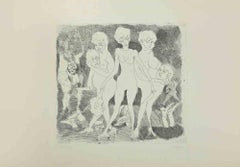
Portrait of Ardengo Soffici is an Etching realized by Mino Maccari in the Mid-20th Century.
Handi signed in the lower right part.
Numbered. Edition 4/100.
Good conditions.
Mino Maccari (Siena, 1924-Rome, June 16, 1989) was an Italian writer, painter, engraver and journalist, winner of the Feltrinelli Prize for Painting in 1963 and first winner of the Forte dei Marmi Satira Prize in 1973.After completing his secondary education, he enrolls in university. An interventionist like many young people of his time, he took part in the Great War at the age of nineteen as a field artillery officer. At the end of the conflict he resumed his university studies in Siena and in 1920 he graduated in law. In 1924 he was called by Angiolo Bencini to take care of the printing of the magazine Il Selvaggio, openly uncompromising fascist, revolutionary and anti-bourgeois, where his first engravings were published. After a few years of coexistence between work at the newspaper and the law firm, at the beginning of 1926 he left the legal profession to take over the direction of Il Selvaggio which he would hold until 1942. In 1928 he was the author of the small book published by Vallecchi (Florence), Il Trastullo di Strapaese (little songs and engraved woodwinds) which collected fascist songs (the same book was seized several times from Antonio Gramsci during his detention). With the transfer of the editorial staff of the Selvaggio in 1925 from Colle di Val d'Elsa to Florence, Maccari collaborated with Ardengo Soffici, Ottone Rosai and Achille Lega. In the meantime, between 1927 and 1930, he made himself known to the general public as a painter by participating in various national exhibitions. Also in 1930 Maccari works in Turin at La Stampa as editor-in-chief and has the writer Curzio Malaparte as director. His presence in the cultural and editorial world of the fascist regime is very intense, he writes and collaborates with various magazines: Quadrivio, L'Italia Letteraria, L'Italiano and Omnibus by Leo Longanesi; then, during the war, in il Primato di Bottai and, subsequently again, in Il Mondo di Pannunzio (from the first number, in 1949), up to Documento by Federigo Valli. His graphic production is also vast, ranging from the Album of Vallecchi (1925), Il trastullo di Strapaese (1928) to Linoleum (1931). Maccari illustrated in 1934 La vecchia del Bal Bullier by Antonio Baldini and in 1942 he published the Album folder, followed by Come quando fuori Piove and Il superfluo illustrata.For his pictorial work full of evident chromatic accentuations and fast brushstrokes, the violent drawing combined with the lively stroke of the graphic sign of his engravings, he is recognized by critics as a complete artist. In 1962 he was also entrusted with the presidency of the Accademia di San Luca in Rome and managed to obtain a personal exhibition at Gallery 63 in New York. His production of drawings, watercolors, temperas, etc. is endless, sometimes in collaboration with prestigious publishing houses; it is worth mentioning, just as an excellent example, the 32 b/w and color drawings with which he illustrated Il gusto di vivere, a volume that collects writings by Giancarlo Fusco, edited by Natalia Aspesi and published by Laterza in 1985. Maccari, Sienese and great contradaiolo della Torre, painted the Palio...
Category
Mid-20th Century Modern Figurative Prints
Materials
Paper, Etching
Figures - Etching by Mino Maccari - 1940s
By Mino Maccari
Located in Roma, IT
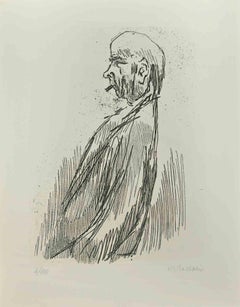
Figures is an Etching realized by Mino Maccari in the 1940s.
Hand-signed in the lower right part.
Artist's Proof.
Good conditions.
Mino Maccari (Siena, ...
Category
1940s Modern Figurative Prints
Materials
Paper, Etching
Figures - Drypoint by Mino Maccari - Mid-20th Century
By Mino Maccari
Located in Roma, IT
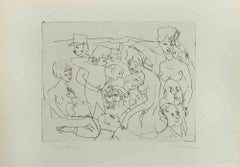
Figures is an Etching and Drypoint realized by Mino Maccari in the Mid-20th Century.
Hand-signed in the lower right part.
Numbered. Edition,3/40.
Good conditions.
Mino Maccari (Siena, 1924-Rome, June 16, 1989) was an Italian writer, painter, engraver and journalist, winner of the Feltrinelli Prize for Painting in 1963 and first winner of the Forte dei Marmi Satira Prize in 1973.After completing his secondary education, he enrolls in university. An interventionist like many young people of his time, he took part in the Great War at the age of nineteen as a field artillery officer. At the end of the conflict he resumed his university studies in Siena and in 1920 he graduated in law. In 1924 he was called by Angiolo Bencini to take care of the printing of the magazine Il Selvaggio, openly uncompromising fascist, revolutionary and anti-bourgeois, where his first engravings were published. After a few years of coexistence between work at the newspaper and the law firm, at the beginning of 1926 he left the legal profession to take over the direction of Il Selvaggio which he would hold until 1942. In 1928 he was the author of the small book published by Vallecchi (Florence), Il Trastullo di Strapaese (little songs and engraved woodwinds) which collected fascist songs (the same book was seized several times from Antonio Gramsci during his detention). With the transfer of the editorial staff of the Selvaggio in 1925 from Colle di Val d'Elsa to Florence, Maccari collaborated with Ardengo Soffici, Ottone Rosai and Achille Lega. In the meantime, between 1927 and 1930, he made himself known to the general public as a painter by participating in various national exhibitions. Also in 1930 Maccari works in Turin at La Stampa as editor-in-chief and has the writer Curzio Malaparte as director. His presence in the cultural and editorial world of the fascist regime is very intense, he writes and collaborates with various magazines: Quadrivio, L'Italia Letteraria, L'Italiano and Omnibus by Leo Longanesi; then, during the war, in il Primato di Bottai and, subsequently again, in Il Mondo di Pannunzio (from the first number, in 1949), up to Documento by Federigo Valli. His graphic production is also vast, ranging from the Album of Vallecchi (1925), Il trastullo di Strapaese (1928) to Linoleum (1931). Maccari illustrated in 1934 La vecchia del Bal Bullier by Antonio Baldini and in 1942 he published the Album folder, followed by Come quando fuori Piove and Il superfluo illustrata.For his pictorial work full of evident chromatic accentuations and fast brushstrokes, the violent drawing combined with the lively stroke of the graphic sign of his engravings, he is recognized by critics as a complete artist. In 1962 he was also entrusted with the presidency of the Accademia di San Luca in Rome and managed to obtain a personal exhibition at Gallery 63 in New York. His production of drawings, watercolors, temperas, etc. is endless, sometimes in collaboration with prestigious publishing houses; it is worth mentioning, just as an excellent example, the 32 b/w and color drawings with which he illustrated Il gusto di vivere, a volume that collects writings by Giancarlo Fusco, edited by Natalia Aspesi and published by Laterza in 1985. Maccari, Sienese and great contradaiolo della Torre, painted the Palio...
Category
Mid-20th Century Modern Figurative Prints
Materials
Paper, Drypoint, Etching
Recently Viewed
View AllMore Ways To Browse
Vienna Secession Art Posters
Vincent Gallo
Vintage Coney Island Signs
Vintage Erotism
Vintage Muhammad Ali
Wolfgang Hutter
Woman In The Waves
Wynn Chamberlain
12 Tribes Of Israel
1930s Wpa Prints
1960s Womens Fashion
Alaska Watercolor
Albrecht Durer Woodcut Print
Alex Katz Dancer 2
Alice Neel Lithograph
Anders Zorn Etchings
Andy Warhol Dollar Sign
Andy Warhol Electric Chair Art