Items Similar to Shepherds in a Landscape
Want more images or videos?
Request additional images or videos from the seller
1 of 2
Giulio CampagnolaShepherds in a Landscape1515
1515
On Hold
On Hold
On Hold
On Hold
On Hold
On Hold
On Hold
On Hold
On Hold
On Hold
About the Item
GIULIO CAMPAGNOLA (CIRCA 1482-1516) AND DOMENICO CAMPAGNOLA (CIRCA 1500-1564)
Shepherds in a Landscape
engraving, circa 1515-1518, on laid paper, without watermark, a fine, richly tonal and atmospheric impression of this rare print, small to thread margins above and below, trimmed to the subject at left, the right edge of the subject skillfully made-up with pen and ink
Sheet 140 x 260 mm.
Provenance
With R.M. Light
Co., Santa Barbara, California.
Acquired from the above on 1 July 1982; then by descent to the present owner.
The fascinating composition of this rare early engraving, which has been the subject of much discussion, was clarified in the essay on the print in the volume Early Italian Engravings from the National Gallery of Art (see reference below), and our summary notes below are based on this essay.
The right half of the print, the landscape filled with beautiful buildings, lush hills and flora, is by Giulio Campagnola, based on a drawing by Campagnola (in the Louvre) which in turn was based on a drawing by Giorgione (in Rotterdam). Though some authorities have attributed the engraving to Giorgione, the attribution to Campagnola is considered more convincing. The left half of the print, the large figures in the foreground in front of a mass of trees, are quite different from Giulio’s preparatory drawing; Giulio apparently left this part of the composition unfinished for the print (perhaps because of his early death at age 33, or possible dissatisfaction with the image). His adopted son, Domenico, is thought to have finished the composition, following
the general outlines of Giulio’s drawing but bring the figures further to the foreground, and employing a bold engraving technique, in contrast to Giulio’s delicate short strokes. This is not just a question of different artistic personalities, as Konrad Oberhuber pointed out, but of a new spirit: ‘There is also a difference between Giulio’s interest in detailed observation and his serene representation of objects and Domenico’s feeling for the vitality which unifies both figures and nature; this is characteristic of the contrast between the world of Giorgione and that of Titian, between the spirit of the first decade of the cinquecento and that of the new period to follow.’ (Oberhuber, Early Italian Engravings, p. 413.)
Reference:
J. A. Levenson, K. Oberhuber, J. L. Sheehan, Early Italian Engravings from the National Gallery of Art, Washington, D.C., 1973, no. 150, p. 410-413).
- Creator:Giulio Campagnola (1520 - 1582, Italian)
- Creation Year:1515
- Dimensions:Height: 55.12 in (140 cm)Width: 102.37 in (260 cm)Depth: 0.04 in (1 mm)
- Medium:
- Movement Style:
- Period:
- Condition:
- Gallery Location:New York, NY
- Reference Number:1stDibs: LU515311671622
About the Seller
4.9
Recognized Seller
These prestigious sellers are industry leaders and represent the highest echelon for item quality and design.
Established in 2000
1stDibs seller since 2016
108 sales on 1stDibs
Typical response time: 9 hours
Associations
International Fine Print Dealers Association
- ShippingRetrieving quote...Shipping from: New York, NY
- Return Policy
More From This Seller
View AllDimanche en Bretagne
By Jean-Emile Laboureur
Located in New York, NY
Jean-Emile Laboureur (1877-1943), Dimanche en Bretagne, etching, 1939, signed in pencil lower left and inscribed “ep d’artite” lower right. Reference: Laboureur 543, second state (of...
Category
1930s Realist Figurative Prints
Materials
Etching
Apollo and the Muses
Located in New York, NY
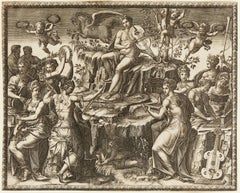
Giorgio Ghisi, Italy 1520-1582. After Luca Penni (Italy 1500-1556). "Apollo and the Muses". Signed GEORGIVS MANT. F. and L. PENNIS R. IN in the plate. Engraving on laid paper, S. 33....
Category
16th Century Northern Renaissance Figurative Prints
Materials
Engraving
Price Upon Request
The Bridge, Santa Maria
By James Abbott McNeill Whistler
Located in New York, NY
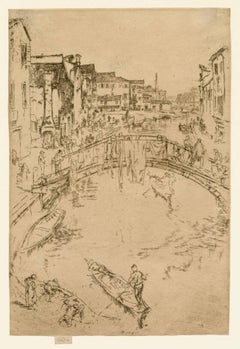
James Whistler (1834-1903), The Bridge, Santa Marta, 1879-80, etching with drypoint, printed in sepia on fine laid paper. Signed with the butterfly and inscribed imp on the tab (also with an exceedingly light butterfly lower right in the plate). Kennedy 204, probably eighth (final) state; Glasgow 201, probably state 9 (of 9) (cf. Margaret F. MacDonald, Grischka Petri, Meg Hausberg, and Joanna Meacock, James McNeill Whistler: The Etchings, a catalogue raisonné, University of Glasgow, 2011), Lochnan 199. Trimmed to the platemark by the artist, h: 11.8 x w: 7.9 in / h: 30 x w: 20.1 cm.
A fine impression, printed with subtle tone.
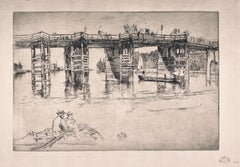
The bridge theme occurs repeatedly in Whistler’s vistas. It is also the main focus of more than one of the Venetian prints. While some bridges are seen from below, from where one would see it if approaching in a gondola (for example Ponte del Piovan, Kennedy 209), The Bridge depicts the scene from a high perspective, opening up the view into the far distance. The small boat approaching the arch in the foreground is again, as in the earlier Thames prints, a stock motif that is probably ultimately derived from the Japanese woodcuts of Hokusai and Hiroshige. The bridge here is the Ponte de le Terese over the Rio de l’Arzere in the Santa Marta quarter.
The early biography of Whistler by Elizabeth and Joseph Pennell is essential for its “immense quantity of information” but also notorious for “the inherent hyperbole and misinformation” (Eric Denker, Annotated Bibliography, in Fine, p. 184). Still, it is worth quoting from the Pennels’ appraisal of The Bridge: “Simplicity of expression has never been carried further. Probably the finest plate, in its simplicity and directness, is The Bridge. Whistler now obtained the quality of richness by suggesting detail, and also by printing. In The Traghetto...
Category
1870s Impressionist Landscape Prints
Materials
Drypoint, Etching
The Mill, Amsterdam, 1889
By James Abbott McNeill Whistler
Located in New York, NY
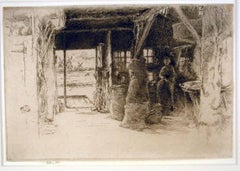
James Whistler (1834-1903), The Mill, 1889, etching and drypoint, signed in pencil with the butterfly on the tab and inscribed “imp”, and inscribed “first state” (twice) and annotated “Wunderlich” and signed again with the butterfly verso. Reference: Kennedy 413, first state (of 5). Glasgow 457, second state (of 6; see discussion below) (cf. Margaret F. MacDonald, Grischka Petri, Meg Hausberg, and Joanna Meacock, James McNeill Whistler: The Etchings, a catalogue raisonné, University of Glasgow, 2011)
On laid paper, in very good condition, trimmed just outside of the platemark all around except for the tab by the artist, 6 1/4 x 9 3/8 inches.
A very fine impression of this great rarity, printed in black/brown ink with a slight veil of plate tone.
provenance:
H. Wunderlich & Co., New York
Louis B. Dailey, New York (Lugt 4500)
sale, Sotheby’s, New York, October 31, 2003, lot 69
literature;
Neue Lagerliste 122: James McNeill Whistler – Etchings...
Category
1880s Impressionist Landscape Prints
Materials
Drypoint, Etching
Lagoon: Noon
By James Abbott McNeill Whistler
Located in New York, NY
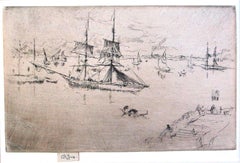
James McNeill Whistler (1830-1903), Lagoon: Noon, etching and drypoint, 1879-1880, signed with the butterfly and inscribed “imp” on the tab [also signed with the butterfly in the plate lower left]. Reference: Glasgow 209, third state (of 3), Kennedy 216, third state (of 3); Lochnan 231, 4 7/8 x 7 7/8 inches.
A fine impression with very little plate tone, and printed with extraordinary attention to the etching and drypoint details. The printed butterfly, usually only barely visible, is clearly defined in this impression (see detail below). Kennedy mades special note that an impression like this, with the clearly visible butterfly, was in the collection of John H. Wrenn.
On a commission from the Fine Arts Society, Whistler created the plates of his Venice series...
Category
1870s Impressionist Landscape Prints
Materials
Drypoint, Etching
Old Putney Bridge
By James Abbott McNeill Whistler
Located in New York, NY
James Whistler (1834-1903), Old Putney Bridge, 1879, etching and drypoint, signed in pencil with a large, elaborate shaded butterfly, lower right and inscribed imp (also signed with the butterfly in the plate), printed in dark-brown/black ink on laid paper, watermark ProPatria, an impression in Glasgow’s seventh (final) state, published by The Fine Art Society, probably printed in 1881, 8x 11 3/4 inches, sheet 12 1/8 x 16 1/8 inches. Reference: Kennedy 178; Glasgow 185.
Provenance: Kraushaar Gallery, New York
A fine impression, with wide margins.
The Fine Art Societys relationship with Whistler began with the new etchings of the Thames he made in 1879, following a visit from Ernest Brown who had joined the staff of the gallery. The plate is on a large scale and shows the change in the artists approach to the Thames since the etchings he had made in Wapping and the docks in the summer of 1859. The central motif is the old bridge, by this stage somewhat dilapidated. It was shortly to be demolished and replaced by the new bridge of Cornish granite...
Category
Late 19th Century Impressionist Landscape Prints
Materials
Drypoint, Etching
You May Also Like
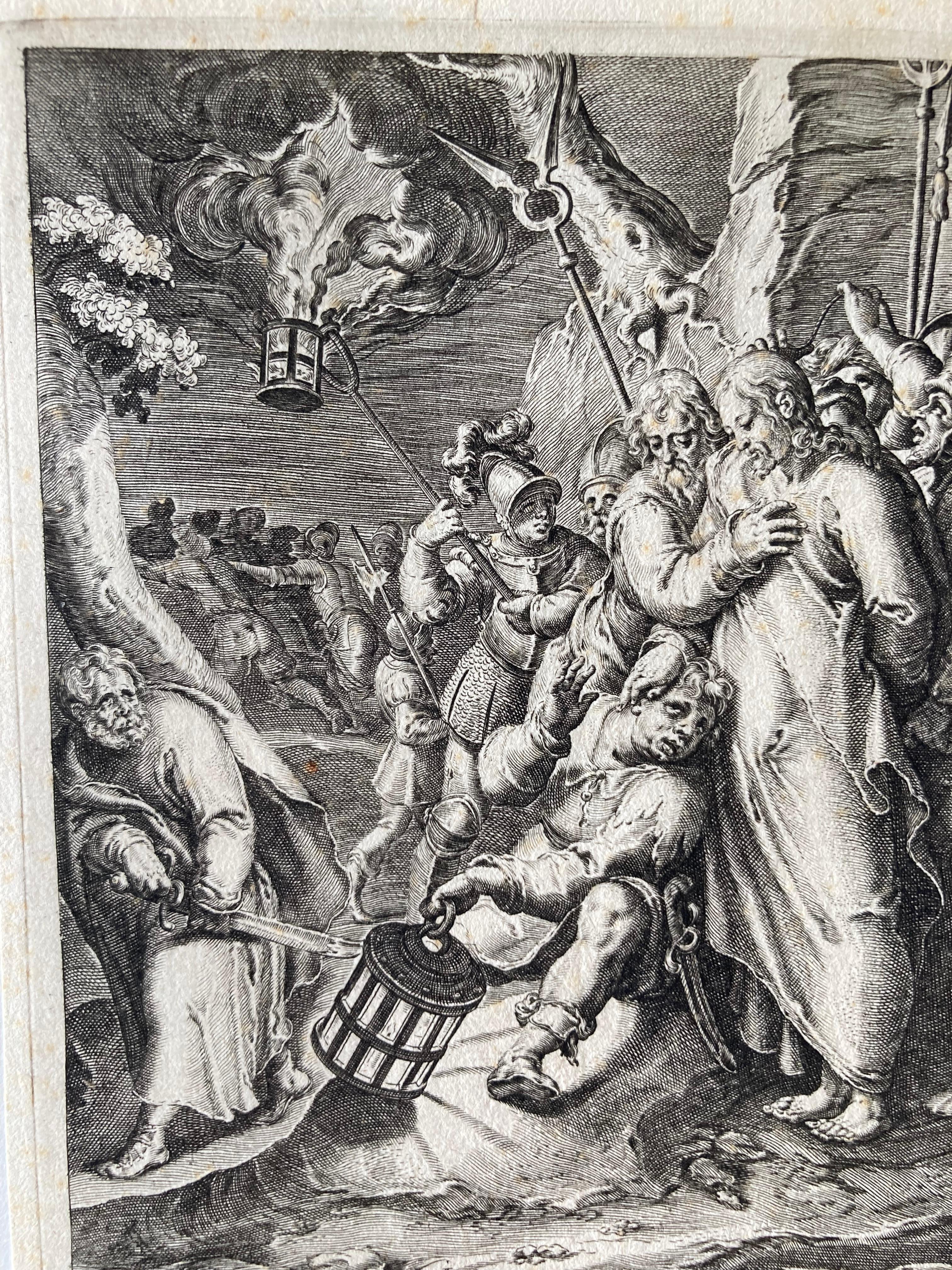
Arrest of Christ, Engraving, a. Karel van Mander, p. by Gheyn, Passion of Chris
Located in Greven, DE
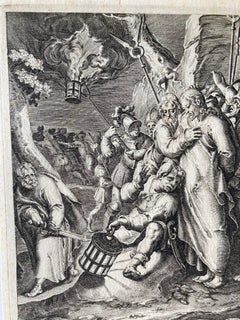
The arrest of Christ; Judas embraces Christ as a group of soldiers apprehend Him; Christ places His hand on the fearful Malchus who sits on the ground holding a lamp; Peter grips his sword; one of the soldiers holds up a flaming torch; after Karel van Mander
The scene is out of a set of 13 engravings "Passion of Christ"
Engraving
Published by: Jacques de Gheyn...
Category
17th Century Northern Renaissance Figurative Prints
Materials
Engraving
Summer
By Edmund Blampied
Located in Storrs, CT
Summer. 1914. Drypoint. Appleby 46. 6 7/8 x 4 7/8 (sheet 11 5/8 x 9 3/16). Edition 77. A fine impression printed on cream wove paper on the full sheet with deckle edges. Signed in pe...
Category
1910s Modern Figurative Prints
Materials
Drypoint
Driving Home in the Rain
By Edmund Blampied
Located in Storrs, CT
Driving Home in the Rain. 1914. Drypoint. Appleby 35. 7 3/8 x 10 1/8 (sheet 12 x 15 3/8). Edition 40. Illustrated: Guichard, British Etchers, 1850-1940; Print Collector's Quarterly 1...
Category
1910s Modern Figurative Prints
Materials
Drypoint
Price Upon Request
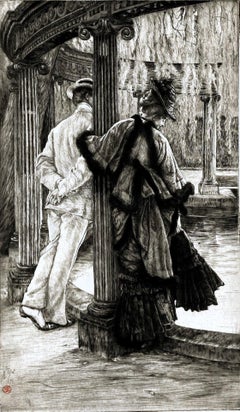
Querelle d
amoureux. (Quarreling). 1
By James Tissot
Located in Storrs, CT
En plein soleil. (In the Sunlight). 1881. Etching and drypoint. Tissot 54, Béraldi 45, Wentworth 54. 7 13/16 x 11 1/2 (sheet 11 1/4 x 15). Edition about 100. Mat line and two hinge s...
Category
19th Century Impressionist Figurative Prints
Materials
Drypoint, Etching
$2,800 Sale Price
20% Off
San Marco [Venice].
By William Walcot R. E. Hon. R. I. B. A.
Located in Storrs, CT
William Walcot. R.E., R.I.B.A. San Marco. Etching with drypoint and aquatint. Dickins 66, Harvey-Lee 91. 3 7/8 x 5 7/8 (sheet 9 1/4 x 12 1/8). Venice set, # 2. Edition 415. A rich impression printed on cream wove paper. Fold in the margin, well outside the image; otherwise good condition. Signed in pencil. Housed in a 16 x 20-inch archival mat.
Soon after Walcot's arrival in England, the Fine Art Society sponsored a trip sent to Italy. This scene is one of four small drypoints that resulted from the artist’s stay in Venice.
When he was seventeen, he began to study architecture under Louis Benois at the Imperial Academy of Art in Saint Petersburg. He went to Paris where he continued his studies at the Ecole des Beaux-Arts and the Atelier Redon. He practiced as an architect briefly in Moscow, designing the Hotel Metropole...
Category
Early 20th Century Modern Landscape Prints
Materials
Drypoint, Etching, Aquatint
![San Marco [Venice].](https://a.1stdibscdn.com/william-walcot-prints-works-on-paper-san-marco-venice-for-sale/a_3352/a_101504721690399029260/sanmarcoimage3_master.jpg?width=240)
Chelsea Old Church, London
By William Walcot R. E. Hon. R. I. B. A.
Located in Storrs, CT
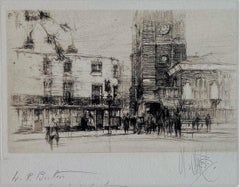
Chelsea Old Church. 1924. Etching, drypoint, and aquatint. Dickins 94. 5 3/8 x 8 (sheet 8 1/2 x 9 3/4). Edition 100 for The Print Collector's Club. A fine proof with tonal wiping, printed on cream wove paper. Signed and dedicated "W.R. Button from W. Walcot London 1930" in pencil.
Chelsea Old Church, also known as All Saints, is an Anglican church, on Old Church Street, Chelsea, London SW3, England, near Albert Bridge. It is the church for a parish in the Diocese of London, part of the Church of England. Inside the Grade I listed building, there is seating for 400 people. There is a memorial plaque to the author Henry James (1843–1916) who lived nearby on Cheyne Walk. To the west of the church is a small public garden containing a sculpture by Sir Jacob Epstein.
When he was seventeen,William Walcot began to study architecture under Louis Benois at the Imperial Academy of Art in Saint Petersburg. He went to Paris where he continued his studies at the Ecole des Beaux-Arts and the Atelier Redon. He practiced as an architect briefly in Moscow, designing the Hotel Metropole...
Category
Early 20th Century Modern Landscape Prints
Materials
Drypoint, Etching, Aquatint
$400 Sale Price
20% Off
More Ways To Browse
Marc Chagall Signed Lithographs Angel
Matisse Screen Print
Michel Delacroix Signed
Mourlot Exhibition Poster
Naked Women Art
Norman Rockwell Freedom From Want
Nursery Prints
Pablo Picasso Dance
Pastel Picasso
Penni Anne Cross
Picasso 1930s
Picasso Flower
Picasso Girl
Picasso Lithograph 1954
Picasso Original Linocuts
Picasso Pochoir
Rainbow Vintage Poster
Ronald B Kitaj