Want more images or videos?
Request additional images or videos from the seller
1 of 10
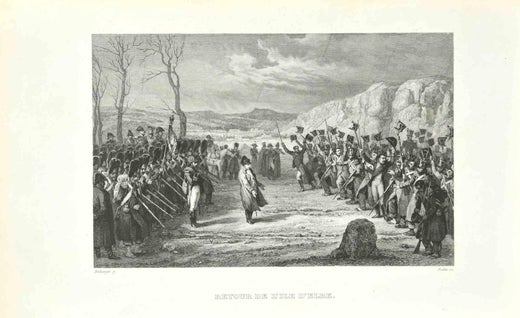
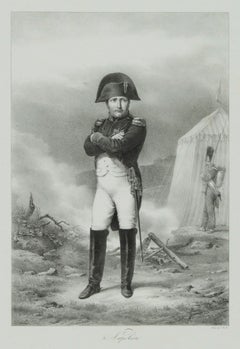
Hippolyte Bellangé Napoleon a Bautzen1822
1822
Price:$425
$500List Price
About the Item
- Creator:Hippolyte Bellangé (1800 - 1866, French)
- Creation Year:1822
- Dimensions:Height: 12.19 in (30.97 cm)Width: 17.38 in (44.15 cm)
- Medium:
- Movement Style:
- Period:
- Condition:
- Gallery Location:Fairlawn, OH
- Reference Number:Seller: FA119231stDibs: LU14013519372
Hippolyte Bellangé
Hippolyte BELLANGÉ was an artist born in France in 1800 and died in 1866. His works went up for sale at public auction 388 times, mostly in the Drawing-Watercolor category. The oldest auction recorded on Artprice.com is "The battle of Alheim" sold in 1986 at Christie's (Drawing-Watercolor) and the most recent is "Military" sold in 2023.
About the Seller
5.0
Recognized Seller
These prestigious sellers are industry leaders and represent the highest echelon for item quality and design.
Gold Seller
Premium sellers maintaining a 4.3+ rating and 24-hour response times
Established in 1978
1stDibs seller since 2013
832 sales on 1stDibs
Associations
International Fine Print Dealers Association
Authenticity Guarantee
In the unlikely event there’s an issue with an item’s authenticity, contact us within 1 year for a full refund. DetailsMoney-Back Guarantee
If your item is not as described, is damaged in transit, or does not arrive, contact us within 7 days for a full refund. Details24-Hour Cancellation
You have a 24-hour grace period in which to reconsider your purchase, with no questions asked.Vetted Professional Sellers
Our world-class sellers must adhere to strict standards for service and quality, maintaining the integrity of our listings.Price-Match Guarantee
If you find that a seller listed the same item for a lower price elsewhere, we’ll match it.Trusted Global Delivery
Our best-in-class carrier network provides specialized shipping options worldwide, including custom delivery.You May Also Like
Return of Napoleon from Egypt - Lithograph - 19th Century
Located in Roma, IT
Lithograph realized after Lafitte in the early 19th Century.
Very good condition.
Category
19th Century Romantic Figurative Prints
Materials
Lithograph
$237
H 7.88 in W 10.24 in D 0.04 in
Paradise, Garden of Eden, Lithograph on paper, Signed, titled #36/100, Unframed
Located in New York, NY
Helen Siegl
Paradise, 1976
Lithograph on wove paper
Pencil signed, dated and numbered 36/100
Unframed
Provenance: Rodger LaPelle Galleries, PA
depicts a scene reminiscent of the Gard...
Category
1970s Romantic Figurative Prints
Materials
Lithograph
A Pair of Framed 19th Century Colored Lithographs of Tudor Scenes by Joseph Nash
By Joseph Nash
Located in Alamo, CA
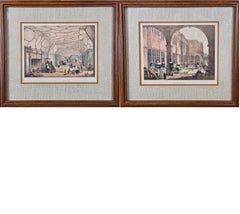
This is a pair of framed 19th century tinted lithographs with hand-coloring entitled "Gallery Over the Hall, Knowle, Kent" and "Terrace Bramshill, Hants" by Charles Joseph Hullmandel (1789-1850) after drawings by Joseph Nash (1809-1878), from "Mansions of England in the Olden Time", published in London in 1839-1849. Nash's publication consists of a series of views of Tudor domestic architecture, which Nash said depicted "the most characteristic features of the domestic architecture of the Tudor Age, and also illustrating the costumes, habits, and recreations of our ancestors." The scenes of the aristocratic ladies and gentlemen (including Henry VIII and Queen Elizabeth I), who are depicted inhabiting the rooms of these great houses, were taken directly from the portraits on the walls.
Charles Joseph Hullmandel, was involved in the creation of these lithographs. He was a famous British lithographer, who invented the "lithotint" process, which he named and patented in 1840. This technique, allowing for greater nuance and value gradation than pure lithography, was an ideal means of expression for Nash's historically rich and picturesque depictions of Tudor mansions and their inhabitants. Hullmandel is also remembered for creating many lithographs from the paintings by J. M. W. Turner.
The "Gallery Over the Hall" depicts a great hall with children playing with skittles (wooden pins resembling bowling pins), a doll and what looks to be a St Charles spaniel, while a lady in Tudor attire watches over them next to a massive stone fireplace. Adults are watching from in the distance while a man bows...
Category
Late 19th Century Romantic Interior Prints
Materials
Lithograph
$940 Sale Price
20% Off
H 16.63 in W 18.63 in D 1.63 in
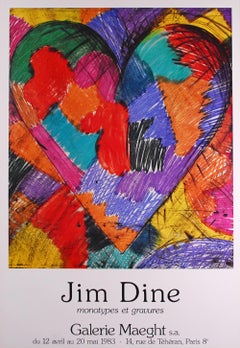
Heart
By Jim Dine
Located in Winterswijk, NL
Color offset lithograph
Made for an exhibition at the Galerie Maeght
Paris, 12 April - 20 May 1983.
Image in great condition, marginal defects
Category
1980s Romantic Figurative Prints
Materials
Lithograph
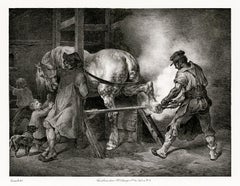
Le maréchal flamand
(The Flemish Blacksmith) — 19th-Century French Romanticism
By Jean Louis Andre Theodore Gericault
Located in Myrtle Beach, SC
Théodore Géricault 'Le maréchal flamand' (The Flemish Blacksmith) from the series ‘Etudes, de chevaux lithographiés,’ lithograph, 1822, 2nd state ...
Category
1820s Romantic Animal Prints
Materials
Lithograph
$1,400
H 9.63 in W 12.75 in
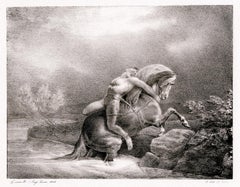
Mazeppa
— 19th-Century French Romanticism
By Jean Louis Andre Theodore Gericault
Located in Myrtle Beach, SC
Théodore Géricault and Eugène Lami, 'Mazeppa' from the series 'Oeuvres de Lord Byron', lithograph, 1823, 2nd state of 3, Delteil 94. Rendered by Thé...
Category
1820s Romantic Animal Prints
Materials
Lithograph
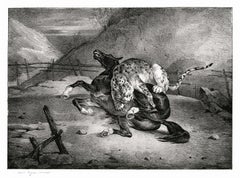
Horse Attacked by Tiger
— 19th-Century French Romanticism
By Jean Louis Andre Theodore Gericault
Located in Myrtle Beach, SC
Théodore Géricault (after), 'Tigre dévorant un cheval' (Tiger Devouring a Horse), lithograph, 3rd state of 3, Clement 97, c. 1820. Lettered 'Volmar ...
Category
1820s Romantic Animal Prints
Materials
Lithograph
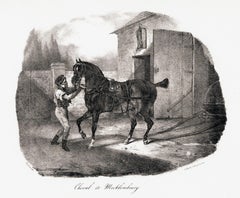
Cheval de Mecklembourg
— 19th-Century French Romanticism
By Jean Louis Andre Theodore Gericault
Located in Myrtle Beach, SC
Théodore Géricault 'Cheval de Mecklembourg' (Mecklembourg Horse), lithograph, 1822, 2nd state of 4, Delteil 47. Signed in the matrix 'Gericault', lower left. Published by Godefroy En...
Category
1820s Romantic Animal Prints
Materials
Lithograph
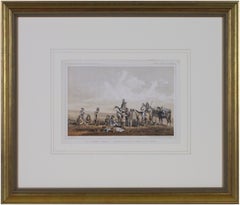
Lieutenant Crovers Despatch – Return of Governor Stevens to Fort Benton
By John Mix Stanley
Located in Milwaukee, WI
In the mid-nineteenth century, the United States government set out to survey and document its newly acquired lands and territories west of the Mississippi. The goals of these surveys were manifold: to produce topographical maps, to document flora and fauna, and to document natural resources to build the emerging US economy. These surveys, and the images from them, also functioned to build the new sense of American identity with the landscape, condensing vistas into the 'picturesque' tradition of European image making. Thus, the entire span of US territory could be seen as a single, cohesive whole.
This lithograph comes from one of six surveys commissioned by the Army's Topographic Bureau in 1853, which sought to find the best route to construct a transcontinental railroad. The result was a thirteen-volume report including maps, lithographs, and technical data entitled 'Explorations and Surveys to ascertain the most practicable and economical route for a Railroad from the Mississippi river to the Pacific Ocean.' In particular, the print comes from the northern survey, commanded by Isaac Stevens, which explored the regions between the 47th and 49th parallels.
5.75 x 8.75 inches, image
6.5 x 9.25 inches, stone
17 x 20 inches, frame
Artist 'Stanley Del.' lower left
Entitled 'Lieutenant Crovers Despatch – Return of Governor Stevens to Fort Benton' lower center margin
Publisher 'Sarony, Major & Knapp. Lith.s 449 Broadway N.Y.' lower right
Inscribed 'U.S.P.R.R. EXP. & SURVEYS — 47th & 49th PARALLELS' upper left
Inscribed 'GENERAL REPORT — PLATE XXXVII' upper right
Framed to conservation standards using 100 percent rag matting with French accents; glazed with UV5 Plexiglas to inhibit fading; housed in a gold reverse ogee moulding.
Print in overall good condition; some localized foxing and discoloration; minor surface abrasions to frame.
John Mix Stanley...
Category
1850s Romantic Landscape Prints
Materials
Lithograph
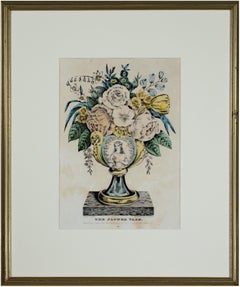
19th century color lithograph still life vase flowers
By Nathaniel Currier
Located in Milwaukee, WI
The present hand-colored lithograph is one of several decorative images of flower-filled vases published by Nathaniel Currier. This example contains roses, tulips, forget-me-nots, and others all within a vase with gold eagle head handles and an image of a beautiful young woman the belly.
16 x 11 inches, artwork
22.5 x 18.25 inches, frame
Entitled bottom center
Signed in the stone, lower left "Lith. and Pub. by N. Currier"
Inscribed lower right "152 Nassau St. Cor. of Spruce N.Y."
Copyrighted bottom center "Entered according to Act of Congress in the year 1848 by N. Currier in the Clerk's office of the Southern District of N.Y." with the number 249
Framed to conservation standards using 100 percent rag matting, housed in a lemon gold moulding.
Nathaniel Currier was a tall introspective man with a melancholy nature. He could captivate people with his piercing stare or charm them with his sparkling blue eyes. Nathaniel was born in Roxbury, Massachusetts on March 27th, 1813, the second of four children. His parents, Nathaniel and Hannah Currier, were distant cousins who lived a humble yet spartan life. When Nathaniel was eight years old, tragedy struck. Nathaniel’s father unexpectedly passed away leaving Nathaniel and his eleven-year-old brother Lorenzo to provide for the family. In addition to their mother, Nathaniel and Lorenzo had to care for six-year-old sister Elizabeth and two-year-old brother Charles. Nathaniel worked a series of odd jobs to support the family, and at fifteen, he started what would become a life-long career when he apprenticed in the Boston lithography shop of William and John Pendleton.
A Bavarian gentleman named Alois Senefelder invented lithography just 30 years prior to young Nat Currier’s apprenticeship. While under the employ of the brothers Pendleton, Nat was taught the art of lithography by the firm’s chief printer, a French national named Dubois, who brought the lithography trade to America.
Lithography involves grinding a piece of limestone flat and smooth then drawing in mirror image on the stone with a special grease pencil. After the image is completed, the stone is etched with a solution of aqua fortis leaving the greased areas in slight relief. Water is then used to wet the stone and greased-ink is rolled onto the raised areas. Since grease and water do not mix, the greased-ink is repelled by the moisture on the stone and clings to the original grease pencil lines. The stone is then placed in a press and used as a printing block to impart black on white images to paper.
In 1833, now twenty-years old and an accomplished lithographer, Nat Currier left Boston and moved to Philadelphia to do contract work for M.E.D. Brown, a noted engraver and printer. With the promise of good money, Currier hired on to help Brown prepare lithographic stones of scientific images for the American Journal of Sciences and Arts. When Nat completed the contract work in 1834, he traveled to New York City to work once again for his mentor John Pendleton, who was now operating his own shop located at 137 Broadway. Soon after the reunion, Pendleton expressed an interest in returning to Boston and offered to sell his print shop to Currier. Young Nat did not have the financial resources to buy the shop, but being the resourceful type he found another local printer by the name of Stodart. Together they bought Pendleton’s business.
The firm ‘Currier & Stodart’ specialized in "job" printing. They produced many different types of printed items, most notably music manuscripts for local publishers. By 1835, Stodart was frustrated that the business was not making enough money and he ended the partnership, taking his investment with him. With little more than some lithographic stones, and a talent for his trade, twenty-two year old Nat Currier set up shop in a temporary office at 1 Wall Street in New York City. He named his new enterprise ‘N. Currier, Lithographer’
Nathaniel continued as a job printer and duplicated everything from music sheets to architectural plans. He experimented with portraits, disaster scenes and memorial prints, and any thing that he could sell to the public from tables in front of his shop. During 1835 he produced a disaster print Ruins of the Planter's Hotel, New Orleans, which fell at two O’clock on the Morning of the 15th of May 1835, burying 50 persons, 40 of whom Escaped with their Lives. The public had a thirst for newsworthy events, and newspapers of the day did not include pictures. By producing this print, Nat gave the public a new way to “see” the news. The print sold reasonably well, an important fact that was not lost on Currier.
Nat met and married Eliza Farnsworth in 1840. He also produced a print that same year titled Awful Conflagration of the Steamboat Lexington in Long Island Sound on Monday Evening, January 18, 1840, by which melancholy occurrence over One Hundred Persons Perished. This print sold out very quickly, and Currier was approached by an enterprising publication who contracted him to print a single sheet addition of their paper, the New York Sun. This single page paper is presumed to be the first illustrated newspaper ever published.
The success of the Lexington print launched his career nationally and put him in a position to finally lift his family up. In 1841, Nat and Eliza had their first child, a son they named Edward West Currier. That same year Nat hired his twenty-one year old brother Charles and taught him the lithography trade, he also hired his artistically inclined brother Lorenzo to travel out west and make sketches of the new frontier as material for future prints. Charles worked for the firm on and off over the years, and invented a new type of lithographic crayon which he patented and named the Crayola. Lorenzo continued selling sketches to Nat for the next few years.
In 1843, Nat and Eliza had a daughter, Eliza West Currier, but tragedy struck in early 1847 when their young daughter died from a prolonged illness. Nat and Eliza were grief stricken, and Eliza, driven by despair, gave up on life and passed away just four months after her daughter’s death.
The subject of Nat Currier’s artwork changed following the death of his wife and daughter, and he produced many memorial prints and sentimental prints during the late 1840s. The memorial prints generally depicted grief stricken families posed by gravestones (the stones were left blank so the purchasers could fill in the names of the dearly departed). The sentimental prints usually depicted idealized portraits of women and children, titled with popular Christian names of the day.
Late in 1847, Nat Currier married Lura Ormsbee, a friend of the family. Lura was a self-sufficient woman, and she immediately set out to help Nat raise six-year-old Edward and get their house in order. In 1849, Lura delivered a son, Walter Black Currier, but fate dealt them a blow when young Walter died one year later. While Nat and Lura were grieving the loss of their new son, word came from San Francisco that Nat’s brother Lorenzo had also passed away from a brief illness. Nat sank deeper into his natural quiet melancholy. Friends stopped by to console the couple, and Lura began to set an extra place at their table for these unexpected guests. She continued this tradition throughout their lives.
In 1852, Charles introduced a friend, James Merritt Ives, to Nat and suggested he hire him as a bookkeeper. Jim Ives was a native New Yorker born in 1824 and raised on the grounds of Bellevue Hospital where his father was employed as superintendent. Jim was a self-trained artist and professional bookkeeper. He was also a plump and jovial man, presenting the exact opposite image of his new boss.
Jim Ives met Charles Currier through Caroline Clark, the object of Jim’s affection. Caroline’s sister Elizabeth was married to Charles, and Caroline was a close friend of the Currier family. Jim eventually proposed marriage to Caroline and solicited an introduction to Nat Currier, through Charles, in hopes of securing a more stable income to support his future wife.
Ives quickly set out to improve and modernize his new employer’s bookkeeping methods. He reorganized the firm’s sizable inventory, and used his artistic skills to streamline the firm’s production methods. By 1857, Nathaniel had become so dependent on Jims’ skills and initiative that he offered him a full partnership in the firm and appointed him general manager. The two men chose the name ‘Currier & Ives’ for the new partnership, and became close friends.
Currier & Ives produced their prints in a building at 33 Spruce Street where they occupied the third, fourth and fifth floors. The third floor was devoted to the hand operated printing presses that were built by Nat's cousin, Cyrus Currier, at his shop Cyrus Currier & Sons in Newark, NJ. The fourth floor found the artists, lithographers and the stone grinders at work. The fifth floor housed the coloring department, and was one of the earliest production lines in the country. The colorists were generally immigrant girls, mostly German, who came to America with some formal artistic training. Each colorist was responsible for adding a single color to a print. As a colorist finished applying their color, the print was passed down the line to the next colorist to add their color. The colorists worked from a master print displayed above their table, which showed where the proper colors were to be placed. At the end of the table was a touch up artist who checked the prints for quality, touching-in areas that may have been missed as it passed down the line. During the Civil War, demand for prints became so great that coloring stencils were developed to speed up production.
Although most Currier & Ives prints were colored in house, some were sent out to contract artists. The rate Currier & Ives paid these artists for coloring work was one dollar per one hundred small folios (a penny a print) and one dollar per one dozen large folios. Currier & Ives also offered uncolored prints to dealers, with instructions (included on the price list) on how to 'prepare the prints for coloring.' In addition, schools could order uncolored prints from the firm’s catalogue to use in their painting classes.
Nathaniel Currier and James Merritt Ives attracted a wide circle of friends during their years in business. Some of their more famous acquaintances included Horace Greeley, Phineas T. Barnum, and the outspoken abolitionists Rev. Henry Ward, and John Greenleaf Whittier (the latter being a cousin of Mr. Currier).
Nat Currier and Jim Ives described their business as "Publishers of Cheap and Popular Pictures" and produced many categories of prints. These included Disaster Scenes, Sentimental Images, Sports, Humor, Hunting Scenes, Politics, Religion, City and Rural Scenes, Trains, Ships, Fire Fighters, Famous Race Horses, Historical Portraits, and just about any other topic that satisfied the general public's taste. In all, the firm produced in excess of 7500 different titles, totaling over one million prints produced from 1835 to 1907.
Nat Currier retired in 1880, and signed over his share of the firm to his son Edward. Nat died eight years later at his summer home 'Lion’s Gate' in Amesbury, Massachusetts. Jim Ives remained active in the firm until his death in 1895, when his share of the firm passed to his eldest son, Chauncey.
In 1902, faced will failing health from the ravages of Tuberculosis, Edward Currier sold his share of the firm to Chauncey Ives...
Category
1840s Romantic Still-life Prints
Materials
Watercolor, Lithograph
$1,220
H 22.5 in W 18.25 in
More From This Seller
View AllNapoleon Standing
Located in Fairlawn, OH
Napoleon Standing
Lithograph, 1822
Signed in the stone lower left corner of image (see photo)
From: Arnault, A. V.
Vie Politique et Militaire de Napoleon (120 plates)
Published, Paris, Librairie Historiquem 1822
Printed by C. Motte, Paris
Considered to be the major pictorial treatise on Napoleon and his military conquests.
Image size: 14 x 9 3/4 inches
Sheet size: 23 5/8 x 17 3/4 inches
Condition: Very good
Horizontal prints...
Category
1820s Romantic Figurative Prints
Materials
Lithograph
L
ACTEUR . . . . - On voit bien qu
il fait chaud . . . . . . . trois spectateurs
By Honoré Daumier
Located in Fairlawn, OH
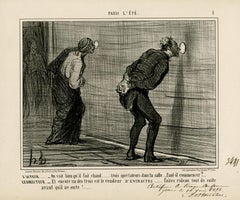
L'ACTEUR . . . . - On voit bien qu'il fait chaud . . . . . . . trois spectateurs dans la salle ..... faut-il commencer ? . . . .
LE DIRECTEUR .- Et encore un des trois est le vendeu...
Category
1850s Romantic Figurative Prints
Materials
Lithograph
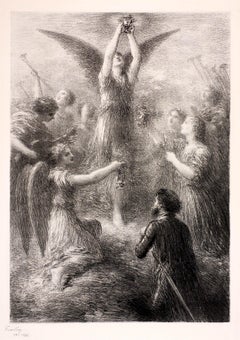
Prelude de Lohengrin (2e planche) (The Appearance of the Holy Grail)
By Henri Fantin-Latour
Located in Fairlawn, OH
Prelude de Lohengrin (2e planche) (The appearance of the Holy Grail)
Lithograph, 1898
Signed and dated in the stone lower left (see photo)
Printed on chine collee paper
Condition...
Category
1890s Romantic Figurative Prints
Materials
Lithograph
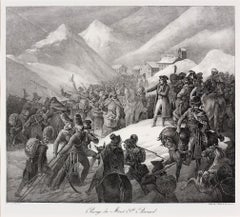
Passage du Mont Saint-Bernard
By Jean Louis Andre Theodore Gericault
Located in Fairlawn, OH
Theodore Gericault (1791-1824)
Passage du Mont Saint-Bernard
Lithograph, 1822
Signed and titled in the stone
As published in Arnault "Vie politique et militaire de Napoleon"
Conditio...
Category
1820s Romantic Figurative Prints
Materials
Lithograph
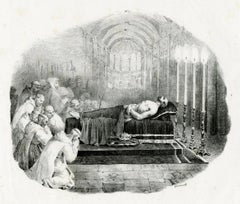
Guillaume le Conquérant rapporté après sa mort à l
église de Boscherville
By Jean Louis Andre Theodore Gericault
Located in Fairlawn, OH
Guillaume le Conquérant rapporté après sa mort à l'église de Boscherville (William the Conqueror brought back after his death to the church at Boscherville)
Lithograph, 1823
As publi...
Category
1820s Romantic Figurative Prints
Materials
Lithograph
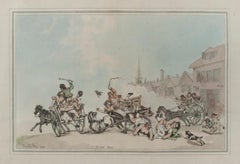
A Cart Race
By Thomas Rowlandson
Located in Fairlawn, OH
A Cart Race
Hand colored etching & aquatint, 1788
Signed in the plate (see photo)
Published by William Hollande, London
Inscribed in the plate with title, artist's name and publication line 'Rowlandson. 1788./ London. Pubd 1789 by Wm Holland No 50. Oxford Street.'
Reference: M.Dorothy George, 'Catalogue of Political and Personal Satires in the British Museum', VI, 1938)
British Museum Satires 7607
Grego, 'Rowlandson', i. 260, Grego II.392
Provenance: Chris Beetles Ltd., London (label), 2003
Jeffrey M. Kaplan, Washington, D.C.
(label)
Fursten zu Oettingen-Wallerstein, Lugt 2715a,
verso (see photo)
Condition: Excellent
Printed on 18th century laid paper
Archival framing by Chris Beetles Ltd., London
Note: The British Museum has two impressions, one trimmed the other full sheet as this example. Accession Number: 1868,0711.35
The Metropolitan Museum has an impression: Accession number 59.533.314
Fitzwilliam Museum: Accession number: 34.14-286
Cleveland Museum of Art accession number: 1958.10
Image description per BM: Three ramshackle two-wheeled carts drawn by wretched horses race (right to left) against a background formed by the church...
Note: The British Museum has two impressions, one trimmed the other full sheet as this example. Accession Number: 1868,0711.35
The Metropolitan Museum has an impression: Accession number 59.533.314
Fitzwilliam Museum: Accession number: 34.14-286
Cleveland Museum of Art accession number: 1958.10
Image description per BM: Three ramshackle two-wheeled carts drawn by wretched horses race (right to left) against a background formed by the clouds of dust which they have raised, with a row of gabled houses (right) inscribed 'St Giles', terminating in a church spire (left), and probably representing Broad St. Giles. The occupants of the carts are Irish costermongers typical of St. Giles. The foremost horse gallops, urged on by the shouts of a standing man brandishing a club. The other occupants, two women and a man, cheer derisively the next cart, whose horse has fallen, one woman falling from it head-first, another lies on the ground. The driver lashes the horse furiously. The third cart, of heavier construction, is starting. The horses are partly obscured by the clouds of dust, but denizens watch from casement windows and a door. Two ragged urchins (right) cheer the race; a dog barks.
"It was said that the amount of copper Thomas Rowlandson etched would sheathe the British Navy. An inveterate gambler, for much of his life Rowlandson had to produce a flood of his comic prints to stay ahead of financial losses.A wealthy uncle and aunt raised Rowlandson after his textile-merchant father went bankrupt. His career developed quickly. He entered London's Royal Academy Schools in 1772, visited Paris in 1774, exhibited at the Royal Academy in 1775, and won a silver medal in 1777. He left school in 1778 to set up in business. Rowlandson's depictions of life in Georgian England exposed human foibles and vanity with sympathy and rollicking humor. During the 1780s he consolidated the delicate style he used for his coarse subjects. He worked mainly in ink and watercolor, his rhythmic compositions, flowing line, and relaxed elegance inspired by French Rococo art...
Category
1780s Romantic Figurative Prints
Materials
Aquatint
Recently Viewed
View AllMore Ways To Browse
Antique Napoleon Prints
Keith Haring Signed Poster
Keith Haring South Africa
Le Cocu Magnifique
Leroy Neiman Golf
Leroy Neiman Originals
Les Caprices De Goya
Marc Chagall Green
Marc Chagall Rooster
Marc Chagall Unsigned Lithographs
Maria Rivans
Marker Keith Haring
Mermaid Poster
Moulin Rouge Cheret Original Poster
Ogata Gekko
Orchestra Poster
Pablo Picasso Signature
Peter Max Angel With Heart