Want more images or videos?
Request additional images or videos from the seller
1 of 3
Ian Hugo
Together
— Mid-Century Surrealism, Atelier 171946
1946
Price:$450
$550List Price
About the Item
- Creator:Ian Hugo (1900 - 1984, American)
- Creation Year:1946
- Dimensions:Height: 5.88 in (14.94 cm)Width: 4.88 in (12.4 cm)
- Medium:
- Movement Style:
- Period:
- Condition:
- Gallery Location:Myrtle Beach, SC
- Reference Number:Seller: 1042221stDibs: LU532312589372
About the Seller
5.0
Recognized Seller
These prestigious sellers are industry leaders and represent the highest echelon for item quality and design.
Platinum Seller
Premium sellers with a 4.7+ rating and 24-hour response times
Established in 1995
1stDibs seller since 2016
334 sales on 1stDibs
Typical response time: 1 hour
Associations
International Fine Print Dealers Association
Authenticity Guarantee
In the unlikely event there’s an issue with an item’s authenticity, contact us within 1 year for a full refund. DetailsMoney-Back Guarantee
If your item is not as described, is damaged in transit, or does not arrive, contact us within 7 days for a full refund. Details24-Hour Cancellation
You have a 24-hour grace period in which to reconsider your purchase, with no questions asked.Vetted Professional Sellers
Our world-class sellers must adhere to strict standards for service and quality, maintaining the integrity of our listings.Price-Match Guarantee
If you find that a seller listed the same item for a lower price elsewhere, we’ll match it.Trusted Global Delivery
Our best-in-class carrier network provides specialized shipping options worldwide, including custom delivery.You May Also Like
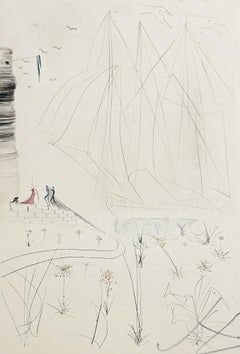
The Arrival of Iseult, from Tristan and Iseult
By Salvador Dalí
Located in Washington, DC
Artist: Salvador Dali
Title: The Arrival of Iseult
Portfolio: Tristan and Iseult
Medium: Color engraving
Year: 1970
Edition: 12/25
Frame Size: 25 1/4" x 20 3/4"
Sheet Size: 17 3/4" x...
Category
1970s Surrealist Figurative Prints
Materials
Engraving
$1,995
Free Shipping
H 25.25 in W 20.75 in
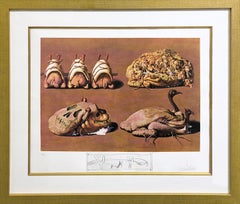
Les Caprices Pinces Princiers (Frank Hunter Authenticated)
By Salvador Dalí
Located in Aventura, FL
From Les Diners De Gala. Photo lithograph with a separate original engraving titled Spoon on Crutches. Hand signed by Salvador Dali. Hand numbered 170/395.
Frame size approx 29 x ...
Category
1970s Surrealist Still-life Prints
Materials
Paper, Engraving, Lithograph
$1,837 Sale Price
25% Off
H 29 in W 34 in D 1 in
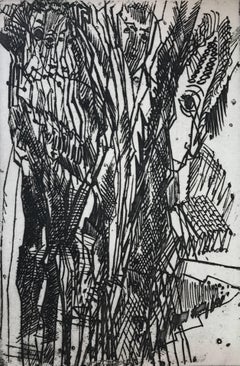
"Untitled"
By Nahum Tschacbasov
Located in Southampton, NY
Artist proof, aquatint, mixed intaglio engraving by the Russian/American artist, Nahum Tschacbasov. Pencil signed and dated lower right, 1947. Artist Proof. Condition: good; slight...
Category
1940s Surrealist Figurative Prints
Materials
Engraving, Aquatint, Intaglio
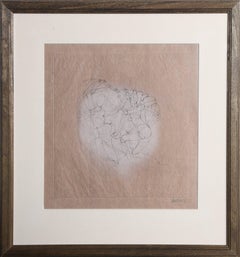
VIII from Les Marionnettes, Surrealist Gouache and Drypoint by Hans Bellmer
By Hans Bellmer
Located in Long Island City, NY
Artist: Hans Bellmer, German (1902 - 1975)
Title: VIII from Les Marionnettes
Year: 1969
Medium: Hand-colored Drypoint Etching on Rice Paper, signed in pencil
Image Size: 12 x 11 inch...
Category
1960s Surrealist Figurative Prints
Materials
Gouache, Rice Paper, Drypoint
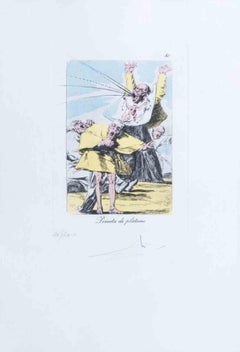
Pirueta de Plátano - Drypoint and Collotype by S.Dalì - 1977
By Salvador Dalí
Located in Roma, IT
Pirueta de Plátano is an original contemporary artwork realized in 1977.
Dry point and collotype, Hand signed by the artist on the lower margin.
Numbered on the lower left margin....
Category
1970s Surrealist Figurative Prints
Materials
Drypoint, Etching
$1,603
H 9.26 in W 5.52 in D 0.04 in
Trajan - Drypoint Etching attr. to Salvador Dalì - 1973
By Salvador Dalí
Located in Roma, IT
Trajan is an original contemporary artwork realized in 1973.
Black and white drypoin etching.
Hand signed on the lower margin.
Numbered on the lower left. Edition of 216/261.
Ref...
Category
1970s Surrealist Figurative Prints
Materials
Etching, Drypoint

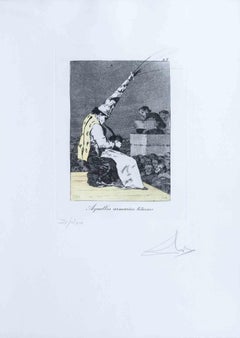
Aquellos Armarios Tinosos - Drypoint and Collotype - 1977
By Salvador Dalí
Located in Roma, IT
Aquellos Armarios Tinosos is a contemporary artwork realized in 1977.
Drypoint and collotype print.
Hand signed by the artist and numbered on the lower margin.
Edition of 21/200.
The artwork belongs to the Series "Les Caprices de Goya...
Category
1970s Surrealist Figurative Prints
Materials
Drypoint, Digital
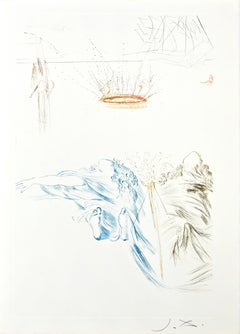
Le Testament de Tristan - Drypoint Etching attr. to S. Dalì - 1969
By Salvador Dalí
Located in Roma, IT
Le Testament de Tristan - From "Tristan et Iseult" is a modern artwork realized in 1969
Colour-printed drypoint etching, from the series of 21 etchings of “ Tristan et Iseult”.
Han...
Category
1960s Surrealist Figurative Prints
Materials
Paper, Etching, Drypoint
$1,425
H 17.72 in W 12.41 in D 0.08 in
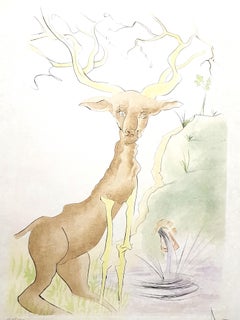
Salvador Dali - Le Cerf from Le Bestiaire de la Fontaine - Signed Engraving
By Salvador Dalí
Located in Collonge Bellerive, Geneve, CH
SALVADOR DALI
Le Cerf se voyant dans l'eau from Le Bestiaire de la Fontaine
1974
Hand signed by Dali
Edition: /250
The dimensions of the image are 22.8 x 15.7 inches on 31 x 23.2 in...
Category
1970s Surrealist Figurative Prints
Materials
Drypoint, Aquatint
$2,969
H 29.93 in W 22.84 in D 0.04 in
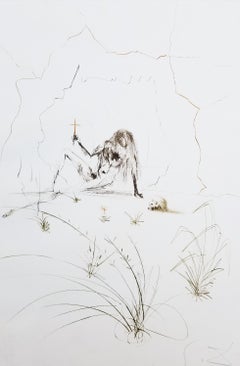
Frère Ogrin, l
hermite (Brother Ogrin, the Hermit) /// Surrealism Salvador Dali
By Salvador Dalí
Located in Saint Augustine, FL
Artist: Salvador Dali (Spanish, 1904-1989)
Title: "Frère Ogrin, l'hermite (Brother Ogrin, the Hermit)"
Portfolio: Tristan et Iseult
*Monogram signed by Dali in pencil lower right
Year: 1970
Medium: Original Engraving on Mandeure paper
Limited edition: 101/125
Printer: Atelier Rigal, Paris, France
Publisher: Leon Amiel, New York, NY and Paris, France
Reference: "The Official Catalog of the Graphic Works of Salvador Dali" - Field No. 70-10-K, page 60; "Dali: Catalogue Raisonné of Etchings and Mixed-Media Prints, 1924-1980" - Michler/Löpsinger No. 416, page 183-184
Framing: Recently framed in a gold ornate moulding with 100% cotton rag matting, gold filet, and 99% UV protective Museum Glass
Framed size: 28" x 22.25"
Sheet size (folded): 18" x 12.75"
Sheet size (unfolded): 18" x 25.5"
Image size: 15.75" x 10.5"
Condition: One tiny tear upper left. Some faint spots lower left. It is otherwise a strong impression is excellent condition
Notes:
Provenance: private collection - Indianapolis, IN; acquired from Ferdinand Roten Galleries, Baltimore, MD retaining their original gallery label on verso. Numbered by Dali in pencil lower left. Comes from Dali's 1970 "Tristan et Iseult" portfolio of 21 color engravings. Leon Amiel chop mark/blind stamp lower left. These engravings from the "Tristan et Iseult" portfolio were printed on folded sheets with their respective text descriptions as issued.
We are specialists in Salvador Dali's printmaking oeuvre, having personally worked with his cataloger Albert Field in the 1980's, we unconditionally guarantee all of our examples to be authentic.
Biography:
Salvador Dalí (May 11, 1904 – January 23, 1989), was a prominent Spanish Catalan surrealist painter born in Figueres, Spain. Dalí was a skilled draftsman, best known for the striking and bizarre images in his surrealist work. His painterly skills are often attributed to the influence of Renaissance masters. His best-known work, The Persistence of Memory, was completed in August 1931. Dalí's expansive artistic repertoire included film, sculpture, and photography, in collaboration with a range of artists in a variety of media.
Dalí attributed his "love of everything that is gilded and excessive, my passion for luxury and my love of oriental clothes...
Category
1970s Surrealist Figurative Prints
Materials
Engraving, Intaglio
$1,400 Sale Price
53% Off
H 28 in W 22.25 in
More From This Seller
View All
Encircled
— Mid-Century Surrealism, Atelier 17
Located in Myrtle Beach, SC
Ian Hugo, 'Encircled', engraving, 1946, edition 50. Signed, dated, titled, and numbered '5/50' in pencil. With the blind stamp 'madeleine-claude jobrack EDIT...
Category
1940s Surrealist Figurative Prints
Materials
Engraving

Forest Woman
— Mid-Century Surrealism, Atelier 17
Located in Myrtle Beach, SC
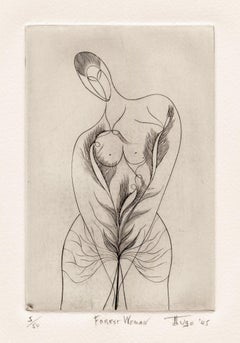
Ian Hugo, 'Forest Woman', engraving, 1945, edition 50. Signed, dated, titled, and numbered '5/50' in pencil. With the blind stamp 'madeleine-claude jobrack E...
Category
1940s Surrealist Figurative Prints
Materials
Engraving
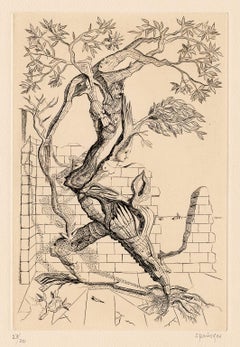
Arbre-Homme
(Tree-Man) —Mid-Century European Surrealism
By Ferdinand Springer
Located in Myrtle Beach, SC
Ferdinand Springer, 'Arbre-Homme', engraving, 1945, edition 23. Signed and numbered '23/20' in pencil.
A fine, richly-inked impression, on heavy, b...
Category
1940s Surrealist Figurative Prints
Materials
Engraving
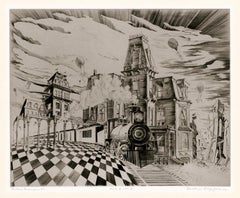
Fantasia Americana, 1880
— Mid-Century American Surrealism
By Lawrence Kupferman
Located in Myrtle Beach, SC
Lawrence Kupferman, 'Fantasia Americana – 1880', drypoint etching with sandground, 1943. Signed, titled, and annotated 'Series A, 1971 2/6' in pencil. A superb, richly-inked impression, on heavy, cream wove paper, with full margins (2 1/2 to 3 1/2 inches); the paper slightly lightened within the original mat opening, otherwise in excellent condition. One of only 6 impressions printed in 1971, with the added sandground grey background tint. Archivally matted to museum standards, unframed.
Image size 11 13/16 x 14 3/4 inches; sheet size 18 x 20 1/4 inches.
Collections: National Gallery of Art, Zimmerli Art Museum (Rutgers University).
ABOUT THE ARTIST
Lawrence Kupferman (1909 - 1982) was born in the Dorchester neighborhood of Boston and grew up in a working-class family. He attended the Boston Latin School and participated in the high school art program at the Museum of Fine Arts, Boston. In the late 1920s, he studied drawing under Philip Leslie Hale at the Museum School—an experience he called 'stultifying and repressive'. In 1932 he transferred to the Massachusetts College of Art, where he first met his wife, the artist Ruth Cobb. He returned briefly to the Museum School in 1946 to study with the influential expressionist German-American painter Karl Zerbe.
Kupferman held various jobs while pursuing his artistic career, including two years as a security guard at the Museum of Fine Arts, Boston. During the 1930s he worked as a drypoint etcher for the Federal Art Project, creating architectural drawings in a formally realistic style—these works are held in the collections of the Fogg Museum and the Smithsonian American Art Museum. In the 1940s he began incorporating more expressionistic forms into his paintings as he became progressively more concerned with abstraction. In 1946 he began spending summers in Provincetown, Massachusetts, where he met and was influenced by Mark Rothko, Hans Hofmann, Jackson Pollock, and other abstract painters. At about the same time he began exhibiting his work at the Boris Mirski Gallery in Boston.
In 1948, Kupferman was at the center of a controversy involving hundreds of Boston-area artists. In February of that year, the Boston Institute of Modern Art issued a manifesto titled 'Modern Art and the American Public' decrying 'the excesses of modern art,' and announced that it was changing its name to the Institute of Contemporary Art (ICA). The poorly conceived statement, intended to distinguish Boston's art scene from that of New York, was widely perceived as an attack on modernism. In protest, Boston artists such as Karl Zerbe, Jack Levine, and David Aronson formed the 'Modern Artists Group' and organized a mass meeting. On March 21, 300 artists, students, and other supporters met at the Old South Meeting House and demanded that the ICA retract its statement. Kupferman chaired the meeting and read this statement to the press:
“The recent manifesto of the Institute is a fatuous declaration which misinforms and misleads the public concerning the integrity and intention of the modern artist. By arrogating to itself the privilege of telling the artists what art should be, the Institute runs counter to the original purposes of this organization whose function was to encourage and to assimilate contemporary innovation.”
The other speakers were Karl Knaths...
Category
1940s Surrealist Figurative Prints
Materials
Drypoint, Etching
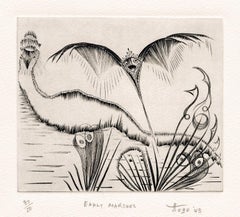
Early Marshes
— Mid-Century Surrealism, Atelier 17
Located in Myrtle Beach, SC
Ian Hugo, 'Early Marshes', from the portfolio 'Ten Engravings'. engraving, 1943, edition 50. Signed, dated, titled, and numbered '37/50' in pencil. A fine impression, with delicate overall plate tone, on cream wove paper, the full sheet with margins (2 5/8 to 7 inches), in excellent condition.
With the blind stamp 'madeleine-claude jobrack EDITIONS', in the bottom right margin. Matted to museum standards, unframed.
Image size 5 x 5 7/8 inches (127 x 149 mm); sheet size 15 x 11 inches (381 x 279 mm).
Ian Hugo originally created "Ten Engravings" in 1945 and the portfolio included a foreword by his partner and collaborator, Anais Nin. In 1978, Hugo republished the portfolio with Madeleine-Claude Jobrack, an American master printmaker who studied under Stanley William Hayter at Atelier 17, Paris, and with Johnny Friedlaender. When Jobrack returned to the States she managed the Robert Blackburn Printmaking Studio in New York before opening her own printing studio, Madeleine-Claude Jobrak Editions.
“The sign of the true artist is one who creates a complete universe, invents new plants, new animals, new figures to transfer to us a new vision of the universe in which dream and reality fuse. Ian Hugo's plants have eyes, the birds have the delicacy of dragonflies, their feathers have the shape of fans. Humor is apparent in every gesture. He uses a fine spider web to give a feeling of flight, speed, lightness. The body of a woman reveals the structure of a leaf, a plant. Wings are moving in a world unified by mythological themes. This is an animated world, humorous and levitating, elusive and decorative, which by its unique forms and shapes gives us the sensation of a rebirth, a liberation from the usual, the familiar, a visit to a new planet.”
—Anais Nin, from the forward to the portfolio ‘Ten Engravings’
ABOUT THE ARTIST
Ian Hugo was born Hugh Parker Guiler in Boston, Massachusetts, on February 15, 1898. His childhood was spent in Puerto Rico—a "tropical paradise," the memory of which stayed with him and surfaced in both his engravings and his films. He attended school in Scotland and graduated from Columbia University where he studied economics and literature.
Hugo was working with the National City Bank when he met and married author Anais Nin in 1923. The couple moved to Paris the following year, where Nin's diary and Guiler's artistic aspirations flowered. Guiler feared his business associates would not understand his interests in art and music, let alone those of his wife, so he began a second, creative life as Ian Hugo. Ian and Anais moved to New York in 1939. The following year he took up engraving and etching, working at Stanley William Hayter’s experimental printmaking workshop Atelier 17, established at the New School for Social Research.
Hugo began producing surreal images often used to illustrate Nin's books. For Nin, his unwavering love and financial support were indispensable—Hugo was the "fixed center, core... my home, my refuge" (Sept. 16, 1937, Nearer the Moon, The Unexpurgated Diary of Anais Nin, 1937-!939). Fictionalized portraits of Higo and Nin appear in Philip Kaufman's 1990 film drama of a literary love triangle, Henry & June.
Inspired by comments that viewers saw motion in his engravings, Hugo took up filmmaking. He asked the avant-garde filmmaker Sasha Hammid for instruction but was told, "Use the camera yourself, make your own mistakes, make your own style." Hugo embarked on an exploration of the film medium as a vehicle to delve into his dreams, his unconscious, and his memories. Without a specific plan, He would collect resonant images, then reorder or superimpose them, seeking a sense of self-connection through the poetic juxtapositions he created. These intuitive explorations resembled the mystical evocations of his engravings, which he described in 1946 as "hieroglyphs of a language in which our unconscious is trying to convey important, urgent messages."
In the underwater world of his film ‘Bells of Atlantis,’ the light originates from the world above the surface; it is otherworldly, out of place, yet essential. In ‘Jazz of Lights,’ the street lights of Times Square become in Nin's words, "an ephemeral flow of sensations." This flow that she also calls "phantasmagorical" had a crucial impact on Stan Brakhage, who said that without Jazz of Lights (1954), "there would have been no Anticipation of the Night" his autobiographical film which ushered in a new era of experimental modernist filmmaking.
Hugo lived the last two decades of his life in a New York apartment high above street level. In the evenings, surrounded by an electrically illuminated man...
Category
1940s Surrealist Figurative Prints
Materials
Engraving
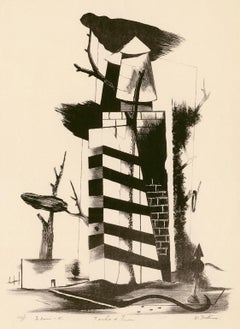
Tanks
Trees — Mid-century American Surrealism
Located in Myrtle Beach, SC
Karl Eugene Fortess, 'Tanks & Trees', lithograph, c. 1940, edition 100. Signed, titled, and numbered '100/P' in pencil. Inscribed 'For Usui - K.' in the bottom left margin. A fine, richly-inked impression, on cream wove paper, with full margins (1 1/2 to 2 1/2 inches); a slight crease across the top right sheet corner, well away from the image; otherwise in excellent condition. Image size 13 1/8 x 10 inches; sheet size 17 3/8 x 13 3/16 inches. Matted to museum standards, unframed.
Provenance: Estate of Francis Pratt.
Francis and her husband Bumpei Usui...
Category
1940s Surrealist Figurative Prints
Materials
Lithograph
Recently Viewed
View AllMore Ways To Browse
Vintage Atlantis
Atelier Hugo
Ian Hugo
Keith Haring Skate
Leon Gaucherel
Marc Chagall Paradise
Maria Izquierdo
Nicolas Cochin
Original Etching 16th Century
Paloma Picasso Print
Paris Gallery Poster
Picasso 1966
Picasso Bottle
Picasso Color Lithograph
Picasso Horse Art
Picasso Toro Y Toreros 1959
Pierre Auguste Renoir Le Chapeau Epingle
Pope Innocent