Want more images or videos?
Request additional images or videos from the seller
1 of 6
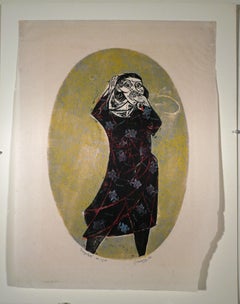
Ikeda ZuigetsuYellow Daffodils (Kinazuisen) —Japanese Woodblock Printc. 1930s
c. 1930s
Price:$750
About the Item
About the Seller
5.0
Recognized Seller
These prestigious sellers are industry leaders and represent the highest echelon for item quality and design.
Platinum Seller
Premium sellers with a 4.7+ rating and 24-hour response times
Established in 1995
1stDibs seller since 2016
336 sales on 1stDibs
Typical response time: 1 hour
Associations
International Fine Print Dealers Association
Authenticity Guarantee
In the unlikely event there’s an issue with an item’s authenticity, contact us within 1 year for a full refund. DetailsMoney-Back Guarantee
If your item is not as described, is damaged in transit, or does not arrive, contact us within 7 days for a full refund. Details24-Hour Cancellation
You have a 24-hour grace period in which to reconsider your purchase, with no questions asked.Vetted Professional Sellers
Our world-class sellers must adhere to strict standards for service and quality, maintaining the integrity of our listings.Price-Match Guarantee
If you find that a seller listed the same item for a lower price elsewhere, we’ll match it.Trusted Global Delivery
Our best-in-class carrier network provides specialized shipping options worldwide, including custom delivery.You May Also Like
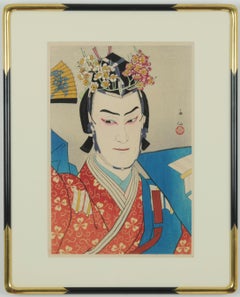
Morita Kanya XIII As Genta Kagesue in the play Genta Kando
By Natori Shunsen
Located in Fairlawn, OH
Morita Kanya XIII As Genta Kagesue in the play Genta Kando
Color woodcut, 1928
Signed and stamped middle right edge
Natori stamp lower left image edge
Series: Collection of Creative...
Category
1920s Showa Figurative Prints
Materials
Woodcut
$2,250
H 14.88 in W 10 in
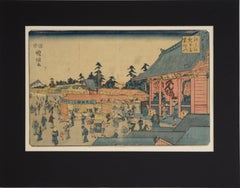
"The Kaminarimon at the Kanseon Temple in Asakusa" - Original Japanese Print
Located in Soquel, CA
"The Kaminarimon at the Kanseon Temple in Asakusa" - Original Japanese Print
Japanese Print "The Kaminarimon at the Kanseon Temple in Asakusa", from the series "Famous Places in Ed...
Category
1850s Showa Figurative Prints
Materials
Rice Paper, Woodcut
$850
H 14 in W 18 in D 1 in
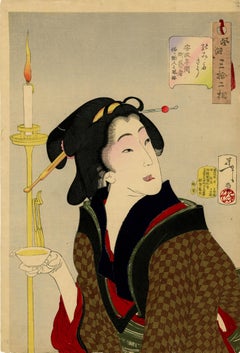
Thirsty: The Appearance of a Town Geisha - a So-Called Wine-Server - in the Anse
By Taiso Yoshitoshi
Located in Fairlawn, OH
Thirsty: The Appearance of a Town Geisha - a So-Called Wine-Server - in the Ansei Era
Color woodcut, 1888
Signed; Seal: Taiso (see photo)
Plate 22 from the series "Thirty-two Aspects...
Category
1880s Showa Figurative Prints
Materials
Woodcut
$1,800
H 14.13 in W 9.63 in
PRAYER
By Jacques Hnizdovsky
Located in Portland, ME
Hnizdovsky, Jacques. PRAYER. Tahir 7. Woodcut, 1944. Artist's proof
before the edition of 100. Inscribed in pencil in Ukranian and with
the date 1944. 5 1/2 x 4 inches, plus margins...
Category
1940s Figurative Prints
Materials
Woodcut
SNAPSHOT
By Antonio Frasconi
Located in Portland, ME
Frasconi, Antonio. SNAPSHOT. Cleveland 165. Woodcut in colors, 1950. Edition of 10. Titled, inscribed "Ed 4/10" and signed and dated in pencil. 22 1/4 x 14 15/16 inches in an oval fo...
Category
1950s Figurative Prints
Materials
Woodcut
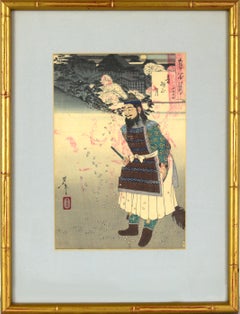
One Hundred Aspects of the Moon, Mt Otawa Moon - Bright God Tamura
By Tsukioka Yoshitoshi
Located in Soquel, CA
"Mount Otawa Moon: Bright God Tamura" - Woodblock on Paper by Tsukioka Yoshitoshi
From the series "One Hundred Aspects of the Moon"
This piece depicts the general Sakanoe no Tamura...
Category
1880s Edo Figurative Prints
Materials
Paper, Ink, Woodcut
$750
H 20.5 in W 15.5 in D 0.75 in
"Candy Seller" Japanese Woodblock on Rice Paper
By Utagawa Yoshiiku
Located in Soquel, CA
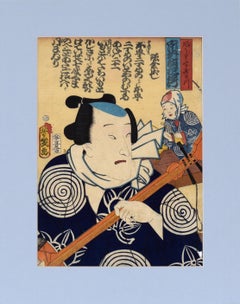
"Candy Seller" (飴売りうずまつ 市村羽左衛門) Japanese Woodblock on Rice Paper
This piece depicts Ichimura Uzaemon as the Candy Peddler Uzumatsu. He is playing a stringed instrument (the shamisen) to attract people to come buy canbdy. The spiral on his clothing is the symbol of the candy seller, along with his crest of the mandarin orange.
This Utagawa Yoshiiku print, titled "Umegoyomi mitate hachi shojin" (梅暦見立八笑人), depicts a scene from the Edo period. The print features a prominent male figure playing a shamisen, a traditional Japanese stringed instrument. The text on the print is in Japanese, and the overall style is characteristic of Ukiyo-e, a genre of Japanese woodblock prints. Utagawa Yoshiiku was a significant artist of the Meiji era, known for his contributions to woodblock printmaking. He was a student of Utagawa Kuniyoshi and worked alongside Tsukioka Yoshitoshi. His works often portray historical events, scenes from Kabuki plays, and contemporary life. This print, in particular, showcases the artist's skill in capturing the details of clothing, facial expressions, and the musical instrument.
Presented in a new blue mat with foam core backing.
Mat size: 18"H x 14"W
Paper size: 16"H x 12"W
Born the son of teahouse proprietor Asakusa Tamichi in 1833, Utagawa Yoshiiku (also known as Ochiai Yoshiiku) became a student of ukiyo-e artist Utagawa Kuniyoshi toward the end of the 1840s. His earliest known work dates to 1852 when he provided the backgrounds to some actor prints by his master.
Yoshiiku's earliest works were portraits of actors (yakusha-e), beauties (bijin-ga), and warriors (musha-e). He later followed Kuniyoshi into making satirical and humorous pieces, and became the leading name in the field after Kuniyosh's death in 1861. He illustrated the Tokyo Nichi Nichi...
Category
1860s Edo Figurative Prints
Materials
Ink, Rice Paper, Woodcut
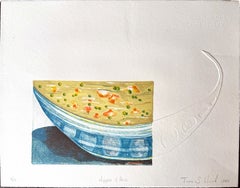
"Nipples and Peas" The Perfect Meal "Soup Etching on Paper by Tina Heck
Located in Soquel, CA
The artwork "Nipples & Peas" by Tina Heck, created in 1983, is a print that combines elements of realism and abstraction. The technique appears to be a combination of printmaking, ...
Category
1980s American Modern Interior Prints
Materials
Laid Paper, Intaglio, Woodcut
$1,050
H 14 in W 11 in D 0.5 in
"Grave of Santa Anna
s Leg" Original Woodblock Print, Signed Artist
s Proof
By Carol Summers
Located in Soquel, CA
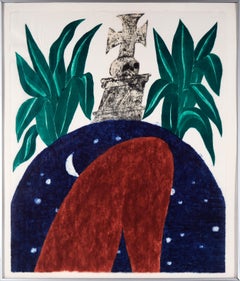
"Grave of Santa Anna's Leg" Original Woodblock Print, Signed Artist's Proof
Boldly colored woodblock print by Carol Summers (American, 1925-2016). This piece is a segment of a grave, with a headstone that has a skull and cross. There are two bright green plants flanking the headstone. Below the headstone and plants, there is a large arched blue shape, with a crescent moon and stars. A red leg, bent at the knee, cuts across the blue arch.
Signed "Carol Summers" along the right edge of the blue shape.
Numbered and titled "A/P Grave of Sant Anna's Leg" along the left edge of the blue shape.
Presented in a silver colored aluminum frame.
Frame size: 32.245"H x 27.25"W
Paper size: 29.75"H x 24.5"W
Carol Summers (1925-2016) has worked as an artist throughout the second half of the 20th century and into the first years of the next, outliving most of his mid-century modernist peers. Initially trained as a painter, Summers was drawn to color woodcuts around 1950 and it became his specialty thereafter. Over the years he has developed a process and style that is both innovative and readily recognizable. His art is known for it’s large scale, saturated fields of bold color, semi-abstract treatment of landscapes from around the world and a luminescent quality achieved through a printmaking process he invented.
In a career that has extended over half a century, Summers has hand-pulled approximately 245 woodcuts in editions that have typically run from 25 to 100 in number. His talent was both inherited and learned. Born in 1925 in Kingston, a small town in upstate New York, Summers was raised in nearby Woodstock with his older sister, Mary. His parents were both artists who had met in art school in St. Louis. During the Great Depression, when Carol was growing up, his father supported the family as a medical illustrator until he could return to painting. His mother was a watercolorist and also quite knowledgeable about the different kinds of papers used for various kinds of painting. Many years later, Summers would paint or print on thinly textured paper originally collected by his mother.
From 1948 to 1951, Carol Summers trained in the classical fine and studio arts at Bard College and at the Art Students League of New York. He studied painting with Steven Hirsh and printmaking with Louis Schanker. He admired the shapes and colors favored by early modernists Paul Klee (Sw: 1879-1940) and Matt Phillips (Am: b.1927- ). After graduating, Summers quit working as a part-time carpenter and cabinetmaker (which had supported his schooling and living expenses) to focus fulltime on art. That same year, an early abstract, Bridge No. 1 was selected for a Purchase Prize in a competition sponsored by the Brooklyn Museum.
In 1952, his work (Cathedral, Construction and Icarus) was shown the first time at the Museum of Modern Art in New York City in an exhibition of American woodcuts...
Category
1980s Contemporary Landscape Prints
Materials
Ink, Handmade Paper, Woodcut
$2,650
H 32.25 in W 27.25 in D 1 in
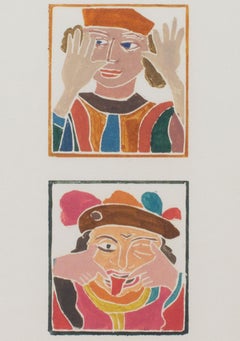
"The Court Jesters, " Two Woodcuts by Andre Derain
By André Derain
Located in Milwaukee, WI
"The Court Jesters" includes two original color woodcuts by Andre Derain. This is from an edition of 200. It features two vignettes of brightly-clad j...
Category
1940s Fauvist Figurative Prints
Materials
Woodcut
More From This Seller
View All
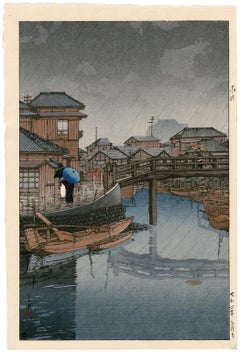
Rain at Shinagawa, Ryoshimachi
— Showa-era Woodblock Print
By Kawase Hasui
Located in Myrtle Beach, SC
Kawase Hasui, 'Rain at Shinagawa, Ryoshimachi' from the series 'Selection of Views of the Tokaido', woodblock print, 1931. A very fine, atmospheric impression, with fresh colors; the...
Category
1930s Showa Figurative Prints
Materials
Woodcut
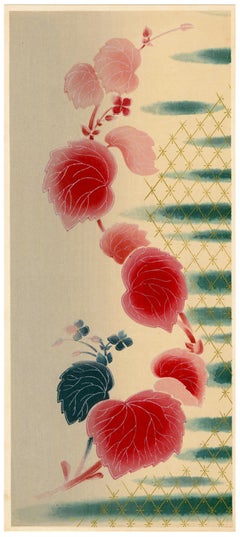
Japanese Kimono Fabric Design — Vintage Color Woodblock Print
Located in Myrtle Beach, SC
Anonymous, Japanese Kimono Fabric Design, color woodcut, c. 1930. A superb impression, with fresh colors, fine graduations, and metallic gold motifs, on ...
Category
Early 1900s Showa Figurative Prints
Materials
Woodcut
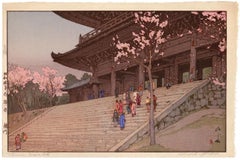
Chion-in Temple Gate
from
Eight Scenes of Cherry Blossoms
— Jizuri Seal
By Hiroshi Yoshida
Located in Myrtle Beach, SC
Hiroshi Yoshida, 'Chion-in Temple Gate (Sunset)' from the series 'Eight Scenes of Cherry Blossoms (Sakura hachi dai: Sakura mon)', color woodblock print, 1935. Signed in brush 'Yoshida' and in pencil 'Hiroshi Yoshida'. A superb, early impression, with fresh colors; the full sheet with margins, on cream Japan paper; an area of slight toning in the top right sheet corner, not affecting the image, otherwise in excellent condition. Marked with a jizuri (self-printed) seal, upper left margin. Self-published by the artist.
Image size 9 5/8 x 14 3/4 inches (444 x 375 mm); sheet size 10 7/8 x 16 inches (276 x 406 mm). Archivally sleeved, unmatted.
Provenance: M. Nakazawa, Tokyo.
Literature: Japanese Landscapes of the 20th Century (Hotei Publishing calendar), 2001, May.
Collections: Honolulu Museum of Art, Museum of Fine Arts, Boston.
ABOUT THE IMAGE
Located in Kyoto, Chionin is the main temple of the Jodo sect of Japanese Buddhism, one of the most popular Buddhist sects in Japan, having millions of followers. The Sanmon Gate, Chionin's entrance gate, standing 24 meters tall and 50 meters wide, it is the largest wooden temple gate in Japan and dates back to the early 1600s. Behind the gate, a broad set of stairs leads to the main temple grounds.
ABOUT THE ARTIST
Painter and printmaker Yoshida Hiroshi (1876-1950) is regarded as one of the greatest artists of the Japanese 'shin hanga' (New Print) movement.
Yoshida was born as the second son of Ueda Tsukane in Kurume, Fukuoka Prefecture, a schoolteacher from an old samurai family. In 1891 he was adopted by his art teacher Yoshida Kasaburo in Fukuoka and took his surname. In 1893 he went to Kyoto to study painting, and the following year to Tokyo to join Koyama Shotaro's Fudosha private school; he also became a member of the Meiji Fine Arts Society. These institutions taught and advocated Western-style painting, greatly influencing Yoshida’s artistic development.
In 1899 Yoshida had his first American exhibition at Detroit Museum of Art (now Detroit Institute of Art), making the first of many visits to the US and Europe. In 1902 he helped reorganize the Meiji Fine Arts Society, renaming it the Taiheiyo-Gakai (Pacific Painting...
Category
1930s Showa Figurative Prints
Materials
Woodcut
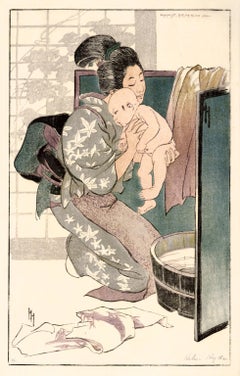
The Bath
— Meji Era Cross-Cultural Woman Artist
By Helen Hyde
Located in Myrtle Beach, SC
Helen Hyde, 'The Bath', color woodblock print, edition not stated, 1905, Mason & Mason 59. Signed in pencil in the image, lower right. Numbered '96' in pencil in the image, lower left. The artist's monogram in the block, lower left, and 'Copyright, 1905, by Helen Hyde.' upper right. A superb impression with fresh colors on tissue-thin cream Japanese paper; the full sheet with margins (7/16 to 1 5/8 inches), in excellent condition. Matted to museum standards, unframed.
Image size 16 1⁄4 x 10 1⁄8 in. (413 x 260 mm); sheet size: 19 1⁄4 x 11 1⁄8 in. (489 x 283 mm).
Literature and Exhibition: Back cover illustration of the catalog of the artist’s prints, 'Helen Hyde', Smithsonian Institution Press, 1990; 'The International Block Print Renaissance, Then And Now, Block Prints In Wichita, Kansas, A Centennial Celebration — 1922-2022', Barbara J. Thompson, Wichita Art Museum, 2022 (back cover).
Impressions of this work are held in the following collections: Achenbach Foundation for Graphic Arts, Art Institute of Chicago, Fine Arts Museums of San Francisco (De Young), Harvard Art Museums, Library of Congress, Metropolitan Museum of Art, New York Public Library, Smithsonian American Art Museum, Terra Foundation for American Art, University of Oregon Museum of Art.
ABOUT THE ARTIST
Helen Hyde (1868-1919) was a pioneer American artist best known for advancing Japanese woodblock printmaking in the United States and for bridging Western and Japanese artistic traditions. Hyde was born in Lima, New York, but after her father died in 1872, her family relocated to Oakland, California, where she spent much of her youth.
Hyde pursued formal art education in the United States and Europe. She enrolled in the San Francisco School of Design, where she took classes from the Impressionist painter Emil Carlsen; two years later, she transferred to the Art Students League in New York, studying there with Kenyon Cox. Eager to expand her artistic repertoire, Hyde traveled to Europe, studying under Franz Skarbina in Berlin and Raphael Collin in Paris. While in Paris, she first encountered Japanese ukiyo-e prints, sparking a lifelong fascination with Japanese aesthetics. After ten years of study, Hyde returned to San Francisco, where she continued to paint and began to exhibit her work.
Hyde learned to etch from her friend Josephine Hyde in about 1885. Her first plates, which she etched herself but had professionally printed, represented children. On sketching expeditions, she sought out quaint subjects for her etchings and watercolors. In 1897, Hyde made her first color etchings—inked á la poupée (applying different ink colors to a single printing plate)—which became the basis for her early reputation. She also enjoyed success as a book illustrator, and her images sometimes depicted the children of Chinatown.
After her mother died in 1899, Hyde sailed to Japan, accompanied by her friend Josephine, where she would reside, with only brief interruptions, until 1914. For over three years, she studied classical Japanese ink painting with the ninth and last master of the great Kano school of painters, Kano Tomonobu. She also studied with Emil Orlik, an Austrian artist working in Tokyo. Orlik sought to renew the old ukiyo-e tradition in what became the shin hanga “new woodcut prints” art movement. She immersed herself in the study of traditional Japanese printmaking techniques, apprenticing with master printer Kanō Tomonobu. Hyde adopted Japanese tools, materials, and techniques, choosing to employ the traditional Japanese system of using craftsmen to cut the multiple blocks and execute the exacting color printing of the images she created. Her lyrical works often depicted scenes of family domesticity, particularly focusing on women and children, rendered in delicate lines and muted colors.
Through her distinctive fusion of East and West, Hyde’s contributions to Western printmaking were groundbreaking. At a time when few Western women ventured to Japan, she mastered its artistic traditions and emerged as a significant figure in the international art scene.
Suffering from poor health, she returned to the United States in 1914, moving to Chicago. Having found restored health and new inspiration during an extended trip to Mexico in 1911, Hyde continued to seek out warmer climates and new subject matter. During the winter of 1916, Hyde was a houseguest at Chicora Wood, the Georgetown, South Carolina, plantation illustrated by Alice Ravenel Huger Smith in Elizabeth Allston Pringle’s 1914 book A Woman Rice Planter. The Lowcountry was a revelation for Hyde. She temporarily put aside her woodcuts and began creating sketches and intaglio etchings of Southern genre scenes and African Americans at work. During her stay, Hyde encouraged Smith’s burgeoning interest in Japanese printmaking and later helped facilitate an exhibition of Smith’s prints at the Art Institute of Chicago.
During World War I, Hyde designed posters for the Red Cross and produced color prints extolling the virtues of home-front diligence.
In ill health, Hyde traveled to be near her sister in Pasadena a few weeks before her death on May 13, 1919. She was buried in the family plot near Oakland, California.
Throughout her career, Hyde enjoyed substantial support from galleries and collectors in the States and in London. She exhibited works at the St. Louis Exposition in 1897, the Pan-American Exhibition in Buffalo in 1901, the Tokyo Exhibition for Native Art (where she won first prize for an ink drawing) in 1901, the Alaska-Yukon-Pacific Exhibition in Seattle in 1909 (received a gold medal for a print), the Newark Museum in 1913, a solo show at the Chicago Art Institute in 1916, and a memorial exhibition in 1920, Detroit Institute of Arts, Color Woodcut Exhibition in 1919, New York Public Library, American Woodblock Prints...
Category
Early 1900s Showa Figurative Prints
Materials
Woodcut
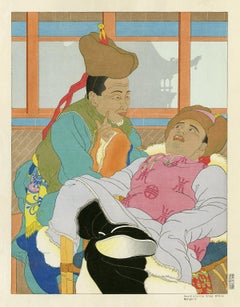
A Very Funny Story, Mongols
— Mid-Century Woodblock Print
By Paul Jacoulet
Located in Myrtle Beach, SC
Paul Jacoulet, 'Une Histoire très Drôle, Mongols', color woodblock print, 1949. A fine impression, with fresh colors, on the artist's handmade, personally watermarked Japan paper, in...
Category
1940s Showa Figurative Prints
Materials
Woodcut
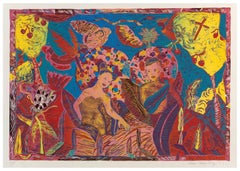
The Garden
— Celebrated Contemporary African American Artist
By Margo Humphrey
Located in Myrtle Beach, SC
Margo Humphrey, 'The Garden (Adam and Eve)', reductive color woodcut, 1989. Signed, dated, and annotated 'A/P' in pencil. Signed and dated in the image, lower right. A fine, richly-inked, artist's proof impression, with fresh, vivid colors, on BFK Rives, heavy, off-white wove paper; the full sheet with margins (1 to 1 3/8 inches), in excellent condition. Archivally sleeved, unmatted. Scarce.
Image size 27 1/4 x 39 1/8 inches (692 x 994 mm); sheet size 29 1/2 x 42 inches (749 x 1,067 mm).
ABOUT THIS WORK
"Humphrey continued to reinterpret stories from the Bible with African American figures. In 1989 she published the woodcut print 'The Garden' at Magnolia Editions in Oakland, CA. For this rare foray into relief printmaking, she employed the reductive method, which uses only one block that is successively carved for each color segment, reducing the block with each cutting. Technically challenging, this lush and elaborate print is a testament to Humphrey’s skills as a printmaker. A youthful Adam and Eve are depicted in a luxuriant tropical landscape. Here, Humphrey chooses not to include the traditional symbols of humanity’s downfall but instead portrays them as being protected by angels in an atmosphere of idyllic bounty. ...Although Humphrey challenges traditional representation of Christian themes, her images are not iconoclastic but present a broader, more inclusive engagement with religious spirituality."
— Adrienne L. Childs, 'Margo Humphrey, The David C. Driskell Series of African American Art: Volume VII,' Pomegranate Communications, Inc., 2009, page 71.
ABOUT THE ARTIST
American printmaker, illustrator, and art teacher Margo Humphrey was born in Oakland, California, in 1942. She earned a BFA in Painting and Printmaking from the California College of Arts and Crafts and a Master of Fine Arts degree in Printmaking from Stanford University.
Humphrey began teaching in 1973 at the University of California Santa Cruz and has since taught at the University of Texas at San Antonio, the San Francisco Art Institute, and the School of the Art Institute of Chicago. She has also taught at the University of the South Pacific in Suva, Fiji; Yaba Technological Institute of Fine Art, Ekoi Island, Nigeria; the University of Benin in Benin City, Nigeria; the Margaret Trowell School of Fine Art in Kampala, Uganda, and the Fine Art School of the National Gallery of Art, Harare, Zimbabwe. In 1989, she was appointed Department Head of Printmaking at the University of Maryland in College Park.
Humphrey has worked in lithography, monoprint, and woodcut with significant printmaking ateliers, including the Rutgers Center for Innovative Print and Paper, the Bob Blackburn Printmaking Workshop, and the Tamarind Institute in New Mexico. She was one of the earliest African-American woman artists to distinguish herself as a lithographer in a highly technical, male-dominated profession and was the first to have her prints published by Tamarind in 1974.
Humphrey’s imagery combines historical perspective, autobiography, and fantasy to illuminate her experience as an African American woman. Bold, saturated color, animated figures, and syncopated rhythmic arrangements are hallmarks of Humphrey's oeuvre. Though Humphrey labels her distinctive style "sophisticated naive," the narrative complexity and technical skill of her works attest to her artistic virtuosity. Joyful, expressive, and at times humorous, her works offer engaging commentary on the presumptions of American culture and myth while embracing her personal vision of authenticity and spirituality.
She developed her 1987 work The Last Bar-B-Que, a vividly colored transformation of the Last Supper, following a three-year period during which she examined portrayals of the iconic subject by artists from Pietro Lorenzetti to Emil Nolde. Her narrative work The Garden, a monumentally scaled reductive woodcut, is a further example of an archetypal subject—Adam and Eve in the Garden of Eden—debunked and rendered with fresh, life-affirming vibrancy.
Since her first solo exhibition in 1965, Humphrey’s works have been exhibited internationally. They are held in major institutions, including the Museum of Modern Art, The Smithsonian American Art Museum, the Philadelphia Museum of Art, the Hampton University Museum, the Victoria and Albert Museum (London), the Museum of Modern Art, Rio de Janeiro, and the National Gallery of Modern Art, Lagos. In 1996, she was invited to be part of the World Printmaking Survey at the Museum of Modern Art, New York.
In 2011, Hampton University Museum mounted a 45-year retrospective of Humphrey’s work Her Story: Margo Humphrey Lithographs and Works on Paper, jointly curated by Robert E. Steele, executive director of the David Driskell...
Category
1980s Expressionist Figurative Prints
Materials
Woodcut
Still Thinking About These?
All Recently ViewedMore Ways To Browse
Le Blanc Seing
Leger Hand Signed Lithograph
Leonard H Mersky
Leroy Neiman Americas Cup
Leroy Neiman Silkscreens
Leroy Neiman Skier
Leroy Neiman Stud Poker
Leroy Neiman Vegas
Lichtenstein Crak
Lichtenstein Mermaid
Lord Leighton Photogravure
Luigi Rossini On Sale
Magritte Victoire
Malcolm Myers
Malleus Maleficarum
Marc Chagall Blue Bird
Marc Chagall Couverture
Marc Chagall Diptych