Items Similar to
Tropical Wash Day
— Mid-Century Modernism
![[Untitled] Beach Scene](https://a.1stdibscdn.com/archivesE/upload/a_5153/1495569335502/IMG_1487_master.JPG)
Want more images or videos?
Request additional images or videos from the seller
1 of 3
J. Jay McVicker
Tropical Wash Day
— Mid-Century Modernism1946
1946
$1,400
£1,063.76
€1,227.38
CA$1,985.24
A$2,139.59
CHF 1,143.98
MX$25,437
NOK 14,382.95
SEK 13,145.18
DKK 9,171.13
About the Item
'Tropical Wash Day', aquatint, edition 100, 1946. Signed in pencil. Signed and dated in the plate, lower left. A superb, richly-inked impression, on heavy cream wove paper, with full margins (1 1/4 to 2 1/4 inches); very faint light toning within the original mat opening, otherwise in excellent condition. Archivally matted to museum standards.
Image size 8 1/4 x 15 1/4 inches; sheet size 11 3/4 x 18 7/8 inches.
Impressions of this work are in the permanent collections of Delaware Art Museum, Fine Arts Museums of San Francisco, Madison Museum of Contemporary Art, Memphis Brooks Museum of Art, The Nelson-Atkins Museum of Art, Tacoma Art Museum, and the Williams College Museum of Art.
McVicker's graphic work is held in numerous museum collections including the Dallas Museum of Art, Fine Arts Museums of San Francisco, Joslyn Art Museum, Los Angeles County Museum of Art, Metropolitan Museum of Art, Oklahoma State University Museum of Art, and the Smithsonian American Art Museum.
ABOUT THE ARTIST
Jay J. McVicker (1911–2004) was an American printmaker and educator best known for his richly atmospheric aquatints depicting Midwestern and Southwestern landscapes, working environments, and scenes of everyday regional life. His finest prints combine strong composition with subtle tonal effects, resulting in images that are both visually compelling and immediately engaging. These aquatints are widely regarded as his most desirable works and remain especially sought after by collectors.
McVicker studied at the School of the Art Institute of Chicago, where he developed a solid foundation in drawing, design, and printmaking. During the 1930s and early 1940s, he produced a distinctive group of aquatints focused on the Midwest—landscapes, small towns, and industrial settings rendered with a keen sense of mood and place. These prints are notable for their controlled use of tone, balanced design, and ability to convey atmosphere without excess detail.
Later, McVicker turned his attention to the American Southwest, adapting his aquatint technique to broader spaces, stronger light, and more open compositions. His Southwestern subjects retain the quiet strength of his Midwestern work while introducing a greater sense of scale and contrast.
McVicker’s Midwestern and Southwestern aquatints stand at the core of his reputation and are valued for their craftsmanship, tonal richness, and clear regional identity. They place him among the generation of mid-twentieth-century American printmakers whose work continues to attract collectors interested in compelling imagery, technical virtuosity, and enduring visual presence.
McVicker’s prints are held in public and institutional collections including the Art Institute of Chicago, the Cleveland Museum of Art, the Dallas Museum of Art, the Fine Arts Museums of San Francisco, the Library of Congress, Los Angeles County Museum of Art, Metropolitan Museum of Art, Oklahoma State University Museum of Art, The Nelson-Atkins Museum of Art, the New York Public Library, the Smithsonian American Art Museum, and other museum, library, and university print collections in the United States.
- Creator:J. Jay McVicker (1911 - 2004)
- Creation Year:1946
- Dimensions:Height: 8.25 in (20.96 cm)Width: 15.25 in (38.74 cm)
- Medium:
- Movement Style:
- Period:
- Condition:
- Gallery Location:Myrtle Beach, SC
- Reference Number:Seller: 1020391stDibs: LU53233945702
About the Seller
5.0
Recognized Seller
These prestigious sellers are industry leaders and represent the highest echelon for item quality and design.
Platinum Seller
Premium sellers with a 4.7+ rating and 24-hour response times
Established in 1995
1stDibs seller since 2016
336 sales on 1stDibs
Typical response time: 1 hour
Associations
International Fine Print Dealers Association
- ShippingRetrieving quote...Shipping from: Myrtle Beach, SC
- Return Policy
More From This Seller
View All
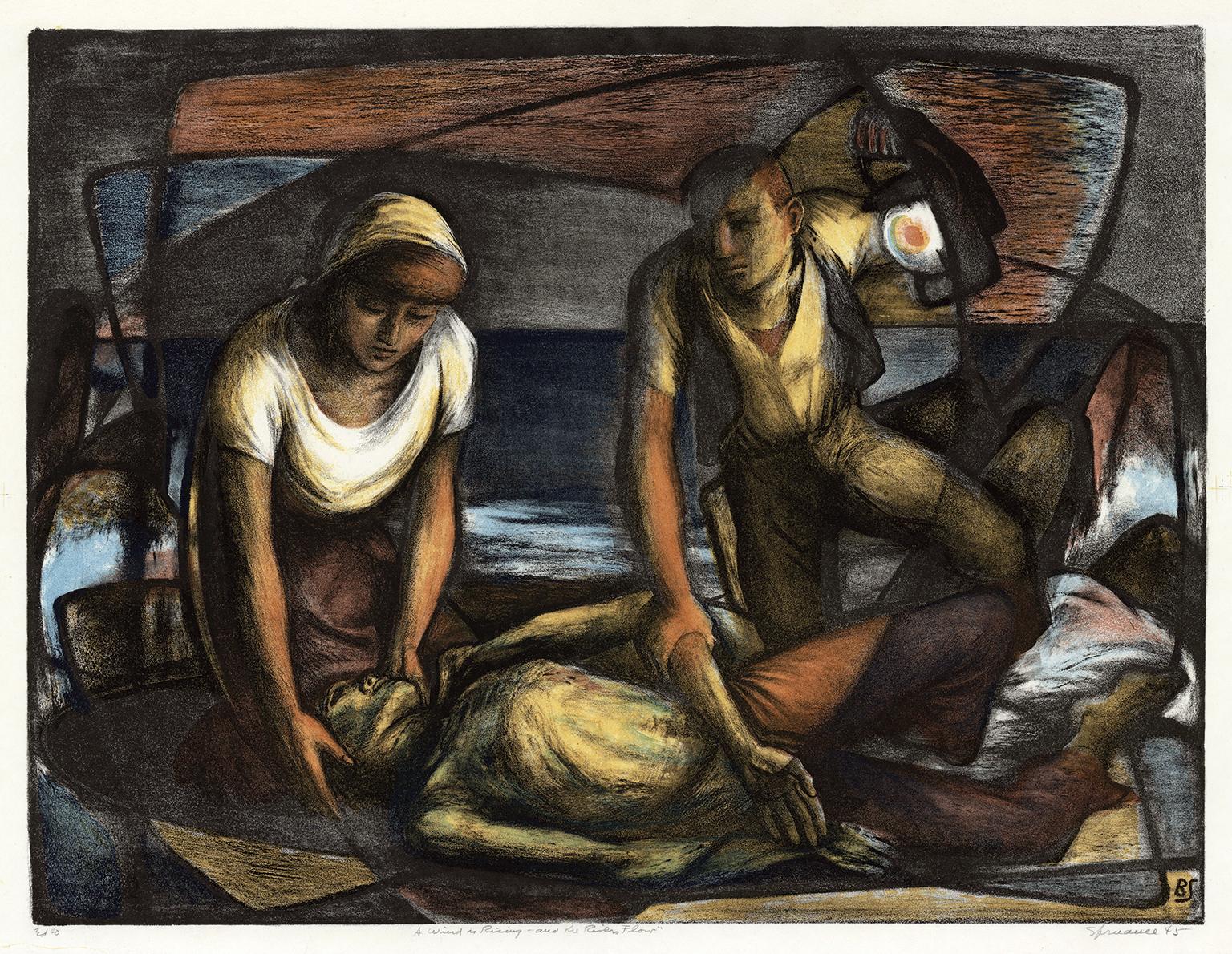
A Wind Is Rising and the Rivers Flow
— Mid-Century American Modernism
By Benton Murdoch Spruance
Located in Myrtle Beach, SC
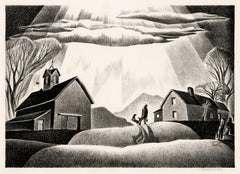
Benton Spruance, 'A Wind is Rising and the Rivers Flow', color lithograph, 1945, edition 40, Fine and Looney 242. Signed, dated, and titled, and annotated 'Ed 40' in pencil. A fine ...
Category
1940s American Modern Figurative Prints
Materials
Lithograph
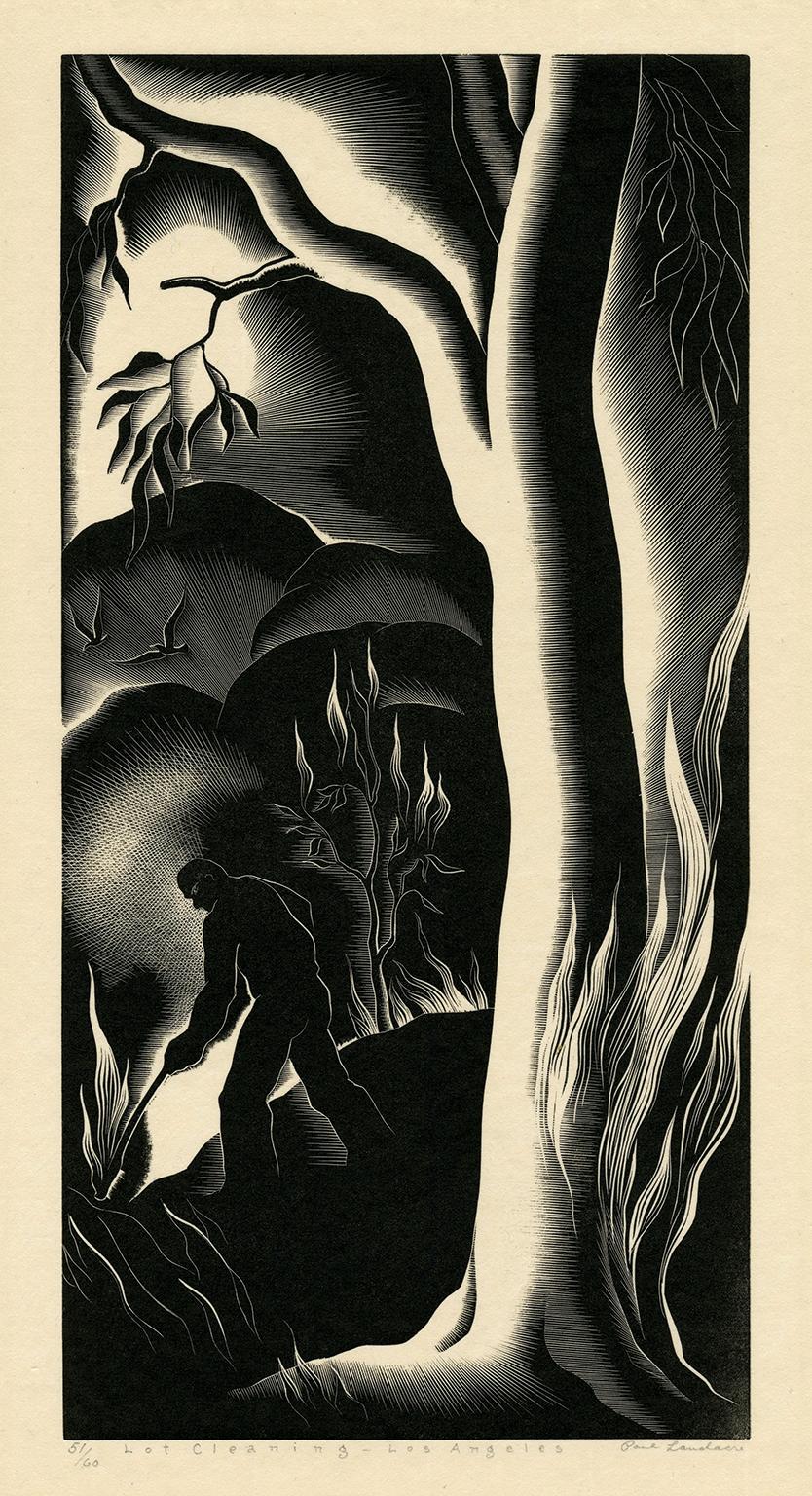
Lot Cleaning, Los Angeles
— 1930s Modernism
By Paul Landacre
Located in Myrtle Beach, SC
'Lot Cleaning, Los Angeles', wood engraving, edition 60, Zeitlin & Ver Brugge 69. Signed, titled and numbered '51/60' in pencil. A brilliant, black impression, on Kitakata Japan pape...
Category
1930s American Modern Figurative Prints
Materials
Woodcut
The Lamentation
— Mid-century Modernism, WWII
By Benton Murdoch Spruance
Located in Myrtle Beach, SC
'The Lamentation', lithograph, 1941, edition 35, Fine and Looney 198. Signed, titled, and annotated 'Ed 35' in pencil. Initialed in the stone, lower ri...
Category
1940s American Modern Figurative Prints
Materials
Lithograph
Partners
— Mid-Century Modernist Regionalism
By Dale Nichols
Located in Myrtle Beach, SC
Dale Nichols, 'Partners', lithograph, edition 250, 1950. Signed in pencil. A fine, richly-inked impression, on cream wove paper; the full sheet with margins (7/8 to 1 5/8 inches); tw...
Category
1950s American Modern Landscape Prints
Materials
Lithograph
$880 Sale Price
20% Off
The French Farm
— Mid-Century Modernism
By Edward August Landon
Located in Myrtle Beach, SC
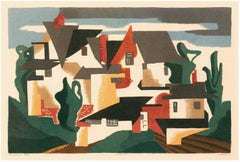
Edward Landon, 'The French Farm', color serigraph, 1942, Ryan 86. Signed, titled, and annotated 'Edition 50' in pencil. A superb impression, with fresh colors, on cream, wove paper; ...
Category
Mid-20th Century American Modern Landscape Prints
Materials
Screen
September Still Life
— Mid-Century Modernism
By Clinton Adams
Located in Myrtle Beach, SC
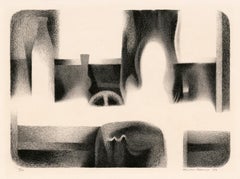
Clinton Adams, 'September Still Life', lithograph, 1956, edition 20. A superb impression, on cream wove paper, with full margins (1 1/2 to 3 1/8 inches);...
Category
1950s American Modern Still-life Prints
Materials
Lithograph
You May Also Like
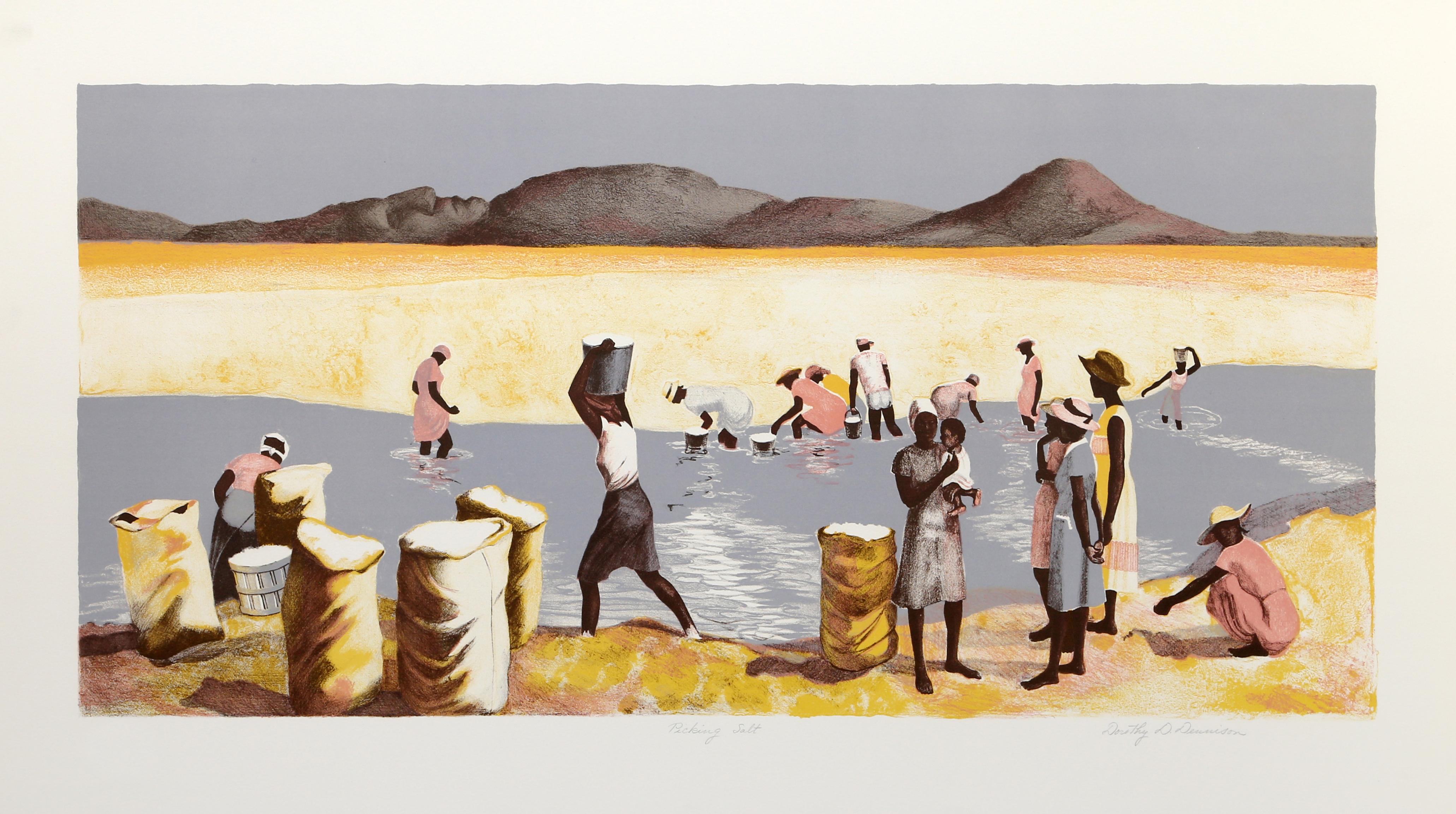
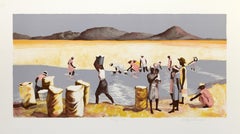
Picking Salt, Modern American Lithograph by Dorothy Dell Dennison
Located in Long Island City, NY
Picking Salt by Dorothy Dell Dennison, American (1908–1994)
Date: circa 1970
Lithograph, signed, titled and numbered in pencil
Edition of 100
Size: 24 in. x 36 in. (60.96 cm x 91.44 cm)
Category
1970s American Modern Figurative Prints
Materials
Lithograph
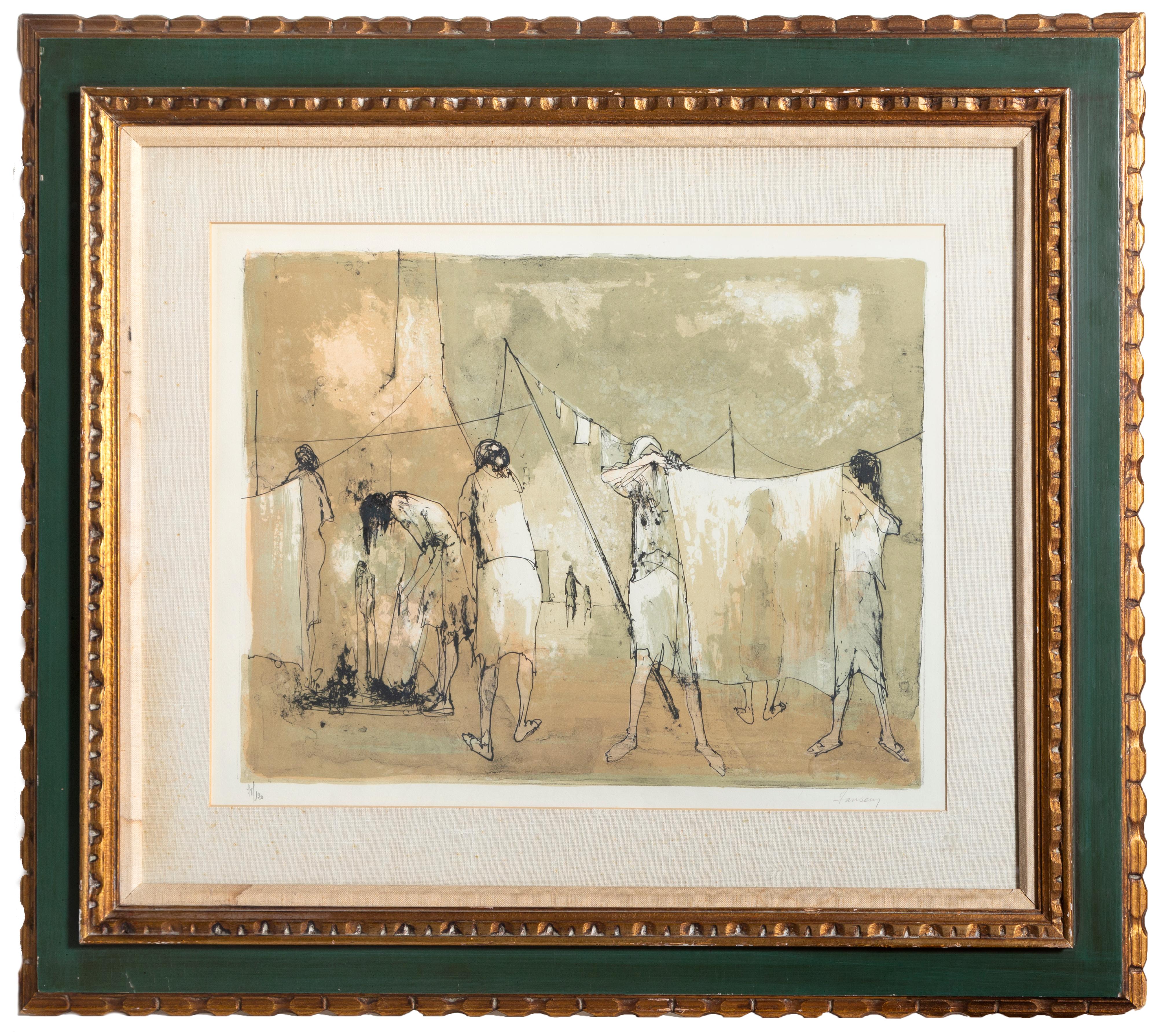
Washing Day, Modern Lithograph by Jean Jansem
By Jean Jansem
Located in Long Island City, NY
Artist: Jean Jansem, French (1920 - )
Title: Washing Day
Year: circa 1970
Medium: Lithograph, signed and numbered in pencil
Edition: EA
Image Size: 17 x 23 inches
Paper Size: 19 x 2...
Category
1960s Modern Figurative Prints
Materials
Lithograph
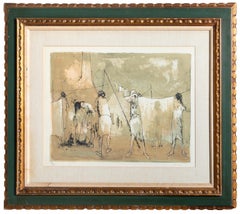
[Untitled] Beach Scene
By Harriet Keese Lanfair
Located in New York, NY
Harriet (Keese) Lanfair (1900-1988) lithograph, c. 1935, signed in pencil on lower right margin. Printed on a very light japan paper, with margins. A proof impression, with printers...
Category
1930s American Realist Figurative Prints
Materials
Lithograph
![[Untitled] Beach Scene](https://a.1stdibscdn.com/archivesE/upload/a_5153/1495569335502/IMG_1487_master.JPG?width=240)
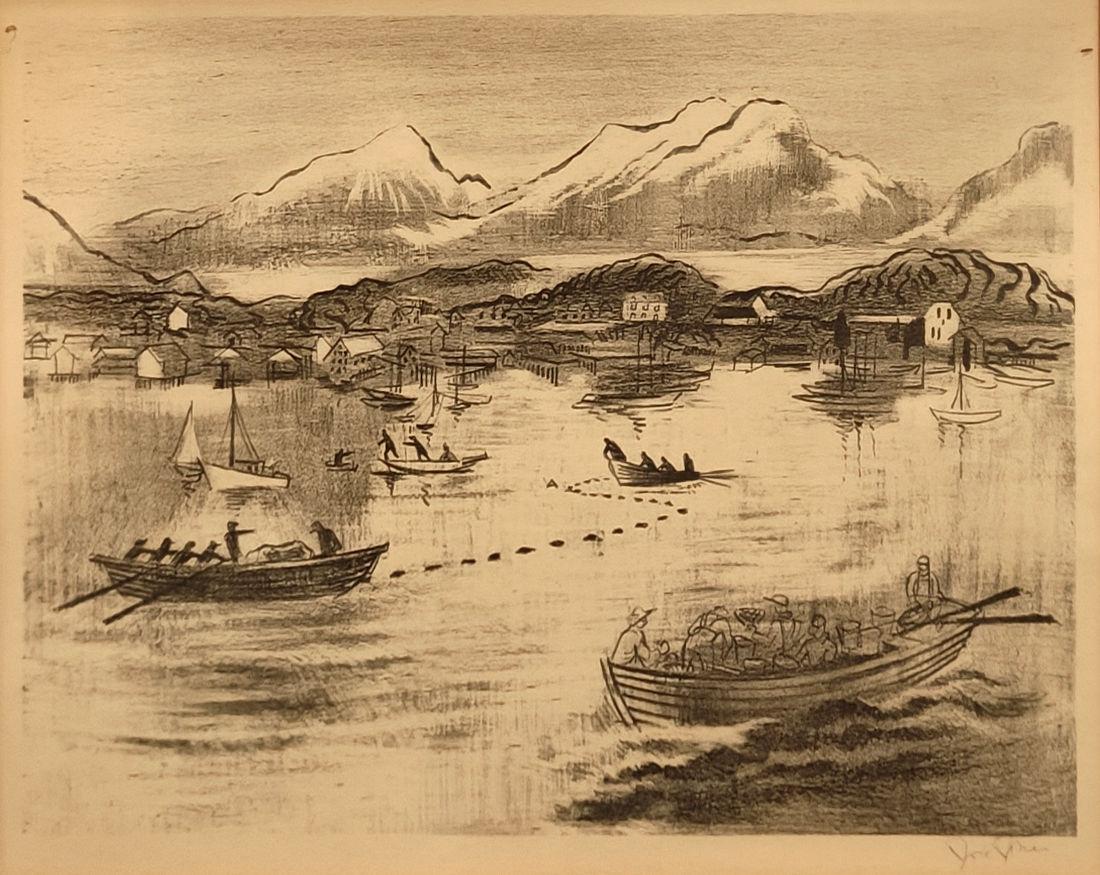
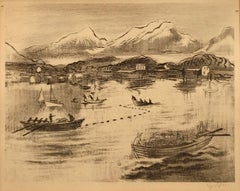
"Fishing Village" Joe Jones, Mid-Century, American Life, Small Town Scene
By Joe Jones
Located in New York, NY
Joe Jones
Fishing Village, 1949
Signed in pencil lower right margin
Lithograph on wove paper
Image 9 5/16 x 12 9/16 inches
Sheet 12 x 15 15/16 inches
From the edition of 250
The initial details of Jones' career are sparse, and this is intentional. The young artist was engaged in a process of self-reinvention, crafting a persona. When he submitted a work to the Sixteen Cities Exhibition at New York City's Museum of Modern Art in 1933, he briefly characterized himself: "Born St. Louis, 1909, self-taught. " Jones intentionally portrayed himself to the art community as an authentic working-class figure, backed by a compelling history. He was the youngest of five children in a family led by a one-armed house painter from St. Louis, a Welsh immigrant, and his German American spouse. At the age of ten, Jones found himself in a Missouri reformatory due to authorities' concerns over his graffiti activities. After completing elementary school, he traveled by freight car to California and back, even being arrested for vagrancy in Pueblo, Colorado. Returning to St. Louis, he attempted to settle down by working alongside his father. Yet, Jones felt a profound restlessness and was drawn toward a more elevated artistic pursuit in his late teenage years. He discovered a local collective of budding artists that formed St. Louis’s "Little Bohemia," sharing a studio and providing mutual support until he managed to secure his own modest workspace in a vacant garage.
Jones’s initial creations comprised still lifes, landscapes, and poignant portraits of those close to him. These subjects were not only accessible but also budget-friendly, as hiring models was beyond his means. He depicted himself, his father, mother, and eventually, his wife. In December 1930, at the age of 21, Jones wed Freda Sies, a modern dancer and political activist who was four years older than him.
By 1933, Jones had started gaining noteworthy local recognition through a solo exhibition at the Artists’ Guild of Saint Louis. Of the twenty-five paintings on display, one, titled River Front (private collection, previously with Hirschl and Adler Galleries), was selected to illustrate a feature article about his show in The Art Digest (February 15, 1933, p. 9). Shortly before this exhibition, a young surgeon named Dr. Robert Elman took an interest in Jones’s art, purchasing several pieces and forming a group of potential patrons committed to providing the emerging artist with a monthly stipend in exchange for art. This group was officially known as the "Co-operative Art Society," but it was informally dubbed the "Joe Jones Club. " Jones became an active participant in the St. Louis artistic scene, particularly within its bohemian segments. He embraced modernism and was a founding member of the "New Hat" movement in 1931, a playful rebellion against the conservative and traditional mainstream art establishment.
The summer of 1933 marked a significant shift in Jones’s journey. Sponsored by a dedicated ally, Mrs. Elizabeth Green, Jones, along with Freda and Green, embarked on an eastward road trip. In Washington, D. C., they explored the Corcoran Gallery of Art, the Freer Gallery (part of the Smithsonian Institution), the Library of Congress, and Mount Vernon. Following this whirlwind of art and American culture, they made their way to New York, where they visited various museums and galleries, including a stop at The New School for Social Research, which featured notable contemporary murals by fellow Missourian Thomas Hart Benton and the politically active Mexican artist, José Clemente Orozco. From June through August, Jones and Freda resided in the artist colony of Provincetown, Massachusetts, later returning home via Detroit to see Diego Rivera’s Detroit Industry mural housed at the Detroit Institute of Fine Arts.
While Elizabeth Green allegedly hoped that Jones would refine his artistic skills under the guidance of Charles Hawthorne or Richard Miller in Provincetown, Jones followed a different path. Rather than pursuing conservative mentors, he connected with an engaging network of leftist intellectuals, writers, and artists who dedicated their time to reading Marx and applying his theories to the American landscape. Jones's reaction to the traditional culture of New England was captured in his statement to a reporter from the St. Louis Post Dispatch: “Class consciousness . . . that’s what I got of my trip to New England. Those people [New Englanders] are like the Chinese—ancestor worshipers. They made me realize where I belong” (September 21, 1933). The stark social divisions he witnessed there prompted him to embrace his working-class identity even more fervently. Upon returning to St. Louis, he prominently identified himself as a Communist. This newfound political stance created friction with some of his local supporters. Many of his middle-class advocates withdrew their backing, likely influenced not only by Jones’s politics but also by his flamboyant and confrontational demeanor.
In December 1933, Jones initiated a complimentary art class for unemployed individuals in the Old Courthouse of St. Louis, the same location where the Dred Scott case was deliberated and where slave auctions formerly took place. Concurrently, the St. Louis Art League was offering paid courses. Emphasizing the theme of social activism, with a studio adorned with Soviet artwork, Jones’s institution operated for just over a year before being removed from the courthouse by local officials. The school’s political focus and unconventional teaching practices, along with its inclusion of a significant number of African American students during a period marked by rigid racial segregation, certainly contributed to its challenges. Under Jones’s guidance, the class created a large chalk pastel mural on board, measuring 16 by 37 feet, titled Social Unrest in St. Louis. Mural painting posed no challenge for the former housepainter, who was adept at handling large wall surfaces. His first significant commission in St. Louis in late 1931 was a mural that celebrated the city’s industrial and commercial fortitude for the local radio station, KMOX. This mural, aimed at conveying optimism amid severe economic hardship, showcased St. Louis's strengths in a modernist approach. When Jones resumed mural work in late 1933, his worldview had evolved considerably. The mural produced for the school in the courthouse, conceived by Jones, featured scenes of modern St. Louis selected to highlight political messages. Jones had observed the technique of utilizing self-contained scenes to craft visual narratives in the murals he encountered in the East. More locally, this compositional strategy was commonly employed by the renowned Missouri artist...
Category
1940s American Realist Landscape Prints
Materials
Paper, Lithograph
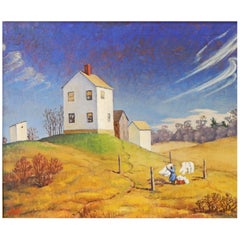
"Laundry Day, " Rural North Carolina on a Fresh Sunny Day, World War II
By Warren Wheelock
Located in Philadelphia, PA
Fresh as a crisp fall day, this painting of a woman taking down laundry at the base of a hill dominated by her home above is a reassuring depiction of wholesome rural life in 1941, p...
Category
Vintage 1940s American Art Deco Paintings
Materials
Paint
$7,600 Sale Price
20% Off
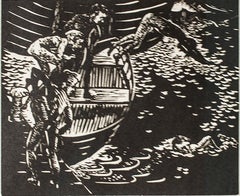
"Swimmers, " Seascape Linoleum Cut by Clarice George Logan
By Clarice George Logan
Located in Milwaukee, WI
"Swimmers" is an original linoleum print by Clarice George Logan. It features five figures enjoying a swim, jumping off from a small boat.
Image: 4.94" x 6"
Framed: 13.87" x 14.87"
Clarice George Logan was born in Mayville, New York in 1909 but moved to Wisconsin in 1921. She attended the Milwaukee State Teachers College from 1927 to 1931 where she studied with Robert von Neumann...
Category
1930s American Modern Figurative Prints
Materials
Linocut
More Ways To Browse
Jay Mcvicker
Cecilia Vicuna
Chagall Accordionist
Chagall Homecoming
Chagall Serenade
Chairs Harold Altman
Charles Bibbs
Chi Chien Wang
Claude Mellan
Coney Island Banner
Connoisseur Antiques
Consuelo Balsan
Conzett And Huber
Copper Plate Picasso
Corridor Of Katmandu
Crucified Skull
Daiva Kaireviciute
Dali Adam And Eve