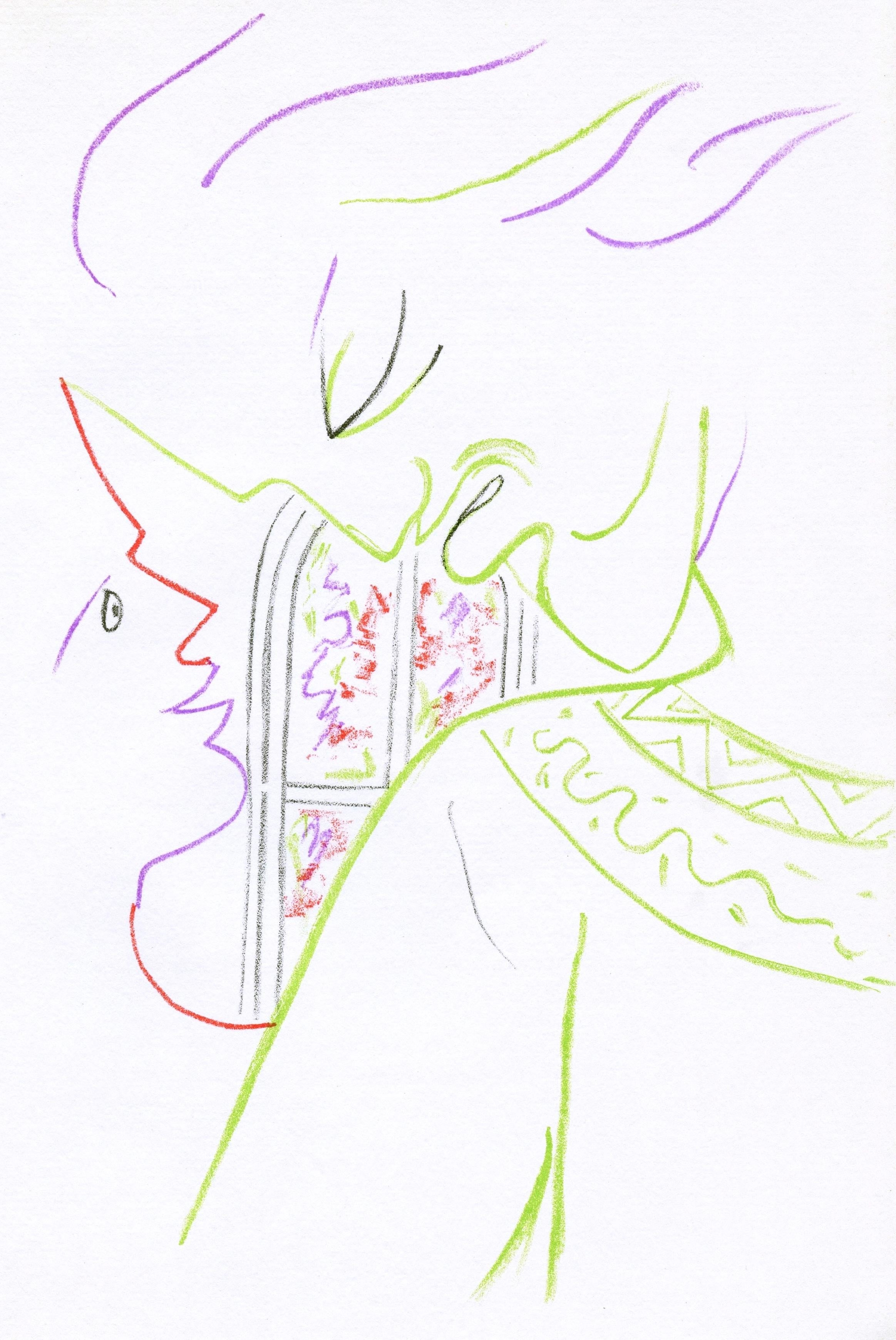
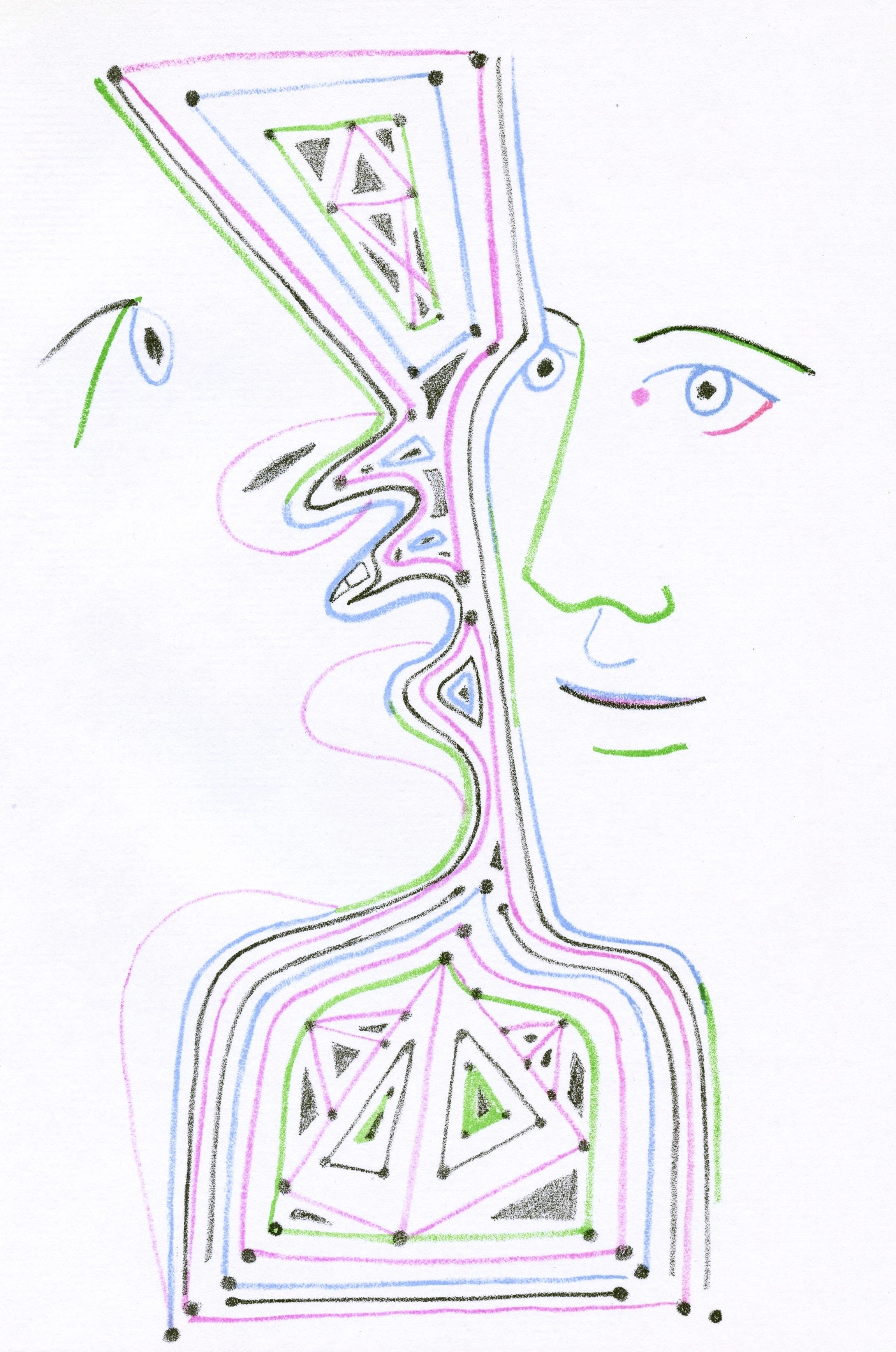
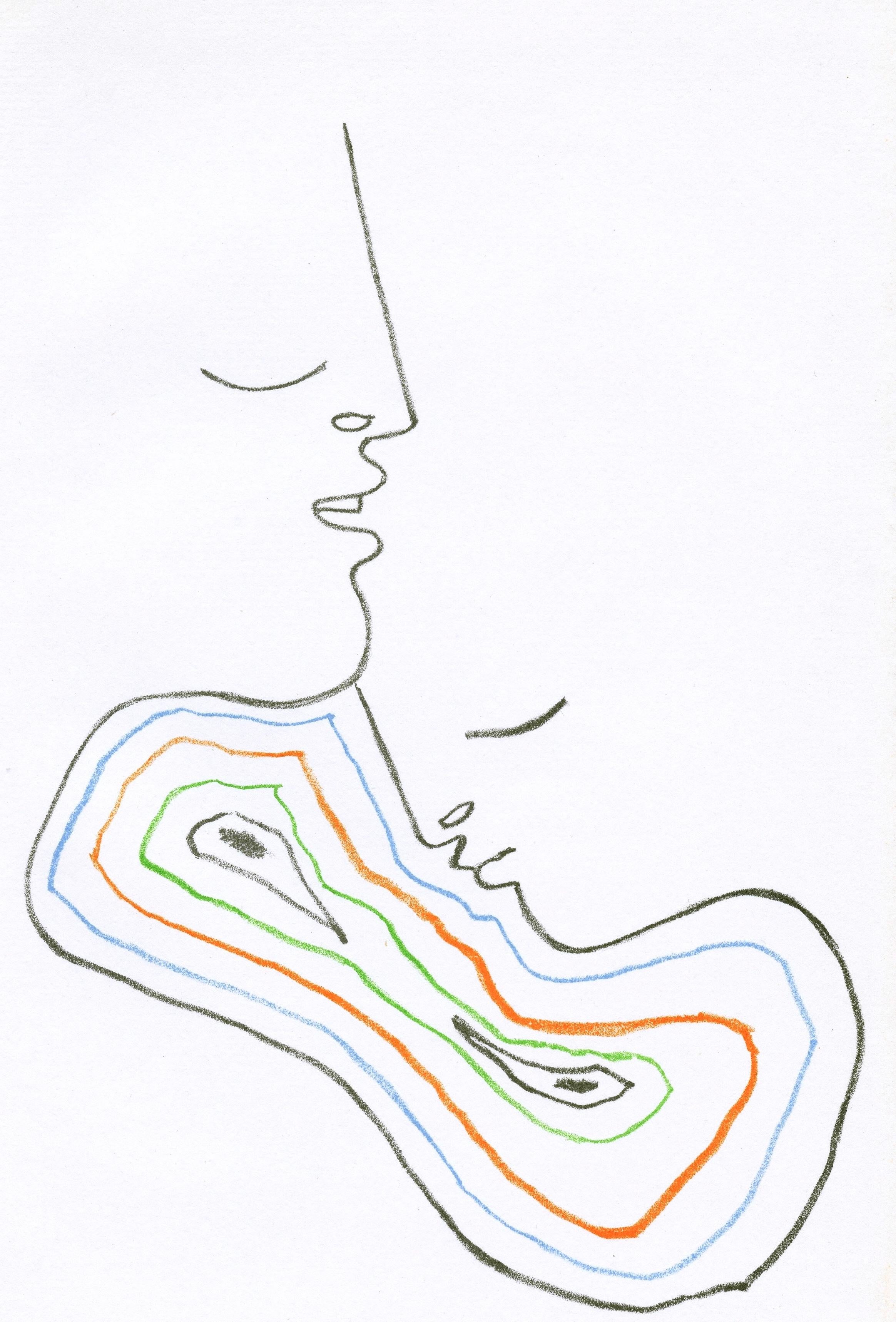
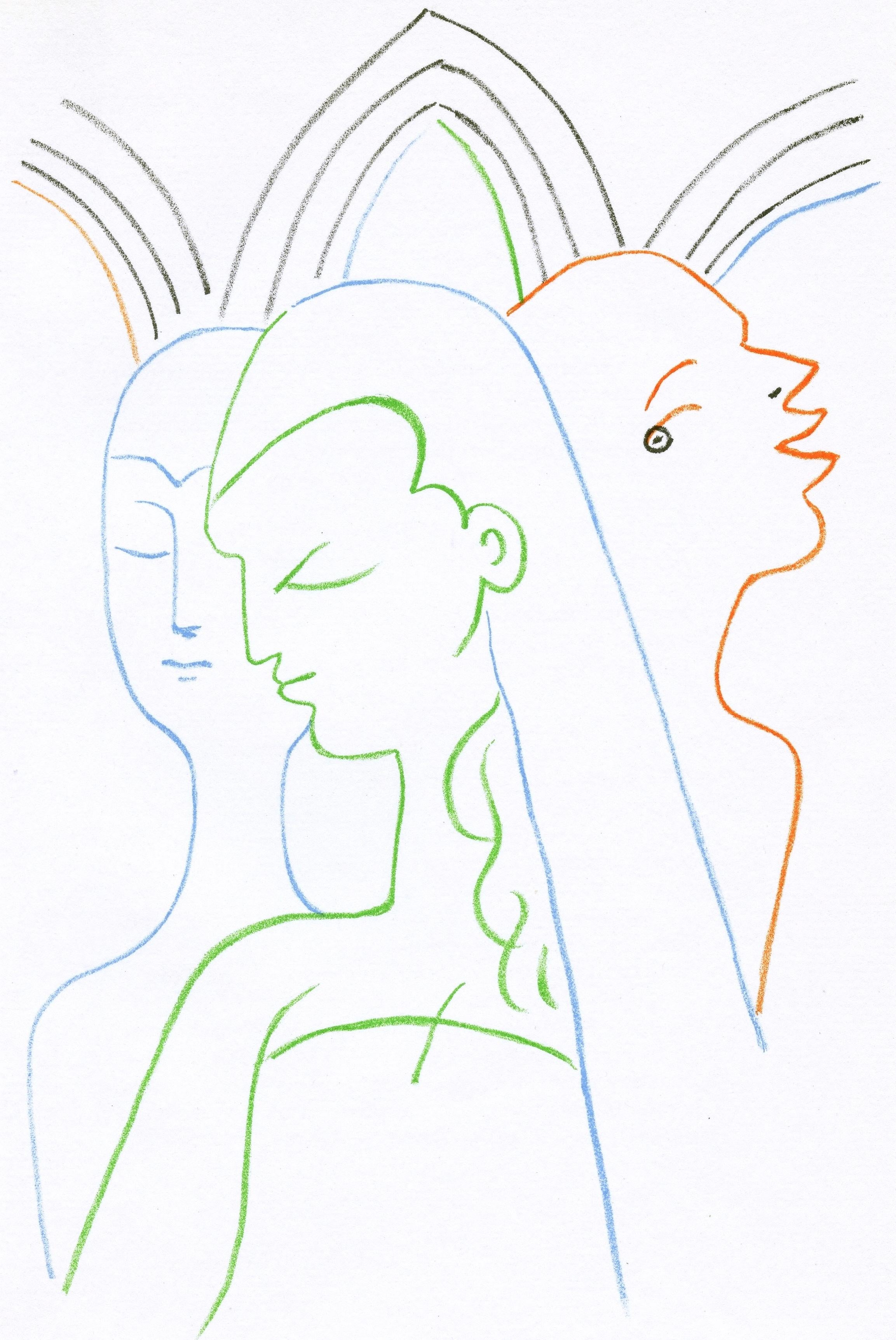
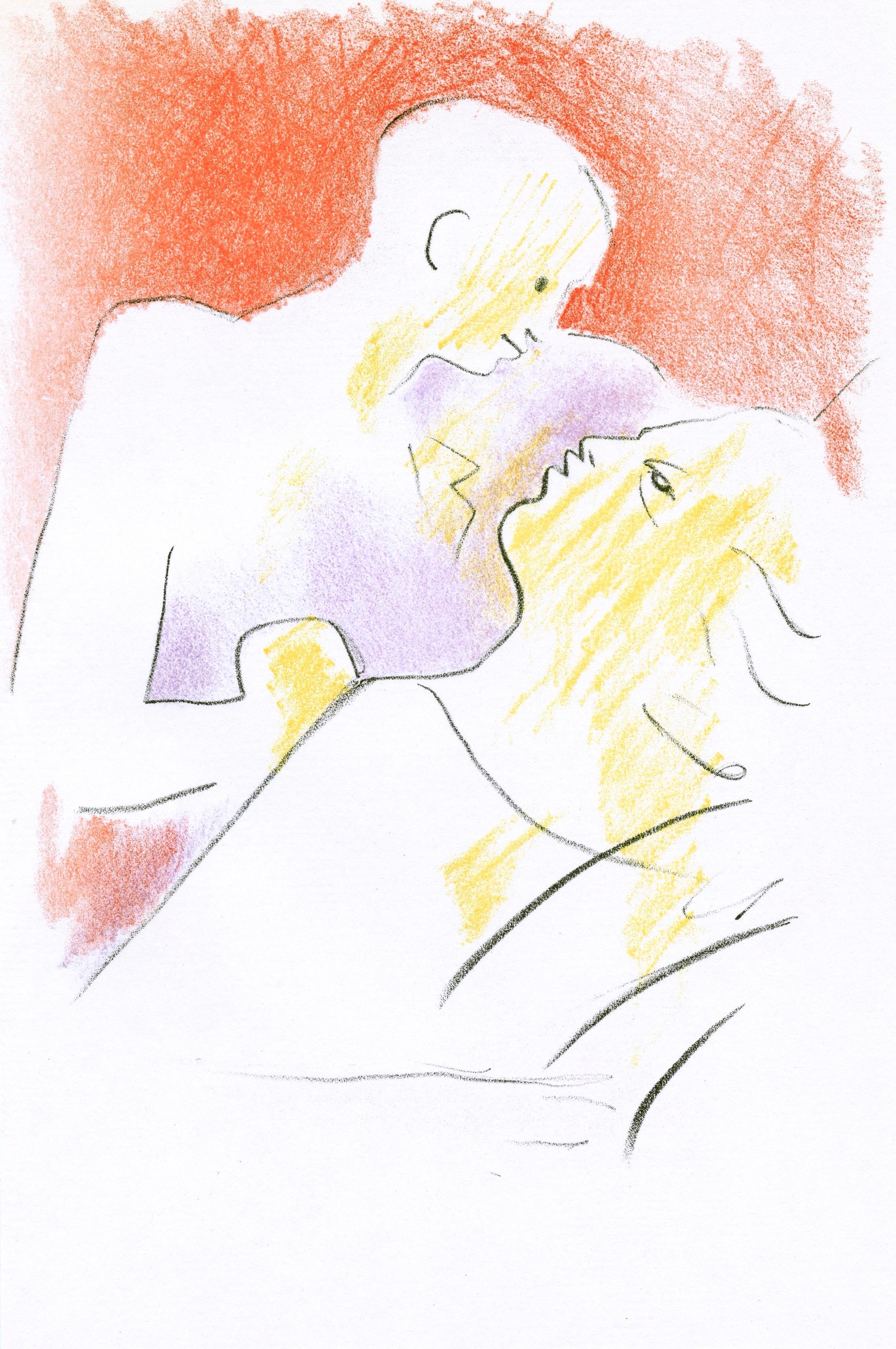
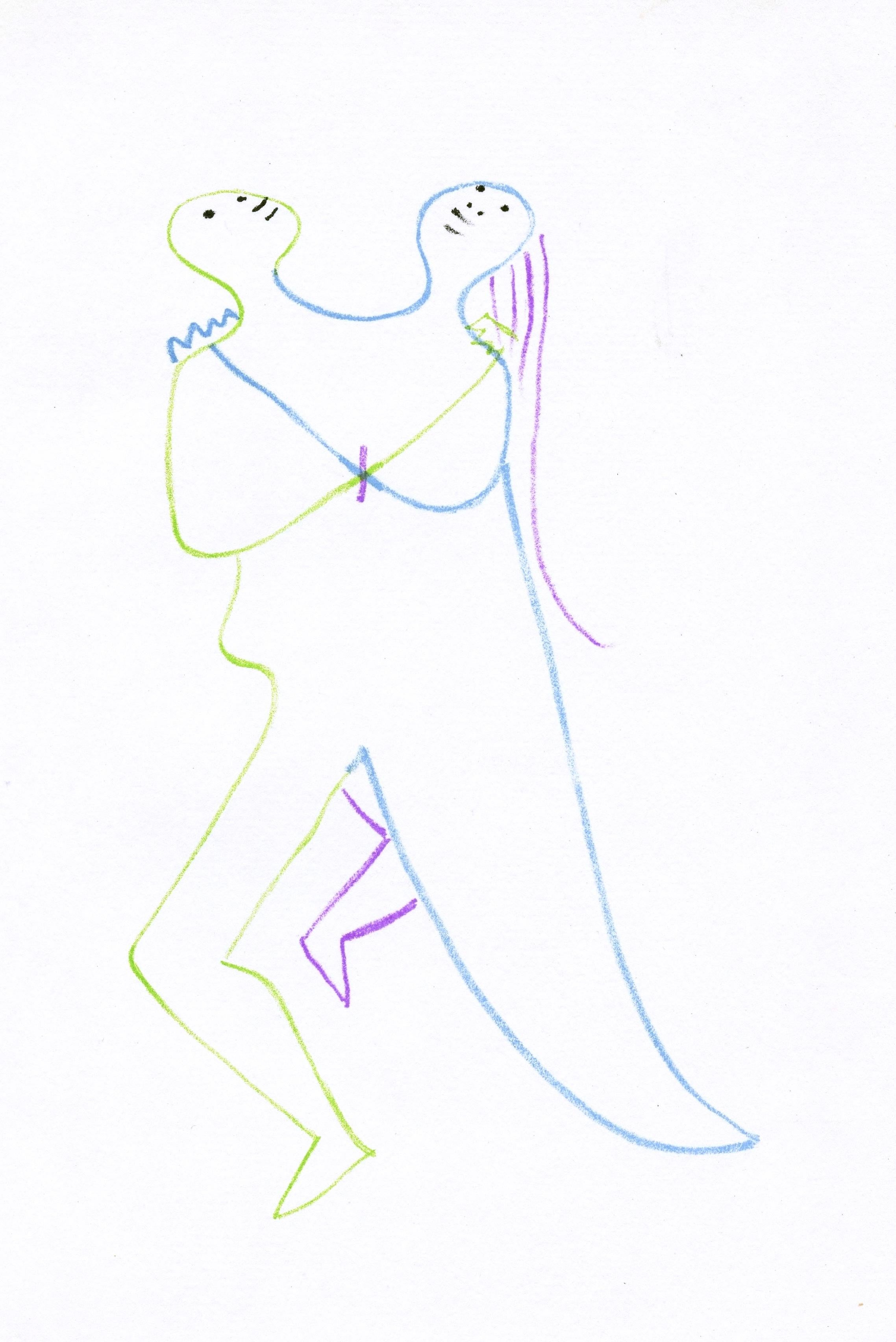
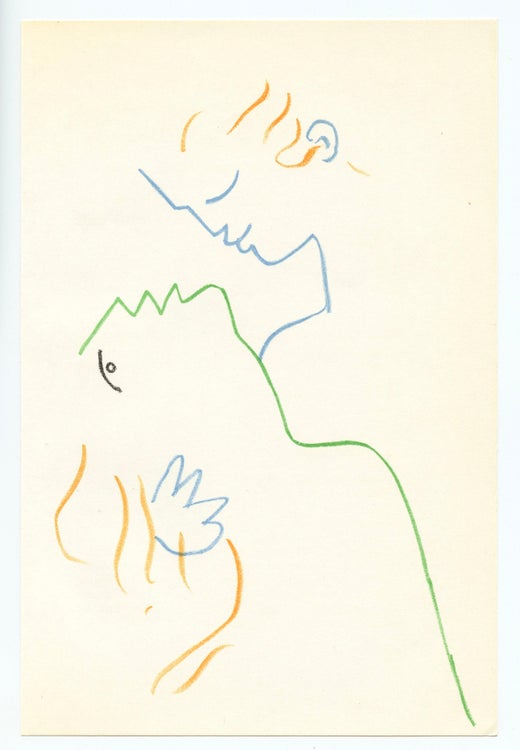
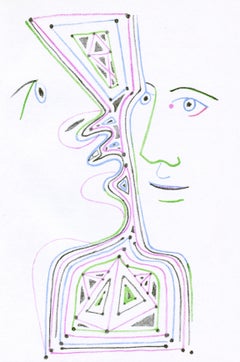
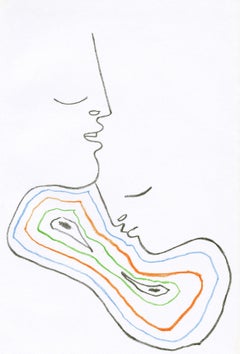
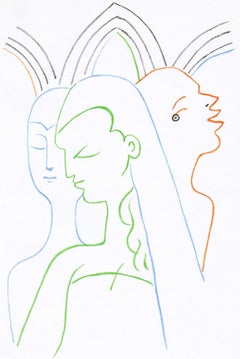
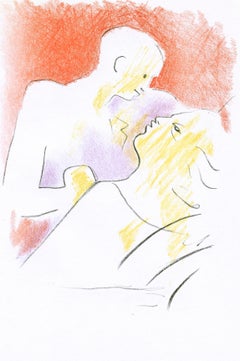
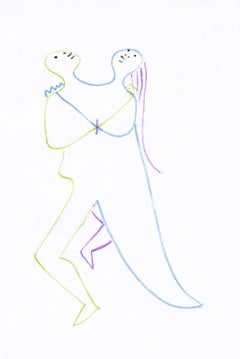
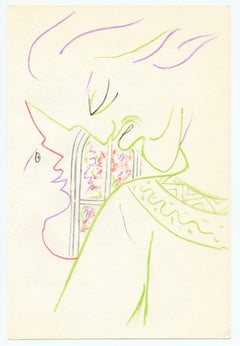
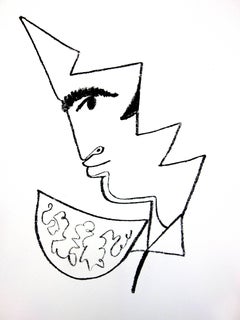
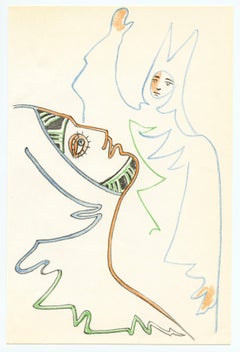
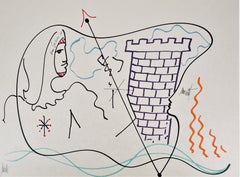
This exquisite lithograph by Jean Cocteau (1889–1963), titled Scene XVII, Les Chevaliers de la Table Ronde (Scene XVII, The Knights of the Round Table), originates from the 1957 album Jean Cocteau de l'Academie francaise, Theatre, Edition ornee par l'auteur de dessins in texte et de quarante lithographies originales en couleurs, tome I (Jean Cocteau of the French Academy, Theater, Edition Adorned by the Author with Text Drawings and Forty Original Lithographs in Colors, Volume I), published by Editions Bernard Grasset, Paris, and printed by Mourlot Freres, Paris, July 30, 1957. The composition reflects Cocteau's lyrical draftsmanship, classical elegance, and theatrical sensibility, expressed through his fluid, poetic line.
Executed as a lithograph on velin Verge de Voiron des Papeteries Navarre paper, this work measures 8.75 x 6 inches (22.23 x 15.24 cm). Unsigned and unnumbered as issued. Printed by Mourlot Freres, Paris, one of the foremost fine art lithographic ateliers of the twentieth century.
Artwork Details:
Artist: Jean Cocteau (1889–1963)
Title: Scene XVII, Les Chevaliers de la Table Ronde (Scene XVII, The Knights of the Round Table), from Jean Cocteau de l'Academie francaise, Theatre, Edition ornee par l'auteur de dessins in texte et de quarante lithographies originales en couleurs, tome I (Jean Cocteau of the French Academy, Theater, Edition Adorned by the Author with Text Drawings and Forty Original Lithographs in Colors, Volume I), 1957
Medium: Lithograph on velin Verge de Voiron des Papeteries Navarre paper
Dimensions: 8.75 x 6 inches (22.23 x 15.24 cm)
Inscription: Unsigned and unnumbered as issued
Date: 1957
Publisher: Editions Bernard Grasset, Paris
Printer: Mourlot Freres, Paris
Condition: Well preserved, consistent with age and medium
Provenance: From the 1957 album Jean Cocteau de l'Academie francaise, Theatre, Edition ornee par l'auteur de dessins in texte et de quarante lithographies originales en couleurs, tome I (Jean Cocteau of the French Academy, Theater, Edition Adorned by the Author with Text Drawings and Forty Original Lithographs in Colors, Volume I), published by Editions Bernard Grasset, Paris
Notes:
Excerpted from the album (translated from French), Completed printing on the presses of l'imprimerie Darantiere in Dijon, the thirtieth of July 1957. The text of Jean Cocteau's Theater edited by Bernard Grasset was composed in Garamond and printed on the presses of l'imprimerie Darantiere in Dijon. The author's lithographies were printed by Atelier Mourlot Freres in Paris. The boards were executed by l'Atelier Barasi in Alfortville, based on the model by Jean Cocteau. The print includes LX examples on Madagascar numbered Madagascar, I to L and I to X, CCX examples on Velin de Rives, numbered Velin de Rives I to CC and I to X, and VMMMMMDCCCXC examples on Verge de Voiron des Papeteries Navarre, under special binding numbered Verge de Voiron I to VMMMMDCCC and S.P. I to S.P. XC.
About the Publication:
Jean Cocteau de l'Academie francaise, Theatre, Edition ornee par l'auteur de dessins in texte et de quarante lithographies originales en couleurs, tome I (Jean Cocteau of the French Academy, Theater, Edition Adorned by the Author with Text Drawings and Forty Original Lithographs in Colors, Volume I) stands among the most ambitious and luxurious Parisian printmaking achievements of the mid twentieth century, uniting Cocteau's theatrical writings with an extensive cycle of original color lithographs created expressly for this edition. Conceived and published by Editions Bernard Grasset, the project embodies the tradition of the French livre d'artiste, merging fine typography—set in the historic Garamond type—and masterful lithographic printing executed by Atelier Mourlot Freres. Cocteau supervised not only the imagery but the entire artistic conception, from page layout to the integration of text drawings, making the album a total work of art shaped by the author's own vision. Bound in several tirages, including luxury examples on Madagascar and Velin de Rives and an edition on Verge de Voiron des Papeteries Navarre, the publication reflects the highest craftsmanship of its era while demonstrating Cocteau's conviction that theater, poetry, and visual art belong to a unified poetic tradition. The album remains a cornerstone of Cocteau's printed oeuvre and a landmark achievement in twentieth-century Parisian printmaking, distinguished for its synthesis of literature, lithography, and design.
About the Artist:
Jean Cocteau (1889–1963) was a French artist, poet, playwright, filmmaker, and designer whose boundless imagination and multidisciplinary genius made him one of the most influential cultural figures of the twentieth century. Born in Maisons-Laffitte near Paris, Cocteau emerged as a prodigy whose creative energy spanned literature, cinema, theater, music, and the visual arts, reshaping modern creativity through his conviction that beauty, myth, and imagination were universal languages. A central figure of the Parisian avant-garde, he moved among and collaborated with Pablo Picasso, Alexander Calder, Alberto Giacometti, Salvador Dali, Joan Miro, Wassily Kandinsky, Marcel Duchamp, and Man Ray—artists who, like Cocteau, were revolutionizing modern thought through bold experimentation. His early collaboration with Picasso and Erik Satie on Parade (1917) for Diaghilev's Ballets Russes signaled a new era of interdisciplinary art, merging music, design, and theater into a total work of imagination. Cocteau's visual art—characterized by fluid line drawings, mythological motifs, and lyrical simplicity—revealed a mastery of composition that blended classical elegance with modern abstraction. His murals for the Chapelle Saint-Pierre in Villefranche-sur-Mer and the Chapelle Saint-Blaise-des-Simples in Milly-la-Foret stand among the great achievements of sacred modern art, balancing spirituality and modernist form with serene clarity. Equally revolutionary were his contributions to literature and film: his novels (Les Enfants Terribles), plays (La Machine Infernale, Les Parents Terribles), and films (La Belle et la Bete, Orphee, Le Testament d'Orphee) established him as one of the founding visionaries of poetic cinema, influencing filmmakers such as Federico Fellini, Jean-Luc Godard, David Lynch, and Guillermo del Toro. In fashion and theater, his collaborations with Coco Chanel, Christian Dior, and Elsa Schiaparelli merged art and couture, expanding his influence beyond the visual and literary arts. His friendship with Jean Marais inspired some of his most intimate works, while his portraits and ceramics revealed a wit and grace that elevated simplicity to transcendence. Cocteau's aesthetic bridged classical myth and modern psychology, dream and reality, light and line—an approach that inspired later artists from Andy Warhol, David Bowie, and Jean-Michel Basquiat to Alexander McQueen and John Galliano. His works are held in major museums including the Centre Pompidou, the Musee Jean Cocteau in Menton, the Tate, and the Museum of Modern Art in New York, and his enduring appeal lies in his ability to unite art forms through poetry, elegance, and imagination. Standing alongside Pablo Picasso, Alexander Calder, Alberto Giacometti, Salvador Dali, Joan Miro, Wassily Kandinsky, Marcel Duchamp, and Man Ray, Cocteau remains a beacon of creative synthesis whose influence continues to shape modern art, film, and design. His highest auction record was achieved by Jean Marais dans "La Belle et la Bete" (1946), which sold for 611,622 USD at Sotheby's, Paris, on October 18, 2023.
Jean Cocteau lithograph, Cocteau Theatre tome I, Cocteau Bernard Grasset, Cocteau Mourlot Freres, Cocteau 1957 edition, Cocteau Verge de Voiron, Cocteau collectible lithograph.