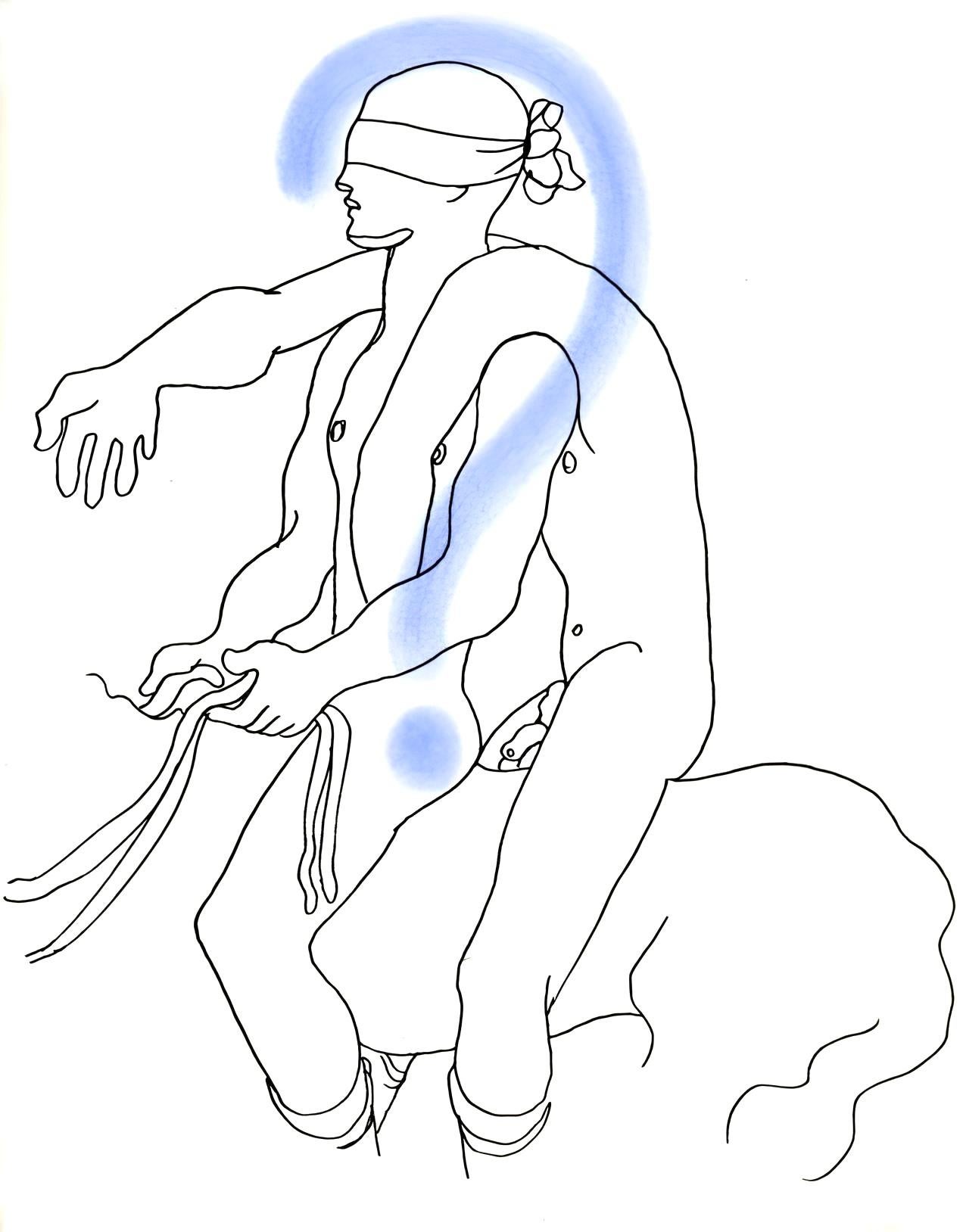
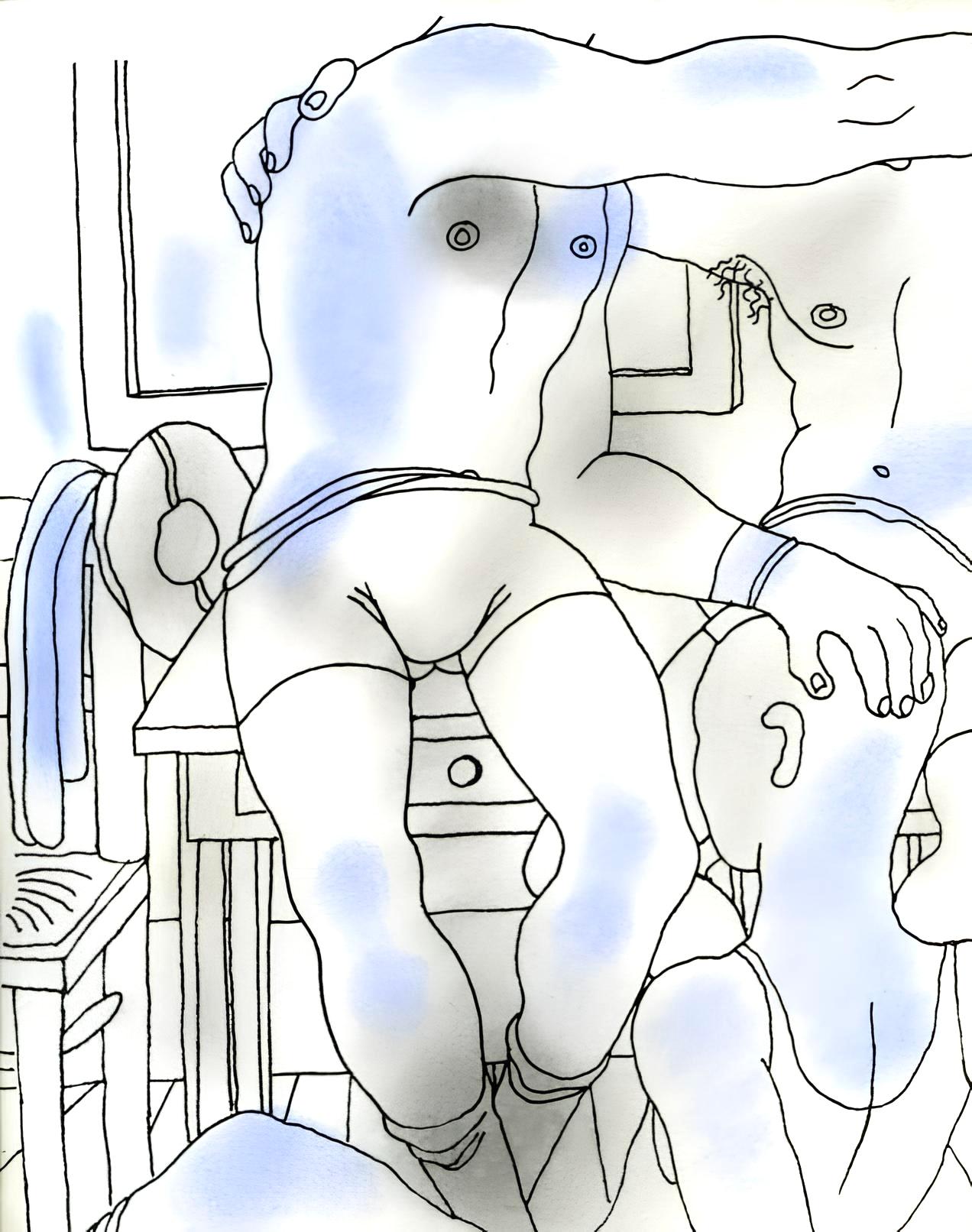
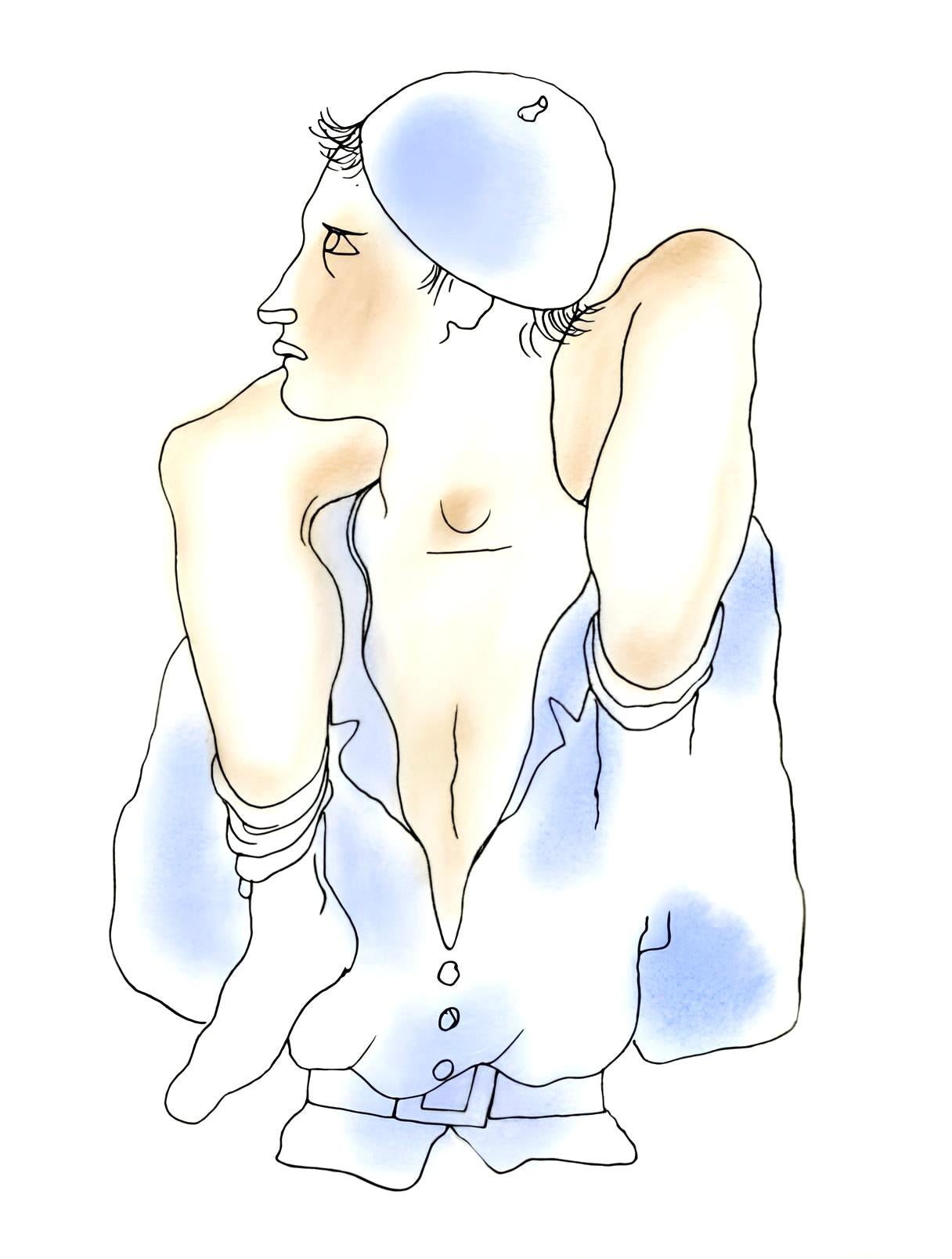
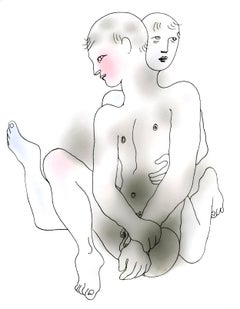
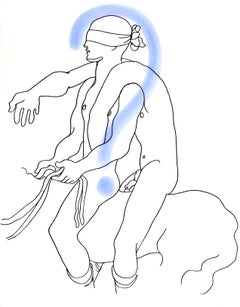
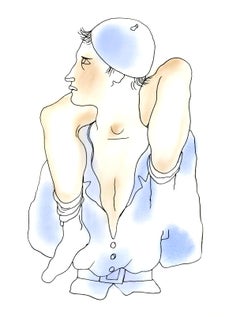
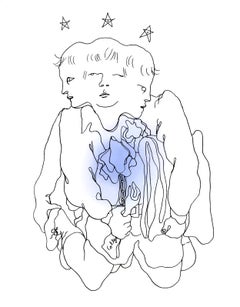
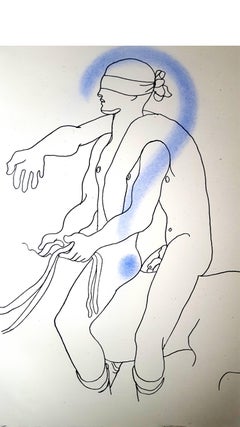
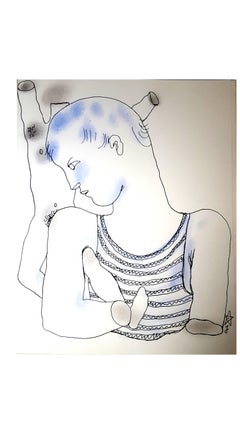
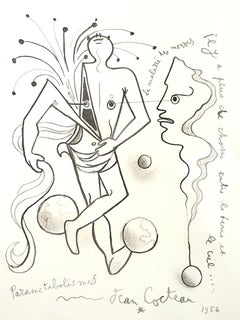
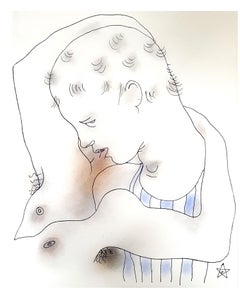
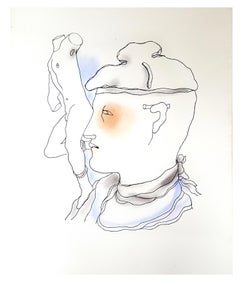
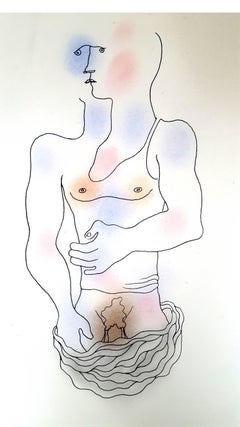
This exquisite lithograph and pochoir with hand coloring by Jean Cocteau (1889–1963), titled Sans titre (Untitled), from the album Le Livre blanc (The White Book), precede dun frontispice et accompagne de 17 dessins de Jean Cocteau (preceded by a frontispiece and accompanied by 17 drawings by Jean Cocteau), originates from the 1930 edition published by Editions du Signe, Paris, printed by Maitres-Imprimeurs, Ducros et Colas, Paris, and hand colored by M.B. Armington (a probable pseudonym of Jean Cocteau), May 10, 1930. The work reflects Cocteaus mastery of linear elegance and psychological nuance, distilling intimacy, vulnerability, and symbolic clarity into a composition that occupies a pivotal place in early twentieth-century modernism and queer cultural history.
Executed as a lithograph and pochoir with hand coloring on velin d'Arches paper, this work measures 11.81 x 9.06 inches. Unsigned and unnumbered, as issued. The edition exemplifies the refined craftsmanship of Ducros and Colas, Maitres-Imprimeurs, and the exceptional hand-coloring attributed to Cocteau himself.
ARTWORK DETAILS
Artist: After Jean Cocteau (1889–1963)
Title: Sans titre (Untitled), from the album Le Livre blanc (The White Book), precede dun frontispice et accompagne de 17 dessins de Jean Cocteau (preceded by a frontispiece and accompanied by 17 drawings by Jean Cocteau)
Year: 1930
Medium: Lithograph and pochoir with hand coloring on velin d'Arches paper
Size: 11.81 x 9.06 inches
Inscription: Unsigned and unnumbered, as issued
Publisher: Editions du Signe, Paris
Printer: Maitres-Imprimeurs, Ducros et Colas, Paris
Catalogue Raisonne References:
Bezit, Emmanuel. Dictionnaire Critique et Documentaire des Peintres, Sculpteurs, Dessinateurs et Graveurs. Gründ, 1976, vol. 3, p. 744.
Carteret, Leon. Le Tresor du Bibliophile: Livres Illustres Modernes, 1875–1945. Editions Carteret, 1958, vol. 5, p. 51.
van der Veen, H. In Liefde Verzameld: Homoseksualiteit en de Nederlandse Literatuur. De Buitenkant, 1992, no. 136.
Monod, Luc. Manuel de Lamateur de Livres Illustres Modernes: 1875–1975. Ides
Calendes, 1992, no. 2912.
Condition: Well preserved, consistent with age and medium
Provenance: From the album Le Livre blanc, published by Editions du Signe, Paris; printed by Ducros et Colas, Paris; hand colored by M.B. Armington (a probable pseudonym of Jean Cocteau), May 10, 1930
NOTES
Excerpted from the album (translated from French), This album, whose plates have been entirely colored by hand by M.B. Armington, an artist-painter, was completed to print on May 10, 1930, by Ducros and Colas, Maitres-Imprimeurs in Paris. The draw has been limited to: XVIII examples on japon nacre, each containing one of the XVIII original drawings and a suite on Hollande, numbered from I to XVIII; VI examples, H.C., marked from A to F; XVIII examples on japon imperial, numbered from XIX to XXXVI; VI examples, H.C., marked from G to L; CCCLXXX examples on velin d'Arches, numbered from XXXVII to CDXVI; XXII examples, H.C., marked from A to V.
ABOUT THE PUBLICATION
Le Livre blanc (The White Book), published in 1930 by Editions du Signe with plates printed by Ducros et Colas and hand colored by the enigmatic M.B. Armington (likely Cocteau himself), occupies a singular and foundational place in the history of LGBTQ+ literature, visual culture, and artistic expression. Issued anonymously at a time when queer narratives were criminalized and pathologized, the album stands as one of the earliest openly gay illustrated works of the twentieth century, presenting a frank, poetic, and emotionally resonant depiction of same-sex desire long before such themes could be expressed without personal risk. The pairing of Cocteaus drawings—marked by linear grace, mythic symbolism, and emotional transparency—with the autobiographical text creates an unprecedented fusion of queer testimony and modernist aesthetics. Produced through traditional printmaking and meticulous hand coloring, the album circulated quietly among progressive circles in Paris, becoming a clandestine cultural milestone for queer readers, artists, and intellectuals. Its rarity, artisanal execution, and profound historical significance position it at the intersection of modernism, queer history, and the evolution of the livre d'artiste, marking it as one of the most culturally consequential illustrated albums of its era.
ABOUT THE ARTIST
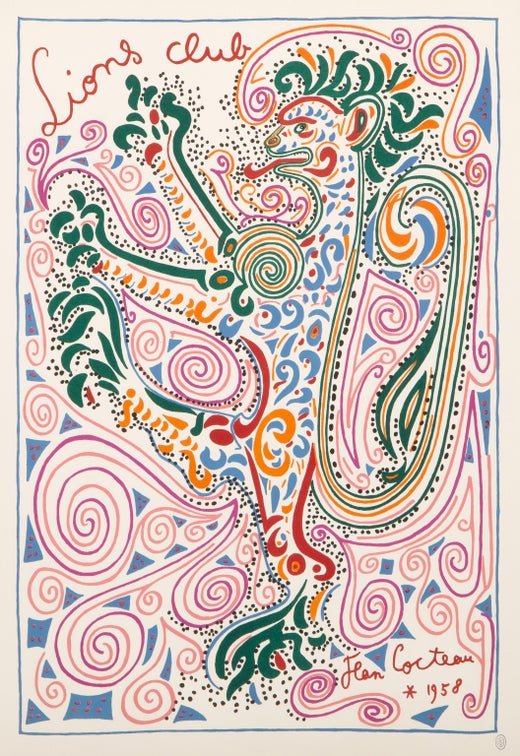
Jean Cocteau (1889–1963) was a French artist, poet, playwright, filmmaker, and designer whose boundless imagination and multidisciplinary genius made him one of the most influential cultural figures of the twentieth century. Born in Maisons-Laffitte near Paris, Cocteau emerged as a prodigy whose creative energy spanned literature, cinema, theater, music, and the visual arts, reshaping modern creativity through his conviction that beauty, myth, and imagination were universal languages. A central figure of the Parisian avant-garde, he moved among and collaborated with Pablo Picasso, Alexander Calder, Alberto Giacometti, Salvador Dali, Joan Miro, Wassily Kandinsky, Marcel Duchamp, and Man Ray—artists who, like Cocteau, were revolutionizing modern thought through bold experimentation. His early collaboration with Picasso and Erik Satie on Parade (1917) for Diaghilevs Ballets Russes signaled a new era of interdisciplinary art, merging music, design, and theater into a total work of imagination. Cocteaus visual art, characterized by fluid line drawings, mythological motifs, and lyrical simplicity, revealed a mastery of composition that blended classical elegance with modern abstraction. His murals for the Chapelle Saint-Pierre in Villefranche-sur-Mer and the Chapelle Saint-Blaise-des-Simples in Milly-la-Foret stand among the great achievements of sacred modern art, balancing spirituality and modernist form with serene clarity. Equally revolutionary were his contributions to literature and film: his novels (Les Enfants Terribles), plays (La Machine Infernale, Les Parents Terribles), and films (La Belle et la Bete, Orphee, Le Testament d'Orphee) established him as one of the founding visionaries of poetic cinema, influencing filmmakers such as Federico Fellini, Jean-Luc Godard, David Lynch, and Guillermo del Toro. In fashion and theater, his collaborations with Coco Chanel, Christian Dior, and Elsa Schiaparelli merged art and couture, expanding his influence beyond the visual and literary arts. His friendship with Jean Marais inspired some of his most intimate works, while his portraits and ceramics revealed a wit and grace that elevated simplicity to transcendence. Cocteaus aesthetic bridged classical myth and modern psychology, dream and reality, light and line—an approach that inspired later artists from Andy Warhol, David Bowie, and Jean-Michel Basquiat to Alexander McQueen and John Galliano. His works are held in major museums including the Centre Pompidou, the Musee Jean Cocteau in Menton, the Tate, and the Museum of Modern Art in New York. His highest auction record was achieved by Jean Marais dans La Belle et la Bete (1946), which sold for 611,622 USD at Sothebys Paris on October 18, 2023.
Keywords: Jean Cocteau Le Livre blanc, Cocteau pochoir, Cocteau lithograph, French modernist print, LGBTQ art history, queer livre d'artiste, velin d'Arches pochoir, Ducros et Colas Paris, Cocteau hand colored prints, rare illustrated albums.