Items Similar to "Momma Always Wanted a Dancer" Black
White Surreal Etching of a Child
Fish
Want more images or videos?
Request additional images or videos from the seller
1 of 14
John Alexander"Momma Always Wanted a Dancer" Black
White Surreal Etching of a Child
Fish1990
1990
$4,500
£3,416.31
€3,938.45
CA$6,365.87
A$6,853.44
CHF 3,670.15
MX$82,581.50
NOK 46,307.12
SEK 42,378.50
DKK 29,429.70
About the Item
Black and white surreal aquatint and etching of a child by Texas artist John Alexander. The work features a child-like figure dressed in a tutu and crown holding a fish in outstretched arms. Signed and editioned 3/35 along front lower margin. Currently hung in a silver frame with a white complementary matting.
Image Dimensions: H 9 in. x W 6 in.
Artist Biography: JOHN ALEXANDER (b.1945, Beaumont, Texas) has made an international career as a skilled draftsman, a painter of lush, sometimes violent landscapes, and as a satirical storyteller. Alexander began seriously studying art at Lamar University in his hometown of Beaumont. An auspicious trip to Chicago found the young artist face to face with what would prove to be lifelong influences, including landscapes from the Hudson River School and a still life by Édouard Manet. After earning an MFA in 1970 from Southern Methodist University in Dallas, Alexander took a teaching position at the University of Houston, where he became a key figure in the city’s nascent art scene. The fruitful ’70s featured his first mature landscapes, followed by freewheeling sketches and a looser, more expressionistic style of painting.
He moved to New York City in 1979, taking a SoHo loft he still calls home. Relocation led to a sense of artistic freedom and a stronger abstract style. He spent the late ’80s and early ’90s satirizing New York’s obsession with excess and celebrity, in the process gaining more renown of his own. In addition to his continuing fascination with the surreal and humankind at its worst, Alexander’s artistic eye has gravitated toward ruminative still lifes, marshy landscapes, and studied portraits of flora and fauna, particularly the birds flocking to his part-time home on Long Island’s East End. Naturalism and conservation remain hallmarks of his work and life, and he says the Beaumont bayou of his youth is never far from his mind.
Alexander has been widely exhibited, with major shows at the Smithsonian American Art Museum in Washington, D.C., and the Museum of Fine Arts, Houston. His work can be found in public collections at the Metropolitan Museum of Art; Hirshhorn Museum and Sculpture Garden; Los Angeles County Museum of Art; Museum of Contemporary Art, Los Angeles; Museum of Contemporary Art, Chicago; Meadows Museum, Dallas; Dallas Museum of Art; Museum of Fine Arts, Houston; and many others.
- Creator:John Alexander (1945, American)
- Creation Year:1990
- Dimensions:Height: 20.25 in (51.44 cm)Width: 16.63 in (42.25 cm)Depth: 1.63 in (4.15 cm)
- Medium:
- Movement Style:
- Period:
- Condition:
- Gallery Location:Houston, TX
- Reference Number:Seller: CA392.2026.0108.69161stDibs: LU551317460532

John Alexander
John Alexander was one of the leading Scottish artists of the 18th century. Born to an Aberdeen doctor, he boasted patrilineal descent from George Jamesone, a purported student of Rubens and Van Dyck, and the founder of a Scottish school of portraiture which found its highest expression in Ramsay and Raeburn in the following century. Alexander travelled to Rome in 1711 where he trained under Giuseppe Bartolomeo Chiari. He produced engravings after Raphael’s frescoes in the Vatican Loggia, and worked for the Marquess of Annandale to collect paintings and sculpture; he made drawings of the works, and collected some copies for himself, which he brought back to Scotland in 1720. Whilst in Italy, Alexander received commissions from the Medici in Florence, and the exiled Stuart court in Rome, who included the Lord Chief Justice Coke and the Earl of Mar. Lord Mar had arrived in Italy after the failed Jacobite rising of 1715, and even commissioned Alexander on behalf of the exiled Royal family: Alexander wrote to Mar, ‘You will receive from the post the Parnassus of Raphael […] I pray you anew to excuse my weak beginnings to the King’ (Holloway, p. 86). Alexander married Isobel Innes of Tillyfour in 1723 and their son Cosmo was born the following year. Their younger son Charles was sent abroad to the Scots Benedictine College at Ratisbon, and his daughter married George Chalmers, son to Roderick Chalmers and heir to an impoverished baronetcy. Alexander took a number of aristocratic commissions, which included the 4th Earl and Countess of Kinmore; James Hamilton, 5th Duke of Hamilton; and the 7th Earl of Wemyss. He was based in Edinburgh in his later career, painting figures of early Enlightenment Edinburgh, such as George Drummond, the Lord Provost who had envisaged the grid plan of Edinburgh’s New Town. Alexander was a close friend of the architect James Gibbs, and the engraver and antiquary George Vertue, who described the artist as ‘a merry dispos’d gent, [who] laughs eternally’ (Holloway, p. 85). Alexander was a signatory in 1729 of the charter of Scotland’s first art institution, the Academy of St Luke of Edinburgh.
About the Seller
5.0
Gold Seller
Premium sellers maintaining a 4.3+ rating and 24-hour response times
Established in 1969
1stDibs seller since 2014
888 sales on 1stDibs
Typical response time: 13 hours
- ShippingRetrieving quote...Shipping from: Houston, TX
- Return Policy
More From This Seller
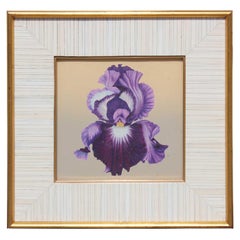
View AllPurple Iris Still Life
By (after) Georgia O
Keeffe
Located in Houston, TX
Gorgeous still life lithograph of a a vibrant purple Iris made in the 1930's by artist unknown in the style of Georgia O'Keeffe.
Category
1930s Realist Still-life Prints
Materials
Lithograph
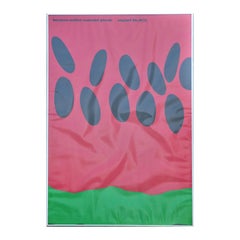
Herman Miller Summer Picnic August 20, 1971 - Watermelon Screen Print
Located in Houston, TX
Original Herman Miller Summer Picnic screen printed lacquer ink and lacquer finish print. August 20, 1971 annual company picnic poster is a...
Category
1970s Pop Art Still-life Prints
Materials
Lacquer, Ink
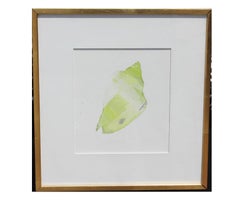
Green Painted Sea Shell Lithograph Edition 33 of 34
By Frances Nail
Located in Houston, TX
Green shell lithograph of a cone shell. Print is edition 33 of 34. Signed and dated by the artist along with titled. Print is framed in a golden frame...
Category
1970s Naturalistic Still-life Prints
Materials
Lithograph
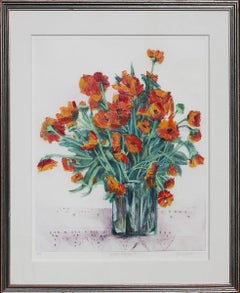
Abstract Contemporary Interior Still Life Print of Marigolds in a Teal Vase
Located in Houston, TX
Abstract contemporary interior still life depicting Marigolds in a teal glass vase. Signed, titled, and editioned by artist at the bottom. Framed in a...
Category
Late 20th Century Abstract Still-life Prints
Materials
Lithograph
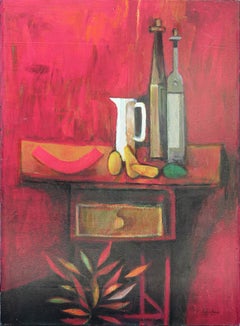
“Red Room, White Pitcher” Red Toned Interior Still Life
Located in Houston, TX
Red toned interior still life depicting a white pitcher, two beverage bottles, three yellow ripe mangoes and one unripe, and a shape that resembles a sliced cantaloupe--all on top of...
Category
Early 2000s Abstract Still-life Prints
Materials
Acrylic, ABS, Giclée
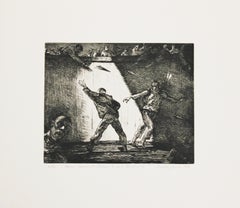
"Four Terrorist Trapped in a Bullring" Edition 2 of 20
By Robert Levers
Located in Houston, TX
Surrealist abstract print of four figures that are in a bullring with other onlookers. In the image, there are paper airplanes flying around the scene. The first two terrorists are i...
Category
1990s Surrealist Abstract Prints
Materials
Lithograph
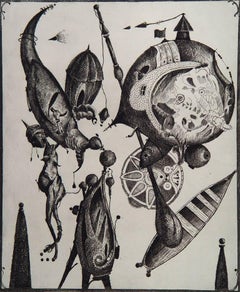
You May Also Like
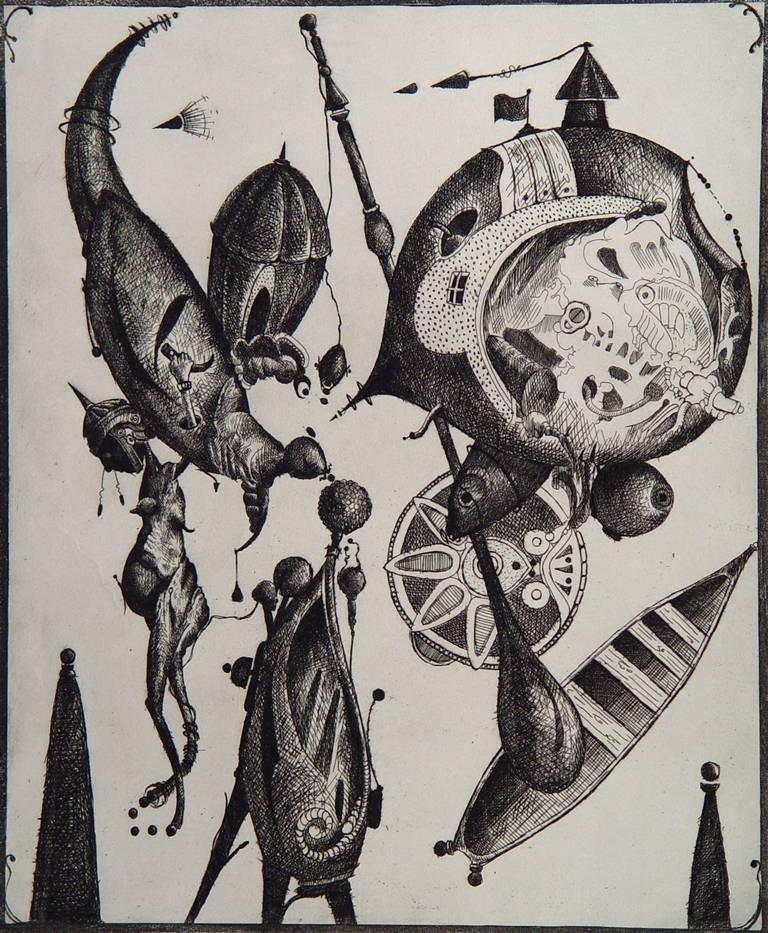
Journey
By Valton Tyler
Located in Dallas, TX
In The New York Times Arts in America column, Edward M. Gomez wrote of Valton Tyler, "visionary seems the right word for describing his vivid, unusual and technically refined paintin...
Category
1960s Surrealist Figurative Prints
Materials
Rag Paper, Etching
Price Upon Request
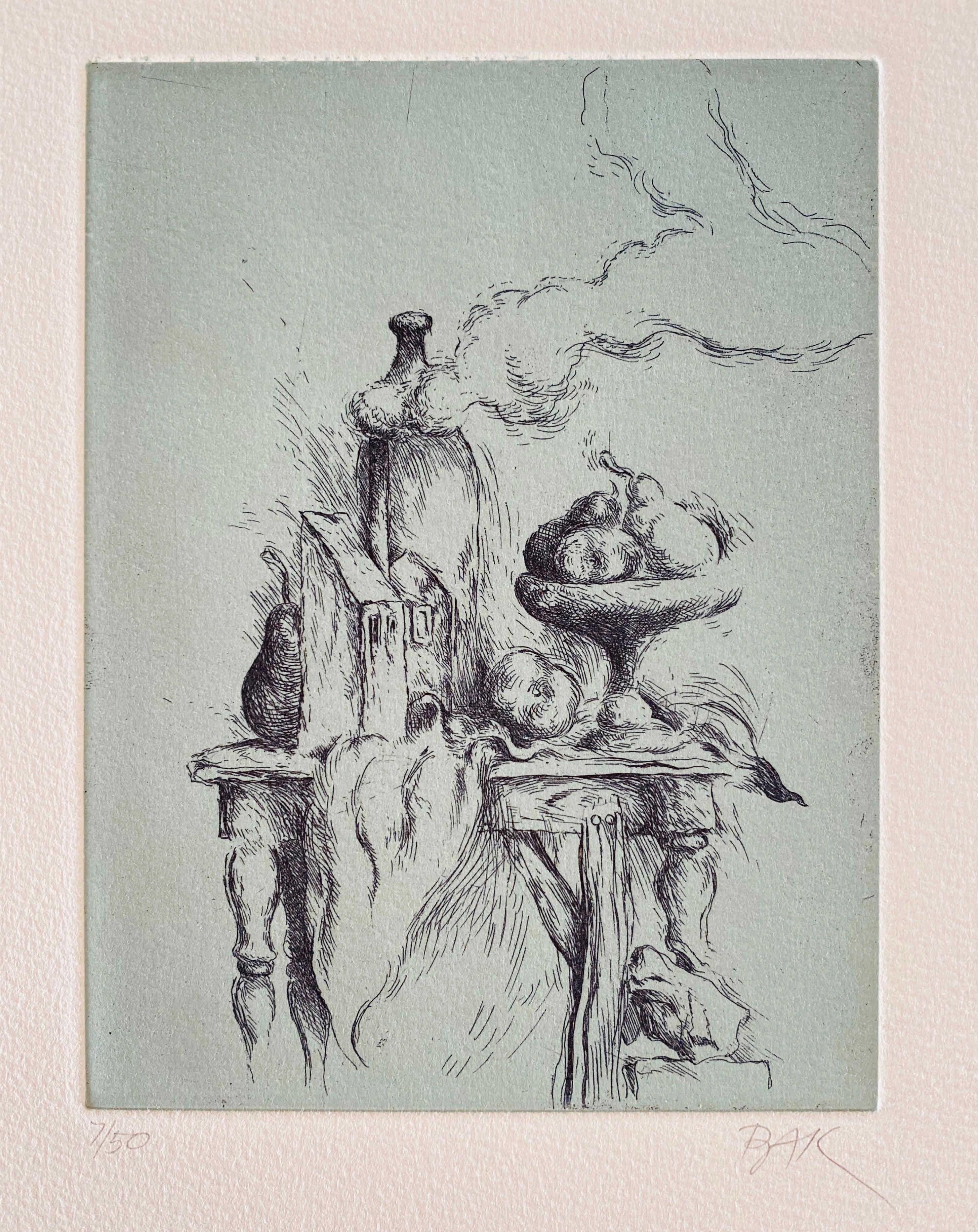
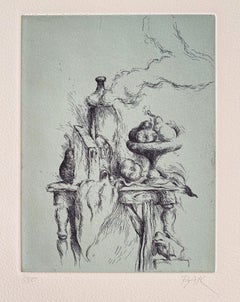
Samuel Bak Surrealist Etching Israeli Bezalel Artist "Hidden Pear", Fruit Bowl
By Samuel Bak
Located in Surfside, FL
HIDDEN PEAR, color etching, signed in pencil, numbered 7/50, Jerusalem Print workshop blind stamp, image 7 ½ x 5 ½”, sheet 15 x 10 ¼”.
Samuel Bak (born 12 August 1933) is a Polish- American painter and writer who survived the Holocaust and immigrated to Israel in 1948. Since 1993, he has lived in the United States.
Samuel Bak was born in Wilno, Poland, Bak was recognized from an early age as having an artistic talent. He describes his family as secular, but proud of their Jewish identity.
By 1939 when Bak was six years old, the war began and Wilno was transferred from Poland to Lithuania. When Wilno was occupied by the Germans on June 24, 1941, Bak and his family were forced to move into the ghetto. At the age of nine, he held his first exhibition inside the Ghetto. Bak and his mother sought refuge in a Benedictine convent where a Catholic nun named Maria Mikulska tried to help them. After returning to the ghetto, they were deported to a forced labour camp, but took shelter again in the convent where they remained in hiding until the end of the war.
By the end of the war, Samuel and his mother were the only members of his extensive family to survive. His father, Jonas, was shot by the Germans in July 1944, only a few days before Samuel's own liberation. As Bak described the situation, "when in 1944 the Soviets liberated us, we were two among two hundred of Vilna's survivors--from a community that had counted 70 or 80 thousand." Bak and his mother as pre-war Polish citizens were allowed to leave Soviet-occupied Wilno and travel to central Poland, at first settling briefly in Lodz. They soon left Poland and traveled into the American occupied zone of Germany. From 1945 to 1948, he and his mother lived in Displaced Persons camps in Germany. He spent most of this period at the Landsberg am Lech DP camp in Germany. It was there he painted a self-portrait shortly before repudiating his Bar Mitzvah ceremony. Bak also studied painting in Munich during this period, and painted "A Mother and Son", 1947, which evokes some of his dark memories of the Holocaust and escape from Soviet-occupied Poland. In 1948, Bak and his mother immigrated to Israel. In 1952, he studied art at the Bezalel Academy of Arts and Design in Jerusalem. After serving in the Israel Defense Forces, he continued his studies in Paris (from 1956 at the École nationale supérieure des Beaux-Arts) and spent various periods of time in Rome, Paris, Switzerland and Israel before settling permanently in the United States. In 2001, Bak returned to Vilnius for the first time and has since visited his hometown several times. Samuel Bak is a conceptual artist with elements of post-modernism as he employs different styles and visual vernaculars, i.e. surrealism (Salvador Dali, Rene Magritte), analytical cubism (Picasso), pop art (Andy Warhol, Roy Lichtenstein) and quotations from the old masters. The artist never paints direct scenes of mass death. Instead, he employs allegory, metaphor and certain artistic devices such as substitution: toys instead of the murdered children who played with them, books, instead of the people who read them. Further devices are quotations of iconographical prototypes, i.e. Michelangelo's "Creation of Adam" on the Sistine Ceiling or Albrecht Dürer's famous engraving entitled "Melencholia" . In the late 1980s Bak opened up about his paintings, stating they convey “a sense of a world that was shattered.” He turns these prototypes into ironical statements. Irony in the art of Samuel Bak does not mean parody or derision, but rather disenchantment, and the attempt to achieve distance from pain. Recurring symbols are: the Warsaw Ghetto Child, Crematorium Chimneys or vast backgrounds of Renaissance landscape that symbolize the indifference of the outside world. These form a disturbing contrast with the broken and damaged images in the foreground. Samuel Bak's paintings cause discomfort, they are a warning against complacency, a bulwark against collective amnesia with reference to all acts of barbarism, worldwide and throughout the ages, through his personal experience of genocide.
In Bak's piece entitled Trains Bak creates a vast grey landscape with large mounts creating the structure of a train. Massive taper candles burn in the distance further down the train tracks, surrounding an eruption. The smoke from the candles and volcano pour into a sky of dark ominous clouds that lurk over the landscape. Here Bak has created a whole new meaning for “trains.” Many of Bak’s pieces incorporate aspects of Jewish culture and the holocaust with a dark and creative twist, such as Shema Israel...
Category
20th Century Surrealist Figurative Prints
Materials
Etching
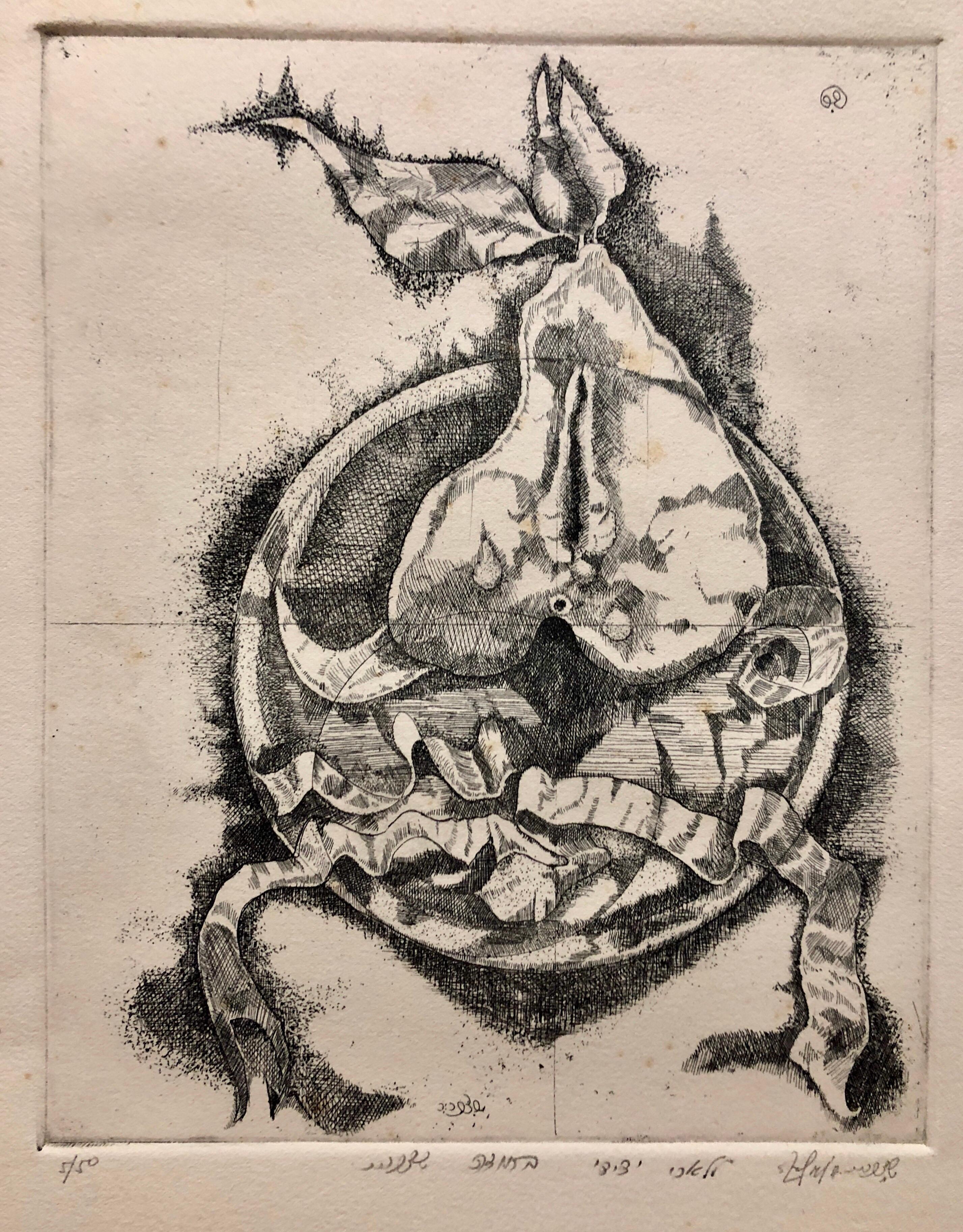
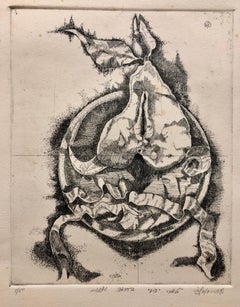
Israeli Modernist Surrealist Etching Cut Pear
By Shlomo Zafrir
Located in Surfside, FL
20.75x14.5 sheet size. 9.5x7.75 image size
Shlomo Zafrir is active/lives in Israel, France. Shlomo Zafrir is known for cubist painting.
Shlomo Zafrir is a painter and, at the same t...
Category
20th Century Surrealist Still-life Prints
Materials
Etching
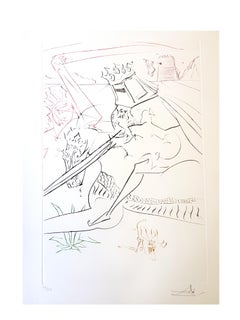
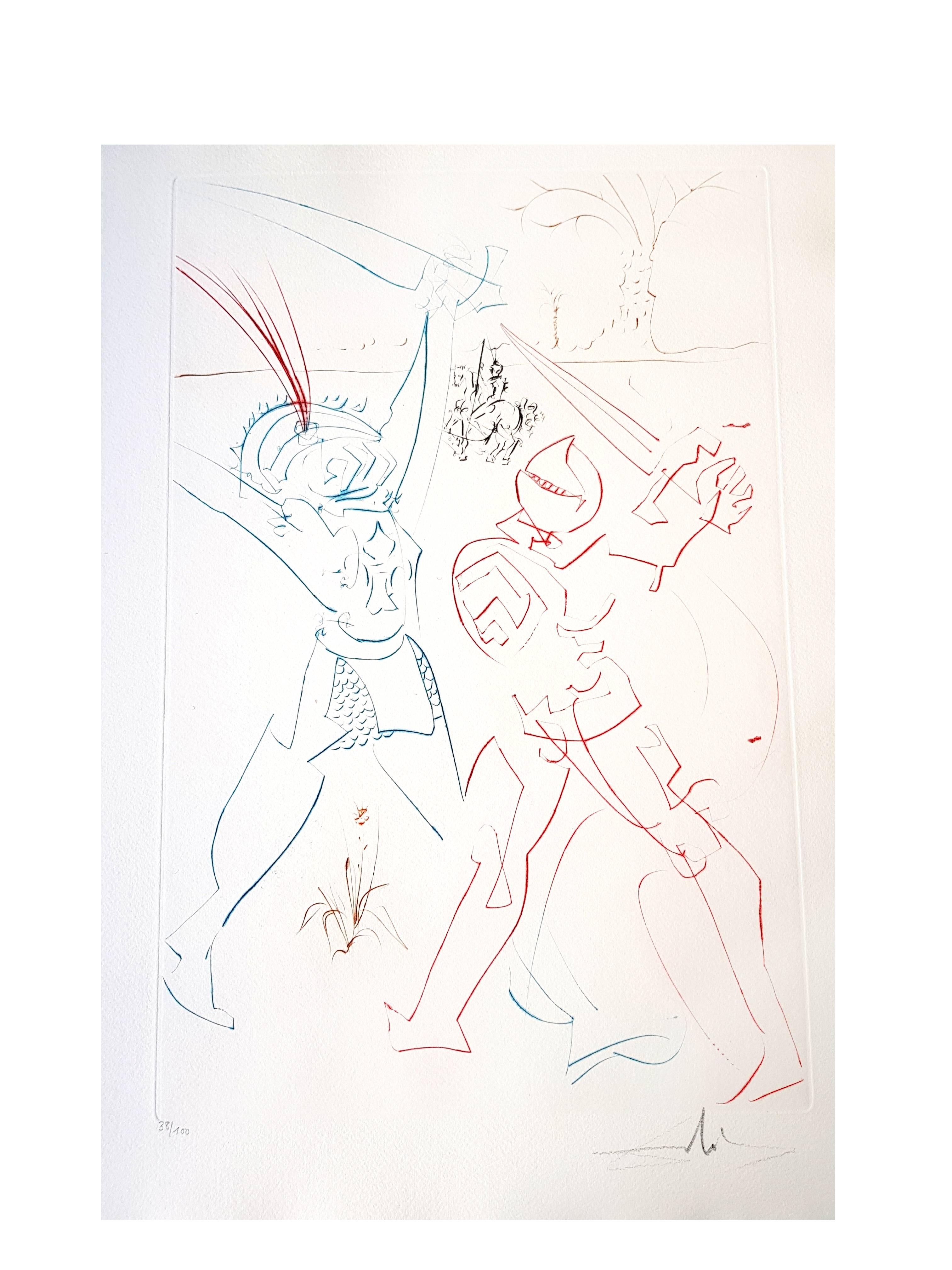
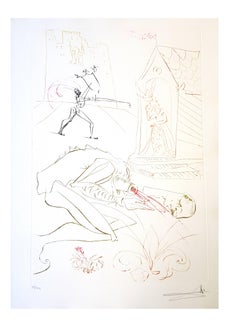
Salvador Dali - Fight Before la Dame - Original Handsigned Etching
By Salvador Dalí
Located in Collonge Bellerive, Geneve, CH
Salvador Dali - Original Handsigned Etching
From La Quête du Graal
Dimensions: 45 x 33 cm
Handsigned
Edition: 38/100
(from the rare deluxe suite aside from the standard edition)
Cat...
Category
1970s Surrealist Figurative Prints
Materials
Etching
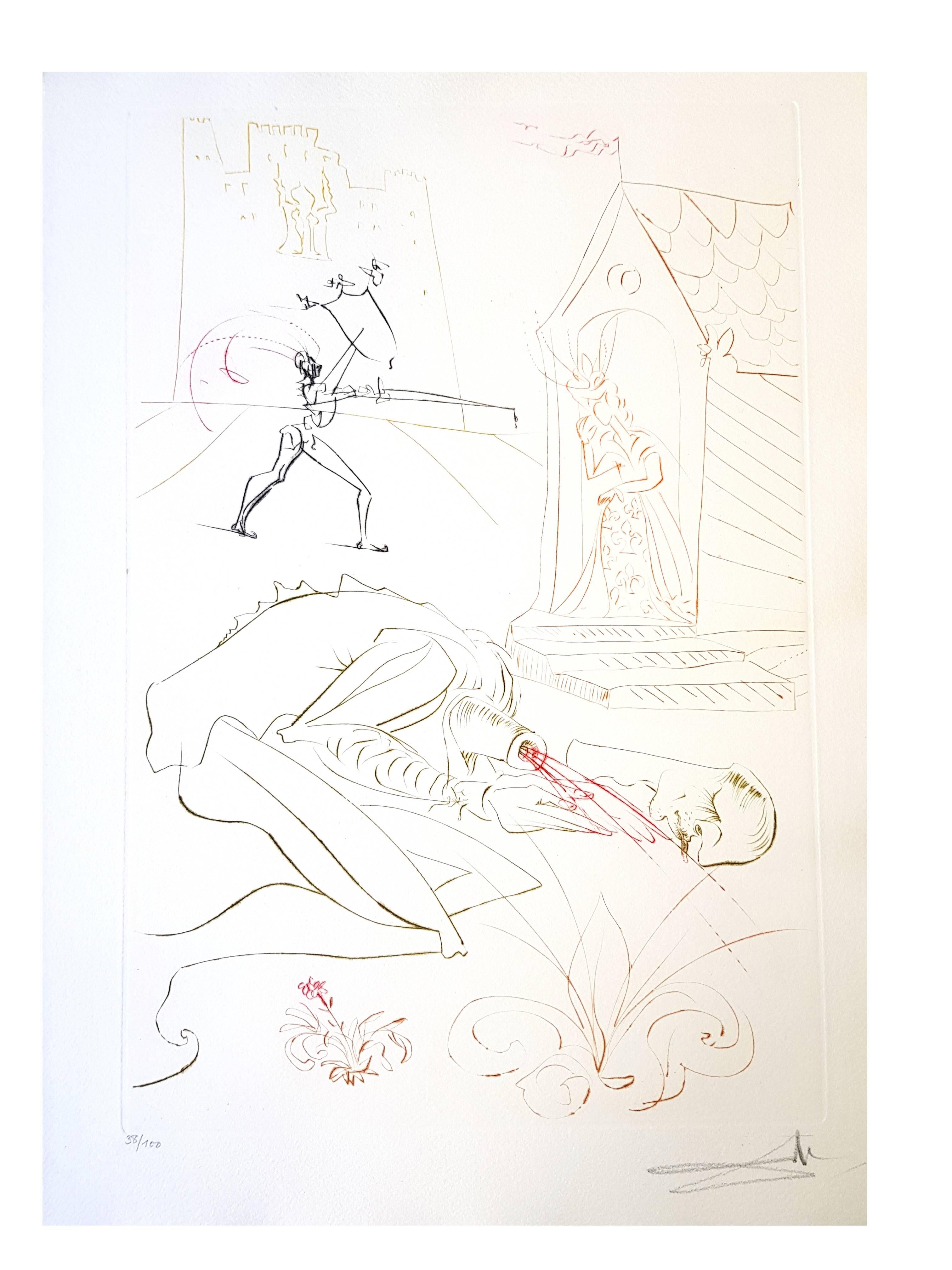
Salvador Dali - The Fall of Lancelot - Original Handsigned Etching
By Salvador Dalí
Located in Collonge Bellerive, Geneve, CH
Salvador Dali - Original Handsigned Etching
From La Quête du Graal
Dimensions: 45 x 33 cm
Handsigned
Edition: 38/100
(from the rare Suite)
Catalogue raisonné: Michler-Löpsinger 778-...
Category
1970s Surrealist Figurative Prints
Materials
Etching

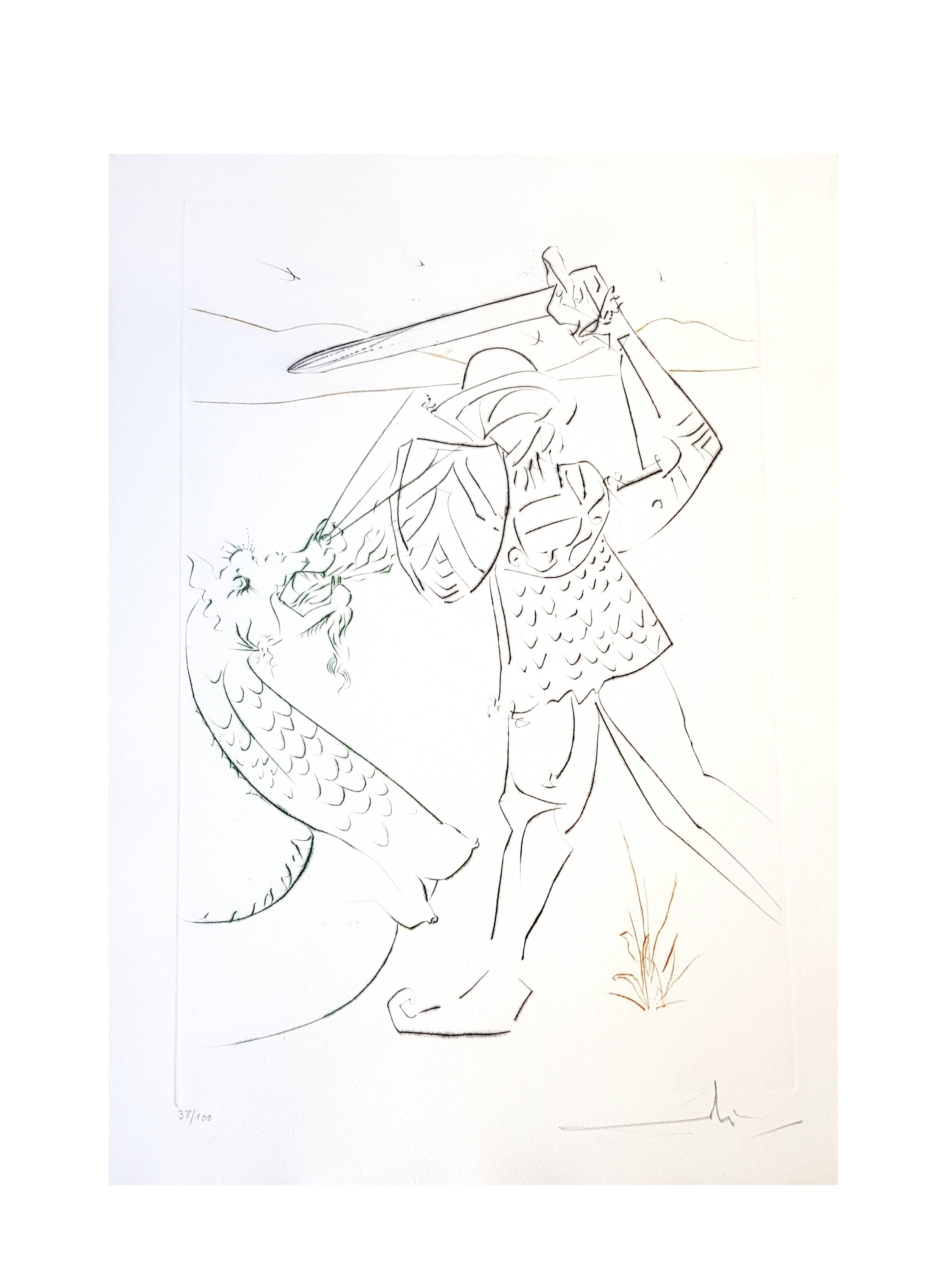
Salvador Dali - The Black Knight - Original Handsigned Etching
By Salvador Dalí
Located in Collonge Bellerive, Geneve, CH
Salvador Dali - Original Handsigned Etching
From La Quête du Graal
Dimensions: 45 x 33 cm
Handsigned
Edition: 38/100
From the rare additional suite of 100 aside from the edition of ...
Category
1970s Surrealist Figurative Prints
Materials
Etching