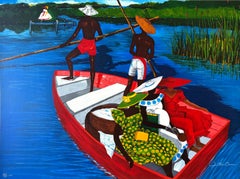
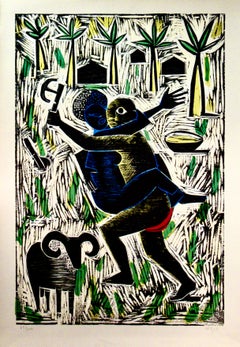
"Lendas Africanas Da Bahia" from the suite.
This artwork titled " Lendas Africanas Da Bahia" from the suite, 1978, is an original colors woodcut by renown Brazilian/Argentinian artist Hector Julio Paride Barnabo Carybe, 1911-1997. It is hand signed and numbered 83/200 in pencil by the artist. The Wood block mark (image) is 23.65 x 15.75 inches, sheet size is 26.75 x 19 inches. It is in excellent condition, has never been framed. It will be shipped in a 8 inches diameter heavy duty tube.
About the artist:
Héctor Julio Páride Bernabó (7 February 1911 – 2 October 1997) was an Argentine-Brazilian artist, researcher, writer, historian and journalist. His nickname and artistic name, Carybé, a type of piranha, comes from his time in the scouts. He died of heart failure after the meeting of a candomblé community's lay board of directors, the Cruz Santa Opô Afonjá Society, of which he was a member.
Quick Facts Born, Died ...
Carybé
Born
Héctor Julio Páride Bernabó
7 February 1911
Lanús, Argentina
Died
2 October 1997 (aged 86)
Salvador, Bahia, Brazil
Nationality
Brazilian
Known for
Painter, engraver, draughtsman, illustrator, potter, sculptor, mural painter, researcher, historian and journalist
Close
He produced thousands of works, including paintings, drawings, sculptures and sketches. He was an Obá de Xangô, an honorary position at Ilê Axé Opô Afonjá.
Orixá Panels in the Afro-Brazilian Museum in Salvador
Some of Carybé's work can be found in the Afro-Brazilian Museum in Salvador: 27 cedar panels representing different orixás or divinities of the Afro-Brazilian religion candomblé. Each panel shows a divinity with their associated implements and animal. The work was commissioned by the former Banco da Bahia S.A., now Banco BBM S.A., which originally installed them in its branch on Avenida Sete de Setembro in 1968.
Murals at Miami International Airport
American Airlines, Odebrecht and the Miami-Dade Aviation Department partnered to install two of Carybé's murals at Miami International Airport. They have been displayed in the American Airlines terminal at John F. Kennedy International Airport in New York since 1960. The 16.5 x 53-foot murals were accredited when Carybé won the first and the second prize in a contest of public art pieces for JFK airport.
As its terminal at that airport was due for demolition, American Airlines donated the murals to Miami-Dade County, and Odebrecht invested in a project to remove, restore, transport and install the murals at Miami International Airport.
The mural "Rejoicing and Festival of the Americas" portrays colorful scenes from popular festivals throughout the Americas, and "Discovery and Settlement of the West" depicts the pioneers’ journey into the American West.
Carybé's Woodcuts in Gabriel García Márquez's Books
Carybé illustrated four books by the Colombian writer Gabriel García Márquez, including One Hundred Years of Solitude, The Autumn of the Patriarch, Chronicle of a Death Foretold, and Love in the Time of Cholera "Carybé: um mestre da cultura baiana". ArqBahia Arquitetura, design, arte e lifestyle (in Brazilian Portuguese). 26 April 2023.. In particular, the woodcuts in One Hundred Years of Solitude are well-known for providing a visual image of the fictional town of Macondo, where the story takes place. The illustrations depict the colorful and winding houses, the railway bridge, and the hot and humid climate of the region, contributing to the reader's immersion in the story.
Carybé's woodcuts are, therefore, an important part of Gabriel García Márquez's literary legacy, bringing a visual dimension to his stories that further enriches the reader's experience.
Timeline
1911 — Birth in Lanús, Argentina.
1919 — Moved to Brazil.
1921 — The name Carybé is first given to him by the Clube do Flamengo scouts group, in Rio de Janeiro.
1925 — Beginning of his artistic endeavours, going to the pottery workshop of his elder brother, Arnaldo Bernabó, in Rio de Janeiro.
1927–1929 — Studies at the National School of Fine Arts, in Rio de Janeiro.
1930 — Worked for the newspaper Noticias Gráficas, in Buenos Aires, Argentina.
1935–1936 — Works with the writer Julio Cortázar and as a draughtsman for the El Diario newspaper.
1938 — Sent to Salvador by newspaper Prégon.
1939 — First collective exhibition, with the artist Clemente Moreau, at the Buenos Aires City Museum of Fine Arts, Argentina; illustrates the book Macumba, Relatos de la Tierra Verde, by Bernardo Kardon, published by Tiempo Nuestro.
1940 — Illustrates the book Macunaíma, by Mário de Andrade.
1941 — Draws the Esso Almanach, the payment for which allows him to set on a long journey through Uruguay, Brazil, Bolivia, and Argentina.
1941–1942 — Study trip around several South American countries.
1942 — Illustration for the book La Carreta by Henrique Amorim, published by El Ateneo (Buenos Aires, Argentina).
1943 — Together with Raul Brié, translates the book Macunaíma, by Mário de Andrade, into Spanish; produces the illustrations for the works Maracatu, Motivos Típicos y Carnavalescos, by Newton Freitas, published by Pigmaleon, Luna Muerta, by Manoel Castilla, published by Schapire, and Amores de Juventud, by Casanova Callabero; also publishes and illustrates Me voy al Norte, for the quarterly magazine Libertad Creadora; awarded First Prize by the Cámara Argentina del Libro (Argentine Book Council) for the illustration of the book Juvenília, by Miguel Cané (Buenos Aires, Argentina).
1944 — Illustrates the books The Complete Poetry of Walt Whitmann and A Cabana do Pai Tomás, both published by Schapire ; as well as and Los Quatro Gigantes del Alma by Mira y Lopez, Salvador BA; attends capoeira classes, visits candomblé meetings and makes drawings and paintings.
1945 — Does the illustrations for Daniel Defoe's Robinson Crusoe, for the Viau publishing house.
1946 — Helps in setting up the Tribuna da Imprensa newspaper, in Rio de Janeiro.
1947 — Works for the O Diário Carioca newspaper, in Rio de Janeiro.
1948 — Produces texts and illustrations for the book Ajtuss, Ediciones Botella al Mar (Buenos Aires, Argentina).
1949–1950 — Invited by Carlos Lacerda to work at the Tribuna da Imprensa, in Rio de Janeiro.
1950 — Invited by the Education Secretary Anísio Teixeira, moves to Bahia, and produces two panels for the Carneiro Ribeiro Education Center (Park School), in Salvador, Bahia.
1950–1997 — Settles in Salvador, Bahia.
1950–1960 — Actively participate in the plastic arts renewal movement, alongside Mário Cravo Júnior, Genaro de Carvalho, and Jenner Augusto.
1951 — Produces texts and illustrations for the works of the Coleção Recôncavo, published by Tipografia Beneditina and illustrations for the book, Bahia, Imagens da Terra e do Povo, by Odorico Tavares, published by José Olímpio in Rio de Janeiro; for the latter work he receives the gold medal at the 1st Biennial of Books and Graphic Arts.
1952 — Makes roughly 1,600 drawings for the scenes of the movie O Cangaceiro, by Lima Barreto; also works as the art director and as an extra on the film (São Paulo, SP).
1953 — Illustrations for the book A Borboleta Amarela, by Rubem Braga, published by José Olímpio (Rio de Janeiro, RJ).
1955 — Illustrates the work O Torso da Baiana, edited by the Modern Art Museum of Bahia.
1957 — Produces etchings, with original designs, for the special edition of Mário de Andrade's Macunaíma, published by the Sociedade dos 100 Bibliófilos do Brasil.
1958 — Makes an oil painting mural for the Petrobras Office in New York, USA; illustrates the book As Três Mulheres de Xangô, by Zora Seljan, published by Editora G. R. D. (Rio de Janeiro, RJ); Receives a scholarship grant in New York, USA.
1959 — Takes part in the competition for the New York International Airport panels project, in New York, USA, winning first and second prizes.
1961 — Illustrates the book Jubiabá, by Jorge Amado, published by Martins Fontes (São Paulo, SP).
1963 — Awarded the title of Honorary Citizen of Salvador, Bahia.
1965 — Illustrates A Muito Leal e Heróica Cidade de São Sebastião do Rio de Janeiro, published by Raymundo Castro Maya (Rio de Janeiro, RJ).
1966 — With Jorge Amado, co-authors Bahia, Boa Terra Bahia, published by Image (Rio de Janeiro, RJ); writes and illustrates the book Olha o Boi, published by Cultrix (São Paulo, SP).
1967 — Receives the Odorico Tavares Prize – Best Plastic Artist of 1967, in a competition ran by the state government to stimulate the development of plastic arts in Bahia; makes the Orixás Panels for the Banco da Bahia (currently at the UFBA Afro-Brazilian Museum) (Salvador, BA).
1968 — Illustrates the books Carta de Pero Vaz de Caminha ao Rei Dom Manuel, published by Sabiá (Rio de Janeiro) and Capoeira Angolana, by Waldeloir Rego, published by Itapoã (Bahia).
1969 — Produces the illustrations for the book Ninguém Escreve ao Coronel, by Gabriel Garcia Marquez, published by Sabiá (Rio de Janeiro, RJ).
1970 — Illustrates the books O Enterro do Diabo and Os Funerais de Mamãe Grande, published by Sabiá (Rio de Janeiro, RJ), Agotimé her Legend, by Judith Gleason, published by Grossman Publishers (New York, USA).
1971 — Illustrates the books One Hundred Years of Solitude, by Gabriel Garcia Marquez and A Casa Verde by Mario Vargas Llosa, both published by Sabiá (Rio de Janeiro, RJ); produces texts and illustrations for the book Candomblé da Bahia, published by Brunner (São Paulo, SP).
1973 — Illustrations for Gabriel Garcia Marquez's A Incrível e Triste História de Cândida Erendira e sua Avó Desalmada (Rio de Janeiro, RJ); paints the mural for the Legislative Assembly and the panel for the Bahia State Secretary of the Treasury.
1974 — Produces woodcuts for the book Visitações da Bahia, published by Onile.
1976 — Illustrates the book O Gato Malhado e a Andorinha Sinhá: uma história de amor, by Jorge Amado (Salvador, BA); receives the title of Knight of the Order of Merit of Bahia.
1977 — Certified with the Honor for Afro-Brazilian Cult Spiritual Merit, Xangô das Pedrinhas ao Obá de Xangô Carybé (Magé, RJ).
1978 — Makes the concrete sculpture Oxóssi, in the Catacumba Park; illustrates the book A Morte e a Morte de Quincas Berro D´Água, by Jorge Amado, published by Edições Alumbramento (Rio de Janeiro, RJ).
1979 — Produces woodcuts for the book Sete Lendas Africanas da Bahia, published by Onile.
1980 — Designs the costumes and scenery for the ballet Quincas Berro D´Água, at the Teatro Municipal in Rio de Janeiro.
1981 — Publication of the book Iconografia dos Deuses Africanos no Candomblé da Bahia (Ed. Raízes), following thirty years of research.
1982 — Receives the title of Honorary Doctor of the Federal University of Bahia.
1983 — Makes the panel for the Brazilian Embassy in Lagos, Nigeria.
1984 — Receives the Jerônimo Monteiro Commendation – Level of Knight (Espírito Santo); receives the Castro Alves Medal of Merit, granted by the UFBA Academy of Arts and Letters; makes the bronze sculpture Homenagem à mulher baiana (Homage to the Bahian woman), at the Iguatemi Shopping Center (Salvador, BA).
1985 — Designs the costumes and sets for the spectacle La Bohème, at the Castro Alves Theater; illustrates the book Lendas Africanas dos Orixás, by Pierre Verger, published by Currupio.
1992 — Illustrates the book O sumiço da santa: uma história de feitiçaria, by Jorge Amado (Rio de Janeiro, RJ).
1995 — Illustration of the book O uso das plantas na sociedade iorubá, by Pierre Verger (São Paulo, SP).
1996 — Making of the short film Capeta Carybé, by Agnaldo Siri Azevedo, adapted from the book O Capeta Carybé, by Jorge Amado, about the artist Carybé, who was born in Argentina and became the most Bahian of all Brazilians.
1997 — Illustration of the book Poesias de Castro Alves.
Exhibitions
ммIndividual Exhibitions:
1943 — Buenos Aires (Argentina) — First individual exhibition, at the Nordiska Gallery
1944 — Salta (Argentina) — at the Consejo General de Educacion
1945 — Salta (Argentina) — Amigos del Arte, Buenos Aires (Argentina) — Motivos de América, at the Amauta Gallery, Rio de Janeiro RJ — individual exhibition at the IAB/RJ
1947 — Salta (Argentina) — Agrupación Cultural Femenina
1950 — Salvador BA — First individual exhibit in Bahia, at the Bar Anjo Azul; São Paulo SP — MASP.
1952 — São Paulo SP — MAM/SP
1954 — Salvador BA — Oxumaré Gallery
1957 — New York (USA) — Bodley Gallery; Buenos Aires (Argentina) — Bonino Gallery * 1958 - New York (USA) — Bodley Gallery
1962 — Salvador BA - MAM/BA
1963 — Rio de Janeiro RJ — Bonino Gallery
1965 — Rio de Janeiro RJ — Bonino Gallery
1966 — São Paulo SP — Astrea Gallery
1967 — Rio de Janeiro RJ — Santa Rosa Gallery
1969 — London (England) — Varig Airlines
1970 — Rio de Janeiro RJ — Galeria da Praça
1971 — Rio de Janeiro RJ — MAM/RJ, São Paulo SP — A Galeria; Belo Horizonte MG, Brasília DF, Curitiba PR, Florianopolis SC, Porto Alegre RS, Rio de Janeiro RJ and São Paulo SP — The Orixás Panel (exhibition tour), at the Casa da Cultura in Belo Horizonte, MAM/DF, the Public Library of Paraná, the Legislative Assembly of Santa Catarina State, the Legislative Assembly of Rio Grande do Sul, MAM/RJ and MAM/SP
1972 — The Orixás Panel in Fortaleza CE — at the Ceará Federal University Art Museum, and in Recife PE — at the Santa Isabel Theater
1973 — São Paulo SP — A Galeria
1976 — Salvador BA — at the Church of the Nossa Senhora do Carmo Convent
1980 — São Paulo SP — A Galeria
1981 — Lisbon (Portugal) — Cassino Estoril
1982 — São Paulo SP — Renot Art Gallery, São Paulo SP — A Galeria
1983 — New York (USA) — Iconografia dos Deuses Africanos no Candomblé da Bahia, The Caribbean Cultural Center
1984 — Philadelphia (USA) — Art Institute of Philadelphia; Mexico — Museo Nacional de Las Culturas; São Paulo SP — Galeria de Arte André
1986 — Lisbon (Portugal) — Cassino Estoril; Salvador BA — As Artes de Carybé, Núcleo de Artes Desenbanco
1989 — Lisbon (Portugal) — Cassino Estoril; São Paulo SP — MASP
1995 — São Paulo SP — Documenta Galeria de Arte, São Paulo SP — Casa das Artes Galeria, Campinas SP — Galeria Croqui, Curitiba PR — Galeria de Arte Fraletti e Rubbo, Belo Horizonte MG — Nuance Galeria de Arte, Foz do Iguaçu PR — Ita Galeria de Arte, Porto Alegre RS — Bublitz Decaedro Galeria de Artes, Cuiabá MT — Só Vi Arte Galeria, Goiânia GO — Época Galeria de Arte, São Paulo SP — Artebela Galeria Arte Molduras, Fortaleza CE — Galeria Casa D'Arte, Salvador BA — Oxum Casa de Arte
Collective Exhibitions:
1939 — Buenos Aires (Argentina) — Carybé and Clemente Moreau Exhibition, at the Museo Municipal de Belas Artes
1943 — Buenos Aires (Argentina) — 29th Salon de Acuarelistas y Grabadores — first prize
1946 — Buenos Aires (Argentina) — Drawings by Argentine Artists, at the Kraft Gallery
1948 — Washington (USA) — Artists of Argentina, at the Pan American Union Gallery
1949 — Buenos Aires (Argentina) — Carybé and Gertrudis Chale, at the Viau Gallery; Salvador BA — Bahian Showroom of Fine Arts, at the Hotel Bahia
1950 — Salvador BA — 2nd Bahian Showroom of Fine Arts; São Paulo SP — MAM/SP
1951 — São Paulo SP — 1st São Paulo Art Biennial, Trianon Pavilion.
1952 — Salvador BA — 3rd Bahian Showroom of Fine Arts, at Belvedere da Sé; São Paulo SP — MAM/SP
1953 — Recife PE — Mario Cravo Júnior and Carybé, at the Santa Isabel Theater; São Paulo SP — 2nd São Paulo Art Biennial, at MAM/SP
1954 — Salvador BA — 4th Bahian Showroom of Fine Arts, at the Hotel Bahia. — Bronze medal
1955 — São Paulo SP — 3rd São Paulo Art Biennial, at MAM/SP — first prize for drawing
1956 — Salvador BA — Modern Artists of Bahia, at the Oxumaré Gallery; Venice (Italy) — 28th Venice Biennial
1957 — Rio de Janeiro RJ — 6th National Modern Art Show — exemption from the jury; São Paulo SP — Artists from Bahia, at the MAM/SP
1958 — San Francisco (USA) — Works by Brazilian Artists, at the Fine Arts Museums of San Francisco, Washington and New York (USA) — Works by Brazilian Artists, at the Pan American Union and the MoMA
1959 — Seattle (USA) — 30th International Exhibition, at the Seattle Art Museum; Salvador BA — Modern Artists of Bahia, at the Dentistry School.
1961 — São Paulo SP — 6th São Paulo Art Biennial, at MAM/SP — special room
1963 — Lagos (Nigeria) — Brazilian Contemporary Artists, at the Nigerian Museum; São Paulo SP — 7th São Paulo Art Biennial Bienal, at the Fundação Bienal
1964 — Salvador BA — Christmas Exhibition, at the Galeria Querino
1966 — Baghdad (Iraq) — collective exhibition sponsored by the Calouste Gulbenkian Foundation; Madrid (Spain) — Artists of Bahia, at the Hispanic Culture Institute; Rome (Italy) — Piero Cartona Palace; Salvador BA — 1st National Biennial of Plastic Arts (Bienal da Bahia) — special room; Salvador BA — Draughtsmen of Bahia, at the Convivium Gallery
1967 — Salvador BA — Christmas Exhibition at the Panorama Art Gallery; São Paulo SP — Artists of Bahia, at the A Gallery
1968 — São Paulo SP — Bahian Artists, at the A Gallery
1969 — London (England) — Tryon Gallery; São Paulo SP — 1st Panorama of Current Brazilian Art at the MAM/SP; São Paulo SP — Carybé,
Carlos Bastos...