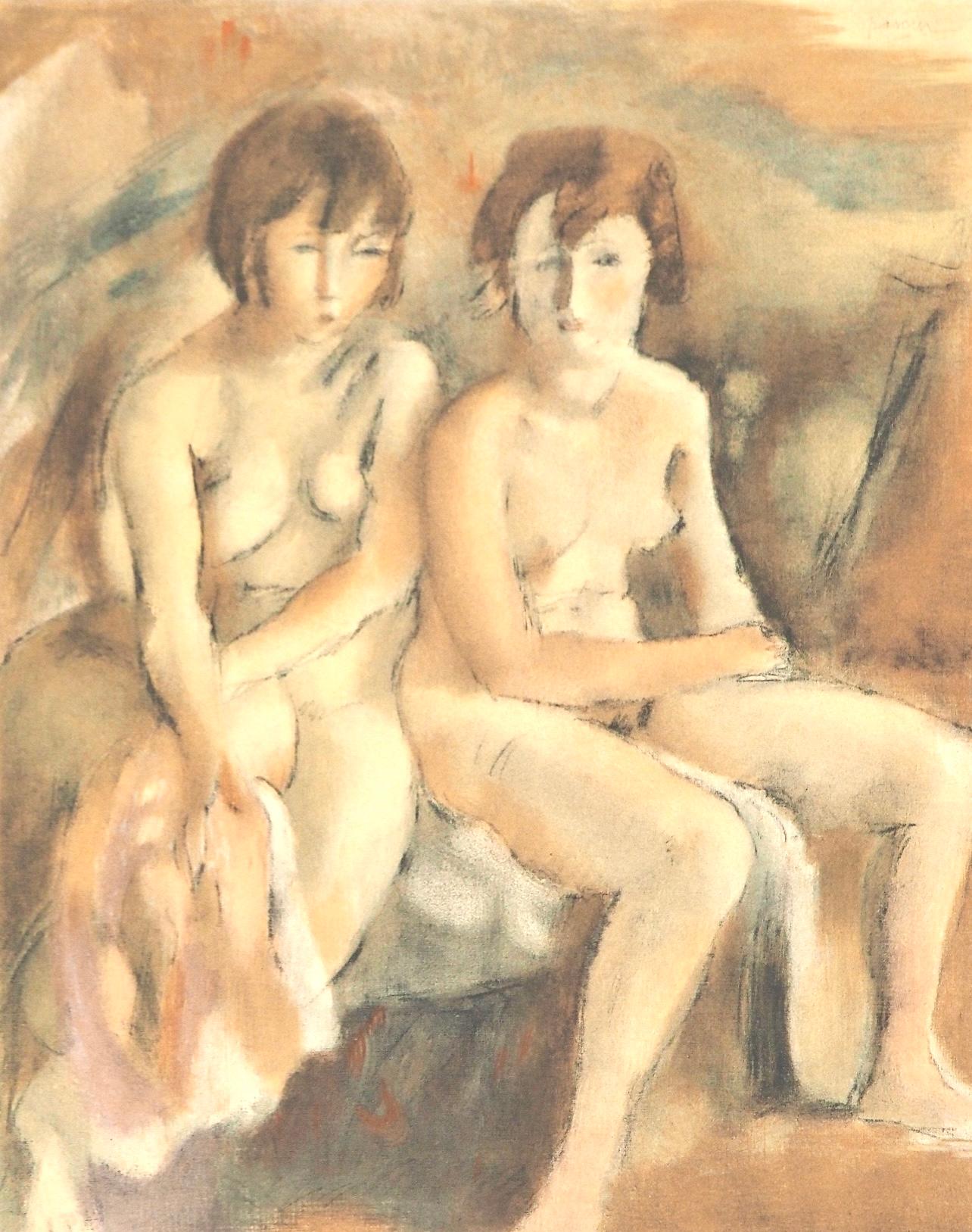
Items Similar to Jules Pascin, Two Young Women, from The Painters My Friends, 1965 (after)
Want more images or videos?
Request additional images or videos from the seller
1 of 10
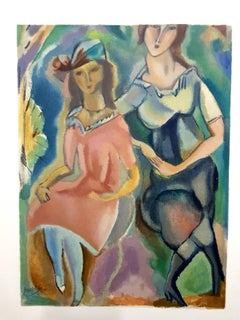
Jules Pascin, Two Young Women, from The Painters My Friends, 1965 (after)1965
1965
$1,196
$1,49520% Off
£916.89
£1,146.1120% Off
€1,049.18
€1,311.4720% Off
CA$1,690.22
CA$2,112.7720% Off
A$1,837.20
A$2,296.5020% Off
CHF 983.48
CHF 1,229.3520% Off
MX$22,207.48
MX$27,759.3520% Off
NOK 12,393.80
NOK 15,492.2420% Off
SEK 11,430.30
SEK 14,287.8720% Off
DKK 7,835.66
DKK 9,794.5820% Off
About the Item
This exquisite woodcut after Jules Pascin (1885–1930), titled Deux jeunes femmes (Two Young Women), from the folio Les Peintres mes amis (The Painters My Friends), originates from the 1965 edition published by Editions d'art Les Heures Claires, Paris, and printed by Atelier Raymond Jacquet, Paris, May 20, 1965. Deux jeunes femmes (Two Young Women) captures Pascin’s lyrical sensitivity and refined draftsmanship, translating his delicate, intimate vision into the tactile language of woodcut. The composition radiates grace and quiet sensuality, revealing Pascin’s profound empathy for the human form and spirit.
Executed as a woodcut on grand velin d'Arches paper, this work measures 15 x 11 inches. Signed in the plate and unnumbered as issued. The edition exemplifies the exceptional standards of Editions d'art Les Heures Claires, Paris, and the master craftsmanship of Atelier Raymond Jacquet, Paris.
Artwork Details:
Artist: After Jules Pascin (1885–1930)
Title: Deux jeunes femmes (Two Young Women), from the folio Les Peintres mes amis (The Painters My Friends), 1965
Medium: Woodcut on grand velin d'Arches paper
Dimensions: 15 x 11 inches (38.1 x 27.94 cm)
Inscription: Signed in the plate and unnumbered as issued
Date: 1965
Publisher: Editions d'art Les Heures Claires, Paris
Printer: Atelier Raymond Jacquet, Paris
Catalogue raisonne reference: Monod, Luc. Manuel de l’amateur de livres illustrés modernes, 1875–1975. Ides et Calendes, 1992, illustration 11485.
Condition: Well preserved, consistent with age and medium
Provenance: From the folio Les Peintres mes amis (The Painters My Friends), published by Editions d'art Les Heures Claires, Paris; printed by Atelier Raymond Jacquet, Paris, May 20, 1965
Notes:
Excerpted from the folio (translated from the folio), The lithographs by Derain and Van Dongen were printed by Lucien Detruit. Those by Dufy, Matisse, Chagall, Dunoyer de Segonzac, Cavailles, Terechkovitch, and Carzou were printed by Mourlot Freres. Those by Picasso and Buffet were printed by P.-J. Ballon. The lithograph by Miro was printed in the workshop Arte, which also printed, in phototype, the frontispiece. The etchings by Villon and Zadkine were printed by Manuel Robbe. That by Braque was printed by A. and P. Crommelynck. The wood engravings and printing of the illustrations by Vlaminck, Rouault, Pascin, and Utrillo were done by Raymond Jacquet. The texts by Andre Warnod, collected by his daughter Jeanine Warnod, were hand-set in De Roos type, size 24, and printed in Paris on the presses of Daragnes. Printing completed on May 20, 1965. Justification of the edition, III examples on large velin d'Arches containing the original copper plates inked for one intaglio illustration; a proof on silk of two lithographs; the four wood-engraved illustrations, mounted; a color separation of one lithograph; and a complete suite of the illustrations on Arches—numbered I to III. XVI examples on large velin d'Arches containing a proof on silk of two lithographs; the four wood-engraved illustrations, mounted; a color separation of one lithograph; and a complete suite of the illustrations on Arches—numbered IV to XIX. XXI examples on large velin d'Arches containing a proof on silk of two lithographs; the four wood-engraved illustrations, mounted; and a complete suite of the illustrations on Arches—numbered XX to XL. XL examples on large velin d'Arches containing a complete suite of the illustrations on Arches—numbered XLI to LXXX. CLXX examples on large velin d'Arches—numbered LXXXI to CCL.
About the Publication:
The folio Les Peintres mes amis (The Painters My Friends), published in Paris in 1965 by Editions d'art Les Heures Claires, stands among the most ambitious postwar French printmaking collaborations. Conceived as a celebration of modern art’s greatest masters, the volume unites original graphic works by Pascin, Vlaminck, Matisse, Picasso, Chagall, Braque, Villon, Derain, Zadkine, Miro, and others, alongside critical essays by Andre Warnod. Each plate was executed under the supervision of Paris’s foremost ateliers—Mourlot Freres, Lucien Detruit, P.-J. Ballon, Manuel Robbe, and Raymond Jacquet—representing the finest techniques of lithography, etching, and woodcut. This luxurious folio exemplifies the artistry and craftsmanship of mid-20th-century French printing, merging text, image, and handcraft into a unified artistic statement. A triumph of the livre d’artiste tradition, it remains a vital record of the enduring creative dialogue between the painters, printers, and publishers who defined the visual culture of their time.
About the Artist:
Jules Pascin (1885–1930) was a Bulgarian-born French painter and draftsman whose exquisite sensitivity, refined draftsmanship, and poetic vision made him one of the most evocative and influential figures of early modern art. Known as “the Prince of Montparnasse,” Pascin became a central figure of the Ecole de Paris and a defining presence in the bohemian world of early 20th-century Paris. Born Julius Mordecai Pincas in Vidin, Bulgaria, to a wealthy Sephardic Jewish family, he studied in Vienna and Munich before moving to Paris in 1905, where he quickly established himself among the leading modernists of his era, including Pablo Picasso, Amedeo Modigliani, Chaim Soutine, Georges Braque, and Marc Chagall. Deeply influenced by Edgar Degas, Henri de Toulouse-Lautrec, and Paul Cezanne, Pascin created paintings and drawings distinguished by their delicate lines, soft tonal harmonies, and psychological depth. His nudes, portraits, and scenes of Parisian cafe life radiate an atmosphere of quiet intimacy and emotional nuance, capturing the fragility and beauty of human existence. Unlike contemporaries such as Picasso, Joan Miro, Salvador Dali, Wassily Kandinsky, Marcel Duchamp, Alexander Calder, Alberto Giacometti, and Man Ray, who pushed toward abstraction and surrealism, Pascin remained devoted to figuration, exploring the subtleties of light, gesture, and emotion with unmatched tenderness. His works express sensuality without artifice, revealing the vulnerability and inner life of his subjects through line and color that seem to breathe with human feeling. His studio became a gathering place for artists and writers such as Ernest Hemingway, Henry Miller, and Anais Nin, who admired his introspection and his ability to translate psychological complexity into visual poetry. Though his life was marked by emotional turbulence and melancholy, his art radiated a timeless empathy that transcended style, influencing later artists including Balthus, Lucian Freud, Francis Bacon, Egon Schiele, and Eric Fischl, who drew inspiration from his fusion of sensuality, sensitivity, and psychological depth. Today, his works are held in major institutions including the Centre Pompidou, Musee d’Orsay, Tate Modern, and the Museum of Modern Art in New York, where they continue to resonate for their humanism and grace. Standing alongside Picasso, Calder, Giacometti, Dali, Miro, Kandinsky, Duchamp, and Man Ray, Jules Pascin helped define the emotional vocabulary of modern painting, and his legacy endures as one of the most intimate and humanist voices of his century. The highest auction record for Jules Pascin was achieved by Portrait de jeune fille en robe rouge sur fond bleu (1928), which sold for $2,950,500 USD at Sotheby’s, New York, on May 8, 2008, confirming his enduring reputation as one of the most refined, psychologically profound, and collectible artists of modern art history.
Jules Pascin Deux jeunes femmes (Two Young Women), Pascin Les Peintres mes amis (The Painters My Friends), Pascin Les Heures Claires, Pascin Raymond Jacquet, Pascin grand velin d'Arches, Pascin collectible print.
- Creation Year:1965
- Dimensions:Height: 15 in (38.1 cm)Width: 11 in (27.94 cm)
- Medium:
- Movement Style:
- After:Jules Pascin (1885-1930, Bulgarian, French)
- Period:
- Condition:
- Gallery Location:Southampton, NY
- Reference Number:1stDibs: LU1465215295702
About the Seller
4.9
Platinum Seller
Premium sellers with a 4.7+ rating and 24-hour response times
Established in 1978
1stDibs seller since 2021
1,238 sales on 1stDibs
Typical response time: <1 hour
- ShippingRetrieving quote...Shipping from: Southampton, NY
- Return Policy
More From This Seller
View AllJules Pascin, Two Nudes, from Pascin, 1954 (after)
By Jules Pascin
Located in Southampton, NY
This exquisite lithograph after Jules Pascin (1885–1930), titled Deux nus (Two Nudes), from the album Pascin, originates from the 1954 edition published by Editions du livre, Monte-Carlo, under the direction of Andre Sauret, Editeur, Monte-Carlo, and printed by Mourlot Freres, Paris, March 3, 1954. Deux nus captures Pascin’s delicate mastery of line and his profound sensitivity to the human form, embodying the poetic lyricism and emotional intimacy that define his work.
Executed as a lithograph on grand velin Renage paper, this work measures 12.25 x 9.5 inches. Signed in the plate and unnumbered as issued. The edition exemplifies the refined craftsmanship of Mourlot Freres, Paris, and the exceptional production standards of Editions du livre, Monte-Carlo.
Artwork Details:
Artist: After Jules Pascin (1885–1930)
Title: Deux nus (Two Nudes), from the album Pascin
Medium: Lithograph on grand velin Renage paper
Dimensions: 12.25 x 9.5 inches (31.1 x 24.1 cm)
Inscription: Signed in the plate and unnumbered as issued
Date: 1954
Publisher: Editions du livre, Monte-Carlo, under the direction of Andre Sauret, Editeur, Monte-Carlo
Printer: Mourlot Freres, Paris
Condition: Well preserved, consistent with age and medium
Provenance: From the album Pascin, published by Editions du livre, Monte-Carlo, 1954
Notes:
Excerpted from the album (translated from French), This album, published under the direction of Andre Sauret, was completed on March 3, 1954. The color plates were executed in the workshops of Mourlot Freres, lithographes, in Paris. Typography of L'Imprimerie Union. The original etchings attached to the C head examples were printed on Roger Lacouriere's presses. The total edition was drawn in MM examples, decomposing as follows: C examples numbered from I to C with III original etchings, MCM examples from CI to MM.
About the Publication:
Pascin, published in Monte-Carlo in 1954 under the direction of Andre Sauret and printed by Mourlot Freres, Paris, stands as one of the most refined tributes to the artist’s oeuvre within the distinguished postwar series of French art albums. The album combines impeccable lithographic craftsmanship with scholarly presentation, highlighting the poetic subtlety and expressive line central to Pascin’s artistic legacy. Printed on grand velin Renage paper, the publication exemplifies the collaboration between Sauret and Mourlot that defined a generation of fine art editions, uniting artists, printers, and publishers dedicated to preserving the vitality of modern art in print. The album reflects the technical mastery of Mourlot’s atelier—celebrated for its work with Picasso, Matisse, Chagall, Braque, and Léger—while reinforcing Editions du livre’s commitment to producing luxurious, museum-quality publications that captured the spirit and emotion of twentieth-century masters. As a fine art album, Pascin occupies a central place among mid-century European art editions, representing both a celebration of the artist’s humanistic vision and a testament to the collaborative artistry that sustained modern printmaking.
About the Artist:
Jules Pascin (1885–1930) was a Bulgarian-born French painter and draftsman whose exquisite sensitivity, refined draftsmanship, and poetic vision made him one of the most evocative and influential figures of early modern art. Known as “the Prince of Montparnasse,” Pascin became a central figure of the Ecole de Paris and a defining presence in the bohemian world of early 20th-century Paris. Born Julius Mordecai Pincas in Vidin, Bulgaria, to a wealthy Sephardic Jewish family, he studied in Vienna and Munich before moving to Paris in 1905, where he quickly established himself among the leading modernists of his era, including Pablo Picasso, Amedeo Modigliani, Chaim Soutine, Georges Braque, and Marc Chagall. Deeply influenced by Edgar Degas, Henri de Toulouse-Lautrec, and Paul Cezanne, Pascin created paintings and drawings distinguished by their delicate lines, soft tonal harmonies, and psychological depth. His nudes, portraits, and scenes of Parisian cafe life radiate an atmosphere of quiet intimacy and emotional nuance, capturing the fragility and beauty of human existence. Unlike contemporaries such as Picasso, Joan Miro, Salvador Dali, Wassily Kandinsky, Marcel Duchamp, Alexander Calder, Alberto Giacometti, and Man Ray, who pushed toward abstraction and surrealism, Pascin remained devoted to figuration, exploring the subtleties of light, gesture, and emotion with unmatched tenderness. His works express sensuality without artifice, revealing the vulnerability and inner life of his subjects through line and color that seem to breathe with human feeling. His studio became a gathering place for artists and writers such as Ernest Hemingway, Henry Miller, and Anais Nin, who admired his introspection and his ability to translate psychological complexity into visual poetry. Though his life was marked by emotional turbulence and melancholy, his art radiated a timeless empathy that transcended style, influencing later artists including Balthus, Lucian Freud, Francis Bacon, Egon Schiele, and Eric Fischl, who drew inspiration from his fusion of sensuality, sensitivity, and psychological depth. Today, his works are held in major institutions including the Centre Pompidou, Musee d’Orsay, Tate Modern, and the Museum of Modern Art in New York, where they continue to resonate for their humanism and grace. Standing alongside Picasso, Calder, Giacometti, Dali, Miro, Kandinsky, Duchamp, and Man Ray, Jules Pascin helped define the emotional vocabulary of modern painting, and his legacy endures as one of the most intimate and humanist voices of his century. The highest auction record for Jules Pascin was achieved by Portrait de jeune fille en robe rouge sur fond bleu (1928), which sold for $2,950,500 USD at Sotheby’s, New York, on May 8, 2008, confirming his enduring reputation as one of the most refined, psychologically profound, and collectible artists of modern art history.
Jules Pascin Deux nus Two Nudes Pascin Editions du livre Monte-Carlo 1954 lithograph...
Category
1950s Modern Figurative Prints
Materials
Lithograph
Jules Pascin, The Two Models, from Pascin, 1954 (after)
By Jules Pascin
Located in Southampton, NY
This exquisite lithograph after Jules Pascin (1885–1930), titled Les deux modeles (The Two Models), from the album Pascin, originates from the 1954 edition published by Editions du l...
Category
1950s Modern Figurative Prints
Materials
Lithograph
Jules Pascin, Ginette and Mireille, from Pascin, 1954 (after)
By Jules Pascin
Located in Southampton, NY
This exquisite lithograph after Jules Pascin (1885–1930), titled Ginette et Mireille (Ginette and Mireille), from the album Pascin, originates from the 1954 edition published by Edit...
Category
1950s Modern Figurative Prints
Materials
Lithograph
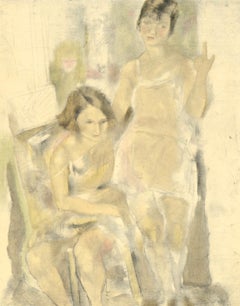
$716 Sale Price
20% Off
Free Shipping
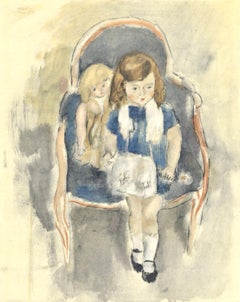
Jules Pascin, Jeanie Warnod, from Pascin, 1954 (after)
By Jules Pascin
Located in Southampton, NY
This exquisite lithograph after Jules Pascin (1885–1930), titled Jeanie Warnod, from the album Pascin, originates from the 1954 edition published by Editions du livre, Monte-Carlo, under the direction of Andre Sauret, Editeur, Monte-Carlo, and printed by Mourlot Freres, Paris, March 3, 1954. Jeanie Warnod captures Pascin’s delicate mastery of line and his profound sensitivity to the human form, embodying the poetic lyricism and emotional intimacy that define his work.
Executed as a lithograph on grand velin Renage paper, this work measures 12.25 x 9.5 inches. Signed in the plate and unnumbered as issued. The edition exemplifies the refined craftsmanship of Mourlot Freres, Paris, and the exceptional production standards of Editions du livre, Monte-Carlo.
Artwork Details:
Artist: After Jules Pascin (1885–1930)
Title: Jeanie Warnod, from the album Pascin
Medium: Lithograph on grand velin Renage paper
Dimensions: 12.25 x 9.5 inches (31.1 x 24.1 cm)
Inscription: Signed in the plate and unnumbered as issued
Date: 1954
Publisher: Editions du livre, Monte-Carlo, under the direction of Andre Sauret, Editeur, Monte-Carlo
Printer: Mourlot Freres, Paris
Condition: Well preserved, consistent with age and medium
Provenance: From the album Pascin, published by Editions du livre, Monte-Carlo, 1954
Notes:
Excerpted from the album (translated from French), This album, published under the direction of Andre Sauret, was completed on March 3, 1954. The color plates were executed in the workshops of Mourlot Freres, lithographes, in Paris. Typography of L'Imprimerie Union. The original etchings attached to the C head examples were printed on Roger Lacouriere's presses. The total edition was drawn in MM examples, decomposing as follows: C examples numbered from I to C with III original etchings, MCM examples from CI to MM.
About the Publication:
Pascin, published in Monte-Carlo in 1954 under the direction of Andre Sauret and printed by Mourlot Freres, Paris, stands as one of the most refined tributes to the artist’s oeuvre within the distinguished postwar series of French art albums. The album combines impeccable lithographic craftsmanship with scholarly presentation, highlighting the poetic subtlety and expressive line central to Pascin’s artistic legacy. Printed on grand velin Renage paper, the publication exemplifies the collaboration between Sauret and Mourlot that defined a generation of fine art editions, uniting artists, printers, and publishers dedicated to preserving the vitality of modern art in print. The album reflects the technical mastery of Mourlot’s atelier—celebrated for its work with Picasso, Matisse, Chagall, Braque, and Léger—while reinforcing Editions du livre’s commitment to producing luxurious, museum-quality publications that captured the spirit and emotion of twentieth-century masters. As a fine art album, Pascin occupies a central place among mid-century European art editions, representing both a celebration of the artist’s humanistic vision and a testament to the collaborative artistry that sustained modern printmaking.
About the Artist:
Jules Pascin (1885–1930) was a Bulgarian-born French painter and draftsman whose exquisite sensitivity, refined draftsmanship, and poetic vision made him one of the most evocative and influential figures of early modern art. Known as “the Prince of Montparnasse,” Pascin became a central figure of the Ecole de Paris and a defining presence in the bohemian world of early 20th-century Paris. Born Julius Mordecai Pincas in Vidin, Bulgaria, to a wealthy Sephardic Jewish family, he studied in Vienna and Munich before moving to Paris in 1905, where he quickly established himself among the leading modernists of his era, including Pablo Picasso, Amedeo Modigliani, Chaim Soutine, Georges Braque, and Marc Chagall. Deeply influenced by Edgar Degas, Henri de Toulouse-Lautrec, and Paul Cezanne, Pascin created paintings and drawings distinguished by their delicate lines, soft tonal harmonies, and psychological depth. His nudes, portraits, and scenes of Parisian cafe life radiate an atmosphere of quiet intimacy and emotional nuance, capturing the fragility and beauty of human existence. Unlike contemporaries such as Picasso, Joan Miro, Salvador Dali, Wassily Kandinsky, Marcel Duchamp, Alexander Calder, Alberto Giacometti, and Man Ray, who pushed toward abstraction and surrealism, Pascin remained devoted to figuration, exploring the subtleties of light, gesture, and emotion with unmatched tenderness. His works express sensuality without artifice, revealing the vulnerability and inner life of his subjects through line and color that seem to breathe with human feeling. His studio became a gathering place for artists and writers such as Ernest Hemingway, Henry Miller, and Anais Nin, who admired his introspection and his ability to translate psychological complexity into visual poetry. Though his life was marked by emotional turbulence and melancholy, his art radiated a timeless empathy that transcended style, influencing later artists including Balthus, Lucian Freud, Francis Bacon, Egon Schiele, and Eric Fischl, who drew inspiration from his fusion of sensuality, sensitivity, and psychological depth. Today, his works are held in major institutions including the Centre Pompidou, Musee d’Orsay, Tate Modern, and the Museum of Modern Art in New York, where they continue to resonate for their humanism and grace. Standing alongside Picasso, Calder, Giacometti, Dali, Miro, Kandinsky, Duchamp, and Man Ray, Jules Pascin helped define the emotional vocabulary of modern painting, and his legacy endures as one of the most intimate and humanist voices of his century. The highest auction record for Jules Pascin was achieved by Portrait de jeune fille en robe rouge sur fond bleu (1928), which sold for $2,950,500 USD at Sotheby’s, New York, on May 8, 2008, confirming his enduring reputation as one of the most refined, psychologically profound, and collectible artists of modern art history.
Jules Pascin Jeanie Warnod Pascin Editions du livre Monte-Carlo 1954 lithograph...
Category
1950s Modern Figurative Prints
Materials
Lithograph
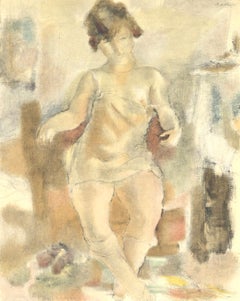
Jules Pascin, Nude with the Pink Blouse, from Pascin, 1954 (after)
By Jules Pascin
Located in Southampton, NY
This exquisite lithograph after Jules Pascin (1885–1930), titled Nu a la chemisette rose (Nude with the Pink Blouse), from the album Pascin, originates from the 1954 edition publishe...
Category
1950s Modern Figurative Prints
Materials
Lithograph
$716 Sale Price
20% Off
Free Shipping
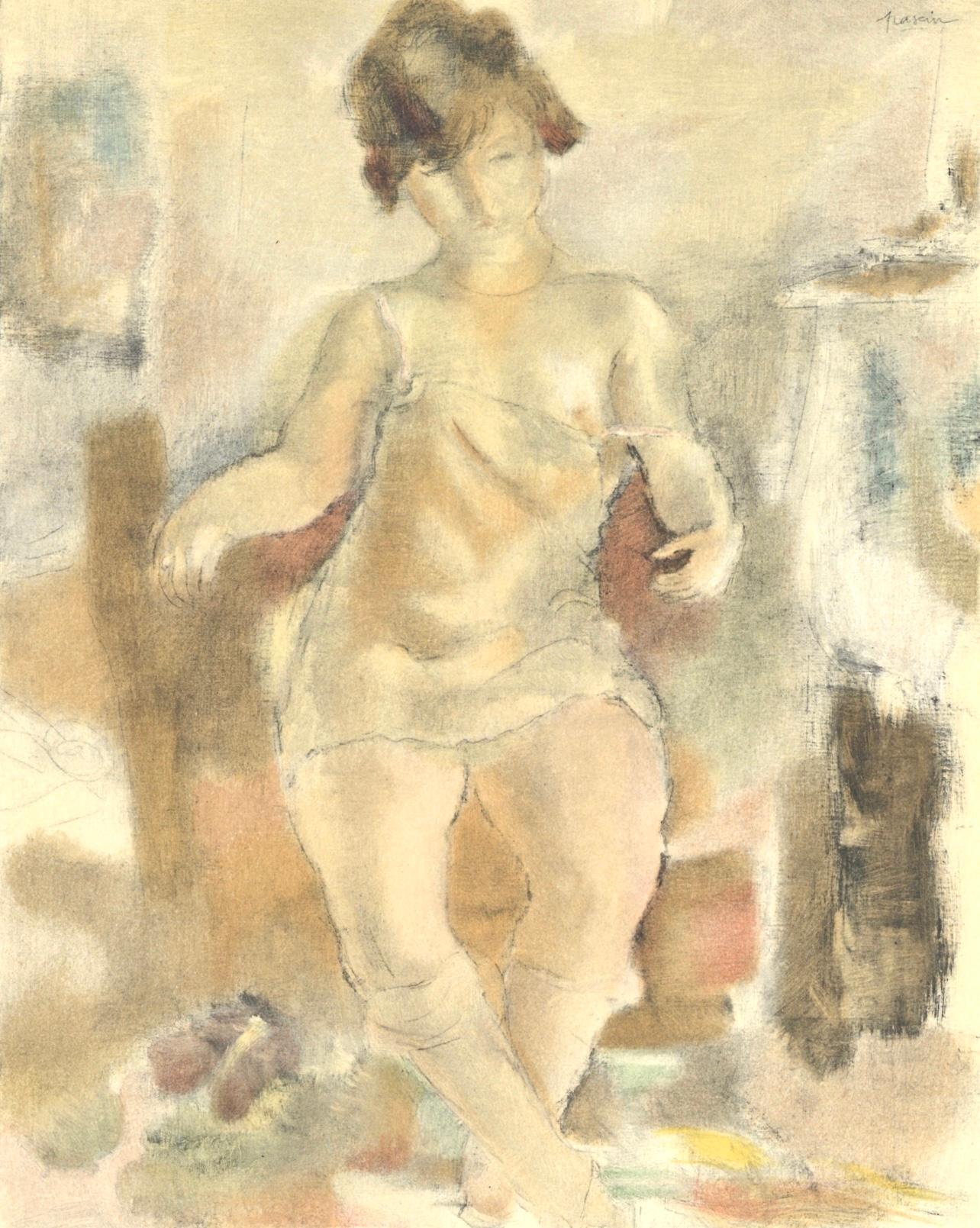
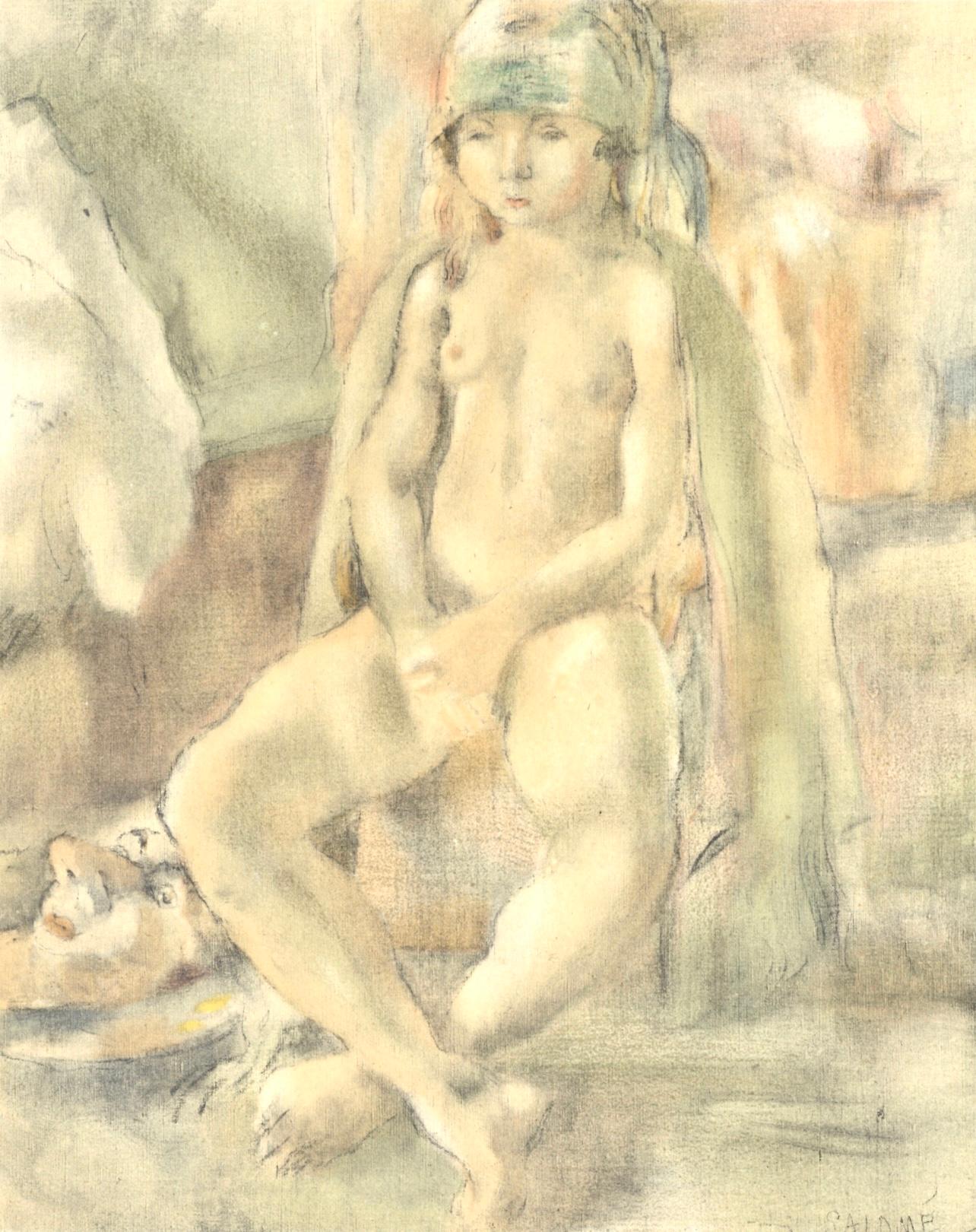
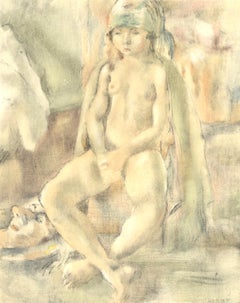
Jules Pascin, Salome, from Pascin, 1954 (after)
By Jules Pascin
Located in Southampton, NY
This exquisite lithograph after Jules Pascin (1885–1930), titled Salome, from the album Pascin, originates from the 1954 edition published by Editions du livre, Monte-Carlo, under the direction of Andre Sauret, Editeur, Monte-Carlo, and printed by Mourlot Freres, Paris, March 3, 1954. Salome captures Pascin’s delicate mastery of line and his profound sensitivity to the human form, embodying the poetic lyricism and emotional intimacy that define his work.
Executed as a lithograph on grand velin Renage paper, this work measures 12.25 x 9.5 inches. Unsigned and unnumbered as issued. The edition exemplifies the refined craftsmanship of Mourlot Freres, Paris, and the exceptional production standards of Editions du livre, Monte-Carlo.
Artwork Details:
Artist: After Jules Pascin (1885–1930)
Title: Salome, from the album Pascin
Medium: Lithograph on grand velin Renage paper
Dimensions: 12.25 x 9.5 inches (31.1 x 24.1 cm)
Inscription: Unsigned and unnumbered as issued
Date: 1954
Publisher: Editions du livre, Monte-Carlo, under the direction of Andre Sauret, Editeur, Monte-Carlo
Printer: Mourlot Freres, Paris
Condition: Well preserved, consistent with age and medium
Provenance: From the album Pascin, published by Editions du livre, Monte-Carlo, 1954
Notes:
Excerpted from the album (translated from French), This album, published under the direction of Andre Sauret, was completed on March 3, 1954. The color plates were executed in the workshops of Mourlot Freres, lithographes, in Paris. Typography of L'Imprimerie Union. The original etchings attached to the C head examples were printed on Roger Lacouriere's presses. The total edition was drawn in MM examples, decomposing as follows: C examples numbered from I to C with III original etchings, MCM examples from CI to MM.
About the Publication:
Pascin, published in Monte-Carlo in 1954 under the direction of Andre Sauret and printed by Mourlot Freres, Paris, stands as one of the most refined tributes to the artist’s oeuvre within the distinguished postwar series of French art albums. The album combines impeccable lithographic craftsmanship with scholarly presentation, highlighting the poetic subtlety and expressive line central to Pascin’s artistic legacy. Printed on grand velin Renage paper, the publication exemplifies the collaboration between Sauret and Mourlot that defined a generation of fine art editions, uniting artists, printers, and publishers dedicated to preserving the vitality of modern art in print. The album reflects the technical mastery of Mourlot’s atelier—celebrated for its work with Picasso, Matisse, Chagall, Braque, and Léger—while reinforcing Editions du livre’s commitment to producing luxurious, museum-quality publications that captured the spirit and emotion of twentieth-century masters. As a fine art album, Pascin occupies a central place among mid-century European art editions, representing both a celebration of the artist’s humanistic vision and a testament to the collaborative artistry that sustained modern printmaking.
About the Artist:
Jules Pascin (1885–1930) was a Bulgarian-born French painter and draftsman whose exquisite sensitivity, refined draftsmanship, and poetic vision made him one of the most evocative and influential figures of early modern art. Known as “the Prince of Montparnasse,” Pascin became a central figure of the Ecole de Paris and a defining presence in the bohemian world of early 20th-century Paris. Born Julius Mordecai Pincas in Vidin, Bulgaria, to a wealthy Sephardic Jewish family, he studied in Vienna and Munich before moving to Paris in 1905, where he quickly established himself among the leading modernists of his era, including Pablo Picasso, Amedeo Modigliani, Chaim Soutine, Georges Braque, and Marc Chagall. Deeply influenced by Edgar Degas, Henri de Toulouse-Lautrec, and Paul Cezanne, Pascin created paintings and drawings distinguished by their delicate lines, soft tonal harmonies, and psychological depth. His nudes, portraits, and scenes of Parisian cafe life radiate an atmosphere of quiet intimacy and emotional nuance, capturing the fragility and beauty of human existence. Unlike contemporaries such as Picasso, Joan Miro, Salvador Dali, Wassily Kandinsky, Marcel Duchamp, Alexander Calder, Alberto Giacometti, and Man Ray, who pushed toward abstraction and surrealism, Pascin remained devoted to figuration, exploring the subtleties of light, gesture, and emotion with unmatched tenderness. His works express sensuality without artifice, revealing the vulnerability and inner life of his subjects through line and color that seem to breathe with human feeling. His studio became a gathering place for artists and writers such as Ernest Hemingway, Henry Miller, and Anais Nin, who admired his introspection and his ability to translate psychological complexity into visual poetry. Though his life was marked by emotional turbulence and melancholy, his art radiated a timeless empathy that transcended style, influencing later artists including Balthus, Lucian Freud, Francis Bacon, Egon Schiele, and Eric Fischl, who drew inspiration from his fusion of sensuality, sensitivity, and psychological depth. Today, his works are held in major institutions including the Centre Pompidou, Musee d’Orsay, Tate Modern, and the Museum of Modern Art in New York, where they continue to resonate for their humanism and grace. Standing alongside Picasso, Calder, Giacometti, Dali, Miro, Kandinsky, Duchamp, and Man Ray, Jules Pascin helped define the emotional vocabulary of modern painting, and his legacy endures as one of the most intimate and humanist voices of his century. The highest auction record for Jules Pascin was achieved by Portrait de jeune fille en robe rouge sur fond bleu (1928), which sold for $2,950,500 USD at Sotheby’s, New York, on May 8, 2008, confirming his enduring reputation as one of the most refined, psychologically profound, and collectible artists of modern art history.
Jules Pascin Salome Pascin Editions du livre Monte-Carlo 1954 lithograph...
Category
1950s Modern Figurative Prints
Materials
Lithograph
You May Also Like
Femininity - Lithograph
By Jules Pascin
Located in Collonge Bellerive, Geneve, CH
(after) Jules Pascin
Title: Femininity
Signed in the plate
Dimensions: 38 x 28 cm
from the edition of 250 as issued in Warnod, Andre, "Les Peintres mes amis" (Paris: Les Heures Claires, 1965)
Jules Pascin, born Julius Mordechai Pincas, was a Bulgarian Jewish painter sometimes referred to as "the Prince of Montparnasse."
He was born on March 31, 1885 in Vidin, Bulgaria to a Spanish-Sephardic Jewish father and a Serbian-Italian mother, the eighth of eleven children. The Pincas family moved to Bucharest, Romania in 1892 and Pascin was raised there until he left for boarding school in Vienna in 1896.
While briefly working for his father’s grain merchant firm in Bucharest at fifteen, Pascin spent much of his time completing his earliest drawings in the local bordello, where he was residing under the Madame’s protection. In 1902, at the age of seventeen, Pascin moved to Vienna to study painting. The next year, he studied at the Heymann Art School in Munich. There, he supported himself by selling satirical drawings to Simplicissimus and other German magazines. Pascin would contribute drawings to a Munich daily through 1929.
Pascin’s contributions were widely recognized for their wit and insight, and upon his arrival in Paris in 1905 he was welcomed at the Gare Montparnasse by an international group of artists and writers who gathered at the Café du Dôme, which Pascin soon began to frequent regularly. The group included Grossman, Grosz, William Howard, Levy, and Emil Orlik. Pascin was also a close friend of Amadeo Modigliani.
Upon his arrival in Paris, Julius Mordechai Pincas changed his name to Jules Pascin and soon became the symbol of the Montparnasse artist community. Always in his bowler hat, he was a witty presence at Le Dôme café, Le Jockey club, and the others haunts of the area’s bohemian society, and was known for hosting legendary all-night parties. In his story, A Moveable Feast, Ernest Hemingway wrote a chapter titled With Pascin At the Dôme, recounting a night in 1923 when he had stopped off at Le Dôme and met Pascin escorted by two models. Hemingway's depiction of the events of that night is considered one of the defining images of Montparnasse at the time.
In 1907, Pascin had his first solo exhibition at Paul Cassirer Gallery in Berlin. Three years later, Cassirir commissioned Pascin to illustrate Heinrich Heine's Aus den Memoiren des Herrn von Schnabelewopski. In 1911, Pascin exhibited his work at Berlin Secession and a year later at the Sonderbund-Aussstellung in Cologne. The artist’s first exhibition in the United States was at the Armory Show in New York, where he exhibited twelve of his works.
Upon the outbreak of World War I, Pascin left Paris for London in order to avoid conscription in the Bulgarian Army. In October 1914, he immigrated to New York, where he stayed through 1920 and would later return again in 1927. Pascin was immediately welcomed into an artists circle based around the Penguin Club and became acquainted with John Quinn, an important art collector. A short time after his arrival in New York, Pascin was given a one-man show by the Berlin Photographic Company, a Madison Avenue gallery. While in New York, Pascin became associated with several progressive painters, including Walt Kuhn, Yasuo Kuniyoshi, and Max Weber. Many of these painters were influenced by Pascin’s unique style, in which he combined elements from Expressionism and Cubism with his own personal view of his environment.
Pascin used his time in the United States to travel extensively, especially in the southern states and the Caribbean islands, recording his travels in sketches that were widely acclaimed. Pascin married Hermine David in 1918. In 1920, Pascin was awarded American citizenship with support from Alfred Stieglitz and Maurice Sterne. He returned to Paris in October of that same year and met his future mistress, Lucy Krohg, the wife of the Norwegian painter Per Krohg...
Category
1960s Modern Portrait Prints
Materials
Lithograph
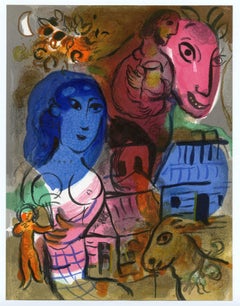
XXe Siecle-Hommage a Marc Chagall
By Marc Chagall
Located in Fairlawn, OH
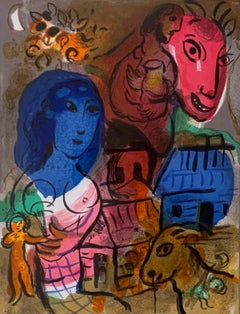
XXe Siecle-Hommage a Marc Chagall
Color lithograph, 1969
Unsigned as issued by XXe Siecle
From: XXe Siecle, Volume, Special Issue Marc Chagall
Published by G. di San Lazzaro for A. M...
Category
1960s French School Figurative Prints
Materials
Lithograph
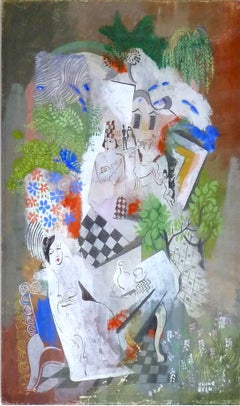
Fantasy
By Bela Kadar
Located in London, GB
BELA KADAR 1877-1956
Budapest 1877-1956 (Hungarian)
Title: Fantasy, circa 1940
Technique: Original Hand Signed Gouache on paper
size: 46.2 x 29.4 cm / 18.2 x 11.6 in
Additional Information: This work is a guache painting by the famous Hungarian artist Bela Kadar.
It is hand signed in pencil "Kadar Bela" in the lower right corner of the paper.
Exhibitions:
New York, Shepherd & Derom Galleries, Hungarian Modernism, 29 April-2 July 2010, no.12.
Tel Aviv, Galerie le Minotaure...
Category
1940s Cubist Figurative Drawings and Watercolors
Materials
Gouache
$27,500
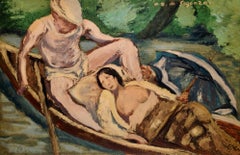
de Segonzac, Les canotiers, Collection Pierre Lévy (after)
By André Dunoyer de Segonzac
Located in Fairfield, CT
Medium: Lithograph on vélin d'Arches paper
Year: 1967
Paper Size: 20 x 26 inches
Inscription: Signed in the plate and unnumbered, as issued
Notes: From the folio, Dunoyer de Segonzac...
Category
1960s Modern Landscape Prints
Materials
Lithograph
$716 Sale Price
20% Off
Homage to Marc Chagall, from XXe Siecle
By Marc Chagall
Located in Washington, DC
Artist: Marc Chagall
Title: Homage to Marc Chagall
Portfolio: XXe Siecle
Medium: Lithograph
Year: 1969
Edition: Unnumbered
Framed Size: 20 1/2" x 17 1/4"
Sheet Size: 12" x 9 1/2"
Im...
Category
1960s Modern Figurative Prints
Materials
Lithograph
Soirée Philosophique by G Mathias – Cubist Reflection on Intellectual Discourse
Located in PÉRIGUEUX, FR
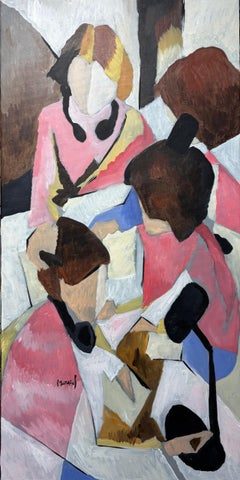
Soirée Philosophique (Philosophical Evening)
80 x 40 cm
Acrylic on Canvas
This captivating cubist painting by Grégoire Mathias portrays an intellectual gathering rendered in his sig...
Category
21st Century and Contemporary Cubist Portrait Paintings
Materials
Canvas, Acrylic
More Ways To Browse
Picasso Stamped Signature
Picasso The Couple
Pietro Fontana Etching
Rabbi German
Raoul Dufy Signed Lithograph
Rie Munoz Prints
River Phoenix
Romare Bearden Mother And Child
Rudolf Hausner
Rufino Tamayo Mixografia
Salvador Dali 1976
Salvador Dali Adam And Eve
Salvador Dali Autumn
Salvador Dali Centaur
Salvador Dali Christ
Salvador Dali Don Quixote
Salvador Dali Dragon
Salvador Dali Lithograph Don Quixote