Want more images or videos?
Request additional images or videos from the seller
1 of 8
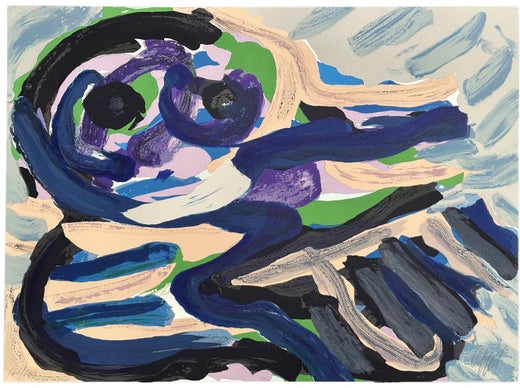
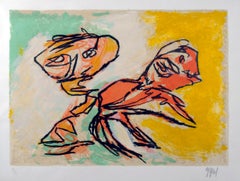
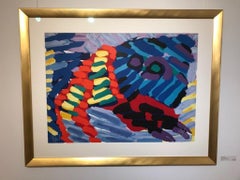
Karel AppelTen by Appel Series - Lithograph -1978 - Handsigned - 13/175 - Modern abstract1978
1978
$2,071.01List Price
About the Item
- Creator:Karel Appel (1921 - 2006, Dutch)
- Creation Year:1978
- Dimensions:Height: 32.68 in (83 cm)Width: 40.56 in (103 cm)
- Medium:
- Movement Style:
- Period:
- Condition:
- Gallery Location:Sint-Truiden, BE
- Reference Number:1stDibs: LU114814184981
Karel Appel
Karel Appel was a founding member of COBRA, an art movement originating in Germany that strived to replicate and invoke the child’s approach to art. Within this movement he created abstracted and simplified figures, often monsters and fractured depictions of people.
About the Seller
5.0
Vetted Professional Seller
Every seller passes strict standards for authenticity and reliability
Established in 2019
1stDibs seller since 2019
136 sales on 1stDibs
Authenticity Guarantee
In the unlikely event there’s an issue with an item’s authenticity, contact us within 1 year for a full refund. DetailsMoney-Back Guarantee
If your item is not as described, is damaged in transit, or does not arrive, contact us within 7 days for a full refund. Details24-Hour Cancellation
You have a 24-hour grace period in which to reconsider your purchase, with no questions asked.Vetted Professional Sellers
Our world-class sellers must adhere to strict standards for service and quality, maintaining the integrity of our listings.Price-Match Guarantee
If you find that a seller listed the same item for a lower price elsewhere, we’ll match it.Trusted Global Delivery
Our best-in-class carrier network provides specialized shipping options worldwide, including custom delivery.You May Also Like
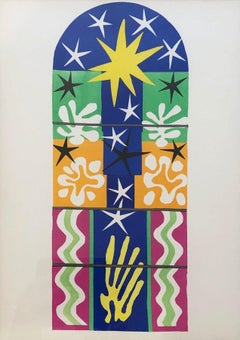
Henri Matisse Abstract Lithograph, Unsigned, 1958, "Nuit de Noel"
By (after) Henri Matisse
Located in Washington, DC
Artist: Henri Matisse (after)
Title: Nuit de Noel
Portfolio: The Last Works of Henri Matisse
Medium: Lithograph
Date: 1958
Edition: 2000
Frame Size: 20 1/2" x 13 3/4"
Sheet Size: 14"...
Category
1950s Abstract Abstract Prints
Materials
Lithograph
$695
Free Shipping
H 20.5 in W 13.75 in
Descente aux Enfers sheet 2
By Georges Braque
Located in Paris, FR
Lithograph, 1961
handsigned by the artist in pencil
27 x 20 cm (image) - 32 x 25 cm (sheet)
References catalogue Vallier 171 Mourlot 78
very good condition
LCD2805
Category
1960s Abstract Abstract Prints
Materials
Lithograph
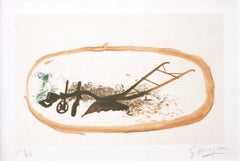
La Charrue
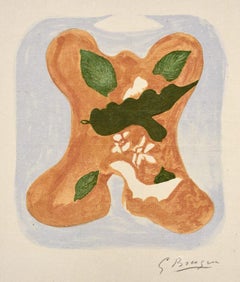
By Georges Braque
Located in Austin, TX
Artist: Georges Braque
Title: "La Charrue" (The Plow)
Year: 1960
Medium: Original Hand Colored Lithograph on Printed Japan Nacre
Signature / Edition: Signed in pencil "G. Braque" in ...
Category
Mid-20th Century Abstract Abstract Prints
Materials
Lithograph
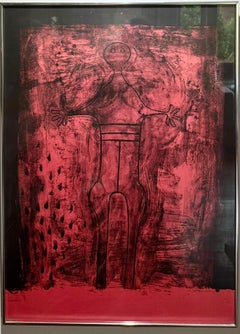
Original Lithograph PENCIL SIGNED Ed. 30/150 Affiche avant la lettre LAS MUJERAS
By Rufino Tamayo
Located in New York, NY
Here we have an Original Pencil Signed and Numbered Lithograph by Rufino Tamayo, famous Mexican American Artist…. known for abstract Figurative Expressionist images
There was only a...
Category
1960s Abstract Expressionist Abstract Prints
Materials
Lithograph
$3,400
H 33 in W 25 in D 1 in
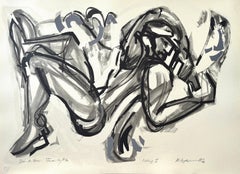
ICARUS I Signed Lithograph, Abstract Male Figure, Greek Mythology, Black, Grey
By Marius Sznajderman
Located in Union City, NJ
ICARUS I is an original hand-drawn lithograph created in 1986 by the French American artist Marius Sznajderman, printed in neutral warm grays and intense black on archival Arches pap...
Category
1980s Abstract Figurative Prints
Materials
Lithograph
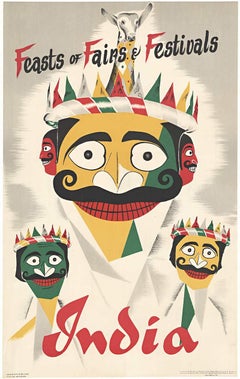
India Feasts of Fairs
Festival original colorful vintage travel poster
Located in Spokane, WA
Original India Feasts of Fairs & Festivals vintage travel poster. Conservation linen backed in very fine condition. Ready to frame. A slight lower fold mark was professionall...
Category
1950s Abstract Expressionist Figurative Prints
Materials
Lithograph
$1,000 Sale Price
20% Off
H 40 in W 25 in D 0.05 in
Sprong in de Lente (Deux Personnages)
By Karel Appel
Located in Fairlawn, OH
Sprong in de Lente (Deux Personnages)
Color lithograph, 1963
Signed, dated and numbered in pencil (see photos)
Edition: 25
Signed, dated and numbered in pencil
Printed on Arches pape...
Category
1960s Abstract Abstract Prints
Materials
Lithograph
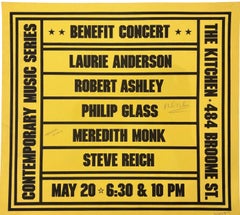
Historic lithograph (Hand signed by Sol Lewitt, Philip Glass and Meredith Monk)
By Sol LeWitt
Located in New York, NY
Sol Lewitt
Benefit Concert (Hand signed by Sol Lewitt, Philip Glass and Meredith Monk), 1978
Offset lithograph
19 1/2 × 21 1/2 inches
Limited Edition of 75 (unnumbered)
Hand signed b...
Category
1970s Abstract Geometric Abstract Prints
Materials
Pencil, Lithograph, Offset
$2,500
H 19.5 in W 21.5 in
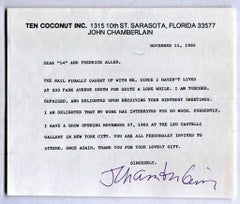
John Chamberlain, Signed Western Union cable re: sculpture show at Leo Castelli
By John Chamberlain
Located in New York, NY
John Chamberlain
Hand Signed Letter re: Leo Castelli Exhibition, 1982
Typewriter on paper (hand signed)
6 1/2 × 8 1/2 inches
Hand-signed by artist, Signed in purple felt tip marker
Hand signed telegraph/letter refers to Chamberlain's exhibition at the legendary Leo Castell Gallery.
A piece of history!
John Chamberlain Biography
John Chamberlain (1927 – 2011) was a quintessentially American artist, channeling the innovative power of the postwar years into a relentlessly inventive practice spanning six decades. He first achieved renown for sculptures made in the late 1950s through 1960s from automobile parts—these were path-breaking works that effectively transformed the gestural energy of Abstract Expressionist painting into three dimensions. Ranging in scale from miniature to monumental, Chamberlain’s compositions of twisted, crushed, and forged metal also bridged the divide between Process Art and Minimalism, drawing tenets of both into a new kinship. These singular works established him as one of the first American artists to determine color as a natural component of abstract sculpture. From the late 1960s until the end of his life, Chamberlain harnessed the expressive potential of an astonishing array of materials, which varied from Plexiglas, resin, and paint, to foam, aluminum foil, and paper bags.
After spending three years in the United States Navy during World War II, Chamberlain enrolled in the Art Institute of Chicago and Black Mountain College, where he developed the critical underpinnings of his work. Chamberlain lived and worked in many parts of the United States, moving between New York City, Long Island, Los Angeles, Santa Fe, Connecticut, and Sarasota, before finally settling on Shelter Island. In many ways, each location provoked a distinct material sensibility, often defined by the availability of that material or the limitations of physical space. In New York City, Chamberlain pulled scrap metal and twelve-inch acoustic tiles from the ceiling of his studio apartment. He chose urethane in Los Angeles in 1965 (a material he had been considering for many years), and film in Mexico in 1968. He eventually returned to metal in 1972, and, in Sarasota, he expanded the scale of his works to make his iconic Gondolas (1981 – 1982). The movement of the artist and the subsequent evolution of the work is indicative not only of a kind of American restlessness but also of Chamberlain’s own personal evolution: he sometimes described his use of automobile materials as sculptural self-portraits, infused with balance and rhythm characteristic of the artist himself.
Chamberlain refused to separate color from his practice, saying, ‘I never thought of sculpture without color. Do you see anything around that has no color? Do you live in a world with no color?’. He both honored and assigned value to color in his practice—in his early sculptures color was not added, but composed from the preexisting palette of his chosen automobile parts. Chamberlain later began adding color to metal in 1974, dripping and spraying—and sometimes sandblasting—paint and lacquer onto his metal components prior to their integration. With his polyurethane foam works, color was a variable of light: ultraviolet rays or sunlight turned the material from white to amber. It was this profound visual effect that brought the artist’s personal Abstract Expressionist hand into industrial three-dimensional sculpture. Chamberlain moved seamlessly through scale and volume, creating material explorations in monumental, heavy-gauge painted aluminum foil in the 1970s, and later in the 1980s and 1990s, miniatures in colorful aluminum foil and chromium painted steel.
Central to Chamberlain’s works is the notion that sculpture denotes a great deal of weight and physicality, disrupting whatever space it occupies. In the Barges series (1971 – 1983) he made immense foam couches, inviting spectators to lounge upon the cushioned landscape. At the end of his career, Chamberlain shifted his practice outdoors, and through a series of determined experiments, finally created brilliant, candy-colored sculptures in twisted aluminum foil. In 2012, four of these sculptures were shown outside the Seagram Building in New York, accompanied by playful titles such as ‘PINEAPPLESURPRISE’ (2010) and ‘MERMAIDSMISCHIEF’ (2009). These final works exemplify Chamberlain’s lifelong dedication to change—of his materials, of his practice, and, consequently, of American Art.
Chamberlain has been the subject of numerous solo exhibitions, including two major Retrospectives at the Solomon R. Guggenheim Museum in New York NY in 2012 and 1971; ‘John Chamberlain, Squeezed and Tied. Foam and Paper Sculptures 1969-70,’ Dan Flavin Art Institute, Dia Center for the Arts, Bridgehampton NY (2007); ‘John Chamberlain. Foam Sculptures 1966–1981, Photographs 1989–2004,’ Chinati Foundation, Marfa TX (2005); ‘John Chamberlain. Current Work and Fond Memories, Sculptures and Photographs 1967–1995,’ Stedelijk Museum, Amsterdam, Netherlands (Traveling Exhibition) (1996); and ‘John Chamberlain. Sculpture, 1954–1985,’ Museum of Contemporary Art, Los Angeles CA (1986). Chamberlain’s sculptures are part of permanent exhibitions at the Chinati Foundation in Marfa TX and at Dia:Beacon in upstate New York. In 1964, Chamberlain represented the United States in the American Pavilion at the 32nd International Exhibition of the Venice Biennale. He received many awards during his life, including a Doctor of Fine Arts, honoris causa, from the College for Creative Studies, Detroit (2010); the Distinction in Sculpture Honor from the Sculpture Center, New York (1999); the Gold Medal from The National Arts Club Award, New York (1997); the Lifetime Achievement Award in Contemporary Sculpture by the International Sculpture Center, Washington D.C. (1993); and the Skowhegan Medal for Sculpture, New York NY (1993).
-Courtesy Hauser & Wirth
Leo Castelli
Leo Castelli was born in 1907 in Trieste, a city on the Adriatic sea, which, at the time, was the main port of the Austro-Hungarian Empire. Leo’s father, Ernest Kraus, was the regional director for Austria-Hungary’s largest bank, the Kreditandstalt; his mother, Bianca Castelli, was the daughter of a Triesten coffee merchant.
With the outbreak of World War I in 1914 the Kraus family relocated to Vienna where Leo continued his education. A particularly memorable moment for Leo during this period of his life was the funeral of Emperor Francis Joseph which he witnessed in November of 1916. Leo and his family returned to Trieste when the war ended in 1918. With the fall of the Austro-Hungarian Empire Trieste embraced its new Italian identity. Motivated by this shift Ernest decided to adopt his wife's more Italian-sounding maiden name, Castelli, which his children also assumed.
In many ways the Castelli’s return Trieste after the war marked an optimistic new beginning for the family. Ernest was made director of the Banca Commerciale Italiana, which had replaced the Kreditandstalt as the top bank in Trieste. This elevated position allowed Ernest and Bianca to cultivate a cosmopolitan life-style. Together they hosted frequent parties which brought them in contact with a spectrum of political, financial, and cultural luminaries. Growing up in such an environment fostered in Leo and his two siblings, Silvia and Giorgio, a strong appreciation of high culture. During this time Leo developed a passion for Modern literature and perfected his fluency in German, French, Italian, and English.
After earning his law degree at the University of Milan in 1932, Leo began his adult life as an insurance agent in Bucharest. Although Leo found the job unfulfilling and tedious, the people he met in Bucharest made up for this deficiency. Among the most significant of Leo’s acquaintances during this time was the eminent businessman, Mihail Shapira. Leo eventually became friendly with the rest of the Shapira family and in 1933 he married Mihail's youngest daughter, Ileana.
In 1934 Leo and Ileana moved to Paris where, thanks to his step-father’s influence, Leo was able to get a job in the Paris branch of the Banca d'Italia. In the same year, Leo met the interior designer René Drouin, who became his close friend. In the spring of 1938, while walking through the Place Vendôme, Leo and René came across a storefront for rent between the Ritz hotel and a Schiaparelli boutique. The space immediately impressed them as an ideal location for an art gallery, a plan which became reality the following spring in 1939. The Drouin Gallery opened with an exhibition featuring painting and furniture by Surrealist artists including Léonor Fini, Augene Berman, Meret Oppenheim, Max Ernst, and Salvador Dali. Despite the success of this initial exhibition, the gallery proved short-lived. Germany invaded Poland on September 1, 1939 marking the start of World War II and consequently the temporary end of the Drouin gallery. René was called to serve in the French army, while Leo, Ileana, and their three-year-old daughter Nina moved to the relative safety of Cannes, where Ileana’s family owned a summer house.
As the war escalated, it became evident that Europe was no longer safe for the Castelli family—Leo and Ileana were both Jewish. In March of 1941, Leo, Ileana and Nina fled to New York bringing with them Nina’s nurse Frances and their dog, Noodle. After a year of moving around the city, the family took up permanent residence at 4 East 77 Street in a townhouse Mihail had bought. Nine months after his arrival in New York, in December of 1943, Leo volunteered for the US army, expediting his naturalization as a US citizen. Owing to his facility with languages, Leo was assigned to serve in the U.S. Army Intelligence Corp, a position which he held for two years, until February 1946.
While on military leave in 1945 Leo visited Paris and stopped by Place Vendôme gallery where René had once more set up business selling work by European avant-garde artists such as Jean Dubuffet and Jean Fautrier. The meeting not only rekindled René and Leo’s friendship but also the latter’s interest in art dealing, a pursuit which Leo began to view as more than a mere hobby but as a potential career. After reconnecting, the two friends decided to go back into partnership with Leo acting as the New York representative for the Drouin Gallery. Working in this capacity, Leo began to form relationships with some of the New York art world’s most influential figures, including Peggy Guggenhiem, Sydney Janis, Willem De Kooning, and Jackson Pollock.
By the late 40s Leo’s ties with René Drouin had begun to slacken, while his alliance with the dealer Sydney Janis became closer. Janis opened his New York gallery in 1948 and in 1950 invited Leo to curate an exhibition of contemporary French and American artists. The show drew a significant connection between the venerable tradition of European Modernism and the emerging artists of the New York School. Not long after this, in 1951, Leo was asked by these same New York School artists to organize the groundbreaking Ninth Street Show. This exhibition was instrumental in establishing Abstract Expressionism as the preeminent art movement of the post-war era.
Leo founded his own gallery in 1957, transforming the living room on the fourth floor of the 77th Street townhouse into an exhibition space. Perhaps the most critical moment of Leo’s career occurred later that year, when he first visited the studios of Robert Rauschenberg and Jasper Johns. In 1958 Leo gave Johns and Rauschenberg solo shows, in January and March respectively. For Johns, this was the first solo show of his career. These exhibitions received wide critical acclaim, solidifying Leo’s reputation not only as a dealer but as the arbiter of a new and important art movement.
Over the course of the 1960s Leo played a formative role in launching the careers of many of the most significant artists of the twentieth century including Roy Lichtenstein, Andy Warhol, Claes Oldenberg, Cy Twombly, Donald Judd, Dan Flavin, Robert Morris, Bruce Nauman, Richard Serra, Joseph Kosuth and Lawrence Weiner. Through his support of these artists Leo likewise helped cultivate and define the movements of Pop, Minimalism, Conceptual Art, and Post-Minimalism.
As business expanded over the course of the 60s and artistic trends shifted in favor of larger artworks, Leo realized that his townhouse gallery was not sufficient to meet these new demands. Indicative of the trend toward maximal art...
Category
1980s Abstract Expressionist Abstract Prints
Materials
Ink, Lithograph, Offset
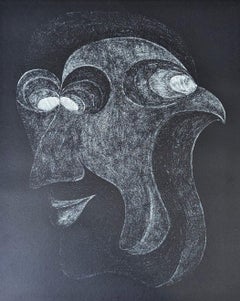
1973 Mid-Century Figurative Signed Swedish Lithograph, Unframed - Two Faces
Located in Bristol, GB
TWO FACES
Sheet size: 50 x 37 cm
Image size: 37.5 x 30 cm
Lithograph on paper
A mid century limited edition (7/23) etching, signed to the lower edge and dated 1973.
It is signed, d...
Category
1950s Abstract Abstract Prints
Materials
Lithograph
$593
H 19.69 in W 14.57 in
More From This Seller
View AllSee me running again - Lithograph -1978 - Handsigned - 172/175 - Modern abstract
By Karel Appel
Located in Sint-Truiden, BE
Karel Appel. Title: See me running again by Appel Series.
Technology: Lithograph.
Published by Atelier Dumas of New York, U.S.A.
Paper size format: 76 x 56 cm. Year: 1978.
Framed...
Category
1970s Abstract Figurative Prints
Materials
Lithograph
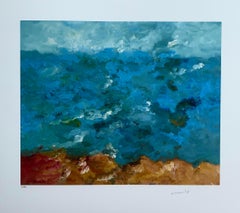
Seestück - Giclee - 2016 - Armando - hand-signed - edition 30 - 2016
Located in Sint-Truiden, BE
Armando
18.09.1929 Amsterdam
Seestück
Giclee on heavy, hand-made cotton paper
Year: 2016
Hand-signed and numbered
Edition: 30
Condition: good
Dimensions: 41.0 x 50.0 / 54.0 x 61.0 cm
ARMANDO (Amsterdam 1929 - Potsdam 2018)
Sculptor, Writer, Film and documentary maker, Violinist
Education:
Armando studied art history in Amsterdam for a number of years.
He lived in Amstelveen and worked in Amsterdam.
Armando (Amsterdam 1929) is one of the most important post-war Dutch artists and he is appreciated nationally and internationally. His work, based on his personal experience of the Second World War in Amersfoort, deals with existential and universal themes that he describes in terms of power and powerlessness, perpetrators and victims, memory, transience and melancholy.
Fascination for violence and evil determines his work from the outset. Amazed by the treacherous beauty of this violence, Armando uniquely elaborates his theme in every discipline that he practices. Driven by the desire for insight into evil and for the mastery of the techniques to shape his theme, he explores the possibilities of every medium to the extreme.
Armando's work comprises series of monumental paintings, pasty and worked through in black and white with here and there traces of color, subtle, poetic drawings and graphics. From 1989 onwards sculptures appear that seem to be shaped and bent by forces of nature. Armando's prose and poetry have their own place. In a very specific language, the unspeakable, surrounded by a lot of white, is expressed. Documentaries in which both perpetrators and victims have the floor, films, theater and theater performances complete an oeuvre of which both visual and literary work have been awarded several times. As a violinist of the Armando Quartet, Armando expresses the feeling of melancholy and melancholy that has a place in all his work, in music.
Exhibitions and prices:
1984 - The Multatuli Prize for those in power, reports from Berlin and Tuscany. 1985 - The first Jacobus van Looy...
Category
21st Century and Contemporary Abstract Abstract Prints
Materials
Handmade Paper
$331 Sale Price
37% Off
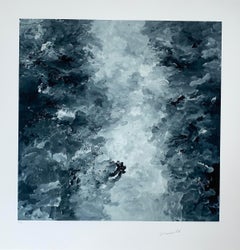
Zurück - Giclee - 2016 - Armando - hand-signed - Edition: 30 - 2016
Located in Sint-Truiden, BE
Armando
18.09.1929 Amsterdam
Zurück
Giclee on heavy, hand-made cotton paper
Year: 2016
Hand-signed and labelled
Edition: e.a.
Condition: In good condition
Dimensions: 50.0 x 50.0 on 63.0 x 61.0 cm
ARMANDO (Amsterdam 1929 - Potsdam 2018)
Sculptor, Writer, Film and documentary maker, Violinist
Education:
Armando studied art history in Amsterdam for a number of years.
He lived in Amstelveen and worked in Amsterdam.
Armando (Amsterdam 1929) is one of the most important post-war Dutch artists and he is appreciated nationally and internationally. His work, based on his personal experience of the Second World War in Amersfoort, deals with existential and universal themes that he describes in terms of power and powerlessness, perpetrators and victims, memory, transience and melancholy.
Fascination for violence and evil determines his work from the outset. Amazed by the treacherous beauty of this violence, Armando uniquely elaborates his theme in every discipline that he practices. Driven by the desire for insight into evil and for the mastery of the techniques to shape his theme, he explores the possibilities of every medium to the extreme.
Armando's work comprises series of monumental paintings, pasty and worked through in black and white with here and there traces of color, subtle, poetic drawings and graphics. From 1989 onwards sculptures appear that seem to be shaped and bent by forces of nature. Armando's prose and poetry have their own place. In a very specific language, the unspeakable, surrounded by a lot of white, is expressed. Documentaries in which both perpetrators and victims have the floor, films, theater and theater performances complete an oeuvre of which both visual and literary work have been awarded several times. As a violinist of the Armando Quartet, Armando expresses the feeling of melancholy and melancholy that has a place in all his work, in music.
Exhibitions and prices:
1984 - The Multatuli Prize for those in power, reports from Berlin and Tuscany. 1985 - The first Jacobus van Looy...
Category
21st Century and Contemporary Abstract Abstract Prints
Materials
Handmade Paper
$331 Sale Price
37% Off
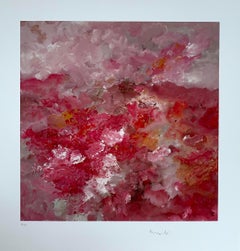
Landschaft - Giclee - 2018 - Armando - hand-signed - Edition: 25 - 2018
Located in Sint-Truiden, BE
Armando
18.09.1929 Amsterdam
Landschaft
Giclee on heavy, hand-made cotton paper
Year: 2018
Hand-signed and numbered
Edition: 25
Condition: In good condition
Dimensions: 48.0 x 47.7 on 61.0 x 58.7 cm
ARMANDO (Amsterdam 1929 - Potsdam 2018)
Sculptor, Writer, Film and documentary maker, Violinist
Education:
Armando studied art history in Amsterdam for a number of years.
He lived in Amstelveen and worked in Amsterdam.
Armando (Amsterdam 1929) is one of the most important post-war Dutch artists and he is appreciated nationally and internationally. His work, based on his personal experience of the Second World War in Amersfoort, deals with existential and universal themes that he describes in terms of power and powerlessness, perpetrators and victims, memory, transience and melancholy.
Fascination for violence and evil determines his work from the outset. Amazed by the treacherous beauty of this violence, Armando uniquely elaborates his theme in every discipline that he practices. Driven by the desire for insight into evil and for the mastery of the techniques to shape his theme, he explores the possibilities of every medium to the extreme.
Armando's work comprises series of monumental paintings, pasty and worked through in black and white with here and there traces of color, subtle, poetic drawings and graphics. From 1989 onwards sculptures appear that seem to be shaped and bent by forces of nature. Armando's prose and poetry have their own place. In a very specific language, the unspeakable, surrounded by a lot of white, is expressed. Documentaries in which both perpetrators and victims have the floor, films, theater and theater performances complete an oeuvre of which both visual and literary work have been awarded several times. As a violinist of the Armando Quartet, Armando expresses the feeling of melancholy and melancholy that has a place in all his work, in music.
Exhibitions and prices:
1984 - The Multatuli Prize for those in power, reports from Berlin and Tuscany. 1985 - The first Jacobus van...
Category
21st Century and Contemporary Abstract Abstract Prints
Materials
Handmade Paper
$331 Sale Price
37% Off
La Valse Hésitation - 20th Century, Surrealist, Lithograph, Figurative Print
By (after) René Magritte
Located in Sint-Truiden, BE
Numbered: 138/275
Color lithograph after the 1950 oil on canvas by René Magritte, printed signature of Magritte and numbered from the edition of 275.
The lithograph features the dry...
Category
20th Century Surrealist Figurative Prints
Materials
Lithograph
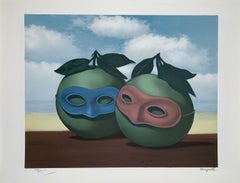
Magritte Portfolio V 20 lithographs- 20th Century, Surrealist, Figurative Print
By (after) René Magritte
Located in Sint-Truiden, BE
Complete set of 20 color lithographs in a beautiful burgundy board with ties, plate-signed by Magritte and numbered from the edition of 275.
The lithograph features the dry stamps of the Magritte Foundation & ADAGP and is countersigned in pencil by Mr. Charly Herscovici, President of the Magritte Foundation, Chairman of the Magritte Museum and unique representative of the Magritte Succession. A proof of edition is printed on the back of the lithograph, guaranteeing its authenticity.
Magritte was a Belgian surrealist artist whose witty and thought-provoking images challenged observers? preconditioned perceptions of reality. Magritte's work frequently displays a juxtaposition of ordinary objects in an unusual context, giving new meanings to familiar things.Magritte grew up in a simple and somewhat tragic household. His father was a modest tailor. His mother, who was mentally unsound, committed suicide in the year 1912. Magritte started drawing at a young age, and his first paintings, produced c. 1915, were Impressionistic in style.Magritte first worked as a draughtsman in a wallpaper factory and, in the year 1922, fell in love with and married Georgette Berger. In 1926, Magritte signed...
Category
20th Century Surrealist Figurative Prints
Materials
Lithograph