Want more images or videos?
Request additional images or videos from the seller
1 of 6
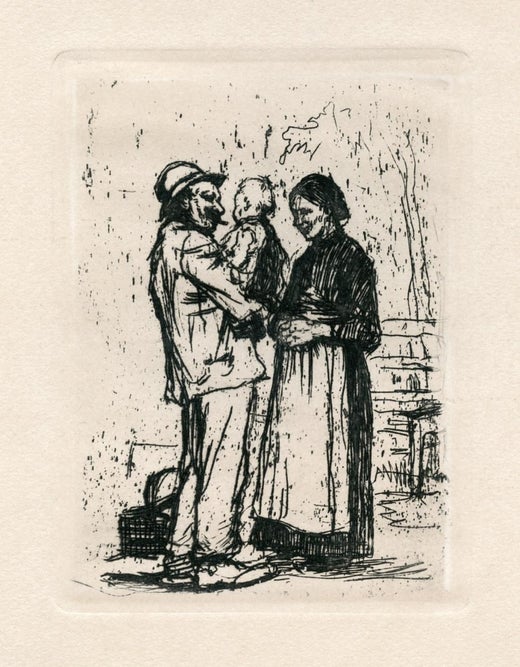
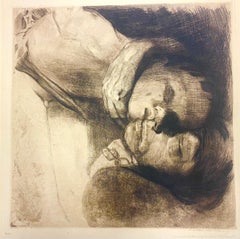
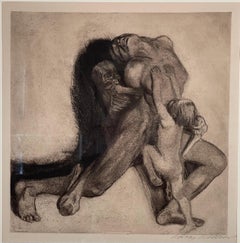
Käthe KollwitzTOD UND FRAU (DEATH AND WOMAN)1910
1910
Price:$11,394.60
$12,500List Price
About the Item
- Creator:Käthe Kollwitz (1867-1945, German)
- Creation Year:1910
- Dimensions:Height: 30 in (76.2 cm)Width: 30 in (76.2 cm)Depth: 2 in (5.08 cm)
- Medium:
- Period:
- Condition:
- Gallery Location:Portland, ME
- Reference Number:Seller: 134401stDibs: LU36738275962
Käthe Kollwitz
Käthe Kollwitz (1867 – 1945) was a German artist who studied both painting and printmaking. However she turned exclusively to print making in the early 1890s. Influenced by fellow German artist Max Klinger, she saw the potential of the print for social commentary. Prints could be reproduced inexpensively and in multiples, allowing her to reach more people.. Her most famous art cycles, including "A Weavers' Revolt" and "Seven Woodcuts on War", depict the effects of poverty, hunger and war on the working class. Despite the realism of her early works, She is now more widely associated with German Expressionism. Kollwitz was the first woman to be elected to the Prussian Academy of Arts. For the next 50 years she produced dramatic, emotion-filled etchings, woodcuts, and lithographs. Initially, her husband’s working-class patients were models. But eventually Kollwitz’s subject matter became a reflection of her own experience as a witness to both World Wars. She was devastated by the suffering and loss of human life, including the loss of a son in the first war and a grandson in the second. Although Kollwitz’s wrenching subjects and virtuoso technique soon made her work popular throughout Germany and the Western world, they also generated controversy. In 1933, the Nazi government forced her to resign her position as the first female professor appointed to the Prussian Academy; soon thereafter she was forbidden to exhibit her art.
About the Seller
5.0
Recognized Seller
These prestigious sellers are industry leaders and represent the highest echelon for item quality and design.
Platinum Seller
Premium sellers with a 4.7+ rating and 24-hour response times
Established in 1966
1stDibs seller since 2016
363 sales on 1stDibs
Typical response time: 3 hours
Associations
International Fine Print Dealers Association
Authenticity Guarantee
In the unlikely event there’s an issue with an item’s authenticity, contact us within 1 year for a full refund. DetailsMoney-Back Guarantee
If your item is not as described, is damaged in transit, or does not arrive, contact us within 7 days for a full refund. Details24-Hour Cancellation
You have a 24-hour grace period in which to reconsider your purchase, with no questions asked.Vetted Professional Sellers
Our world-class sellers must adhere to strict standards for service and quality, maintaining the integrity of our listings.Price-Match Guarantee
If you find that a seller listed the same item for a lower price elsewhere, we’ll match it.Trusted Global Delivery
Our best-in-class carrier network provides specialized shipping options worldwide, including custom delivery.You May Also Like
Large Italian Aquatint Etching Francesco Clemente Neo Expressionist Avant Garde
By Francesco Clemente
Located in Surfside, FL
Francesco Clemente (Italian b. 1952),
'This side up / Telemone #2,
1981
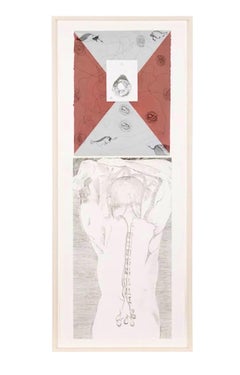
Medium: Intaglio hard ground etching, color aquatint, drypoint, and soft-ground etching with chine collé (ha...
Category
1980s Abstract Expressionist Abstract Prints
Materials
Drypoint, Etching, Aquatint, Intaglio
"Mes Petites Amies, Les Deux Sœurs" signed by Jacques Villon
By Jacques Villon
Located in Milwaukee, WI
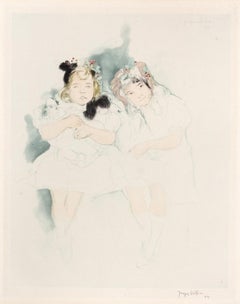
This is a drypoint and aquatint artwork by Jacques Villon. The artist signed in pencil on the lower right. As well as signed in plate at the top right of the image. This is a wonderful artwork of different intaglio processes being brought together in a beautiful almost seamless harmony. The thin pencil like markings and hair detailing are made using the Drypoint printmaking method. Whilst the color details around the girls are made using the Aquatint etching method. Jacques Villon shows his skills as a printmaker with the way these pieces line up perfectly and with how clean the rest of the plate is around the girls. An unnumbered impression, apart from the numbered edition of 50.
Catalogue Raisonne E101, pg. 66-67 (Ginestet & Pouillon. It depicts two young girls.
15" x 11 1/2" art
25 1/8" x 20" frame
French painter, printmaker and illustrator. The oldest of three brothers who became major 20th-century artists, including Raymond Duchamp-Villon and Marcel Duchamp, he learnt engraving at the age of 16 from his maternal grandfather, Emile-Frédéric Nicolle (1830-94), a ship-broker who was also a much appreciated amateur artist. In January 1894, having completed his studies at the Lycée Corneille in Rouen, he was sent to study at the Faculty of Law of the University of Paris, but within a year he was devoting most of his time to art, already contributing lithographs to Parisian illustrated newspapers such as Assiette au beurre. At this time he chose his pseudonym: Jack (subsequently Jacques) in homage to Alphonse Daudet’s novel Jack (1876) and Villon in appreciation of the 15th-century French poet François Villon...
Category
Early 1900s Modern Figurative Prints
Materials
Drypoint, Aquatint, Etching, Intaglio
$21,600
H 25.125 in W 20 in
Chevalier a Genou (Kneeling Knight)
By Salvador Dalí
Located in Milwaukee, WI
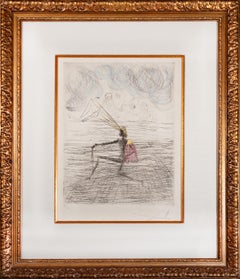
No. 305. Prestel. Ed. Ralf Michler and Lutz W. Lopsinger. Catalog Raisonne of Dali's Etchings and Mixed-Media Prints, 1924 - 1980. From the Faust Series (La Nuit de Walpurgis). This ...
Category
Late 20th Century Figurative Prints
Materials
Drypoint, Etching
Frontispiece
By Salvador Dalí
Located in Milwaukee, WI
No. 189. Prestel. Ed. Ralf Michler and Lutz W. Lopsinger. Catalog Raisonne of Dali's Etchings and Mixed-Media Prints, 1924 - 1980. From the Secret Poems by Apollinaire Series (Poemes...
Category
Late 20th Century Figurative Prints
Materials
Drypoint, Etching
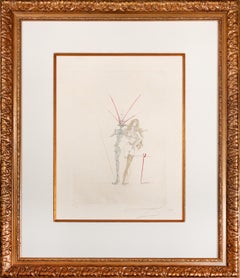
"Mlle Landsberg" (grade planche, pl. 16)
By Henri Matisse
Located in Missouri, MO
"Mlle Landsberg" (grade planche, pl. 16), 1914
Henri Matisse (French, 1869-1954)
Signed and Numbered Lower Right
Edition 12/15
Image size: 7 7/8 x 4 5/16 inches
Sheet size: 17 11/16 x 12 1/2 inches
With frame: 19 1/2 x 14 1/2 inches
Henri Matisse came from a family who were of Flemish origin and lived near the Belgian border. At eight o'clock on the evening of December 31, 1869, he was born in his grandparents' home in the town of Le Cateau in the cheerless far north of France. His father was a self-made seed merchant who was a mixture of determination and tightly coiled tension.
Henri had no clear idea of what he wanted to do with his life. He was a twenty-year-old law clerk convalescing from appendicitis when he first began to paint, using a box of colors given to him by his mother. Little more than a year later, in 1890, he had abandoned law and was studying art in Paris. The classes consisted of drawing from plaster casts and nude models and of copying paintings in the Louvre. He soon rebelled against the school's conservative atmosphere; he replaced the dark tones of his earliest works with brighter colors that reflected his awareness of Impressionism. Matisse was also a violinist; he took an odd pride in the notion that if his painting eye failed, he could support his family by fiddling on the streets of Paris.
Henri found a girlfriend while studying art, and he fathered a daughter, Marguerite, by her in 1894. In 1898 he married another woman, Amelie Parayre. She adopted the beloved Marguerite; they eventually had two sons, Jean, a sculptor and Pierre who became an eminent art dealer. Relations between Matisse and his wife were often strained. He often dallied with other women, and they finally separated in 1939 over a model who had been hired as a companion for Mme. Matisse. She was Madame Lydia, and after Mme. Matisse left, she remained with Matisse until he died.
Matisse spent the summer of 1905 working with Andre Derain in the small Mediterranean seaport of Collioure. They began using bright and dissonant colors. When they and their colleagues exhibited together, they caused a sensation. The critics and the public considered their paintings to be so crude and so roughly crafted that the group became known as Les Fauves (the wild beasts).
By 1907, Matisse moved on from the concerns of Fauvism and turned his attention to studies of the human figure. He had begun to sculpt a few years earlier. In 1910, when he saw an exhibition of Islamic art, he was fascinated with the multiple patterned areas and adapted the decorative universe of the miniatures to his interiors. As a continuation of his interest in the "exotic", Matisse made extended trips to Morocco in 1912 and 1913.
At the end of 1917, Matisse moved to Nice; he would spend part of each year there for the remainder of his life. A meticulous dandy, he wore a light tweed jacket amd a tie when he painted. He never used a palette, but instead squeezed his colors on to plain white kitchen dishes...
Category
1910s Fauvist Figurative Prints
Materials
Drypoint, Etching
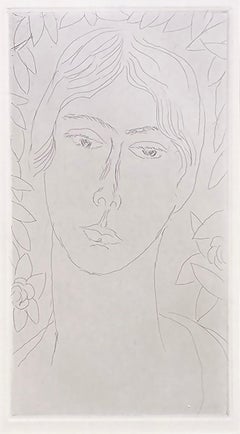
Trajan - Drypoint Etching attr. to Salvador Dalì - 1973
By Salvador Dalí
Located in Roma, IT
Trajan is an original contemporary artwork realized in 1973.
Black and white drypoin etching.
Hand signed on the lower margin.
Numbered on the lower left. Edition of 216/261.
Ref...
Category
1970s Surrealist Figurative Prints
Materials
Etching, Drypoint

Pirueta de Plátano - Drypoint and Collotype by S.Dalì - 1977
By Salvador Dalí
Located in Roma, IT
Pirueta de Plátano is an original contemporary artwork realized in 1977.
Dry point and collotype, Hand signed by the artist on the lower margin.
Numbered on the lower left margin....
Category
1970s Surrealist Figurative Prints
Materials
Drypoint, Etching
$1,598
H 9.26 in W 5.52 in D 0.04 in
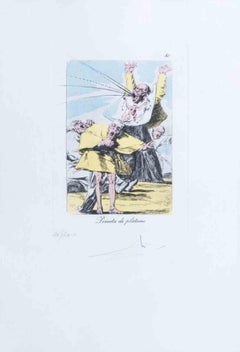
Portrait - Etching - Mid-20th Century
Located in Roma, IT
Portrait is an etching and drypoint on paper realized by an anonymous artist in the Mid-20th Century.
Good conditions.
The profile is depicted through deft and fine delicate stroke...
Category
Mid-20th Century Modern Figurative Prints
Materials
Etching, Drypoint
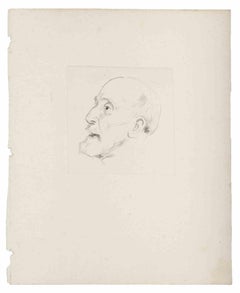
Figures - Drypoint by Mino Maccari - Mid-20th Century
By Mino Maccari
Located in Roma, IT
Mid-20th Century.
Hand-signed in the lower right part.
Numbered. Edition 1/12.
Good conditions.
Mino Maccari (Siena, 1924-Rome, June 16, 1989) was an Italian writer, painter, engraver and journalist, winner of the Feltrinelli Prize for Painting in 1963 and first winner of the Forte dei Marmi Satira Prize in 1973.After completing his secondary education, he enrolls in university. An interventionist like many young people of his time, he took part in the Great War at the age of nineteen as a field artillery officer. At the end of the conflict he resumed his university studies in Siena and in 1920 he graduated in law. In 1924 he was called by Angiolo Bencini to take care of the printing of the magazine Il Selvaggio, openly uncompromising fascist, revolutionary and anti-bourgeois, where his first engravings were published. After a few years of coexistence between work at the newspaper and the law firm, at the beginning of 1926 he left the legal profession to take over the direction of Il Selvaggio which he would hold until 1942. In 1928 he was the author of the small book published by Vallecchi (Florence), Il Trastullo di Strapaese (little songs and engraved woodwinds) which collected fascist songs (the same book was seized several times from Antonio Gramsci during his detention). With the transfer of the editorial staff of the Selvaggio in 1925 from Colle di Val d'Elsa to Florence, Maccari collaborated with Ardengo Soffici, Ottone Rosai and Achille Lega. In the meantime, between 1927 and 1930, he made himself known to the general public as a painter by participating in various national exhibitions. Also in 1930 Maccari works in Turin at La Stampa as editor-in-chief and has the writer Curzio Malaparte as director. His presence in the cultural and editorial world of the fascist regime is very intense, he writes and collaborates with various magazines: Quadrivio, L'Italia Letteraria, L'Italiano and Omnibus by Leo Longanesi; then, during the war, in il Primato di Bottai and, subsequently again, in Il Mondo di Pannunzio (from the first number, in 1949), up to Documento by Federigo Valli. His graphic production is also vast, ranging from the Album of Vallecchi (1925), Il trastullo di Strapaese (1928) to Linoleum (1931). Maccari illustrated in 1934 La vecchia del Bal Bullier by Antonio Baldini and in 1942 he published the Album folder, followed by Come quando fuori Piove and Il superfluo illustrata.For his pictorial work full of evident chromatic accentuations and fast brushstrokes, the violent drawing combined with the lively stroke of the graphic sign of his engravings, he is recognized by critics as a complete artist. In 1962 he was also entrusted with the presidency of the Accademia di San Luca in Rome and managed to obtain a personal exhibition at Gallery 63 in New York. His production of drawings, watercolors, temperas, etc. is endless, sometimes in collaboration with prestigious publishing houses; it is worth mentioning, just as an excellent example, the 32 b/w and color drawings with which he illustrated Il gusto di vivere, a volume that collects writings by Giancarlo Fusco, edited by Natalia Aspesi and published by Laterza in 1985. Maccari, Sienese and great contradaiolo della Torre, painted the Palio...
Category
Mid-20th Century Modern Figurative Prints
Materials
Paper, Drypoint, Etching
$532
H 13.78 in W 19.69 in D 0.04 in
Erotic Scene - Etching by Mino Maccari - Mid-20th Century
By Mino Maccari
Located in Roma, IT
Erotic Scene is an Etching and Drypoint realized by Mino Maccari in the Mid-20th Century.
Hand-signed in the lower part.
Good conditions.
Mino Maccari (Siena, 1924-Rome, June 1...
Category
Mid-20th Century Modern Figurative Prints
Materials
Paper, Drypoint, Etching
$390
H 6.7 in W 9.85 in D 0.04 in
More From This Seller
View AllLE POTIN
By Jacques Villon
Located in Portland, ME
Villon, Jacques (French, 1875-1963) LE POTIN (GP E96) Drypoint and aquatint printed in green, 1904, Edition of 50. Printed on Arches paper, signed and numbered 32 in pencil. Publishe...
Category
Early 1900s Figurative Prints
Materials
Drypoint, Aquatint
TOD, FRAU, UND KIND (DEATH, WOMAN, AND CHILD
By Käthe Kollwitz
Located in Portland, ME
Kollwitz, Kathe. TOD, FRAU UND KIND (DEATH, WOMAN AND CHILD). Knesebeck 108, Klipstein 113. Etching, drypoint, sandpaper, and soft-ground with the imprint of Ziegler's transfer paper...
Category
1910s Figurative Prints
Materials
Drypoint, Etching
TOD UND FRAU (DEATH AND WOMAN)
By Käthe Kollwitz
Located in Portland, ME
Kollwitz, Kathe. TOD UND FRAU (DEATH AND WOMAN). Knesebeck 107, State VII; Klipstein 103. Line etching, drypoint, sandpaper, soft ground with imprint of granulated tone paper and Zie...
Category
1910s Figurative Prints
Materials
Drypoint, Etching
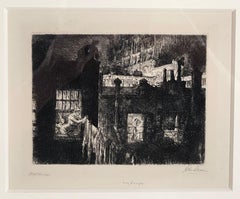
NIGHT WINDOWS
By John Sloan
Located in Portland, ME
Sloan, John (American, 1871-1951). NIGHT WINDOWS. Morse 152. Etching and drypoint, 1910. The 5th state of 5. Edition of 100. Titled, signed, and inscribed...
Category
1910s Figurative Prints
Materials
Drypoint, Etching
CAKE WALK DES PETITES FILLES
By Jacques Villon
Located in Portland, ME
Villon, Jacques. CAKE WALK DES PETITES FILLES. GP.102, second state of four. Drypoint and aquatint in colors, 1904. Edition of only 10 (there was an edition of 30 in state 4, with th...
Category
Early 1900s Figurative Prints
Materials
Drypoint, Aquatint

LE PETIT ENTERREMENT (The Small Funeral)
By Félix Hilaire Buhot
Located in Portland, ME
Buhot, Felix. LE PETIT ENTERREMENT (The Small Funeral). B/G 154. Second state of two. Etching, roulette, aquatint and drypoint printed in blue on tan wove paper, 1880. 3 3/8 x 4 1/2 inches; 86 x 115 mm., (sheet 8 3/8 x 10 3/8 inches; 215 x 264 mm.). Signed with the red owl...
Category
1880s Figurative Prints
Materials
Drypoint, Etching
Still Thinking About These?
All Recently ViewedMore Ways To Browse
Salvador Dali Medusa
Salvador Dali Sa
Salvador Dali Signed Etching El Cid
Salvador Dali The Businessman
Salvador Dali The Mystic Ladder
Santos Chavez
Saul Steinberg Mouton Rothschild Wine Label
Sempe Print
Serigraphs By Tarkay
Shane Turner
Shannon Cartier Lucy
Shannon Lucy
Shepard Fairey Dark Wave
Shepard Fairey Kiss Me Deadly
Shepard Fairey Skateboard
Siemen Dijkstra
Signed Fernando Botero
Signed Picasso Poster