Want more images or videos?
Request additional images or videos from the seller
1 of 7
Lon MegargeeThe Cowboy Builds a Loop by Lon Megargee, Portfolio of Sixteen Prints 19441944
1944
$1,500List Price
About the Item
- Creator:Lon Megargee (1883 - 1960, American)
- Creation Year:1944
- Dimensions:Height: 12 in (30.48 cm)Width: 8.75 in (22.23 cm)
- Period:
- Condition:
- Gallery Location:Phoenix, AZ
- Reference Number:1stDibs: LU2623215178662
About the Seller
No Reviews Yet
Vetted Professional Seller
Every seller passes strict standards for authenticity and reliability
1stDibs seller since 2023
8 sales on 1stDibs
Authenticity Guarantee
In the unlikely event there’s an issue with an item’s authenticity, contact us within 1 year for a full refund. DetailsMoney-Back Guarantee
If your item is not as described, is damaged in transit, or does not arrive, contact us within 7 days for a full refund. Details24-Hour Cancellation
You have a 24-hour grace period in which to reconsider your purchase, with no questions asked.Vetted Professional Sellers
Our world-class sellers must adhere to strict standards for service and quality, maintaining the integrity of our listings.Price-Match Guarantee
If you find that a seller listed the same item for a lower price elsewhere, we’ll match it.Trusted Global Delivery
Our best-in-class carrier network provides specialized shipping options worldwide, including custom delivery.You May Also Like
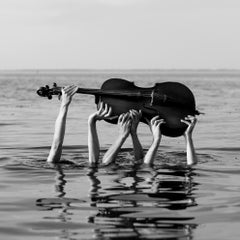
"Music is Eternal" Photography 39" x 39" in Edition of 3 by Olha Stepanian
By Olha Stepanian
Located in Culver City, CA
"Music is Eternal" Photography 39" x 39" in Edition of 3 by Olha Stepanian
Printed on Epson Professional Paper
Signed and numbered by the artist
Not framed. Ships in a tube.
Ava...
Category
21st Century and Contemporary Surrealist Black and White Photography
Materials
Photographic Paper
$2,150
H 39 in W 39 in D 0.1 in
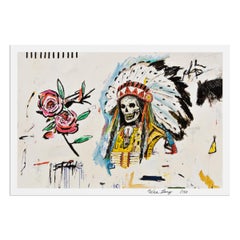
Wes Lang, Everything (Moon and Stars) - Signed Print and Artist
s Book
By Wes Lang
Located in Hamburg, DE
Wes Lang (American, b. 1972)
Everything/ Moon and Stars, 2021
Medium: Archival pigment print, artist’s catalogue (in clamshell)
Print dimensions: 20 x 28.5 cm (7 7/8 x 11 1/4 in)
Cla...
Category
21st Century and Contemporary Contemporary Figurative Prints
Materials
Archival Pigment
$3,566
H 7.88 in W 11.23 in
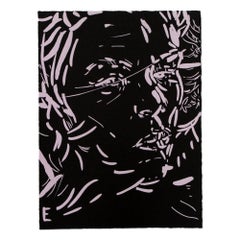
Elizabeth Peyton, E (Self-Portrait) - Signed Linocut Print, Abstract Figuration
By Elizabeth Peyton
Located in Hamburg, DE
Elizabeth Peyton (American, b. 1965)
E (Self-Portrait), 2019
Medium: Linocut on colored paper
Dimensions: 30 x 22 cm
Edition of 30: Hand-signed and numbered
Condition: Excellent
Category
21st Century and Contemporary Contemporary Portrait Prints
Materials
Linocut
$6,175
H 11.82 in W 8.67 in
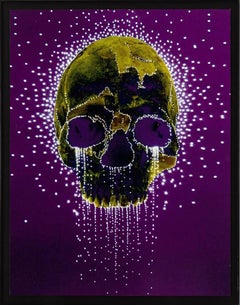
Daniele Buetti, White Tears on Skull: Swiss Conceptual Art, Contemporary Art
By Daniele Buetti
Located in Hamburg, DE
Daniele Buetti (born 1955) - Swiss conceptual artist
White Tears on Skull, 2007
Medium: C-print on Kodak paper
Dimensions: 70 x 50 cm
Edition of 50: Hand-signed and numbered on label...
Category
21st Century and Contemporary Contemporary Interior Prints
Materials
C Print
$2,137
H 27.56 in W 19.69 in
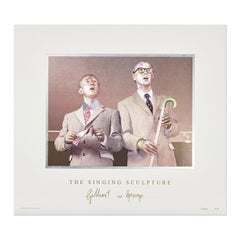
Gilbert
George, The Singing Sculpture 1969-91 - British Art, Signed Print
By Gilbert
George
Located in Hamburg, DE
Gilbert & George (British, b. 1942 and 1943)
The Singing Sculpture 1969-91, 1993
Medium: Relief print in colors, on aluminium foil (Dufex) flush-mounted to museum board, with screenp...
Category
20th Century Contemporary Figurative Prints
Materials
Screen
$4,750
H 30.87 in W 33.86 in
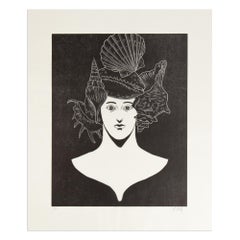
Nicolas Party, Portrait with Shells - Original Woodcut, Signed Print
By Nicolas Party
Located in Hamburg, DE
Nicolas Party (Swiss, b. 1980)
Portrait with Shells, 2021
Medium: Woodcut on HM-5 Gampi-shi
Dimensions: 45.7 x 38.1 cm (18 x 15 inches)
Edition of 50: Hand-signed and numbered
Condit...
Category
21st Century and Contemporary Contemporary Portrait Prints
Materials
Woodcut
$6,651
H 18 in W 15.01 in
Cecily Brown, The Tribulations of St. Anthony - Aquatint Etching, Signed Print
By Cecily Brown
Located in Hamburg, DE
Cecily Brown (British, b. 1969)
The Tribulations of St. Anthony, 2010
Medium: Aquatint etching on pearlescent paper
Dimensions: 40 x 30.5 cm
Edition of 25: Hand-signed and numbered
C...
Category
21st Century and Contemporary Abstract Abstract Prints
Materials
Etching

$5,468
H 15.75 in W 12.01 in
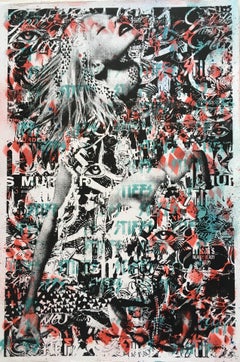
Countdown To Violence, Spray Paint Stencil and Screen Print, Limited Edition
By Prefab77
Located in Palm Desert, CA
'Countdown To Violence' (2012) by Prefab77
Size 60 x 90 cm
Limited Edition of 10 (#4/10)
5 layer spraypaint stencils & 1 layer gloss black screenprint, on hand painted, hand-deckled ...
Category
2010s Street Art More Prints
Materials
Screen, Spray Paint, Stencil
$770
H 35.44 in W 23.63 in D 0.04 in
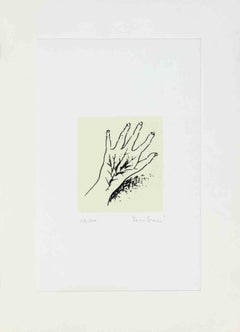
The Hand - Lithograph by Orfeo Tamburi - Mid-20th Century
By Orfeo Tamburi
Located in Roma, IT
The Hand is a modern artwork realized by Orfeo Tamburi in the mid-20th Century.
Mixed colored Lithograph.
Hand signed and numbered on the lower margin.
Edition of 21/100.
Category
Mid-20th Century Contemporary Figurative Prints
Materials
Lithograph
$332
H 12.6 in W 9.26 in D 0.08 in
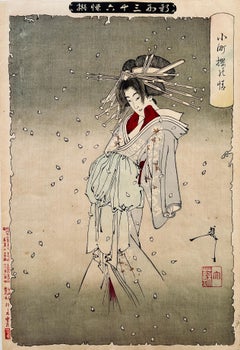
The Spirit of the Komachi Cherry Tree
from
36 Ghost Stories
Woodblock Print
Located in San Rafael, CA
Tsukioka Yoshitoshi (Japanese, 1839 - 1892)
'The Spirit of the Komachi Cherry Tree', or 'Komachi-Zakura no Sei' 1889
From the series '36 Supernatural Beings in New Forms' or 'Shinga...
Category
Late 19th Century Other Art Style Figurative Prints
Materials
Paper, Pigment
$1,200 Sale Price
20% Off
H 14.13 in W 9.5 in D 0.02 in
More From This Seller
View AllThe Bronc by Lon Megargee
Located in Phoenix, AZ
Lon Megargee 1883-1960
"The Bronc"
Wood block print
Signed in plate, lower right
Image size: 9 x 10 inches
Frame size 21 x 21.5 inches
Creator of Stetson's hat logo "Last Drop from his Hat"
Lon Megargee
1883 - 1960
At age 13, Lon Megargee came to Phoenix in 1896 following the death of his father in Philadelphia. For several years he resided with relatives while working at an uncle’s dairy farm and at odd jobs. He returned to Philadelphia in 1898 – 1899 in order to attend drawing classes at the Pennsylvania Academy of the Fine Arts. Back in Phoenix in 1899, he decided at the age of 16 to try to make his living as a cowboy.
Lon moved to the cow country of Wickenburg, Arizona where he was hired by Tex Singleton’s Bull Ranch. He later joined the Three Bar R. . . and after a few years, was offered a job by Billy Cook of the T.T. Ranch near New River. By 1906, Megargee had learned his trade well enough to be made foreman of Cook’s outfit.
Never shy about taking risks, Lon soon left Cook to try his own hand at ranching. He partnered with a cowpuncher buddy, Tom Cavness, to start the El Rancho Cinco Uno at New River. Unfortunately, the young partners could not foresee a three-year drought that would parch Arizona, costing them their stock and then their hard-earned ranch.
Breaking with his romantic vision of cowboy life, Megargee finally turned to art full time. He again enrolled at the Pennsylvania Academy of Art and then the Los Angeles School of Art and Design during 1909 – 1910. The now well-trained student took his first trip to paint “en plein air” (outdoors) to the land of Hopi and Navajo peoples in northern Arizona. After entering paintings from this trip in the annual Territorial Fair at Phoenix, in 1911, he surprisingly sold his first oil painting to a major enterprise – the Santa Fe Railroad . . . Lon received $50 for “Navajos Watching the Santa Fe Train.” He soon sold the SFRR ten paintings over the next two years. For forty years the railroad was his most important client, purchasing its last painting from him in 1953.
In a major stroke of good fortune during his early plein-air period, Megargee had the opportunity to paint with premier artist, William R. Leigh (1866 – 1955). Leigh furnished needed tutoring and counseling, and his bright, impressionistic palette served to enhance the junior artist’s sense of color and paint application. In a remarkable display of unabashed confidence and personable salesmanship, Lon Megargee, at age 30, forever linked his name with Arizona art history. Despite the possibility of competition from better known and more senior artists, he persuaded Governor George Hunt and the Legislature in 1913 to approve 15 large, historic and iconic murals for the State Capitol Building in Phoenix. After completing the murals in 1914, he was paid the then princely sum of roughly $4000. His Arizona statehood commission would launch Lon to considerable prominence at a very early point in his art career.
Following a few years of art schooling in Los Angeles, and several stints as an art director with movie studios, including Paramount, Megargee turned in part to cover illustrations for popular Western story magazines in the 1920s.
In the 1920s, as well, Lon began making black and white prints of Western types and of genre scenes from woodblocks. These prints he generally signed and sold singly. In 1933, he published a limited edition, signed and hard-cover book (about 250 copies and today rare)containing a group of 28 woodblock images. Titled “The Cowboy Builds a Loop,” the prints are noteworthy for strong design, excellent draftsmanship, humanistic and narrative content, and quality. Subjects include Southwest Indians and cowboys, Hispanic men and women, cattle, horses, burros, pioneers, trappers, sheepherders, horse traders, squaw men and ranch polo players. Megargee had a very advanced design sense for simplicity and boldness which he demonstrated in how he used line and form. His strengths included outstanding gestural (action) art and strong figurative work. He was superb in design, originality and drawing, as a study of his prints in the Hays collection reveals.
In 1944, he published a second group of Western prints under the same title as the first. Reduced to 16 images from the original 28 subjects, and slightly smaller, Lon produced these prints in brown ink on a heavy, cream-colored stock. He designed a sturdy cardboard folio to hold each set. For the remainder of his life, Lon had success selling these portfolios to museum stores, art fairs and shows, and to the few galleries then selling Western art.
Drawing on real working and life experiences, Lon Megargee had a comprehensive knowledge, understanding and sensitivity for Southwestern subject matter. Noted American modernist, Lew Davis...
Category
Early 20th Century American Impressionist Figurative Prints
Materials
Woodcut
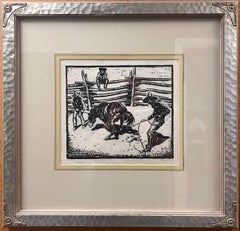
The Sheepherder by Lon Megargee
Located in Phoenix, AZ
Lon Megargee 1883-1960
"The Sheepherder"
Wood block print
Signed in plate, lower right
Image size: 10 x 10 inches
Frame size 22 x 22 inches
Creator of Stetson's hat logo "Last Drop from his Hat"
Lon Megargee
1883 - 1960
At age 13, Lon Megargee came to Phoenix in 1896 following the death of his father in Philadelphia. For several years he resided with relatives while working at an uncle’s dairy farm and at odd jobs. He returned to Philadelphia in 1898 – 1899 in order to attend drawing classes at the Pennsylvania Academy of the Fine Arts. Back in Phoenix in 1899, he decided at the age of 16 to try to make his living as a cowboy.
Lon moved to the cow country of Wickenburg, Arizona where he was hired by Tex Singleton’s Bull Ranch. He later joined the Three Bar R. . . and after a few years, was offered a job by Billy Cook of the T.T. Ranch near New River. By 1906, Megargee had learned his trade well enough to be made foreman of Cook’s outfit.
Never shy about taking risks, Lon soon left Cook to try his own hand at ranching. He partnered with a cowpuncher buddy, Tom Cavness, to start the El Rancho Cinco Uno at New River. Unfortunately, the young partners could not foresee a three-year drought that would parch Arizona, costing them their stock and then their hard-earned ranch.
Breaking with his romantic vision of cowboy life, Megargee finally turned to art full time. He again enrolled at the Pennsylvania Academy of Art and then the Los Angeles School of Art and Design during 1909 – 1910. The now well-trained student took his first trip to paint “en plein air” (outdoors) to the land of Hopi and Navajo peoples in northern Arizona. After entering paintings from this trip in the annual Territorial Fair at Phoenix, in 1911, he surprisingly sold his first oil painting to a major enterprise – the Santa Fe Railroad . . . Lon received $50 for “Navajos Watching the Santa Fe Train.” He soon sold the SFRR ten paintings over the next two years. For forty years the railroad was his most important client, purchasing its last painting from him in 1953.
In a major stroke of good fortune during his early plein-air period, Megargee had the opportunity to paint with premier artist, William R. Leigh (1866 – 1955). Leigh furnished needed tutoring and counseling, and his bright, impressionistic palette served to enhance the junior artist’s sense of color and paint application. In a remarkable display of unabashed confidence and personable salesmanship, Lon Megargee, at age 30, forever linked his name with Arizona art history. Despite the possibility of competition from better known and more senior artists, he persuaded Governor George Hunt and the Legislature in 1913 to approve 15 large, historic and iconic murals for the State Capitol Building in Phoenix. After completing the murals in 1914, he was paid the then princely sum of roughly $4000. His Arizona statehood commission would launch Lon to considerable prominence at a very early point in his art career.
Following a few years of art schooling in Los Angeles, and several stints as an art director with movie studios, including Paramount, Megargee turned in part to cover illustrations for popular Western story magazines in the 1920s.
In the 1920s, as well, Lon began making black and white prints of Western types and of genre scenes from woodblocks. These prints he generally signed and sold singly. In 1933, he published a limited edition, signed and hard-cover book (about 250 copies and today rare)containing a group of 28 woodblock images. Titled “The Cowboy Builds a Loop,” the prints are noteworthy for strong design, excellent draftsmanship, humanistic and narrative content, and quality. Subjects include Southwest Indians and cowboys, Hispanic men and women, cattle, horses, burros, pioneers, trappers, sheepherders, horse traders, squaw men and ranch polo players. Megargee had a very advanced design sense for simplicity and boldness which he demonstrated in how he used line and form. His strengths included outstanding gestural (action) art and strong figurative work. He was superb in design, originality and drawing, as a study of his prints in the Hays collection reveals.
In 1944, he published a second group of Western prints under the same title as the first. Reduced to 16 images from the original 28 subjects, and slightly smaller, Lon produced these prints in brown ink on a heavy, cream-colored stock. He designed a sturdy cardboard folio to hold each set. For the remainder of his life, Lon had success selling these portfolios to museum stores, art fairs and shows, and to the few galleries then selling Western art.
Drawing on real working and life experiences, Lon Megargee had a comprehensive knowledge, understanding and sensitivity for Southwestern subject matter. Noted American modernist, Lew Davis...
Category
Early 20th Century American Impressionist Figurative Prints
Materials
Woodcut
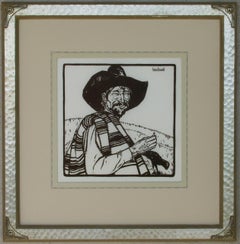
Rodeo Queen by Luis Jimenez
Located in Phoenix, AZ
Rodeo Queen, 1981
Edition 36/50
Signed lower left, Inscribed: for the "Rose" 82.
Provenance: Print was a gift to Rozanne Charington, companion and model for "Rodeo Queen", "Rose Tattoo" and "Jimenez at Adeliza's Candy Store".
Lithograph on paper
42 ½ × 29 in. (107.3 × 73.7 cm)
Luis Alfonso Jimenez
Born, 1940, El Paso, Texas, died 2006, Hondo, New Mexico.
Statement: Luis Jimenez, in his work, celebrates the vitality of life. . . . Jimenez es un hijo de la frontera; he knows its people and the landscape. It is the transformation of these people into art that is his most important contribution to the art of this vast region which stretches between Mexico and the United States.
His subject matter utilizes the popular images of the cultura del norte, and a large part of it is depicted and transformed in the rough and tumble world of la frontera. He is also a son of el norte, and so he uses its materials and explores its emerging, popular myths. The tension and attraction of Jimnez’s work is that he always creates within the space of his two worlds, the Mexicano and the Americano. He constantly shows us the irony of the two forces which repel, while showing us glimpses of the synthesis he seeks. What a gift it has been to us for this talented artist to reflect on the soul of our region. He gives meaning to our existence and history.
Rudolfo Anaya (passage chosen by the artist), A View from La Frontera, Man on Fire: Luis Jimenez, pp. 1, 3, 6Biography: Luis Jimenez was born in Texas to parents who had emigrated from Mexico to the United States; he would later dedicate his 1989 sculpture Border Crossing to his father, who had entered the country illegally. The elder Jimenez was a neon sign designer in El Paso, and Luis worked with him as a youth. His experience working in the neon shop and his fascination with U.S. car culture would both become major influences on his art career.
Jimenez studied architecture at the University of Texas, Austin (UTA), and also took art courses in which he first created sculptures with wood, steel, and fiberglass, choosing the latter because of its association with U.S. popular culture. He subsequently became one of the artists who made fiberglass an acceptable medium in the 1960s. In 1964 Jimenez received his B.S. in art from UTA, and he continued his studies at the Universidad Nacional Autonoma de Mexico in Mexico City.
In 1966 he moved to New York City and worked as an assistant to sculptor Seymour Lipton. Jimenez began to exhibit his art while in New York and in 1972 moved to New Mexico to focus on creating public sculptures, even as he maintained his diverse output of drawings, prints, and lithographs.
Drawing on his early experiences, Jimenez creates works that come from a border perspective, one that draws upon the hybridity bred by culture clashes. Often socially and politically informed, his works speak not only in regional terms, those germane to the southwestern United States, but to broader, more global issues as well. They exhibit a profoundly Chicano aesthetic and sensibility, one that is informed by Mexican and Mexican American traditions, North American popular culture, Chicano cultural icons, and images and themes unique to the Southwest. Death, sexuality, and the struggle of the common people are frequent themes.
Inspired by authors who write in an autobiographical style, Jimenez creates works that function as personal narrative yet are also able to make statements about culture in more global terms. His use of bold colors and lines, a legacy from his fathers work as a neon sign maker, lends a dynamic sensuality to his work, one that is particularly evident in his monumental fiberglass and acrylic urethane sculptural works
Many of Jimenez's works correspond to scholar Toms Ybarra-Fraustos definition of the Chicano aesthetic of rasquachismo, a lowbrow sensibility that appeals to the working class in that it applies to objects that subvert expressions of the mainstream or dominant culture. Creating art that speaks to the people, Jimenez is able to transform regional and culturally specific myths and symbols into globally recognized and relevant icons.
Exhibitions:
In addition to his personal work, Jimenez has been commissioned for numerous public art projects. In 1999 his sculpture Southwest Piet was designated a National Treasure by First Lady Hillary Clinton.
The many exhibitions featuring his work have included Human Concern/Personal Torment (Whitney Museum of American Art, New York, 1969).
The First International Motorcycle Art Show (Phoenix Art Museum, Phoenix, AZ, 1973).
Three Texas Artists (Centre Cultural Americaine, USIS, Paris, 1977),
Recent Trends in Collecting (Smithsonian Institution, Washington, DC, 1982).
Committed to Print (Museum of Modern Art, New York, 1989)
Printmaking in Texas: The 1980s (Modern Art Museum, Fort Worth, TX.
Laguna Gloria Art Museum, Austin, 1990.
The Whitney Biennial (Whitney Museum of American Art, New York, 1991)
Man On Fire: Luis Jimnez (Albuquerque Museum of Art, NM, 1994-95).
47th Annual Purchase Exhibition (American Academy of Arts and Letters, New York, 1995).
Traveling solo exhibition, Working Class Heroes: Images from the Popular Culture (1997-2000).
Jiménez
Collier Gallery has been in continuous operation for over 40 years. Originally located just off Main Street in downtown Scottsdale, Arizona, we have moved to Phoenix to accommodate and showcase our large inventory including:
• Original works by Maynard Dixon, Lon Megargee, Ed Mell, Fritz Scholder, Bill Schenck, Bill Lesch, Luis Jimenez, Greg
Singley, Dan Budnik, and other 20th century Western, WPA and Contemporary Southwestern artists.
• The Fine Art Estate of Lon Megargee
• Vintage rodeo...
Category
1980s Contemporary Figurative Prints
Materials
Lithograph
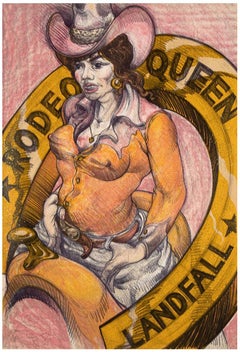
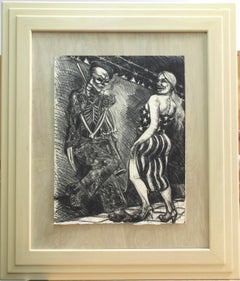
Coscolina Con Muerto (Flirt With Death)
Located in Phoenix, AZ
Coscolina Con Muerto (Flirt With Death) 1986
Stone Lithograph Edition 35/50
Size: 26.75 x 21 inches
Frame size: 44.75 x 39
Luis Alfonso Jimenez
Born, 1940, El Paso, Texas, died 2006, Hondo, New Mexico.
Statement: Luis Jimenez, in his work, celebrates the vitality of life. . . . Jimenez es un hijo de la frontera; he knows its people and the landscape. It is the transformation of these people into art that is his most important contribution to the art of this vast region which stretches between Mexico and the United States.
His subject matter utilizes the popular images of the cultura del norte, and a large part of it is depicted and transformed in the rough and tumble world of la frontera. He is also a son of el norte, and so he uses its materials and explores its emerging, popular myths. The tension and attraction of Jimnez’s work is that he always creates within the space of his two worlds, the Mexicano and the Americano. He constantly shows us the irony of the two forces which repel, while showing us glimpses of the synthesis he seeks. What a gift it has been to us for this talented artist to reflect on the soul of our region. He gives meaning to our existence and history.
Rudolfo Anaya (passage chosen by the artist), A View from La Frontera, Man on Fire: Luis Jimnez, pp. 1, 3, 6Biography: Luis Jimnez was born in Texas to parents who had emigrated from Mexico to the United States; he would later dedicate his 1989 sculpture Border Crossing to his father, who had entered the country illegally. The elder Jimnez was a neon sign designer in El Paso, and Luis worked with him as a youth. His experience working in the neon shop and his fascination with U.S. car culture would both become major influences on his art career.
Jimenez studied architecture at the University of Texas, Austin (UTA), and also took art courses in which he first created sculptures with wood, steel, and fiberglass, choosing the latter because of its association with U.S. popular culture. He subsequently became one of the artists who made fiberglass an acceptable medium in the 1960s. In 1964 Jimenez received his B.S. in art from UTA, and he continued his studies at the Universidad Nacional Autnoma de Mexico in Mexico City.
In 1966 he moved to New York City and worked as an assistant to sculptor Seymour Lipton. Jimnez began to exhibit his art while in New York and in 1972 moved to New Mexico to focus on creating public sculptures, even as he maintained his diverse output of drawings, prints, and lithographs.
Drawing on his early experiences, Jimnez creates works that come from a border perspective, one that draws upon the hybridity bred by culture clashes. Often socially and politically informed, his works speak not only in regional terms, those germane to the southwestern...
Category
1980s Contemporary Figurative Prints
Materials
Lithograph
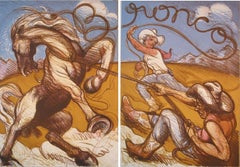
Bronco
Located in Phoenix, AZ
SHIPPING FEES INCLUDE SHIPPING CHARGE, PACKAGING & **INSURANCE**
Luis Alfonso Jimenez
Born, 1940, El Paso, Texas, died 2006, Hondo, New Mexico.
Statement: Luis Jimenez, in his work, celebrates the vitality of life. . . . Jimenez es un hijo de la frontera; he knows its people and the landscape. It is the transformation of these people into art that is his most important contribution to the art of this vast region which stretches between Mexico and the United States.
His subject matter utilizes the popular images of the cultura del norte, and a large part of it is depicted and transformed in the rough and tumble world of la frontera. He is also a son of el norte, and so he uses its materials and explores its emerging, popular myths. The tension and attraction of Jimnez’s work is that he always creates within the space of his two worlds, the Mexicano and the Americano. He constantly shows us the irony of the two forces which repel, while showing us glimpses of the synthesis he seeks. What a gift it has been to us for this talented artist to reflect on the soul of our region. He gives meaning to our existence and history.
Rudolfo Anaya (passage chosen by the artist), A View from La Frontera, Man on Fire: Luis Jimnez, pp. 1, 3, 6Biography: Luis Jimnez was born in Texas to parents who had emigrated from Mexico to the United States; he would later dedicate his 1989 sculpture Border Crossing to his father, who had entered the country illegally. The elder Jimnez was a neon sign designer in El Paso, and Luis worked with him as a youth. His experience working in the neon shop and his fascination with U.S. car culture would both become major influences on his art career.
Jimenez studied architecture at the University of Texas, Austin (UTA), and also took art courses in which he first created sculptures with wood, steel, and fiberglass, choosing the latter because of its association with U.S. popular culture. He subsequently became one of the artists who made fiberglass an acceptable medium in the 1960s. In 1964 Jimenez received his B.S. in art from UTA, and he continued his studies at the Universidad Nacional Autnoma de Mexico in Mexico City.
In 1966 he moved to New York City and worked as an assistant to sculptor Seymour Lipton. Jimnez began to exhibit his art while in New York and in 1972 moved to New Mexico to focus on creating public sculptures, even as he maintained his diverse output of drawings, prints, and lithographs.
Drawing on his early experiences, Jimnez creates works that come from a border perspective, one that draws upon the hybridity bred by culture clashes. Often socially and politically informed, his works speak not only in regional terms, those germane to the southwestern United States, but to broader, more global issues as well. They exhibit a profoundly Chicano aesthetic and sensibility, one that is informed by Mexican and Mexican American traditions, North American popular culture, Chicano cultural icons, and images and themes unique to the Southwest. Death, sexuality, and the struggle of the common people are frequent themes.
Inspired by authors who write in an autobiographical style, Jimnez creates works that function as personal narrative yet are also able to make statements about culture in more global terms. His use of bold colors and lines, a legacy from his fathers work as a neon sign maker, lends a dynamic sensuality to his work, one that is particularly evident in his monumental fiberglass and acrylic urethane sculptural works
Many of Jimnezs works correspond to scholar Toms Ybarra-Fraustos definition of the Chicano aesthetic of rasquachismo, a lowbrow sensibility that appeals to the working class in that it applies to objects that subvert expressions of the mainstream or dominant culture. Creating art that speaks to the people, Jimnez is able to transform regional and culturally specific myths and symbols into globally recognized and relevant icons.
Exhibitions:
In addition to his personal work, Jimnez has been commissioned for numerous public art projects. In 1999 his sculpture Southwest Piet was designated a National Treasure by First Lady Hillary Clinton.
The many exhibitions featuring his work have included Human Concern/Personal Torment (Whitney Museum of American Art, New York, 1969).
The First International Motorcycle Art Show (Phoenix Art Museum, Phoenix, AZ, 1973).
Three Texas Artists (Centre Cultural Americaine, USIS, Paris, 1977),
Recent Trends in Collecting (Smithsonian Institution, Washington, DC, 1982).
Committed to Print (Museum of Modern Art, New York, 1989)
Printmaking in Texas: The 1980s (Modern Art Museum, Fort Worth, TX.
Laguna Gloria Art Museum, Austin, 1990.
The Whitney Biennial (Whitney Museum of American Art, New York, 1991)
Man On Fire: Luis Jimnez (Albuquerque Museum of Art, NM, 1994-95).
47th Annual Purchase Exhibition (American Academy of Arts and Letters, New York, 1995).
Traveling solo exhibition, Working Class Heroes: Images from the Popular Culture (1997-2000).
Jiménez
Collier Gallery has been in continuous operation for over 40 years. Originally located just off Main Street in downtown Scottsdale, Arizona, we have moved to Phoenix to accommodate and showcase our large inventory including:
• Original works by Maynard Dixon, Lon Megargee, Ed Mell, Fritz Scholder, Bill Schenck, Bill Lesch, Luis Jimenez, Greg
Singley, Dan Budnik, and other 20th century Western, WPA and Contemporary Southwestern artists.
• The Fine Art Estate of Lon Megargee
• Vintage rodeo...
Category
1970s Contemporary Figurative Prints
Materials
Lithograph
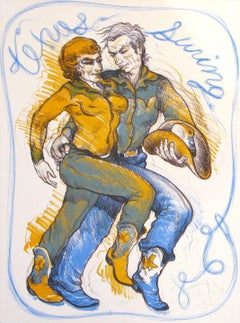
Texas Swing by Luis Jimenez
By Luis Jiménez
Located in Phoenix, AZ
Texas Swing
Luis Alfonso Jimenez 1940-2006
Stone Lithograph Edition of 50
Artist Proof
24 x 18 inches
Luis Alfonso Jimenez
Born, 1940, El Paso, Texas, died 2006, Hondo, New Mexico.
Statement: Luis Jimenez, in his work, celebrates the vitality of life. . . . Jimenez es un hijo de la frontera; he knows its people and the landscape. It is the transformation of these people into art that is his most important contribution to the art of this vast region which stretches between Mexico and the United States.
His subject matter utilizes the popular images of the cultura del norte, and a large part of it is depicted and transformed in the rough and tumble world of la frontera. He is also a son of el norte, and so he uses its materials and explores its emerging, popular myths. The tension and attraction of Jimnez’s work is that he always creates within the space of his two worlds, the Mexicano and the Americano. He constantly shows us the irony of the two forces which repel, while showing us glimpses of the synthesis he seeks. What a gift it has been to us for this talented artist to reflect on the soul of our region. He gives meaning to our existence and history.
Rudolfo Anaya (passage chosen by the artist), A View from La Frontera, Man on Fire: Luis Jimnez, pp. 1, 3, 6Biography: Luis Jimnez was born in Texas to parents who had emigrated from Mexico to the United States; he would later dedicate his 1989 sculpture Border Crossing to his father, who had entered the country illegally. The elder Jimenez was a neon sign designer in El Paso, and Luis worked with him as a youth. His experience working in the neon shop and his fascination with U.S. car culture would both become major influences on his art career.
Jimenez studied architecture at the University of Texas, Austin (UTA), and also took art courses in which he first created sculptures with wood, steel, and fiberglass, choosing the latter because of its association with U.S. popular culture. He subsequently became one of the artists who made fiberglass an acceptable medium in the 1960s. In 1964 Jimenez received his B.S. in art from UTA, and he continued his studies at the Universidad Nacional Autonoma de Mexico in Mexico City.
In 1966 he moved to New York City and worked as an assistant to sculptor Seymour Lipton. Jimnez began to exhibit his art while in New York and in 1972 moved to New Mexico to focus on creating public sculptures, even as he maintained his diverse output of drawings, prints, and lithographs.
Drawing on his early experiences, Jimenez creates works that come from a border perspective, one that draws upon the hybridity bred by culture clashes. Often socially and politically informed, his works speak not only in regional terms, those germane to the southwestern United States, but to broader, more global issues as well. They exhibit a profoundly Chicano aesthetic and sensibility, one that is informed by Mexican and Mexican American traditions, North American popular culture, Chicano cultural icons, and images and themes unique to the Southwest. Death, sexuality, and the struggle of the common people are frequent themes.
Inspired by authors who write in an autobiographical style, Jimenez creates works that function as personal narrative yet are also able to make statements about culture in more global terms. His use of bold colors and lines, a legacy from his fathers work as a neon sign maker, lends a dynamic sensuality to his work, one that is particularly evident in his monumental fiberglass and acrylic urethane sculptural works
Many of Jimenez's works correspond to scholar Toms Ybarra-Fraustos definition of the Chicano aesthetic of rasquachismo, a lowbrow sensibility that appeals to the working class in that it applies to objects that subvert expressions of the mainstream or dominant culture. Creating art that speaks to the people, Jimenez is able to transform regional and culturally specific myths and symbols into globally recognized and relevant icons.
Exhibitions:
In addition to his personal work, Jimenez has been commissioned for numerous public art projects. In 1999 his sculpture Southwest Piet was designated a National Treasure by First Lady Hillary Clinton.
The many exhibitions featuring his work have included Human Concern/Personal Torment (Whitney Museum of American Art, New York, 1969).
The First International Motorcycle Art Show (Phoenix Art Museum, Phoenix, AZ, 1973).
Three Texas Artists (Centre Cultural Americaine, USIS, Paris, 1977),
Recent Trends in Collecting (Smithsonian Institution, Washington, DC, 1982).
Committed to Print (Museum of Modern Art, New York, 1989)
Printmaking in Texas: The 1980s (Modern Art Museum, Fort Worth, TX.
Laguna Gloria Art Museum, Austin, 1990.
The Whitney Biennial (Whitney Museum of American Art, New York, 1991)
Man On Fire: Luis Jimnez (Albuquerque Museum of Art, NM, 1994-95).
47th Annual Purchase Exhibition (American Academy of Arts and Letters, New York, 1995).
Traveling solo exhibition, Working Class Heroes: Images from the Popular Culture (1997-2000).
Jiménez
Collier Gallery has been in continuous operation for over 40 years. Originally located just off Main Street in downtown Scottsdale, Arizona, we have moved to Phoenix to accommodate and showcase our large inventory including:
• Original works by Maynard Dixon, Lon Megargee, Ed Mell, Fritz Scholder, Bill Schenck, Bill Lesch, Luis Jimenez, Greg
Singley, Dan Budnik, and other 20th century Western, WPA and Contemporary Southwestern artists.
• The Fine Art Estate of Lon Megargee
• Vintage rodeo...
Category
1970s Contemporary Figurative Prints
Materials
Lithograph
Recently Viewed
View AllMore Ways To Browse
Vintage Stetson
Stetson Hat Vintage
Lithograph Picasso 1957
Make Art Not War
Marc Chagall Poster Framed
Marc Chagall The Lovers
Marino Marini Shakespeare
Mary Cassatt Etchings
Matisse Signed Print
Max Baer
Max Beckmann Drypoint
May Belfort
Melanie Taylor Kent
Mexican Revolution Art
Michel Delacroix On Sale
Munch Poster 1969
Naoko Matsubara
Nude At The Window Dali