Items Similar to Grinzing, Snow Scene, Austria, large color etching
Want more images or videos?
Request additional images or videos from the seller
1 of 12
Luigi KasimirGrinzing, Snow Scene, Austria, large color etching1940
1940
$1,000
£762.98
€868.59
CA$1,405.51
A$1,545
CHF 811.12
MX$18,371.15
NOK 10,416.59
SEK 9,488.39
DKK 6,489.74
About the Item
Artist: Luigi Kasimir Austrian (1881-1962)
Title: Grinzing, Austria
Year: 1940
Medium: Color Etching
Sight size: 17.5 x 22.5 inches
Sheet Size: 20 x 25 inches
Framed Size:27.5 x 32.5 inches
Signature: Estate signed lower center
Edition: unknown
Condition: Very good condition. See below
This artwork titled "Grinzing, Snow Scene, Austria" 1940 is a color etching (printed with the original copper plate engraved by the artist) on watermarked Kasimir Vienna paper by Austrian artist Luigi Kasimir, 1881-1962. It is hand signed by the artist's estate in pencil at the lower center. The plate mark (image) size is 17.35 x 22.5 inches, framed size is 27.5 x 32.5 inches. Grinzing is a town near Vienna. The color etching is custom matted with a linen mat and gold liner The wood frame is gold with a black detailing. The print is in very good condition. The mat is in very good condition. The frame is in fair/good condition with some small losses. It is framed with Plexiglas. Please see pictures. I can ship the print with or without the frame.
About the artist.
Luigi Kasimir was born in 1881 at Pettau, today Ptuj, Slovenia, then a part of the Austro-Hungarian monarchy. He inherited his talent from his ancestors; his grandfather was a painter and a poet, and his father an officer in the Habsburg army, who later became a professional painter. Kasimir attended the Vienna Academy of Art where he studied under Wilhelm Unger, who introduced him to the technique of the coloured etching, and also to his future wife, the artist Tanna Hoernes.[1] He died in 1962 in Grinzing, a suburb of Vienna.Kasimir was among the first to develop the technique of the coloured etching. Before this, prints were usually hand-coloured with the colour being applied in a casual, haphazard manner. Kasimir would first create a sketch usually in pastel, he then transferred the design on as many as four to six plates, printing one after the other and applying the colour on the plate, all done by hand.
Kasimir is mainly famous for his etchings, but he also produced some oil painting, as well as some pastels. One of his favourite genres was the landscape, or veduta. He demonstrated a predisposition for street scenes, and tourist landmarks. He depicted places from all over Europe, mainly Italy, Austria, and Germany. He also travelled to the United States to do a series of etchings of famous sights ranging from urban landmarks such as New York City skyscrapers, to natural wonders like Yosemite Valley. Luigi Kasimir’s etchings can be seen in many galleries and museums, from the New York Metropolitan Museum of Art to countless galleries and fine print collections around the world.
- Creator:Luigi Kasimir (1881 - 1962, Austro-Hungarian)
- Creation Year:1940
- Dimensions:Height: 27.5 in (69.85 cm)Width: 32.5 in (82.55 cm)Depth: 1.25 in (3.18 cm)
- Medium:
- Movement Style:
- Period:
- Condition:The print is in very good condition. The mat is in very good condition. The frame is in fair/good condition with some small losses. It is framed with Plexiglas. Please see pictures. I can ship the print with or without the frame.
- Gallery Location:San Francisco, CA
- Reference Number:Seller: PM12172025-11stDibs: LU666317377582
Luigi Kasimir
Alois Heinrich “Luigi” Kasimir (Austrian, 1881-1962) was born on April 18, 1881 in Ptuj, Austria (today Slovenia) then a part of the Austro-Hungarian monarchy. He may have inherited his talent from his ancestors; his grandfather was a painter and a poet, and his father, an officer in the Habsburg army, who later became a professional painter. Kasimir attended the Vienna Academy of Art where he studied under Willhelm Unger, who introduced him to the technique of the color etching, and also to his future wife, the artist Tanna Hoernes. Kasimir was among the early practitioners of the multi-plate color etching. Before this, prints were usually hand-colored with the color being applied in a casual, haphazard manner. Kasimir would first create a sketch—usually in pastel. He then transferred the design on as many as four to six plates, printing one after the other and applying the color to the plate - all done by hand. Although Luigi Kasimir is mainly famous for his etchings, but he also produced some oil painting, as well as some pastels. One of his favorite genres was the landscape. He demonstrated a predisposition for monuments, street scenes, and tourist landmarks. He depicted places from all over Europe, mainly Italy, Austria, and Germany. He also travelled to the United States to do a series of etchings of famous sights ranging from urban landmarks such as New York skyscrapers to natural wonders like California’s Yosemite Valley. Kasimir designed a bookplate for Sigmund Freud, who also hung an etching of the Roman Forum by Kasimir in his consulting room. Kasimir’s wife, Tanna and their son Robert worked in a similar style. Luigi Kasimir died in 1962 in Grinzing, a suburb of Vienna, Austria
About the Seller
5.0
Platinum Seller
Premium sellers with a 4.7+ rating and 24-hour response times
Established in 1999
1stDibs seller since 2017
872 sales on 1stDibs
Typical response time: <1 hour
- ShippingRetrieving quote...Shipping from: San Francisco, CA
- Return Policy
More From This Seller
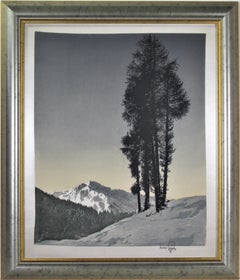
View AllWinter Landscape
By Hans Figura
Located in San Francisco, CA
Artist: Hans Figura (Austrian, 1898-1978)
Title: Winter Landscape
Year: Circa 1950
Medium: Color etching with aquatint on silk
Edition: Unknown
Plate mark (Image) size: 17.25 x 13.75 inches
Framed size: 23 x 19.5 inches
Signature: Hand signed in pencil by the artist
Condition: very good
Frame: Custom framed in a silver and gold frame
About the artist.
Hans Figura (Austrian, 1898-1978) was a noted painter and etcher, who was well known for his aquatint etchings on paper or satin of European and American landscape and cityscape scenes, as well as paintings of landscape and cityscape scenes, Tyrolean Alp scenes of villages and chalets, street scenes, harbor and marine scenes.
Hans Figura was born January 22, 1898, in the small town of Nagy-Kikinda near the Austro-Hungarian border, to Austrian parents. His father was a railway official and he spent his childhood in various small villages along the railway line between Vienna and Hungary. He graduated from the highschool in Vienna and also studied at the Higher Graphical Federal Education and Research Institute, a vocational school there (Höhere Graphische Bundes-Lehr und Versuchsanstalt)
As a young man, he served as an officer in the Austrian Army during WWI from 1916-18 on the Russian and Italian fronts. After the war he attended medical school at the University of Vienna for several years beginning in 1918, and seven semesters later, he passed his first state exam, but eventually decided that he preferred the arts to medicine. He also studied at the Academy of Fine Arts in Vienna (Akademie der bildenden Künste Wien) and by 1922 he had devoted himself to painting and etching, while also working in other artistic printing mediums, batik, illustration, bookbinding and working with leather.
From 1923-28, Figura made numerous art study trips throughout Europe including; Germany, Italy, France, Belgium, Holland, England, Czechoslovakia and Hungary. His first major success came in 1924, when he won acclaim for his etchings exhibited in Italy and the United States. In 1929, he visited the United States and in 1930, he traveled back to France, Holland and also Switzerland. During this time, Figura maintained studios in both New York City and Vienna, Austria. Throughout the course of his career, he exhibited his paintings and prints in many of the large cities throughout Europe and the United States and many of his etchings and paintings were acquired by museums and galleries, including The Kulturamt, Vienna, Austria; the Landesmuseum of Lower Austria; as well as The Society of Art Lovers, Berlin and Munich.
Select Exhibitions:
1924- Exhibitions in Italy and the United States.
Circa Mid 1920's-1939- All the exhibitions at the Kunstlerhaus, Vienna, Austria.
1926- "Secession...
Category
Mid-20th Century Realist Landscape Prints
Materials
Etching
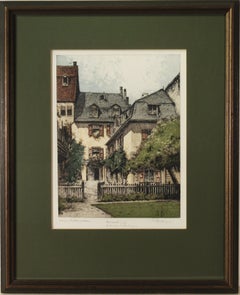
Bonn, Bethovenhaus (Bonn, the House of Bethoven)
By Josef Eidenberger
Located in San Francisco, CA
This artwork titled "Bonn, Bethovenhaus" c. 1970 is an color etching by noted Austrian artist Josef Eidenberger, 1899-1991. It is hand signed, titled, dedicated and resigned a second time in pencil by the artist. The plate mark (image) size is 12 x 9.10 inches, framed size is 21.65 x 17.65 inches. Custom framed in a dark wood frame, with green matting. It is in excellent condition.
About the artist.
Josef Eidenberger was born in 1899 in the little town of Goisern, Austria,he began his artistic career as a landscape painter. In 1923 he enrolled in the famed Graphic Academy of Art in Vienna and studied under Professor Alfred Cossman.
His recognized talent brought him many commissions from city officials and members of the business communities throughout Europe, especially in Austria and Germany. In 1973 after visiting the United States for the first time he created a series of California etchings...
Category
Mid-20th Century Realist Figurative Prints
Materials
Etching
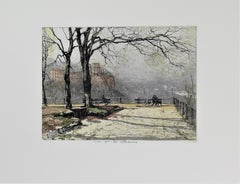
Heidelberg Terrace, Germany
Located in San Francisco, CA
This artwork titled "Hidelberg Terrace, Germany" c.1930 is an original color etching on watermarked Kasimir Vienna wove paper by Austrian/American artist Tana Kasimir Hoernes, 1887-1972. It is hand signed in pencil by the artist's estate at the lower center. The image (plate mark) size is 8.5 x 11.5 inches, sheet size is is 15 x 19 inches. It is in excellent condition, has never been framed
About the artist:
Tanna Kasimir...
Category
Mid-20th Century Realist Figurative Prints
Materials
Etching
Good Memories, Home 1982
By Josef Eidenberger
Located in San Francisco, CA
This artwork titled "Good Memories, Home 1982" 1982 is an color etching by noted Austrian artist Josef Eidenberger, 1899-1991. It is hand signed, titled, dated and resigned a second time in pencil by the artist. The plate mark size is 10.25 x 7 inches, framed size is 18 x 14.10 inches. Custom framed in a wood and silver color frame, with green matting and brown filet. It is in excellent condition.
About the artist.
Josef Eidenberger was born in 1899 in the little town of Goisern, Austria,he began his artistic career as a landscape painter. In 1923 he enrolled in the famed Graphic Academy of Art in Vienna and studied under Professor Alfred Cossman.
His recognized talent brought him many commissions from city officials and members of the business communities throughout Europe, especially in Austria and Germany. In 1973 after visiting the United States for the first time he created a series of California etchings...
Category
Mid-20th Century Realist Figurative Prints
Materials
Etching
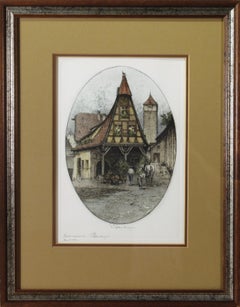
Cityscape
Located in San Francisco, CA
This artwork titled "Cityscape" c.1930 is an original color etching on wove paper by Austrian/American artist Tana Kasimir Hoernes, 1887-1972. It is hand signed in pencil by the artist. The image (plate mark) size is 12.75 x 9.15 inches, framed size is 19.35 x 15.25 inches. Custom framed in a silver with brown patina frame, with light grey matting and green and red filet. It is in excellent condition,
About the artist:
Tanna Kasimir...
Category
Mid-20th Century Realist Figurative Prints
Materials
Etching
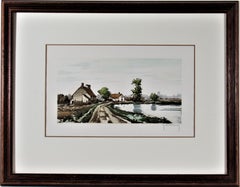
Landscape with Pond
By Roger Hebbelinck
Located in San Francisco, CA
Artist: Roger Hebbelinck (Belgian, born 1912)
Title: Landscape with Pond
Year: Circa 1960
Medium: Color etching with aquatint
Edition: Numbered 43/3...
Category
Mid-20th Century Realist Landscape Prints
Materials
Aquatint
You May Also Like
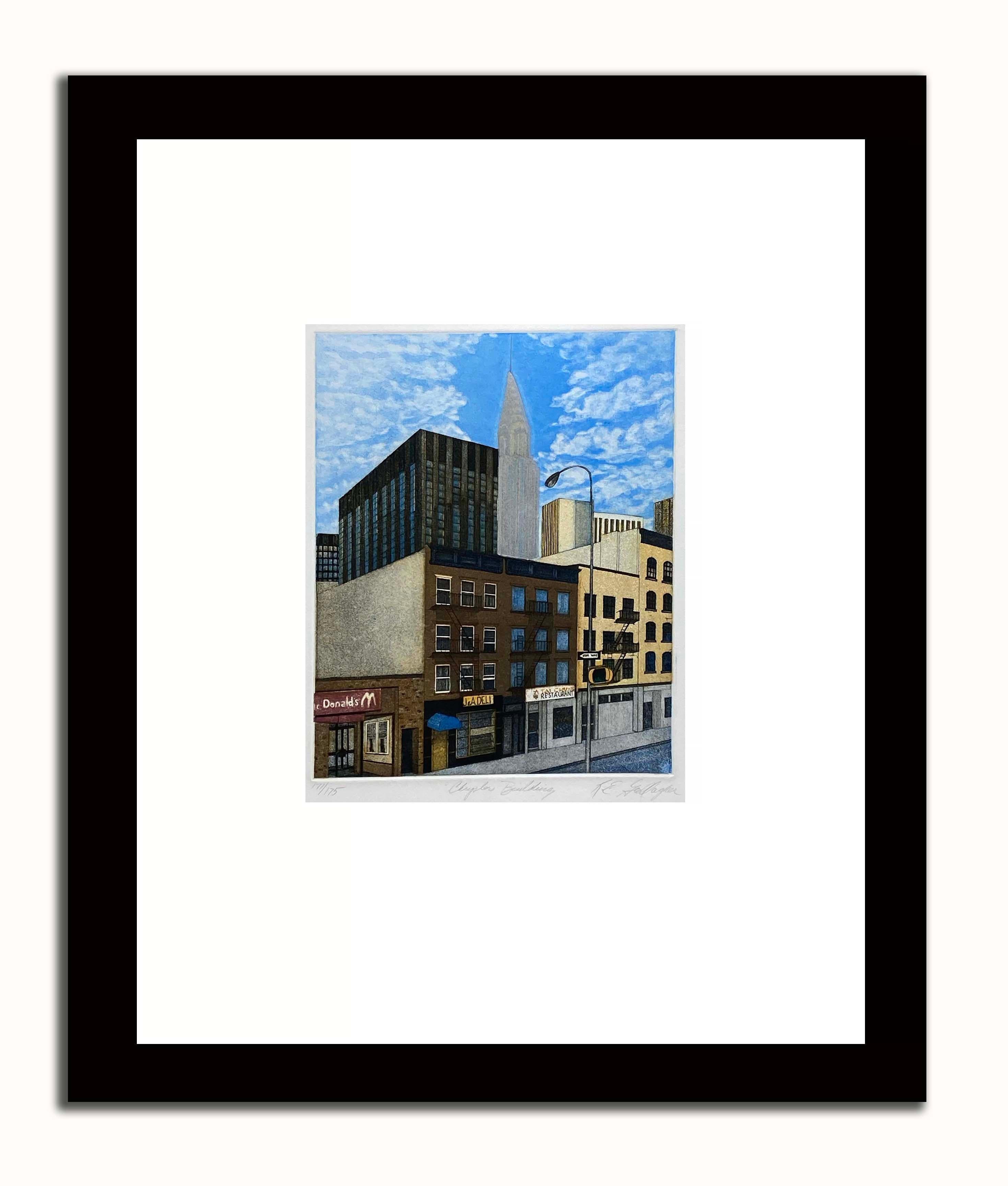
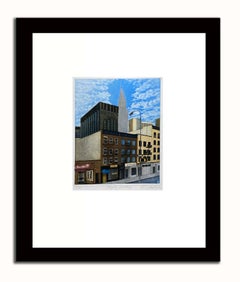
New York City Skyline Modern Print Chrysler State Building Framed Unique Etching
By Katherine Gallagher
Located in Buffalo, NY
Limited edition aquatint etching of the New York City skyline by Katherine E. Gallagher. This piece features the famous Chrysler Building prominently in the background along with a M...
Category
1980s Realist Landscape Prints
Materials
Etching, Aquatint
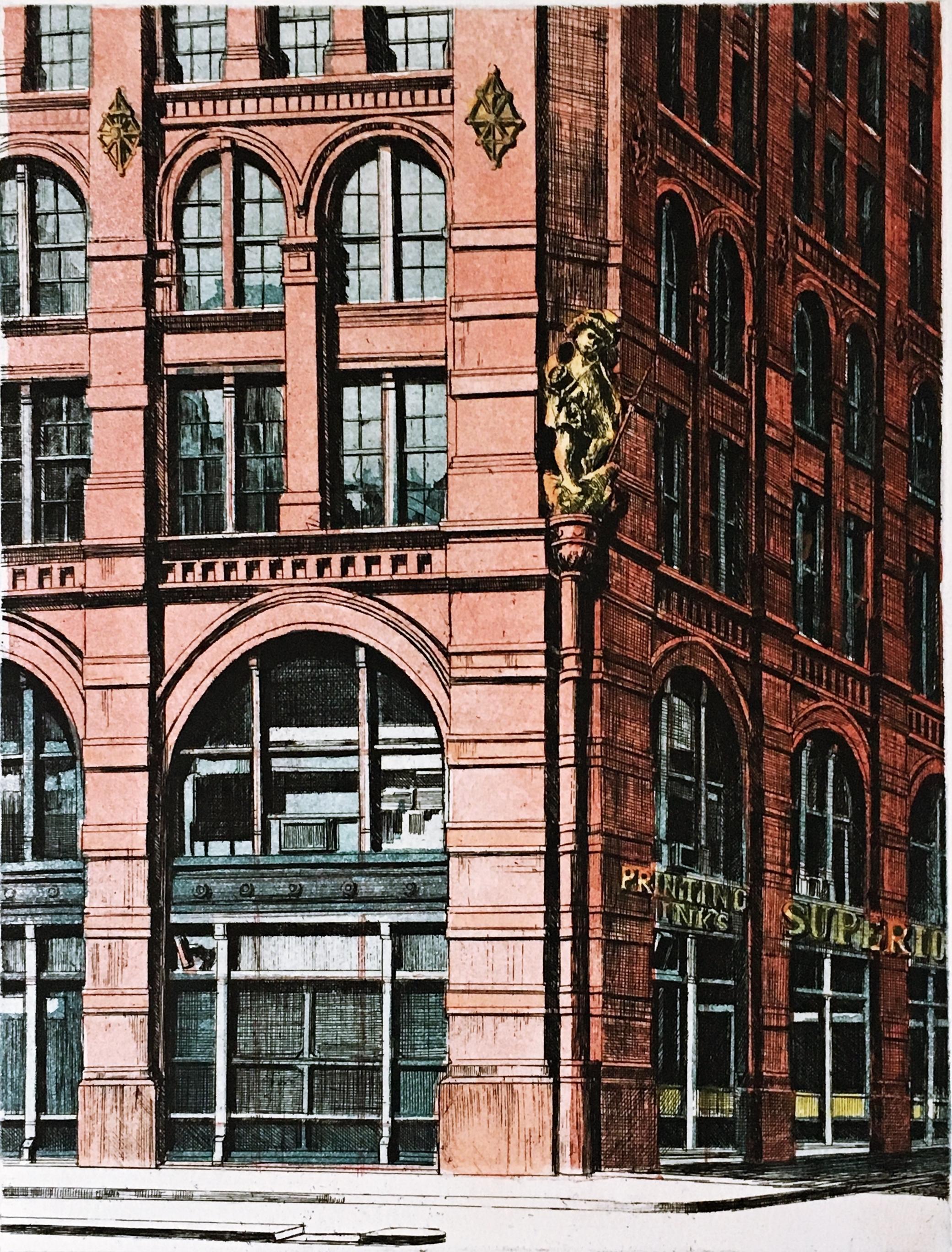
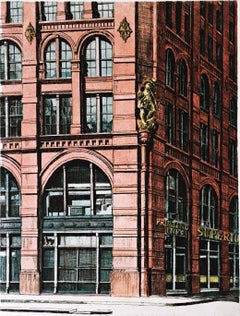
Puck Corner, SOHO, New York signed, numbered by top architectural artist, Framed
By Richard Haas
Located in New York, NY
Richard Haas
Puck Corner, SOHO, New York, 1971
Etching and Aquatint (affixed to white matting)
Hand signed and numbered 10/100 by the artist on the lower front
Elegantly matted and f...
Category
1970s Realist Figurative Prints
Materials
Pencil, Etching, Aquatint
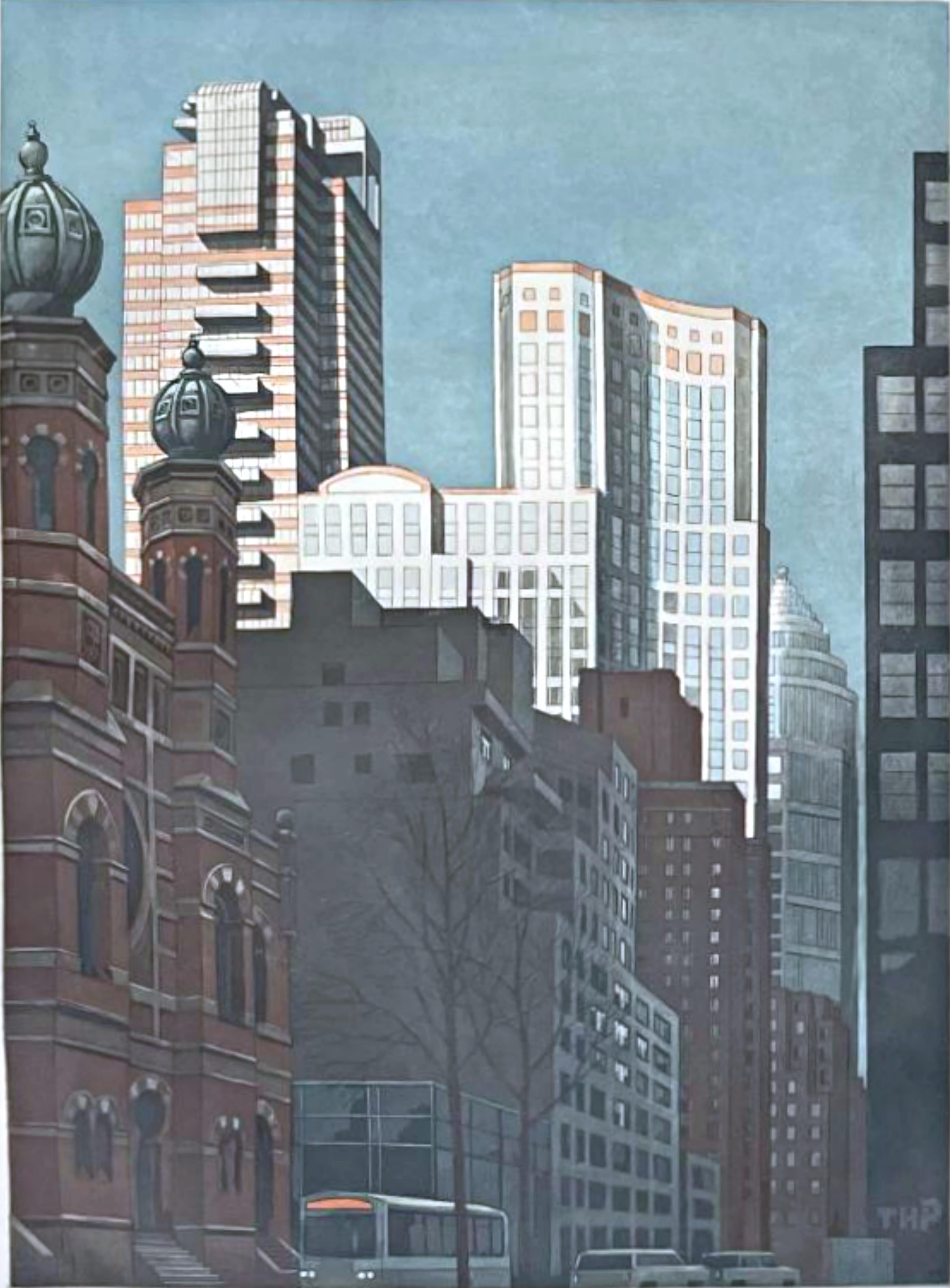
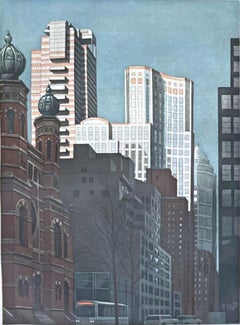
Central Synagogue Lexington Avenue Looking North Etching and aquatint S/N Framed
By Richard Haas
Located in New York, NY
Richard Haas
Central Synagogue - Lexington Avenue Looking North, 1991
Etching and aquatint on wove paper
Signed, dated and numbered 8/35 in graphite pencil on the front; bears the or...
Category
1990s Realist Landscape Prints
Materials
Etching, Aquatint
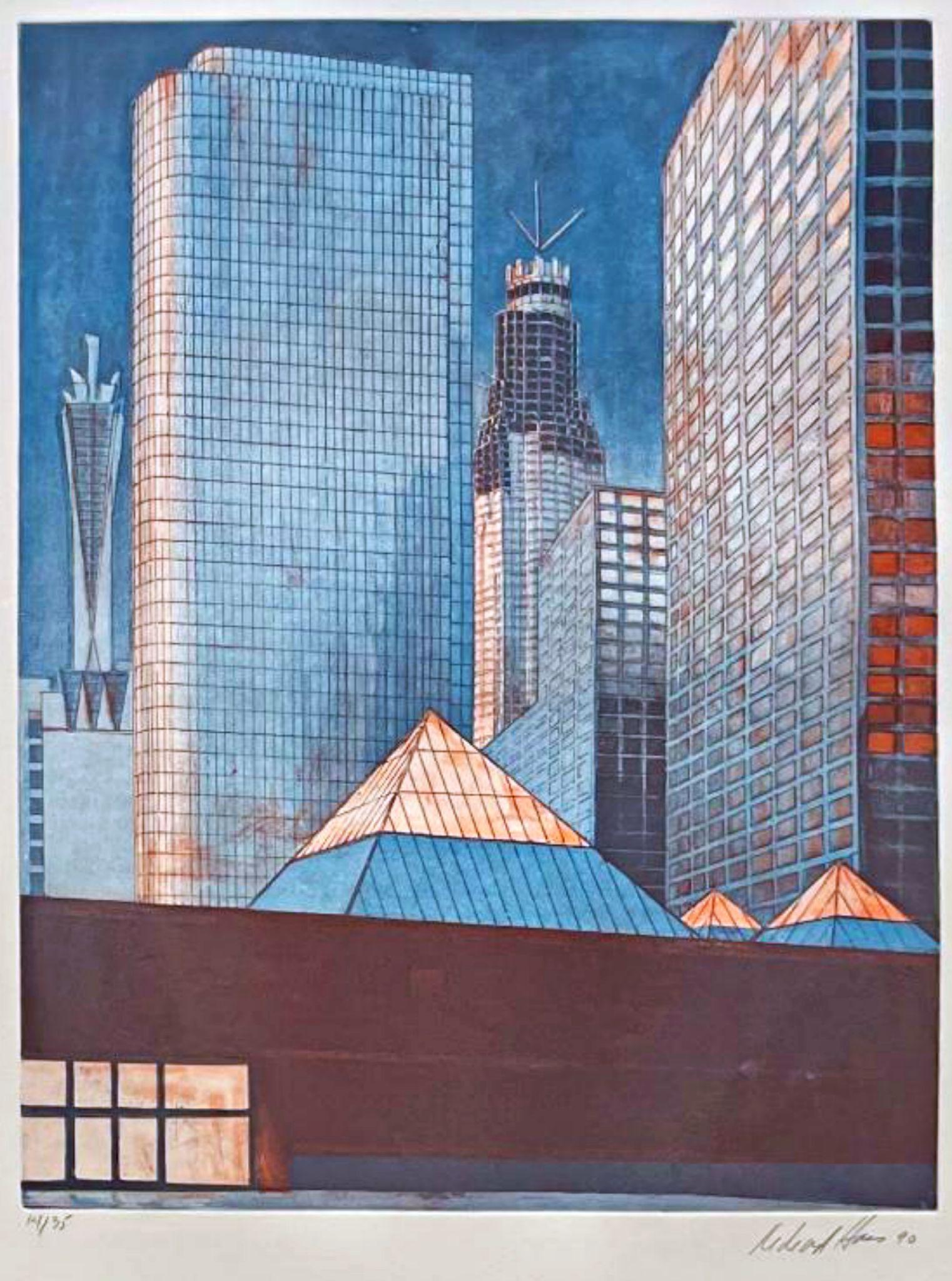
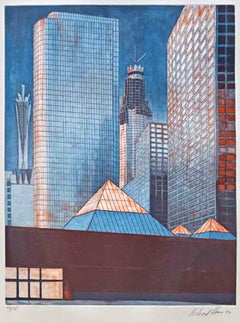
Richard Haas, Downtown Los Angeles MOCA, Etching
Aquatint, Signed/N, Framed
By Richard Haas
Located in New York, NY
Richard Haas
Downtown Los Angeles MOCA (Museum of Contemporary Art), 1991
Etching and aquatint on paper with printers blind stamp
SIgned, dated '91 and numbered 14/35 in graphite pen...
Category
1990s Realist Landscape Prints
Materials
Etching, Aquatint
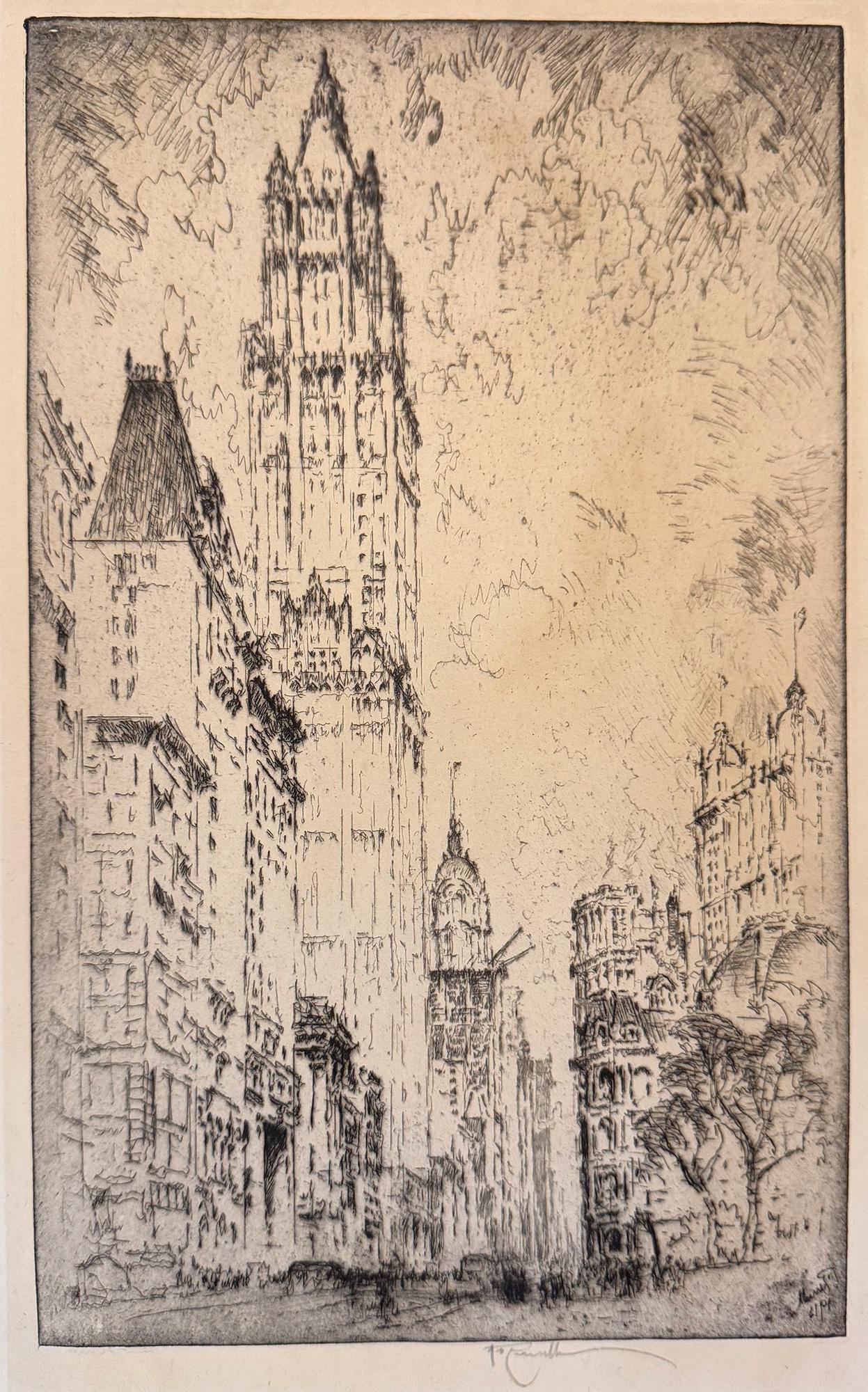
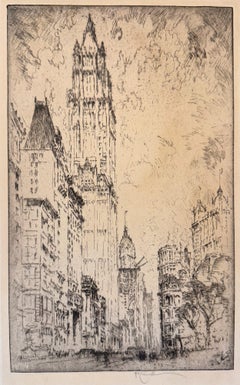
Woolworth Building, New York
By Paul Schumann
Located in Middletown, NY
A rich and tonal image of an icon of Manhattan architecture.
Etching with drypoint, 11 7/8 x 7 3/8 inches (300 x 186 mm), full margins. Edition of 100. Signed in pencil, lower right...
Category
Early 20th Century Realist Landscape Prints
Materials
Handmade Paper, Drypoint, Etching
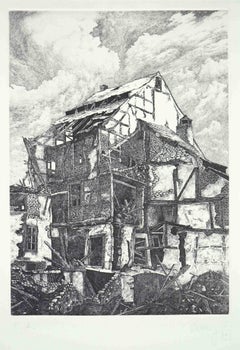
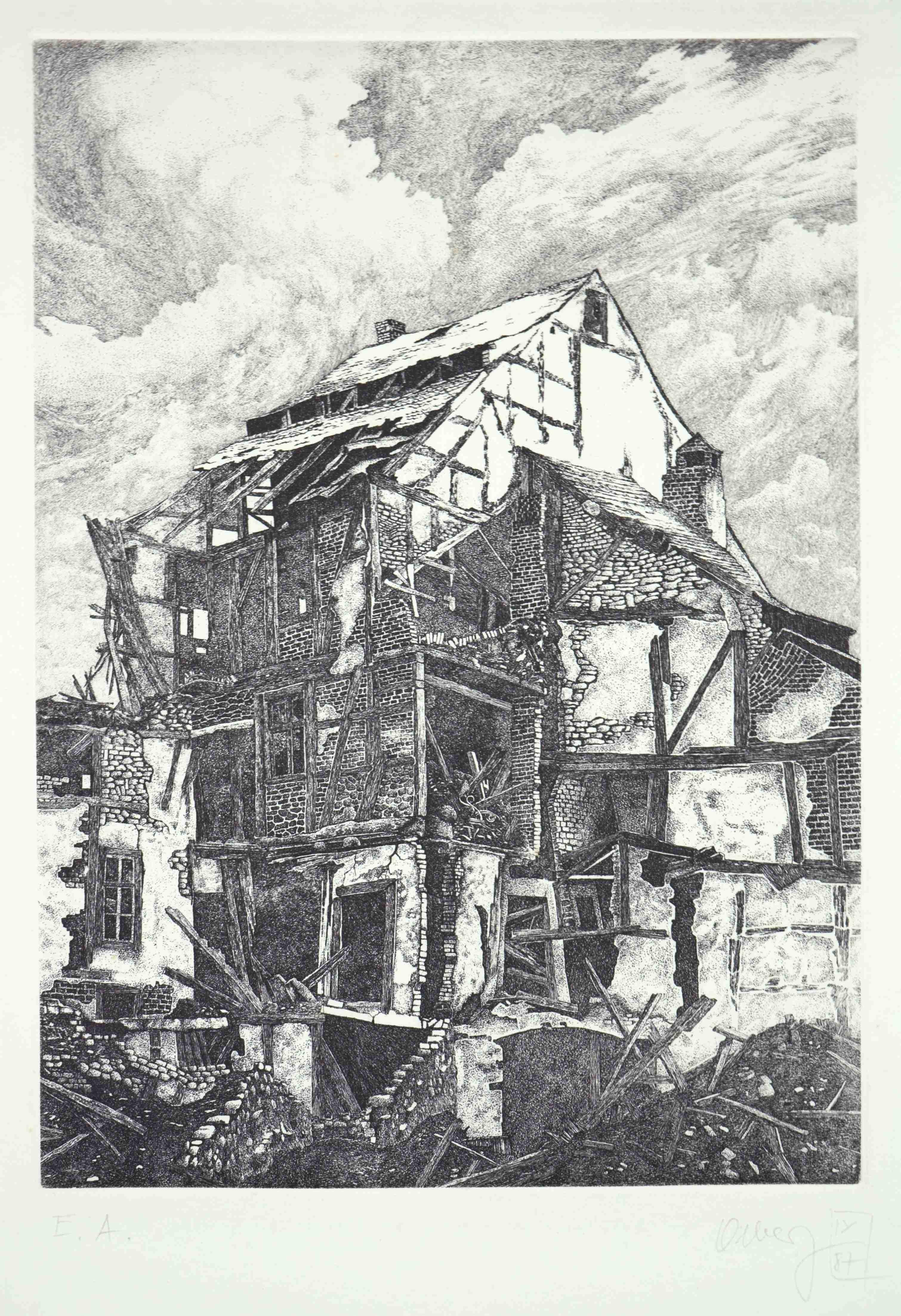
Agony - The architecture of decay -
Located in Berlin, DE
Jörg Olberg (*1956 Dresden), Agony, 1987. etching, E.A. (edition of 30), 24 x 17 cm (image), 46 x 37 cm (sheet), each signed in pencil lower right "Olberg" and dated "IX [19]87", inscribed lower left "E.A. [Epreuve d'Artiste]".
- minimal crease and dust stains in the broad margin
- The architecture of decay -
About the artwork
Jörg Olberg draws here the sum of his artistic study of the Berlin ruins, which were still present in the cityscape well into the 80s. With his work "Agony" he creates an allegory of decay. Positioned in the landscape of ruins, a ruined house grows before the viewer, rising like the Tower of Babel into the sky, its roof and gable brightly illuminated by the sun. But already the roof shows mostly only the rafters, and as the gaze is drawn further down, the building visibly disintegrates, the beams protruding in all directions looking like splintered bones. Slowly but inexorably - in agony - the house will collapse in on itself and become nothing more than the burial mound of itself. At the same time, the small-scale stone composition and the plaster form a pattern-like ornamentation of decay.
The tension in the picture is fed by the counter-movement of growth and collapse, which is heightened by the dramatic formation of clouds. The swirls of clouds are reminiscent of a world landscape...
Category
1980s Realist Figurative Prints
Materials
Etching, Paper