Want more images or videos?
Request additional images or videos from the seller
1 of 8
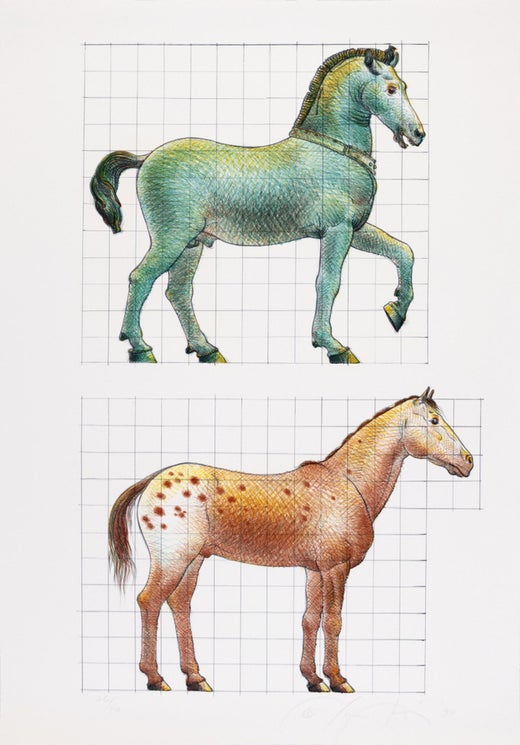
Luis JiménezFiesta (Diptych)1986
1986
Price:$2,000
About the Item
- Creator:Luis Jiménez (1940-2007, American)
- Creation Year:1986
- Dimensions:Height: 34 in (86.36 cm)Width: 48 in (121.92 cm)
- Medium:
- Movement Style:
- Period:
- Condition:
- Gallery Location:Long Island City, NY
- Reference Number:1stDibs: LU4664548231
Luis Jiménez
Born in El Paso, Texas, he worked at his father's neon sign studio as a child, which prepared him to make public art. He studied art and architecture at the University of Texas in Austin and El Paso, earning a bachelor's degree in 1964. He moved to New York City in 1966 after completing his post-graduate work at Ciudad Universitaria, Mexico City, D.F. He became an accomplished artist and taught art at the University of Arizona and later the University of Houston. As a sculptor, Jiménez was known for his large polychromed fiberglass sculptures, often of Southwestern and Hispanic themes. His works were often controversial. They are eminently recognizable due to their themes, his original sculptural style, and the colorful, undulating surfaces the artist employed. The finish of his sculptures had more in common with commercial products than with conventional fine art sculptures. Man on Fire (1969) at the Smithsonian American Art Museum in 2023 Jiménez was influenced by the murals of José Clemente Orozco and Diego Rivera. He was very much a contemporary artist whose roots were in pop art, as much as they were in both the modernism of the Mexican muralists and the regionalism of Thomas Hart Benton and Grant Wood. Heroic sculptures were Jiménez's forte, championing the common man in his work. By working in his father's shop on neon signs and sculptures, he was brought in contact with popular culture, which also included lowrider car culture. The brightly painted fiberglass bodywork, often accented with glitter, served as a particularly relevant artistic influence.[5] While he is best known as a sculptor, Jiménez also made remarkable color lithographs and color drawings in pencil, pastel, and oil stick. He made preparatory drawings for his sculptures, some of which were very large. Most of his sculptures were made of fiberglass, which were cast in a mold, after which they were painted with multiple layers of paint and coated with epoxy. One art expert has noted, "There was no surface on any Luis Jiménez sculpture that was ever any less than six different colors, each airbrushed separately adding a slightly different tone." Jiménez would also often use flake, that glittery quality often seen on lowrider cars, in his paint. In 1993, Jiménez was a recipient of the New Mexico Governor's Awards for Excellence in the Arts. In 1998 he received a Distinguished Alumni award from the University of Texas in recognition of his artwork.
About the Seller
4.9
Platinum Seller
Premium sellers with a 4.7+ rating and 24-hour response times
Established in 1979
1stDibs seller since 2014
3,194 sales on 1stDibs
Typical response time: 1 hour
Authenticity Guarantee
In the unlikely event there’s an issue with an item’s authenticity, contact us within 1 year for a full refund. DetailsMoney-Back Guarantee
If your item is not as described, is damaged in transit, or does not arrive, contact us within 7 days for a full refund. Details24-Hour Cancellation
You have a 24-hour grace period in which to reconsider your purchase, with no questions asked.Vetted Professional Sellers
Our world-class sellers must adhere to strict standards for service and quality, maintaining the integrity of our listings.Price-Match Guarantee
If you find that a seller listed the same item for a lower price elsewhere, we’ll match it.Trusted Global Delivery
Our best-in-class carrier network provides specialized shipping options worldwide, including custom delivery.You May Also Like
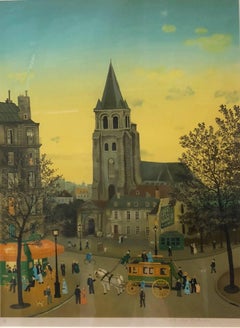
Hand signed Folk Art Naive lithograph on Arches paper Paris Evening Cafe Scene
By Michel Delacroix
Located in Surfside, FL
size includes frame: 32.5" H x 26.5" W;
Lithograph in colors depicting an enchanted evening in Paris with a bright cafe and a church or public building on a charming Paris square. ...
Category
20th Century Folk Art Figurative Prints
Materials
Lithograph
$1,750
H 32.5 in W 26.5 in
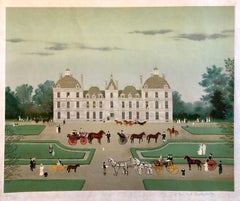
Hand signed Folk Art Naive lithograph on Japon Paper Paris French Country Scene
By Michel Delacroix
Located in Surfside, FL
Château de Cheverny in the Loire Valley of France
Lithograph in colors depicting an enchanted evening at Cheverny with a horse drawn wagon and carriages on a winter day, Signed in...
Category
20th Century Folk Art Figurative Prints
Materials
Lithograph
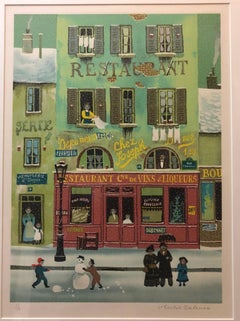
Hand signed Folk Art Naive lithograph on Arches Paper Paris Snowman Scene
By Michel Delacroix
Located in Surfside, FL
Lithograph in colors depicting an enchanted evening in Paris with a snowman and children playing outside the restaurant Chez Joseph on a winter day. Signed in bottom right margin "M...
Category
20th Century Folk Art Figurative Prints
Materials
Lithograph
$1,450
H 28.75 in W 22.75 in
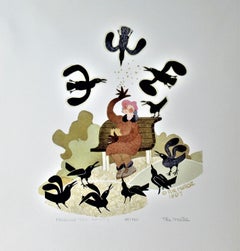
Feeding the Ravens
Located in San Francisco, CA
This artwork titled "Feeding the Ravens" 1997 is a color offset lithograph on paper by noted American artist Rie Mounier Munoz, 1921-2015. It is hand signed and numbered 29/950 in pencil by the artist. The image size is 9.65 x 8.35 inches, sheet size is 13.85 x 12.25 inches. It is in excellent condition, has never been framed.
About the artist:
Alaska painter Rie Mounier Munoz was the child of Dutch parents who immigrated to California, where she was born and raised. She is known for her colorful scenes of everyday life in Alaska.
Rie (from Marie) Munoz (moo nyos), studied art at Washington and Lee University in Virginia. In 1950, she traveled up the Inside Passage by steamship, fell in love with Juneau, and gave herself until the boat left the next day to find a job and a place to live. Since then Juneau has been home to Munoz. She began painting small vignettes of Alaska soon after arriving in Juneau, and also studied art at the University of Alaska-Juneau.
Munoz painted in oils in what she describes as a "painstakingly realistic" style, which she found stiff and "somewhat boring." Her breakthrough came a few years later when an artist friend introduced her to a versatile, water-soluble paint called casein. The immediacy of this inexpensive medium prompted an entirely new style. Rie's paintings became colorful and carefree, mirroring her own optimistic attitude toward life. With her newfound technique she set about recording everyday scenes of Alaskans at work and at play.
Of the many jobs she has held journalist, teacher, museum curator, artist, mother, Munoz recalls one of her most memorable was as a teacher on King Island in 1951, where she taught 25 Eskimo children. The island was a 13-hour umiak (a walrus skin boat) voyage from Nome, an experience she remembers vividly. After teaching in the Inupiat Eskimo village on the island with her husband during one school year, she felt a special affinity for Alaska's Native peoples and deliberately set about recording their traditional lifestyles that she knew to be changing very fast.
For the next twenty years, Rie practiced her art as a "Sunday painter," in and around prospecting with her husband, raising a son, and working as a freelance commercial artist, illustrator, cartoonist, and curator of exhibits for the Alaska State Museum. During her years in Alaska, Munoz has lived in a variety of small Alaskan communities, including prospecting and mining camps.
Her paintings reflect an interest in the day-to-day activities of village life such as fishing, berry picking, children at play, as well as her love of folklore and legends. Munoz says that what has appealed to her most were "images you might not think an artist would want to paint," such as people butchering crab, skinning a seal, or doing their laundry in a hand-cranked washing machine.
In 1972, with her hand-cut stencil and serigraph prints selling well in four locations in Alaska, she felt confident enough to leave her job at the Alaska State Museum and devote herself full time to her art. Freed from the constraints of an office job, she began to produce close to a hundred paintings a year, in addition to stone lithograph and serigraph prints.
From her earliest days as an artist, Rie had firm beliefs about selling her work. First, she insisted the edition size should be kept modest. When she decided in 1973 to reproduce Eskimo Story Teller as an offset lithography print and found the minimum print run to be 500, she destroyed 200 of the prints. She did the same with King Island, her second reproduction. Reluctantly, to meet market demand, she increased the edition size of the reproductions to 500 and then 750. The editions stayed at that level for almost ten years before climbing to 950 and 1250.
Her work has been exhibited many solo watercolor exhibits in Alaska, Oregon and Washington State, including the Charles and Emma Frye Art Museum, Alaska State Museum in Juneau, Anchorage Historical and Fine Arts Museum, Tongass Historical Museum in Ketchikan, and Yukon Regional Library in Whitehorse; Yukon Territory, and included in exhibits at the Smithsonian Institute and Russell Senate Office Building in Washington, D.C.
Munozs paintings have graced the covers of countless publications, from cookbooks to mail order catalogs, and been published in magazines, newspapers, posters, calendars, and two previous collections of her work: Rie Munoz...
Category
Late 20th Century Folk Art Animal Prints
Materials
Lithograph
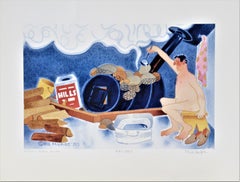
Steam Bath, Aniak
Located in San Francisco, CA
This artwork titled "Steam Bath, Aniak" 1995 is a color offset lithograph on paper by noted American artist Rie Mounier Munoz, 1921-2015. It is hand signed and numbered 38/950 in pencil by the artist. The image size is 6.75 x 10 inches, sheet size is 10.5 x 14 inches. It is in excellent condition..
About the artist:
Alaska painter Rie Mounier Munoz was the child of Dutch parents who immigrated to California, where she was born and raised. She is known for her colorful scenes of everyday life in Alaska.
Rie (from Marie) Munoz (moo nyos), studied art at Washington and Lee University in Virginia. In 1950, she traveled up the Inside Passage by steamship, fell in love with Juneau, and gave herself until the boat left the next day to find a job and a place to live. Since then Juneau has been home to Munoz. She began painting small vignettes of Alaska soon after arriving in Juneau, and also studied art at the University of Alaska-Juneau.
Munoz painted in oils in what she describes as a "painstakingly realistic" style, which she found stiff and "somewhat boring." Her breakthrough came a few years later when an artist friend introduced her to a versatile, water-soluble paint called casein. The immediacy of this inexpensive medium prompted an entirely new style. Rie's paintings became colorful and carefree, mirroring her own optimistic attitude toward life. With her newfound technique she set about recording everyday scenes of Alaskans at work and at play.
Of the many jobs she has held journalist, teacher, museum curator, artist, mother, Munoz recalls one of her most memorable was as a teacher on King Island in 1951, where she taught 25 Eskimo children. The island was a 13-hour umiak (a walrus skin boat) voyage from Nome, an experience she remembers vividly. After teaching in the Inupiat Eskimo village on the island with her husband during one school year, she felt a special affinity for Alaska's Native peoples and deliberately set about recording their traditional lifestyles that she knew to be changing very fast.
For the next twenty years, Rie practiced her art as a "Sunday painter," in and around prospecting with her husband, raising a son, and working as a freelance commercial artist, illustrator, cartoonist, and curator of exhibits for the Alaska State Museum. During her years in Alaska, Munoz has lived in a variety of small Alaskan communities, including prospecting and mining camps.
Her paintings reflect an interest in the day-to-day activities of village life such as fishing, berry picking, children at play, as well as her love of folklore and legends. Munoz says that what has appealed to her most were "images you might not think an artist would want to paint," such as people butchering crab, skinning a seal, or doing their laundry in a hand-cranked washing machine.
In 1972, with her hand-cut stencil and serigraph prints selling well in four locations in Alaska, she felt confident enough to leave her job at the Alaska State Museum and devote herself full time to her art. Freed from the constraints of an office job, she began to produce close to a hundred paintings a year, in addition to stone lithograph and serigraph prints.
From her earliest days as an artist, Rie had firm beliefs about selling her work. First, she insisted the edition size should be kept modest. When she decided in 1973 to reproduce Eskimo Story Teller as an offset lithography print and found the minimum print run to be 500, she destroyed 200 of the prints. She did the same with King Island, her second reproduction. Reluctantly, to meet market demand, she increased the edition size of the reproductions to 500 and then 750. The editions stayed at that level for almost ten years before climbing to 950 and 1250.
Her work has been exhibited many solo watercolor exhibits in Alaska, Oregon and Washington State, including the Charles and Emma Frye Art Museum, Alaska State Museum in Juneau, Anchorage Historical and Fine Arts Museum, Tongass Historical Museum in Ketchikan, and Yukon Regional Library in Whitehorse; Yukon Territory, and included in exhibits at the Smithsonian Institute and Russell Senate Office Building in Washington, D.C.
Munozs paintings have graced the covers of countless publications, from cookbooks to mail order catalogs, and been published in magazines, newspapers, posters, calendars, and two previous collections of her work: Rie Munoz...
Category
Late 20th Century Folk Art Nude Prints
Materials
Lithograph
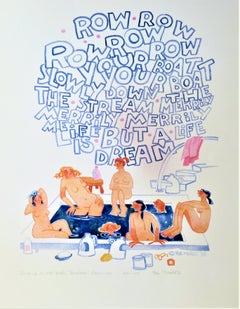
Singing in the Bath, Tenakee Springs
Located in San Francisco, CA
This artwork titled "Singing in the Bath, Tenakee Springs" 1996 is a color offset lithograph on paper by noted American artist Rie Mounier Munoz, 1921-2015. It is hand signed and numbered 1077/1100 in pencil by the artist. The image size is 13.5 x 10 inches, sheet size is 16 x 12.35 inches. It is in excellent condition, has never been framed.
About the artist:
Alaska painter Rie Mounier Munoz was the child of Dutch parents who immigrated to California, where she was born and raised. She is known for her colorful scenes of everyday life in Alaska.
Rie (from Marie) Munoz (moo nyos), studied art at Washington and Lee University in Virginia. In 1950, she traveled up the Inside Passage by steamship, fell in love with Juneau, and gave herself until the boat left the next day to find a job and a place to live. Since then Juneau has been home to Munoz. She began painting small vignettes of Alaska soon after arriving in Juneau, and also studied art at the University of Alaska-Juneau.
Munoz painted in oils in what she describes as a "painstakingly realistic" style, which she found stiff and "somewhat boring." Her breakthrough came a few years later when an artist friend introduced her to a versatile, water-soluble paint called casein. The immediacy of this inexpensive medium prompted an entirely new style. Rie's paintings became colorful and carefree, mirroring her own optimistic attitude toward life. With her newfound technique she set about recording everyday scenes of Alaskans at work and at play.
Of the many jobs she has held journalist, teacher, museum curator, artist, mother, Munoz recalls one of her most memorable was as a teacher on King Island in 1951, where she taught 25 Eskimo children. The island was a 13-hour umiak (a walrus skin boat) voyage from Nome, an experience she remembers vividly. After teaching in the Inupiat Eskimo village on the island with her husband during one school year, she felt a special affinity for Alaska's Native peoples and deliberately set about recording their traditional lifestyles that she knew to be changing very fast.
For the next twenty years, Rie practiced her art as a "Sunday painter," in and around prospecting with her husband, raising a son, and working as a freelance commercial artist, illustrator, cartoonist, and curator of exhibits for the Alaska State Museum. During her years in Alaska, Munoz has lived in a variety of small Alaskan communities, including prospecting and mining camps.
Her paintings reflect an interest in the day-to-day activities of village life such as fishing, berry picking, children at play, as well as her love of folklore and legends. Munoz says that what has appealed to her most were "images you might not think an artist would want to paint," such as people butchering crab, skinning a seal, or doing their laundry in a hand-cranked washing machine.
In 1972, with her hand-cut stencil and serigraph prints selling well in four locations in Alaska, she felt confident enough to leave her job at the Alaska State Museum and devote herself full time to her art. Freed from the constraints of an office job, she began to produce close to a hundred paintings a year, in addition to stone lithograph and serigraph prints.
From her earliest days as an artist, Rie had firm beliefs about selling her work. First, she insisted the edition size should be kept modest. When she decided in 1973 to reproduce Eskimo Story Teller as an offset lithography print and found the minimum print run to be 500, she destroyed 200 of the prints. She did the same with King Island, her second reproduction. Reluctantly, to meet market demand, she increased the edition size of the reproductions to 500 and then 750. The editions stayed at that level for almost ten years before climbing to 950 and 1250.
Her work has been exhibited many solo watercolor exhibits in Alaska, Oregon and Washington State, including the Charles and Emma Frye Art Museum, Alaska State Museum in Juneau, Anchorage Historical and Fine Arts Museum, Tongass Historical Museum in Ketchikan, and Yukon Regional Library in Whitehorse; Yukon Territory, and included in exhibits at the Smithsonian Institute and Russell Senate Office Building in Washington, D.C.
Munozs paintings have graced the covers of countless publications, from cookbooks to mail order catalogs, and been published in magazines, newspapers, posters, calendars, and two previous collections of her work: Rie Munoz...
Category
Late 20th Century Folk Art Nude Prints
Materials
Lithograph
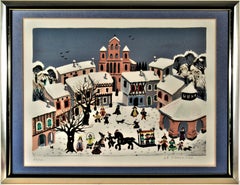
Village en Hiver
Located in San Francisco, CA
This artwork "Village en Hiver" c.1980 is an original color lithograph by French artist Madeleine (Mady) De La Giraudiere, 1922-2018. It is hand signed a...
Category
Late 20th Century Folk Art Figurative Prints
Materials
Lithograph
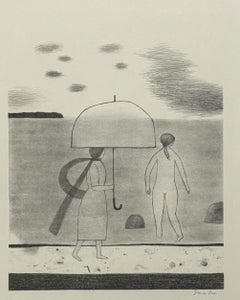
Modernist FOLK ART Original Pencil Lithograph "GRAY DAY AT THE BEACH"
By Doris Lee
Located in New York, NY
Doris Lee
Lithograph
1964
Edition Size: 250
Image Size: 12 x 9.5 inches
Sheet Size: 16.75 x 13 inches
Reference: AAA 1532
Signed lower left
Condition: Good
Provenance: ASA
Doris Emrick Lee...
Category
1960s Folk Art Landscape Prints
Materials
Lithograph, Archival Pigment
$1,100
H 17 in W 13 in D 1 in
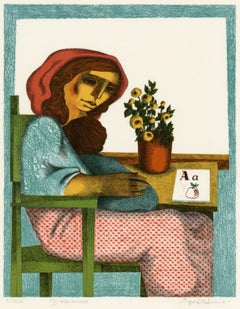
Descanso (Break)
By Jorge Dumas
Located in Fairlawn, OH
Signed, titled and numbered in pencil
Edition: 250 (5/250)
Signed, titled and numbered in pencil
Published by Circle Gallery Ltd.
Printer: Atelier Dumas, New York
Condition: Very good
Atelier Dumas opened in New York printing own work as well as
those of Peter Max, Agam, Romare Bearden, Dali, Erté, Peter Hurd,
Ting, Karl Appel...
Category
1970s Folk Art Figurative Prints
Materials
Lithograph
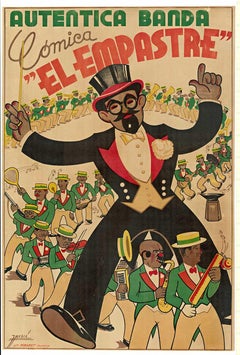
Original El Empastre Autentica Comica Banda vintage poster
Located in Spokane, WA
Original Autentica Banda Comica “El Empastre” vintage poster. Archival linen backed in A- condition, ready to frame. Printed by Mirabet in Valencia, Spain.
El Empastre, a come...
Category
1940s Folk Art Portrait Prints
Materials
Lithograph
$749 Sale Price
20% Off
H 37.5 in W 25.5 in D 0.05 in
More From This Seller
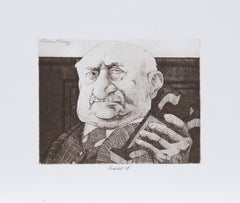
View AllExhibit A, Folk Art Lithograph by Charles Bragg
By Charles Bragg
Located in Long Island City, NY
Charles Bragg, American (1931 - 2017) - Exhibit A, Year: 1976, Medium: Lithograph, Image Size: 5.5 x 7 inches, Size: 11.5 in. x 14.5 in. (29.21 cm x 36.83 cm)
Category
1970s Folk Art Figurative Prints
Materials
Lithograph
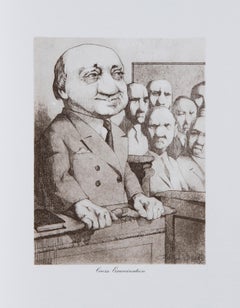
Cross Examination, Folk Art Lithograph by Charles Bragg
By Charles Bragg
Located in Long Island City, NY
Charles Bragg, American (1931 - 2017) - Cross Examination, Year: 1976, Medium: Lithograph, Image Size: 8 x 6 inches, Size: 14.5 in. x 11.5 in. (36.83 cm x 29.21 cm)
Category
1970s Folk Art Figurative Prints
Materials
Lithograph
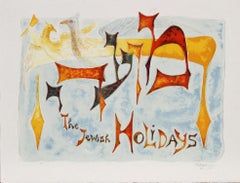
The Jewish Holidays, Modern Portfolio of 22 lithographs by Chaim Gross
By Chaim Gross
Located in Long Island City, NY
The Jewish Holidays portfolio by Chaim Gross. This portfolio consists of 11 color lithographs plus 11 black and white lithographs of the same images depicting 11 of the Jewish Holid...
Category
1960s Folk Art Figurative Prints
Materials
Lithograph
Women from Salt River, Folk Art Lithograph by R.C. Gorman
By R.C. Gorman
Located in Long Island City, NY
An original hand-signed lithograph by Native American artist, RC Gorman. Numbered AP 15.
Category
1990s Folk Art Figurative Prints
Materials
Lithograph

...And The Children, Folk Art Lithograph by Ruth Anaya
Located in Long Island City, NY
Ruth Anaya, Canadian (1933 - ) - ...And The Children, Medium: Lithograph on natural paper, signed, titled and numbered in pencil, Edition: 89/100, Image Size: 6 x 14 inches, Frame...
Category
Mid-20th Century Folk Art Figurative Prints
Materials
Lithograph
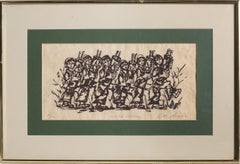
Filippe, Folk Art Lithograph by Vic Herman
Located in Long Island City, NY
Vic Herman, American (1919 - 1999) - Filippe, Year: circa 1979, Medium: Lithograph, signed and numbered in pencil, Edition: 300, AP 45, Image Size: 24 x 16 inches, Size: 29 in. ...
Category
1970s Folk Art Figurative Prints
Materials
Lithograph
Still Thinking About These?
All Recently ViewedRead More
Romare Bearden’s Humanity Infuses His Bright, Bold Art
Through collage, painting and printmaking, the artist foregrounded Black life in America in revolutionary new ways.
Chryssa’s 1962 Neon Sculpture Was Way ahead of the Art-World Curve
By working with lettering, neon and Pop imagery, Chryssa pioneered several postmodern themes at a time when most male artists detested commercial mediums.