Items Similar to Die Bettler (The Beggars)
Want more images or videos?
Request additional images or videos from the seller
1 of 9
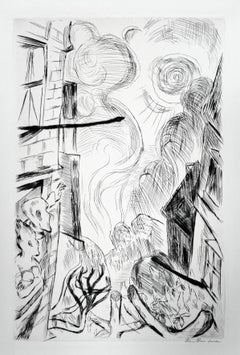
Max BeckmannDie Bettler (The Beggars)1922
1922
$9,500
£7,210.99
€8,269.19
CA$13,409.20
A$14,393.52
CHF 7,663.81
MX$170,475.07
NOK 96,849.62
SEK 88,450.72
DKK 61,774.63
About the Item
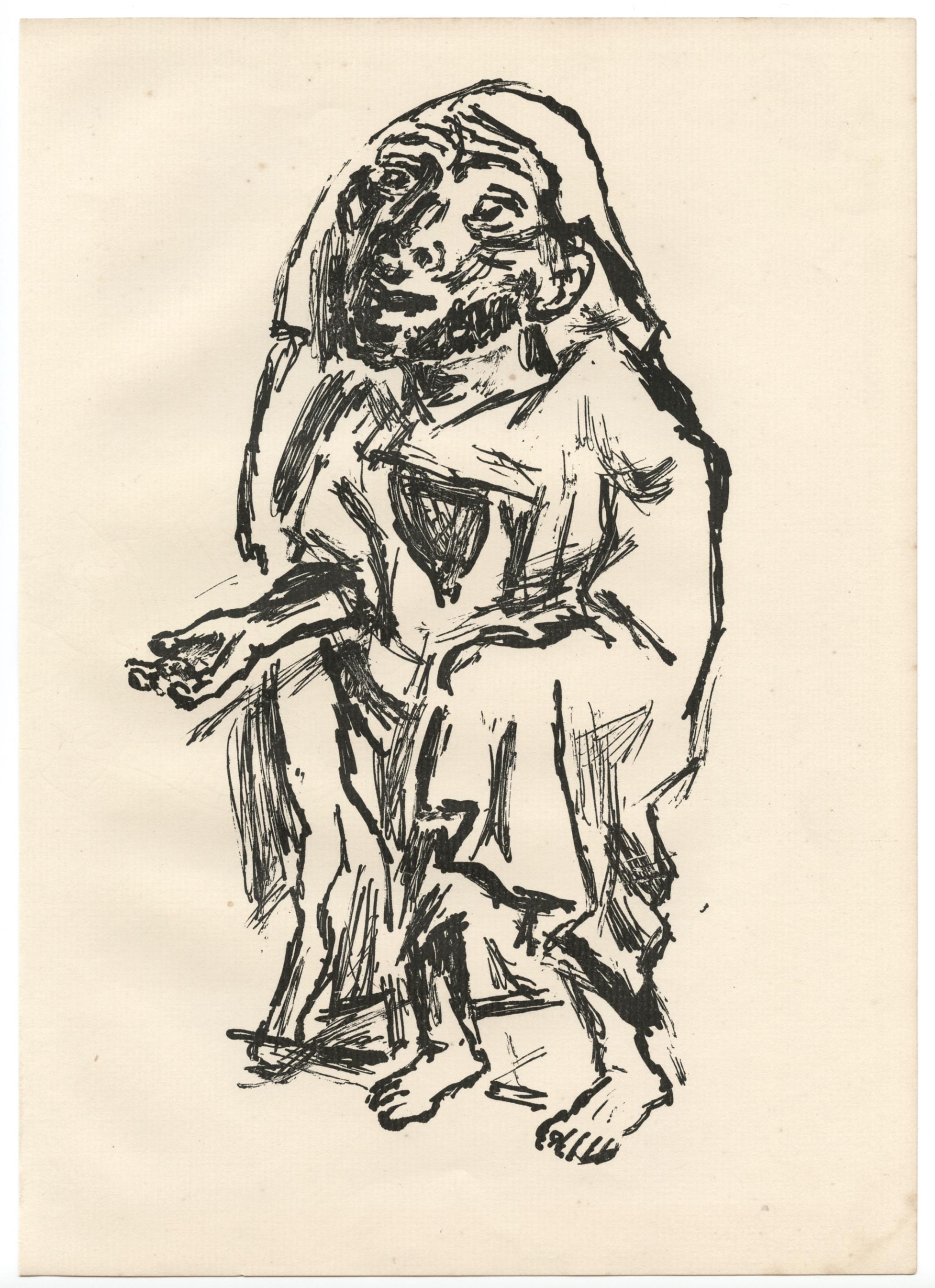
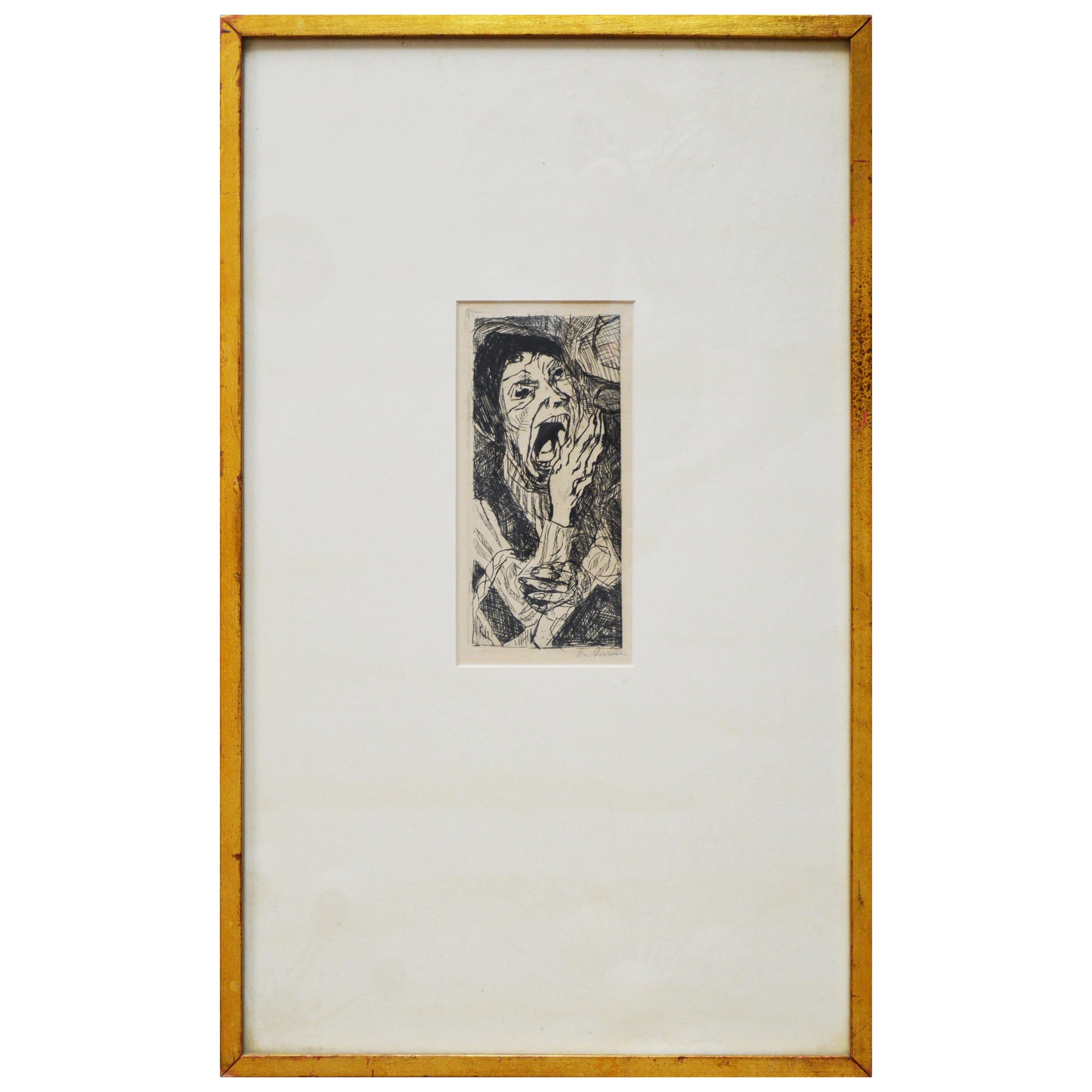
Die Bettler (The Beggars)
Lithograph, 1922
Signed in pencil lower right (see photo)
From: Berliner Reise Series, Plate 7
Printed on wove paper
Edition: 100
Condition: Printers crease in the lower left margin, not affecting image. According to Jorg Maas, this printer's crease has been on every impression of this image that he has seen.Full sheet as issued.
Reference: Glaser 195
Gallwitz 188b
Hofmaier 219B
An example of this image is in the following museum collections:
Brooklyn Museum
Museum of Modern Art, New York (MOMA)
Worcester Art Museum
Museum of Fine Arts, Boston
Metropolitan Museum of Art, New York
Fine Arts Museum of San Francisco
Portland Art Museum, Oregon
St. Louis Art Museum
Art Institute of Chicago
Text from Frances Carey and Antony Griffiths, 'The Print in Germany 1880-1933', BM 1984, no.153
The portfolio 'Berliner Reise' (Journey to Berlin) consisting of ten large transfer lithographs, can be seen as a sort of sequel to 'Die Hölle'. Compared with the earlier series the approach is more dispassionate, and the artist presents himself in the first introductory plate more as the neutral observer, pen in hand, than the critic and appalled participant. The plates are organised in a series of contrasts or parallels. 'The disappointed I' is the second plate, and shows a group of seven well-to-do people discussing in a circle the news brought to them by their conservative newspaper, the '[Neue Preussische] Kreuz-Zeitung' [a conservative daily endorsed by the Prussian aristocracy]. Their discontent, evident in their gestures and expressions, must be with the end of the German Reich and the establishment of Weimar democracy. The contrasting third plate, 'Night', portrays a poor family sleeping in exhaustion in a mean tenement block; the baby is given Beckmann's own features. The sixth plate is also entitled 'The disappointed', but the four people yawning as they conduct a desultory conversation are now identified as Communist ideologues by the publications they carry, which are speeches and addresses by Rosa Luxemburg and Karl Liebknecht; the failure of the Spartacus rising has left them as disappointed as the monarchists.
'Berliner Reise' was drawn in the early months of 1922 and published by J.B. Neumann in April that year in a signed and numbered edition of one hundred. The two plates catalogued in Carey
Griffiths 1984, being neither signed nor numbered, must be a few spare sheets printed above the stated number in case of accident and thus left unsigned when they were not needed. None of the original transfer drawings seems to survive, though von Wiese catalogues several related pencil studies from a sketchbook.
Courtesy British Museum
- Creator:Max Beckmann (1884-1950, German)
- Creation Year:1922
- Dimensions:Height: 18.375 in (46.68 cm)Width: 13.125 in (33.34 cm)
- Medium:
- Movement Style:
- Period:
- Condition:
- Gallery Location:Fairlawn, OH
- Reference Number:Seller: FA95071stDibs: LU14014041542
Max Beckmann
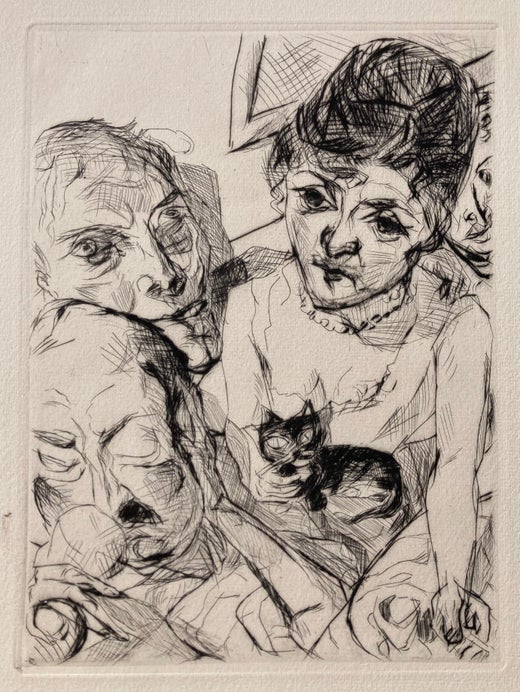
Max Beckmann was one of the most influential artists of the 20th century - both as a painter and as an outstanding graphic artist. Printmaking was the main medium he worked in between 1914 and 1924, creating a total of 156 drypoints, 72 lithographs and 16 woodcuts. From wikipedia: Max Carl Friedrich Beckmann (February 12, 1884 – December 27, 1950) was a German painter, draftsman, printmaker, sculptor, and writer. Although he is classified as an Expressionist artist, he rejected both the term and the movement.[1] In the 1920s, he was associated with the New Objectivity (Neue Sachlichkeit), an outgrowth of Expressionism that opposed its introverted emotionalism. Even when dealing with light subject matter like circus performers, Beckmann often had an undercurrent of moodiness or unease in his works. By the 1930s, his work became more explicit in its horrifying imagery and distorted forms with combination of brutal realism and social criticism, coinciding with the rise of nazism in Germany.
About the Seller
5.0
Recognized Seller
These prestigious sellers are industry leaders and represent the highest echelon for item quality and design.
Platinum Seller
Premium sellers with a 4.7+ rating and 24-hour response times
Established in 1978
1stDibs seller since 2013
841 sales on 1stDibs
Typical response time: <1 hour
Associations
International Fine Print Dealers Association
- ShippingRetrieving quote...Shipping from: Fairlawn, OH
- Return Policy
More From This Seller
View AllLower East Side Crowd
By Abraham Walkowitz
Located in Fairlawn, OH
Lower East Side Crowd
Ink and ink wash on paper, c. 1910
Signed in ink lower center edge (see photo)
Signed with the initials lower right corner (see p...
Category
1910s American Modern Figurative Drawings and Watercolors
Materials
Ink
The Irish Fair
By George Wesley Bellows
Located in Fairlawn, OH
Irish Fair
Lithograph, 1923
Signed and numbered in pencil by the artist (see photo)
Titled "Irish Fair" by the artist in pencil
Edition: 84
Housed in an archival frame with acid free matting (see photo)
Provenance:
Estate of the artist, Bellows Family Trust
H.V. Allison & Company (label)
Private Collection, Columbus
References And Exhibitions:
Reference: Mason 153
Note: An illustration commissioned by The Century Company for Don Byrne's novel The Wind Bloweth
Image: 18 7/8 x 21 3/8"
Frame: 29 1/2 x 30 1/2"
“Eleven on a hot July morning, and the little town...
Category
1920s Ashcan School Figurative Prints
Materials
Lithograph
Triste Os (Sad Bones)
By Georges Rouault
Located in Fairlawn, OH
Triste Os (Sad Bones)
Color etching and aquatint on Montval laid paper, 1934
Monogrammed and dated in the plate (see photo)
Edition: 250
References And Exhibitions:
Plate 8 from the ...
Category
1930s French School Figurative Prints
Materials
Etching, Aquatint
Untitled (Double sided watercolor) Recto: Figures seated at a table
By Ben Shahn
Located in Fairlawn, OH
Watercolor on paper
Most probably related to the artist's creation of images surrounding Haggadah (Passover) which he started in 1930 and finished with the publication of his book in...
Category
1960s American Modern Figurative Drawings and Watercolors
Materials
Watercolor
The Woman and the Street
By Marc Chagall
Located in Fairlawn, OH
The Woman and the Street
Etching, 1927-1930
Signed in the plate lower right corner (see photo)
From: The Fables of La Fontaine, Plate 84
From the deluxe portfolio edition of 40 examp...
Category
1920s French School Prints and Multiples
Materials
Etching
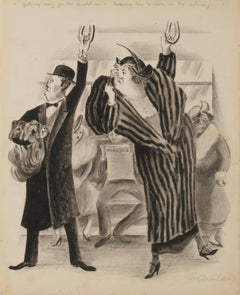
Getting Ready for the Revolution - Learning How to Ride in the Subway
By Adolf Arthur Dehn
Located in Fairlawn, OH
Getting Ready for the Revolution - Learning How to Ride in the Subway
Litho crayons on illustrator’s board, c. 1932
Signed: Adolf Dehn (VED) lower right corner (signed by Virginia Dehn, the artist’s widow)
Tilted along the upper edge of the recto in pencil by the artist
Verso inscriptions: “VF 3168.D” in a circle, also annotated in red pencil “32” in a circle and “699
Provenance:
Mary Ryan Gallery, exhibition entitled Adolf Dehn Lithographs, 1927-1940, Nov. 16 to Dec. 12, 1982. The original exhibition notice us affixed to the backing board of the frame
Note: A drawing intended or used in the publication Vanity Fair, for whom Dehn worked in the mid 1920’s to the 1930’s.
Adolf Dehn, American Watercolorist and Printmaker, 1895-1968
Adolf Dehn was an artist who achieved extraordinary artistic heights, but in a very particular artistic sphere—not so much in oil painting as in watercolor and lithography. Long recognized as a master by serious print collectors, he is gradually gaining recognition as a notable and influential figure in the overall history of American art.
In the 19th century, with the invention of the rotary press, which made possible enormous print runs, and the development of the popular, mass-market magazines, newspaper and magazine illustration developed into an artistic realm of its own, often surprisingly divorced from the world of museums and art exhibitions, and today remains surprisingly overlooked by most art historians. Dehn in many regards was an outgrowth of this world, although in an unusual way, since as a young man he produced most of his illustrative work not for popular magazines, such as The Saturday Evening Post, but rather for radical journals, such as The Masses or The Liberator, or artistic “little magazines” such as The Dial. This background established the foundation of his outlook, and led later to his unique and distinctive contribution to American graphic art.
If there’s a distinctive quality to his work, it was his skill in introducing unusual tonal and textural effects into his work, particularly in printmaking but also in watercolor. Jackson Pollock seems to have been one of many notable artists who were influenced by his techniques.
Early Years, 1895-1922
For an artist largely remembered for scenes of Vienna and Paris, Adolf Dehn’s background was a surprising one. Born in Waterville, Minnesota, on November 22, 1895, Dehn was the descendent of farmers who had emigrated from Germany and homesteaded in the region, initially in a one-room log cabin with a dirt floor. Adolf’s father, Arthur Clark Dehn, was a hunter and trapper who took pride that he had no boss but himself, and who had little use for art. Indeed, during Adolf’s boyhood the walls of his bedroom and the space under his bed were filled with the pelts of mink, muskrats and skunks that his father had killed, skinned and stretched on drying boards. It was Adolf’s mother, Emilie Haas Dehn, a faithful member of the German Lutheran Evangelical Church, who encouraged his interest in art, which became apparent early in childhood. Both parents were ardent socialists, and supporters of Eugene Debs...
Category
1930s American Modern Figurative Drawings and Watercolors
Materials
Oil Crayon
You May Also Like
EVENING (SELF PORTRAIT with the Battenbergs)
By Max Beckmann
Located in Santa Monica, CA
MAX BECKMANN (German 1884 - 1950)
EVENING (Self-Portrait with the Battenbergs) 1916, (Hofmaier 90: Gallwitz 67)
Etching and drypoint, Plate 10 from the portfolio Gesichter (Faces)...
Category
1910s Expressionist Figurative Prints
Materials
Drypoint, Etching
"Der Bettler" original lithograph
Located in Henderson, NV
Medium: original lithograph. Printed in Germany in 1921 for the rare Ganymed portfolio of "Das dritte Jahrbuch der Marees Gesellschaft", published in Munich by Marees-Gesellschaft, R...
Category
1920s Expressionist Prints and Multiples
Materials
Lithograph
Beckmann, Composition (Hofmaier 323-329), Der Mensch ist kein Haustier (after)
By Max Beckmann
Located in Southampton, NY
Lithograph on Van Gelder Zonen Bütten paper. Inscription: Unsigned and unnumbered, as issued. Good condition. Notes: From the volume, Der Mensch ist kein Haustier, 1937. Published by...
Category
1930s Modern Figurative Prints
Materials
Lithograph
$1,036 Sale Price
58% Off
Free Shipping
Spring (Fruling) (also known as Street in Frankfort)
By Max Beckmann
Located in New York, NY
Max Beckmann, Spring (Fruling) (also known as Street in Frankfort), etching and drypoint, 1918, signed lower right. Reference: Hofmaier 133IIb, from the edition of 60 on laid paper; ...
Category
1910s Expressionist Landscape Prints
Materials
Drypoint, Etching
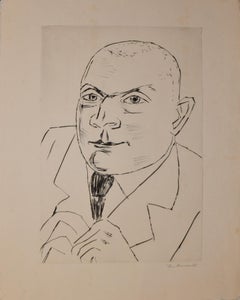
Portrait of Baron Simolin II (large version)
By Max Beckmann
Located in Roma, RM
Max Beckmann (Leipzig 1884 – New York 1950), Portrait of Baron Simolin II (large version)(1928)
Drypoint, 38 x 25 cm (plate), 48 x 40 cm (sheet), signed and dated lower right.
Category
1920s Expressionist Portrait Prints
Materials
Drypoint
Max Beckmann Signed "Strasse II" 1916 German Expressionist Framed Drypoint Print
By Max Beckmann
Located in St.Petersburg, FL
Max Beckmann (German, 1884-1950) German Expressionist
Date: 1916
Medium: Drypoint etching
Dimensions:
Plate - 3 5/8” x 7 5/8” (~9.2 x 19.4 cm)
Sheet - approx. 10” x 16.5” (~25.4 x 41.9 cm)
Framed - 15” x 24” (~38 x 61 cm)
Paper: Cream, slightly textured (BSB). Stamped and embossed BSB Publisher: Probably Verlag Graphisches Kabinett Gu¨nther Franke, Munich (stamped Graph. Kabinett Mu¨nchen)
Edition: Unknown
Techniques: Intaglio
Provenance: Estate of former Ringling College of Art and Design professor
A wonderfully chilling Expressionist print by German master Max Beckmann, from his early period during mid-World War I. The print is a section plate...
Category
Vintage 1910s German Expressionist Prints
Materials
Paper
More Ways To Browse
Antique Oregon
The Avengers
Triple Self Portrait
Vitraux Pour Jerusalem
Walasse Ting Geisha
Wayland Moore
Whitney Poster
Yoshitoshi Taiso
1930s Woodblock
Ai Weiwei Tree
Alice And Wonderland Salvador Dali
Andre Heller
Andy Warhol Invitation
Angel Zarraga
Antique Boat Motors
Antique Mermaid Print
Bonnard Etching
Carlos Bastos