Want more images or videos?
Request additional images or videos from the seller
1 of 3
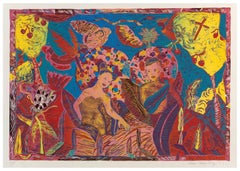
Munehiro Hasegawa
Seven Actors in a Dragon Boat
— Edo period Kamigata Woodblock Printc. 1850
c. 1850
Price:$550
About the Item
- Creator:Munehiro Hasegawa (1850 - 1870, Japanese)
- Creation Year:c. 1850
- Dimensions:Height: 9.5 in (24.13 cm)Width: 14.25 in (36.2 cm)
- Medium:
- Movement Style:
- Period:
- Condition:
- Gallery Location:Myrtle Beach, SC
- Reference Number:Seller: 982101stDibs: LU532316477572
About the Seller
5.0
Recognized Seller
These prestigious sellers are industry leaders and represent the highest echelon for item quality and design.
Platinum Seller
Premium sellers with a 4.7+ rating and 24-hour response times
Established in 1995
1stDibs seller since 2016
336 sales on 1stDibs
Typical response time: 1 hour
Associations
International Fine Print Dealers Association
Authenticity Guarantee
In the unlikely event there’s an issue with an item’s authenticity, contact us within 1 year for a full refund. DetailsMoney-Back Guarantee
If your item is not as described, is damaged in transit, or does not arrive, contact us within 7 days for a full refund. Details24-Hour Cancellation
You have a 24-hour grace period in which to reconsider your purchase, with no questions asked.Vetted Professional Sellers
Our world-class sellers must adhere to strict standards for service and quality, maintaining the integrity of our listings.Price-Match Guarantee
If you find that a seller listed the same item for a lower price elsewhere, we’ll match it.Trusted Global Delivery
Our best-in-class carrier network provides specialized shipping options worldwide, including custom delivery.You May Also Like
"Sun Saburo Matsugaya" - Mid 19th Century Figurative Japanese Woodblock Print
By Utagawa Kunisada (Toyokuni III)
Located in Soquel, CA
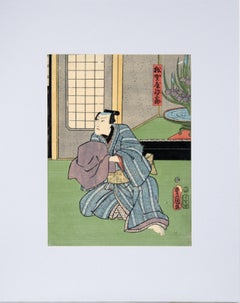
"Sun Saburo Matsugaya" - Mid 19th Century Figurative Japanese Woodblock Print
Beautiful mid 19th century figural Japanese woodblock print of a seated man with lilies in the background by Utagawa Toyokuni III (Kunisada) (Japanese, 1786-1864/5). Artist's chop is in the lower right corner of the piece. The actor is Magosaburo Matsugaya from the play "Katakiuchi Rumors"
Presented in a new grey-blue mat with foamcore backing.
Mat size: 21"H x 16"W
Paper size: 14"H x 9.75"W
During his lifetime Kunisada Utagawa...
Category
1850s Edo Figurative Prints
Materials
Paper, Ink, Woodcut
$540 Sale Price
20% Off
H 21 in W 16 in D 0.25 in
Study of Utagawa Hiroshige
s "View of Hara-Juku" 53 Stations of the Tokaido Road
By Utagawa Hiroshige
Located in Soquel, CA
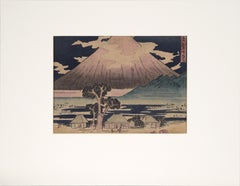
Study of Utagawa Hiroshige's "View of Hara-Juku" 53 Stations of the Tokaido Road
Hand painted study of Utagawa Hiroshige's "View of Hara-Juku", (by unknown artist), from "53 Station...
Category
1920s Edo Landscape Prints
Materials
Paper, Ink, Woodcut
$380 Sale Price
20% Off
H 11 in W 14 in D 0.25 in
One Hundred Aspects of the Moon, Mt Otawa Moon - Bright God Tamura
By Tsukioka Yoshitoshi
Located in Soquel, CA
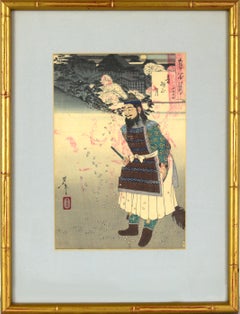
"Mount Otawa Moon: Bright God Tamura" - Woodblock on Paper by Tsukioka Yoshitoshi
From the series "One Hundred Aspects of the Moon"
This piece depicts the general Sakanoe no Tamura...
Category
1880s Edo Figurative Prints
Materials
Paper, Ink, Woodcut
$750
H 20.5 in W 15.5 in D 0.75 in
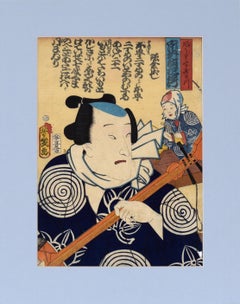
"Candy Seller" Japanese Woodblock on Rice Paper
By Utagawa Yoshiiku
Located in Soquel, CA
"Candy Seller" (飴売りうずまつ 市村羽左衛門) Japanese Woodblock on Rice Paper
This piece depicts Ichimura Uzaemon as the Candy Peddler Uzumatsu. He is playing a stringed instrument (the shamisen) to attract people to come buy canbdy. The spiral on his clothing is the symbol of the candy seller, along with his crest of the mandarin orange.
This Utagawa Yoshiiku print, titled "Umegoyomi mitate hachi shojin" (梅暦見立八笑人), depicts a scene from the Edo period. The print features a prominent male figure playing a shamisen, a traditional Japanese stringed instrument. The text on the print is in Japanese, and the overall style is characteristic of Ukiyo-e, a genre of Japanese woodblock prints. Utagawa Yoshiiku was a significant artist of the Meiji era, known for his contributions to woodblock printmaking. He was a student of Utagawa Kuniyoshi and worked alongside Tsukioka Yoshitoshi. His works often portray historical events, scenes from Kabuki plays, and contemporary life. This print, in particular, showcases the artist's skill in capturing the details of clothing, facial expressions, and the musical instrument.
Presented in a new blue mat with foam core backing.
Mat size: 18"H x 14"W
Paper size: 16"H x 12"W
Born the son of teahouse proprietor Asakusa Tamichi in 1833, Utagawa Yoshiiku (also known as Ochiai Yoshiiku) became a student of ukiyo-e artist Utagawa Kuniyoshi toward the end of the 1840s. His earliest known work dates to 1852 when he provided the backgrounds to some actor prints by his master.
Yoshiiku's earliest works were portraits of actors (yakusha-e), beauties (bijin-ga), and warriors (musha-e). He later followed Kuniyoshi into making satirical and humorous pieces, and became the leading name in the field after Kuniyosh's death in 1861. He illustrated the Tokyo Nichi Nichi...
Category
1860s Edo Figurative Prints
Materials
Ink, Rice Paper, Woodcut
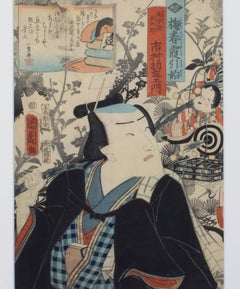
19th century color woodcut Japanese ukiyo-e print samurai figure
By Toyoharu Kunichika
Located in Milwaukee, WI
"Ichimura Hazaemon as Hatsuyumeya Mitsujiro" is a woodcut print by Toyoharu Kunichika in red, blue, and black.
14" x 9 1/2" art
20 3/4" x 16 3/4" framed
From the series “First Per...
Category
1860s Edo Figurative Prints
Materials
Woodcut
$3,000
H 20.75 in W 16.75 in
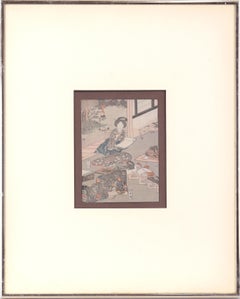
Scribe and Personal Assistant to the Shogun - Japanese Woodblock Print on Paper
Located in Soquel, CA
Scribe and Personal Assistant to the Shogun - Japanese Woodblock Print on Paper
Detailed woodblock print by an unknown artist, In the style of Suzuki Harunobu. There are two women i...
Category
19th Century Edo Figurative Prints
Materials
Paper, Ink, Woodcut
$920 Sale Price
20% Off
H 20.25 in W 16.25 in D 1 in
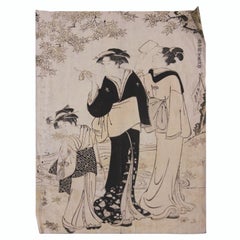
Beauties under a Maple Tree Japanese Woodblock Print
By Torii Kiyonaga
Located in Houston, TX
Three Beauties under a maple tree from the series "A Contest of Fashionable Beauties of the Gay Quarters". The woodblock print is printed on rice paper....
Category
1780s Edo Figurative Prints
Materials
Woodcut
$900
H 15 in W 10 in D 0.004 in
Bijin-ga Woman Kneeling by River Japanese Print
By Kuniyasu
Located in Houston, TX
Japanese woodblock print of a woman kneeling by the river. She is holding a stick making it appear like she is fishing with it. The woodblock print is printed on rice paper. The print is not framed.
Artist Biography: Utagawa Kuniyasu...
Category
1830s Edo Figurative Prints
Materials
Woodcut

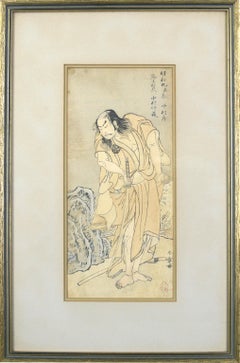
Actor as Samurai - 18th Century Japanese Woodblock Print
By Katsukawa Shunshō
Located in Soquel, CA
Actor as Samurai - 18th Century Japanese Woodblock Print
Woodblock print depicting an actor, possibly Nakamura Denkuro II, as a samurai. The actor stands with his sword unsheathed a...
Category
Late 18th Century Edo Figurative Prints
Materials
Woodcut, Rice Paper
$750
H 19 in W 12.5 in D 0.63 in
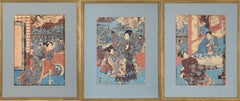
The Four Seasons: Spring Japanese Woodblock Triptych ink on Paper Tales of Genji
Located in Soquel, CA
The Four Seasons: Spring - Japanese Woodblock Triptych in Ink on Paper
Colorful kabuki scene by Utagawa Kuniteru (Japanese, active 1818-18...
Category
Early 19th Century Edo Figurative Prints
Materials
Paper, Ink, Woodcut
$1,480 Sale Price
20% Off
H 18.75 in W 44.25 in D 0.75 in
More From This Seller
View All
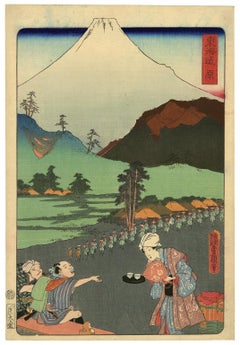
Tokaido
— Mt. Fuji Rising – Mid-Nineteenth Century Woodblock Print
By Utagawa Kunisada (Toyokuni III)
Located in Myrtle Beach, SC
Utagawa Kunisada (Tokoyuni III), 'Tokaido', color woodblock, 1863. Signed in the cartouche, lower right. A fine impression, with rich, fresh colors and pronounced woodgrain, the full...
Category
1860s Edo Figurative Prints
Materials
Woodcut
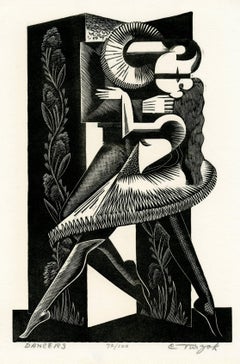
Dancers
— 1930s American Modernism
By Charles Turzak
Located in Myrtle Beach, SC
Charles Turzak, 'Dancers', 1939, wood engraving, edition 100. Signed, titled, and numbered 72/100 in pencil. A fine, richly-inked impression, on off-white Japan paper, with full marg...
Category
Mid-20th Century Art Deco Figurative Prints
Materials
Woodcut
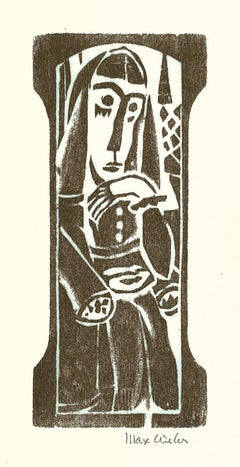
Seated Figure
— American Expressionism
By Max Weber
Located in Myrtle Beach, SC
Max Weber, 'Seated Figure", woodcut, edition not stated, 1919-20, Rubenstein 17. Signed in pencil. A fine impression on cream Japan paper; the full sheet with margins (2 to 3 1/8 in...
Category
1920s Expressionist Figurative Prints
Materials
Woodcut
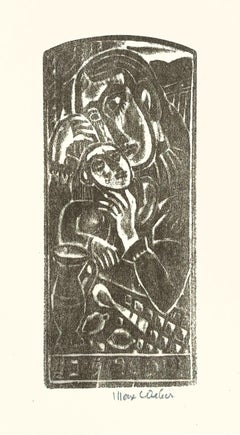
Mother Love (Madonna and Child) — American Expressionism
By Max Weber
Located in Myrtle Beach, SC
Max Weber, 'Mother Love' (Madonna and Child), woodcut, 1920, edition not stated, Rubenstein 35. Signed in pencil. A fine impression, on cream wove Japan paper, with full margins (1 5...
Category
1920s Expressionist Figurative Prints
Materials
Woodcut
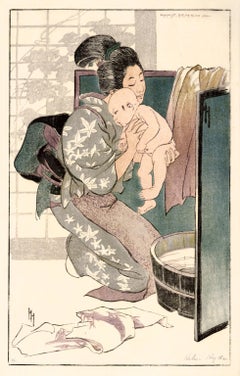
The Bath
— Meji Era Cross-Cultural Woman Artist
By Helen Hyde
Located in Myrtle Beach, SC
Helen Hyde, 'The Bath', color woodblock print, edition not stated, 1905, Mason & Mason 59. Signed in pencil in the image, lower right. Numbered '96' in pencil in the image, lower left. The artist's monogram in the block, lower left, and 'Copyright, 1905, by Helen Hyde.' upper right. A superb impression with fresh colors on tissue-thin cream Japanese paper; the full sheet with margins (7/16 to 1 5/8 inches), in excellent condition. Matted to museum standards, unframed.
Image size 16 1⁄4 x 10 1⁄8 in. (413 x 260 mm); sheet size: 19 1⁄4 x 11 1⁄8 in. (489 x 283 mm).
Literature and Exhibition: Back cover illustration of the catalog of the artist’s prints, 'Helen Hyde', Smithsonian Institution Press, 1990; 'The International Block Print Renaissance, Then And Now, Block Prints In Wichita, Kansas, A Centennial Celebration — 1922-2022', Barbara J. Thompson, Wichita Art Museum, 2022 (back cover).
Impressions of this work are held in the following collections: Achenbach Foundation for Graphic Arts, Art Institute of Chicago, Fine Arts Museums of San Francisco (De Young), Harvard Art Museums, Library of Congress, Metropolitan Museum of Art, New York Public Library, Smithsonian American Art Museum, Terra Foundation for American Art, University of Oregon Museum of Art.
ABOUT THE ARTIST
Helen Hyde (1868-1919) was a pioneer American artist best known for advancing Japanese woodblock printmaking in the United States and for bridging Western and Japanese artistic traditions. Hyde was born in Lima, New York, but after her father died in 1872, her family relocated to Oakland, California, where she spent much of her youth.
Hyde pursued formal art education in the United States and Europe. She enrolled in the San Francisco School of Design, where she took classes from the Impressionist painter Emil Carlsen; two years later, she transferred to the Art Students League in New York, studying there with Kenyon Cox. Eager to expand her artistic repertoire, Hyde traveled to Europe, studying under Franz Skarbina in Berlin and Raphael Collin in Paris. While in Paris, she first encountered Japanese ukiyo-e prints, sparking a lifelong fascination with Japanese aesthetics. After ten years of study, Hyde returned to San Francisco, where she continued to paint and began to exhibit her work.
Hyde learned to etch from her friend Josephine Hyde in about 1885. Her first plates, which she etched herself but had professionally printed, represented children. On sketching expeditions, she sought out quaint subjects for her etchings and watercolors. In 1897, Hyde made her first color etchings—inked á la poupée (applying different ink colors to a single printing plate)—which became the basis for her early reputation. She also enjoyed success as a book illustrator, and her images sometimes depicted the children of Chinatown.
After her mother died in 1899, Hyde sailed to Japan, accompanied by her friend Josephine, where she would reside, with only brief interruptions, until 1914. For over three years, she studied classical Japanese ink painting with the ninth and last master of the great Kano school of painters, Kano Tomonobu. She also studied with Emil Orlik, an Austrian artist working in Tokyo. Orlik sought to renew the old ukiyo-e tradition in what became the shin hanga “new woodcut prints” art movement. She immersed herself in the study of traditional Japanese printmaking techniques, apprenticing with master printer Kanō Tomonobu. Hyde adopted Japanese tools, materials, and techniques, choosing to employ the traditional Japanese system of using craftsmen to cut the multiple blocks and execute the exacting color printing of the images she created. Her lyrical works often depicted scenes of family domesticity, particularly focusing on women and children, rendered in delicate lines and muted colors.
Through her distinctive fusion of East and West, Hyde’s contributions to Western printmaking were groundbreaking. At a time when few Western women ventured to Japan, she mastered its artistic traditions and emerged as a significant figure in the international art scene.
Suffering from poor health, she returned to the United States in 1914, moving to Chicago. Having found restored health and new inspiration during an extended trip to Mexico in 1911, Hyde continued to seek out warmer climates and new subject matter. During the winter of 1916, Hyde was a houseguest at Chicora Wood, the Georgetown, South Carolina, plantation illustrated by Alice Ravenel Huger Smith in Elizabeth Allston Pringle’s 1914 book A Woman Rice Planter. The Lowcountry was a revelation for Hyde. She temporarily put aside her woodcuts and began creating sketches and intaglio etchings of Southern genre scenes and African Americans at work. During her stay, Hyde encouraged Smith’s burgeoning interest in Japanese printmaking and later helped facilitate an exhibition of Smith’s prints at the Art Institute of Chicago.
During World War I, Hyde designed posters for the Red Cross and produced color prints extolling the virtues of home-front diligence.
In ill health, Hyde traveled to be near her sister in Pasadena a few weeks before her death on May 13, 1919. She was buried in the family plot near Oakland, California.
Throughout her career, Hyde enjoyed substantial support from galleries and collectors in the States and in London. She exhibited works at the St. Louis Exposition in 1897, the Pan-American Exhibition in Buffalo in 1901, the Tokyo Exhibition for Native Art (where she won first prize for an ink drawing) in 1901, the Alaska-Yukon-Pacific Exhibition in Seattle in 1909 (received a gold medal for a print), the Newark Museum in 1913, a solo show at the Chicago Art Institute in 1916, and a memorial exhibition in 1920, Detroit Institute of Arts, Color Woodcut Exhibition in 1919, New York Public Library, American Woodblock Prints...
Category
Early 1900s Showa Figurative Prints
Materials
Woodcut
The Garden
— Celebrated Contemporary African American Artist
By Margo Humphrey
Located in Myrtle Beach, SC
Margo Humphrey, 'The Garden (Adam and Eve)', reductive color woodcut, 1989. Signed, dated, and annotated 'A/P' in pencil. Signed and dated in the image, lower right. A fine, richly-inked, artist's proof impression, with fresh, vivid colors, on BFK Rives, heavy, off-white wove paper; the full sheet with margins (1 to 1 3/8 inches), in excellent condition. Archivally sleeved, unmatted. Scarce.
Image size 27 1/4 x 39 1/8 inches (692 x 994 mm); sheet size 29 1/2 x 42 inches (749 x 1,067 mm).
ABOUT THIS WORK
"Humphrey continued to reinterpret stories from the Bible with African American figures. In 1989 she published the woodcut print 'The Garden' at Magnolia Editions in Oakland, CA. For this rare foray into relief printmaking, she employed the reductive method, which uses only one block that is successively carved for each color segment, reducing the block with each cutting. Technically challenging, this lush and elaborate print is a testament to Humphrey’s skills as a printmaker. A youthful Adam and Eve are depicted in a luxuriant tropical landscape. Here, Humphrey chooses not to include the traditional symbols of humanity’s downfall but instead portrays them as being protected by angels in an atmosphere of idyllic bounty. ...Although Humphrey challenges traditional representation of Christian themes, her images are not iconoclastic but present a broader, more inclusive engagement with religious spirituality."
— Adrienne L. Childs, 'Margo Humphrey, The David C. Driskell Series of African American Art: Volume VII,' Pomegranate Communications, Inc., 2009, page 71.
ABOUT THE ARTIST
American printmaker, illustrator, and art teacher Margo Humphrey was born in Oakland, California, in 1942. She earned a BFA in Painting and Printmaking from the California College of Arts and Crafts and a Master of Fine Arts degree in Printmaking from Stanford University.
Humphrey began teaching in 1973 at the University of California Santa Cruz and has since taught at the University of Texas at San Antonio, the San Francisco Art Institute, and the School of the Art Institute of Chicago. She has also taught at the University of the South Pacific in Suva, Fiji; Yaba Technological Institute of Fine Art, Ekoi Island, Nigeria; the University of Benin in Benin City, Nigeria; the Margaret Trowell School of Fine Art in Kampala, Uganda, and the Fine Art School of the National Gallery of Art, Harare, Zimbabwe. In 1989, she was appointed Department Head of Printmaking at the University of Maryland in College Park.
Humphrey has worked in lithography, monoprint, and woodcut with significant printmaking ateliers, including the Rutgers Center for Innovative Print and Paper, the Bob Blackburn Printmaking Workshop, and the Tamarind Institute in New Mexico. She was one of the earliest African-American woman artists to distinguish herself as a lithographer in a highly technical, male-dominated profession and was the first to have her prints published by Tamarind in 1974.
Humphrey’s imagery combines historical perspective, autobiography, and fantasy to illuminate her experience as an African American woman. Bold, saturated color, animated figures, and syncopated rhythmic arrangements are hallmarks of Humphrey's oeuvre. Though Humphrey labels her distinctive style "sophisticated naive," the narrative complexity and technical skill of her works attest to her artistic virtuosity. Joyful, expressive, and at times humorous, her works offer engaging commentary on the presumptions of American culture and myth while embracing her personal vision of authenticity and spirituality.
She developed her 1987 work The Last Bar-B-Que, a vividly colored transformation of the Last Supper, following a three-year period during which she examined portrayals of the iconic subject by artists from Pietro Lorenzetti to Emil Nolde. Her narrative work The Garden, a monumentally scaled reductive woodcut, is a further example of an archetypal subject—Adam and Eve in the Garden of Eden—debunked and rendered with fresh, life-affirming vibrancy.
Since her first solo exhibition in 1965, Humphrey’s works have been exhibited internationally. They are held in major institutions, including the Museum of Modern Art, The Smithsonian American Art Museum, the Philadelphia Museum of Art, the Hampton University Museum, the Victoria and Albert Museum (London), the Museum of Modern Art, Rio de Janeiro, and the National Gallery of Modern Art, Lagos. In 1996, she was invited to be part of the World Printmaking Survey at the Museum of Modern Art, New York.
In 2011, Hampton University Museum mounted a 45-year retrospective of Humphrey’s work Her Story: Margo Humphrey Lithographs and Works on Paper, jointly curated by Robert E. Steele, executive director of the David Driskell...
Category
1980s Expressionist Figurative Prints
Materials
Woodcut