Want more images or videos?
Request additional images or videos from the seller
1 of 5
Natalie S. HenryNatalie S. Henry, Skipping (Children Skipping Rope)1925
1925
Price:$300
$400List Price
About the Item
- Creator:Natalie S. Henry (1907 - 1992)
- Creation Year:1925
- Dimensions:Height: 5 in (12.7 cm)Width: 6 in (15.24 cm)
- Medium:
- Movement Style:
- Period:
- Condition:Very good condition. a few creases in margins, far outside the image.
- Gallery Location:New York, NY
- Reference Number:1stDibs: LU141026912652
About the Seller
4.9
Gold Seller
Premium sellers maintaining a 4.3+ rating and 24-hour response times
Established in 1988
1stDibs seller since 2020
131 sales on 1stDibs
Authenticity Guarantee
In the unlikely event there’s an issue with an item’s authenticity, contact us within 1 year for a full refund. DetailsMoney-Back Guarantee
If your item is not as described, is damaged in transit, or does not arrive, contact us within 7 days for a full refund. Details24-Hour Cancellation
You have a 24-hour grace period in which to reconsider your purchase, with no questions asked.Vetted Professional Sellers
Our world-class sellers must adhere to strict standards for service and quality, maintaining the integrity of our listings.Price-Match Guarantee
If you find that a seller listed the same item for a lower price elsewhere, we’ll match it.Trusted Global Delivery
Our best-in-class carrier network provides specialized shipping options worldwide, including custom delivery.You May Also Like
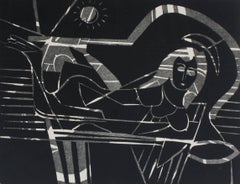
Reclining Nude
By Irene Zevon
Located in Buffalo, NY
An original linocut print by American artist Irene Zevon. The reclining nude is one of Zevon's most coveted subject matters. This 1959 print is one of a series of ten prints.
Category
1950s American Modern Figurative Prints
Materials
Linocut, Paper
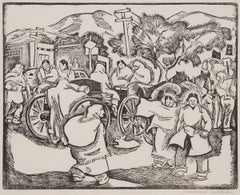
Barbara Latham 1950s Modernist Linocut “Saturday Morning, Taos Plaza”
By Barbara Latham
Located in Denver, CO
A vibrant celebration of Taos life and culture, Saturday Morning (Market, Taos Plaza, New Mexico) is a striking 1950s modernist linocut print by acclaimed New Mexico artist Barbara L...
Category
Mid-20th Century American Modern Figurative Prints
Materials
Linocut
$1,650
H 16 in W 17.75 in
Man
By Elizabeth Catlett
Located in Missouri, MO
Elizabeth Catlett
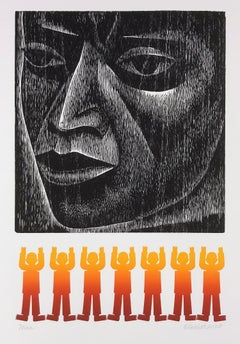
“Man” 1975 (The Print Club of Cleveland Publication Number 83, 2005)
Woodcut and Color Linocut
Printed in 2003 at JK Fine Art Editions Co., Union City, New Jersey
Signed and Dated By The Artist Lower Right
Titled Lower Left
Ed. of 250
Image Size: approx 18 x 12 inches
Elizabeth Catlett (1915-2012) is regarded as one of the most important women artists and African American artists of our time. She believed art could affect social change and that she should be an agent for that change: “I have always wanted my art to service black people—to reflect us, to relate to us, to stimulate us, to make us aware of our potential.” As an artist and an activist, Catlett highlighted the dignity and courage of motherhood, poverty, and the working class, returning again and again to the subject she understood best—African American women.
The work below, entitled, “Man”, is "carved from a block of wood, chiseled like a relief. Catlett, a sculptor as well as a printmaker, carves figures out of wood, and so is extremely familiar with this material. For ‘Man’ she exploits the grain of the wood, allowing to to describe the texture of the skin and form vertical striations, almost scarring the image. Below this intense, three-dimensional visage parades seven boys, printed repetitively from a single linoleum block in a “rainbow roll” that changes from gold to brown. This row of brightly colored figures with bare feet, flat like a string of paper dolls, raise their arms toward the powerful depiction of the troubled man above.”
Biography:
Elizabeth Catlett (1915-2012)
Known for abstract sculpture in bronze and marble as well as prints and paintings, particularly depicting the female figure, Elizabeth Catlett is unique for distilling African American, Native American, and Mexican art in her work. She is "considered by many to be the greatest American black sculptor". . .(Rubinstein 320)
Catlett was born in Washington D.C. and later became a Mexican citizen, residing in Cuernavaca Morelos, Mexico. She spent the last 35 years of her life in Mexico.
Her father, a math teacher at Tuskegee Institute in Alabama, died before she was born, but the family, including her working mother, lived in the relatively commodious home of his family in DC. Catlett received a Bachelor of Arts degree from Howard University, where there was much discussion about whether or not black artists should depict their own heritage or embrace European modernism.
She earned a Master of Fine Arts degree in 1940 from the University of Iowa, where she had gone to study with Grant Wood, Regionalist* painter. His teaching dictum was "paint what you know best," and this advice set her on the path of dealing with her own background. She credits Wood with excellent teaching and deep concern for his students, but she had a problem during that time of taking classes from him because black students were not allowed housing in the University's dormitories.
Following graduation in 1940, she became Chair of the Art Department at Dillard University in New Orleans. There she successfully lobbied for life classes with nude models, and gained museum admission to black students at a local museum that to that point, had banned their entrance. That same year, her painting Mother and Child, depicting African-American figures won her much recognition.
From 1944 to 1946, she taught at the George Washington Carver School, an alternative community school in Harlem that provided instruction for working men and women of the city. From her experiences with these people, she did a series of paintings, prints, and sculptures with the theme "I Am a Negro Woman."
In 1946, she received a Rosenwald Fellowship*, and she and her artist husband, Charles White, traveled to Mexico where she became interested in the Mexican working classes. In 1947, she settled permanently in Mexico where she, divorced from White, married artist Francisco Mora...
Category
Late 19th Century American Modern Figurative Prints
Materials
Linocut, Woodcut
"Fifty Years Later" - Linocut Print on Paper 1/10
Located in Soquel, CA
"Fifty Years Later" - Linocut Print on Paper 1/10
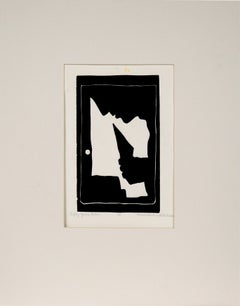
A silhouetted image of a person's profile dropping their ballot into a voting box. The simple shapes, t...
Category
21st Century and Contemporary American Modern Figurative Prints
Materials
Paper, Linocut
$450
H 18 in W 14 in D 0.25 in
"History of Detroit" Linoleum Cut, Black Ink, African American, Mural Style
By Hubert Massey
Located in Detroit, MI
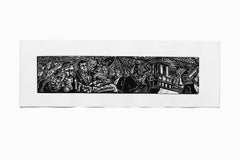
"History of Detroit" is in the style of a mural by the master muralist from the city of Detroit, Hubert Massey. It renders in dramatic composition the ov...
Category
Early 2000s American Modern Figurative Prints
Materials
Linocut
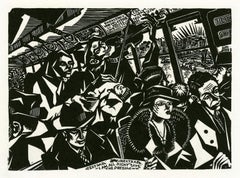
Commuters
— Early 20th-Century Modernism
By George Josimovich
Located in Myrtle Beach, SC
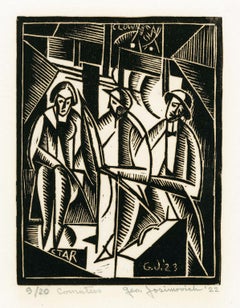
George Josimovich, 'Commuters', linocut, 1922-23, edition 20. Signed, dated '22, titled, and annotated '9/20' in pencil. Initialed in the block 'G.J....
Category
1920s American Modern Figurative Prints
Materials
Linocut
Sisters
— Renowned Black American, Harlem Renaissance Artist
Located in Myrtle Beach, SC
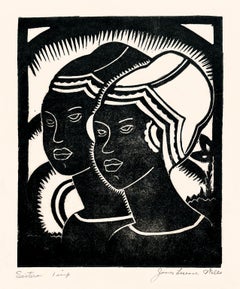
James Lesesne Wells, 'Sisters', linocut, edition not stated but small, 1928. Signed, titled, and annotated 'imp' in pencil. A fine impression on off-white wove Japan paper, with wide margins (1 7/8 to 3 3/4 inches), in excellent condition. Printed by the artist. Very scarce. Matted to museum standards, unframed.
Image size 8 3/16 x 6 3/4 inches (208 x 171 mm); sheet size 13 1/2 x 10 3/4 inches (343 x 273 mm).
Exhibition and Literature: 'Narratives of African American Art and Identity: The David C. Driskell Collection,' The Art Gallery at the University of Maryland, extensive touring exhibition, 1998-2000.
Collections: Pennsylvania Academy of the Fine Arts, Smithsonian Institution (Anacostia Community Museum).
ABOUT THE ARTIST
“Wells is more than an artist with a deep concern for his fellow man. He carries many of his themes a step further into an apocalyptic world, a world of revelation and shifting lights. … He works on large blocks in a bold free style. … His work has a vigor, therefore, that is not often used in the medium today.”
—Jacob Kainen (painter, critic, and collector) from Richard J. Powell’s 1986 essay Phoenix Ascending: The Art of James Lesesne Wells.
James Lesesne Wells was an American painter, printmaker, educator, and pioneering figure of the Harlem Renaissance, whose work established a vital connection between African heritage, modernist form, and African American cultural identity. Known for his innovative use of linoleum and woodblock printing, Wells played a key role in shaping 20th-century African American art and inspired countless students throughout his lengthy career as a teacher at Howard University.
Born in Atlanta, Georgia, Wells' early exposure to the arts came through church and community, where African American cultural traditions were central. He pursued formal artistic training at Lincoln University in Pennsylvania (earning a B.A. in 1924), followed by studies at the Pennsylvania Academy of the Fine Arts and the Barnes Foundation, where he encountered European modernists as well as traditional African sculpture, which profoundly influenced his style.
Wells moved to New York in the late 1920s, swiftly immersing himself in the lively artistic and intellectual scene of Harlem. There, he became associated with artists, writers, and thinkers of the Harlem Renaissance, contributing to the growth of Black cultural identity. Considered a mentor to many famed artists of the Harlem Renaissance, Wells served as director of a summer art workshop in Harlem where his assistants included Charles Alston, Jacob Lawrence, and Palmer Hayden...
Category
1920s American Modern Figurative Prints
Materials
Linocut
$3,500
H 8.19 in W 6.75 in
Modern Music
— WPA Modernism, New York City El
Located in Myrtle Beach, SC
Albert Potter, 'Modern Music' also Twilight Melodies', linocut, c. 1935, from the posthumous edition of 20, printed in 1977, authorized by the artist’s widow. Estate authenticated in...
Category
1930s American Modern Figurative Prints
Materials
Linocut
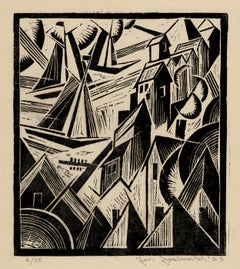
Harbor with Sailboats — Early 20th-Century Modernism
By George Josimovich
Located in Myrtle Beach, SC
George Josimovich, Untitled (Harbor with Sailboats) ', linocut, 1923, edition 35. Signed, dated, and annotated '4/35' in pencil. Initialed 'G J' in ...
Category
1920s American Modern Figurative Prints
Materials
Linocut
"Noel, " Religious Linocut in Blue on Tissue Paper signed by Sylvia Spicuzza
By Sylvia Spicuzza
Located in Milwaukee, WI
"Noel" is an original linocut on tissue paper by Sylvia Spicuzza. The artist stamped her signature lower right. This artwork features the Virgin Mary holding the baby Jesus. Both fig...
Category
1950s American Modern Figurative Prints
Materials
Linocut
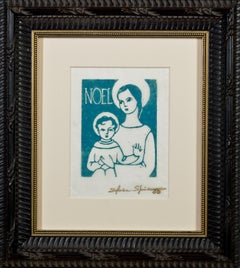
Sylvia Spicuzza"Noel, " Religious Linocut in Blue on Tissue Paper signed by Sylvia Spicuzza, c. 1950
$1,300
H 10.875 in W 9.5 in
More From This Seller
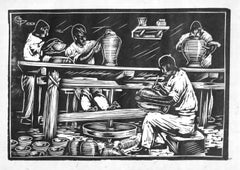
View AllHeinrich Glintenkamp, Pottery Shop, Mexico
By Heinrich Glintenkamp
Located in New York, NY
Heinrich Glintenkamp was American painter, printmaker, and illustrator. His work was featured in "The Masses" and in the the Metropolitan Museum of Art and Pennsylvania Academy of th...
Category
1930s American Modern Interior Prints
Materials
Linocut
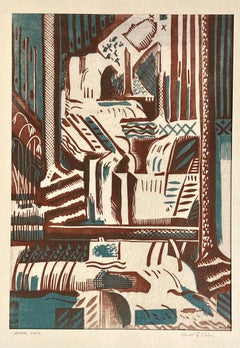
Harold E. Keeler, Water Fall
Located in New York, NY
Harold E. Keeler worked in Hollywood as a set designer. That seems especially important here because the Water Fall looks a little as though it could be a w...
Category
1930s American Modern Landscape Prints
Materials
Linocut
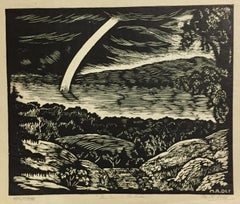
Maurice Robert Dey, Rainbow on the Hudson
Located in New York, NY
Biographical information on Maurice Robert Dey is hard to find. He was born on 1899 (or maybe 1900), in Switzerland. As an adult he lived and worked in Woodstock, the NY artists' c...
Category
1930s American Modern Landscape Prints
Materials
Linocut
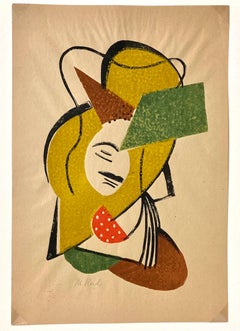
Martha Reed, (Color Abstraction) (Head?)
By Martha Reed
Located in New York, NY
Martha Reed was the daughter of the artist Doel Reed and as an adult she joined her parents in Taos, New Mexico.
There she designed clothes with a south-we...
Category
Mid-20th Century American Modern Abstract Prints
Materials
Linocut
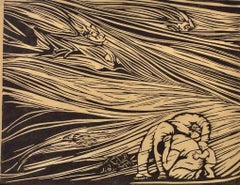
Evelyn G. Schultz, Typhoon
Located in New York, NY
The only mention I can find of Evelyn G. Schultz is that she was a charter member of the San Diego Watercolor Society. But the medium of the linocut (here on tan paper) was frequentl...
Category
1940s American Modern Figurative Prints
Materials
Linocut
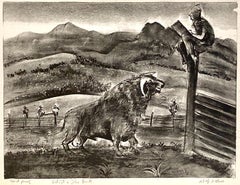
Adolf Dehn, The Artist and The Bull, 1940, self-portrait lithograph, Colorado
By Adolf Dehn
Located in New York, NY
Adolf Dehn, The Artist and The Bull, is from Dehn's period of teaching in Colorado at both the Broadmoor Art Academy and the Colorado Springs Fine Arts Center. In this humous self-p...
Category
1940s American Modern Landscape Prints
Materials
Lithograph
Still Thinking About These?
All Recently ViewedMore Ways To Browse
Natalie Henry
Vintage Braniff Airline Posters
Vintage Hockey Signs
Vintage Ira Posters
Virginia Fisher On Sale
Virginia Fisher
War And Peace Picasso
Warhol Northwest Mask
Warner Kreuter
Washerwoman Renoir
Weyman Lew On Sale
Whitford Carter
Will James Prints
William Peabody
Woodblock Zodiac
Yvonne Cole Meo
1970s Dali Painting
Al Hirschfeld Big Band