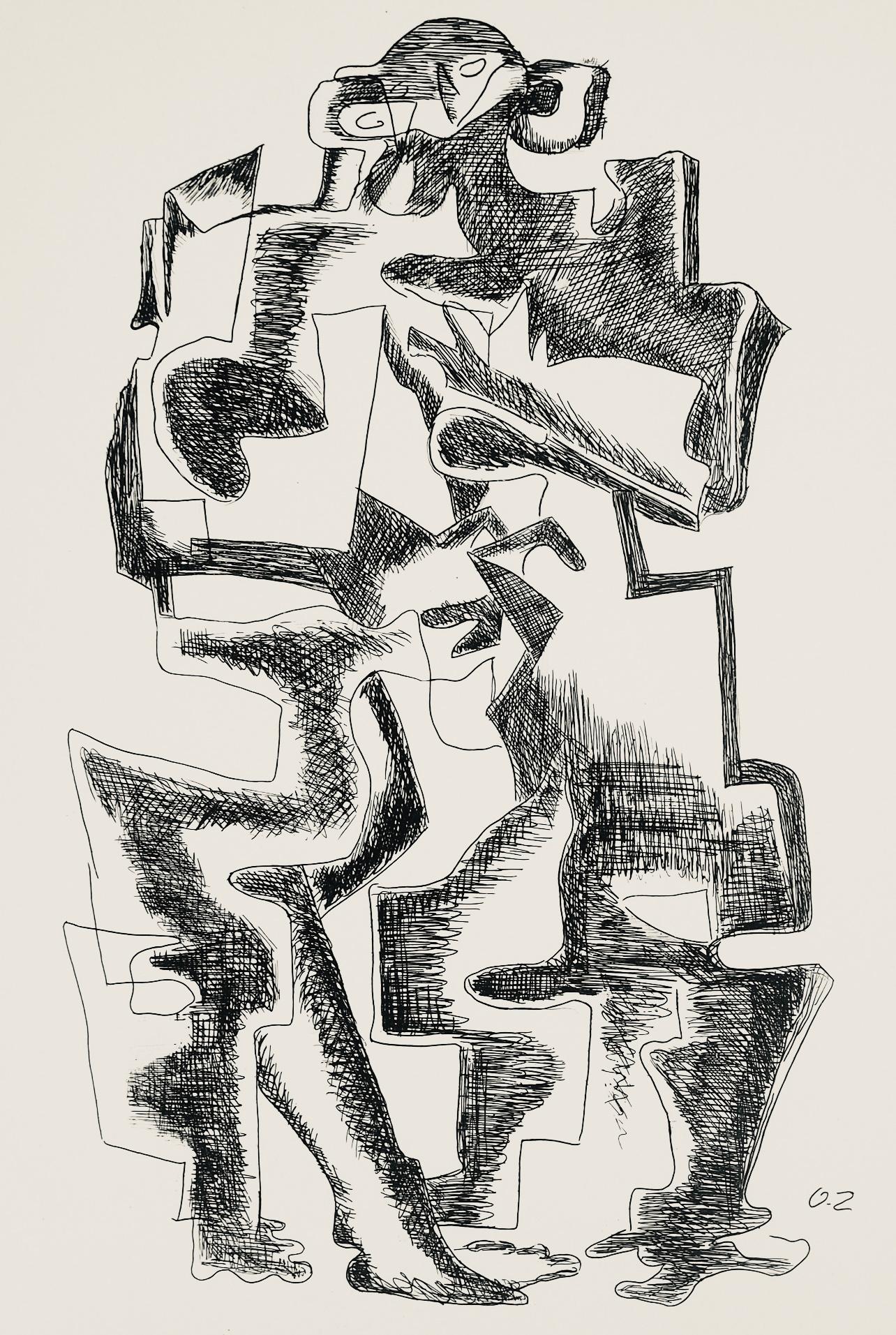
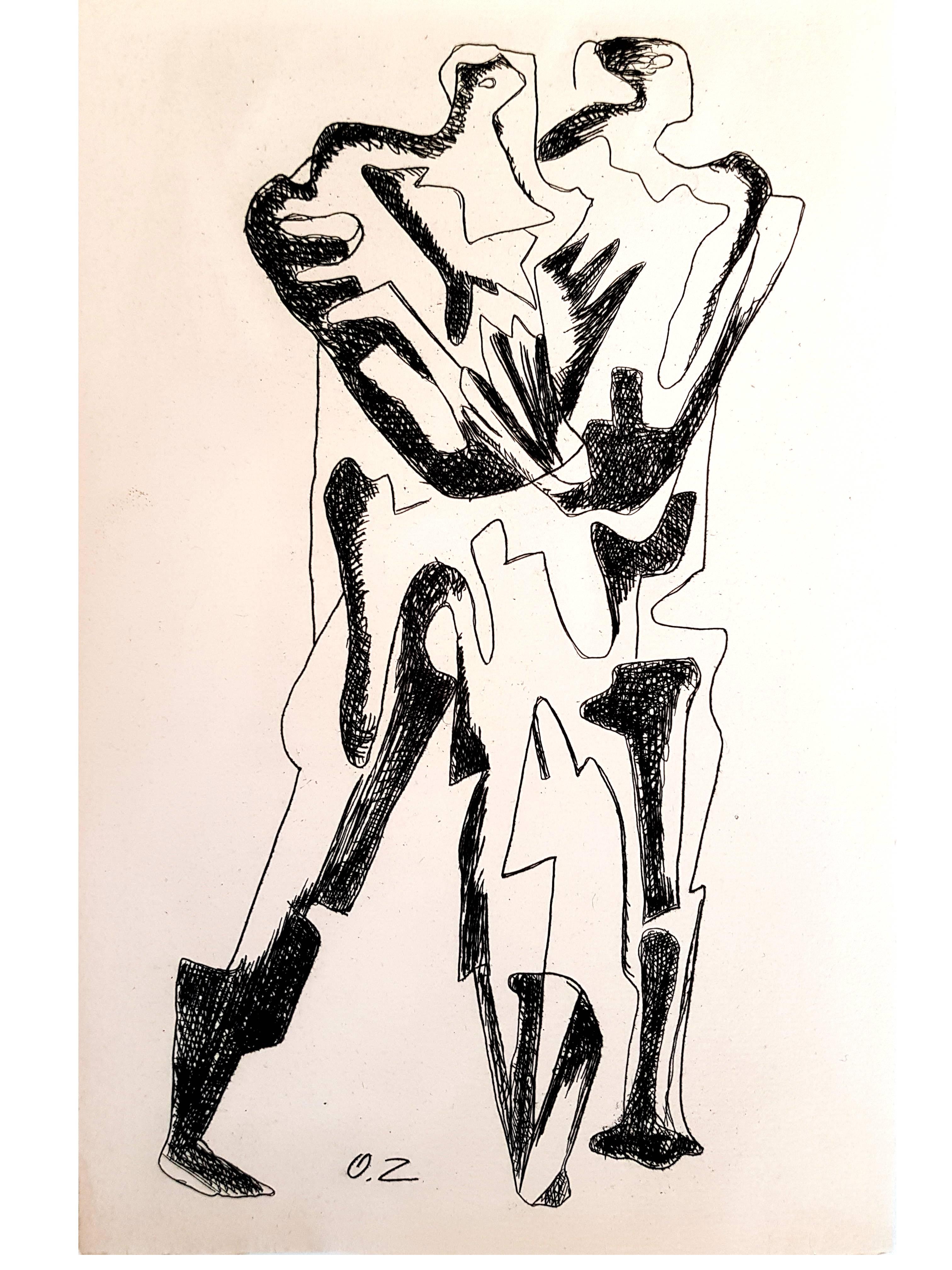
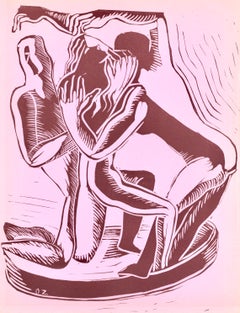
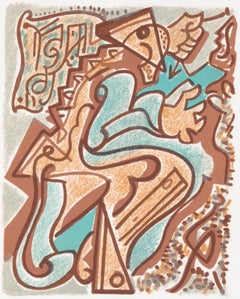
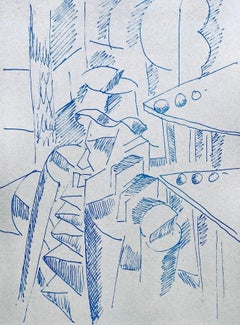
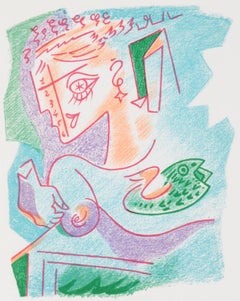
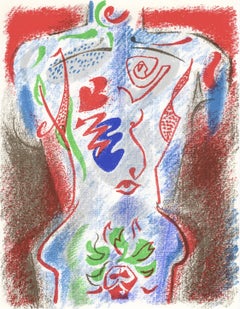
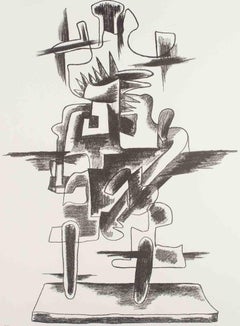
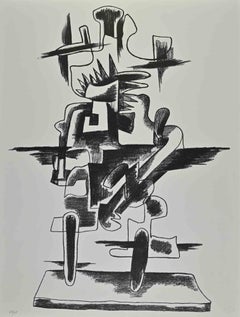
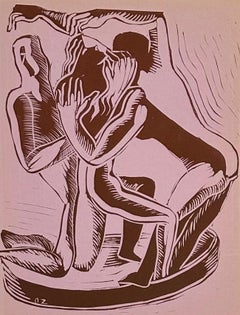
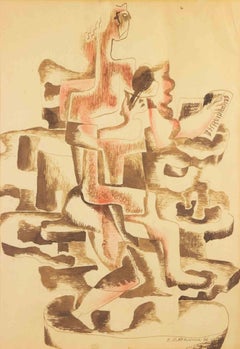
This exquisite etching by Ossip Zadkine (1890–1967), titled Homme debout (Standing Man), from the folio Les Peintres mes amis (The Painters My Friends), originates from the 1965 edition published by Editions d'art Les Heures Claires, Paris, and printed by Atelier de Manuel Robbe, Paris, May 20, 1965. Homme debout (Standing Man) reflects Zadkine’s sculptural sensibility translated into graphic form—a rhythmic study of the human figure as both structure and spirit. Through angular contours and expressive planes, Zadkine evokes vitality, strength, and transcendence, transforming Cubist fragmentation into a lyrical meditation on human resilience and harmony.
Executed as an etching on grand velin d'Arches paper, this work measures 15 x 11 inches. Signed in the plate and unnumbered as issued. The edition exemplifies the exceptional standards of Editions d'art Les Heures Claires, Paris, and the technical mastery of Atelier de Manuel Robbe, Paris.
Artwork Details:
Artist: Ossip Zadkine (1890–1967)
Title: Homme debout (Standing Man), from the folio Les Peintres mes amis (The Painters My Friends), 1965
Medium: Etching on grand velin d'Arches paper
Dimensions: 15 x 11 inches (38.1 x 27.94 cm)
Inscription: Signed in the plate and unnumbered as issued
Date: 1965
Publisher: Editions d'art Les Heures Claires, Paris
Printer: Atelier de Manuel Robbe, Paris
Catalogue raisonne reference: Monod, Luc. Manuel de l’amateur de livres illustrés modernes, 1875–1975. Ides et Calendes, 1992, illustration 11485.
Condition: Well preserved, consistent with age and medium
Provenance: From the folio Les Peintres mes amis (The Painters My Friends), published by Editions d'art Les Heures Claires, Paris; printed by Atelier de Manuel Robbe, Paris, May 20, 1965
Notes:
Excerpted from the folio (translated from the folio), The lithographs by Derain and Van Dongen were printed by Lucien Detruit. Those by Dufy, Matisse, Chagall, Dunoyer de Segonzac, Cavailles, Terechkovitch, and Carzou were printed by Mourlot Freres. Those by Picasso and Buffet were printed by P.-J. Ballon. The lithograph by Miro was printed in the workshop Arte, which also printed, in phototype, the frontispiece. The etchings by Villon and Zadkine were printed by Manuel Robbe. That by Braque was printed by A. and P. Crommelynck. The wood engravings and printing of the illustrations by Vlaminck, Rouault, Pascin, and Utrillo were done by Raymond Jacquet. The texts by Andre Warnod, collected by his daughter Jeanine Warnod, were hand-set in De Roos type, size 24, and printed in Paris on the presses of Daragnes. Printing completed on May 20, 1965. Justification of the edition, III examples on large velin d'Arches containing the original copper plates inked for one intaglio illustration; a proof on silk of two lithographs; the four wood-engraved illustrations, mounted; a color separation of one lithograph; and a complete suite of the illustrations on Arches—numbered I to III. XVI examples on large velin d'Arches containing a proof on silk of two lithographs; the four wood-engraved illustrations, mounted; a color separation of one lithograph; and a complete suite of the illustrations on Arches—numbered IV to XIX. XXI examples on large velin d'Arches containing a proof on silk of two lithographs; the four wood-engraved illustrations, mounted; and a complete suite of the illustrations on Arches—numbered XX to XL. XL examples on large velin d'Arches containing a complete suite of the illustrations on Arches—numbered XLI to LXXX. CLXX examples on large velin d'Arches—numbered LXXXI to CCL.
About the Publication:
The folio Les Peintres mes amis (The Painters My Friends), published in Paris in 1965 by Editions d'art Les Heures Claires, represents one of the most ambitious collaborative undertakings of postwar French printmaking. Conceived as a tribute to the great masters of 20th-century modern art, the volume brought together original graphic works by many of the leading painters and sculptors of the era—including Zadkine, Villon, Matisse, Picasso, Braque, Chagall, Derain, and Miro—alongside texts by the noted critic Andre Warnod. Each artist contributed an original work, rendered by the foremost ateliers of Paris under the highest standards of fine-art printmaking. The project exemplifies the technical brilliance of mid-century lithography and intaglio printing, combining the artistry of master printers such as Lucien Detruit, Mourlot Freres, P.-J. Ballon, Manuel Robbe, and Raymond Jacquet with the visionary editorial direction of Les Heures Claires. The folio stands as a testament to the vitality of the livre d’artiste tradition, uniting image, text, and craftsmanship in a rare celebration of artistic fraternity and innovation.
About the Artist:
Ossip Zadkine (1890–1967) was a Russian-born French sculptor and painter whose masterful fusion of Cubism, Expressionism, and lyrical humanism established him as one of the most visionary sculptors of the 20th century. A poet of form and rhythm, Zadkine transformed the fragmented geometry of Cubism into a deeply emotional language of movement, structure, and spiritual resonance. Born in Vitebsk, Belarus (then part of the Russian Empire), Zadkine studied in London before settling in Paris in 1910, where he immersed himself in the city’s avant-garde circles among Pablo Picasso, Alexander Calder, Alberto Giacometti, Salvador Dali, Joan Miro, Wassily Kandinsky, Marcel Duchamp, and Man Ray—artists who, like him, redefined the boundaries of modern expression. Influenced by the innovations of Picasso and Braque and by the primal vitality of African and Cycladic art, Zadkine extended Cubism into three dimensions, creating sculptures that merged analytic structure with organic rhythm. His early carvings in wood and stone fragmented and reassembled the human form, infusing abstraction with warmth, emotion, and a sense of life’s continuity. Serving as a stretcher-bearer in World War I, Zadkine witnessed the destruction of humanity firsthand, an experience that would permeate his art with themes of suffering, resilience, and rebirth. After the war, he became a central figure in the Ecole de Paris, his works of the 1920s and 1930s blending geometric dynamism with a lyrical sensuality that bridged modernism and mythology. His sculptures—such as Orpheus, The Violinist, and Reclining Woman—exemplified his belief that art was “the architecture of emotion,” where mass and void coexisted in harmony. During World War II, Zadkine fled occupied France for New York, teaching at the Art Students League and influencing a generation of young sculptors before returning to Paris to create his greatest masterpiece, The Destroyed City (1951–1953), a monumental bronze memorial in Rotterdam commemorating the devastation of war. The work’s hollow torso and outstretched arms became a universal symbol of both anguish and transcendence, epitomizing his lifelong belief in art’s power to restore humanity to modern life. His mature style combined structural innovation with an organic lyricism that inspired Henry Moore, Barbara Hepworth, Lynn Chadwick, Eduardo Paolozzi, and Isamu Noguchi, while his emphasis on rhythm and unity influenced the trajectory of modern sculpture and design. Zadkine’s later years were devoted to teaching at the Academie de la Grande Chaumiere and refining his vision of art as a dialogue between nature, form, and spirit. His sculptures, drawings, and reliefs—held today in the Musee Zadkine (Paris), the Museum of Modern Art (New York), Tate Modern (London), and the Centre Pompidou (Paris)—embody a universal language of renewal and compassion. Standing alongside Pablo Picasso, Alexander Calder, Alberto Giacometti, Salvador Dali, Joan Miro, Wassily Kandinsky, Marcel Duchamp, and Man Ray, Ossip Zadkine remains one of the defining sculptors of modern art—a visionary who reconciled fragmentation and unity, intellect and emotion, to express the indomitable strength of the human soul. His highest auction record was achieved by Torse d’homme (circa 1920–1922), which sold for $3.43 million USD at Christie’s, New York, on November 15, 2017, reaffirming his enduring importance as one of the most emotionally profound, structurally innovative, and collectible sculptors of the 20th century.
Ossip Zadkine Homme debout (Standing Man), Zadkine Les Peintres mes amis (The Painters My Friends), Zadkine Les Heures Claires, Zadkine Manuel Robbe, Zadkine grand velin d'Arches, Zadkine collectible print.