1 of 5
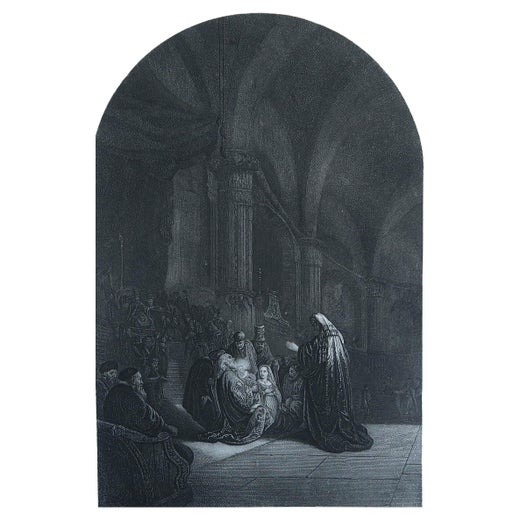
Rembrandt van RijnJan Uytenbogaert, The Goldweigher1639
1639
About the Item
- Creator:Rembrandt van Rijn (1606 - 1669, Dutch)
- Creation Year:1639
- Dimensions:Height: 17.75 in (45.09 cm)Width: 15.75 in (40.01 cm)Depth: 1 in (2.54 cm)
- Medium:
- Movement Style:
- Period:
- Condition:On medium Japan paper, in fine condition aside from slight discoloration in the (3/8 inch) margins and verso.
- Gallery Location:Boston, MA
- Reference Number:1stDibs: LU397312365982
Rembrandt van Rijn
Rembrandt was the most influential 17th Century Dutch painter. After years of early success as a portrait painter, his life was beset by financial hardship and personal tragedy. He continued to paint portraits and develop etchings. Rembrandt's portraits of his contemporaries, self-portraits and illustrations of scenes from the Bible are regarded as his greatest creative triumphs. His self-portraits form a unique and intimate autobiography, in which the artist surveyed himself without vanity and with the utmost sincerity. Like many artists of the Dutch Golden Age, such as Jan Vermeer of Delft, Rembrandt was also an avid art collector and dealer. Rembrandt never went abroad, but he was considerably influenced by the work of the Italian masters and Netherlandish artists who had studied in Italy, like Pieter Lastman, the Utrecht Caravaggists, Flemish Baroque, and Peter Paul Rubens. Rembrandt's foremost contribution in the history of printmaking was his transformation of the etching process from a relatively new reproductive technique into a true art form, along with Jacques Callot. His reputation as the greatest etcher in the history of the medium was established in his lifetime and never questioned since. Few of his paintings left the Dutch Republic while he lived, but his prints were circulated throughout Europe, and his wider reputation was initially based on them alone.
Authenticity Guarantee
In the unlikely event there’s an issue with an item’s authenticity, contact us within 1 year for a full refund. DetailsMoney-Back Guarantee
If your item is not as described, is damaged in transit, or does not arrive, contact us within 7 days for a full refund. Details24-Hour Cancellation
You have a 24-hour grace period in which to reconsider your purchase, with no questions asked.Vetted Professional Sellers
Our world-class sellers must adhere to strict standards for service and quality, maintaining the integrity of our listings.Price-Match Guarantee
If you find that a seller listed the same item for a lower price elsewhere, we’ll match it.Trusted Global Delivery
Our best-in-class carrier network provides specialized shipping options worldwide, including custom delivery.You May Also Like
William Hogarth
s "Analysis of Beauty": A Set of Two Framed 18th C. Engravings
By William Hogarth
Located in Alamo, CA
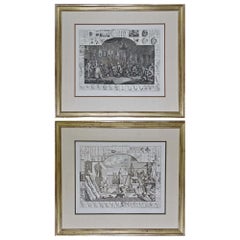
The two plates in this set were created utilizing both engraving and etching techniques by William Hogarth in 1753, originally as illustrations of his book on aesthetics, entitled "Analysis of Beauty". Due to their popularity, these plates were later published separately. The publication line in the lower right reads: "Designed, Engraved, and Publish'd by Wm. Hogarth, March 5th 1753, according to Act of Parliament." Hogarth's original copper plates were refurbished where needed by James Heath and engravings were republished in London in 1822 by Braddock, Cradock & Joy. This was the last time Hogarth's copper plates were used for printing. Most were melted during World War I for the construction of bombs.
These large folio sized "Analysis of Beauty" engravings are presented in antiqued gold-colored frames with double mats; the outer silk mats are light brown-colored and the inner mats are dark brown. Each frame measures 27.38" x 31.25" x 1.13". There is one tiny spot in the right margin of plate 1 and another in the lower margin; the latter could be from the printing process. The prints are otherwise in excellent condition.
The "Analysis of Beauty" series is in the collection of many major museums, including: The British Museum, The Metropolitan Museum of Art, The Tate Museum, The Chicago Art Institute and The Fine Arts Museums of San Francisco.
The first engraving (Plate 1) depicts a courtyard of statues which is filled with some of the most famous works of classical sculpture. The most important sculptures are surrounded by less impressive works. The Medicean Venus (#13) is in the center with a statue of Julius Caesar (#19) to the right, elevated on a pulley with a short, overdressed Brutus stands over the falling Caesar. The Apollo Belvedere (#12) is next. A judge stands to the right with his foot on a cherub (#16). Another crying cherub holds a gallows and wipes his tears with the judge's robe.
A sphinx (#21) and the drunken Silenus (#107) are below the Venus. Michaelangelo's torso (#54) and a statue of Antonius (#6) are seen in the foreground. The Farnese Hercules (#3) and a bust of another Hercules (#4) under two statuettes of Isis are also included in the scene.
The key to these objects is included in the form of a serpentine line winding around a cone (#26), Hogarth's "Line of Beauty". For Hogarth the winding line is an essential element of beauty in art. Hogarth's theory of beauty is communicated in this plate.
Plate 2 is thought to represent the Wanstead Assembly, with the Earl of Tynley and his household. It is an adaptation of a scene in the Happy Marriage series, which complements Hogarth's Marriage à la Mode...
Category
Mid-18th Century Old Masters Interior Prints
Materials
Engraving, Etching
$2,975
H 27.38 in W 31.25 in D 1.13 in
La Prêteuse sur Gage
By Auguste Brouet
Located in Middletown, NY
Brussels: Fondation de Dietrich et Cie, 1914. Etching with drypoint on Japon paper, 3 5/8 x 4 inches (93 x 102 mm); sheet 11 1/8 x 9 7/8 inches (283 x 251 mm), full margins. Signed a...
Category
Early 20th Century French School Interior Prints
Materials
Handmade Paper, Etching, Drypoint
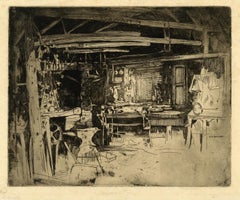
The Smithy
By Sir David Young Cameron, R.A.
Located in Middletown, NY
A warm composition, in theme and tone; the creaky timber interior of a 19th century Scottish blacksmith's shop.
Etching and drypoint on cream laid Japan paper, 8 x 10 inches (202 x ...
Category
Late 20th Century Modern Interior Prints
Materials
Laid Paper, Drypoint, Etching
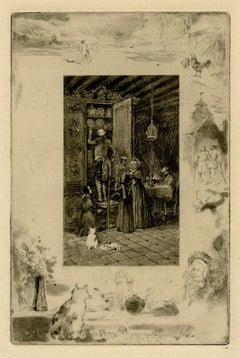
Les Vieux (The Elders)
By Félix Hilaire Buhot
Located in Middletown, NY
A lovely, dark impression with excellent provenance.
Paris: Lemerre, 1880.
Etching, drypoint, aquatint (dust ground and spirit ground), spit bite, and roulette in black on cream laid paper with a deckle edge, 6 3/4 x 4 1/2 inches (170 x 112 mm), full margins. Fourth state (of 5). An illustration from Alphonse Daudet's, Lettres de mon moulin, Paris, 1880. In very good condition with some light uniform toning and two areas of paper tape at the top right and left corners on the verso (from a former mount). With the 1921 J.H. de Bois circular ink stamp in green ink in the lower right margin on the recto (Lugt L.733).
[Bourcard 113].
A note regarding the provenance:
J. H. de Bois was a well known late-19th century modern art...
Category
1880s French School Interior Prints
Materials
Etching, Drypoint, Aquatint
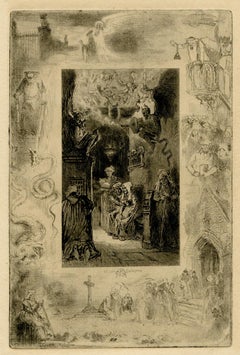
Le Curé de Cucignan
By Félix Hilaire Buhot
Located in Middletown, NY
A lovely, dark impression with excellent provenance.
Paris: Lemerre, 1880.
Etching, drypoint, aquatint (dust ground and spirit ground), spit bite, and roulette in black on cream laid paper with a deckle edge, 6 3/4 x 4 1/2 inches (170 x 112 mm), full margins. Third state (of 4). An illustration from Alphonse Daudet's, Lettres de mon moulin, Paris, 1880. In very good condition with some light uniform toning and two areas of paper tape at the top right and left corners on the verso (from a former mount). With the 1921 J.H. de Bois circular ink stamp in green ink in the lower right margin on the recto (Lugt L.733).
[Bourcard 112]
A note regarding the provenance:
J. H. de Bois was a well known late-19th century modern art...
Category
1880s French School Interior Prints
Materials
Drypoint, Etching, Aquatint, Laid Paper
La diligence de Beaucaire
By Félix Hilaire Buhot
Located in Middletown, NY
Paris: Lemerre, 1880.
Etching, drypoint, aquatint (dust ground and spirit ground), spit bite, and roulette in black on cream laid paper with a deckle edge, 6 3/4 x 4 1/2 inches (170 x 112 mm), full margins. Third state (of 3). An illustration from Alphonse Daudet's, Lettres de mon moulin, Paris, 1880. In very good condition with some light uniform toning and two areas of paper tape at the top right and left corners on the verso (from a former mount). With the 1921 J.H. de Bois circular ink stamp in green ink in the lower right margin on the recto (Lugt L.733).
[Bourcard 110].
A note regarding the provenance:
J. H. de Bois was a well known late-19th century modern art...
Category
1880s French School Interior Prints
Materials
Laid Paper, Drypoint, Etching, Aquatint

France at her Furnaces
By James McBey
Located in Plano, TX
1917. Etching. Hardie 175. 8 x 15 (sheet 10 1/8 x 16 15/16). Edition 76. Slight mat line; otherwise excellent condition. A rich impression printed on antique laid paper with full m...
Category
1910s Modern Interior Prints
Materials
Drypoint, Etching
Politics
By Edmund Blampied
Located in Plano, TX
Politics (Tonnere de Brest). 1926. Drypoint. Appleby 108. 7 x 9 (sheet 10 1/2 x 15 1/2). A rich impression printed on cream wove paper with full margins. Illustrated: Salaman, Modern...
Category
Early 20th Century Modern Figurative Prints
Materials
Drypoint, Etching
The Letter
By Edmund Blampied
Located in Plano, TX
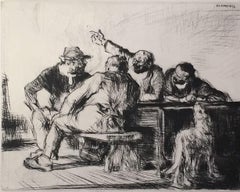
The Letter. 1921. Drypoint. Appleby 107. 7 x 9 3/8 (sheet 10 1/2 x 15 7/16). Edition 100. Illustrated: Fine Prints of the Year, 1925; Salaman, Modern Masters of Etching: Edmund Blamp...
Category
Early 20th Century Modern Figurative Prints
Materials
Drypoint, Etching
Soup
By Edmund Blampied
Located in Plano, TX
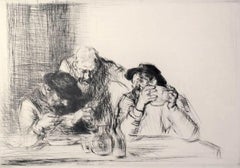
Soup. 1920. Drypoint. Appleby 65. 9 x 8 1/8 (sheet 15 x 11 9/16). Edition 100. Illlustrated: Print Collector's Quarterly 13 (1926): 85. Signed in pencil.
Edmund Blampied was a painter, etcher, lithographer and sculptor. Born in 1886 to a family of three boys in St. Martin, Jersey, Blampied became interested in drawing at an early age. After visiting the studio of John Helier Lander in 1899, Blampied decided to make a career as an artist. In 1903 he went to London to attend Lambeth Art School, where he studied etching under Walter Seymour.
In 1905, he joined the Daily Chronicle as an artist. In that year he was awarded a scholarship to Bolt Court Scool of Photo-engraving and Lithography.
In 1912 he left the Chronicle and established his own studio. He earned a living by illustrating novels and short stories.
In 1913, he had his first exhibition at the Leicester Gallery in London. The following year he married Marianne Van Abbé.
During the 1920's, he became a member of the Royal Society of Painter-Etchers and Engravers. During the 1920s Blampied became a member of the Royal Society of Painters-Etchers and Engravers and exhibited in London to critical acclaim. He produced a folio of comic drawings in the 1930s which was published in New York in 1934 and another that was published in London in 1936. The Keeper of Prints and Drawings at the British Museum published a mongraph on his work. His London exhibitions were highly successful.
In 1938, he moved to Bulwarks, St.Aubin in Jersey, but at the onset of the Occupation, had to relocate to Route Orange, St. Brelade. remained there throughout World War II during the German Occupation, despite the fact that his wife was Jewish. During the Occupation he designed bank...
Category
1920s Modern Figurative Prints
Materials
Drypoint, Etching