Want more images or videos?
Request additional images or videos from the seller
1 of 6
Rembrandt van Rijn“The Presentation in the Temple” (Simeon’s Hymn of Praise)1640, printed later
1640, printed later
About the Item
- Creator:Rembrandt van Rijn (1606 - 1669, Dutch)
- Creation Year:1640, printed later
- Dimensions:Height: 21 in (53.34 cm)Width: 32.5 in (82.55 cm)Depth: 3 in (7.62 cm)
- Medium:
- Movement Style:
- Period:1640-1649
- Condition:
- Gallery Location:Missouri, MO
- Reference Number:1stDibs: LU74733353913
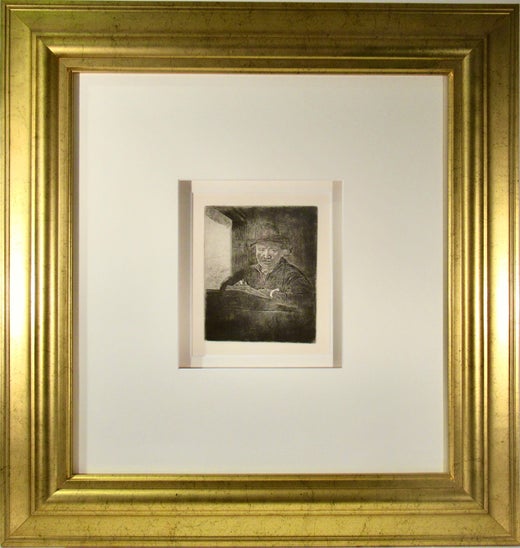
Rembrandt van Rijn
Rembrandt was the most influential 17th Century Dutch painter. After years of early success as a portrait painter, his life was beset by financial hardship and personal tragedy. He continued to paint portraits and develop etchings. Rembrandt's portraits of his contemporaries, self-portraits and illustrations of scenes from the Bible are regarded as his greatest creative triumphs. His self-portraits form a unique and intimate autobiography, in which the artist surveyed himself without vanity and with the utmost sincerity. Like many artists of the Dutch Golden Age, such as Jan Vermeer of Delft, Rembrandt was also an avid art collector and dealer. Rembrandt never went abroad, but he was considerably influenced by the work of the Italian masters and Netherlandish artists who had studied in Italy, like Pieter Lastman, the Utrecht Caravaggists, Flemish Baroque, and Peter Paul Rubens. Rembrandt's foremost contribution in the history of printmaking was his transformation of the etching process from a relatively new reproductive technique into a true art form, along with Jacques Callot. His reputation as the greatest etcher in the history of the medium was established in his lifetime and never questioned since. Few of his paintings left the Dutch Republic while he lived, but his prints were circulated throughout Europe, and his wider reputation was initially based on them alone.
About the Seller
5.0
Vetted Professional Seller
Every seller passes strict standards for authenticity and reliability
Established in 1970
1stDibs seller since 2017
156 sales on 1stDibs
Typical response time: Several days
Authenticity Guarantee
In the unlikely event there’s an issue with an item’s authenticity, contact us within 1 year for a full refund. DetailsMoney-Back Guarantee
If your item is not as described, is damaged in transit, or does not arrive, contact us within 7 days for a full refund. Details24-Hour Cancellation
You have a 24-hour grace period in which to reconsider your purchase, with no questions asked.Vetted Professional Sellers
Our world-class sellers must adhere to strict standards for service and quality, maintaining the integrity of our listings.Price-Match Guarantee
If you find that a seller listed the same item for a lower price elsewhere, we’ll match it.Trusted Global Delivery
Our best-in-class carrier network provides specialized shipping options worldwide, including custom delivery.You May Also Like
One Can
t Tell Why - Proof from the Disasters of War
By Francisco Goya
Located in New York, NY
Francisco José de Goya y Lucientes (1746 Fuendetodos – Bordeaux 1828), No se puede saber por qué – One can’t tell why ca. 1808–1814, etching, burnished aquatint, drypoint, an...
Category
1810s Old Masters Figurative Prints
Materials
Drypoint, Etching, Aquatint
The Spectacle Seller
By Adriaen Jansz van Ostade
Located in Middletown, NY
Etching and drypoint on cream laid paper, 4 x 3 3/8 inches (102 x 86 mm), 1/4 inch margins. Signed in the plate, lower left corner. The 3rd state (of 6), after the rounding of the pl...
Category
Mid-17th Century Old Masters Figurative Prints
Materials
Laid Paper, Drypoint, Etching
Altra veduta del medesimo in prospettiva...
By Giovanni Battista Piranesi
Located in Roma, IT
Title : Altra veduta del medesimo in prospettiva, fra una lampada e un piccolo vaso in bronzo
Artist proof, with a good contrast and sharp details, printed on antique laid paper, lar...
Category
1770s Old Masters Figurative Prints
Materials
Drypoint
$2,138
H 22.84 in W 31.3 in D 0.08 in
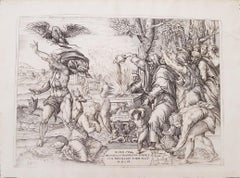
The Sacrifice of Iphigenia
By Nicolas Beatrizet
Located in Roma, IT
Black and white etching and drypoint on wire rod paper, representing the myth of the sacrifice of Iphigenia. On the altar is inscribed "Iphigenia" in capital letters. On the lower left margin is inscribed "N. Beatrizet Lo Taringus F.", slightly discolored (Beatrizet usually signed his plates with the letters "N. B. L. F."). At the center of the lower margin is inscribed "Romae, Michaelis Tramezini formis cum privilegio summi Pont. M.D.L.III".
After a drawing attributed to either Michelangelo Buonarroti, Salviati, or Baccio Bandinelli...
Category
16th Century Old Masters Figurative Prints
Materials
Drypoint, Etching
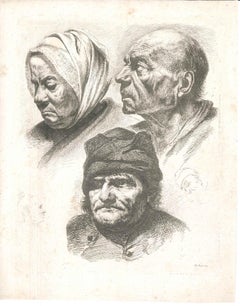
Study of Five Heads - Original Etching by J.-J. Boissieu
By Jean-Jacques de Boissieu
Located in Roma, IT
Study of Five Heads is a beautiful black and white etching with drypoint interventions on paper, realized at the end of XVIII century by the French artist Jean-Jacques de Boissieu (Lyon, 1736- 1810).
Five study of heads of which two profiles (a female and a male) are lightly sketched with the drypoint technique, and we could appreciate the incredible draftsmanship. Instead, the bigger three portraits are very detailed and etched with a superb technique. Although the subjects are drawn in different scales and with different degrees of finish, each portrait has the dignity of a unique piece and the composition is very balanced.
In particular on the lower margin at the center there is the portrait of "Le Père Cotrot, Garçon Teinturier à Lyon'", an elderly man, toothless and with a large-nosed, slightly turned to left, with a hat and unbuttoned jacket over waistcoat, shows all his wrinkles in a very realistic way.
Signed on plate on lower right margin “De Boissieu”.
This old master’s original print with fresh impressions, is in very good conditions, except for a usual yellowing of the paper above all on the edges and some signs of the time and light foxing along the margins, do not affect the image.
Jean-Jacques de Boissieu (Lyon,1736 –1810)
Jean-Jacques de Boissieu was a French artist studied at the École de Dessin in Lyon, but he was mostly self-taught.
His first prints were realized between 1758–64. When he went to Italy in the retinue of the ambassador and Duc de la Rochefoucauld d’Enville, he had the lifechanging encounter: he met Voltaire and he entered in the world of luminaries, he had the opportunity of realizing some plates for the Diderot-d’Alembert’s Encyclopèdie. Then he continued to produce prints in Lyon, Boissieu made many etchings of the Roman and Dutch countryside, as well as the French countryside around Lyon, which earned him a reputation as the last representative of the older etching...
Category
Late 18th Century Old Masters Animal Prints
Materials
Drypoint, Etching
$285
H 10.83 in W 8.55 in D 0.04 in
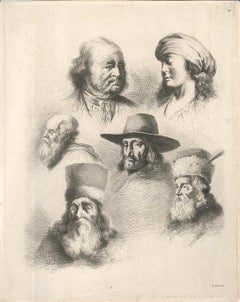
Study of Six Heads - Etching by J.-J. Boissieu
By Jean-Jacques de Boissieu
Located in Roma, IT
Study of Six Heads is a beautiful black and white etching with drypoint interventions on paper, realized at the end of XVIII century by the French artist Jean-Jacques de Boissieu (Lyon, 1736- 1810).
Six study od heads ( four elder men, a middle-aged man at the center, and a woman with turbant) etched with a superb technique and an incredible draftsmanship are drawn to different scales and with different degrees of finish, have the dignity of six different portraits with the same passion and effort.
Signed on plate on lower right margin “De Boissieu”. Inscription ( number plate) on higher-right corner "10".
This old master’s original print with lifetime impressions, is in very good conditions, except for a usual yellowing of the paper above all on the edges and some signs of the time,do not affect the image.
Jean-Jacques de Boissieu (Lyon,1736 –1810)
Jean-Jacques de Boissieu was a French artist studied at the École de Dessin in Lyon, but he was mostly self-taught.
His first prints were realized between 1758–64. When he went to Italy in the retinue of the ambassador and Duc de la Rochefoucauld d’Enville, he had the lifechanging encounter: he met Voltaire and he entered in the world of luminaries, he had the opportunity of realizing some plates for the Diderot-d’Alembert’s Encyclopèdie. Then he continued to produce prints in Lyon, Boissieu made many etchings of the Roman and Dutch countryside, as well as the French countryside around Lyon, which earned him a reputation as the last representative of the older etching...
Category
Late 18th Century Old Masters Animal Prints
Materials
Drypoint, Etching
$285
H 11.62 in W 9.34 in D 0.04 in
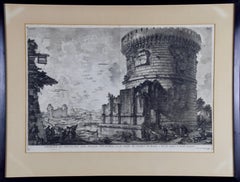
Ancient Roman Architecture: Original Framed 18th C. Etching by G. Piranesi
By Giovanni Battista Piranesi
Located in Alamo, CA
"Veduta del Sepolcro della Famiglia Plauzia per la Strada Che Conduce da Roma a Tivoli vicino a Ponte Lugano" from "Le Antichità Romane" (Roman Antiquities), one of the most famous works by Piranesi. "Antichita" illustrates the tombs along the Appian Way...
Category
Early 18th Century Old Masters Figurative Prints
Materials
Etching, Engraving, Drypoint
$3,100 Sale Price
20% Off
H 24.38 in W 31.75 in D 0.75 in
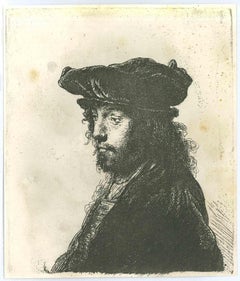
The Fourth Oriental Head - Engraving after Rembrandt - 19th Century
By Charles Amand Durand
Located in Roma, IT
The Fourth Oriental Head is an engraving on ivory-colored paper realized by Charles Amand Durand after an etching by Rembrandt dated 1635. This wonderful piece of art belongs to an e...
Category
19th Century Old Masters Figurative Prints
Materials
Engraving
$594
H 6.3 in W 5.32 in D 0.04 in
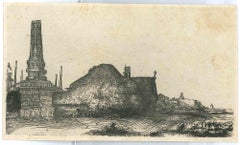
Landscape with an Obelisk - Engraving after Rembrandt - 19th Century
By Charles Amand Durand
Located in Roma, IT
Landscape with an Obelisk is an engraving on ivory-colored paper realized after an etching by Rembrandt dated 1650 ca. This wonderful piece of art belongs to an edition of the late 1...
Category
19th Century Old Masters Figurative Prints
Materials
Engraving
$689
H 3.94 in W 6.5 in D 0.04 in
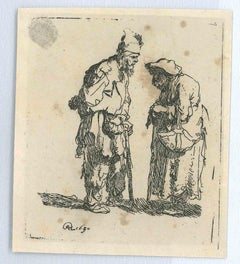
Beggar Man and Beggar Woman - Engraving after Rembrandt - 19th Century
By Charles Amand Durand
Located in Roma, IT
Beggar Man and Beggar Woman Conversing is an engraving on ivory-colored paper realized by Charles Amand Durand after an etching by Rembrandt dated 1630. Thi...
Category
19th Century Old Masters Figurative Prints
Materials
Engraving
$285
H 3.35 in W 5.71 in D 0.04 in
More From This Seller
View All"Mlle Landsberg" (grade planche, pl. 16)
By Henri Matisse
Located in Missouri, MO
"Mlle Landsberg" (grade planche, pl. 16), 1914
Henri Matisse (French, 1869-1954)
Signed and Numbered Lower Right
Edition 12/15
Image size: 7 7/8 x 4 5/16 inches
Sheet size: 17 11/16 x 12 1/2 inches
With frame: 19 1/2 x 14 1/2 inches
Henri Matisse came from a family who were of Flemish origin and lived near the Belgian border. At eight o'clock on the evening of December 31, 1869, he was born in his grandparents' home in the town of Le Cateau in the cheerless far north of France. His father was a self-made seed merchant who was a mixture of determination and tightly coiled tension.
Henri had no clear idea of what he wanted to do with his life. He was a twenty-year-old law clerk convalescing from appendicitis when he first began to paint, using a box of colors given to him by his mother. Little more than a year later, in 1890, he had abandoned law and was studying art in Paris. The classes consisted of drawing from plaster casts and nude models and of copying paintings in the Louvre. He soon rebelled against the school's conservative atmosphere; he replaced the dark tones of his earliest works with brighter colors that reflected his awareness of Impressionism. Matisse was also a violinist; he took an odd pride in the notion that if his painting eye failed, he could support his family by fiddling on the streets of Paris.
Henri found a girlfriend while studying art, and he fathered a daughter, Marguerite, by her in 1894. In 1898 he married another woman, Amelie Parayre. She adopted the beloved Marguerite; they eventually had two sons, Jean, a sculptor and Pierre who became an eminent art dealer. Relations between Matisse and his wife were often strained. He often dallied with other women, and they finally separated in 1939 over a model who had been hired as a companion for Mme. Matisse. She was Madame Lydia, and after Mme. Matisse left, she remained with Matisse until he died.
Matisse spent the summer of 1905 working with Andre Derain in the small Mediterranean seaport of Collioure. They began using bright and dissonant colors. When they and their colleagues exhibited together, they caused a sensation. The critics and the public considered their paintings to be so crude and so roughly crafted that the group became known as Les Fauves (the wild beasts).
By 1907, Matisse moved on from the concerns of Fauvism and turned his attention to studies of the human figure. He had begun to sculpt a few years earlier. In 1910, when he saw an exhibition of Islamic art, he was fascinated with the multiple patterned areas and adapted the decorative universe of the miniatures to his interiors. As a continuation of his interest in the "exotic", Matisse made extended trips to Morocco in 1912 and 1913.
At the end of 1917, Matisse moved to Nice; he would spend part of each year there for the remainder of his life. A meticulous dandy, he wore a light tweed jacket amd a tie when he painted. He never used a palette, but instead squeezed his colors on to plain white kitchen dishes...
Category
1910s Fauvist Figurative Prints
Materials
Drypoint, Etching
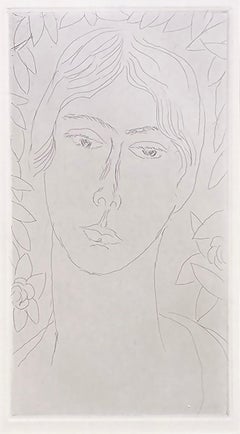
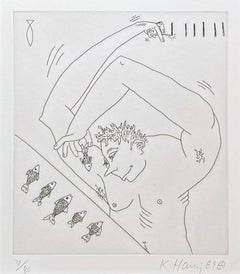
Figure and Fish (from The Valley Suite)
By Keith Haring
Located in Missouri, MO
Figure and Fish (from The Valley Suite), 1989 by Keith Haring (1958-1990)
Without Frame: 10" x 8.75"
With Frame: 18.25" x 17.25"
Signed and Dated Lower Right
Edition 31/80 Lower Left
"The Valley" is a group of etchings...
Category
Late 20th Century Pop Art Figurative Prints
Materials
Engraving
Price Upon Request
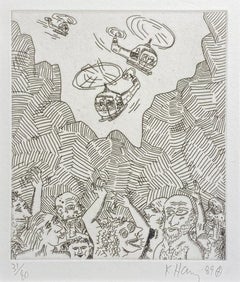
Helicopters, Mountains, People (from The Valley Suite)
By Keith Haring
Located in Missouri, MO
Helicopters, Mountains, People (from The Valley Suite) by Keith Haring (1958-1990)
Without Frame: 10" x 8.75"
With Frame: 18.25" x 17.25"
Signed and Dated Lower Right
Edition 31/80 Lower Left
"The Valley" is a group of etchings...
Category
Late 20th Century Pop Art Figurative Prints
Materials
Engraving
Price Upon Request
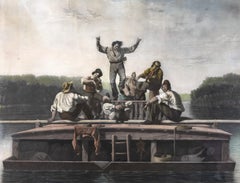
The Jolly Flat Boat Men
By George Caleb Bingham
Located in Missouri, MO
The Jolly Flat Boat Men, 1847
After George Caleb Bingham (American, 1811-1879)
Engraved by Thomas Doney (French, active New York 1844-1849)
Engraving with Hand-Coloring
Published by The American Art-Union, New York (1838-1851)
Printed by Powell and Co.
18 x 24 inches
32 x 38 inches with frame
In 1847, the American Art-Union purchased Bingham’s painting "The Jolly Flat Boat Men" (1846; National Gallery of Art) directly from the artist. The subscription-based organization, founded in 1838 as the Apollo Association, boasted nearly ten-thousand members at this date. For an annual fee of five dollars, each received a large reproductive engraving and was entered in a lottery to win original artworks exhibited at the Art-Union’s Free Gallery. Aimed at educating the public about contemporary American art, the organization developed an impressive distribution network that reached members in every state. The broad circulation of the Art-Union's print helped to establish Bingham's reputation and made his river scene famous.
Born in Augusta County, Virginia in the Shenandoah River Valley, George Caleb Bingham became known for classically rendered western genre, especially Missouri and Mississippi River scenes of boatmen bringing cargo to the American West and politicians seeking to influence frontier life. One of his most famous river genre paintings was The Jolly Flatboatmen completed in several versions in 1846. This first version of this painting is in the Manoogian Collection at the National Gallery of Art. Fame resulted for this work when it was exhibited in New York at the American Art Union whose organizers made an engraving of 10,000 copies and distributed it to all of their members. Paintings such as Country Politician (1849) and County Election (1852) and Stump Speaking (1854) reflected Bingham's political interests.
In 1819, as an eight-year old, he moved to Boon's Lick, Missouri with his parents and grandfather who had been farmers and inn keepers in the Shenandoah Valley near Rockingham, Virginia. Reportedly as a child there, he took every opportunity to escape supervision to travel the River and watch the marine activity.
His father died in 1827, when his son was sixteen years old. His mother had encouraged his art talent, but art lessons were not easily obtainable. In order to earn money, he apprenticed to a cabinet maker but determined to become an artist. By 1835, he had a modest reputation as a frontier painter and successfully charged twenty dollars per portrait in St. Louis. "His portraits had become standard decorations in prosperous Missouri homes." (Samuels 46). In 1836, he moved to Natchez, Mississippi and there had the same kind of career, only was able to charge forty dollars per portrait.
He remained largely self taught until 1837, when he, age 26 and using the proceeds from his portraiture, studied several months at the Pennsylvania Academy of the Fine Arts. He later said that he learned much of his atmospheric style and classically balanced composition by copying paintings in collections in St. Louis and Philadelphia and that among his most admired painters were Thomas Cole, John Vanderlyn, and William Sidney Mount. Between 1856 and 1859, Bingham traveled back and forth to Dusseldorf, Germany, where he studied the work of genre painters. Some critics think these influences were negative on his work because during that time period, he abandoned his luminist style that had brought him so much public affirmation.
Bingham credited Chester Harding (1792-1866) as being the earliest and one of the most lasting influences on his work. Harding,a leading portraitists when Bingham was a young man, had a studio in Franklin, near Bingham's home town. In 1822, when Bingham was ten years old, he watched Harding finish a portrait of Daniel Boone. Bingham recalled that watching Harding with the Boone portrait was a lasting inspiration and that it was the first time he had ever seen a painting in progress. Harding suggested to Bingham that he begin doing portraiture by finding subjects in the river men, which, of course, opened the subject matter that established fame and financial success for Bingham. Harding also encouraged Bingham to copy with paint engravings. He later painted two portraits of Boone but, contrary to the assertions of some scholars, he did not do Boone portraits in the company of Harding.
Bingham's portraits of Boone are not located, but one of them, a wood signboard for a hotel in Boonville circa 1828 to 1830, showed a likeness of Boone in buckskin dress...
Category
1840s Hudson River School Figurative Prints
Materials
Engraving
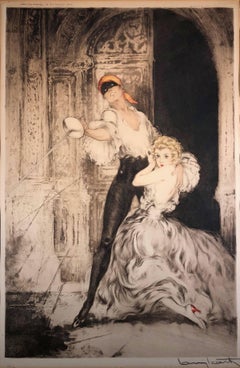
Don Juan
By Louis Icart
Located in Missouri, MO
Aquating Engraving
Image Size: approx. 20 1/4 x 13 3/8
Framed Size: 28 x 20.5 inches
Pencil Signed Lower Right
Louis Justin Laurent Icart was born in Toulouse in 1890 and died in Paris in 1950. He lived in New York City in the 1920s, where he became known for his Art-Deco color etchings of glamourous women.
He was first son of Jean and Elisabeth Icart and was officially named Louis Justin Laurent Icart. The use of his initials L.I. would be sufficient in this household. Therefore, from the moment of his birth he was dubbed 'Helli'. The Icart family lived modestly in a small brick home on rue Traversière-de-la-balance, in the culturally rich Southern French city of Toulouse, which was the home of many prominent writers and artists, the most famous being Henri de Toulouse-Lautrec.
Icart entered the l'Ecole Superieure de Commerce de Toulouse in order to continue his studies for a career in business, particularly banking (his father's profession). However, he soon discovered the play writings of Victor Hugo (1802-1885), which were to change the course of his life. Icart borrowed whatever books he could find by Hugo at the Toulouse library, devouring the tales, rich in both romantic imagery and the dilemmas of the human condition. It was through Icart's love of the theater that he developed a taste for all the arts, though the urge to paint was not as yet as strong for him as the urge to act.
It was not until his move to Paris in 1907 that Icart would concentrate on painting, drawing and the production of countless beautiful etchings, which have served (more than the other mediums) to indelibly preserve his name in twentieth century art history.
Art Deco, a term coined at the 1925 Paris Exposition des Arts Decoratifs, had taken its grip on the Paris of the 1920s. By the late 1920s Icart, working for both publications and major fashion and design studios, had become very successful, both artistically and financially. His etchings reached their height of brilliance in this era of Art Deco, and Icart had become the symbol of the epoch. Yet, although Icart has created for us a picture of Paris and New York life in the 1920s and 1930s, he worked in his own style, derived principally from the study of eighteenth-century French masters such as Jean Antoine Watteau, François Boucher and Jean Honoré Fragonard.
In Icart's drawings, one sees the Impressionists Degas...
Category
1920s Art Deco Figurative Prints
Materials
Engraving, Aquatint
$2,800 Sale Price
20% Off
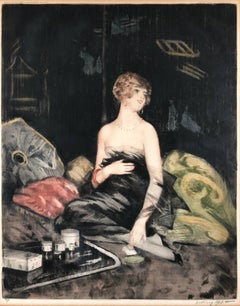
In the Boudoir
By William Ablett
Located in Missouri, MO
Aquating Engraving
Image Size: Approx 19 x 15.5
Framed Size: Approx. 28.5 x 24.5
William Albert Ablett (1877 - 1937)
Although born to English parents, William Ablett lived in Par...
Category
Early 20th Century Art Deco Figurative Prints
Materials
Engraving, Aquatint
Price Upon Request
Still Thinking About These?
All Recently ViewedMore Ways To Browse
William Hogarth Beauty
Yoko Ono Lithograph Harold Town
Zamy Steynovitz Serigraph
Zeno Giglietti
18th Century Shoe Buckle
1960 1970 Posters
Abraham Lincoln Emancipation Proclamation
Ak47 Lotus
Al Hirschfeld Barbra Streisand
Alex Katz Bicycle
Alex Katz Christy
Alex Katz Twilight
Alice Ravenel Huger Smith
Alvar Aalto Poster
Andre Gregory
Antique Trunk Lithographs
Aristide Bruant Dans Son Cabaret
Art Nouveau Artemis