Want more images or videos?
Request additional images or videos from the seller
1 of 8
Sadao WatanabeThe Three Wise Men1969
1969
Price:$2,000
About the Item
- Creator:Sadao Watanabe (1913 - 1998, Japanese)
- Creation Year:1969
- Dimensions:Height: 40 in (101.6 cm)Width: 34 in (86.36 cm)Depth: 3 in (7.62 cm)
- Medium:
- Movement Style:
- Period:
- Condition:
- Gallery Location:Storrs, CT
- Reference Number:1stDibs: LU33521205213
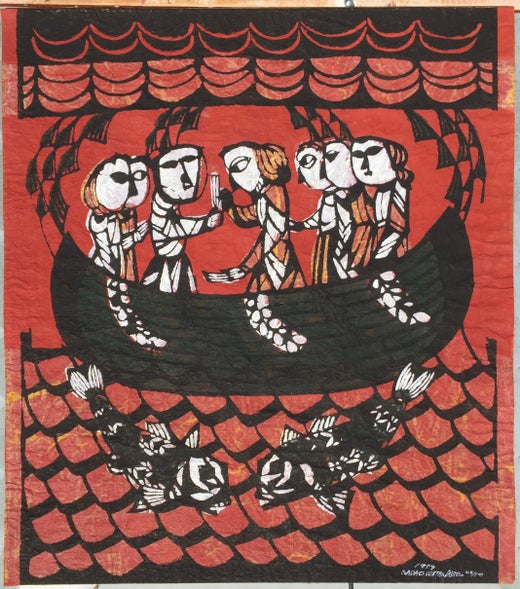
Sadao Watanabe
Sadao Watanabe, born in Tokyo in 1913, used the medium called kappazuri ("stencil printing"), a technique related to 'katazome' ("stencil dyeing"). 'Katazome' is said to have originated in Okinawa (the method there was called 'bingata'). The paper most widely used in Japan for stencil printing is called 'shibugami', made from several layers of 'kozo' paper laminated with persimmon tannin. The sheets are dried and smoke-cured to strengthen them and make them flexible and waterproof. Once the artist makes a drawing, it is fixed to the 'shibugami' with a thin adhesive. The basic pattern is then carved into a "key impression" stencil (the equivalent to the keyblock in woodblock printing) called the 'omogata'. If colors will also be used for the final design, separate stencils are sometimes cut for each color. If the stencil pattern has thin lines they can be reinforced with silk gauze, which still allow for uniform printing of colors. The first stage of the printing process involves the application and drying of a dye-resist paste to cover all the portions of the design to be left unprinted by the design. The patterns and colors can then be brushed over the stencil while affecting only those areas without resist paste. Typically the first colors printed are the lighter areas so that darker colors can be overprinted. After all the colors are printed and dried, the key impression stencil is finally used to print the key design over all the previous colors. The dye resist paste is then washed off (called 'mizumoto', "to wash by water") and the paper is dried on a wood board. Watanabe typically printed on a colored ground, so he would first apply a color to the paper. Watanabe, who was baptized a Christian in 1930, based his designs exclusively on Biblical subjects, though his Christian stories and figures are interpreted through a filter of traditional Japanese techniques and even some older Buddhist figure prints. The folk-art movement in Japan began in the 1930s as an attempt to keep alive various traditional arts, among them stencil printing. Watanabe was an early member of a small but important group of artists who dedicated themselves to learning and preserving these arts. Watanabe's emotioonally moving Biblical prints are have been popular throughout the world, and have been hung in the Vatican, the White House, in museums and in private collections.
About the Seller
5.0
Recognized Seller
These prestigious sellers are industry leaders and represent the highest echelon for item quality and design.
Gold Seller
Premium sellers maintaining a 4.3+ rating and 24-hour response times
Established in 1977
1stDibs seller since 2016
729 sales on 1stDibs
Typical response time: 7 hours
Associations
International Fine Print Dealers Association
Authenticity Guarantee
In the unlikely event there’s an issue with an item’s authenticity, contact us within 1 year for a full refund. DetailsMoney-Back Guarantee
If your item is not as described, is damaged in transit, or does not arrive, contact us within 7 days for a full refund. Details24-Hour Cancellation
You have a 24-hour grace period in which to reconsider your purchase, with no questions asked.Vetted Professional Sellers
Our world-class sellers must adhere to strict standards for service and quality, maintaining the integrity of our listings.Price-Match Guarantee
If you find that a seller listed the same item for a lower price elsewhere, we’ll match it.Trusted Global Delivery
Our best-in-class carrier network provides specialized shipping options worldwide, including custom delivery.You May Also Like
after Jean Dubuffet - Man - Pochoir
By Jean Dubuffet
Located in Collonge Bellerive, Geneve, CH
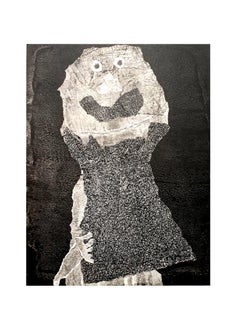
after Jean Dubuffet - Man - Pochoir
1960
Dimensions: 32 x 25 cm
Edition: G. di San Lazzaro.
From the art review XXème siècle
Unsigned and unumbered as issued
Category
1960s Modern Figurative Prints
Materials
Stencil
after Jean Dubuffet - Man - Pochoir
By Jean Dubuffet
Located in Collonge Bellerive, Geneve, CH
after Jean Dubuffet - Man - Pochoir
1956
Dimensions: 32 x 25 cm
Edition: G. di San Lazzaro.
From the art review XXè siècle
Unsigned and unumbered as issued
Category
1950s Modern Figurative Prints
Materials
Stencil
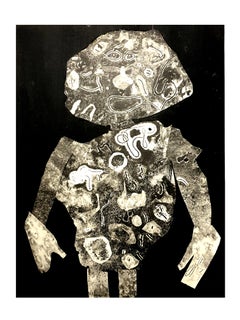
after Jean Dubuffet - Personnage - Pochoir
By Jean Dubuffet
Located in Collonge Bellerive, Geneve, CH
after Jean Dubuffet
Personnage
Pochoir on paper
1956
Dimensions: 32 x 25 cm
Edition: G. di San Lazzaro.
From the art revue XXe siècle
Unsigned and unumbered as issued
Category
1950s Modern Figurative Prints
Materials
Stencil

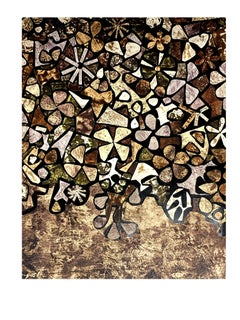
after Jean Dubuffet - Flowers - Pochoir
By Jean Dubuffet
Located in Collonge Bellerive, Geneve, CH
after Jean Dubuffet - Flowers - Pochoir
1957
Dimensions: 32 x 25 cm
Edition: G. di San Lazzaro.
From the art review XXe siècle
Unsigned and unumbered as issued
Category
1950s Modern Figurative Prints
Materials
Stencil
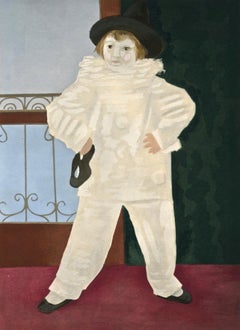
Pablo Picasso, Paul as Pierrot, from Chroniques du Jour, 1930 (after)
By Pablo Picasso
Located in Southampton, NY
This exquisite lithograph and pochoir after Pablo Picasso (1881–1973), titled Paul en Pierrot (Paul as Pierrot), from the album, Pablo Picasso, 1930, originates from the 1930 edition published by Editions des Chroniques du Jour, Paris, and printed by L'Atelier Desjobert, Paris, 1930. Paul en Pierrot (Paul as Pierrot) exemplifies Picasso’s tender and theatrical portrayal of his son Paul, rendered with the lyrical charm and painterly sophistication that defined his neoclassical period. Through the combination of lithographic precision and pochoir color, the work evokes both the intimacy of family life and the dreamlike symbolism of commedia dell’arte, merging affection and artistry in a composition of striking emotional balance.
Executed as a lithograph and pochoir on velin paper, this work measures 11.38 x 9.09 inches. Unsigned and unnumbered as issued. The edition exemplifies the refined craftsmanship of Editions des Chroniques du Jour and the technical excellence of L'Atelier Desjobert, one of the premier Parisian workshops specializing in pochoir and fine art lithography.
Artwork Details:
Artist: After Pablo Picasso (1881–1973)
Title: Paul en Pierrot (Paul as Pierrot), from the album, Pablo Picasso, 1930
Medium: Lithograph and pochoir on velin paper
Dimensions: 11.38 x 9.09 inches (28.9 x 23.1 cm)
Inscription: Unsigned and unnumbered as issued
Date: 1930
Publisher: Editions des Chroniques du Jour, Paris
Printer: L'Atelier Desjobert, Paris
Catalogue raisonne references: Cramer, Patrick. Pablo Picasso, The Illustrated Books: Catalogue Raisonne. Patrick Cramer, 1983, illustration 18; Bloch, Georges. Pablo Picasso: Catalogue of the Printed Graphic Work 1904–1967. Kornfeld & Klipstein, 1968, illustration 98; Reusse, Gerhard. Pablo Picasso: The Illustrated Books, Catalogue Raisonne. Verlag Gerd Hatje, 1983, illustration 31
Condition: Well preserved, consistent with age and medium
Provenance: From the album, Pablo Picasso, published by Editions des Chroniques du Jour, Paris, and printed by L'Atelier Desjobert, Paris, 1930
Notes:
Excerpted from the album, This volume has been printed in MCC numbered examples, of which DL (LI to DC) constitute the edition in French and DCL (DCI to MCCL). The edition in English has been printed on behalf of E. Weyhe, 794 Lexington Avenue, New York (DCI to MC) and of A. Zwemmer, 78 Charing Cross Road, London, W. C.2. (MCI to MCCL). There have also been printed L examples on Arches paper with a lithograph by Picasso (I to L) distributed between the two editions, and some press examples.
About the Publication:
The album Pablo Picasso, published in 1930 by Editions des Chroniques du Jour, Paris, under the direction of Christian Zervos, stands among the earliest major printed tributes to the artist’s emerging international acclaim. Conceived as part of the publisher’s broader initiative to document and celebrate the modernist vanguard, the volume presented a series of lithographs and pochoirs interpreting Picasso’s drawings, watercolors, and gouaches from the preceding decade. Executed at the esteemed Atelier Desjobert, the edition combined the lithographic precision of line with the pochoir method’s hand-applied color, producing images of exceptional tonal depth and fidelity. Issued in both French and English, with distribution in Paris, New York, and London through E. Weyhe and A. Zwemmer, the album was limited to MCC copies, including a special suite of L examples on Arches paper containing an original lithograph by Picasso. The publication represented a vital collaboration between artist, publisher, and printer—uniting the intellectual rigor of Zervos’s art criticism with the material beauty of fine French printmaking. Today, Pablo Picasso, 1930 is recognized as a landmark in 20th-century art publishing, reflecting both the refinement of interwar Parisian craftsmanship and the international reach of Picasso’s genius.
About the Artist:
Pablo Picasso (1881–1973) was a Spanish painter, sculptor, printmaker, and ceramicist whose extraordinary vision revolutionized modern art and defined the visual language of the 20th century. A child prodigy from Malaga, Spain, Picasso's career spanned more than seven decades and encompassed an astonishing range of styles and innovations—from the melancholic Blue and romantic Rose periods to his pioneering invention of Cubism with Georges Braque, which shattered conventional notions of perspective and form. Influenced by the bold expressiveness of El Greco, the structure of Cezanne, and the vitality of African and Iberian sculpture, Picasso became a central figure of the Paris avant-garde, working in creative dialogue with contemporaries such as Henri Matisse, Alexander Calder, Alberto Giacometti, Salvador Dali, Joan Miro, Wassily Kandinsky, Marcel Duchamp, and Man Ray. His insatiable experimentation extended across painting, drawing, printmaking, ceramics, and sculpture, forever expanding the boundaries of artistic expression. A master of reinvention, Picasso profoundly shaped generations of artists who followed—from Andy Warhol, Roy Lichtenstein, David Hockney, and Jean-Michel Basquiat to Jeff Koons and Banksy—cementing his status as a timeless cultural icon whose works remain among the most sought after worldwide. His landmark painting Les Femmes d'Alger (Version O) achieved a record-breaking sale of 179,365,000 USD at Christie's, New York, on May 11, 2015, affirming Picasso's enduring legacy as one of the most influential and valuable artists in history.
Pablo Picasso Paul en Pierrot (Paul as Pierrot), Picasso 1930, Picasso Desjobert, Picasso pochoir...
Category
1930s Modern Figurative Prints
Materials
Lithograph, Stencil
$2,396 Sale Price
20% Off
Free Shipping
H 11.38 in W 9.094 in
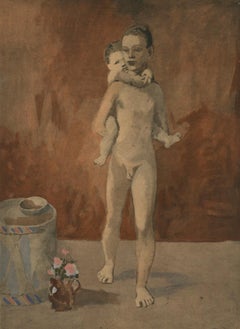
Pablo Picasso, The Child with the Doll, from Chroniques du Jour, 1930 (after)
By Pablo Picasso
Located in Southampton, NY
This exquisite lithograph and pochoir after Pablo Picasso (1881–1973), titled L’Enfant a l’ange (The Child with the Doll), from the album, Pablo Picasso, 1930, originates from the 1930 edition published by Editions des Chroniques du Jour, Paris, and printed by L'Atelier Desjobert, Paris, 1930. L’Enfant a l’ange (The Child with the Angel) exemplifies Picasso’s exploration of mythological and spiritual imagery during the early 1930s—a period in which he synthesized the formal innovations of Cubism with the poetic lyricism of his neoclassical and Surrealist phases. Through the delicate layering of lithographic line and pochoir color, the work evokes both innocence and transcendence, merging classical grace with modern expressiveness in a composition that feels simultaneously intimate and monumental.
Executed as a lithograph and pochoir on velin paper, this work measures 11.38 x 9.09 inches. Unsigned and unnumbered as issued. The edition exemplifies the refined craftsmanship of Editions des Chroniques du Jour and the technical excellence of L'Atelier Desjobert, one of the premier Parisian workshops specializing in pochoir and fine art lithography.
Artwork Details:
Artist: After Pablo Picasso (1881–1973)
Title: L’Enfant a l’ange (The Child with the Doll), from the album, Pablo Picasso, 1930
Medium: Lithograph and pochoir on velin paper
Dimensions: 11.38 x 9.09 inches (28.9 x 23.1 cm)
Inscription: Unsigned and unnumbered as issued
Date: 1930
Publisher: Editions des Chroniques du Jour, Paris
Printer: L'Atelier Desjobert, Paris
Catalogue raisonne references: Cramer, Patrick. Pablo Picasso, The Illustrated Books: Catalogue Raisonne. Patrick Cramer, 1983, illustration 18; Bloch, Georges. Pablo Picasso: Catalogue of the Printed Graphic Work 1904–1967. Kornfeld & Klipstein, 1968, illustration 98; Reusse, Gerhard. Pablo Picasso: The Illustrated Books, Catalogue Raisonne. Verlag Gerd Hatje, 1983, illustration 31
Condition: Well preserved, consistent with age and medium
Provenance: From the album, Pablo Picasso, published by Editions des Chroniques du Jour, Paris, and printed by L'Atelier Desjobert, Paris, 1930
Notes:
Excerpted from the album, This volume has been printed in MCC numbered examples, of which DL (LI to DC) constitute the edition in French and DCL (DCI to MCCL). The edition in English has been printed on behalf of E. Weyhe, 794 Lexington Avenue, New York (DCI to MC) and of A. Zwemmer, 78 Charing Cross Road, London, W. C.2. (MCI to MCCL). There have also been printed L examples on Arches paper with a lithograph by Picasso (I to L) distributed between the two editions, and some press examples.
About the Publication:
The album Pablo Picasso, published in 1930 by Editions des Chroniques du Jour, Paris, under the direction of Christian Zervos, stands among the earliest major printed tributes to the artist’s emerging international acclaim. Conceived as part of the publisher’s broader initiative to document and celebrate the modernist vanguard, the volume presented a series of lithographs and pochoirs interpreting Picasso’s drawings, watercolors, and gouaches from the preceding decade. Executed at the esteemed Atelier Desjobert, the edition combined the lithographic precision of line with the pochoir method’s hand-applied color, producing images of exceptional tonal depth and fidelity. Issued in both French and English, with distribution in Paris, New York, and London through E. Weyhe and A. Zwemmer, the album was limited to MCC copies, including a special suite of L examples on Arches paper containing an original lithograph by Picasso. The publication represented a vital collaboration between artist, publisher, and printer—uniting the intellectual rigor of Zervos’s art criticism with the material beauty of fine French printmaking. Today, Pablo Picasso, 1930 is recognized as a landmark in 20th-century art publishing, reflecting both the refinement of interwar Parisian craftsmanship and the international reach of Picasso’s genius.
About the Artist:
Pablo Picasso (1881–1973) was a Spanish painter, sculptor, printmaker, and ceramicist whose extraordinary vision revolutionized modern art and defined the visual language of the 20th century. A child prodigy from Malaga, Spain, Picasso's career spanned more than seven decades and encompassed an astonishing range of styles and innovations—from the melancholic Blue and romantic Rose periods to his pioneering invention of Cubism with Georges Braque, which shattered conventional notions of perspective and form. Influenced by the bold expressiveness of El Greco, the structure of Cezanne, and the vitality of African and Iberian sculpture, Picasso became a central figure of the Paris avant-garde, working in creative dialogue with contemporaries such as Henri Matisse, Alexander Calder, Alberto Giacometti, Salvador Dali, Joan Miro, Wassily Kandinsky, Marcel Duchamp, and Man Ray. His insatiable experimentation extended across painting, drawing, printmaking, ceramics, and sculpture, forever expanding the boundaries of artistic expression. A master of reinvention, Picasso profoundly shaped generations of artists who followed—from Andy Warhol, Roy Lichtenstein, David Hockney, and Jean-Michel Basquiat to Jeff Koons and Banksy—cementing his status as a timeless cultural icon whose works remain among the most sought after worldwide. His landmark painting Les Femmes d'Alger (Version O) achieved a record-breaking sale of 179,365,000 USD at Christie's, New York, on May 11, 2015, affirming Picasso's enduring legacy as one of the most influential and valuable artists in history.
Pablo Picasso L’Enfant a l’ange (The Child with the Doll), Picasso 1930, Picasso Desjobert, Picasso pochoir...
Category
1930s Modern Figurative Prints
Materials
Lithograph, Stencil
$2,396 Sale Price
20% Off
Free Shipping
H 11.38 in W 9.094 in
World Class, iconic coveted 13 color silkscreen with paint Unique variant Signed
By Mr. Brainwash
Located in New York, NY
Mr. Brainwash
World Class, 2009
Thirteen color silkscreen on hand stained archival art paper. Individually finished with spray paint and stencil balloon; unique variant
Hand signed t...
Category
Early 2000s Street Art Portrait Prints
Materials
Spray Paint, Archival Paper, Screen, Stencil

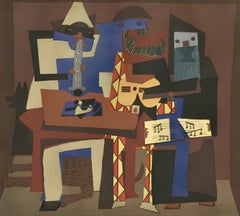
Pablo Picasso, The Three Musicians, from Chroniques du Jour, 1930 (after)
By Pablo Picasso
Located in Southampton, NY
This exquisite lithograph and pochoir after Pablo Picasso (1881–1973), titled Les Trois Musiciens (The Three Musicians), from the album, Pablo Picasso, 1930, originates from the 1930 edition published by Editions des Chroniques du Jour, Paris, and printed by L'Atelier Desjobert, Paris, 1930. Les Trois Musiciens (The Three Musicians) captures Picasso’s Cubist mastery at its height, translating one of his most celebrated compositions into the refined medium of lithograph and pochoir. The scene depicts three abstracted figures—a harlequin, a monk, and a pierrot—arranged in a complex geometric harmony that embodies both the structure and rhythm of modernity. Through vivid color and precise pochoir layering, Picasso’s interplay of form, shadow, and light transforms the musicians into a symphony of shape and sound, reflecting the artist’s enduring fascination with the relationship between visual art and music.
Executed as a lithograph and pochoir on velin paper, this work measures 9.09 x 11.38 inches. Unsigned and unnumbered as issued. The edition exemplifies the refined craftsmanship of Editions des Chroniques du Jour and the technical excellence of L'Atelier Desjobert, one of the premier Parisian workshops specializing in pochoir and fine art lithography.
Artwork Details:
Artist: After Pablo Picasso (1881–1973)
Title: Les Trois Musiciens (The Three Musicians), from the album, Pablo Picasso, 1930
Medium: Lithograph and pochoir on velin paper
Dimensions: 9.09 x 11.38 inches (23.1 x 28.9 cm)
Inscription: Unsigned and unnumbered as issued
Date: 1930
Publisher: Editions des Chroniques du Jour, Paris
Printer: L'Atelier Desjobert, Paris
Catalogue raisonne references: Cramer, Patrick. Pablo Picasso, The Illustrated Books: Catalogue Raisonne. Patrick Cramer, 1983, illustration 18; Bloch, Georges. Pablo Picasso: Catalogue of the Printed Graphic Work 1904–1967. Kornfeld & Klipstein, 1968, illustration 98; Reusse, Gerhard. Pablo Picasso: The Illustrated Books, Catalogue Raisonne. Verlag Gerd Hatje, 1983, illustration 31
Condition: Well preserved, consistent with age and medium
Provenance: From the album, Pablo Picasso, published by Editions des Chroniques du Jour, Paris, and printed by L'Atelier Desjobert, Paris, 1930
Notes:
Excerpted from the album, This volume has been printed in MCC numbered examples, of which DL (LI to DC) constitute the edition in French and DCL (DCI to MCCL). The edition in English has been printed on behalf of E. Weyhe, 794 Lexington Avenue, New York (DCI to MC) and of A. Zwemmer, 78 Charing Cross Road, London, W. C.2. (MCI to MCCL). There have also been printed L examples on Arches paper with a lithograph by Picasso (I to L) distributed between the two editions, and some press examples.
About the Publication:
The album Pablo Picasso, published in 1930 by Editions des Chroniques du Jour, Paris, under the direction of Christian Zervos, stands among the earliest major printed tributes to the artist’s emerging international acclaim. Conceived as part of the publisher’s broader initiative to document and celebrate the modernist vanguard, the volume presented a series of lithographs and pochoirs interpreting Picasso’s drawings, watercolors, and gouaches from the preceding decade. Executed at the esteemed Atelier Desjobert, the edition combined the lithographic precision of line with the pochoir method’s hand-applied color, producing images of exceptional tonal depth and fidelity. Issued in both French and English, with distribution in Paris, New York, and London through E. Weyhe and A. Zwemmer, the album was limited to MCC copies, including a special suite of L examples on Arches paper containing an original lithograph by Picasso. The publication represented a vital collaboration between artist, publisher, and printer—uniting the intellectual rigor of Zervos’s art criticism with the material beauty of fine French printmaking. Today, Pablo Picasso, 1930 is recognized as a landmark in 20th-century art publishing, reflecting both the refinement of interwar Parisian craftsmanship and the international reach of Picasso’s genius.
About the Artist:
Pablo Picasso (1881–1973) was a Spanish painter, sculptor, printmaker, and ceramicist whose extraordinary vision revolutionized modern art and defined the visual language of the 20th century. A child prodigy from Malaga, Spain, Picasso's career spanned more than seven decades and encompassed an astonishing range of styles and innovations—from the melancholic Blue and romantic Rose periods to his pioneering invention of Cubism with Georges Braque, which shattered conventional notions of perspective and form. Influenced by the bold expressiveness of El Greco, the structure of Cezanne, and the vitality of African and Iberian sculpture, Picasso became a central figure of the Paris avant-garde, working in creative dialogue with contemporaries such as Henri Matisse, Alexander Calder, Alberto Giacometti, Salvador Dali, Joan Miro, Wassily Kandinsky, Marcel Duchamp, and Man Ray. His insatiable experimentation extended across painting, drawing, printmaking, ceramics, and sculpture, forever expanding the boundaries of artistic expression. A master of reinvention, Picasso profoundly shaped generations of artists who followed—from Andy Warhol, Roy Lichtenstein, David Hockney, and Jean-Michel Basquiat to Jeff Koons and Banksy—cementing his status as a timeless cultural icon whose works remain among the most sought after worldwide. His landmark painting Les Femmes d'Alger (Version O) achieved a record-breaking sale of 179,365,000 USD at Christie's, New York, on May 11, 2015, affirming Picasso's enduring legacy as one of the most influential and valuable artists in history.
Pablo Picasso Les Trois Musiciens (The Three Musicians), Picasso 1930, Picasso Desjobert, Picasso pochoir...
Category
1930s Cubist Figurative Prints
Materials
Lithograph, Stencil
$2,396 Sale Price
20% Off
Free Shipping
H 9.094 in W 11.38 in
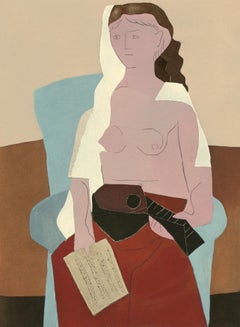
Pablo Picasso, Woman with Mandolin, from Chroniques du Jour, 1930 (after)
By Pablo Picasso
Located in Southampton, NY
This exquisite lithograph and pochoir after Pablo Picasso (1881–1973), titled Femme à la mandoline (Woman with Mandolin), from the album, Pablo Picasso, 1930, originates from the 1930 edition published by Editions des Chroniques du Jour, Paris, and printed by L'Atelier Desjobert, Paris, 1930. Femme à la mandoline (Woman with Mandolin) exemplifies Picasso’s lyrical interpretation of the female form during his neoclassical period, fusing harmony, sensuality, and musicality into a composition that reflects both the artist’s Mediterranean roots and his mastery of modernist form. Through the union of lithographic line and pochoir color, the work conveys a balance between intimacy and abstraction, celebrating rhythm, grace, and the timeless relationship between art and music.
Executed as a lithograph and pochoir on velin paper, this work measures 11.38 x 9.09 inches. Unsigned and unnumbered as issued. The edition exemplifies the refined craftsmanship of Editions des Chroniques du Jour and the technical excellence of L'Atelier Desjobert, one of the premier Parisian workshops specializing in pochoir and fine art lithography.
Artwork Details:
Artist: After Pablo Picasso (1881–1973)
Title: Femme à la mandoline (Woman with Mandolin), from the album, Pablo Picasso, 1930
Medium: Lithograph and pochoir on velin paper
Dimensions: 11.38 x 9.09 inches (28.9 x 23.1 cm)
Inscription: Unsigned and unnumbered as issued
Date: 1930
Publisher: Editions des Chroniques du Jour, Paris
Printer: L'Atelier Desjobert, Paris
Catalogue raisonne references: Cramer, Patrick. Pablo Picasso, The Illustrated Books: Catalogue Raisonne. Patrick Cramer, 1983, illustration 18; Bloch, Georges. Pablo Picasso: Catalogue of the Printed Graphic Work 1904–1967. Kornfeld & Klipstein, 1968, illustration 98; Reusse, Gerhard. Pablo Picasso: The Illustrated Books, Catalogue Raisonne. Verlag Gerd Hatje, 1983, illustration 31
Condition: Well preserved, consistent with age and medium
Provenance: From the album, Pablo Picasso, published by Editions des Chroniques du Jour, Paris, and printed by L'Atelier Desjobert, Paris, 1930
Notes:
Excerpted from the album, This volume has been printed in MCC numbered examples, of which DL (LI to DC) constitute the edition in French and DCL (DCI to MCCL). The edition in English has been printed on behalf of E. Weyhe, 794 Lexington Avenue, New York (DCI to MC) and of A. Zwemmer, 78 Charing Cross Road, London, W. C.2. (MCI to MCCL). There have also been printed L examples on Arches paper with a lithograph by Picasso (I to L) distributed between the two editions, and some press examples.
About the Publication:
The album Pablo Picasso, published in 1930 by Editions des Chroniques du Jour, Paris, under the direction of Christian Zervos, stands among the earliest major printed tributes to the artist’s emerging international acclaim. Conceived as part of the publisher’s broader initiative to document and celebrate the modernist vanguard, the volume presented a series of lithographs and pochoirs interpreting Picasso’s drawings, watercolors, and gouaches from the preceding decade. Executed at the esteemed Atelier Desjobert, the edition combined the lithographic precision of line with the pochoir method’s hand-applied color, producing images of exceptional tonal depth and fidelity. Issued in both French and English, with distribution in Paris, New York, and London through E. Weyhe and A. Zwemmer, the album was limited to MCC copies, including a special suite of L examples on Arches paper containing an original lithograph by Picasso. The publication represented a vital collaboration between artist, publisher, and printer—uniting the intellectual rigor of Zervos’s art criticism with the material beauty of fine French printmaking. Today, Pablo Picasso, 1930 is recognized as a landmark in 20th-century art publishing, reflecting both the refinement of interwar Parisian craftsmanship and the international reach of Picasso’s genius.
About the Artist:
Pablo Picasso (1881–1973) was a Spanish painter, sculptor, printmaker, and ceramicist whose extraordinary vision revolutionized modern art and defined the visual language of the 20th century. A child prodigy from Malaga, Spain, Picasso's career spanned more than seven decades and encompassed an astonishing range of styles and innovations—from the melancholic Blue and romantic Rose periods to his pioneering invention of Cubism with Georges Braque, which shattered conventional notions of perspective and form. Influenced by the bold expressiveness of El Greco, the structure of Cezanne, and the vitality of African and Iberian sculpture, Picasso became a central figure of the Paris avant-garde, working in creative dialogue with contemporaries such as Henri Matisse, Alexander Calder, Alberto Giacometti, Salvador Dali, Joan Miro, Wassily Kandinsky, Marcel Duchamp, and Man Ray. His insatiable experimentation extended across painting, drawing, printmaking, ceramics, and sculpture, forever expanding the boundaries of artistic expression. A master of reinvention, Picasso profoundly shaped generations of artists who followed—from Andy Warhol, Roy Lichtenstein, David Hockney, and Jean-Michel Basquiat to Jeff Koons and Banksy—cementing his status as a timeless cultural icon whose works remain among the most sought after worldwide. His landmark painting Les Femmes d'Alger (Version O) achieved a record-breaking sale of 179,365,000 USD at Christie's, New York, on May 11, 2015, affirming Picasso's enduring legacy as one of the most influential and valuable artists in history.
Pablo Picasso Femme à la mandoline (Woman with Mandolin), Picasso 1930, Picasso Desjobert, Picasso pochoir...
Category
1930s Cubist Figurative Prints
Materials
Lithograph, Stencil
$2,396 Sale Price
20% Off
Free Shipping
H 11.38 in W 9.094 in
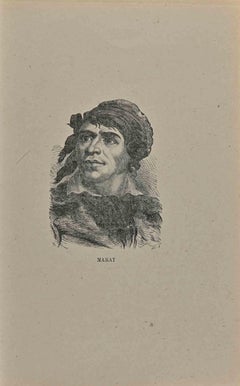
Portrait of Marat - Lithograph - Early 19th century
Located in Roma, IT
Portrait of Marat is an original Lithograph realized by an unknown artist in the early 19th Century.
Good conditions.
The artwork is depicted with perfect hatching and strong stro...
Category
Early 19th Century Modern Figurative Prints
Materials
Lithograph
$237
H 9.45 in W 5.71 in D 0.08 in
More From This Seller
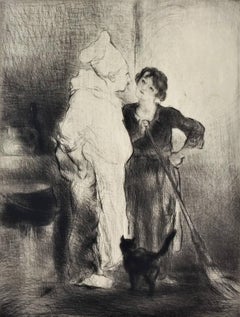
View AllBelow Stairs.
By Edmund Blampied
Located in Storrs, CT
Below Stairs. 1930-31. Drypoint. Appleby 143. 10 1/4 x 7 3/4 (sheet 15 3/4 x 10 1/8). Edition 100, #31. A very rich, tonal impression on cream-colored laid paper. Unobtrusive soiling in the top left- and lower-left hand margins, just below the platemark; and light mat line just outside the platemark. . Signed and numbered in ink. Housed in a 20 x 16-inch archival mat, suitable for framing. A charming discussion between the chef and a scullery maid in a "Downtown Abbey...
Category
1930s Modern Figurative Prints
Materials
Drypoint, Etching
$975 Sale Price
56% Off
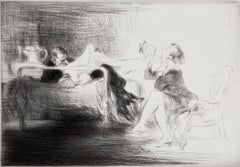
En Pension.
By Edmund Blampied
Located in Storrs, CT
En Pension. 1929-30. Drypoint. Appleby 142. 8 1/2 x 12 1/8 (sheet 11 1/2 x 18 5/16). Edition 100. A rich impression printed on cream wove paper with wide margins. Signed in ink. H...
Category
1920s Modern Figurative Prints
Materials
Drypoint, Etching
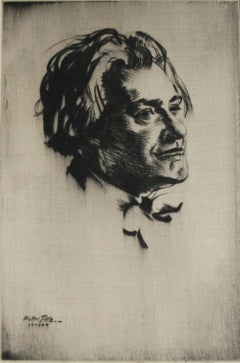
Portrait of James McBey.
By Walter Tittle
Located in Storrs, CT
James McBey. 1931. Drypoint. 8 7/8 x 5 7/8 (sheet 11 1/2 x 9 ). An extremely rich impression with drypoint burr, printed by the artist on cream wove paper. Signed in the plate lower ...
Category
1930s American Modern Portrait Prints
Materials
Drypoint, Etching
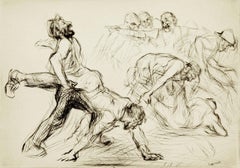
Wheelbarrow Race
By Edmund Blampied
Located in Storrs, CT
1925-26. Drypoint. Appleby 114. 8 9/16 x 12 (sheet 12 x 17). Edition 100, #10. An excellent impression with burr, printed with plate tone on the full sheet of 'VGI' laid paper with ...
Category
1920s Modern Figurative Prints
Materials
Drypoint, Etching
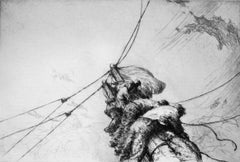
On the Yard, plate 3.
By Arthur John Trevor Briscoe
Located in Storrs, CT
Laver 139, Hurst 246. 8 7/8 x 13 7/8 (sheet 11 1/2 x 16 1/4). Trial proof. No published edition. An extremely rich impression with plate tone printed on 'antique laid paper countermarked 'DS&Pine 17940 with a Strasbourg lily watermark. Signed and annotated 'trial' in pencil. An exceptional proof of the greatest rarity.
Housed in a 16 x 20-inch archival mat, suitable for framing.
In 1899 Briwcoe acquired a studio in Malden, Essex, and bought a 3-ton cutter which, with his young family, he would spend eight or nine months a year, sailing to Calais, along the Belgian coast, and through the Dutch waterways, constantly sketching and painting in both oil and watercolor.
In 1922, after a meeting with the etcher James McBey, Briscoe returned to etching once more producing plates of some of his sea sketches. The two artists sailed together in Briscoe's, forty-ton yacht, the "Golden Vanity...
Category
Early 20th Century Modern Figurative Prints
Materials
Etching
$1,500 Sale Price
33% Off
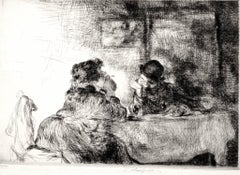
Chez Madame Dupont
By Edmund Blampied
Located in Storrs, CT
Chez Madame Dupont. 1931-32. Drypoint. Appleby 158. 8 3/16 x 11 3/4 ( 11 1/8 x 18 1/3). Edition 100, #75. A fine impression on pale cream-colored laid paper, printed on the full shee...
Category
1930s Modern Figurative Prints
Materials
Drypoint, Etching
$1,000 Sale Price
33% Off