Video Loading
Want more images or videos?
Request additional images or videos from the seller
1 of 10

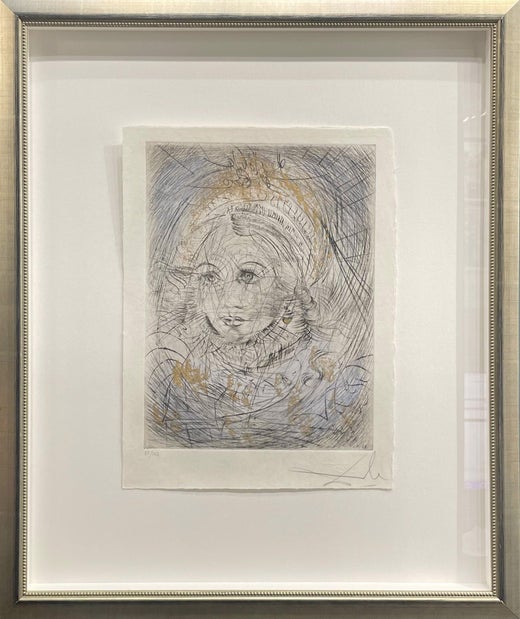
Salvador Dalí­
Death of Carmen

1970

Price:$3,800

You May Also Like

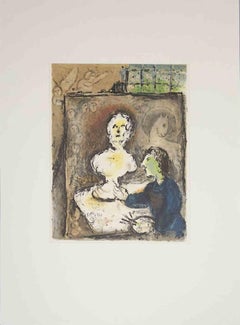
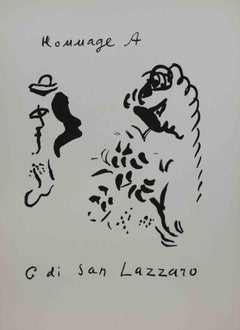
Hommage à San Lazzaro - Lithograph by M. Chagall - 1975
By Marc Chagall
Located in Roma, IT
Hommage à San Lazzaro is a lithograph realized by Marc Chagall for the Art Revew "XXème Siècle". This original print (not signed and not numbered) comes from the portfolio Hommage à...
Category

1970s Surrealist Figurative Prints

Materials

Lithograph

Odyssey - Lithograph after Marc Chagall - 1989
By Marc Chagall
Located in Roma, IT
Odyssey is a splendid artwork realized after Marc Chagall and published in 1989. Mixed colored lithograph on paper. This beautiful artwork is from the German edition of Chagall's O...
Category

1980s Surrealist Figurative Prints

Materials

Lithograph

Odyssey - Lithograph after Marc Chagall - 1989
$415
H 14.57 in W 11.03 in D 0.04 in
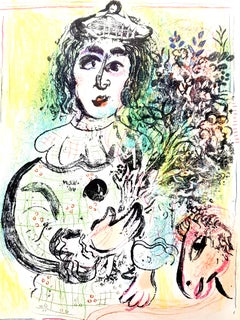
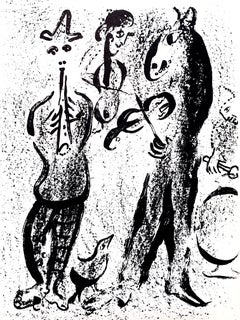
Marc Chagall - Flowered Clown - Original Lithograph
By Marc Chagall
Located in Collonge Bellerive, Geneve, CH
Marc Chagall Original Lithograph 1963 Dimensions: 32 x 24 cm From Chagall Lithograph II Reference: Mourlot 399 Condition : Excellent Unsigned and unumbered as issued
Category

1960s Surrealist Figurative Prints

Materials

Lithograph

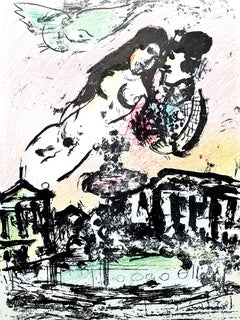
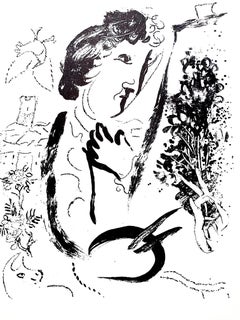
Marc Chagall - Original Lithograph
By Marc Chagall
Located in Collonge Bellerive, Geneve, CH
Marc Chagall Original Lithograph 1963 Dimensions: 32 x 24 cm Reference: Chagall Lithographe 1957-1962. VOLUME II. Condition : Excellent Marc Chagall (born in 1887) Marc Chagall was born in Belarus in 1887 and developed an early interest in art. After studying painting, in 1907 he left Russia for Paris, where he lived in an artist colony on the city’s outskirts. Fusing his own personal, dreamlike imagery with hints of the fauvism and cubism popular in France at the time, Chagall created his most lasting work—including I and the Village (1911)—some of which would be featured in the Salon des Indépendants exhibitions. After returning to Vitebsk for a visit in 1914, the outbreak of WWI trapped Chagall in Russia. He returned to France in 1923 but was forced to flee the country and Nazi persecution during WWII. Finding asylum in the U.S., Chagall became involved in set and costume design before returning to France in 1948. In his later years, he experimented with new art forms and was commissioned to produce numerous large-scale works. Chagall died in St.-Paul-de-Vence in 1985. The Village Marc Chagall was born in a small Hassidic community on the outskirts of Vitebsk, Belarus, on July 7, 1887. His father was a fishmonger, and his mother ran a small sundries shop in the village. As a child, Chagall attended the Jewish elementary school, where he studied Hebrew and the Bible, before later attending the Russian public school. He began to learn the fundamentals of drawing during this time, but perhaps more importantly, he absorbed the world around him, storing away the imagery and themes that would feature largely in most of his later work. At age 19 Chagall enrolled at a private, all-Jewish art school and began his formal education in painting, studying briefly with portrait artist Yehuda Pen. However, he left the school after several months, moving to St. Petersburg in 1907 to study at the Imperial Society for the Protection of Fine Arts. The following year, he enrolled at the Svanseva School, studying with set designer Léon Bakst, whose work had been featured in Sergei Diaghilev's Ballets Russes. This early experience would prove important to Chagall’s later career as well. Despite this formal instruction, and the widespread popularity of realism in Russia at the time, Chagall was already establishing his own personal style, which featured a more dreamlike unreality and the people, places and imagery that were close to his heart. Some examples from this period are his Window Vitebsk (1908) and My Fianceé with Black Gloves (1909), which pictured Bella Rosenfeld, to whom he had recently become engaged. The Beehive Despite his romance with Bella, in 1911 an allowance from Russian parliament member and art patron Maxim Binaver enabled Chagall to move to Paris, France. After settling briefly in the Montparnasse neighborhood, Chagall moved further afield to an artist colony known as La Ruche (“The Beehive”), where he began to work side by side with abstract painters such as Amedeo Modigliani and Fernand Léger as well as the avant-garde poet Guillaume Apollinaire. At their urging, and under the influence of the wildly popular fauvism and cubism, Chagall lightened his palette and pushed his style ever further from reality. I and the Village (1911) and Homage to Apollinaire (1912) are among his early Parisian works, widely considered to be his most successful and representative period. Though his work stood stylistically apart from his cubist contemporaries, from 1912 to 1914 Chagall exhibited several paintings at the annual Salon des Indépendants exhibition, where works by the likes of Juan Gris, Marcel Duchamp and Robert Delaunay were causing a stir in the Paris art world. Chagall’s popularity began to spread beyond La Ruche, and in May 1914 he traveled to Berlin to help organize his first solo exhibition, at Der Sturm Gallery. Chagall remained in the city until the highly acclaimed show opened that June. He then returned to Vitebsk, unaware of the fateful events to come. War, Peace and Revolution In August 1914 the outbreak of World War I precluded Chagall’s plans to return to Paris. The conflict did little to stem the flow of his creative output, however, instead merely giving him direct access to the childhood scenes so essential to his work, as seen in paintings such as Jew in Green (1914) and Over Vitebsk (1914). His paintings from this period also occasionally featured images of the war’s impact on the region, as with Wounded Soldier (1914) and Marching (1915). But despite the hardships of life during wartime, this would also prove to be a joyful period for Chagall. In July 1915 he married Bella, and she gave birth to a daughter, Ida, the following year. Their appearance in works such as Birthday (1915), Bella and Ida by the Window (1917) and several of his “Lovers” paintings give a glimpse of the island of domestic bliss that was Chagall’s amidst the chaos. To avoid military service and stay with his new family, Chagall took a position as a clerk in the Ministry of War Economy in St. Petersburg. While there he began work on his autobiography and also immersed himself in the local art scene, befriending novelist Boris Pasternak, among others. He also exhibited his work in the city and soon gained considerable recognition. That notoriety would prove important in the aftermath of the 1917 Russian Revolution when he was appointed as the Commissar of Fine Arts in Vitebsk. In his new post, Chagall undertook various projects in the region, including the 1919 founding of the Academy of the Arts. Despite these endeavors, differences among his colleagues eventually disillusioned Chagall. In 1920 he relinquished his position and moved his family to Moscow, the post-revolution capital of Russia. In Moscow, Chagall was soon commissioned to create sets and costumes for various productions at the Moscow State Yiddish Theater...
Category

1960s Surrealist Figurative Prints

Materials

Lithograph

Marc Chagall - Original Lithograph
$1,482
H 9.45 in W 12.6 in D 0.04 in
Marc Chagall - Original Lithograph
By Marc Chagall
Located in Collonge Bellerive, Geneve, CH
Marc Chagall Original Lithograph 1963 Dimensions: 32 x 24 cm Reference: Chagall Lithographe 1957-1962. VOLUME II. Condition : Excellent Marc Chagall (born in 1887) Marc Chagall was born in Belarus in 1887 and developed an early interest in art. After studying painting, in 1907 he left Russia for Paris, where he lived in an artist colony on the city’s outskirts. Fusing his own personal, dreamlike imagery with hints of the fauvism and cubism popular in France at the time, Chagall created his most lasting work—including I and the Village (1911)—some of which would be featured in the Salon des Indépendants exhibitions. After returning to Vitebsk for a visit in 1914, the outbreak of WWI trapped Chagall in Russia. He returned to France in 1923 but was forced to flee the country and Nazi persecution during WWII. Finding asylum in the U.S., Chagall became involved in set and costume design before returning to France in 1948. In his later years, he experimented with new art forms and was commissioned to produce numerous large-scale works. Chagall died in St.-Paul-de-Vence in 1985. The Village Marc Chagall was born in a small Hassidic community on the outskirts of Vitebsk, Belarus, on July 7, 1887. His father was a fishmonger, and his mother ran a small sundries shop in the village. As a child, Chagall attended the Jewish elementary school, where he studied Hebrew and the Bible, before later attending the Russian public school. He began to learn the fundamentals of drawing during this time, but perhaps more importantly, he absorbed the world around him, storing away the imagery and themes that would feature largely in most of his later work. At age 19 Chagall enrolled at a private, all-Jewish art school and began his formal education in painting, studying briefly with portrait artist Yehuda Pen. However, he left the school after several months, moving to St. Petersburg in 1907 to study at the Imperial Society for the Protection of Fine Arts. The following year, he enrolled at the Svanseva School, studying with set designer Léon Bakst, whose work had been featured in Sergei Diaghilev's Ballets Russes. This early experience would prove important to Chagall’s later career as well. Despite this formal instruction, and the widespread popularity of realism in Russia at the time, Chagall was already establishing his own personal style, which featured a more dreamlike unreality and the people, places and imagery that were close to his heart. Some examples from this period are his Window Vitebsk (1908) and My Fianceé with Black Gloves (1909), which pictured Bella Rosenfeld, to whom he had recently become engaged. The Beehive Despite his romance with Bella, in 1911 an allowance from Russian parliament member and art patron Maxim Binaver enabled Chagall to move to Paris, France. After settling briefly in the Montparnasse neighborhood, Chagall moved further afield to an artist colony known as La Ruche (“The Beehive”), where he began to work side by side with abstract painters such as Amedeo Modigliani and Fernand Léger as well as the avant-garde poet Guillaume Apollinaire. At their urging, and under the influence of the wildly popular fauvism and cubism, Chagall lightened his palette and pushed his style ever further from reality. I and the Village (1911) and Homage to Apollinaire (1912) are among his early Parisian works, widely considered to be his most successful and representative period. Though his work stood stylistically apart from his cubist contemporaries, from 1912 to 1914 Chagall exhibited several paintings at the annual Salon des Indépendants exhibition, where works by the likes of Juan Gris, Marcel Duchamp and Robert Delaunay were causing a stir in the Paris art world. Chagall’s popularity began to spread beyond La Ruche, and in May 1914 he traveled to Berlin to help organize his first solo exhibition, at Der Sturm Gallery. Chagall remained in the city until the highly acclaimed show opened that June. He then returned to Vitebsk, unaware of the fateful events to come. War, Peace and Revolution In August 1914 the outbreak of World War I precluded Chagall’s plans to return to Paris. The conflict did little to stem the flow of his creative output, however, instead merely giving him direct access to the childhood scenes so essential to his work, as seen in paintings such as Jew in Green (1914) and Over Vitebsk (1914). His paintings from this period also occasionally featured images of the war’s impact on the region, as with Wounded Soldier (1914) and Marching (1915). But despite the hardships of life during wartime, this would also prove to be a joyful period for Chagall. In July 1915 he married Bella, and she gave birth to a daughter, Ida, the following year. Their appearance in works such as Birthday (1915), Bella and Ida by the Window (1917) and several of his “Lovers” paintings give a glimpse of the island of domestic bliss that was Chagall’s amidst the chaos. To avoid military service and stay with his new family, Chagall took a position as a clerk in the Ministry of War Economy in St. Petersburg. While there he began work on his autobiography and also immersed himself in the local art scene, befriending novelist Boris Pasternak, among others. He also exhibited his work in the city and soon gained considerable recognition. That notoriety would prove important in the aftermath of the 1917 Russian Revolution when he was appointed as the Commissar of Fine Arts in Vitebsk. In his new post, Chagall undertook various projects in the region, including the 1919 founding of the Academy of the Arts. Despite these endeavors, differences among his colleagues eventually disillusioned Chagall. In 1920 he relinquished his position and moved his family to Moscow, the post-revolution capital of Russia. In Moscow, Chagall was soon commissioned to create sets and costumes for various productions at the Moscow State Yiddish Theater...
Category

1960s Surrealist Figurative Prints

Materials

Lithograph

Marc Chagall - Original Lithograph
$1,482
H 9.45 in W 12.6 in D 0.04 in
Marc Chagall - Original Lithograph
By Marc Chagall
Located in Collonge Bellerive, Geneve, CH
Marc Chagall Original Lithograph 1963 Dimensions: 32 x 24 cm Reference: Chagall Lithographe 1957-1962. VOLUME II. Unsigned edition of over 5,000 Condition : Excellent Marc Chagall (born in 1887) Marc Chagall was born in Belarus in 1887 and developed an early interest in art. After studying painting, in 1907 he left Russia for Paris, where he lived in an artist colony on the city’s outskirts. Fusing his own personal, dreamlike imagery with hints of the fauvism and cubism popular in France at the time, Chagall created his most lasting work—including I and the Village (1911)—some of which would be featured in the Salon des Indépendants exhibitions. After returning to Vitebsk for a visit in 1914, the outbreak of WWI trapped Chagall in Russia. He returned to France in 1923 but was forced to flee the country and Nazi persecution during WWII. Finding asylum in the U.S., Chagall became involved in set and costume design before returning to France in 1948. In his later years, he experimented with new art forms and was commissioned to produce numerous large-scale works. Chagall died in St.-Paul-de-Vence in 1985. The Village Marc Chagall was born in a small Hassidic community on the outskirts of Vitebsk, Belarus, on July 7, 1887. His father was a fishmonger, and his mother ran a small sundries shop in the village. As a child, Chagall attended the Jewish elementary school, where he studied Hebrew and the Bible, before later attending the Russian public school. He began to learn the fundamentals of drawing during this time, but perhaps more importantly, he absorbed the world around him, storing away the imagery and themes that would feature largely in most of his later work. At age 19 Chagall enrolled at a private, all-Jewish art school and began his formal education in painting, studying briefly with portrait artist Yehuda Pen. However, he left the school after several months, moving to St. Petersburg in 1907 to study at the Imperial Society for the Protection of Fine Arts. The following year, he enrolled at the Svanseva School, studying with set designer Léon Bakst, whose work had been featured in Sergei Diaghilev's Ballets Russes. This early experience would prove important to Chagall’s later career as well. Despite this formal instruction, and the widespread popularity of realism in Russia at the time, Chagall was already establishing his own personal style, which featured a more dreamlike unreality and the people, places and imagery that were close to his heart. Some examples from this period are his Window Vitebsk (1908) and My Fianceé with Black Gloves (1909), which pictured Bella Rosenfeld, to whom he had recently become engaged. The Beehive Despite his romance with Bella, in 1911 an allowance from Russian parliament member and art patron Maxim Binaver enabled Chagall to move to Paris, France. After settling briefly in the Montparnasse neighborhood, Chagall moved further afield to an artist colony known as La Ruche (“The Beehive”), where he began to work side by side with abstract painters such as Amedeo Modigliani and Fernand Léger as well as the avant-garde poet Guillaume Apollinaire. At their urging, and under the influence of the wildly popular fauvism and cubism, Chagall lightened his palette and pushed his style ever further from reality. I and the Village (1911) and Homage to Apollinaire (1912) are among his early Parisian works, widely considered to be his most successful and representative period. Though his work stood stylistically apart from his cubist contemporaries, from 1912 to 1914 Chagall exhibited several paintings at the annual Salon des Indépendants exhibition, where works by the likes of Juan Gris, Marcel Duchamp and Robert Delaunay were causing a stir in the Paris art world. Chagall’s popularity began to spread beyond La Ruche, and in May 1914 he traveled to Berlin to help organize his first solo exhibition, at Der Sturm Gallery. Chagall remained in the city until the highly acclaimed show opened that June. He then returned to Vitebsk, unaware of the fateful events to come. War, Peace and Revolution In August 1914 the outbreak of World War I precluded Chagall’s plans to return to Paris. The conflict did little to stem the flow of his creative output, however, instead merely giving him direct access to the childhood scenes so essential to his work, as seen in paintings such as Jew in Green (1914) and Over Vitebsk (1914). His paintings from this period also occasionally featured images of the war’s impact on the region, as with Wounded Soldier (1914) and Marching (1915). But despite the hardships of life during wartime, this would also prove to be a joyful period for Chagall. In July 1915 he married Bella, and she gave birth to a daughter, Ida, the following year. Their appearance in works such as Birthday (1915), Bella and Ida by the Window (1917) and several of his “Lovers” paintings give a glimpse of the island of domestic bliss that was Chagall’s amidst the chaos. To avoid military service and stay with his new family, Chagall took a position as a clerk in the Ministry of War Economy in St. Petersburg. While there he began work on his autobiography and also immersed himself in the local art scene, befriending novelist Boris Pasternak, among others. He also exhibited his work in the city and soon gained considerable recognition. That notoriety would prove important in the aftermath of the 1917 Russian Revolution when he was appointed as the Commissar of Fine Arts in Vitebsk. In his new post, Chagall undertook various projects in the region, including the 1919 founding of the Academy of the Arts. Despite these endeavors, differences among his colleagues eventually disillusioned Chagall. In 1920 he relinquished his position and moved his family to Moscow, the post-revolution capital of Russia. In Moscow, Chagall was soon commissioned to create sets and costumes for various productions at the Moscow State Yiddish...
Category

1960s Surrealist Figurative Prints

Materials

Lithograph

Marc Chagall - Original Lithograph
$1,482
H 9.45 in W 12.6 in D 0.04 in
Marc Chagall - Original Lithograph
By Marc Chagall
Located in Collonge Bellerive, Geneve, CH
Marc Chagall Original Lithograph 1963 Dimensions: 32 x 24 cm Reference: Chagall Lithographe 1957-1962. VOLUME II. Unsigned edition of over 5,000 Condition : Excellent Marc Chagall (born in 1887) Marc Chagall was born in Belarus in 1887 and developed an early interest in art. After studying painting, in 1907 he left Russia for Paris, where he lived in an artist colony on the city’s outskirts. Fusing his own personal, dreamlike imagery with hints of the fauvism and cubism popular in France at the time, Chagall created his most lasting work—including I and the Village (1911)—some of which would be featured in the Salon des Indépendants exhibitions. After returning to Vitebsk for a visit in 1914, the outbreak of WWI trapped Chagall in Russia. He returned to France in 1923 but was forced to flee the country and Nazi persecution during WWII. Finding asylum in the U.S., Chagall became involved in set and costume design before returning to France in 1948. In his later years, he experimented with new art forms and was commissioned to produce numerous large-scale works. Chagall died in St.-Paul-de-Vence in 1985. The Village Marc Chagall was born in a small Hassidic community on the outskirts of Vitebsk, Belarus, on July 7, 1887. His father was a fishmonger, and his mother ran a small sundries shop in the village. As a child, Chagall attended the Jewish elementary school, where he studied Hebrew and the Bible, before later attending the Russian public school. He began to learn the fundamentals of drawing during this time, but perhaps more importantly, he absorbed the world around him, storing away the imagery and themes that would feature largely in most of his later work. At age 19 Chagall enrolled at a private, all-Jewish art school and began his formal education in painting, studying briefly with portrait artist Yehuda Pen. However, he left the school after several months, moving to St. Petersburg in 1907 to study at the Imperial Society for the Protection of Fine Arts. The following year, he enrolled at the Svanseva School, studying with set designer Léon Bakst, whose work had been featured in Sergei Diaghilev's Ballets Russes. This early experience would prove important to Chagall’s later career as well. Despite this formal instruction, and the widespread popularity of realism in Russia at the time, Chagall was already establishing his own personal style, which featured a more dreamlike unreality and the people, places and imagery that were close to his heart. Some examples from this period are his Window Vitebsk (1908) and My Fianceé with Black Gloves (1909), which pictured Bella Rosenfeld, to whom he had recently become engaged. The Beehive Despite his romance with Bella, in 1911 an allowance from Russian parliament member and art patron Maxim Binaver enabled Chagall to move to Paris, France. After settling briefly in the Montparnasse neighborhood, Chagall moved further afield to an artist colony known as La Ruche (“The Beehive”), where he began to work side by side with abstract painters such as Amedeo Modigliani and Fernand Léger as well as the avant-garde poet Guillaume Apollinaire. At their urging, and under the influence of the wildly popular fauvism and cubism, Chagall lightened his palette and pushed his style ever further from reality. I and the Village (1911) and Homage to Apollinaire (1912) are among his early Parisian works, widely considered to be his most successful and representative period. Though his work stood stylistically apart from his cubist contemporaries, from 1912 to 1914 Chagall exhibited several paintings at the annual Salon des Indépendants exhibition, where works by the likes of Juan Gris, Marcel Duchamp and Robert Delaunay were causing a stir in the Paris art world. Chagall’s popularity began to spread beyond La Ruche, and in May 1914 he traveled to Berlin to help organize his first solo exhibition, at Der Sturm Gallery. Chagall remained in the city until the highly acclaimed show opened that June. He then returned to Vitebsk, unaware of the fateful events to come. War, Peace and Revolution In August 1914 the outbreak of World War I precluded Chagall’s plans to return to Paris. The conflict did little to stem the flow of his creative output, however, instead merely giving him direct access to the childhood scenes so essential to his work, as seen in paintings such as Jew in Green (1914) and Over Vitebsk (1914). His paintings from this period also occasionally featured images of the war’s impact on the region, as with Wounded Soldier (1914) and Marching (1915). But despite the hardships of life during wartime, this would also prove to be a joyful period for Chagall. In July 1915 he married Bella, and she gave birth to a daughter, Ida, the following year. Their appearance in works such as Birthday (1915), Bella and Ida by the Window (1917) and several of his “Lovers” paintings give a glimpse of the island of domestic bliss that was Chagall’s amidst the chaos. To avoid military service and stay with his new family, Chagall took a position as a clerk in the Ministry of War Economy in St. Petersburg. While there he began work on his autobiography and also immersed himself in the local art scene, befriending novelist Boris Pasternak, among others. He also exhibited his work in the city and soon gained considerable recognition. That notoriety would prove important in the aftermath of the 1917 Russian Revolution when he was appointed as the Commissar of Fine Arts in Vitebsk. In his new post, Chagall undertook various projects in the region, including the 1919 founding of the Academy of the Arts. Despite these endeavors, differences among his colleagues eventually disillusioned Chagall. In 1920 he relinquished his position and moved his family to Moscow, the post-revolution capital of Russia. In Moscow, Chagall was soon commissioned to create sets and costumes for various productions at the Moscow State Yiddish...
Category

1960s Surrealist Figurative Prints

Materials

Lithograph

Marc Chagall - Original Lithograph
$1,482
H 9.45 in W 12.6 in D 0.04 in
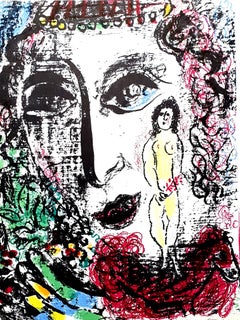
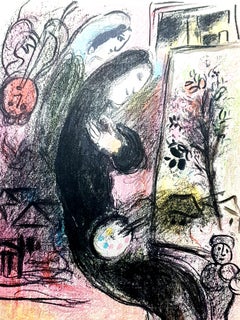
Marc Chagall - Inspiration - Original Lithograph from "Chagall Lithographe" v. 2
By Marc Chagall
Located in Collonge Bellerive, Geneve, CH
Marc Chagall Original Lithograph from Chagall Lithographe 1957-1962. VOLUME II. 1963 Dimensions: 32 x 24 cm From the unsigned edition of 10000 copies without margins Reference: Mourlot 398 Condition : Excellent Marc Chagall (born in 1887) Marc Chagall was born in Belarus in 1887 and developed an early interest in art. After studying painting, in 1907 he left Russia for Paris, where he lived in an artist colony on the city’s outskirts. Fusing his own personal, dreamlike imagery with hints of the fauvism and cubism popular in France at the time, Chagall created his most lasting work—including I and the Village (1911)—some of which would be featured in the Salon des Indépendants exhibitions. After returning to Vitebsk for a visit in 1914, the outbreak of WWI trapped Chagall in Russia. He returned to France in 1923 but was forced to flee the country and Nazi persecution during WWII. Finding asylum in the U.S., Chagall became involved in set and costume design before returning to France in 1948. In his later years, he experimented with new art forms and was commissioned to produce numerous large-scale works. Chagall died in St.-Paul-de-Vence in 1985. The Village Marc Chagall was born in a small Hassidic community on the outskirts of Vitebsk, Belarus, on July 7, 1887. His father was a fishmonger, and his mother ran a small sundries shop in the village. As a child, Chagall attended the Jewish elementary school, where he studied Hebrew and the Bible, before later attending the Russian public school. He began to learn the fundamentals of drawing during this time, but perhaps more importantly, he absorbed the world around him, storing away the imagery and themes that would feature largely in most of his later work. At age 19 Chagall enrolled at a private, all-Jewish art school and began his formal education in painting, studying briefly with portrait artist Yehuda Pen. However, he left the school after several months, moving to St. Petersburg in 1907 to study at the Imperial Society for the Protection of Fine Arts. The following year, he enrolled at the Svanseva School, studying with set designer Léon Bakst, whose work had been featured in Sergei Diaghilev's Ballets Russes. This early experience would prove important to Chagall’s later career as well. Despite this formal instruction, and the widespread popularity of realism in Russia at the time, Chagall was already establishing his own personal style, which featured a more dreamlike unreality and the people, places and imagery that were close to his heart. Some examples from this period are his Window Vitebsk (1908) and My Fianceé with Black Gloves (1909), which pictured Bella Rosenfeld, to whom he had recently become engaged. The Beehive Despite his romance with Bella, in 1911 an allowance from Russian parliament member and art patron Maxim Binaver enabled Chagall to move to Paris, France. After settling briefly in the Montparnasse neighborhood, Chagall moved further afield to an artist colony known as La Ruche (“The Beehive”), where he began to work side by side with abstract painters such as Amedeo Modigliani and Fernand Léger as well as the avant-garde poet Guillaume Apollinaire. At their urging, and under the influence of the wildly popular fauvism and cubism, Chagall lightened his palette and pushed his style ever further from reality. I and the Village (1911) and Homage to Apollinaire (1912) are among his early Parisian works, widely considered to be his most successful and representative period. Though his work stood stylistically apart from his cubist contemporaries, from 1912 to 1914 Chagall exhibited several paintings at the annual Salon des Indépendants exhibition, where works by the likes of Juan Gris, Marcel Duchamp and Robert Delaunay were causing a stir in the Paris art world. Chagall’s popularity began to spread beyond La Ruche, and in May 1914 he traveled to Berlin to help organize his first solo exhibition, at Der Sturm Gallery. Chagall remained in the city until the highly acclaimed show opened that June. He then returned to Vitebsk, unaware of the fateful events to come. War, Peace and Revolution In August 1914 the outbreak of World War I precluded Chagall’s plans to return to Paris. The conflict did little to stem the flow of his creative output, however, instead merely giving him direct access to the childhood scenes so essential to his work, as seen in paintings such as Jew in Green (1914) and Over Vitebsk (1914). His paintings from this period also occasionally featured images of the war’s impact on the region, as with Wounded Soldier (1914) and Marching (1915). But despite the hardships of life during wartime, this would also prove to be a joyful period for Chagall. In July 1915 he married Bella, and she gave birth to a daughter, Ida, the following year. Their appearance in works such as Birthday (1915), Bella and Ida by the Window (1917) and several of his “Lovers” paintings give a glimpse of the island of domestic bliss that was Chagall’s amidst the chaos. To avoid military service and stay with his new family, Chagall took a position as a clerk in the Ministry of War Economy in St. Petersburg. While there he began work on his autobiography and also immersed himself in the local art scene, befriending novelist Boris Pasternak, among others. He also exhibited his work in the city and soon gained considerable recognition. That notoriety would prove important in the aftermath of the 1917 Russian Revolution when he was appointed as the Commissar of Fine Arts in Vitebsk. In his new post, Chagall undertook various projects in the region, including the 1919 founding of the Academy of the Arts. Despite these endeavors, differences among his colleagues eventually disillusioned Chagall. In 1920 he relinquished his position and moved his family to Moscow, the post-revolution capital of Russia. In Moscow, Chagall was soon commissioned to create sets and costumes for various productions at the Moscow State Yiddish Theater...
Category

1960s Surrealist Figurative Prints

Materials

Lithograph

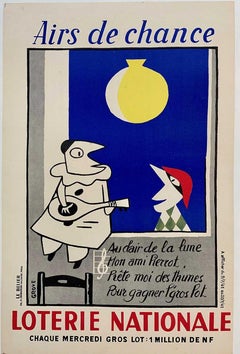
Original AIRS DE CHANCE Loterie Nationale original French lottery poster
Located in Spokane, WA
Original AIRS DE CHANCE Loterie Nationale French vintage poster. Translated, it means, "In the moonlight, my friend Pierrot, lend me your money to win the jackpot." Linen-backed original French lottery...
Category

1960s Surrealist Figurative Prints

Materials

Lithograph

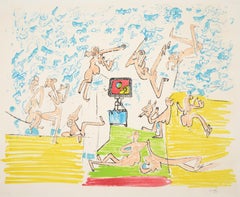
Roberto Matta FOG GOG MAGOG PLANCHE 6 Lithograph
By Roberto Matta
Located in Lake Worth Beach, FL
Artist/Designer; Manufacturer: Roberto Matta (Chilean, 1911-2002) Marking(s); notes: signed, blind stamp; ed. 94/100; 1971 Materials: lithograph on Arches paper Dimensions (H, W, D):...
Category

1970s Surrealist Figurative Prints

Materials

Lithograph

More From This Seller

View All
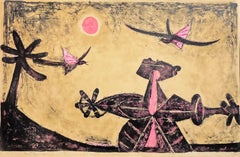
Observador de Pajaros
By Rufino Tamayo
Located in Missouri, MO
"Observador de Pajaros" 1950 By. Rufino Tamayo (Mexican, 1899-1991) Edition 83/200 Lower Right Signed Lower Left Unframed: 15.5" x 22.5" Framed: 21.75" x 28.25" Rufino Tamayo (August 26, 1899- June 24, 1991) A native of Oaxaca in Southern Mexico, Rufino Tamayo's father was a shoemaker, and his mother a seamstress. Some accounts state that he was descended from Zapotec Indians, but he was actually 'mestizo' - of mixed indigenous/European ancestry. (Santa Barbara Museum of Art). He began painting at age 11. Orphaned at the age of 12, Tamayo moved to Mexico City, where he was raised by his maternal aunt who owned a wholesale fruit business. In 1917, he entered the San Carlos Academy of Fine Arts, but left soon after to pursue independent study. Four years later, Tamayo was appointed the head designer of the department of ethnographic drawings at the National Museum of Archaeology in Mexico City. There he was surrounded by pre-Colombian objects, an aesthetic inspiration that would play a pivotal role in his life. In his own work, Tamayo integrated the forms and tones of pre-Columbian ceramics into his early still lives and portraits of Mexican men and women. In the early 1920s he also taught art classes in Mexico City's public schools. Despite his involvement in Mexican history, he did not subscribe to the idea of art as nationalistic propaganda. Modern Mexican art at that time was dominated by 'The Three Great Ones' : Diego Rivera, Jose Clemente Orozco, and David Alfaro Siqueros, but Tamayo began to be noted as someone 'new' and different' for his blending of the aesthetics of post Revolutionary Mexico with the vanguard artists of Europe and the United States. After the Mexican Revolution, he focused on creating his own identity in his work, expressing what he thought was the traditional Mexico, and refusing to follow the political trends of his contemporary artists. This caused some to see him as a 'traitor' to the political cause, and he felt it difficult to freely express himself in his art. As a result, he decided to leave Mexico in 1926 and move to New York, along with his friend, the composer Carlos Chavez. The first exhibition of Tamayo's work in the United States was held at the Weyhe Gallery, New York, in that same year. The show was successful, and Tamayo was praised for his 'authentic' status as a Mexican of 'indigenous heritage', and for his internationally appealing Modernist aesthetic. (Santa Barbara Museum of Art). Throughout the late thirties and early forties New York's Valentine Gallery gave him shows. For nine years, beginning in 1938, he taught at the Dalton School in New York. In 1929, some health problems led him to return to Mexico for treatment. While there he took a series of teaching jobs. During this period he became romantically involved with the artist Maria...
Category

20th Century Abstract Abstract Prints

Materials

Lithograph

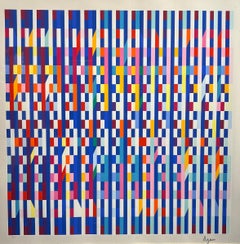
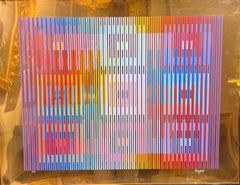
Blue Rings (Abstract Composition)
By Yaacov Agam
Located in Missouri, MO
Blue Rings (Abstract Composition), Serigraph By Yaacov Agam (Israeli, b. 1928) Signed Lower Right Edition 8/270 Lower Left Unframed: 21" x 21.5" Framed: 31" ...
Category

20th Century Abstract Abstract Prints

Materials

Lithograph

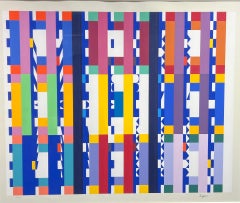
Abstract Purple, Blue, Greens
By Yaacov Agam
Located in Missouri, MO
Abstract Purple, Blue, Greens (Serigraph) By Yaacov Agam (Israeli, b. 1928) Signed Lower Right Edition 4/30 Lower Left Unframed: 14" x 33" Framed: 21" x 41" Yaacov Agam is one of the pioneer creators of the kinetic movement in art as well as its most outstanding contemporary representative. Agam was born in 1928 a son of a Rabbi of Rishon LeZion (Israel), who devoted his life to the study of Jewish religious matters and wrote books. Agam considers himself somehow as a visual continuation of his father's quest for spirituality. He studied at the Bezalel Academy of Art in Jerusalem, and in Switzerland at the Eidgenossische Technische Hochschule and the Zurich University. After arriving to Paris in 1951, Agam held his first one man exhibition with a great success in 1953 This exhibition consisted totally of kinetic, movable and transformable paintings, which actually was the first one-man show in art history exclusively devoted to kinetic art. A passionate experimenter, Agam deals with such problems as the 4th dimension, simultaneity and time in the visual, plastic arts, and has extended his experiments to application in the fields of literature, music and art theory. His works express a concept that breaks away with the established way of expressing reality in limited, static way. In his works, he strives to demonstrate the principle of reality as a continuous "becoming" rather than static "graven image." His paintings Double Metamorphosis 11 in the Museum of Modern Art in New York and Transparent Rhythms 11 in the Hirshhorn Museum and Sculpture Garden of the Smithsonian Institution in Washington, D.C. give the best example of his polymorphic painting. His works are placed in many public places including Communication x 9 on the Michigan Avenue in Chicago (1983), Communication: Night and Day at the AT&T building in New York (1974), Super Lines Volumes at the Pare Floral in Paris (1971), and his murals Peace and Life arc installed at the Parliament of Europe in Strasbourg (1977). Agam has expressed the new concepts in monumental works as in his Jacob's Ladder, which forms the ceiling of the National Convention House in Jerusalem. He created a "floating museum", including all the artworks for public areas and cabins, for the Carnival Cruise Line's luxury cruise ship "Celebration" (1987). His fire-water fountain in Dizengoff Square in Tel Aviv (1986) streams water, fire, and music -elements of flux and life which cannot be static - as its colored elements rotate in this multidimensional monumental work. For the Elysee Palace in Paris, with the request of President Georges Pompidou Agam created in 1972 a whole environmental of the Salon with the walls covered with polymorphic murals of changing images a kinetic ceiling, moving transparent colored doors and a kinetic carpet on which he placed a sculpture. It embraces viewers: they are no longer looking at a framed, fixed scene, but rather arc moving within an artistic space which changes constantly according to their shifting position and point of view. Similar attempt was made for the concert hall, Forum Leverkusen in Germany in 1970. Agam created many environmental sculptures, including Hundred Gates in the garden of the residence of the President of Israel in Jerusalem, 3 x 3 Interplay installed at the Julliard School of Music at the Lincoln Center and Wings of the Heart at J. F. Kennedy airport in New York. In 1984, he made a sculpture Beating Heart for the Hadassah Hospital in Jerusalem. In 1988, he created a transparent torah ark...
Category

20th Century Abstract Abstract Prints

Materials

Lithograph

Emerging
By Yaacov Agam
Located in Missouri, MO
Emerging, 1985 By. Yaacov Agam ( Israeli, b. 1928) Color Serigraph Signed Lower Right Edition 1/12 Lower Left Unframed: 25" x 31" Framed: 34" x 43" Yaacov Agam is one of the pioneer creators of the kinetic movement in art as well as its most outstanding contemporary representative. Agam was born in 1928 a son of a Rabbi of Rishon LeZion (Israel), who devoted his life to the study of Jewish religious matters and wrote books. Agam considers himself somehow as a visual continuation of his father's quest for spirituality. He studied at the Bezalel Academy of Art in Jerusalem, and in Switzerland at the Eidgenossische Technische Hochschule and the Zurich University. After arriving to Paris in 1951, Agam held his first one man exhibition with a great success in 1953 This exhibition consisted totally of kinetic, movable and transformable paintings, which actually was the first one-man show in art history exclusively devoted to kinetic art. A passionate experimenter, Agam deals with such problems as the 4th dimension, simultaneity and time in the visual, plastic arts, and has extended his experiments to application in the fields of literature, music and art theory. His works express a concept that breaks away with the established way of expressing reality in limited, static way. In his works, he strives to demonstrate the principle of reality as a continuous "becoming" rather than static "graven image." His paintings Double Metamorphosis 11 in the Museum of Modern Art in New York and Transparent Rhythms 11 in the Hirshhorn Museum and Sculpture Garden of the Smithsonian Institution in Washington, D.C. give the best example of his polymorphic painting. His works are placed in many public places including Communication x 9 on the Michigan Avenue in Chicago (1983), Communication: Night and Day at the AT&T building in New York (1974), Super Lines Volumes at the Pare Floral in Paris (1971), and his murals Peace and Life arc installed at the Parliament of Europe in Strasbourg (1977). Agam has expressed the new concepts in monumental works as in his Jacob's Ladder, which forms the ceiling of the National Convention House in Jerusalem. He created a "floating museum", including all the artworks for public areas and cabins, for the Carnival Cruise Line's luxury cruise ship "Celebration" (1987). His fire-water fountain in Dizengoff Square in Tel Aviv (1986) streams water, fire, and music -elements of flux and life which cannot be static - as its colored elements rotate in this multidimensional monumental work. For the Elysee Palace in Paris, with the request of President Georges Pompidou Agam created in 1972 a whole environmental of the Salon with the walls covered with polymorphic murals of changing images a kinetic ceiling, moving transparent colored doors and a kinetic carpet on which he placed a sculpture. It embraces viewers: they are no longer looking at a framed, fixed scene, but rather arc moving within an artistic space which changes constantly according to their shifting position and point of view. Similar attempt was made for the concert hall, Forum Leverkusen in Germany in 1970. Agam created many environmental sculptures, including Hundred Gates in the garden of the residence of the President of Israel in Jerusalem, 3 x 3 Interplay installed at the Julliard School of Music at the Lincoln Center and Wings of the Heart at J. F. Kennedy airport in New York. In 1984, he made a sculpture Beating Heart for the Hadassah Hospital in Jerusalem. In 1988, he created a transparent torah ark...
Category

20th Century Abstract Abstract Prints

Materials

Lithograph

Emerging
Price Upon Request
Curtain
By Yaacov Agam
Located in Missouri, MO
Curtain By. Yaacov Agam (Israeli, b. 1928) Signed Lower Right Edition 221/227 Unframed: 18" x 22.5" Framed: 30.5" x 34.5" Yaacov Agam is one of the pioneer creators of the kinetic movement in art as well as its most outstanding contemporary representative. Agam was born in 1928 a son of a Rabbi of Rishon LeZion (Israel), who devoted his life to the study of Jewish religious matters and wrote books. Agam considers himself somehow as a visual continuation of his father's quest for spirituality. He studied at the Bezalel Academy of Art in Jerusalem, and in Switzerland at the Eidgenossische Technische Hochschule and the Zurich University. After arriving to Paris in 1951, Agam held his first one man exhibition with a great success in 1953 This exhibition consisted totally of kinetic, movable and transformable paintings, which actually was the first one-man show in art history exclusively devoted to kinetic art. A passionate experimenter, Agam deals with such problems as the 4th dimension, simultaneity and time in the visual, plastic arts, and has extended his experiments to application in the fields of literature, music and art theory. His works express a concept that breaks away with the established way of expressing reality in limited, static way. In his works, he strives to demonstrate the principle of reality as a continuous "becoming" rather than static "graven image." His paintings Double Metamorphosis 11 in the Museum of Modern Art in New York and Transparent Rhythms 11 in the Hirshhorn Museum and Sculpture Garden of the Smithsonian Institution in Washington, D.C. give the best example of his polymorphic painting. His works are placed in many public places including Communication x 9 on the Michigan Avenue in Chicago (1983), Communication: Night and Day at the AT&T building in New York (1974), Super Lines Volumes at the Pare Floral in Paris (1971), and his murals Peace and Life arc installed at the Parliament of Europe in Strasbourg (1977). Agam has expressed the new concepts in monumental works as in his Jacob's Ladder, which forms the ceiling of the National Convention House in Jerusalem. He created a "floating museum", including all the artworks for public areas and cabins, for the Carnival Cruise Line's luxury cruise ship "Celebration" (1987). His fire-water fountain in Dizengoff Square in Tel Aviv (1986) streams water, fire, and music -elements of flux and life which cannot be static - as its colored elements rotate in this multidimensional monumental work. For the Elysee Palace in Paris, with the request of President Georges Pompidou Agam created in 1972 a whole environmental of the Salon with the walls covered with polymorphic murals of changing images a kinetic ceiling, moving transparent colored doors and a kinetic carpet on which he placed a sculpture. It embraces viewers: they are no longer looking at a framed, fixed scene, but rather arc moving within an artistic space which changes constantly according to their shifting position and point of view. Similar attempt was made for the concert hall, Forum Leverkusen in Germany in 1970. Agam created many environmental sculptures, including Hundred Gates in the garden of the residence of the President of Israel in Jerusalem, 3 x 3 Interplay installed at the Julliard School of Music at the Lincoln Center and Wings of the Heart at J. F. Kennedy airport in New York. In 1984, he made a sculpture Beating Heart for the Hadassah Hospital in Jerusalem. In 1988, he created a transparent torah ark...
Category

20th Century Abstract Abstract Prints

Materials

Lithograph

Curtain
Price Upon Request
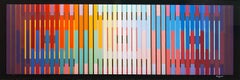
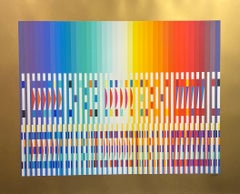
Spectrum
By Yaacov Agam
Located in Missouri, MO
Spectrum By. Yaacov Agam (Israeli, b. 1928) Signed Lower Right Edition 158/180 Lower Left Unframed: 27" x 33.5" Framed: 36.5" x 43" Yaacov Agam is one of the pioneer creators of the kinetic movement in art as well as its most outstanding contemporary representative. Agam was born in 1928 a son of a Rabbi of Rishon LeZion (Israel), who devoted his life to the study of Jewish religious matters and wrote books. Agam considers himself somehow as a visual continuation of his father's quest for spirituality. He studied at the Bezalel Academy of Art in Jerusalem, and in Switzerland at the Eidgenossische Technische Hochschule and the Zurich University. After arriving to Paris in 1951, Agam held his first one man exhibition with a great success in 1953 This exhibition consisted totally of kinetic, movable and transformable paintings, which actually was the first one-man show in art history exclusively devoted to kinetic art. A passionate experimenter, Agam deals with such problems as the 4th dimension, simultaneity and time in the visual, plastic arts, and has extended his experiments to application in the fields of literature, music and art theory. His works express a concept that breaks away with the established way of expressing reality in limited, static way. In his works, he strives to demonstrate the principle of reality as a continuous "becoming" rather than static "graven image." His paintings Double Metamorphosis 11 in the Museum of Modern Art in New York and Transparent Rhythms 11 in the Hirshhorn Museum and Sculpture Garden of the Smithsonian Institution in Washington, D.C. give the best example of his polymorphic painting. His works are placed in many public places including Communication x 9 on the Michigan Avenue in Chicago (1983), Communication: Night and Day at the AT&T building in New York (1974), Super Lines Volumes at the Pare Floral in Paris (1971), and his murals Peace and Life arc installed at the Parliament of Europe in Strasbourg (1977). Agam has expressed the new concepts in monumental works as in his Jacob's Ladder, which forms the ceiling of the National Convention House in Jerusalem. He created a "floating museum", including all the artworks for public areas and cabins, for the Carnival Cruise Line's luxury cruise ship "Celebration" (1987). His fire-water fountain in Dizengoff Square in Tel Aviv (1986) streams water, fire, and music -elements of flux and life which cannot be static - as its colored elements rotate in this multidimensional monumental work. For the Elysee Palace in Paris, with the request of President Georges Pompidou Agam created in 1972 a whole environmental of the Salon with the walls covered with polymorphic murals of changing images a kinetic ceiling, moving transparent colored doors and a kinetic carpet on which he placed a sculpture. It embraces viewers: they are no longer looking at a framed, fixed scene, but rather arc moving within an artistic space which changes constantly according to their shifting position and point of view. Similar attempt was made for the concert hall, Forum Leverkusen in Germany in 1970. Agam created many environmental sculptures, including Hundred Gates in the garden of the residence of the President of Israel in Jerusalem, 3 x 3 Interplay installed at the Julliard School of Music at the Lincoln Center and Wings of the Heart at J. F. Kennedy airport in New York. In 1984, he made a sculpture Beating Heart for the Hadassah Hospital in Jerusalem. In 1988, he created a transparent torah ark...
Category

20th Century Abstract Abstract Prints

Materials

Lithograph

Spectrum
Price Upon Request

Still Thinking About These?

All Recently Viewed