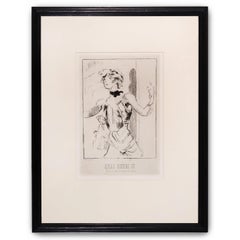
Items Similar to A Fine Judaica Etching "Atonement" Yom Kippur in the Synagogue
Want more images or videos?
Request additional images or videos from the seller
1 of 7
Samuel George CahanA Fine Judaica Etching "Atonement" Yom Kippur in the Synagogue1950
1950
$650
£495.81
€564.88
CA$913.58
A$996.69
CHF 527.74
MX$11,943.22
NOK 6,721.10
SEK 6,145.94
DKK 4,217.87
About the Item
In this copper plate etching, Cahan captures the religious ardor and penitent sentiment shared by the figures in the artwork. The piece is number seventy-six in a series of one-hundred etchings entitled Atonement. Cahan’s heavy use of line, as well as, his ability to convey emotion give the viewer a sensitive but harmonized rendering of Jewish prayer. Dimensions w/Frame: 17 1/2" x 15"
The well-known twentieth century American illustrator, etcher, and painter Samuel George Cahan was born in Kovno, Russia, now part of Lithuania. His parents were both born in Russia during the early 1870’s. Two years after his birth, his family emigrated to America and eventually settled in New York City's Lower East Side. Cahan said that his interest for drawing started when he was only an infant. In a 1967 interview, the artist describes his primary school years as vastly disinteresting. While other students heeded their teachers or studied math, Cahan drew.
At 12-years-old, Cahan exhibited his early talent for drawing on Fulton Street’s sidewalk. Barefoot and armed with chalk, he crouched outside a restaurant and drew the sinking of Maine. At the time, it was recognizable ship that was smashed by the British. One of the men who passed by his vibrant rendering of the wreckage was the Chief Editor of the New York World newspaper, Nelson Hersh. Upon seeing the young boy’s skill, Hersh offered him a job in the newspaper’s art department. During his time at the newspaper, he worked on sketching court trials and learned from other prominent American artists working in the art department, such as George Luks.
After leaving the newspaper, he explored other artistic mediums that combined his love of color and line. From etchings on copper plates, he moved onto watercolor, and finally to oil. As an adult, he began to seriously study Fine art. Cahan first studied with the famous American artist Robert Henri. They would meet in the evenings along with other students including George Bellows and Stuart Davis. He continued his studies at the distinguished Art Students League of New York and eventually became a life member. Throughout his life, he exhibited his work with French
Company Gallery. In addition, he showed his work at the National Academy of Design where he was honored with several awards.
“An artist is not a camera,” was one of Cahan’s favorite mottos. He applied this belief to all his paintings. The artist was a great supporter of Judaism and would often take his inspiration from the Jewish community. Whether landscapes or portraits, many of his works blend his interest in culture, color, and narratives. Cahan uses gestural line and brush strokes to create emotion masterpieces that connect to broad audiences. Although Cahan died in 1974, he left a legacy of artworks that chronicle the Jewish community in New York City.
- Creator:Samuel George Cahan (January 11, 1886 - October 23, 1974, American)
- Creation Year:1950
- Dimensions:Height: 17.5 in (44.45 cm)Width: 15 in (38.1 cm)
- Medium:
- Period:
- Condition:
- Gallery Location:Surfside, FL
- Reference Number:1stDibs: LU38217360312
About the Seller
4.9
Platinum Seller
Premium sellers with a 4.7+ rating and 24-hour response times
Established in 1995
1stDibs seller since 2014
1,845 sales on 1stDibs
Typical response time: 1 hour
- ShippingRetrieving quote...Shipping from: Surfside, FL
- Return Policy
More From This Seller
View AllSamuel Bak Surrealist Etching Israeli Bezalel Artist "Hidden Pear", Fruit Bowl
By Samuel Bak
Located in Surfside, FL
HIDDEN PEAR, color etching, signed in pencil, numbered 7/50, Jerusalem Print workshop blind stamp, image 7 ½ x 5 ½”, sheet 15 x 10 ¼”.
Samuel Bak (born 12 August 1933) is a Polish- American painter and writer who survived the Holocaust and immigrated to Israel in 1948. Since 1993, he has lived in the United States.
Samuel Bak was born in Wilno, Poland, Bak was recognized from an early age as having an artistic talent. He describes his family as secular, but proud of their Jewish identity.
By 1939 when Bak was six years old, the war began and Wilno was transferred from Poland to Lithuania. When Wilno was occupied by the Germans on June 24, 1941, Bak and his family were forced to move into the ghetto. At the age of nine, he held his first exhibition inside the Ghetto. Bak and his mother sought refuge in a Benedictine convent where a Catholic nun named Maria Mikulska tried to help them. After returning to the ghetto, they were deported to a forced labour camp, but took shelter again in the convent where they remained in hiding until the end of the war.
By the end of the war, Samuel and his mother were the only members of his extensive family to survive. His father, Jonas, was shot by the Germans in July 1944, only a few days before Samuel's own liberation. As Bak described the situation, "when in 1944 the Soviets liberated us, we were two among two hundred of Vilna's survivors--from a community that had counted 70 or 80 thousand." Bak and his mother as pre-war Polish citizens were allowed to leave Soviet-occupied Wilno and travel to central Poland, at first settling briefly in Lodz. They soon left Poland and traveled into the American occupied zone of Germany. From 1945 to 1948, he and his mother lived in Displaced Persons camps in Germany. He spent most of this period at the Landsberg am Lech DP camp in Germany. It was there he painted a self-portrait shortly before repudiating his Bar Mitzvah ceremony. Bak also studied painting in Munich during this period, and painted "A Mother and Son", 1947, which evokes some of his dark memories of the Holocaust and escape from Soviet-occupied Poland. In 1948, Bak and his mother immigrated to Israel. In 1952, he studied art at the Bezalel Academy of Arts and Design in Jerusalem. After serving in the Israel Defense Forces, he continued his studies in Paris (from 1956 at the École nationale supérieure des Beaux-Arts) and spent various periods of time in Rome, Paris, Switzerland and Israel before settling permanently in the United States. In 2001, Bak returned to Vilnius for the first time and has since visited his hometown several times. Samuel Bak is a conceptual artist with elements of post-modernism as he employs different styles and visual vernaculars, i.e. surrealism (Salvador Dali, Rene Magritte), analytical cubism (Picasso), pop art (Andy Warhol, Roy Lichtenstein) and quotations from the old masters. The artist never paints direct scenes of mass death. Instead, he employs allegory, metaphor and certain artistic devices such as substitution: toys instead of the murdered children who played with them, books, instead of the people who read them. Further devices are quotations of iconographical prototypes, i.e. Michelangelo's "Creation of Adam" on the Sistine Ceiling or Albrecht Dürer's famous engraving entitled "Melencholia" . In the late 1980s Bak opened up about his paintings, stating they convey “a sense of a world that was shattered.” He turns these prototypes into ironical statements. Irony in the art of Samuel Bak does not mean parody or derision, but rather disenchantment, and the attempt to achieve distance from pain. Recurring symbols are: the Warsaw Ghetto Child, Crematorium Chimneys or vast backgrounds of Renaissance landscape that symbolize the indifference of the outside world. These form a disturbing contrast with the broken and damaged images in the foreground. Samuel Bak's paintings cause discomfort, they are a warning against complacency, a bulwark against collective amnesia with reference to all acts of barbarism, worldwide and throughout the ages, through his personal experience of genocide.
In Bak's piece entitled Trains Bak creates a vast grey landscape with large mounts creating the structure of a train. Massive taper candles burn in the distance further down the train tracks, surrounding an eruption. The smoke from the candles and volcano pour into a sky of dark ominous clouds that lurk over the landscape. Here Bak has created a whole new meaning for “trains.” Many of Bak’s pieces incorporate aspects of Jewish culture and the holocaust with a dark and creative twist, such as Shema Israel...
Category
20th Century Surrealist Figurative Prints
Materials
Etching
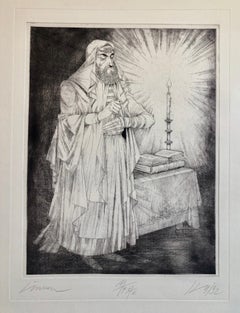
Hungarian Modernist Judaica Etching Print Teffilin, Jewish Rabbi in Prayer
By Janos Kass
Located in Surfside, FL
From very small edition of 15 on handmade mould made paper, with Jewish star Magen David watermark. From the deluxe boxed portfolio edition. Hand signed in pencil.
János Kass (December 26, 1927 – March 29, 2010) was a Hungarian illustrator, printmaker, graphic designer, postage stamp designer, animated film director and teacher. Hungary's foremost graphic artist and book illustrator. Born in Szeged, he was the storyboard artist for the first fully digital animated film. This is done in a manner reminiscent of Saul Raskin, Tully Filmus and William Gropper, this is a modern take on a classic judaic subject matter, similar in style and tone to Abram Krol, Jakob Steinhardt, Josef Budko and Hermann Struck.
Beginning his artistic studies at the Applied Art Academy, Kass finished in 1951 at the Academy of Fine Arts, a student of Gyula Hincz, György Kádár and György Konecsni. From 1956 to 1959 he held the Derkovits scholarship.
From 1961 to 1962, he was assistant professor at the Book-Art Academy in Leipzig, Germany.
Kass regularly took part in every major national exhibition at home and abroad. He had one-man shows in Italy (1963), Australia (1970) and Switzerland (1976). He participated in the Venice Biennial (1960), the Youth Biennial in Paris (1961), and Biennials in Lugano, Tokyo, Ljubljana, São Paulo and Buenos Aires, along with "Intergrafik" exhibitions in Berlin.
He made many friends within the British graphic art fraternity while spending some months in London during 1980, working on one of the earliest, fully digitized computer-animated films, Dilemma, with John Halas. He had already won recognition with his illustrations and book designs. At the 1973 Leipzig book fair, his work was awarded the title of best illustrated book at the fair. This accolade was repeated at the Frankfurt fair in 1999.
The 11-minute Dilemma was nominated at that year's Cannes Film Festival for the Golden Palm for Best Short Film, and is considered the first fully digital animated film. Kass was also a background artist for the "So Beautiful and So Dangerous" segment of Ivan Reitman Productions' 1981 animated feature film Heavy Metal.
Kass' drawings, etchings and silk-screen prints were exhibited in the Fitzwilliam Museum in Cambridge in 1989 and in 1990 at London Olympia. He later held a one-man show in Edinburgh.
He illustrated something like 400 books, classical novels and children's stories, among them an elegant edition of Imre Madách's 19th-century drama The Tragedy of Man, published in Iain MacLeod's translation by Edinburgh's Canongate press in 1993. He won Hungary's highest artistic award, the Kossuth prize, and was an elected member of the Széchenyi academy. János Kass’ s numerous works can be found in the Hungarian National Gallery. Since 1985, the János Kass Gallery...
Category
1990s Expressionist Figurative Prints
Materials
Etching
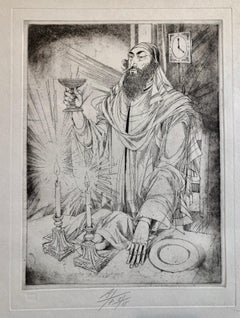
Hungarian Modernist Judaica Etching Print Kiddush, Jewish Rabbi at Shabbat Feast
By Janos Kass
Located in Surfside, FL
From very small edition of 15 on handmade mould made paper, with Jewish star Magen David watermark. From the deluxe boxed portfolio edition.
János Kass (...
Category
1990s Expressionist Figurative Prints
Materials
Etching
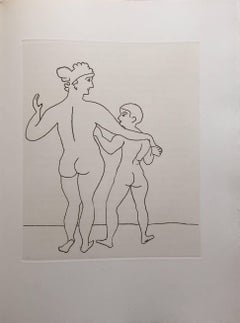
Erotic Etching from Le Satyricon
By André Derain
Located in Surfside, FL
This lot is for one etching.
---
Derain was born in 1880 in Chatou, Yvelines, Île-de-France, just outside Paris. In 1895 Derain began to study on his own, contrary to claims that mee...
Category
20th Century Figurative Prints
Materials
Etching
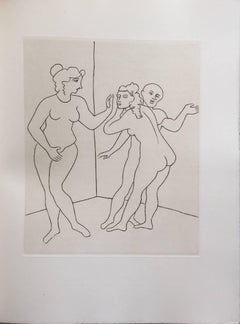
Female Nude Erotic Art Deco Etching from Le Satyricon
By André Derain
Located in Surfside, FL
This lot is for one etching.
---
Derain was born in 1880 in Chatou, Yvelines, Île-de-France, just outside Paris. In 1895 Derain began to study on his own, contrary to claims that mee...
Category
20th Century Figurative Prints
Materials
Etching
Figurative Etching from Le Satyricon
By André Derain
Located in Surfside, FL
This lot is for one etching.
---
Derain was born in 1880 in Chatou, Yvelines, Île-de-France, just outside Paris. In 1895 Derain began to study on his own, contrary to claims that mee...
Category
20th Century Figurative Prints
Materials
Etching
You May Also Like
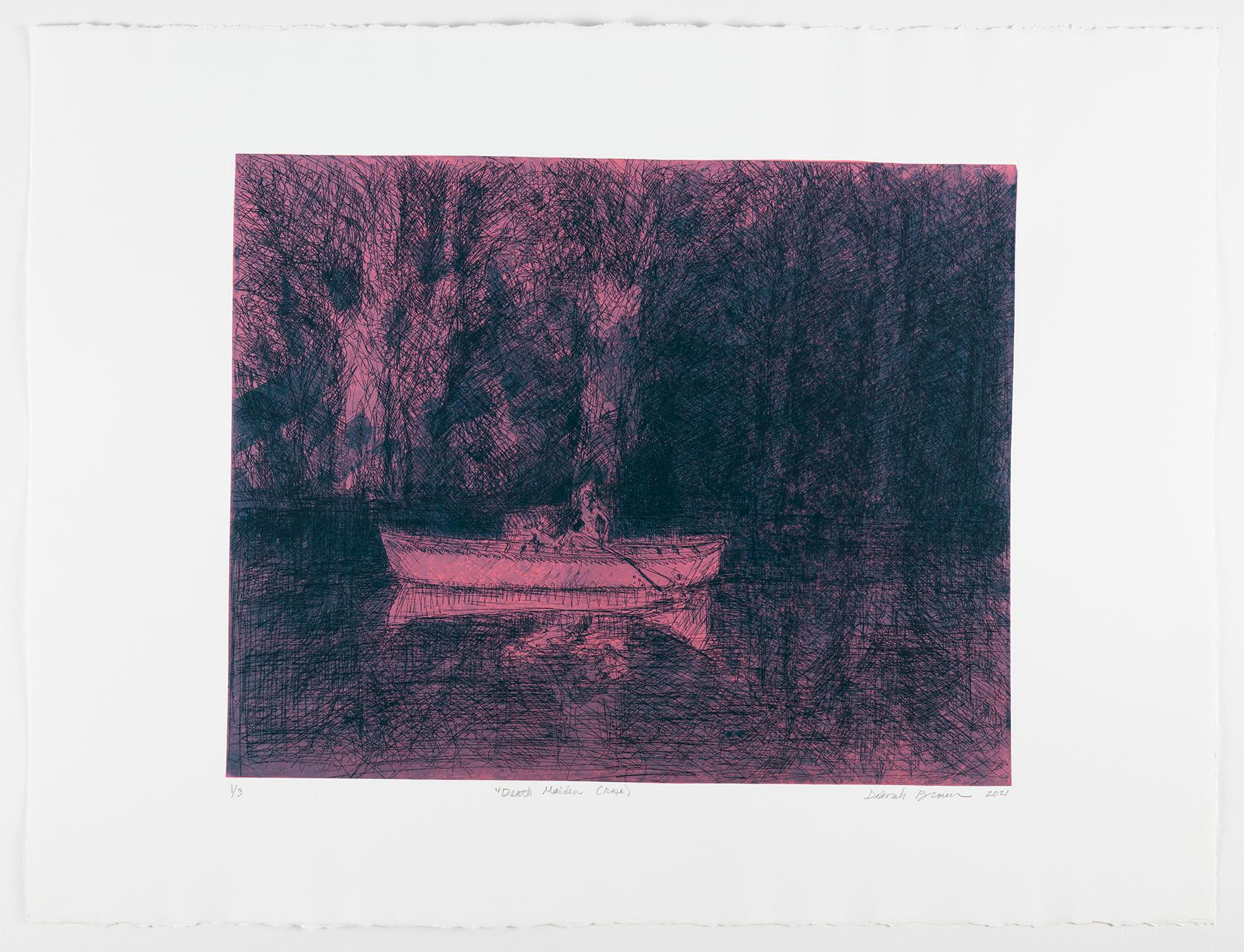
Death Maiden by Deborah Brown
By Deborah Brown
Located in New York, NY
Deborah Brown
Death Maiden, 2021
Hard ground line, sugar lift and aquatint etching, Chine-collé printed on Rives BFK white paper
Image Size: 16 x 20 inches
Paper Size: 22 x 30 inc...
Category
2010s Contemporary Figurative Prints
Materials
Etching
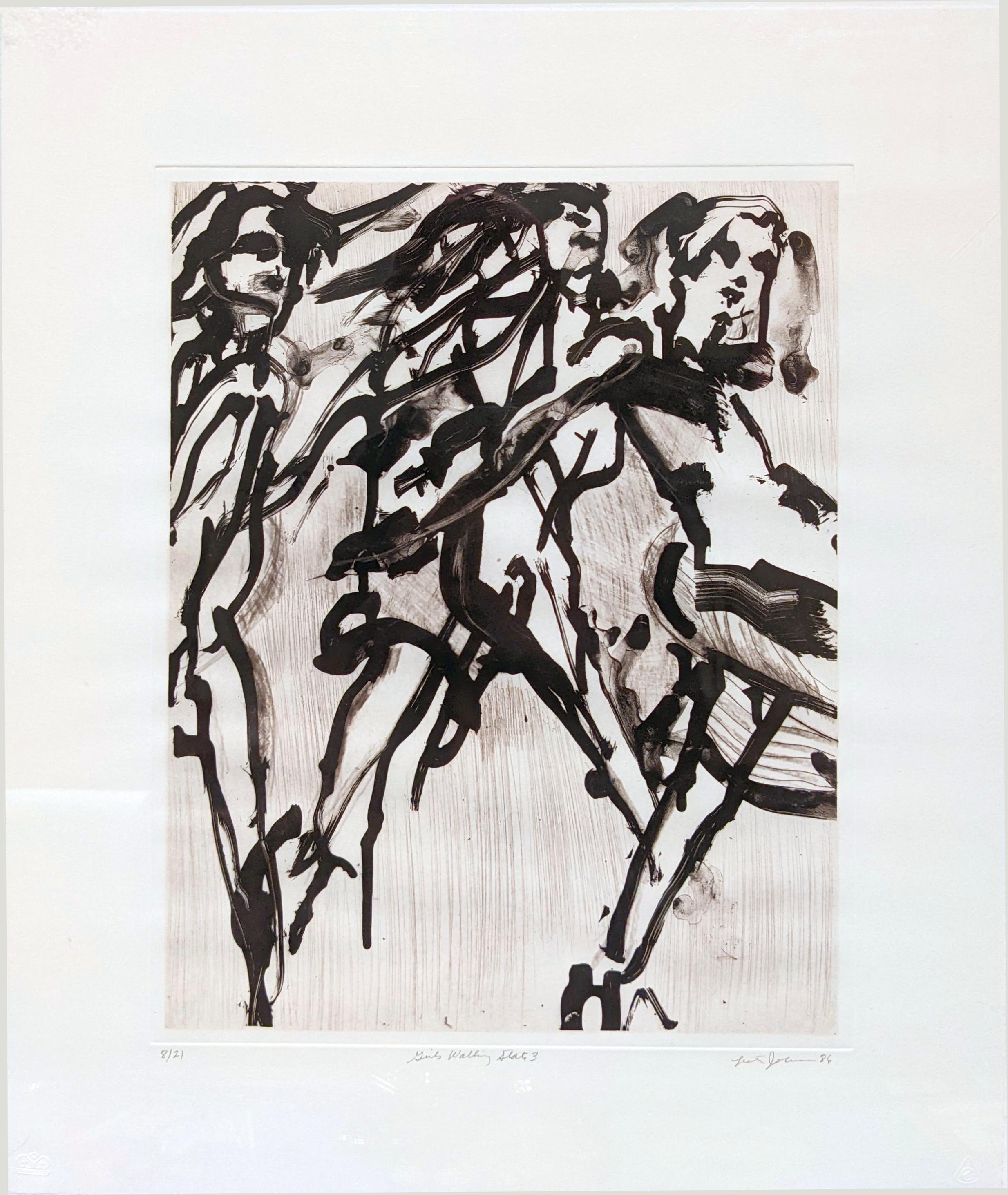
Girls Walking State 3
By Lester Johnson
Located in New York, NY
Lester Johnson Girls Walking State 3 etching 1986. Designated edition number 8 of 21 in pencil lower left recto. Signed in pencil "Lester Johnson" lower right recto.
Category
1980s Expressionist Figurative Prints
Materials
Etching, Aquatint, Intaglio
$1,440 Sale Price
20% Off
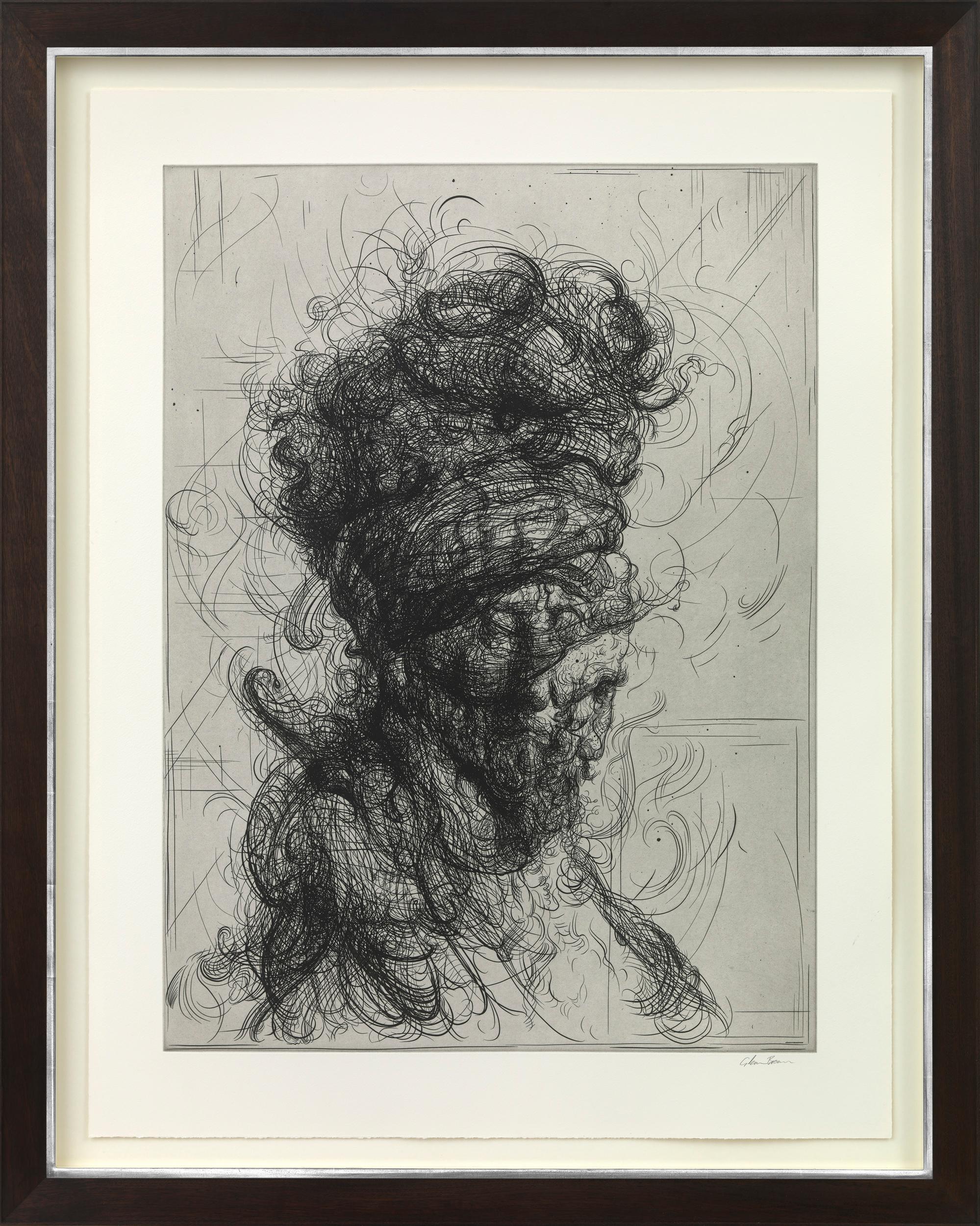
Plate 1, from: Half-Life (after Rembrandt)
By Glenn Brown
Located in London, GB
This is a truly stunning work by contemporary great, Glenn Brown. This work is an Artist Proof, one of only 12 created.
The frame is handmade by famous London framers, Darbyshire. I...
Category
2010s Abstract Expressionist Figurative Prints
Materials
Paper, Etching
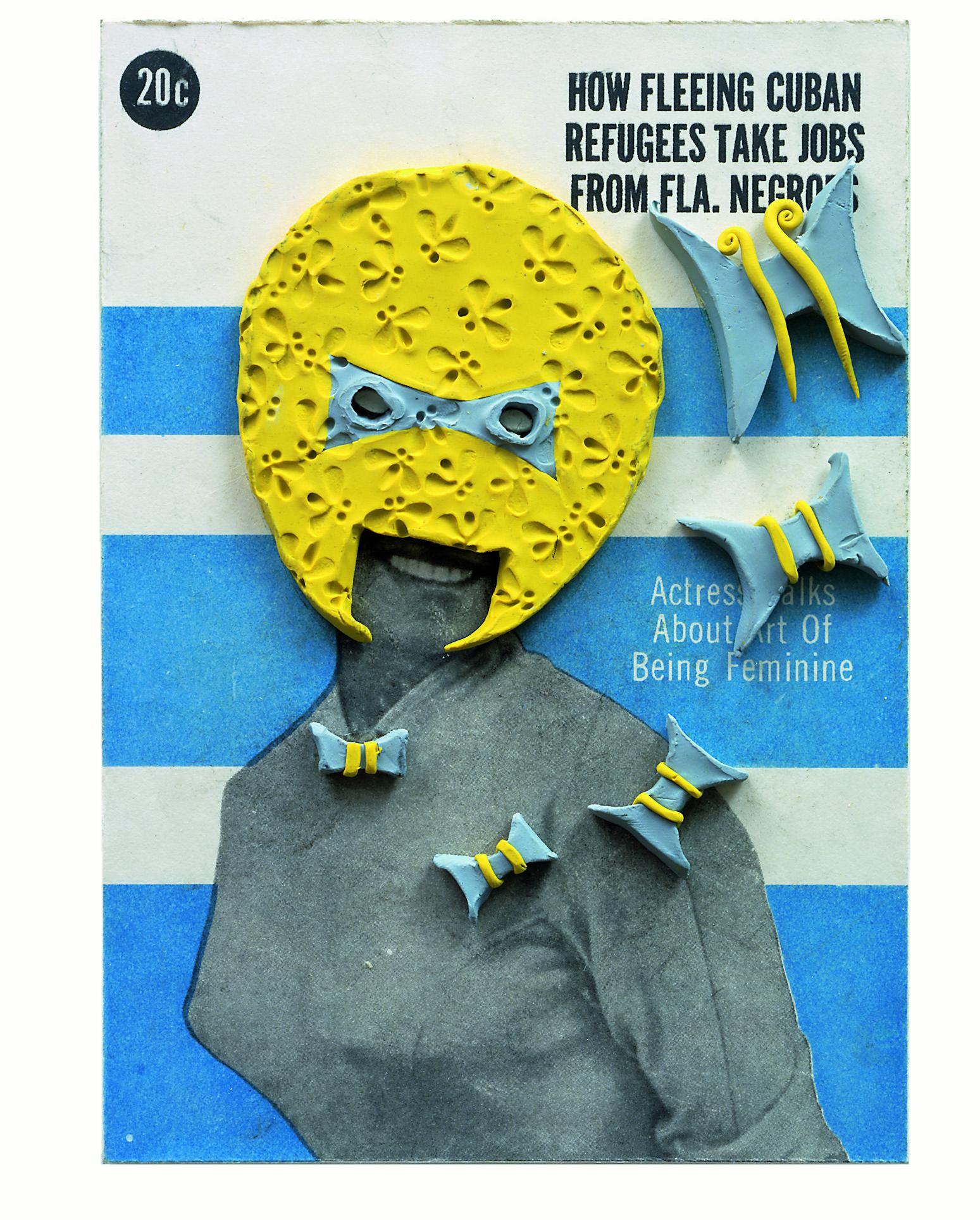
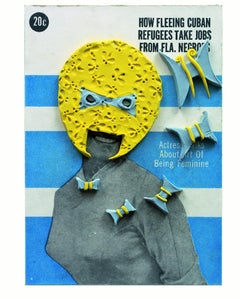
Ruby Dee
By Ellen Gallagher
Located in New York, NY
Two-plate photogravure with aquatint and unique hand-shaped plasticine elements (in three colors) on multilayered laminated paper.
Category
Early 2000s Figurative Prints
Materials
Aquatint, Photogravure
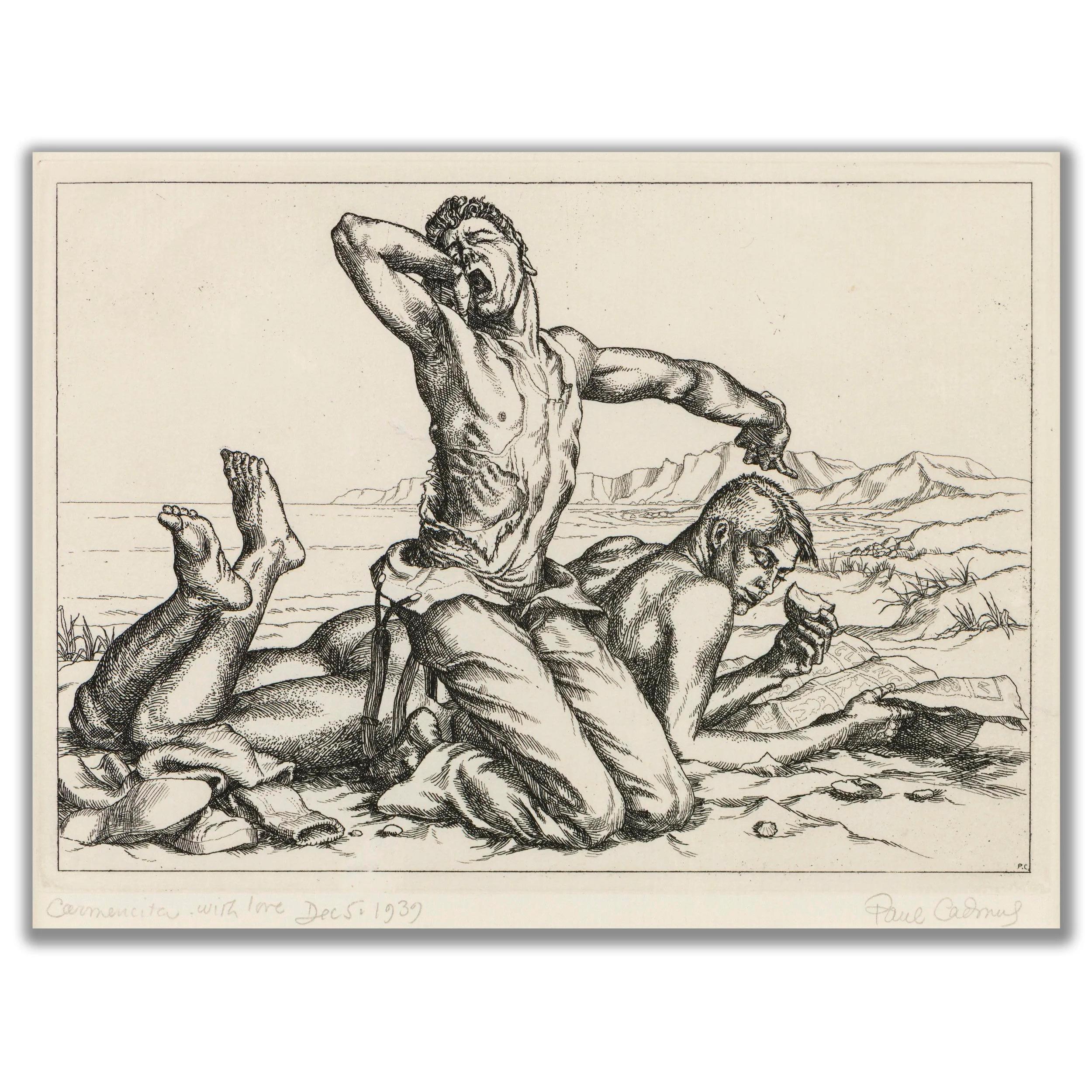
Two Boys on a Beach No.1
By Paul Cadmus
Located in London, GB
Etching
Signed (lower right) and dedicated ‘To Carmencita, 1939’ (lower left)
From edition of 75
13cm x 18cm (plate size), (40cm x 44cm framed)
Cadmus was an American artist known ...
Category
1930s American Realist Figurative Prints
Materials
Etching

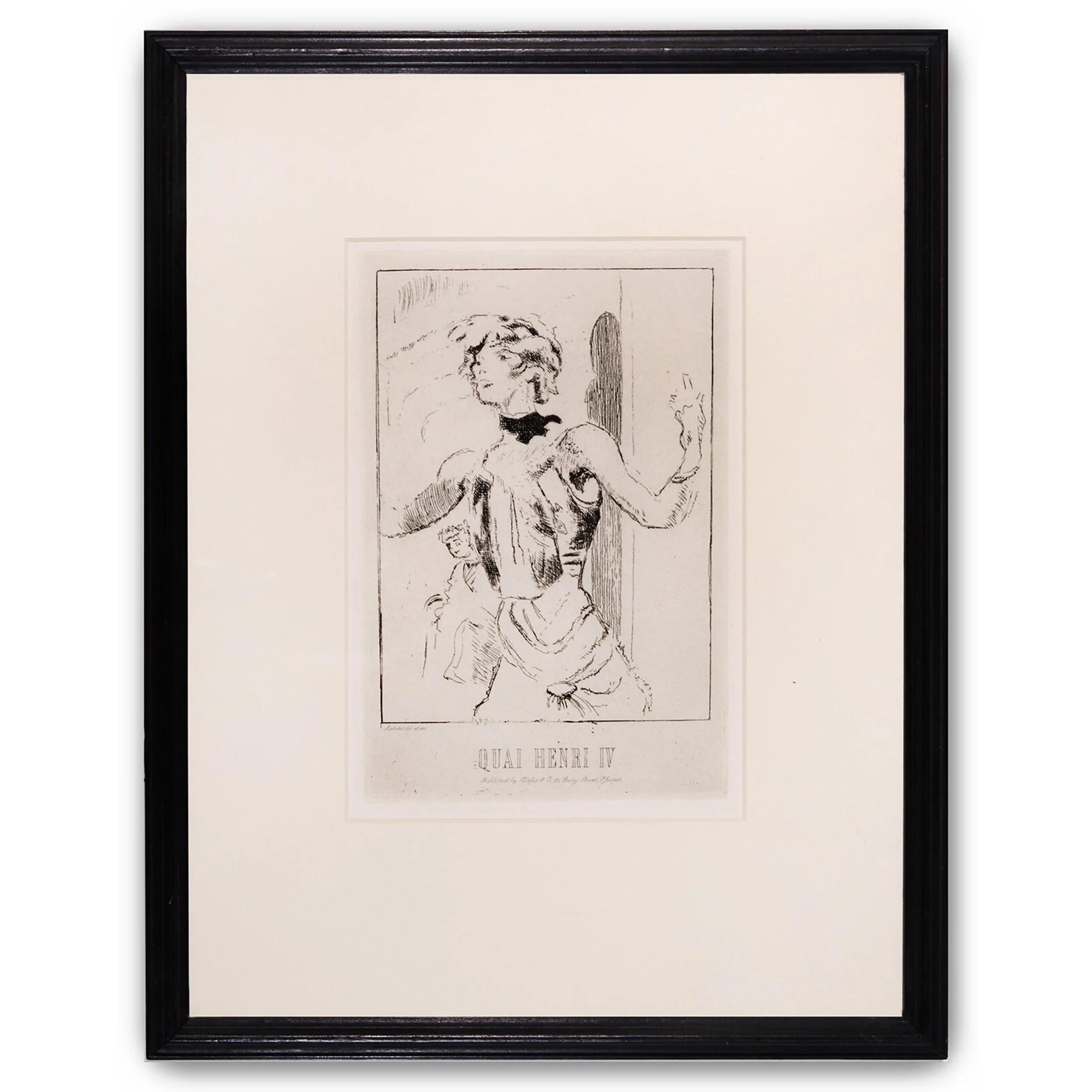
Dieppe, Quai Kenry IV
By Walter Sickert
Located in London, GB
Etching
19.7cm × 13.2cm (37cm × 29cm framed)
Contained within the Sickert Print Catalogue Raisonné (Ruth Bromberg 167 iii/iii), this image is possibly of a female impersonator, from...
Category
1910s Figurative Prints
Materials
Etching