Bauhaus Figurative Prints
to
3
6
1
2
Overall Width
to
Overall Height
to
15,661
8,450
2,627
2,448
2,264
1,005
813
747
613
429
344
115
90
37
5
1
9
2
5
1
1
4
4
1
5
5
2
2
2
2
1
1
1
1
1
1
1
1
1
5
2
1
1
1
9
Style: Bauhaus
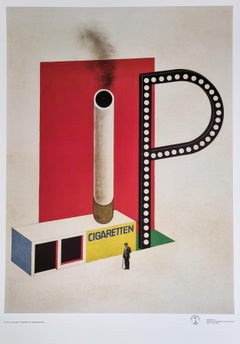
Sale and Marketing Kiosk for P Cigarettes (Bauhaus) (20% OFF + Free Shipping)
Located in Kansas City, MO
Herbert Bayer
Sale and Marketing Kiosk for P Cigarettes (Verkauf- und Werbekiosk, Zigarettenmarke P ), 1924
Offset Lithograph
Year: 1994
Size: 33.2 × 23.2 inches
Publisher: Bauhaus A...
Category
1920s Bauhaus Figurative Prints
Materials
Lithograph

$120 Sale Price
20% Off
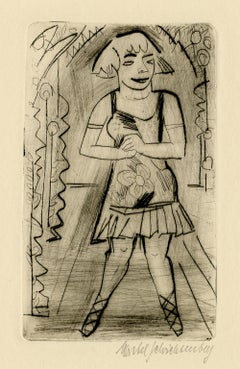
Varietesoubrette, Schwalbennest
also Dancer — 1920s German Expressionism
Located in Myrtle Beach, SC
Martel Schwichtenberg (1896-1945), 'Varietésoubrette, Schwalbennest (Variety Soubrette, Swallow’s Nest), drypoint, 1922. Signed in pencil. A fine, richly-inked impression; the full sheet of cream wove paper, with wide margins (3 3/4 to 5 1/4 inches), in excellent condition. Image size 7 3/16 x 4 5/16 inches; sheet size 16 3/8 x 12 1/8 inches. Archivally matted to museum standards, unframed.
Published in Die Schaffenden...
Category
1920s Bauhaus Figurative Prints
Materials
Drypoint
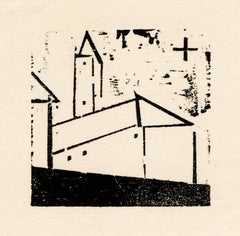
Church with Star
– Artist
s Personal Letterhead, Bauhaus Modernism
Located in Myrtle Beach, SC
Lyonel Feininger, 'Church with Star (Kirche mit Stern)', woodcut, 1936, one of a small but unknown number of letterhead proofs; Prasse W265. Annotated 'W 265' (Feininger catalogue number) and inventory no. '2808' in pencil, in the bottom right sheet corner. A fine impression, on cream, laid letterhead stock; hinge remains on the left and right top sheet edges, verso, in excellent condition. Very scarce.
Image size 2 3/8 x 2 3/8 inches; sheet size 10 1/16 x 7 1/16 inches. Archivally sleeved, unmatted.
ABOUT THE ARTIST
Lyonel Feininger (1871-1956) was born in New York City into a musical family—his father was a violinist and composer, his mother was a singer and pianist. He studied violin with his father, and by the age of 12, he was performing in public, but he also drew incessantly, most notably the steamboats and sailing ships on the Hudson and East Rivers, and the landscape around Sharon, Conn., where he spent time on a farm owned by a family friend. At the age of 16 he left New York to study music and art in Germany, from where his parents emigrated. Drawn more to the visual arts, he attended schools in Hamburg, Berlin, and Paris from 1887 to 1892.
After completing his studies, Feininger began his artistic career as a cartoonist and illustrator, his originality leading him to great success. In 1906, after working for a dozen years in Germany, he was offered a job as a cartoonist at the Chicago Tribune, the largest circulation newspaper in the Midwest. He worked there for a year, inventing what became the standard design for the comic strip: in the words of John Carlin, “an overall pattern. . . that allowed the page to be read both as a series of elements one after the other, like language and as a group of juxtaposed images, like visual art.” His originality did not end there: he went on to become one of the great abstract painters. Like Kandinsky, music was his model, but Kandinsky only knew music from the outside—as a listener (inspired initially by Wagner, then by Schoenberg)—while Feininger knew it from the inside. He lived in Paris from 1906 to 1908, during which time he met and was influenced by the work of progressive painters Robert Delaunay and Jules Pascin, as well as that of Paul Cezanne and Vincent van Gogh. He began painting full-time, developing his distinctive Iyrical style based on Cubist and Expressionist idioms and a concern for the emotive qualities of light and color. He exhibited with the Der Blaue Reiter group in 1913, and in 1917, he had his first solo exhibition at Galerie Der Sturm in Berlin.
One year after his solo exhibition, in 1918, Feininger began making woodcuts. He became enamored with the medium, producing an impressive 117 in his first year of exploring the printmaking medium. In 1919 at the invitation of the architect Walter Gropius, he was appointed the first master at the newly formed Staatliches Bauhaus in Weimar. His woodcut of a cathedral crowned...
Category
1930s Bauhaus Figurative Prints
Materials
Woodcut
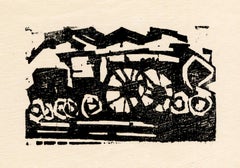
Little Locomotive
– Artist
s Personal Letterhead, Bauhaus Modernism
Located in Myrtle Beach, SC
Lyonel Feininger, 'Little Locomotive (Kleine Lokomotive)', woodcut, 1936, one of a small but unknown number of letterhead proofs; Prasse W158. Annotated 'W 158' (Feininger catalogue number) and '1936' in pencil, in the bottom right sheet corner.
A fine impression, on cream, laid letterhead stock; hinge remains on the left and right top sheet edges, verso, in excellent condition. Very scarce.
Image size 2 1/4 x 3 5/16 inches; sheet size 10 x 7 inches. Archivally sleeved, unmatted.
Exhibited: 'Lyonel Feininer, Woodcuts Used As Letterheads'; Associated American Artists; Feb 4 - March 2, 1974; New York, NY.
Collections: Cleveland Museum of Art, Museum of Modern Art, Staatliche Museen zu Berlin (East Berlin KK).
ABOUT THE ARTIST
Lyonel Feininger (1871-1956) was born in New York City into a musical family—his father was a violinist and composer, his mother was a singer and pianist. He studied violin with his father, and by the age of 12, he was performing in public, but he also drew incessantly, most notably the steamboats and sailing ships on the Hudson and East Rivers, and the landscape around Sharon, Conn., where he spent time on a farm owned by a family friend. At the age of 16 he left New York to study music and art in Germany, from where his parents emigrated. Drawn more to the visual arts, he attended schools in Hamburg, Berlin, and Paris from 1887 to 1892.
After completing his studies, Feininger began his artistic career as a cartoonist and illustrator, his originality leading him to great success. In 1906, after working for a dozen years in Germany, he was offered a job as a cartoonist at the Chicago Tribune, the largest circulation newspaper in the Midwest. He worked there for a year, inventing what became the standard design for the comic strip: in the words of John Carlin, “an overall pattern. . . that allowed the page to be read both as a series of elements one after the other, like language and as a group of juxtaposed images, like visual art.” His originality did not end there: he went on to become one of the great abstract painters. Like Kandinsky, music was his model, but Kandinsky only knew music from the outside—as a listener (inspired initially by Wagner, then by Schoenberg)—while Feininger knew it from the inside. He lived in Paris from 1906 to 1908, during which time he met and was influenced by the work of progressive painters Robert Delaunay and Jules Pascin, as well as that of Paul Cezanne and Vincent van Gogh. He began painting full-time, developing his distinctive Iyrical style based on Cubist and Expressionist idioms and a concern for the emotive qualities of light and color. He exhibited with the Der Blaue Reiter group in 1913, and in 1917, he had his first solo exhibition at Galerie Der Sturm in Berlin.
One year after his solo exhibition, in 1918, Feininger began making woodcuts. He became enamored with the medium, producing an impressive 117 in his first year of exploring the printmaking medium. In 1919 at the invitation of the architect Walter Gropius, he was appointed the first master at the newly formed Staatliches Bauhaus in Weimar. His woodcut of a cathedral crowned...
Category
1930s Bauhaus Figurative Prints
Materials
Woodcut
Three Masted Ship, 2
– Artist
s Personal Letterhead, Bauhaus Modernism
Located in Myrtle Beach, SC
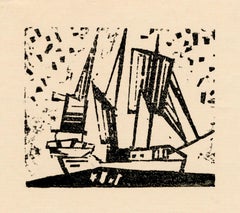
Lyonel Feininger, 'Three Masted Ship, 2 (Dreimastiges Schiff, 2)', woodcut, 1937, one of a small but unknown number of letterhead proofs; Prasse W296. Feininger estate stamp and inventory no. 'W 865' in pencil, bottom left sheet corner. Annotated 'W 296' and 'on block : 3702a' in pencil, bottom right sheet corner.
A fine impression, on cream, laid, letterhead stock; hinge remains on the left and right top sheet edges, verso, in excellent condition. Very scarce.
Image size 2 1/4 x 2 11/16 inches; sheet size 10 x 6 3/4 inches. Archivally sleeved, unmatted.
Exhibited: 'Lyonel Feininer, Woodcuts Used As Letterheads'; Associated American Artists; Feb 4 - March 2, 1974; New York, NY.
ABOUT THE ARTIST
Lyonel Feininger (1871-1956) was born in New York City into a musical family—his father was a violinist and composer, his mother was a singer and pianist. He studied violin with his father, and by the age of 12, he was performing in public, but he also drew incessantly, most notably the steamboats and sailing ships on the Hudson and East Rivers, and the landscape around Sharon, Conn., where he spent time on a farm owned by a family friend. At the age of 16 he left New York to study music and art in Germany, from where his parents emigrated. Drawn more to the visual arts, he attended schools in Hamburg, Berlin, and Paris from 1887 to 1892.
After completing his studies, Feininger began his artistic career as a cartoonist and illustrator, his originality leading him to great success. In 1906, after working for a dozen years in Germany, he was offered a job as a cartoonist at the Chicago Tribune, the largest circulation newspaper in the Midwest. He worked there for a year, inventing what became the standard design for the comic strip: in the words of John Carlin, “an overall pattern. . . that allowed the page to be read both as a series of elements one after the other, like language and as a group of juxtaposed images, like visual art.” His originality did not end there: he went on to become one of the great abstract painters. Like Kandinsky, music was his model, but Kandinsky only knew music from the outside—as a listener (inspired initially by Wagner, then by Schoenberg)—while Feininger knew it from the inside. He lived in Paris from 1906 to 1908, during which time he met and was influenced by the work of progressive painters Robert Delaunay and Jules Pascin, as well as that of Paul Cezanne and Vincent van Gogh. He began painting full-time, developing his distinctive Iyrical style based on Cubist and Expressionist idioms and a concern for the emotive qualities of light and color. He exhibited with the Der Blaue Reiter group in 1913, and in 1917, he had his first solo exhibition at Galerie Der Sturm in Berlin.
One year after his solo exhibition, in 1918, Feininger began making woodcuts. He became enamored with the medium, producing an impressive 117 in his first year of exploring the printmaking medium. In 1919 at the invitation of the architect Walter Gropius, he was appointed the first master at the newly formed Staatliches Bauhaus in Weimar. His woodcut of a cathedral crowned...
Category
1930s Bauhaus Figurative Prints
Materials
Woodcut
Church with House and Tree
– Artist
s Personal Letterhead, Bauhaus Modernism
Located in Myrtle Beach, SC
Lyonel Feininger, 'Church with House and Tree (Kirche mit Haus und Baum)', woodcut, 1936, one of a small but unknown number of letterhead proofs; Prasse W290 V. Inscribed 'J. F. note paper', in pencil, in the artist’s hand; with the Feininger estate stamp and catalog no. 'W 859' in pencil. Annotated 'W.290 V state 3609' in pencil, in the bottom right sheet corner.
A fine impression, on cream, laid letterhead stock; hinge remains on the left and right top sheet edges, verso, in excellent condition. Very scarce.
Image size 2 3/8 x 2 3/4 inches; sheet size 10 x 7 5/16 inches. Archivally sleeved, unmatted.
Exhibited: 'Lyonel Feininer, Woodcuts Used As Letterheads'; Associated American Artists; Feb 4 - March 2, 1974; NY, NY.
ABOUT THE ARTIST
Lyonel Feininger (1871-1956) was born in New York City into a musical family—his father was a violinist and composer, his mother was a singer and pianist. He studied violin with his father, and by the age of 12, he was performing in public. Still, he also drew incessantly, most notably the steamboats and sailing ships on the Hudson and East Rivers, and the landscape around Sharon, Conn., where he spent time on a farm owned by a family friend. At the age of 16 he left New York to study music and art in Germany, from where his parents emigrated. Drawn more to the visual arts, he attended schools in Hamburg, Berlin, and Paris from 1887 to 1892.
After completing his studies, Feininger began his artistic career as a cartoonist and illustrator, his originality leading him to great success. In 1906, after working for a dozen years in Germany, he was offered a job as a cartoonist at the Chicago Tribune, the largest circulation newspaper in the Midwest. He worked there for a year, inventing what became the standard design for the comic strip: in the words of John Carlin, “an overall pattern. . . that allowed the page to be read both as a series of elements one after the other, like language and as a group of juxtaposed images, like visual art.” His originality did not end there: he went on to become one of the great abstract painters. Like Kandinsky, music was his model, but Kandinsky only knew music from the outside—as a listener (inspired initially by Wagner, then by Schoenberg)—while Feininger knew it from the inside. He lived in Paris from 1906 to 1908, during which time he met and was influenced by the work of progressive painters Robert Delaunay and Jules Pascin, as well as that of Paul Cezanne and Vincent van Gogh. He began painting full-time, developing his distinctive Iyrical style based on Cubist and Expressionist idioms and a concern for the emotive qualities of light and color. He exhibited with the Der Blaue Reiter group in 1913, and in 1917, he had his first solo exhibition at Galerie Der Sturm in Berlin.
One year after his solo exhibition, in 1918, Feininger began making woodcuts. He became enamored with the medium, producing an impressive 117 in his first year of exploring the printmaking medium. In 1919 at the invitation of the architect Walter Gropius, he was appointed the first master at the newly formed Staatliches Bauhaus in Weimar. His woodcut of a cathedral crowned...
Category
1930s Bauhaus Figurative Prints
Materials
Woodcut
Church with House and Tree
– Artist
s Personal Letterhead, 1940s Modernism
Located in Myrtle Beach, SC
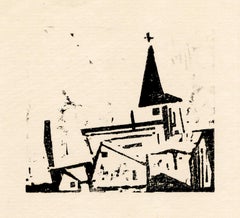
Lyonel Feininger, 'Church with House and Tree (Kirche mit Haus und Baum)', woodcut, 1936, one of a small but unknown number of letterhead proofs; Prasse W290 IV. Annotated 'PW 290 state IV / IV 3669', in pencil, in the bottom right sheet corner. With the artist's typed address and date adjacent to the letterhead image: 'Falls Village, Connecticut September 26th, 1940'.
A fine impression, on buff, wove letterhead stock; several small losses, and tears, in the sheet edges (not affecting the image area); a crease in the bottom right sheet edge, otherwise in good condition. Very scarce.
Image size: 2 3/8 x 2 3/4 inches; sheet size 11 x 8 5/8 inches. Archivally sleeved, unmatted.
Feininger moved from Germany to New York City in 1938 and began spending his summers in Falls Village in 1940.
Exhibited: 'Lyonel Feininer, Woodcuts Used As Letterheads'; Associated American Artists; Feb 4 - March 2, 1974; New York, NY.
ABOUT THE ARTIST
Lyonel Feininger (1871-1956) was born in New York City into a musical family—his father was a violinist and composer, his mother was a singer and pianist. He studied violin with his father, and by the age of 12, he was performing in public, but he also drew incessantly, most notably the steamboats and sailing ships on the Hudson and East Rivers, and the landscape around Sharon, Conn., where he spent time on a farm owned by a family friend. At the age of 16 he left New York to study music and art in Germany, from where his parents emigrated. Drawn more to the visual arts, he attended schools in Hamburg, Berlin, and Paris from 1887 to 1892.
After completing his studies, Feininger began his artistic career as a cartoonist and illustrator, his originality leading him to great success. In 1906, after working for a dozen years in Germany, he was offered a job as a cartoonist at the Chicago Tribune, the largest circulation newspaper in the Midwest. He worked there for a year, inventing what became the standard design for the comic strip: in the words of John Carlin, “an overall pattern. . . that allowed the page to be read both as a series of elements one after the other, like language and as a group of juxtaposed images, like visual art.” His originality did not end there: he went on to become one of the great abstract painters. Like Kandinsky, music was his model, but Kandinsky only knew music from the outside—as a listener (inspired initially by Wagner, then by Schoenberg)—while Feininger knew it from the inside. He lived in Paris from 1906 to 1908, during which time he met and was influenced by the work of progressive painters Robert Delaunay and Jules Pascin, as well as that of Paul Cezanne and Vincent van Gogh. He began painting full-time, developing his distinctive Iyrical style based on Cubist and Expressionist idioms and a concern for the emotive qualities of light and color. He exhibited with the Der Blaue Reiter group in 1913, and in 1917, he had his first solo exhibition at Galerie Der Sturm in Berlin.
One year after his solo exhibition, in 1918, Feininger began making woodcuts. He became enamored with the medium, producing an impressive 117 in his first year of exploring the printmaking medium. In 1919 at the invitation of the architect Walter Gropius, he was appointed the first master at the newly formed Staatliches Bauhaus in Weimar. His woodcut of a cathedral crowned...
Category
1930s Bauhaus Figurative Prints
Materials
Woodcut
BENDIX ALUFROID original horizontal French poster
Located in Spokane, WA
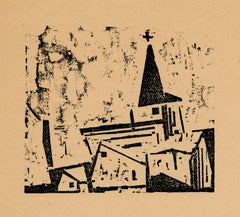
Original Bendix Alufroid French Lithographic Vintage Poster by Hervé Morvan from the 1960s. Archival linen-backed and in very fine condition, ready for framing.
Add a touch of cla...
Category
1960s Bauhaus Figurative Prints
Materials
Lithograph

$796 Sale Price
20% Off
Florence Henri
Located in New York, NY
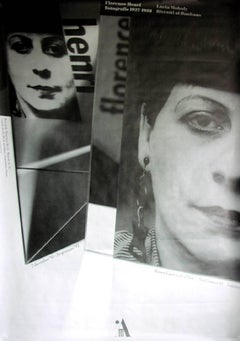
Ritratti al Bauhaus. Photo-offset poster.
Museo cantonale d'arte Lugano
Year: 1991.
Monguzzi studied in Geneva and London, spent part of his early career in at the studio of Antonio Boggeri, in Milan. The inspiration of the experimental and visually-daring work of the avant garde designers Herbert Bayer, El Lissitsky, Jan Tschichold, Piet Zwart, Paul Schuitema, Ladislav Sutnar...
Category
1990s Bauhaus Figurative Prints
Materials
Offset
Related Items
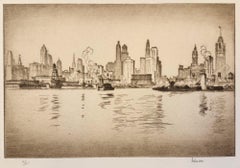
Chicago Skyline
Located in Middletown, NY
A beautiful turn-of-the-century lake view of Chicago by an American artist known for his Texas landscapes.
Etching with drypoint on watermarked Umbria laid paper with deckle edges, 7 1/4 x 10 7/8 inches (182 x 275 mm), full margins. Signed and numbered 4/25 in pencil, lower margin. In good condition with adhesive residue at the sheet edges on the verso, does not show through to the recto. A lovely Lake Michigan landscape...
Category
Early 20th Century Bauhaus Figurative Prints
Materials
Handmade Paper, Etching, Drypoint
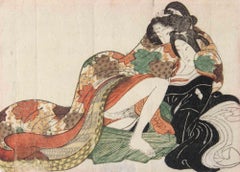
Shunga - Woodcut attr. Keisai Eisen - Mid-19th Century
By Keisai Eisen
Located in Roma, IT
Woodcut shunga print attributed to Keisai Eisen and realized in the early 19th century.
Good condition except for some signs of time.
Category
Mid-19th Century Bauhaus Figurative Prints
Materials
Woodcut
$355
H 3.55 in W 4.73 in D 0.04 in
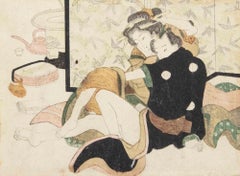
Shunga - Woodcut attr. Keisai Eisen - Mid-19th Century
By Keisai Eisen
Located in Roma, IT
Woodcut shunga print attributed to Keisai Eisen and realized in the early 19th century.
Good condition except for some signs of time.
Category
Mid-19th Century Bauhaus Figurative Prints
Materials
Woodcut
$355
H 3.55 in W 4.73 in D 0.04 in
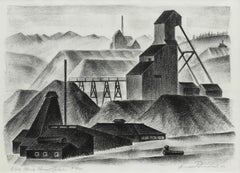
Arnold Ronnebeck Lithograph "Silver Mine, Russell Gulch" Colorado Scene
Located in Denver, CO
"Silver Mine, Russell Gulch (12/25)" is a striking black-and-white lithograph by German-born American Modernist Arnold Ronnebeck (1885–1947). This rare print depicts a historic minin...
Category
1930s Bauhaus Figurative Prints
Materials
Lithograph
$2,750
H 20.5 in W 26.5 in D 0.5 in
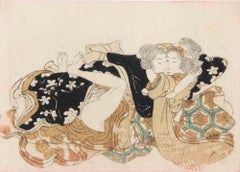
Shunga - Woodcut attr. Keisai Eisen - Mid-19th Century
By Keisai Eisen
Located in Roma, IT
Woodcut shunga print attributed to Keisai Eisen and realized in the early 19th century.
Good condition except for some signs of time.
Category
Mid-19th Century Bauhaus Figurative Prints
Materials
Woodcut
$356
H 3.55 in W 4.73 in D 0.04 in
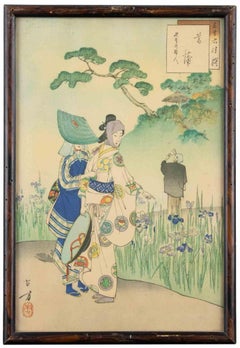
Sanjûroku Kasen ... - Woodcut by Mizuno Toshikata - 1893
Located in Roma, IT
Nishiki-e (woodcut print), in vertical oban format (31x20.5) realized by Mizuno Toshikata in 1893 (Meiji 26).
Belongs to the Series "Sanjûroku Kasen" (Thirty-Six Beauties in Compari...
Category
1890s Bauhaus Figurative Prints
Materials
Woodcut
$380
H 12.21 in W 8.08 in D 0.04 in
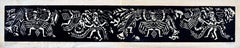
"Rainbow-Man" - Abstracted Mexican Figurative Woodblock Print
By Pedro Puesta
Located in Soquel, CA
"Rainbow-man," an abstracted Mexican figurative woodblock by Pedro Puerta (Mexican, 20th Century), 1974. Titled "Rainbow-Man" lower left and "from a Michoacan Pot" "Reproduced with a...
Category
1970s Bauhaus Figurative Prints
Materials
Paper, Ink, Woodcut
$1,195
H 11 in W 59 in D 1 in
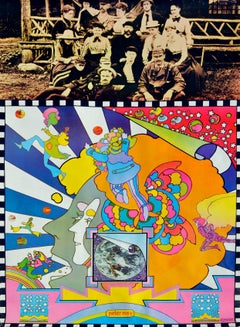
Instant Nutriment #4, 1969 - Modern Pop Art Psychedelic Print
By Peter Max
Located in Soquel, CA
Instant Nutriment #4, 1969 - Modern Pop Art Psychedelic Print
A vintage psychedelic print, Instant Nutriment #4, 1969 by Peter Max (German, b. 1937). Unframed. Shipped Rolled in tube. Some edge wear to paper. Image: 36"H x 24"W
One of the most famous of all living artist's, Peter Max is a pop culture icon. His bold colors, uplifting images and an uncommon artistic diversity have touched almost every phase of American culture and has inspired many generations. Peter Max has painted for six U.S. Presidents and his art is on display in Presidential Libraries and in U.S. Embassies. Max has painted our Lady Liberty annually since America's Bicentennial and in 2000 a collage of his Liberties adorned over 145 million Verizon phone books. Max has been named an official artist of the 2006 U.S. Olympic Team at the Winter Olympics in Turin, Italy. He has also been Official Artist of 5 Super Bowls, World Cup USA, The World Series, The U.S. Open, The Indy 500, The NYC Marathon...
Category
1960s Bauhaus Figurative Prints
Materials
Paper, Ink, Lithograph
$1,450
H 35.75 in W 24 in D 0.1 in
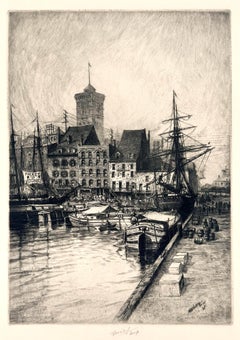
Coenties Slip
Located in Middletown, NY
Lower Manhattan and the Seaport as the artist imagined it would have appeared before 1835.
New York: 1907.
Etching with drypoint on Japon paper, 13 7/8 x 9 3/4 inches (353 x 248 mm...
Category
Late 19th Century Bauhaus Figurative Prints
Materials
Etching, Drypoint, Handmade Paper
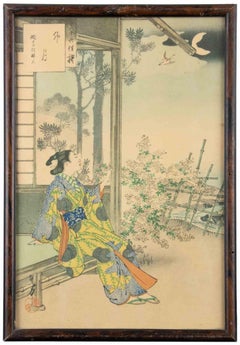
Sanjûroku Kasen ... - Woodcut by Mizuno Toshikata - 1893
Located in Roma, IT
Nishiki-e (woodcut print), in vertical oban format (31x20.5) realized by Mizuno Toshikata in 1893 (Meiji 26).
Belongs to the Series "Sanjûroku Kasen" (Thirty-Six Beauties in Compari...
Category
1890s Bauhaus Figurative Prints
Materials
Woodcut
$404
H 12.21 in W 8.08 in D 0.04 in
Seven Sculptural Ideas - Lithograph by Henry Moore - 1973
By Henry Moore
Located in Roma, IT
Hand signed, numbered and dated. Edition of 65 prints. Very good condition.
Category
1970s Bauhaus Figurative Prints
Materials
Lithograph

$2,617
H 25.79 in W 19.69 in D 0.04 in
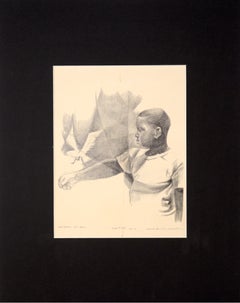
"And Search for Peace" - Rare Signed Figurative Lithograph in Ink on Paper
Located in Soquel, CA
"And Search for Peace" - Rare Signed Figurative Lithograph in Ink on Paper
Bold lithograph by Eugene Hawkins (American, b. 1933). Rendered in a semi-abstracted style, a young, black boy holds out his arm for a dove, the symbol of peace to land.
Titled, numbered, dated, and signed along the bottom edge: "and search for peace litho #22/50 Jan 64 Eugene Hawkins, Legend #412"
Presented in a new black mat.
Mat size: 18"H x 14"W
Image size: 11"H x 8.75"W
Eugene Hawkins (American, b. 1933) is a BIPOC artist...
Category
1960s Bauhaus Figurative Prints
Materials
Paper, Ink, Lithograph
$575
H 18 in W 14 in D 0.25 in
Previously Available Items
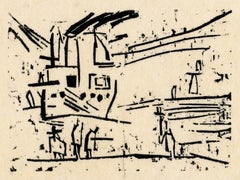
Ausfahrender Dampfer Odin (Outboard Steamer Odin)
— German Expressionism
Located in Myrtle Beach, SC
Lyonel Feininger, 'Ausfahrender Dampfer Odin (Outboard Steamer Odin)', woodcut, 1918, proofs only. Prasse W75. Signed in pencil and annotated '1860', the artist’s inventory number. A...
Category
1910s Bauhaus Figurative Prints
Materials
Woodcut
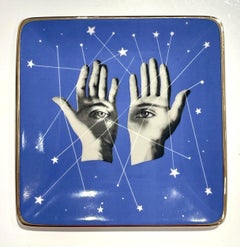
Things to Come tray
Located in New York, NY
Herbert Bayer
Things to Come tray, 2018
Porcelain dish with metallic gold edge and silkscreened image
Limited edition of an unknown quantity, originally distributed by the Museum of Modern Art, before it sold out.
Measurements:
Box:
5.5 x 5.5 inches
Tray:
5 x 5 inches
Provenance:
Originally distributed by the Museum of Modern Art, before it sold out
Manufacturer:
Galison Publishing LLC and The Museum of Modern Art
Herbert Bayer biography:
Artistic polymath Herbert Bayer was one of the Bauhaus’s most influential students, teachers, and proponents, advocating the integration of all arts throughout his career. Bayer began his studies as an architect in 1919 in Darmstadt. From 1921 to 1923 he attended the Bauhaus in Weimar, studying mural painting with Vasily Kandinsky and typography, creating the Universal alphabet, a typeface consisting of only lowercase letters that would become the signature font of the Bauhaus. Bayer returned to the Bauhaus from 1925 to 1928 (moving in 1926 to Dessau, its second location), working as a teacher of advertising, design, and typography, integrating photographs into graphic compositions.
He began making his own photographs in 1928, after leaving the Bauhaus; however, in his years as a teacher the school was a fertile ground for the New Vision photography passionately promoted by his close colleague László Moholy-Nagy, Moholy-Nagy’s students, and his Bauhaus publication Malerei, Photographie, Film (Painting, photography, film). Most of Bayer’s photographs come from the decade 1928–38, when he was based in Berlin working as a commercial artist. They represent his broad approach to art, including graphic views of architecture and carefully crafted montages.
In 1938 Bayer emigrated to the United States with an invitation from Alfred H. Barr, Jr., founding director of The Museum of Modern Art, to apply his theories of display to the installation of the exhibition Bauhaus: 1919–28 (1938) at MoMA. Bayer developed this role through close collaboration with Edward Steichen, head of the young Department of Photography, designing the show Road to Victory (1942), which would set the course for Steichen’s influential approach to photography exhibition. Bayer remained in America working as a graphic designer for the remainder of his career.
-Courtesy of MOMA
More about Herbert Bayer:
Herbert Bayer (1900-1985) was born in Austria, where he entered into an apprenticeship under the architect and designer, Georg Smidthammer, with whom Bayer learned drawing, painting, and architectural drafting, inspired by nature and without formal knowledge of art history. In 1920, Bayer discovered the theoretical writings of the artist Vassily Kandinsky, as well as Walter Gropius’ 1919 Bauhaus manifesto, in which Gropius declared the necessity for a return to crafts, in which were found true creativity and inspiration. Bayer traveled to Weimar to meet Gropius in October of 1921 and was immediately accepted into the Bauhaus. There, he was deeply influenced by the instruction of Kandinsky, Johannes Itten and Paul Klee.
In 1928 Bayer moved to Berlin together with several members of the Bauhaus staff including Gropius, Moholy-Nagy and Marcel Breuer. He found work as a freelance graphic designer, particularly with German Vogue, under its art director Agha. When the latter returned to Paris, Bayer joined the staff full time, and also worked increasingly with Dorland, the magazine's principle advertising agency. It was in the period from 1928 to his emigration to America in 1938 that he developed his unique vision as an artist, combining a strongly modernist aesthetic sense with a rare ability to convey meaning clearly and directly. This seamless combination of art, craft and design mark Bayer as true prophet of Bauhaus theories.
Bayer followed Gropius to America in 1938, and set his breadth of skills to work later that year in designing the landmark Bauhaus 1918-1928 exhibition at the Museum of Modern Art. Bayer flourished in New York as a designer and architect, but it was his meeting with the industrialist Walter Paepcke in 1946 that allowed him to harness his concepts of 'total design' to the postwar boom. Paepcke was developing Aspen as a cultural and intellectual destination, and found in Bayer the perfect collaborator. Bayer was designer, educator and indeed architect for Paepcke's Aspen Institute...
Category
2010s Bauhaus Figurative Prints
Materials
Metal
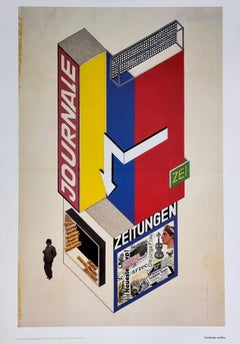
Magazine Stand (Bauhaus)
Located in Kansas City, MO
Herbert Bayer
Magazine Stand (Zeitungskiosk), 1924
Offset Lithograph
Year: 1994
Size: 33.2 × 23.2 inches
Publisher: Bauhaus Archiv, Berlin - Germany
COA provided
-------------------...
Category
1920s Bauhaus Figurative Prints
Materials
Lithograph
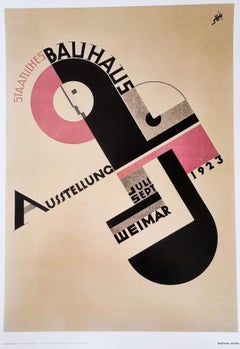
Staatliches Bauhaus ($35 SHIPPING U.S. only (not $55!)
Located in Kansas City, MO
$35 SHIPPING U.S. only (not $55) - Simply request a quote during Checkout
Joost Schmidt
Staatliches Bauhaus, 1923
Offset Lithograph
Year: 1988
Size...
Category
1920s Bauhaus Figurative Prints
Materials
Lithograph
Church with Houses
— Artist
s Personal Letterhead, Bauhaus Modernism
Located in Myrtle Beach, SC
Lyonel Feininger, 'Church with Houses' also 'Tree and Star' ('Kirche mit Hausern', 'Baum und Stern'), woodcut, 1933, one of a small but unknown number of letterhead proofs; Prasse W275. Annotated 'W 275' (Feininger catalogue number) and inventory number '3033' in pencil, in the bottom right sheet corner. A fine, richly-inked impression, on cream, laid letterhead paper, in excellent condition. Very scarce.
Image size 2 7/16 x 2 5/8 inches; sheet size 10 x 6 7/8 inches. Archivally sleeved, unmatted.
Exhibited: 'Lyonel Feininer, Woodcuts Used As Letterheads'; Associated American Artists; Feb 4 - March 2, 1974; New York, NY.
ABOUT THE ARTIST
Lyonel Feininger (1871-1956) was born in New York City into a musical family—his father was a violinist and composer, his mother was a singer and pianist. He studied violin with his father, and by the age of 12, he was performing in public, but he also drew incessantly, most notably the steamboats and sailing ships on the Hudson and East Rivers, and the landscape around Sharon, Conn., where he spent time on a farm owned by a family friend. At the age of 16 he left New York to study music and art in Germany, from where his parents emigrated. Drawn more to the visual arts, he attended schools in Hamburg, Berlin, and Paris from 1887 to 1892.
After completing his studies, Feininger began his artistic career as a cartoonist and illustrator, his originality leading him to great success. In 1906, after working for a dozen years in Germany, he was offered a job as a cartoonist at the Chicago Tribune, the largest circulation newspaper in the Midwest. He worked there for a year, inventing what became the standard design for the comic strip: in the words of John Carlin, “an overall pattern. . . that allowed the page to be read both as a series of elements one after the other, like language and as a group of juxtaposed images, like visual art.” His originality did not end there: he went on to become one of the great abstract painters. Like Kandinsky, music was his model, but Kandinsky only knew music from the outside—as a listener (inspired initially by Wagner, then by Schoenberg)—while Feininger knew it from the inside. He lived in Paris from 1906 to 1908, during which time he met and was influenced by the work of progressive painters Robert Delaunay and Jules Pascin, as well as that of Paul Cezanne and Vincent van Gogh. He began painting full-time, developing his distinctive Iyrical style based on Cubist and Expressionist idioms and a concern for the emotive qualities of light and color. He exhibited with the Der Blaue Reiter group in 1913, and in 1917, he had his first solo exhibition at Galerie Der Sturm in Berlin.
One year after his solo exhibition, in 1918, Feininger began making woodcuts. He became enamored with the medium, producing an impressive 117 in his first year of exploring the printmaking medium. In 1919 at the invitation of the architect Walter Gropius, he was appointed the first master at the newly formed Staatliches Bauhaus in Weimar. His woodcut of a cathedral crowned...
Category
1930s Bauhaus Figurative Prints
Materials
Woodcut
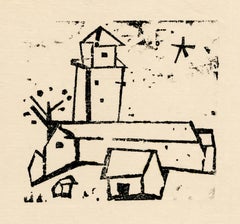
Buildings with Crescent Moon (Gebaude mit Mondsichel) – Artist
s letterhead
Located in Myrtle Beach, SC
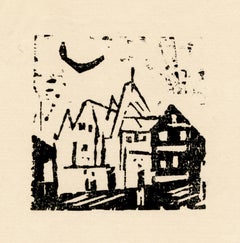
Lyonel Feininger, 'Buildings with Crescent Moon (Gebaude mit Mondsichel)', woodcut, 1936, one of a small but unknown number of letterhead proofs; Prasse W214 III. Annotated 'W 214 II...
Category
1930s Bauhaus Figurative Prints
Materials
Woodcut
Ships (Three Sailing Ships)
Located in Myrtle Beach, SC
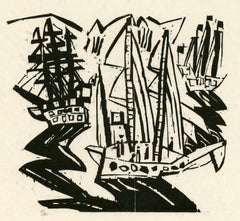
Lyonel Feininger, 'Ships (Three Sailing Ships)', woodcut, 1919, proofs only; posthumous edition 100 (1964), Prasse W151 II. Numbered '55/100' in pencil; F...
Category
1910s Bauhaus Figurative Prints
Materials
Woodcut
Bauhaus figurative prints for sale on 1stDibs.
Find a wide variety of authentic Bauhaus figurative prints available for sale on 1stDibs. Works in this style were very popular during the 20th Century, but contemporary artists have continued to produce works inspired by this movement. If you’re looking to add figurative prints created in this style to introduce contrast in an otherwise neutral space in your home, the works available on 1stDibs include elements of purple and other colors. Many Pop art paintings were created by popular artists on 1stDibs, including Lyonel Feininger, and Bruno Monzuzzi. Frequently made by artists working with Woodcut Print, and Lithograph and other materials, all of these pieces for sale are unique and have attracted attention over the years. Not every interior allows for large Bauhaus figurative prints, so small editions measuring 2.38 inches across are also available. Prices for figurative prints made by famous or emerging artists can differ depending on medium, time period and other attributes. On 1stDibs, the price for these items starts at $120 and tops out at $1,400, while the average work sells for $900.
More Ways To Browse
Eduardo Roca
Edward B Gay
Edward Hopper Oil Painting
Edward Simmons
Edwin Lord Weeks
Elizabeth Enders
Elizabeth Horning
Emil Holzhauer
England Church Oil Painting
English Deer Painting
English Fox Hunt Painting
English Toy Terrier
Enrique Martinez Celaya
Eric Aho
Eritrea Art
Ernest Chateignon
Erotic Art Animal
Eugene Chigot