Post-Minimalist Figurative Prints
to
4
1
Overall Width
to
Overall Height
to
15,548
7,962
2,661
2,427
2,252
1,054
997
726
674
416
324
112
93
39
4
1
5
5
5
1
1
1
5
1
5
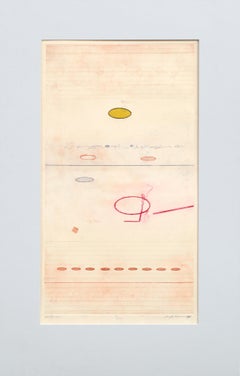
Style: Post-Minimalist
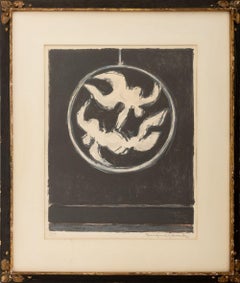
Poema visual
By Joan Brossa
Located in New York, NY
Lithograph on paper (Edition of 25)
Signed in pencil, l.r.
Numbered in pencil, l.l.
This print is offered by ClampArt, located in New York City.
Joan Brossa (1919-1998) was a Cata...
Category
1980s Post-Minimalist Figurative Prints
Materials
Lithograph
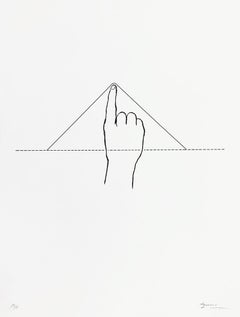
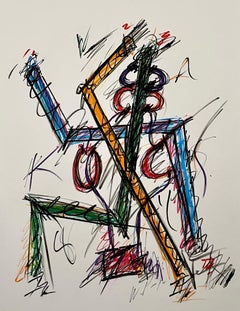
1981 American Post Minimalist Abstract Art Lithograph Neon Series Keith Sonnier
Located in Surfside, FL
Keith Sonnier, American (1941-2020)
lithograph
From Neon series
circa 1980-1981
Bears the Waterstreet Press watermarks and Arches paper blind stamp to lower right corner. Pub. Edizioni Lucio Amelio
Hand signed with initials in pencil
Dimensions: 30 x 21 3/4 inches
Post minimalist Abstract by Keith Sonnier
Keith Sonnier (1941 – 2020) was a post minimalist sculptor, performance artist, video and light artist. Sonnier was one of the first artists to use light in sculpture in the 1960s. With his use of neon in combination with ephemeral materials he achieved international recognition. Sonnier was part of the Process Art movement.
James Keith Sonnier was born July 31, 1941, in Mamou, Louisiana. His family was Cajun and Roman Catholic. His father was a hardware store owner, Joseph Sonnier, and his mother was a florist and singer, Mae Ledoux. He graduated in 1963 from Southwestern Louisiana Institute (now known as the University of Louisiana at Lafayette). In 1966, he graduated with his MFA degree from Rutgers University, where he studied under Allan Kaprow, Robert Watts, and Robert Morris. After graduation from Rutgers, he moved to New York City with Jackie Winsor and some of his former classmates.
Sonnier died in Southampton, NY on July 18, 2020.
Sonnier began experimenting with neon in 1968. Neon lights became a signature material used in his sculptural works. The common materials Sonnier employed included neon and fluorescent lights; reflective materials; aluminum and copper; and glass and wires. Of the generation of James Turrell and Dan Flavin, He was also associated with the Light and Space movement, a loosely affiliated art movement related to op art, minimalism and geometric abstraction originating in Southern California in the 1960s and influenced by John McLaughlin. It is characterized by a focus on perceptual phenomena, such as light, volume and scale, and the use of materials such as glass, neon, fluorescent lights, resin and cast acrylic, often forming installations conditioned by the work's surroundings. Artists included Ron Cooper...
Category
1980s Post-Minimalist Figurative Prints
Materials
Paper, Lithograph
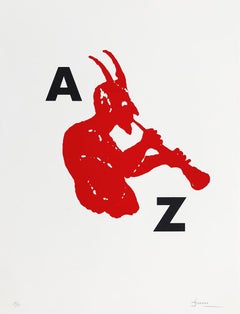
Faune
By Joan Brossa
Located in New York, NY
Lithograph on paper (Edition of 25)
Signed in pencil, l.r.
Numbered in pencil, l.l.
This print is offered by ClampArt, located in New York City.
Joan Brossa (1919-1998) was a Cata...
Category
1980s Post-Minimalist Figurative Prints
Materials
Lithograph
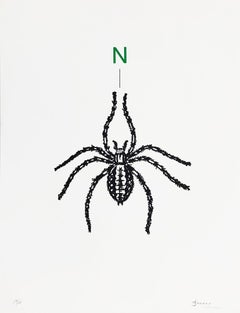
Brúixola
By Joan Brossa
Located in New York, NY
Lithograph on paper (Edition of 25)
Signed in pencil, l.r.
Numbered in pencil, l.l.
This print is offered by ClampArt, located in New York City.
Joan Brossa (1919-1998) was a Cata...
Category
1980s Post-Minimalist Figurative Prints
Materials
Lithograph
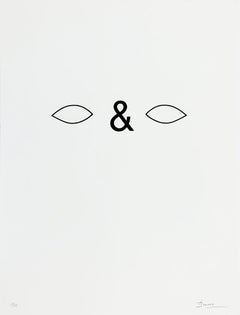
Careta
By Joan Brossa
Located in New York, NY
Lithograph on paper (Edition of 25)
Signed in pencil, l.r.
Numbered in pencil, l.l.
This print is offered by ClampArt, located in New York City.
Joan Brossa (1919-1998) was a Cata...
Category
1980s Post-Minimalist Figurative Prints
Materials
Lithograph
Related Items
The Smell of Us (Limited edition softcover book)
By Larry Clark
Located in New York, NY
Larry Clark
The Smell of Us, 2015
Limited Edition softcover book printed on heavy paper stock in oblong binding (Edition: 250)
5 1/2 × 8 inches
This first edition book by Larry Clark...
Category
2010s Post-Minimalist Figurative Prints
Materials
Mixed Media, Lithograph, Offset
Jean Cocteau - Blue Lady - Original Lithograph
By Jean Cocteau
Located in Collonge Bellerive, Geneve, CH
Original Lithograph by Jean Cocteau
Title: Blue Lady
Signed in the plate
Dimensions: 32 x 25.5 cm
Edition: 200
1959
Publisher: Bibliophiles Du Palais
Unnumb...
Category
1950s Post-Minimalist Figurative Prints
Materials
Lithograph
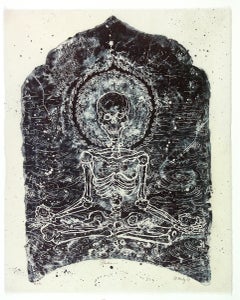
$1,426
H 12.6 in W 10.04 in D 0.04 in
Original Pan American World Airways by Clipper to Portugal and Spain poster
By Jean Carlu
Located in Spokane, WA
Original vintage poster: Portugal and Spain by Pan American World Airways Clipper, Artist: Jean Carlu. Pan American original vintage poster large travel size format 27.5" x 41.1" Earliest version (the 1950s) of the poster for travel by Constellation aircraft.
Original linen-backed, Pan American World Airways by Clipper vintage poster for travel to Portugal and Spain. Wear and stress marks in the top and bottom dark area but are not tears.. Small touch-up on the left white border.
In the middle of this image, it features a matador with a cape hanging off his shoulder. Surrounding the image in vignettes of cut-out windows showing typical landscape scenes and castles. A great smaller format original for "The World's Most Experienced Airline". One of the windmills shown in this image has cloth sails. Trimming the sails allowed the windmill to turn at near the optimal speed in a large range of wind velocities. Pan American World Airways by Clipper.
Pan American a.k.a. Pan Am Airlines posters are very collectible and rare year to year. This a great design opportunity for a home with a European flair. The Pan Am Clipper...
Category
1950s Post-Minimalist Figurative Prints
Materials
Lithograph
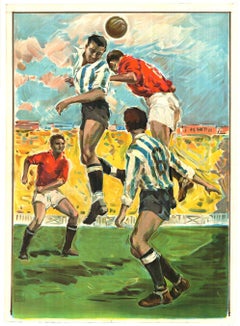
$1,598
H 42 in W 27.5 in D 0.05 in
Untitled (from Ten Painters on War and Peace), hand signed lithograph
Located in Aventura, FL
Lithograph in colors on arches paper. Hand signed and numbered by Ivan Schwebel. Edition 115/190.
From the "Ten Painters on War and Peace" portfolio. Printed on May 10, 1978 to ...
Category
1970s Post-Minimalist Figurative Prints
Materials
Paper, Lithograph
$375 Sale Price
25% Off
H 19.5 in W 25.5 in
Mascara Roja
Located in San Francisco, CA
This artwork titled "Mascara Roja" 1969 is an original colors lithograph on B.F.K. Rives paper by renown Mexican artist Rufino Tamayo, 1899-1991. It is hand signed and inscribed H.C. (Hors Commerce) in pencil by the artist. The image size is 21 x 27.25 inches, framed size is 37.25 x 42 inches. Published by Touchtone Publisher, New York, printed by Ateliers Desjobert, Paris. Referenced and pictured in the artist's catalogue raisonne by Pereda, plate #124. Custom framed in a wooden gold leaf frame, with gold and red spacer and fabric matting. It is in excellent condition.
About the artist:
A native of Oaxaca in Southern Mexico, Rufino Tamayo's father was a shoemaker, and his mother a seamstress. Some accounts state that he was descended from Zapotec Indians, but he was actually 'mestizo' - of mixed indigenous/European ancestry. (Santa Barbara Museum of Art). He began painting at age 11. Orphaned at the age of 12, Tamayo moved to Mexico City, where he was raised by his maternal aunt who owned a wholesale fruit business.
In 1917, he entered the San Carlos Academy of Fine Arts, but left soon after to pursue independent study. Four years later, Tamayo was appointed the head designer of the department of ethnographic drawings at the National Museum of Archaeology in Mexico City. There he was surrounded by pre-Colombian objects, an aesthetic inspiration that would play a pivotal role in his life. In his own work, Tamayo integrated the forms and tones of pre-Columbian ceramics into his early still lives and portraits of Mexican men and women.
In the early 1920s he also taught art classes in Mexico City's public schools. Despite his involvement in Mexican history, he did not subscribe to the idea of art as nationalistic propaganda. Modern Mexican art at that time was dominated by 'The Three Great Ones' : Diego Rivera, Jose Clemente Orozco, and David Alfaro Siqueros, but Tamayo began to be noted as someone 'new' and different' for his blending of the aesthetics of post Revolutionary Mexico with the vanguard artists of Europe and the United States.
After the Mexican Revolution, he focused on creating his own identity in his work, expressing what he thought was the traditional Mexico, and refusing to follow the political trends of his contemporary artists. This caused some to see him as a 'traitor' to the political cause, and he felt it difficult to freely express himself in his art. As a result, he decided to leave Mexico in 1926 and move to New York, along with his friend, the composer Carlos Chavez. The first exhibition of Tamayo's work in the United States was held at the Weyhe Gallery, New York, in that same year. The show was successful, and Tamayo was praised for his 'authentic' status as a Mexican of 'indigenous heritage', and for his internationally appealing Modernist aesthetic. (Santa Barbara Museum of Art).
Throughout the late thirties and early forties New York's Valentine Gallery gave him shows. For nine years, beginning in 1938, he taught at the Dalton School in New York.
In 1929, some health problems led him to return to Mexico for treatment. While there he took a series of teaching jobs. During this period he became romantically involved with the artist Maria Izquierdo...
Category
Mid-20th Century Post-Minimalist Figurative Prints
Materials
Lithograph
Cornucopia (limited edition hardback monograph hand signed by Damien Hirst)
By Damien Hirst
Located in New York, NY
Damien Hirst
Cornucopia, 2010
Limited edition hardback monograph (hand signed by Damien Hirst)
Hand signed in ink by Damien Hirst on the first front end page
12 1/2 × 9 3/4 × 3/4 inches
This limited edition illustrated hardback monograph, with no dust jacket, exactly as issued, was published on the occasion of the artist's show at Musee Oceanographique de Monaco in April 2010, 'Cornucopia' celebrates Hirst's paintings and sculptures from 1994-2009." This book was gifted by Damien Hirst to a member of an American Rock & Roll band that Hirst befriended.
Stated Limited Edition of 2000 (unnumbered)
About the book:
Publisher: Musée Océanographique de Monaco, 2010
Text: English / French. 160 pgs with color illustrations
Limited Edition: 2000 (the regular edition is not signed; this was exceptionally hand signed by Hirst)
About Damien Hirst:
People are afraid of change, so you create a kind of belief for them through repetition. It’s like breathing. I’ve always been drawn to series and pairs. A unique thing is quite a frightening object.
—Damien Hirst
Since emerging onto the international art scene in the late 1980s, Damien Hirst has created installations, sculptures, paintings, and drawings that examine the complex relationships between art and beauty, religion and science, and life and death. From serialized paintings of multicolored spots to animal specimens...
Category
2010s Post-Minimalist Figurative Prints
Materials
Paper, Ink, Mixed Media, Lithograph, Offset
$1,250
H 12.5 in W 9.75 in D 0.75 in
Rare Palestine Antique Hebrew Judaica Yahrzeit Synagogue Sign Memorial Plaque
Located in Surfside, FL
Circa 1890-1920. This Neoclassical, Judaic, Egyptian revival, Orientalist Mizrach sign, was produced in British Mandate Palestine by the chromolithograph process at the beginning of the 20th century. It pictures vignettes of holy places. with a hand written memorial. It was for the Tzedakah charity fund for the century-old institutions in Jerusalem: The great "Torah Center Etz Chaim"; a Free Kitchen for poor children and orphans; the famous Bikur Cholim Hospital with its dispensaries and clinics and the only Home for Incurable Invalids in Eretz Israel. They also worked with Arthur Szyk and Alfred Salzmann.. The A.L. Monsohn Lithographic Press (Monzon Press, Monson Press, דפוס אבן א"ל מאנזאהן, דפוס מונזון) was established in Jerusalem in 1892 by Abraham-Leib (or Avrom-Leyb) Monsohn II (Jerusalem, c.1871-1930) and his brother Moshe-Mordechai (Meyshe-Mordkhe). Sponsored by members of the Hamburger family, the brothers had been sent to Frankfurt, Germany in 1890 to study lithography. Upon returning to Jerusalem in 1892 with a hand press, they established the A.L. Monsohn Lithographic Press in the Old City of Jerusalem. According to the Information Center for Israeli Art A.L. Monsohn "created complex decorations for documents and oriental calendars that combined the tradition of Jewish art with modern printing techniques such as photographic lithography, raised printing and gilding."
The founders of the Monsohn press produced Jewish-themed color postcards, greeting cards, Jewish National Fund stamps, and maps documenting the evolution of the Jewish settlement in Eretz Israel in the nineteenth-twentieth centuries; religious material such as decorative plaques for synagogues, portraits of Old Yishuv rabbis such as Shmuel Salant, Mizrah posters indicating the direction of prayer for synagogues, memorial posters, and posters for Sukkot booths; color frontispieces for books such as Pentateuch volumes and the early song collections of Abraham Zvi Idelsohn (e.g., Shire Zion, Jerusalem 1908); artistic wedding invitations; and labels, packaging and advertisements for the pioneering entrepreneurs of Eretz Israel. The texts appearing in the Monsohn products were in several languages: Hebrew, Arabic, Yiddish, English, German (e.g., a c1920 trilingual Hebrew-English-Arabic "Malaria Danger" broadside warning the public of mosquitoes spreading malaria). Many of the brilliantly colored postcards and maps can be seen online as can the artistic invitations to his children's weddings which Monsohn published in the Jerusalem Hebrew press.
For years, the Monsohn (later, Monson/Monzon) Press was considered the best and most innovative in the country—pioneering in such techniques as gold-embossing and offset printing, among others. Early items for tourists included collections of Flowers of the Holy Land (c. 1910–1918)—pressed local flowers accompanied by scenes from the Eretz Israel countryside and relevant verses from the Bible, edited by Jsac Chagise (or Itzhak Haggis), an immigrant from Vitebsk, and bound in carved olive wood boards. Shortly after World War I Monsohn (now spelled מונזון) used zincography to produce the prints included in the Hebrew Gannenu educational booklets for young children illustrated by Ze'ev Raban of the Bezalel Academy of Art and Design and printed in Jerusalem by Hayim Refael Hakohen (vol. 1, 1919; vols. 2–3, 1920). In 1934 Monsohn moved into the new, western part of Jerusalem, in a shop with four presses and 30 workers, including Abraham-Leib's sons, David, Yosef, Moshe and Shimon, and his daughter Raytse's husband, Abraham Barmacz. The concern did business with all sectors of the city's population, including Arabs, for whom they printed in Arabic. Among their clients were members of the Ginio, Havilio, and Elite families, and Shemen, Dubek, and other renowned national brands, manufacturing products such as wine, candies, oil, and cigarettes. They also printed movie and travel posters, and government posters, postcards and documents, hotel luggage labels...
Category
Early 20th Century Post-Minimalist Figurative Prints
Materials
Lithograph
Modern Israeli Lithograph Reuven Rubin Views Of Israel Judaica Horses, Riders
By Reuven Rubin
Located in Surfside, FL
Lithograph printed by Chez Daniel Jacomet, Paris, France 1960 offset lithograph in colors on Arches, signed in crayon on the justification sheet (this auction is just for the one lithograph pictured as the 1st photo, the justification sheet with the original drawing is just included for provenance and is not part of this sale), on Arches deckle edged paper. limited edition of 250. plate signed and hand signed in pencil.
Israeli views Lithograph by Israeli Master.
Reuven Rubin 1893 -1974 was a Romanian-born Israeli painter and Israel's first ambassador to Romania.
Rubin Zelicovici (later Reuven Rubin) was born in Gala?i to a poor Romanian Jewish Hasidic family. He was the eighth of 13 children. In 1912, he left for Ottoman-ruled Palestine to study art at Bezalel Academy of Art and Design in Jerusalem. Finding himself at odds with the artistic views of the Academy's teachers, he left for Paris, France, in 1913 to pursue his studies at the École Nationale Supérieure des Beaux-Arts. At the outbreak of World War I, he was returned to Romania, where he spent the war years.
In 1921, he traveled to the United States with his friend and fellow artist, Arthur Kolnik, with whom he had shared a studio in Cernovitzu. In New York City, the two met artist Alfred Stieglitz, who was instrumental in organizing their first American show at the Anderson Gallery.Following the exhibition, in 1922, they both returned to Europe. In 1923, Rubin emigrated to Mandate Palestine.
Rubin met his wife, Esther, in 1928, aboard a passenger ship to Palestine on his return from a show in New York. She was a Bronx girl who had won a trip to Palestine in a Young Judea competition. He died in 1974
Artistic career
Joseph Zaritsky...
Category
1960s Post-Minimalist Figurative Prints
Materials
Lithograph, Offset
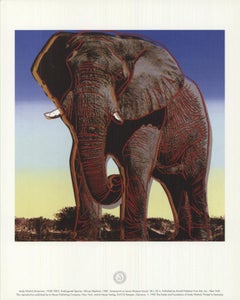
Original For Every Fighter A Woman Worker, Y.W.C.A. vintage poster WW1
Located in Spokane, WA
For Every Fighter a Woman Worker. Original vintage poster. Linen Lined. Very good condition. Artist: Ernest Hamlin Baker. Size: 28" x 42". Year: 1918 Linen backed trimme...
Category
1910s Post-Minimalist Figurative Prints
Materials
Lithograph
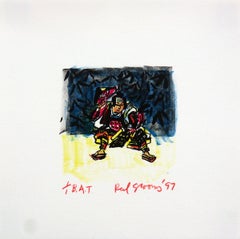
$1,000 Sale Price
20% Off
H 42 in W 18 in D 0.05 in
CARIBOU, MOUNT JACQUES CARTIER
Located in Aventura, FL
Lithograph on paper. Hand signed, titled and numbered by the artist. Edition of 350.
Artwork is in excellent condition. Certificate of Authenticity is included. All reasonable o...
Category
Late 20th Century Post-Minimalist Figurative Prints
Materials
Paper, Lithograph
DeVilbiss Purfume Art Deco Poster by George Petty for the A.C. Schultz Company
Located in New York, NY
This beautiful Art Deco poster was realized by the esteemed American Artist George Petty for the A.C. Schultz Company in 1926. The work is an advertisement for DeVilbiss Perfume, which depicts a "Petty Girl" (as they came to be known) in the center of the composition floating in a pentagonal black color block. With short cropped silvery white hair and red lipstick, the female figure in center (suggestive of a stylized flapper) squeezes the atomizer of her perfume bottle misting herself in fragrance. Skyscraper style geometric forms suggesting elaborately faceted gemstones- in hues of rose, lavender, orange sapphire and yellow diamond- explode around her, suggesting the stage design for the set of the iconic film "Metropolis". The top of the composition features a bronze color block reading "DeVilbiss Perfume sprays" and in scrolling Deco lettering text reads “A drop of perfume bursting into myriad atoms of fragrance makes the use of perfume an added delight” near the bottom of the piece. Additionally, there is a solid black color block with crystalline black forms emanating outwards at the base of the composition, as well as a geometric abstract form on the right side of the piece imbuing it with a distinctly modernist inflection. With its quintessentially Art Deco sensibility, this piece is sure to delight discerning collectors of the period as well as those with a distinct appreciation for unusual (and stunning) fine art pieces. its vibrant palate and clean modernist lines make this piece a winning addition to any style of interior from classic Deco to contemporary. The piece comes presented in a custom gallery frame and is in excellent vintage condition.
George Petty was an American illustrator known for his series of pin-ups known as "Petty Girls" which he created for Esquire magazine. The Petty Girl were coquettish women whose legs were elongated to create idealized female forms. They were featured on magazine centerfolds, billboards, and calendars for companies such as Ridgid Tools. Born George Brown Petty IV on April 27, 1894 in Abbeville, LA, Petty received his formal training at the School of the Art Institute of Chicago under Ruth Van Sickle Ford...
Category
1920s Post-Minimalist Figurative Prints
Materials
Lithograph
$2,975
H 42 in W 29 in D 1 in
Tracey Emin: My Photo Album (Hand signed, inscribed and dated by Tracey Emin)
By Tracey Emin
Located in New York, NY
Tracey Emin
Tracey Emin: My Photo Album (Hand signed, inscribed and dated by Tracey Emin), 2013
Hardback monograph (hand signed, inscribed to Kevin and dated by Tracey Emin)
Warmly signed, inscribed and dated by Tracey Emin on the title page
9 × 7 1/4 × 1 inches
Warmly signed, inscribed to Kevin and dated by Tracey Emin on the title page Tracey signed this for the present owner at an official book signing in New York back in 2013, so provenance is direct.
Publisher's blurb:
My Photo Album is a journey through the life of British artist Tracey Emin using photographs from her personal collection. Edited from the albums she has kept from an early age, this visual autobiography contains some amazing images: Tracey sharing a pram as a baby with her twin Paul, her bus-pass photo aged 14, a ‘glamour’ shoot as a semi-naked art...
Category
2010s Post-Minimalist Figurative Prints
Materials
Ink, Mixed Media, Lithograph, Offset
$1,000
H 9 in W 7.25 in D 1 in
Previously Available Items
Bijou Gets Undressed 8
By Julian Opie
Located in Palm Desert, CA
"Bijou Gets Undressed 8" is a screenprint on Fedrigoni Sirio paper made in 2004 by Julian Opie. The work is signed in pencil, lower left, "Julian Opie" and editioned in pencil, lower...
Category
21st Century and Contemporary Post-Minimalist Figurative Prints
Materials
Screen
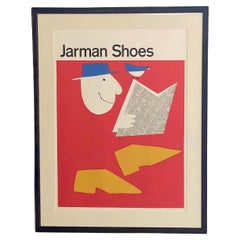
"Jarman Shoes" Advertisement Poster by Jayme Odgers
Located in Pasadena, CA
Jarman Shoes is a footwear company that originated in Tennessee in 1924. In the 1970s, Jarman's visual ads featured realistic images of their shoes with slogans such as "Look Smarter, Feel Better."
Jayme Odgers...
Category
Late 20th Century Post-Minimalist Figurative Prints
Materials
Lithograph
H 41.88 in W 31.88 in D 0.88 in
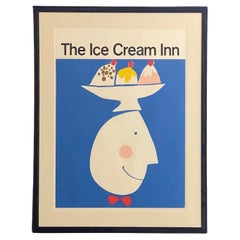
"The Ice-Cream Inn" Advertisement Poster by Jayme Odgers
Located in Pasadena, CA
The power of a poster lies not in being merely looked at, but in being seen and received. A kind of visual attack, it must be instantly readable to anyone glancing at it. And convey its meaning and narration without any need for intellectual interpretation. To achieve this, it must possess an immediate, brutal calling power that forces the gaze and leaves an instantaneous visual impact.
The Ice Cream Inn is a visual experimentation signed by the artist Jayme Odgers...
Category
1960s Post-Minimalist Figurative Prints
Materials
Lithograph
H 41.88 in W 31.88 in D 0.88 in
Poema visual
By Joan Brossa
Located in New York, NY
Lithograph on paper (Edition of 25)
Signed in pencil, l.r.
Numbered in pencil, l.l.
This print is offered by ClampArt, located in New York City.
Joan Brossa (1919-1998) was a Cata...
Category
1980s Post-Minimalist Figurative Prints
Materials
Lithograph
Post-minimalist figurative prints for sale on 1stDibs.
Find a wide variety of authentic Post-Minimalist figurative prints available for sale on 1stDibs. Works in this style were very popular during the 21st Century and Contemporary, but contemporary artists have continued to produce works inspired by this movement. Many Pop art paintings were created by popular artists on 1stDibs, including Joan Brossa, and Julian Opie. Frequently made by artists working with Lithograph, and Screen Print and other materials, all of these pieces for sale are unique and have attracted attention over the years. Not every interior allows for large Post-Minimalist figurative prints, so small editions measuring 15 inches across are also available. Prices for figurative prints made by famous or emerging artists can differ depending on medium, time period and other attributes. On 1stDibs, the price for these items starts at $975 and tops out at $35,000, while the average work sells for $975.
Recently Viewed
View AllMore Ways To Browse
Edward Simmons
Edwin Lord Weeks
Elizabeth Enders
Elizabeth Horning
Emil Holzhauer
England Church Oil Painting
English Deer Painting
English Fox Hunt Painting
English Toy Terrier
Enrique Martinez Celaya
Eric Aho
Eritrea Art
Ernest Chateignon
Erotic Art Animal
Eugene Chigot
Eugene Devaud De Madelin
Eugene Jardin
Faith Sheppard