1 of 4

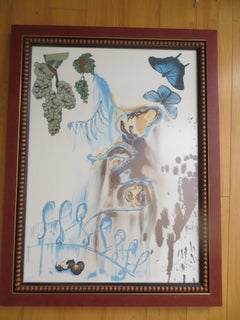
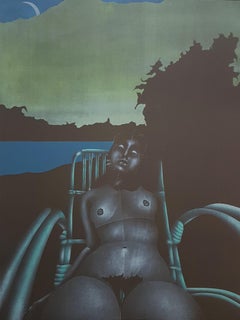
Valerio Adami
Metamorphose

1982

$1,015.94List Price

You May Also Like

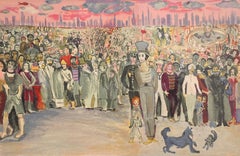
“Marcel Marceau Mime”
By Marcel Marceau
Located in Southampton, NY
Original artist signed colored lithograph by the well known French actor, artist and mime, Marcel Marceau. Circa 1975. Condition is very good Edition:, 112/275; signed in pencil lowe...
Category

1970s Post-Modern Figurative Prints

Materials

Archival Paper, Lithograph

“Marcel Marceau Mime”
$950 Sale Price
32% Off
H 19.25 in W 27.5 in D 1 in
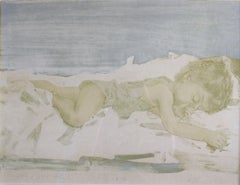
The boy 1/17. 1983. Paper, lithography, 39x51 cm
Located in Riga, LV
The boy 1/17. 1983. Paper, lithography, 39x51 cm The artwork was published in the catalog - "Baņuta Ancāne. Personālizstāde ''Rīgas galerijā''. 30.09.-11.10.2003" Publisher: Neputn...
Category

1980s Post-Modern Portrait Prints

Materials

Paper, Lithograph

The boy  1/17. 1983. Paper, lithography, 39x51 cm
$764 Sale Price
20% Off
H 15.36 in W 20.08 in D 0.79 in
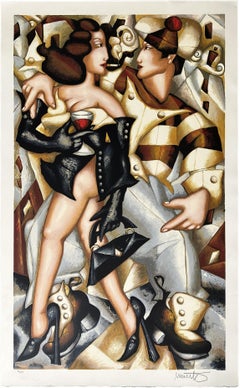
Amsterdam Signed Limited Edition Lithograph Large
By Ernesto
Located in Rochester Hills, MI
Artist Name: Ernesto Amsterdam Title: Capturing the Essence of Amsterdam: Medium Type: Lithograph on Arches Archival Pape Size-Width Size-Height: 46½'' x 28¾'' inches Signed Edit...
Category

1990s Post-Modern Figurative Prints

Materials

Lithograph

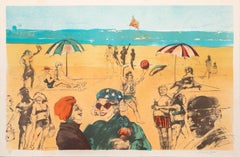
Beach
By Marcia Marx
Located in Long Island City, NY
Artist: Marcia Marx, American (1931 - 2005) Title: Beach Year: circa 1975 Medium: Lithograph, signed and numbered in pencil Edition: 250 Paper Size: 25 x 38 inches
Category

Late 20th Century Post-Modern Figurative Prints

Materials

Lithograph

Beach
$450
H 25 in W 38 in
Original Dali Fantasy of the seasons Lithograph
By Salvador Dali and Philippe Halsman
Located in Pasadena, CA
Salvador Dalí (Spanish, 1904-1989) Date: Circa 1982 Medium: Offset lithograph in color on paper Edition: Limited edition, typically 100 copies; this one is numbered EA Signature:...
Category

1970s Post-Modern Figurative Prints

Materials

Lithograph

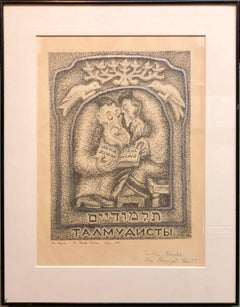
The Talmudists Post Soviet Non Conformist Avant Garde Judaica Lithograph
By Alek Rapoport
Located in Surfside, FL
Dimensions w/Frame: 18.5 X 14.5 Alek Rapoport (November 24, 1933, Kharkiv, Ukraine SSR – February 4, 1997, San Francisco) was a Russian Nonconformist artist, art theorist and teacher. Alek Rapoport spent his childhood in Kiev (Ukraine SSR). During Stalin's "purges" both his parents were arrested. His father was shot and his mother spent ten years in a Siberian labor camp. Rapoport lived with his aunt. At the beginning of World War II, he was evacuated to the city of Ufa (the Bashkir Autonomous Soviet Socialist Republic). A time of extreme loneliness, cold, hunger and deprivation, this period also marked the beginning of Rapoport's drawing studies. After the war, Rapoport lived in Chernovtsy (Western Ukraine), a city with a certain European flair. At the local House of Folk Arts, he found his first art teacher, E.Sagaidachny (1886–1961), a former member of the nonconformist artist groups Union of the Youth (Soyuz Molodyozhi) and Donkey's Tail, popular during the 1910s–1920s. His other art teacher was I. Beklemisheva (1903–1988). Impressed by Rapoport's talent, she later (1950) organized his move to Leningrad, where he entered the famous V.Serov School of Art (the former School of the Imperial Society for the Promotion of Arts, OPKh, later the Tavricheskaya Art School). His association with this school lasted eight years, first as a student, and then, from 1965 to 1968, as a teacher. With "Socialist realism" the only official style during this time, most of the art school's faculty had to conceal any prior involvement in non-conformist art movements. Ya.K.Shablovsky, V.M.Sudakov, A.A.Gromov introduced their students to Constructivism only through clandestine means. (1959–1963) Rapoport studied stage design at the Leningrad Institute of Theater, Music and Cinema under the supervision of the famous artist and stage director N.P.Akimov. Akimov taught a unique course based on theories of Russian Suprematism and Constructivism, while encouraging his graduate students to apply their knowledge to every field of art design. Despite differences in personal artistic taste with Akimov, who was drawn to Vermeer and Dalí, Rapoport was influenced by Akimov's personality and liberalism, as well as the logical style of his art. In 1963, Rapoport graduated from the institute. His highly acclaimed MFA work involved the stage and costume design for I.Babel's play Sunset. In preparation, he traveled to the southwest regions of the Soviet Union, where he accumulated many objects of Judaic iconography from former ghettos, disappearing synagogues and old cemeteries. He wandered Odessa in search of Babel's characters and the atmosphere of his books. He organized a new liberal course in technical aesthetics, introducing his students to Lotman's theory of semiotics, the Modulor of Le Corbusier, the Bauhaus school, Russian Constructivism, Russian icons and contemporary Western art. As a result of his "radicalism," Rapoport was fired for "ideological conspiracy." He sought to cultivate himself as Jewish artist. This became particularly noticeable after the Six-Day War, when the Israeli victory led intellectuals, including the Jewish intelligentsia, to feel a heightened interest in Jewish culture and its Biblical roots. Rapoport's works of this period include Three Figures, a series of images of Talmudic Scholars, and works dealing with anti-Semitism. In the 1970s Rapoport joined the non-conformist movement, which opposed the dogmas of "Socialist realism" in art, along with Soviet censorship. The movement sought to preserve the traditions of Russian iconography...
Category

1970s Post-Modern Figurative Prints

Materials

Lithograph

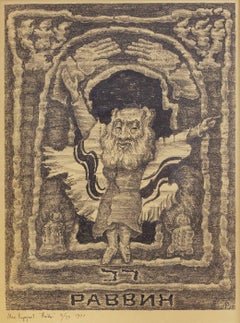
The Rabbi 1977 Soviet Non Conformist Avant Garde Print
By Alek Rapoport
Located in Surfside, FL
Dimensions w/Frame: 25 3/4" x 20 3/4" Alek Rapoport (November 24, 1933, Kharkiv, Ukraine SSR – February 4, 1997, San Francisco) was a Russian Nonconformist artist, art theorist and teacher. Alek Rapoport spent his childhood in Kiev (Ukraine SSR). During Stalin's "purges" both his parents were arrested. His father was shot and his mother spent ten years in a Siberian labor camp. Rapoport lived with his aunt. At the beginning of World War II, he was evacuated to the city of Ufa (the Bashkir Autonomous Soviet Socialist Republic). A time of extreme loneliness, cold, hunger and deprivation, this period also marked the beginning of Rapoport's drawing studies. After the war, Rapoport lived in Chernovtsy (Western Ukraine), a city with a certain European flair. At the local House of Folk Arts, he found his first art teacher, E.Sagaidachny (1886–1961), a former member of the nonconformist artist groups Union of the Youth (Soyuz Molodyozhi) and Donkey's Tail, popular during the 1910s–1920s. His other art teacher was I. Beklemisheva (1903–1988). Impressed by Rapoport's talent, she later (1950) organized his move to Leningrad, where he entered the famous V.Serov School of Art (the former School of the Imperial Society for the Promotion of Arts, OPKh, later the Tavricheskaya Art School). His association with this school lasted eight years, first as a student, and then, from 1965 to 1968, as a teacher. With "Socialist realism" the only official style during this time, most of the art school's faculty had to conceal any prior involvement in non-conformist art movements. Ya.K.Shablovsky, V.M.Sudakov, A.A.Gromov introduced their students to Constructivism only through clandestine means. (1959–1963) Rapoport studied stage design at the Leningrad Institute of Theater, Music and Cinema under the supervision of the famous artist and stage director N.P.Akimov. Akimov taught a unique course based on theories of Russian Suprematism and Constructivism, while encouraging his graduate students to apply their knowledge to every field of art design. Despite differences in personal artistic taste with Akimov, who was drawn to Vermeer and Dalí, Rapoport was influenced by Akimov's personality and liberalism, as well as the logical style of his art. In 1963, Rapoport graduated from the institute. His highly acclaimed MFA work involved the stage and costume design for I.Babel's play Sunset. In preparation, he traveled to the southwest regions of the Soviet Union, where he accumulated many objects of Judaic iconography from former ghettos, disappearing synagogues and old cemeteries. He wandered Odessa in search of Babel's characters and the atmosphere of his books. He organized a new liberal course in technical aesthetics, introducing his students to Lotman's theory of semiotics, the Modulor of Le Corbusier, the Bauhaus school, Russian Constructivism, Russian icons and contemporary Western art. As a result of his "radicalism," Rapoport was fired for "ideological conspiracy." He sought to cultivate himself as Jewish artist. This became particularly noticeable after the Six-Day War, when the Israeli victory led intellectuals, including the Jewish intelligentsia, to feel a heightened interest in Jewish culture and its Biblical roots. Rapoport's works of this period include Three Figures, a series of images of Talmudic Scholars, and works dealing with anti-Semitism. In the 1970s Rapoport joined the non-conformist movement, which opposed the dogmas of "Socialist realism" in art, along with Soviet censorship. The movement sought to preserve the traditions of Russian iconography and the Constructivist/Suprematist style of the 1910s. Despite the authorities' persecutions of nonconformist artists (including arrests, forced evictions, terminations of employment, and various forms of routine hassling), they united in a group, "TEV – Fellowship of Experimental Exhibitions." TEV's exhibitions proved tremendously successful. In the same period, Rapoport became one of the initiators of another anti-establishment group, ALEF (Union of Leningrad's Jewish Artists). In the United States this group was known as "Twelve from the Soviet Underground." Rapoport's involvement with this group increased tension with the authorities and attracted KGB scrutiny, including "friendly conversations," surveillance, detentions and house arrests. It became increasingly dangerous for him to live and work in the USSR. In October 1976, Rapoport with his wife and son were forced to leave Russia. In Italy, Rapoport exhibited at the Venice Biennale, "La Nuova Arte Sovietica-Una prospettiva non-ufficiale" (1977), participated in television programs about nonconformist art in the Soviet Union, and created lithographic works continuing his theme of Jewish characters from Babel's play Sunset. In 1977, Rapoport's family was granted U.S. immigration status and settled in San Francisco. a significant event in Rapoport's life occurred in his meeting with San Francisco gallery owner Michael Dunev, who became his friend and representative, organizing all his exhibitions until the artist's death. Toward the end of the 1980s and beginning of the 1990s, Rapoport completed his most ambitious works on the theme of the Old Testament prophets: Samson Destroying the House of the Philistines (1989), Lamentation and Mourning and Woe (1990), the four paintings Angel and Prophets (1990–1991) and Three Deeds of Moses (1992). In 1992, the artist's friends in St. Petersburg organized the first exhibition of his works there since his departure into exile, with works patiently gathered from collectors and art museums. This exhibition, held in the City Museum of St. Petersburg and accompanied by headlines such as "A St. Petersburg artist returns to his town," was followed by much larger ones in 1993 (St. Petersburg and Moscow), organized in collaboration with Michael Dunev Gallery under the name California Branches – Russian Roots. He Exhibited in "Soviet Artists, Jewish Themes...
Category

1970s Post-Modern Figurative Prints

Materials

Lithograph

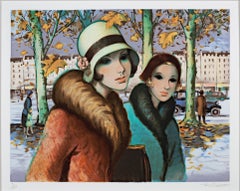
20th century color lithograph French winter scene female figures trees leaves
By Francois Batet
Located in Milwaukee, WI
"Promenade sous les Arbres (Walk under the Trees)" is an original color lithograph by Francois Batet, signed in the lower right and numbered in the lower left. At the center of the p...
Category

1980s Post-Modern Figurative Prints

Materials

Lithograph

20th century color lithograph French scene female figures river umbrellas
By Francois Batet
Located in Milwaukee, WI
"Sur les Ponts de Paris" (Bridges of Paris) is an original color lithograph by Francois Batet, signed on the lower right corner. Three women in stylish 20's fashion cruise by in the ...
Category

1980s Post-Modern Figurative Prints

Materials

Lithograph

From Portfolio "Twilight" with Karin Szekessy
By Paul Wunderlich
Located in Kansas City, MO
Paul Wunderlich From Portfolio "Twilight" with Karin Szekessy Year: 1971 Medium: Color Lithograph Edition: 125 Size: 33 x 25 in. Publisher: A.A.A., New ...
Category

1970s Post-Modern Prints and Multiples

Materials

Lithograph

Still Thinking About These?

All Recently Viewed