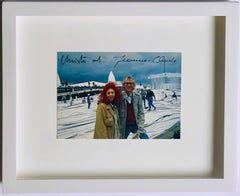
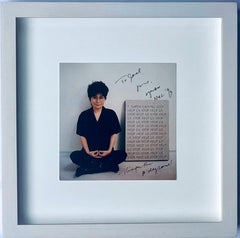
Art Card: Willem de Kooning and Elaine de Kooning, 1953 (Hand Signed by BOTH Willem de Kooning and Elaine de Kooning) from the Dan Pope collection, 1985
Offset lithograph postcard (Signed by both Elaine and Willem de Kooning)
We have yet to ever come across any other like this anywhere in the world; this art card has been uniquely hand signed by both artists.
Coveted, collectors item with superb provenance
This postcard depicts Hans Namuth's famous 1953 photograph of Elaine de Kooning and Willem de Kooning in the New York studio
It is, exceptionally, hand signed in in by both Elaine and Willem
Dan Pope, a former CBS cameraman, was one of the few serious collectors of autographs by visual artists in the 1980s - long before the internet era. He wrote to the de Koonings, requested they both sign this card, which they returned in an addressed stamped envelope Dan included. As additional provenance, the envelope, dated 1985 and postmarked from Hicksville, Long Island (the main post office serving East Hampton where the de Koonings lived and worked in the mid 1980s.
This work has been elegantly float framed in a museum quality wood frame under UV plexiglass.
Measurements:
Framed:
9 inches (vertical) by 10.75 inches (horizontal) by 2 inches
Art Card:
5.25 inches (vertical) by 4.5 inches (horizontal)
Willem de Kooning Biography
b. 1904, Rotterdam, Netherlands; d. 1997, East Hampton, New York
Willem de Kooning was born on April 24, 1904, in Rotterdam, Netherlands. From 1916 to 1925 he took evening classes at the Academie van Beeldende Kunsten en Technische Wetenschappen, Rotterdam, while apprenticed to a commercial art and decorating firm and later working for an art director. In 1924 he visited museums in Belgium and studied further in Brussels and Antwerp. De Kooning came to the United States in 1926 and settled briefly in Hoboken, New Jersey. He worked as a house painter before moving to New York in 1927, where he met Stuart Davis, Arshile Gorky, and John Graham. He took various commercial-art and odd jobs until 1935, when he was employed in the mural and easel divisions of the Works Progress Administration Federal Art Project. Thereafter, he painted full time. In the late 1930s his abstract and figurative work was primarily influenced by the Cubism and Surrealism of Pablo Picasso and also by Gorky, with whom he shared a studio.
In 1938 De Kooning started his first Women series, which would become a major recurrent theme. During the 1940s he participated in group shows with other artists who would form the New York school and become known as Abstract Expressionists. De Kooning's first solo show, which took place at the Egan Gallery, New York, in 1948, established his reputation as a major artist; it included a number of the black-and-white abstractions he had initiated in 1946. The Women of the early 1950s were followed by abstract urban landscapes, parkways, rural landscapes, and, in the 1960s, a new group of Women.
In 1968 De Kooning visited the Netherlands for the first time since 1926 for the opening of his retrospective at the Stedelijk Museum, Amsterdam. In Rome in 1969, he executed his first sculptures—figures modeled in clay and later cast in bronze—and in 1970–71 he began a series of life-size figures. In 1974 the Walker Art Center, Minneapolis, organized a show of De Kooning's drawings and sculpture that traveled throughout the United States, and in 1978 the Guggenheim Museum mounted an exhibition of his work. In 1979 De Kooning and Eduardo Chillida received the Andrew W. Mellon Prize, which was accompanied by an exhibition at the Carnegie Institute, Pittsburgh. De Kooning settled in the Springs, East Hampton, New York, in 1963. He was honored with retrospectives at the Museum of Modern Art, New York (1997, 2011–12). The artist died on March 19, 1997, in East Hampton.
b. 1918, Brooklyn, New York; d. 1989, Southampton, New York
Born on March 12, 1918, in Brooklyn, Elaine Fried was exposed to art through frequent museum and gallery visits with her mother from a young age. Shortly after enrolling at Hunter College, New York, she withdrew in 1937 and began studying art at the Leonardo da Vinci Art School, New York, with Conrad Marca-Relli, who became a close friend. She also took drawing classes from the man who would eventually become her husband, Willem de Kooning, in 1938. Her early works are still lifes and portraits distinctly influenced by Cubism, but in the mid- to late 1940s she began making abstract paintings as well as writing art criticism. She worked as an editorial associate at Art News under Thomas Hess, writing essays on Arshile Gorky, Hans Hofmann, and Franz Kline, and making Abstract Expressionism accessible to a broader audience. In 1948, De Kooning spent the summer at Black Mountain College near Asheville, North Carolina, where she played the title role in a production of Erik Satie’s Le piège de Méduse (The Ruse of Medusa, 1948), produced by John Cage and Merce Cunningham, for which she also designed the sets. Her first solo exhibition was in 1952 at the Stable Gallery, New York, where she showed again in 1954 and 1956.
De Kooning was a founding member of the Club, a group of avant-garde artists that met in Greenwich Village to discuss and debate art from 1949 until 1962. Though a fierce defender of Abstract Expressionism, she eventually became known for her portraits, particularly of men. After receiving a teaching appointment at the University of New Mexico, Albuquerque, in 1958, she traveled to Ciudad Juárez, Mexico, where she saw her first bullfight. The experience inspired a series of bull paintings on horizontal canvases, rendered in a bolder palette than that of her previous work. In 1961 she was included in the Whitney Annual (later the Whitney Biennial), New York, and in 1962 was commissioned to paint John F. Kennedy’s portrait, in part because of her reputation for quick execution. Despite an entire year obsessively working on the portrait, after the president’s death in 1964 she ceased painting altogether for another year.
From the late 1940s to the early 1980s, De Kooning painted basketball players at play using a loose, expressionistic style, and in the 1980s made a series of quasi-figurative, orgiastic paintings titled Bacchus. In 1983 she visited the Paleolithic caves in Lascaux, France, and began a series of paintings based on the cave paintings, titled Cave Walls, in which outlines of animals such as deer, bison, and goats, are rendered against turbulent grounds of dense brushstrokes. Toward the end of her life, she also made a number of works on paper in ink, continuing with the theme of cave paintings.
De Kooning had several solo gallery shows throughout her lifetime at museums including the Montclair Art Museum, New Jersey (1973), and Guild Hall Museum, East Hampton, New York (1989). Her work was featured in the Museum of Modern Art–organized exhibition, Young American Painters (1956–58), which traveled throughout the United States (but was not presented in New York). De Kooning was also included in group shows at Walker Art Center, Minneapolis (1956); Pittsburgh International (now Carnegie International, 1956); Art Institute of Chicago (1964); Hirshhorn Museum and Sculpture Garden, Washington, D.C. (1980); and Guild Hall Museum, East Hampton (1990). De Kooning died on February 1, 1989, in Southampton, New York.
b. 1918, Brooklyn, New York; d. 1989, Southampton, New York
Born on March 12, 1918, in Brooklyn, Elaine Fried was exposed to art through frequent museum and gallery visits with her mother from a young age. Shortly after enrolling at Hunter College, New York, she withdrew in 1937 and began studying art at the Leonardo da Vinci Art School, New York, with Conrad Marca-Relli, who became a close friend. She also took drawing classes from the man who would eventually become her husband, Willem de Kooning, in 1938. Her early works are still lifes and portraits distinctly influenced by Cubism, but in the mid- to late 1940s she began making abstract paintings as well as writing art criticism. She worked as an editorial associate at Art News under Thomas Hess, writing essays on Arshile Gorky, Hans Hofmann, and Franz Kline, and making Abstract Expressionism accessible to a broader audience. In 1948, De Kooning spent the summer at Black Mountain College near Asheville, North Carolina, where she played the title role in a production of Erik Satie’s Le piège de Méduse (The Ruse of Medusa, 1948), produced by John Cage and Merce Cunningham, for which she also designed the sets. Her first solo exhibition was in 1952 at the Stable Gallery, New York, where she showed again in 1954 and 1956.
De Kooning was a founding member of the Club, a group of avant-garde artists that met in Greenwich Village to discuss and debate art from 1949 until 1962. Though a fierce defender of Abstract Expressionism, she eventually became known for her portraits, particularly of men. After receiving a teaching appointment at the University of New Mexico, Albuquerque, in 1958, she traveled to Ciudad Juárez, Mexico, where she saw her first bullfight. The experience inspired a series of bull paintings on horizontal canvases, rendered in a bolder palette than that of her previous work. In 1961 she was included in the Whitney Annual (later the Whitney Biennial), New York, and in 1962 was commissioned to paint John F. Kennedy’s portrait, in part because of her reputation for quick execution. Despite an entire year obsessively working on the portrait, after the president’s death in 1964 she ceased painting altogether for another year.
From the late 1940s to the early 1980s, De Kooning painted basketball players at play using a loose, expressionistic style, and in the 1980s made a series of quasi-figurative, orgiastic paintings titled Bacchus. In 1983 she visited the Paleolithic caves in Lascaux, France, and began a series of paintings based on the cave paintings, titled Cave Walls, in which outlines of animals such as deer, bison, and goats, are rendered against turbulent grounds of dense brushstrokes. Toward the end of her life, she also made a number of works on paper in ink, continuing with the theme of cave paintings.
De Kooning had several solo gallery shows throughout her lifetime at museums including the Montclair Art Museum, New Jersey (1973), and Guild Hall Museum, East Hampton, New York (1989). Her work was featured in the Museum of Modern Art–organized exhibition, Young American Painters (1956–58), which traveled throughout the United States (but was not presented in New York). De Kooning was also included in group shows at Walker Art Center, Minneapolis (1956); Pittsburgh International (now Carnegie International, 1956); Art Institute of Chicago (1964); Hirshhorn Museum and Sculpture Garden, Washington, D.C. (1980); and Guild Hall Museum, East Hampton (1990). De Kooning died on February 1, 1989, in Southampton, New York.
-Courtesy Guggenheim Museum