Want more images or videos?
Request additional images or videos from the seller
1 of 2
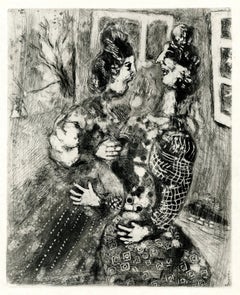
Hiroshi YoshidaA Window in Fatehpur-Sikri1931
1931
Price:$3,500
About the Item
About the Seller
5.0
Recognized Seller
These prestigious sellers are industry leaders and represent the highest echelon for item quality and design.
Platinum Seller
Premium sellers with a 4.7+ rating and 24-hour response times
Established in 1978
1stDibs seller since 2013
840 sales on 1stDibs
Associations
International Fine Print Dealers Association
Authenticity Guarantee
In the unlikely event there’s an issue with an item’s authenticity, contact us within 1 year for a full refund. DetailsMoney-Back Guarantee
If your item is not as described, is damaged in transit, or does not arrive, contact us within 7 days for a full refund. Details24-Hour Cancellation
You have a 24-hour grace period in which to reconsider your purchase, with no questions asked.Vetted Professional Sellers
Our world-class sellers must adhere to strict standards for service and quality, maintaining the integrity of our listings.Price-Match Guarantee
If you find that a seller listed the same item for a lower price elsewhere, we’ll match it.Trusted Global Delivery
Our best-in-class carrier network provides specialized shipping options worldwide, including custom delivery.You May Also Like
Men in Room - Original Etching - Early 19th Century
Located in Roma, IT
Image dimensions: 20 x 15 cm.
Men in Room is an original etching on paper, realized by an Anonymous artist in the Early 19th Century, following the so-called "Historic Romanticism"....
Category
Early 19th Century Figurative Prints
Materials
Woodcut
$236
H 9.85 in W 13.78 in D 0.08 in
"Toy Horse Dance" Japanese Woodblock Triptych with Beauties and Mt Fuji
Located in Soquel, CA
"Toy Horse Dance" Japanese Woodblock Triptych with Beauties and Mt Fuji
Vibrant three-panel woodblock print by Utagawa Toyohiro (Japanese,...
Category
Early 20th Century Edo Figurative Prints
Materials
Ink, Rice Paper, Woodcut
Utagawa Toyohiro"Toy Horse Dance" Japanese Woodblock Triptych with Beauties and Mt Fuji, early 1900s
$1,700
H 24 in W 36 in D 0.25 in
Deutzia Flowers: The Wife of Kasamori - Original Woodblock Print
Located in Soquel, CA
Deutzia Flowers: The Wife of Kasamori - Original Woodblock Print
Deutzia Flowers: The Wife of Kasamori, from the Series "Beauties of the Floating World Associated with Flowers" by S...
Category
1760s Edo Figurative Prints
Materials
Woodcut, Ink, Rice Paper
$900
H 18 in W 14 in D 0.5 in
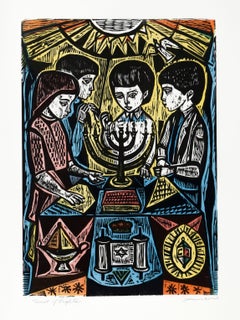
Feast of Lights, Woodcut Print by Irving Amen
By Irving Amen
Located in Long Island City, NY
This tri-tone woodcut depicts children gathered around a menorah for Hannukah, the Jewish Festival of Lights. As it appears that all of the candles are lit, it is likely that this ei...
Category
1980s Interior Prints
Materials
Woodcut
$360 Sale Price
20% Off
H 26 in W 18.5 in
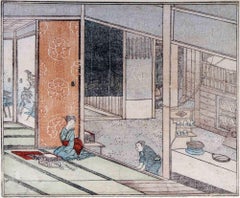
Interior Scene with Traditional Service by Utagawa Hiroshige - 19th Century
By Utagawa Hiroshige
Located in Roma, IT
This loverly original print is the work of the famous japanese Master Utagawa Hiroshige (1797-1858).
It represents an everyday scene with two characters in a perspective interior vi...
Category
19th Century Modern Figurative Prints
Materials
Woodcut
$506
H 7.6 in W 9.18 in D 0.04 in
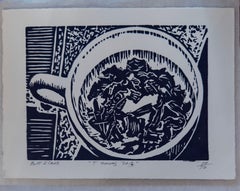
T leaves
Located in New York, NY
Edition 19/50
Category
2010s Interior Prints
Materials
Woodcut
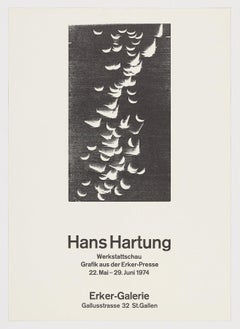
Hans Hartung 1974 Original Unused Vintage Poster Woodcut Erker Galerie German
By Hans Hartung
Located in Miami, FL
Hans Hartung (Germany, 1904-1989)
Erker-Galerie, 1974
Woodcut on paper
27.6 x 19.7 in. (70 x 50 cm.)
Excellent condition, unframed
Edition of 0
Ref: HAR100-203
Hans Hartung was born...
Category
1970s Abstract Abstract Prints
Materials
Woodcut
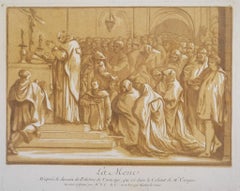
La Messe (The Mass), after Caravaggio
Located in Middletown, NY
Chiaroscuro woodcut with underlying engraving on cream laid paper, printed from two blocks in brown and olive. 10 1/4 x 12 3/4 inches (260 x 321 mm) (plate), full margins with the text printing clearly below in black ink. In very good condition with scattered surface soiling and several minor flecks of light discoloration in the margins, especially in the area of the lower right corner, well outside of image area. Unobtrusive notations in pencil in the margin and on the verso. All condition issues are consistent with age. After a drawing of the same title by Polidoro da Caravaggio...
Category
Mid-18th Century Old Masters Figurative Prints
Materials
Laid Paper, Engraving, Woodcut
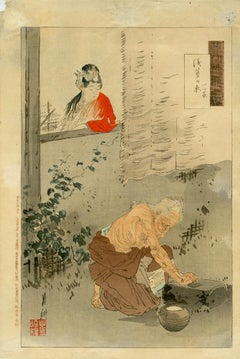
The Lonely House at Asajigahara.
Located in Middletown, NY
A scene from a series of ghost stories and spooky rural legends.
Tokyo: Matsuki Heikichi, 1896.
Woodcut in ink with embossing and hand-coloring in watercolor on handmade mulberry pa...
Category
Late 19th Century Edo Figurative Prints
Materials
Watercolor, Handmade Paper, Woodcut
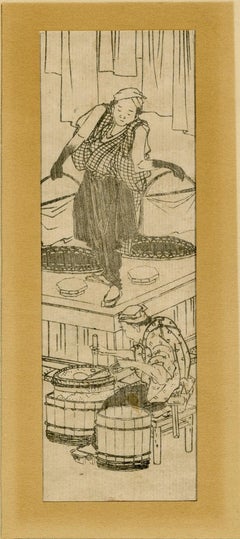
Dyeing Paper
Located in Middletown, NY
Japan: circa 1770.
Woodcut on cream laid paper, 7 1/4 x 2 1/2 inches (182 x 63 mm), narrow margins. Laid down to non-archival board with scattered soiling and some adhesive staining...
Category
Late 18th Century Edo Figurative Prints
Materials
Handmade Paper, Laid Paper, Woodcut
More From This Seller
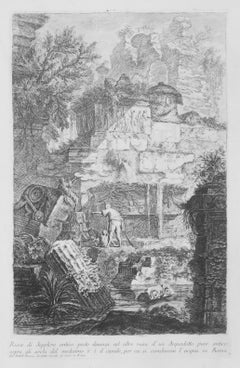
View AllRuine di Sepolcro antico
By Giovanni Battista Piranesi
Located in Fairlawn, OH
Ruine di Sepolcro antico
Etching, 1743
Signed in the plate bottomleft in the caaption plate
From: Prima Parte, 1743
Second edition: 1750-1778
Watermark: R 37-39
A lifetime impression printed during Piranesi’s life, before the plates are moved to Paris by his sons in the 1790’s
Coniditon: Excellent/Very good
Image size: 14 5/8 x 9 3/4 inches
Reference: Robison 17 iii/V
Piranesi In Rome: Prima Parte di Architetture e Prospettive
"Although Piranesi studied architecture in Venice, he never was able to find work in the field other than a few jobs involving remodeling in Rome. While Piranesi was struggling to support his architectural endeavors upon his arrival in Rome in 1740, he spent a short period of time in the studio of master painter Giovanni Battista Tiepolo (1696-1770) in addition to his apprenticeship with Giuseppe Vasi. The first production of Piranesi’s early years in Rome and a culmination of his training under Vasi, Tiepolo, and his uncle, was the Prima Parte di Architetture e Prospettive (1743). The Prima Parte was a collection of twelve etchings of imaginary temples, palaces, ruins, and a prison. During this time, Piranesi was still developing the unique style of etching he is known for today, and as such the Prima Parte differs significantly in technique compared to later works. In the Frontispiece of the Prima Parte, Piranesi’s lines are definite and exact with very little flow to them, designed in the form of traditional etching. The detail is immaculate, and yet perspective of the piece is oddly simple and familiar to the viewer. Piranesi’s technique employs miniscule markings and lines, intricately woven together to create a stippling effect. The Prima Parte, described as “rigid” by art historian Jonathan Scott, came to be seen as a stark contrast to his later sketches, which were much lighter and freer. Influenced by the style of Tiepolo, which epitomized the lightness and brightness of the Rococo period, Piranesi adopted some of the more painterly techniques of the masters he apprenticed under. Piranesi made the medium of etching appear as though it was a sketch or a painting, hence a “freer” and more fluid design in his later works. For example, the frontispiece of the Prima Parte read as an etching to Piranesi’s audience, but in his later vedute, the style of etching almost appears to be made of brushstrokes. Moreover, at the same time Piranesi was working on the Prima Parte, he aided the artist Giambattista Nolli. There is a small section of Nolli’s map...
Category
1740s Old Masters Interior Prints
Materials
Etching
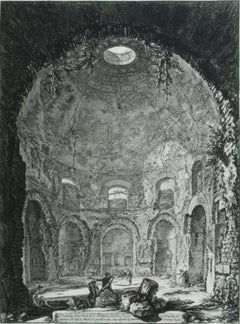
The So-Called Tempio della Tosse, Near Tivoli. Interior Upright
By Giovanni Battista Piranesi
Located in Fairlawn, OH
The So-Called Tempio della Tosse, Near Tivoli. Interior Upright (Veduta interna del Tempio della Tosse)
"Temple of the Cough"
Etching, 1764
Signed in the plate
From: Vedute di Roma...
Category
1760s Old Masters Interior Prints
Materials
Etching
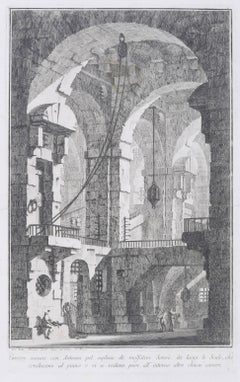
Carcere ascura
By Giovanni Battista Piranesi
Located in Fairlawn, OH
Carcere ascura
Etching, 1743
Signed in the plate bottom left corner
From: Prima Parte, 1743
Second edition: 1750-1778
Watermark: R 37-39
A lifetime impression printed during Piranesi’s life, before the plates are moved to Paris by his sons in the 1790’s
This image foretells Piranesi's famous set, Carceri (Prisons) which is his next creative effort.
Condition: Horizontal crease midway in the sheet associated with the manufacture of the paper.
Visible watermark verso
Small printer crease in the bottom right below the caption plate.
Image size: 14 1/2 x 9 1/2 inches
Reference: Robison 3 iii/VI
Piranesi In Rome: Prima Parte di Architetture e Prospettive
"Although Piranesi studied architecture in Venice, he never was able to find work in the field other than a few jobs involving remodeling in Rome. While Piranesi was struggling to support his architectural endeavors upon his arrival in Rome in 1740, he spent a short period of time in the studio of master painter Giovanni Battista Tiepolo (1696-1770) in addition to his apprenticeship with Giuseppe Vasi. The first production of Piranesi’s early years in Rome and a culmination of his training under Vasi, Tiepolo, and his uncle, was the Prima Parte di Architetture e Prospettive (1743). The Prima Parte was a collection of twelve etchings of imaginary temples, palaces, ruins, and a prison. During this time, Piranesi was still developing the unique style of etching he is known for today, and as such the Prima Parte differs significantly in technique compared to later works. In the Frontispiece of the Prima Parte, Piranesi’s lines are definite and exact with very little flow to them, designed in the form of traditional etching. The detail is immaculate, and yet perspective of the piece is oddly simple and familiar to the viewer. Piranesi’s technique employs miniscule markings and lines, intricately woven together to create a stippling effect. The Prima Parte, described as “rigid” by art historian Jonathan Scott, came to be seen as a stark contrast to his later sketches, which were much lighter and freer. Influenced by the style of Tiepolo, which epitomized the lightness and brightness of the Rococo period, Piranesi adopted some of the more painterly techniques of the masters he apprenticed under. Piranesi made the medium of etching appear as though it was a sketch or a painting, hence a “freer” and more fluid design in his later works. For example, the frontispiece of the Prima Parte read as an etching to Piranesi’s audience, but in his later vedute, the style of etching almost appears to be made of brushstrokes. Moreover, at the same time Piranesi was working on the Prima Parte, he aided the artist Giambattista Nolli. There is a small section of Nolli’s map...
Category
1740s Old Masters Interior Prints
Materials
Etching
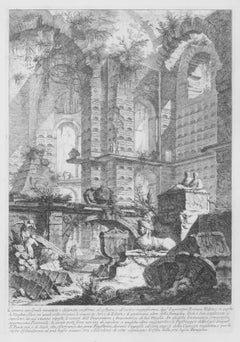
Camera sepolcrale
By Giovanni Battista Piranesi
Located in Fairlawn, OH
Camera sepolcrale
Etching 1743
Signed in the bottom left corner
From: Prima Parte, 1743
Second edition: 1750-1778
Watermark: R 37-39
A lifetime impression printed during Piranesi’s life, before the plates are moved to Paris by his sons in the 1790’s
Condition: Excellent
Image size: 14 5/8 x 9 3/4 inches
Reference: Robison 20 iii/V
Piranesi In Rome: Prima Parte di Architetture e Prospettive
"Although Piranesi studied architecture in Venice, he never was able to find work in the field other than a few jobs involving remodeling in Rome. While Piranesi was struggling to support his architectural endeavors upon his arrival in Rome in 1740, he spent a short period of time in the studio of master painter Giovanni Battista Tiepolo (1696-1770) in addition to his apprenticeship with Giuseppe Vasi. The first production of Piranesi’s early years in Rome and a culmination of his training under Vasi, Tiepolo, and his uncle, was the Prima Parte di Architetture e Prospettive (1743). The Prima Parte was a collection of twelve etchings of imaginary temples, palaces, ruins, and a prison. During this time, Piranesi was still developing the unique style of etching he is known for today, and as such the Prima Parte differs significantly in technique compared to later works. In the Frontispiece of the Prima Parte, Piranesi’s lines are definite and exact with very little flow to them, designed in the form of traditional etching. The detail is immaculate, and yet perspective of the piece is oddly simple and familiar to the viewer. Piranesi’s technique employs miniscule markings and lines, intricately woven together to create a stippling effect. The Prima Parte, described as “rigid” by art historian Jonathan Scott, came to be seen as a stark contrast to his later sketches, which were much lighter and freer. Influenced by the style of Tiepolo, which epitomized the lightness and brightness of the Rococo period, Piranesi adopted some of the more painterly techniques of the masters he apprenticed under. Piranesi made the medium of etching appear as though it was a sketch or a painting, hence a “freer” and more fluid design in his later works. For example, the frontispiece of the Prima Parte read as an etching to Piranesi’s audience, but in his later vedute, the style of etching almost appears to be made of brushstrokes. Moreover, at the same time Piranesi was working on the Prima Parte, he aided the artist Giambattista Nolli. There is a small section of Nolli’s map...
Category
1740s Old Masters Interior Prints
Materials
Etching
The Art of Conversation (Three characters on...)
By Marcel Gromaire
Located in Fairlawn, OH
The Art of Conversation (Three characters on...)
Etching, 1958
Signed in pencil lower right: “Gromaire” (see photo)
Edition: 110 (18/110) see photo
Printed on RIVES paper
Publisher: ...
Category
1950s Cubist Interior Prints
Materials
Etching
The Woman and the Street
By Marc Chagall
Located in Fairlawn, OH
The Woman and the Street
Etching, 1927-1930
Signed in the plate lower right corner (see photo)
From: The Fables of La Fontaine, Plate 84
From the deluxe portfolio edition of 40 examp...
Category
1920s French School Prints and Multiples
Materials
Etching