1630s Interior Prints
to
1
Overall Width
to
Overall Height
to
1
1
123
217
1,068
742
11
13
22
52
38
62
74
212
240
91
103
1
1
1
Period: 1630s
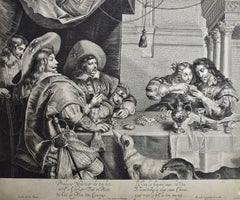
The Card Game: An Early 17th Century Engraving by A. Voet after Cornelis de Vos
By Alexander Voet
Located in Alamo, CA
A 17th century engraving entitled "The Card Game" by old master artist Alexander de Voet after a painting by Cornelis de Vos, created in 1632. The pain...
Category
Old Masters 1630s Interior Prints
Materials
Engraving
Related Items
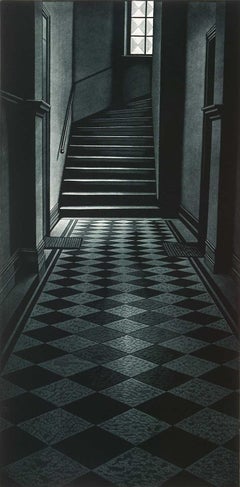
Days Gone
Located in New Orleans, LA
Vanttinen created this mezzotint in an edition of 100 and it is titled and signed in pencil.
Jukka Vanttinen (Finn, b. 1954)
Jukka Vanttinen was introduced to the medium of mezzoti...
Category
Contemporary 1630s Interior Prints
Materials
Mezzotint

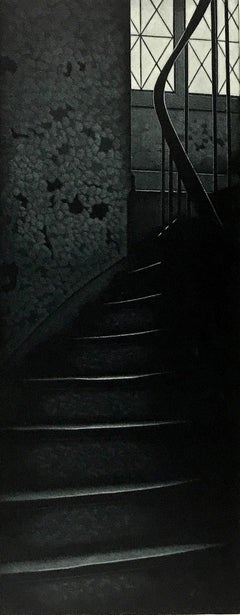
Before It Happened (A mysterious staircase offers no clues as to what happened)
Located in New Orleans, LA
This Finnish artist creates a mezzotint in black and white. This impression is #44 of 100 and is signed, dated and titled in pencil.
Jukka Vanttinen (Finn, b. 1954)
Jukka Vanttinen...
Category
Modern 1630s Interior Prints
Materials
Mezzotint
Jukka VanttinenBefore It Happened (A mysterious staircase offers no clues as to what happened), 2005
$375 Sale Price
25% Off
H 21.38 in W 8.5 in
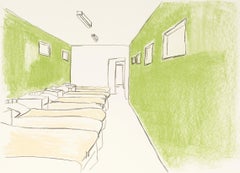
The Ward - Mandela, Former South African President, Signed Art, Robben Island
Located in Knowle Lane, Cranleigh
Nelson Mandela, The Ward, Signed Limited Edition Lithograph
Many people are unaware that Nelson Mandela turned his hand to art in his 80's as a way of leaving a legacy for his family...
Category
Contemporary 1630s Interior Prints
Materials
Lithograph
$8,181
H 15.75 in W 20.08 in D 1.58 in
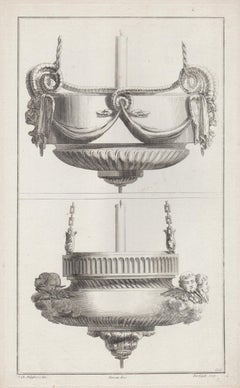
French Neoclassical Design Engraving for Braziers
Located in Melbourne, Victoria
Copper-line engraving. C1768.
Delafosse was a French decorative designer, engraver and architect. Apprenticed for a time to a sculptor, by 1767 he styled himself an 'architect and professor of design'. He published the first volume of his most important work, 'Nouvelle Iconologie Historique' in 1768, containing 110 plates of his designs for furniture, decorative arts and architectural...
Category
French School 1630s Interior Prints
Materials
Engraving
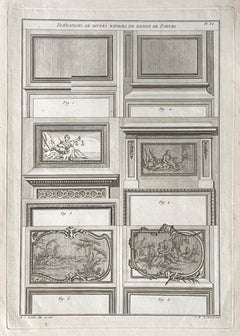
Elevations de Divers Especes de Dessus de Portes, Roubo French design engraving
Located in Melbourne, Victoria
'Elevations de Divers Especes de Dessus de Portes'
French copper-line engraving by JB Bichard after Andre Jacob Roubo (1739–1791). 18th century laid watermarked paper.
From Roubo's...
Category
French School 1630s Interior Prints
Materials
Engraving
$140
H 18.12 in W 11.42 in
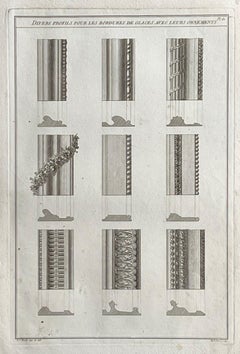
Different Profils Pour Les Bordures, Roubo French cabinetmaking design engraving
Located in Melbourne, Victoria
'Different Profils Pour Les Bordures de Glaces avec leurs Ornements'
French copper-line engraving by Michelinot after Andre Jacob Roubo (1739–1791). 18th century laid watermarked pa...
Category
French School 1630s Interior Prints
Materials
Engraving
$140
H 18.12 in W 11.42 in
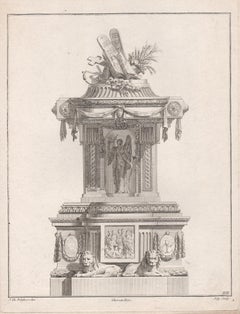
French Neoclassical design for a Pulpit, engraving after Delafosse
Located in Melbourne, Victoria
Copper-line engraving. C1768.
Delafosse was a French decorative designer, engraver and architect. Apprenticed for a time to a sculptor, by 1767 he styled himself an 'architect and professor of design'. He published the first volume of his most important work, 'Nouvelle Iconologie Historique' in 1768, containing 110 plates of his designs for furniture, decorative arts and architectural...
Category
French School 1630s Interior Prints
Materials
Engraving
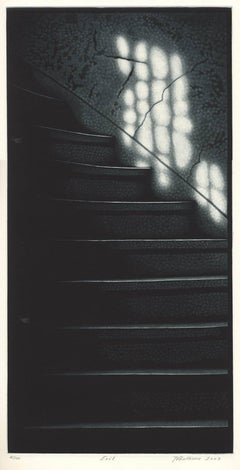
Exit (Dappled sunlight in an ancient stairway leads to an uncertain end.)
Located in New Orleans, LA
Finns always seek the solace of nature. Is this mysterious stairway an escape from the challenges of civilization? Vanttinen created this mezzotint in an edition of 100 and it is tit...
Category
Contemporary 1630s Interior Prints
Materials
Mezzotint
$337 Sale Price
25% Off
H 21.5 in W 10.75 in
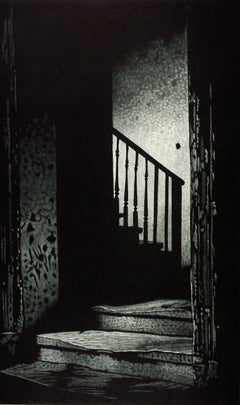
Attic
Located in New Orleans, LA
This Finnish artist creates a mezzotint in black and white. This impression is #34 of 100 and is signed, dated and titled in pencil.
Jukka Vanttinen (Finn, b. 1954)
Jukka Vanttinen...
Category
Modern 1630s Interior Prints
Materials
Mezzotint
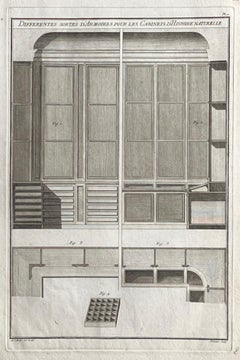
Les Cabinets D
Histoire Naturelle, Roubo French cabinetmaking design engraving
Located in Melbourne, Victoria
'Differentes Sortes D'Armoires Pour Les Cabinets D'Histoire Naturelle'
French copper-line engraving by Pelletier after Andre Jacob Roubo (1739–1791). 18th century laid watermarked p...
Category
French School 1630s Interior Prints
Materials
Engraving
$140
H 18.12 in W 11.42 in
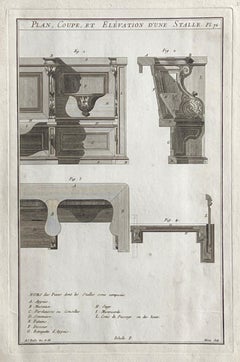
Plan, Coupe, et Elevation d
une Stalle, Roubo French cabinetmaking engraving
Located in Melbourne, Victoria
'Plan, Coupe, et Elevation d'une Stalle'
French copper-line engraving by Milson after Andre Jacob Roubo (1739–1791). 18th century laid watermarked paper.
From Roubo's 'L'Art du Men...
Category
French School 1630s Interior Prints
Materials
Engraving
$140
H 18.12 in W 11.42 in
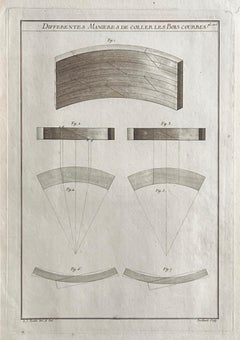
Differents Manieres de Coller, Roubo French cabinetmaking design engraving
Located in Melbourne, Victoria
'Differents Manieres de Coller les Bois Courbes'
French copper-line engraving by Berthault after Andre Jacob Roubo (1739–1791). 18th century laid watermarked paper.
From Roubo's 'L...
Category
French School 1630s Interior Prints
Materials
Engraving
$140
H 18.12 in W 11.42 in
Previously Available Items
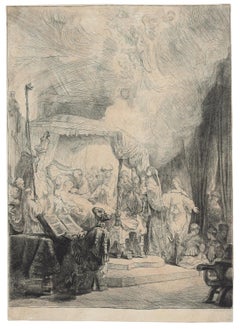
The Death of the Virgin - Original Etching by Rembrandt - 1639
Located in Roma, IT
The Death of the Virgin is an etching with drypoint tweaks on wire rod double filigree paper, realized in 1639 by Rembrandt Harmenszoon van Rijn (Leiden, 1606 - Amsterdam, 1669).
Probable specimen of III state on three (according to White & Boon), IV on four (following Biörklund-Barnard).
Signature and date on plate on the lower left corner “Rembrandt f. 1639".
The paper has a cluster watermark with symmetrical elements in the center (similar to Ash Grapes B.a.) and a second watermark written on 4 lines (perhaps identifiable with Ash Words C.a.).
Superb specimen on doubly watermarked paper: the first on four lines dating back to around 1764 and widely diffused in Normandy and Germany; the second, clustered, traced back to the second decade of the 17th century. Sheet characterized by a legible and appreciable impression for the chiaroscuro; good conditions of conservation, even though some thinning is reported, in particular along the left margin and on the lower left corner, together with small gaps visible on the back and a superficial deposit of particles.
Reference:
Gersaint 1751, p. 71, n. 97; Bartsch 99; Hind 1924, n. 161; Biörklund-Barnard 1957, n. 39, IV; New Hollstein (Dutch & Flemish), n. 173 (Rembrandt); Hinterding et al. 2000 n. 32.III; White & Boon 1969, n. 99.III.
One of the most interesting works with a religious subject by the great old master, for both the compositional freedom and the technical expertise. We do not know who the customer was; it could have been a Catholic client, but this hypothesis seems to be at least doubtful precisely because of the peculiarity with which the episode is narrated. Certainly, this artwork is linked to a precise market request, given its size - this is the second largest incision of the artist - and the commitment to such an important work.
A more detailed description of this religious event is described particularly well in the Legenda Aurea by Jacopo da Varagine, a guiding text in the Middle Ages for all the artists who wanted to portray the Death of the Virgin: an angel appeared to Mary announcing her imminent death. It is told that the Apostles, dispersed in the four corners of the world to proclaim the Gospel, were miraculously transported to Mount Zion to be near them.
Disagreeing with other exegetes, Hinterding claims that Rembrandt knew the Legenda but was inspired by it in an original way, combining two moments in a single choral scene. Indeed, the scene depicted by the artist takes place in the bedroom of the Virgin: the angel appears at the top, accompanied by the cherubs, while the Apostles gather around her bed. For this marvelous etching, in addition to the aforementioned text by the Dominican friar da Varagine, Rembrandt certainly also looked at two fundamental works (to understand the genesis of the composition): the Death of the Virgin by Albrecht Dürer, from the silographic series of the Life of the Virgin, of which he owned a specimen, perhaps bought at auction in 1638, and a stained glass window designed by Dirck Pietersz Crabeth (1501-1574), in the Oude Kerk in Amsterdam. From Crabeth, he took the figure in the foreground that is reading the Holy Scriptures, perhaps the personification of the Church, and the canopy bed that stands out at the center of the scene. The young man with long hair described on the right, perhaps San Giovanni Evangelista, is instead a quotation from the Adoration of the Magi (1513) by Lucas Van Leyden, an artist much appreciated by Rembrandt. In Rembrandt's version of Mary's farewell, there are not only the Apostles: around her there are men and women, young and old, someone, intrigued, peeks out from behind the bed or a curtain, in the background, on the right, others pray kneeling...
Category
Old Masters 1630s Interior Prints
Materials
Etching
H 15.56 in W 12.41 in D 0.04 in