1720s Interior Prints
to
1
1
1
Overall Width
to
Overall Height
to
123
235
1,071
752
11
12
22
55
39
62
72
209
240
95
103
2
2
1
1
1
1
1
1
1
1
2
Period: 1720s
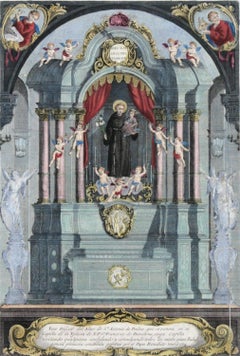
Altar de St. Antonio de Padua Hand Colored Engraving 1724
Located in Paonia, CO
Anthony of Padua or Anthony of Lisbon born Fernando Martins de Bulhoes 15 August 1195 – 13 June 1231) was a Portuguese Catholic priest and friar of the Franciscan Order. He was born and raised by a wealthy family in Lisbon, Portugal, and died in Padua, Italy. Noted by his contemporaries for his powerful preaching, expert knowledge of scripture, and undying love and devotion to the poor and the sick, he was one of the most quickly canonized saints in church history, being canonized less than a year after his death. He was proclaimed a Doctor of the Church by Pope Pius XII...
Category
Baroque 1720s Interior Prints
Materials
Engraving
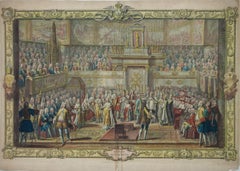
Le Roy Mene au Trone from Series Le Sacre de Louis XV 1722-1731
Located in Paonia, CO
Le Roy Mene au Trone from the Series Le Sacre de Louis XV (1722-1731 ) is an etching by French artist Charles Nicolas Cochin the Elder ( 1688-1754...
Category
French School 1720s Interior Prints
Materials
Etching
Related Items
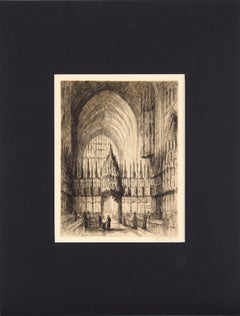
Chester Cathedral - Drypoint Etching in Ink on Paper
Located in Soquel, CA
Chester Cathedral - Drypoint Etching in Ink on Paper
Dramatic drypoint etching by J. Alphege Brewer (British, 1881-1946). This composition shows the interior of Chester Cathedral in Brewer's characteristic style - highly detailed and with strong contrast. The scene encompasses the cathedral from floor to ceiling, capturing the immense size of the building. There are several people in the scene which contribute to the sense of scale.
Signed by hand "J. Alphege Brewer" in the lower right corner.
Titled "Chester Cathedral" in plate, lower left corner.
Includes original card with artist's name.
Presented in a new black mat with foamcore backing.
Mat size: 16"H x 12"W
Paper size: 10.75"H x 7.75"W
James Alphege Brewer was well known in the early 20th century as a producer of color etchings of European cathedrals and other scenes of church, college, and community. He was born July 24, 1881, in the Kensington section of London, England, the son of Henry W. Brewer, noted artist of historical architecture and prominent convert to the Catholic Church, and the grandson of John Sherren Brewer, Jr., “the brilliant editor of the Calendar of Letters of Henry VIII.” His great uncle was E. Cobham Brewer, the polymath who compiled Brewer’s Dictionary of Phrase and Fable. Among his older siblings were the artist Henry C. Brewer and the organist and writer John Francis Brewer.
Brewer attended the Westminster School of Art in London, where his brother Henry also trained. In 1910, he married Florence Emma Lucas, an accomplished painter in oil and watercolor, whose father was the noted landscape artist George Lucas and whose great uncle was David Lucas, the famous engraver for John Constable. Florence's brothers Edwin and George assisted Brewer in the printing of Brewer's etchings.
Brewer exhibited at the Royal Academy (RA) and the Royal Institute of Painters in Watercolour (RI), at the Paris Salon of the Académie des Beaux-Arts, and in the shows of the Royal Cambrian Academy (RCA). He became an associate of the Royal Cambrian Academy in 1929 and a full member in the last two years of his life. He was also a member of the Hampstead Society of Artists, the Society of Graphic Art, and the Ealing Arts Club, where he was first Honorary Art Secretary and then Honorary Art Chairman. Most of Brewer's larger etchings were published by Alfred Bell...
Category
Romantic 1720s Interior Prints
Materials
Paper, Ink, Drypoint

$495
H 16 in W 12 in D 0.25 in
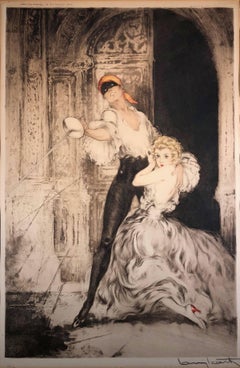
Don Juan
By Louis Icart
Located in Missouri, MO
Aquating Engraving
Image Size: approx. 20 1/4 x 13 3/8
Framed Size: 28 x 20.5 inches
Pencil Signed Lower Right
Louis Justin Laurent Icart was born in Toulouse in 1890 and died in Paris in 1950. He lived in New York City in the 1920s, where he became known for his Art-Deco color etchings of glamourous women.
He was first son of Jean and Elisabeth Icart and was officially named Louis Justin Laurent Icart. The use of his initials L.I. would be sufficient in this household. Therefore, from the moment of his birth he was dubbed 'Helli'. The Icart family lived modestly in a small brick home on rue Traversière-de-la-balance, in the culturally rich Southern French city of Toulouse, which was the home of many prominent writers and artists, the most famous being Henri de Toulouse-Lautrec.
Icart entered the l'Ecole Superieure de Commerce de Toulouse in order to continue his studies for a career in business, particularly banking (his father's profession). However, he soon discovered the play writings of Victor Hugo (1802-1885), which were to change the course of his life. Icart borrowed whatever books he could find by Hugo at the Toulouse library, devouring the tales, rich in both romantic imagery and the dilemmas of the human condition. It was through Icart's love of the theater that he developed a taste for all the arts, though the urge to paint was not as yet as strong for him as the urge to act.
It was not until his move to Paris in 1907 that Icart would concentrate on painting, drawing and the production of countless beautiful etchings, which have served (more than the other mediums) to indelibly preserve his name in twentieth century art history.
Art Deco, a term coined at the 1925 Paris Exposition des Arts Decoratifs, had taken its grip on the Paris of the 1920s. By the late 1920s Icart, working for both publications and major fashion and design studios, had become very successful, both artistically and financially. His etchings reached their height of brilliance in this era of Art Deco, and Icart had become the symbol of the epoch. Yet, although Icart has created for us a picture of Paris and New York life in the 1920s and 1930s, he worked in his own style, derived principally from the study of eighteenth-century French masters such as Jean Antoine Watteau, François Boucher and Jean Honoré Fragonard.
In Icart's drawings, one sees the Impressionists Degas...
Category
Art Deco 1720s Interior Prints
Materials
Engraving, Aquatint
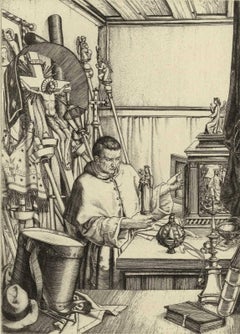
The Sacristan
By Harry Morley
Located in New Orleans, LA
This image shows a cleric seated in a church sacristy surrounded by religious statues, croziers, various saints, statues and chalices. It is an origina...
Category
Modern 1720s Interior Prints
Materials
Engraving
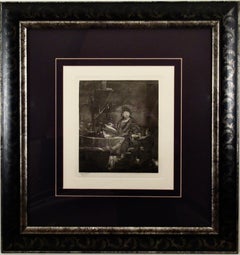
Jan Oytenbogaert
Located in San Francisco, CA
This artwork titled Jan Uytenbogaert" 1639 is an etching on paper After Rembrandt Van Rijn, 1606-1669, plate engraved By French renown engraver Charles Armand Durand, 1831-1905. Sign...
Category
Realist 1720s Interior Prints
Materials
Etching
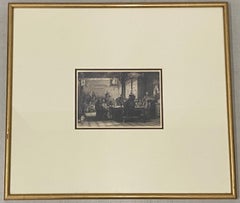
G. Paterson "Dinner Party at a Mandarin
s House" Engraving After T. Allom c.1840
Located in San Francisco, CA
G. Paterson "Dinner Party at a Mandarin's House" Original Engraving After T. Allom C.1840
Original engraving
Dimensions 8" wide x 5" high
The frame measures 20.5" wide x 18.5" hig...
Category
Realist 1720s Interior Prints
Materials
Engraving
$250
H 18 in W 20.5 in D 0.5 in
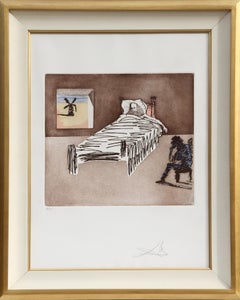
Le Legacy from Historia de Don Quichotte de la Mancha, Etching by Salvador Dali
Located in Long Island City, NY
Artist: Salvador Dali, Spanish (1904 - 1989)
Title: Le Legacy from Historia de Don Quichotte de la Mancha
Year: 1981
Medium: Etching on Arches, signed and numbered in pencil
Edition:...
Category
Surrealist 1720s Interior Prints
Materials
Etching
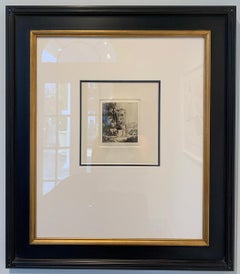
Jesus and the Woman at the Well,
by Amand-Durand, Engraving
By Armand Durand
Located in Oklahoma City, OK
This early 19th century framed 35" x 31" engraving by artist Amand-Durand depcits an etching of 'Jesus and the Woman at the Well,' after the Dutch master, Rembrandt van Rijn. This poignant Biblical story is depicted by Arman-Durand in Rembrandt style...
Category
Old Masters 1720s Interior Prints
Materials
Engraving
$1,200 Sale Price
20% Off
H 30.5 in W 26.5 in D 1.5 in
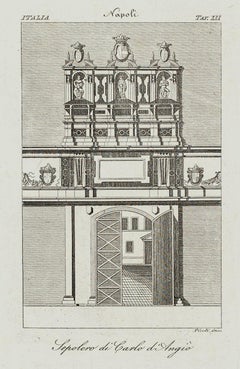
Sepulcher of Carlo di Angiò - Rome - Early 19th Century
Located in Roma, IT
Sepulcher of Carlo di Angiò is an original etching, realized by Piroli written below the image down in the XIX century, the table is XII is written at the top of the image on the rig...
Category
1720s Interior Prints
Materials
Etching, Aquatint
$213
H 11.42 in W 8.67 in D 0.08 in
Vin Rouge (Red Wine)
Located in Plano, TX
1932. Drypoint. Appleby 167. 9 1/4 x 11 5/8 (sheet 11 3/8 x 17 15/16). Edition 100 #48. Mat line, well outside the image; otherwise excellent condition. A rich impression with drypo...
Category
Modern 1720s Interior Prints
Materials
Drypoint
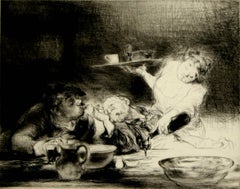
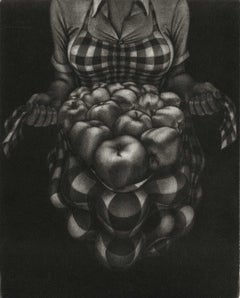
Fructidore (Fruit being carried is hard to distinguish from the woman
s body)
By Anne Dykmans
Located in New Orleans, LA
In Anne Dykmans' "Fructidore", a well endowed woman uses her plaid apron to carry a bunch of fruit. Parts of her body clothed in plaid seem to suggest the same fruit she is carrying...
Category
Modern 1720s Interior Prints
Materials
Mezzotint
Xisco Mensua Spanish artist 1995 original signed framed engraving print n2
By Xisco Mensua
Located in Miami, FL
Xisco Mensua (Spain, 1960)
Untitled from Portfolio "Junio - Julio", 1995
engraving on paper
12.6 x 9.5 in. (32 x 24 cm.)
Edition of 6
Frame 16x20 in.
ID: MEN1253-002
Hand-signed by a...
Category
Contemporary 1720s Interior Prints
Materials
Paper, Engraving
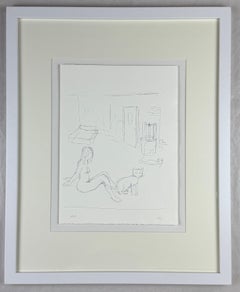
Xisco Mensua Spanish artist 1995 original signed framed engraving print n3
By Xisco Mensua
Located in Miami, FL
Xisco Mensua (Spain, 1960)
Untitled from Portfolio "Junio - Julio", 1995
engraving on paper
12.6 x 9.5 in. (32 x 24 cm.)
Edition of 6
Frame 16x20 in.
ID: MEN1253-003
Hand-signed by a...
Category
Contemporary 1720s Interior Prints
Materials
Paper, Engraving